
24 hour live in care provides continuous, one-to-one support in a person’s home, ensuring someone is always available to deliver care, supervision, and reassurance. Unlike standard live-in care, which typically involves one carer who rests overnight, 24 hour care uses two carers working in shifts to provide active support both day and night.
Families often choose 24 hour care at home for elderly individuals who need frequent assistance, including overnight monitoring, mobility support, or help with complex health conditions.
This type of care allows people to remain safely in familiar surroundings while receiving consistent personal care, companionship, and medical support tailored to their needs.

Key Facts About 24 Hour Live-In Care
- 24-hour live-in care cost typically ranges from £1,350 to £2,250+ per week, depending on care needs, location, and provider.
- It provides continuous 24 hour care at home, often using two carers rotating shifts to ensure full coverage.
- It supports individuals with complex or high-dependency needs, including dementia, mobility issues, and post-hospital recovery.
- The price of long term care at home can be comparable to or higher than residential care, but it offers greater independence and one-to-one support.
- Some individuals may qualify for local authority funding for care in your own home, or NHS Continuing Healthcare, which can reduce overall costs.
- It remains a preferred alternative to care homes for families who want personalised care in a familiar environment.
RELATED: UK State Pension Age Increase 2026: What Care Businesses Need to Know
24 Hour Live-In Care vs Standard Live-In Care: What’s the Difference?
Many families assume all live-in care provides the same level of support, but there is a clear difference between standard live-in care and full 24 hour live in care.
Standard Live-In Care
- Involves one carer living in the home
- Carer works 8–10 hours per day
- Carer gets sleep breaks at night
- Suitable for individuals who need support during the day with minimal night-time needs
24 Hour Live-In Care
- Involves two carers working in shifts
- Provides active, waking support day and night
- No reliance on sleep breaks, someone is always alert
- Designed for individuals who need continuous supervision or frequent overnight care
Key Difference (Simple Explanation)
Standard live-in care offers support with rest periods, while 24 hour home care delivers constant, uninterrupted care coverage.
Families typically choose 24 hour care when safety becomes a concern at night, for example, if a loved one wanders, requires repositioning, or needs frequent assistance. In these cases, standard live-in care may no longer provide enough support, making 24 hour live in care the safer and more appropriate option.
What Does a 24 Hour Live-In Carer Do Daily?
A 24 hour live-in carer delivers continuous, hands-on support throughout the day and night, ensuring the individual remains safe, comfortable, and well cared for at all times. From a caregiver’s standpoint, the role requires consistency, attentiveness, and the ability to respond quickly to changing needs.
Daily Responsibilities
- Personal care: Assist with bathing, dressing, toileting, and grooming while maintaining dignity and comfort
- Medication support: Administer or prompt medication and monitor health conditions
- Mobility assistance: Help with walking, transfers, repositioning, and fall prevention
- Meal preparation: Plan and prepare meals based on dietary needs and preferences
- Companionship: Provide emotional support, conversation, and engagement in daily activities
- Household tasks: Light cleaning, laundry, and maintaining a safe living environment
Overnight Responsibilities
- Monitor the individual’s condition during the night
- Assist with toileting or continence care
- Reposition to prevent pressure sores
- Respond immediately to emergencies or distress
From a Caregiver Perspective
Providing 24 hour home care is not just about completing tasks, it requires building trust, understanding routines, and staying alert at all times. Because this level of care often involves two carers working in rotation, each carer must communicate clearly and maintain consistency to ensure seamless support.
24 hour live in care demands active, continuous involvement, unlike standard live-in care where carers can rest overnight.
READ MORE: UK Pensioners PIP Backdated Payments 2025: What You Need to Know in 2026
Who Needs 24 Hour Care at Home?
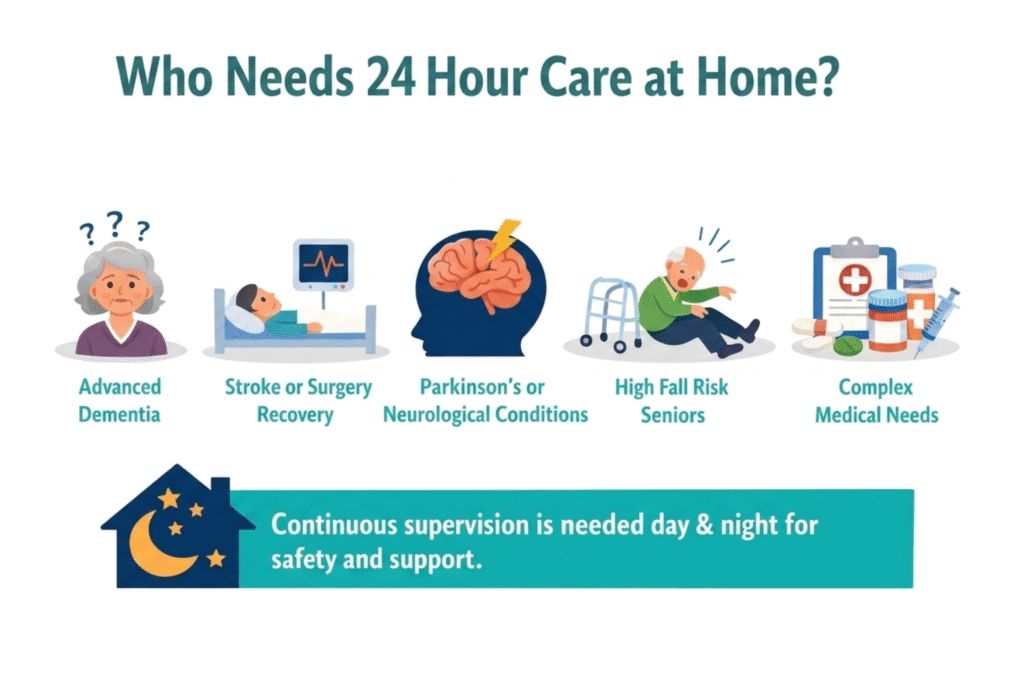
Not everyone requires full 24 hour live in care. This level of support becomes necessary when a person’s needs go beyond daytime assistance and require continuous supervision, including during the night.
People Who Typically Need 24 Hour Care at Home
- Individuals with advanced dementia
They may wander at night, become disoriented, or need frequent reassurance and supervision. - People recovering from stroke or major surgery
They often require ongoing mobility support, repositioning, and close monitoring. - Those living with Parkinson’s or neurological conditions
Symptoms can fluctuate throughout the day and night, requiring consistent care. - Elderly individuals with high fall risk
Continuous support helps prevent injuries and ensures immediate assistance if needed. - People with complex medical needs
Including those who require frequent medication, continence care, or overnight interventions.
When 24 Hour Live-In Care May NOT Be Necessary
- If support is only needed during the day
- If the individual sleeps through the night without assistance
- If occasional visits (domiciliary care) can meet their needs
24 hour care at home for elderly individuals is most appropriate when safety, supervision, and immediate response are required at all times, especially overnight.
Quick Decision Guide
- Needs help only during the day → Standard live-in care or domiciliary care
- Needs occasional night support → Live-in care with waking nights (sometimes)
- Needs constant monitoring and overnight care → 24 hour live in care
How Much Does 24 Hour Live-In Care Cost in the UK?
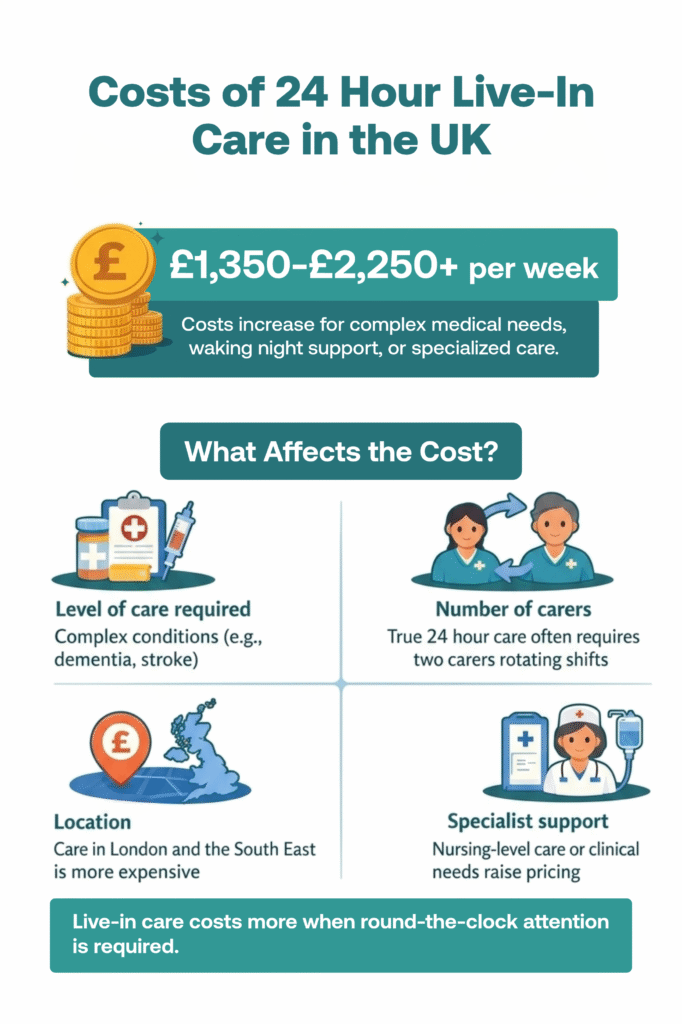
The 24-hour live-in care cost in the UK typically ranges from £1,350 to over £2,250 per week, depending on the level of care required, location, and provider. Higher costs usually reflect complex medical needs, waking night support, or specialist care.
What Affects the Cost?
- Level of care required: Complex conditions (e.g. dementia, stroke recovery) increase costs
- Number of carers: True 24 hour care often requires two carers rotating shifts
- Location: Care in London and the South East tends to cost more
- Specialist support: Nursing-level care or clinical needs raise pricing
The live in carer cost increases significantly when continuous waking support is required, compared to standard live-in care.
Cost Comparison: Home Care vs Care Homes
| Type of Care | Average Weekly Cost |
| 24 hour live in care | £1,350 – £2,250+ |
| Residential care home | £800 – £1,500 |
| Nursing home care | £1,000 – £2,000+ |
- Cost of care homes may appear lower, but they provide shared care rather than one-to-one support
- Nursing home costs UK can approach or exceed live-in care for complex needs
- Care home charges England vary widely depending on location and services
Is It Worth the Cost?
While the price of long term care at home can be high, many families choose it for:
- One-to-one personalised care
- Staying in familiar surroundings
- Greater independence and comfort
Additional Cost Considerations
- Food and accommodation for the carer
- Travel and agency fees
- Equipment or home adaptations
Can You Reduce the Cost?
Some individuals may qualify for:
- Local authority funding for care in your own home
- NHS Continuing Healthcare (for complex medical needs)
These options can significantly reduce the overall home care services cost if eligibility criteria are met.
SEE ALSO: Temporary Occupation Permit in the UK (2026): What Care Businesses Must Know
Is 24 Hour Live-In Care Better Than a Care Home?
Choosing between 24 hour live in care and a residential care home depends on the individual’s needs, lifestyle preferences, and budget. Both options provide support, but they deliver very different experiences.
Key Differences
| Factor | 24 Hour Live-In Care | Care Home |
| Environment | Stay in your own home | Move into a shared facility |
| Care Type | One-to-one personalised care | Staff support multiple residents |
| Routine | Fully flexible | Structured schedule |
| Independence | High | Limited |
| Cost | £1,350 – £2,250+ per week | £800 – £2,000+ per week |
Why Families Choose 24 Hour Care at Home
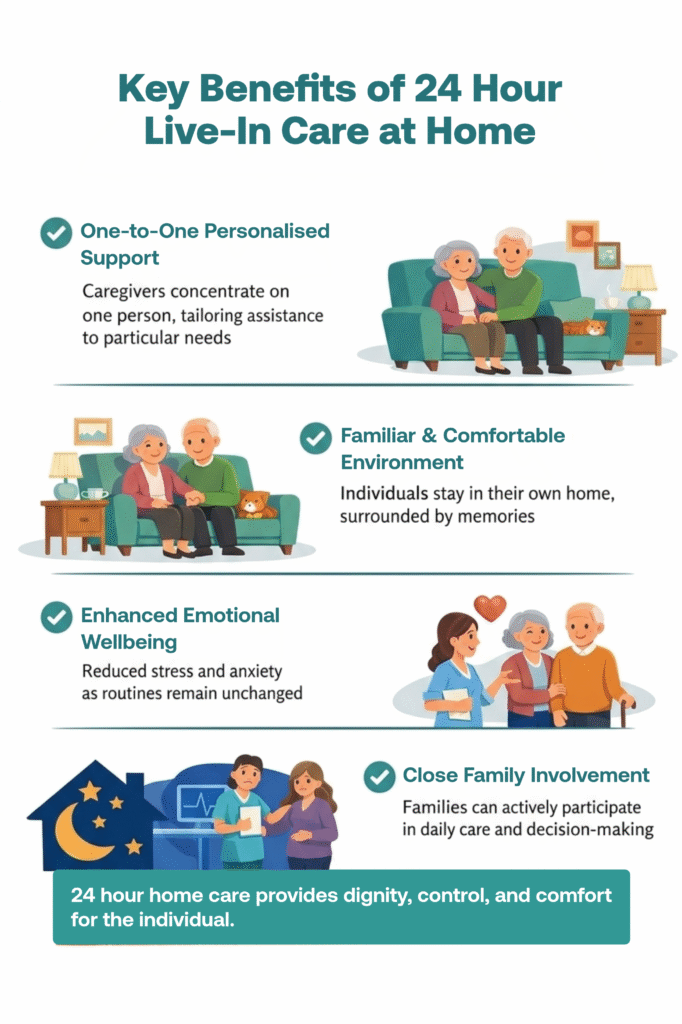
- Familiar environment: Individuals remain in their own home, surrounded by memories and comfort
- Personalised care: Carers tailor support to one person rather than dividing attention
- Stronger emotional wellbeing: Reduced stress compared to moving into a facility
- Family involvement: Loved ones can stay closely involved in daily care
When a Care Home May Be More Suitable
- If the individual prefers a social environment with other residents
- If care needs require specialised medical equipment available on-site
- If the cost of old people’s home is more affordable than home-based care
Cost Perspective
- Cost of care homes may seem lower upfront, but they provide shared attention
- Care home charges England vary widely based on location and services
- 24-hour care homes near me searches often reveal limited availability in some areas
Simple Decision Insight
- Choose 24 hour home care if you want personalised, one-to-one support in a familiar setting.
- Choose a care home if you prefer a structured environment with shared care and social interaction.
From a caregiver business perspective, many families lean toward 24 hour live in care because it offers control, flexibility, and dignity, especially for individuals with complex or evolving needs.
Common Problems With Live-In Carers (And How to Avoid Them)
While 24 hour live in care offers many benefits, families and providers must address common challenges to ensure safe and effective care delivery. From a caregiver business standpoint, identifying and managing these risks early improves both client outcomes and staff performance.
Common Problems With Live-In Carers
- Carer burnout
Continuous care without proper rotation or rest leads to fatigue and reduced care quality - Poor carer-client matching
Personality clashes or mismatched expectations can affect trust and cooperation - Lack of supervision
Without proper oversight, care standards may drop over time - Inconsistent care delivery
Poor handovers between carers can lead to gaps in support - Limited boundaries in private arrangements
With private live-in carers, families may struggle to manage schedules, expectations, or accountability
How to Avoid These Problems
- Use structured shift systems
True 24 hour care should involve at least two carers rotating shifts to maintain quality - Work with regulated providers
The best live-in care agencies UK follow strict standards, provide training, and monitor performance - Ensure proper onboarding and matching
Match carers based on skills, experience, and personality fit - Maintain clear communication
Daily logs, care plans, and handover notes ensure continuity - Schedule regular reviews
Monitor care quality and adjust plans as needs change
Agency vs Private Carers
- Private live-in carers may offer lower costs but often lack structure, training, and oversight
- Agencies provide:
- vetted carers
- backup support
- compliance with CQC standards
Key Insight
Most problems with live-in carers arise from poor structure, lack of supervision, or unrealistic expectations, not from the care model itself.
From a caregiver business perspective, strong systems, proper staffing, and continuous monitoring turn 24 hour live in care into a reliable and high-quality solution for families.
MORE: What are Cold Weather Payments? Eligibility & How to Claim (2026)
Can You Get Funding for 24 Hour Care at Home?
Many families worry about the cost of 24 hour live in care, but financial support may be available depending on your circumstances. Understanding funding options can significantly reduce the overall burden of long-term care.
Local Authority Funding for Care in Your Own Home
Local councils can provide local authority funding for care in your own home if you meet certain criteria.
To qualify:
- You must complete a care needs assessment
- Your financial situation will be reviewed (means-tested)
- The council will determine how much support you need
If eligible, the council may:
- Contribute toward your care costs
- Arrange care services directly
- Offer a personal budget so you can choose your provider
NHS Continuing Healthcare (CHC)
For individuals with complex medical needs, the NHS may fully fund care through Continuing Healthcare.
This applies if:
- Your primary need is health-related rather than social care
- You require ongoing medical supervision
NHS Continuing Healthcare can cover the full cost of 24 hour home care, including carers, equipment, and support services.
Other Financial Support Options
- Attendance Allowance: For individuals over State Pension age needing help with personal care
- Personal savings or insurance: Many families combine private funding with support schemes
- Home care coverage plans: Some providers offer structured payment options
Important Cost Insight
- Funding for home care is not automatic, you must apply and meet eligibility criteria
- Even with support, you may still contribute toward home care services cost depending on your financial assessment
How to Choose the Best Live-In Care Agency in the UK
Choosing the right provider determines the quality, safety, and consistency of 24 hour live in care. From a caregiver business perspective, families should focus on reliability, regulation, and long-term support, not just price.
What to Look For in a Care Provider
- CQC Registration
Ensure the agency is registered with the Care Quality Commission (CQC) in England. This confirms the provider meets required safety and quality standards. - Experienced and Trained Carers
The best providers invest in training, especially for complex conditions like dementia or post-stroke care. - Structured Care Plans
A strong agency creates personalised care plans and updates them regularly as needs change. - 24/7 Monitoring and Support
Reliable agencies offer ongoing supervision, emergency support, and regular quality checks. - Carer Matching Process
The best live-in care agencies UK carefully match carers based on skills, experience, and personality fit.
Agency vs Private Live-In Carers
- Private live-in carers
- Lower upfront cost
- Less oversight
- No guaranteed backup if the carer is unavailable
- Agency-provided carers
- Fully vetted and trained
- Ongoing supervision and compliance
- Backup carers available when needed
While private live-in carers may seem cost-effective, agencies provide structure, accountability, and consistency, especially important for 24 hour care.
Questions to Ask Before Choosing a Provider
- Are you fully CQC registered and inspected?
- How do you handle emergencies or carer absence?
- What experience do your carers have with similar conditions?
- How do you ensure continuity between carers in 24 hour care?
Key Insight
The right provider does more than deliver care, they manage risk, ensure consistency, and support both the client and their family.
For families investing in 24 hour home care, choosing a regulated, experienced agency often leads to better outcomes, fewer disruptions, and higher overall care quality.
READ: What Is the Care Certificate? 2026 Update
Live-In Care Jobs in the UK: What Caregivers Should Know
The demand for 24 hour live in care continues to grow across the UK, creating strong opportunities for caregivers seeking stable and meaningful work. From a caregiver business perspective, understanding the realities of these roles helps both agencies and carers maintain high-quality care delivery.
What Live-In Care Jobs Involve
- Living in the client’s home for a set period (often 1–2 weeks on rotation)
- Providing personal care, companionship, and daily support
- Assisting with mobility, meals, and medication
- Working closely with another carer in 24 hour care setups
- Maintaining clear communication and care records
Types of Live-In Care Jobs
- Agency roles:
Structured schedules, training, and ongoing support - Private live in care jobs non agency UK:
Direct arrangements with families, often with more flexibility but less oversight
Pay and Working Conditions
- Weekly pay varies depending on experience and complexity of care
- Many roles include accommodation and meals
- Work involves long hours and requires emotional resilience
Live-in care jobs UK often appeal to caregivers who value continuity, relationship-building, and meaningful impact in clients’ lives.
Challenges Caregivers Should Expect
- Physical and emotional demands of continuous care
- Managing boundaries while living in someone else’s home
- Night-time responsibilities in 24 hour home care setups
- Adapting to different client needs and routines
Why Agencies Matter for Caregivers
Working with established providers offers:
- Training and professional development
- Compliance with care standards
- Backup support and structured shifts
- Safer working conditions
Key Insight
Providing 24 hour live in care requires more than basic caregiving skills; it demands consistency, communication, and the ability to deliver high-quality care under pressure.
For caregiver businesses, investing in training, fair scheduling, and proper support systems ensures both carers and clients benefit from a sustainable and effective care model.
Need Help Setting Up or Managing 24 Hour Live-In Care?
Get expert support for care planning, CQC-compliant systems, and high-quality caregiver matching. Book a call with Care Sync Experts today, and let’s help you deliver safe, consistent, and fully supported care at home.
FAQ
How much is a live-in carer paid in the UK?
Live-in carers in the UK typically earn between £600 and £1,200 per week, depending on experience, responsibilities, and whether they work through an agency or privately. Carers providing 24 hour live in care or supporting complex needs often earn at the higher end due to the intensity of the role.
How much does an overnight carer cost in the UK?
An overnight carer usually costs between £120 and £250 per night, depending on whether the care is:
– Sleeping night care (carer can rest but remains on call)
– Waking night care (carer stays awake and provides active support)
Waking night care costs more because it requires continuous attention, similar to 24 hour home care setups.
Who pays for a live-in carer in the UK?
Payment for a live-in carer depends on the individual’s financial and care situation. Funding can come from:
– Private funds (self-funded care)
– Local authority funding after a means-tested assessment
– NHS Continuing Healthcare (CHC) for individuals with complex medical needs
In many cases, families combine private funds with local authority funding for care in your own home to cover the full cost.
How much should I pay a private carer in the UK?
Private carers in the UK typically charge between £15 and £30 per hour, depending on experience and level of care required. For full-time arrangements, weekly rates for private live-in carers can range from £700 to £1,400+, but costs may increase for complex or 24 hour care needs.
Choosing private care may reduce costs, but it also requires managing schedules, compliance, and backup support independently.