Tag: Allowance

  • How Much Is JSA (Jobseeker’s Allowance) in 2026?

    How Much Is JSA (Jobseeker’s Allowance) in 2026?

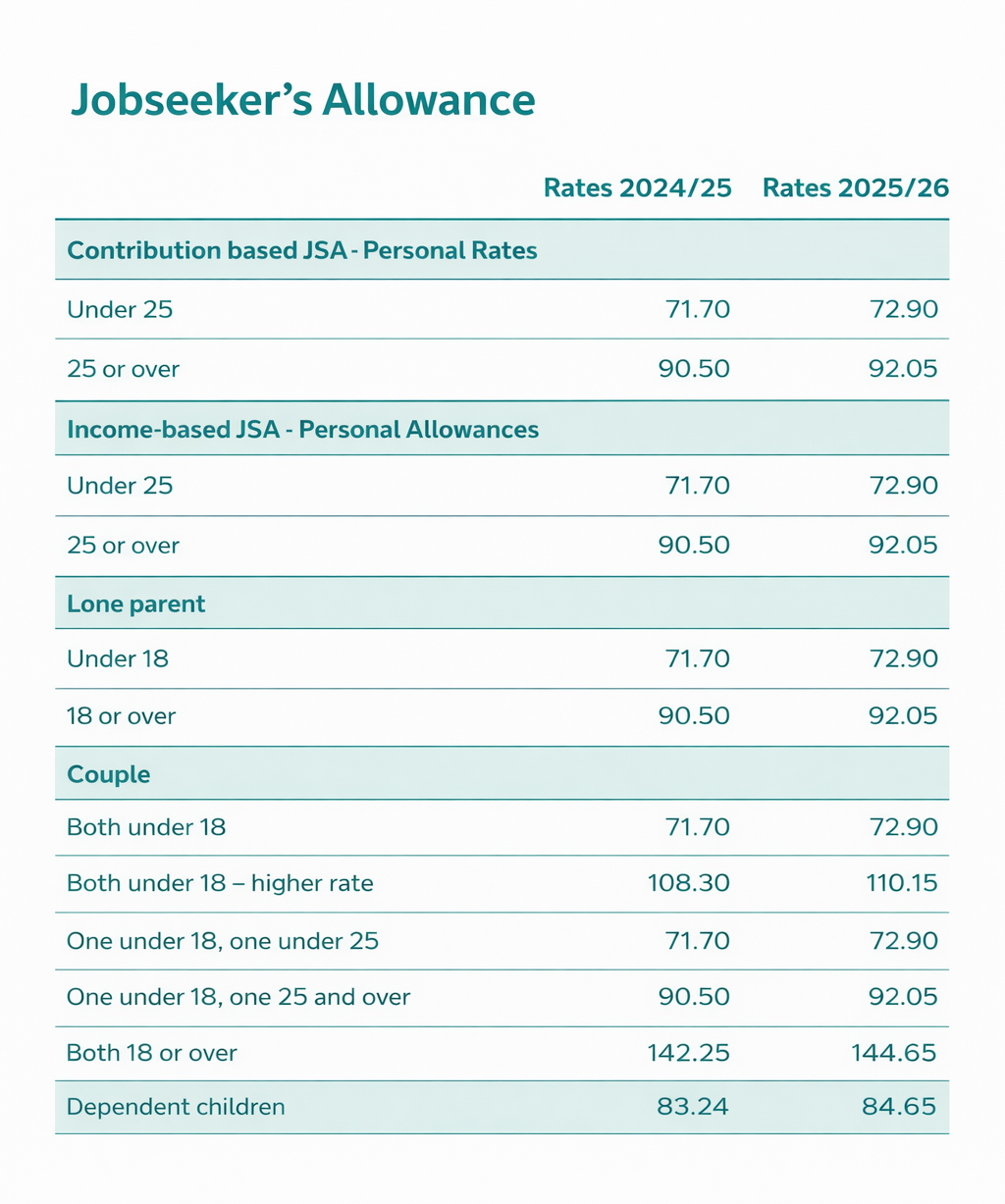
    New Style Jobseeker’s Allowance (JSA) pays up to £72.90 per week if you’re under 25 and up to £92.05 per week if you’re 25 or over in the 2025/26 tax year. You can usually receive this JSA payment for up to 182 days (about 6 months) while you actively look for work.

    JSA is not means tested, so your savings or your partner’s income do not affect your claim. Instead, eligibility depends on your National Insurance contributions, making it different from other unemployment and benefits support.

    In short, if you’re asking how much is JSA or how much is job seekers allowance, the answer depends mainly on your age and contribution history, not your savings.

    Get expert support for your next tender, inspection-ready policies, or CQC registration — book a call with Care Sync Experts today and let’s get you compliant and competitive.

    Key Facts About Jobseeker’s Allowance

    • JSA payment (weekly):

    Up to £72.90 (18–24) and £92.05 (25+)

    • Payment frequency:

    You usually receive JSA every 2 weeks into your bank account

    • Duration:

    You can claim for up to 182 days (around 6 months)

    • Means testing:

    New Style JSA is not means tested, so savings and partner income do not affect your claim

    • Eligibility basis:

    Your entitlement depends on your National Insurance contributions, not household finances

    • Work requirement:

    You must be actively looking for work and meet your Jobcentre agreement

    • Other benefits:

    You can sometimes claim JSA alongside Universal Credit, depending on your situation

    If you’re wondering is job seekers allowance means tested, the answer for New Style JSA is no, but you must still meet strict JSA eligibility rules based on your work history.

    What JSA Means for Care Workers and Care Providers

    CQC vs CIW vs RQIA – What’s the Difference in UK Care Regulations?

    Jobseeker’s Allowance plays an important role in the care sector, where employment can be unpredictable. Many care workers move between roles, work on zero-hour contracts, or take short breaks between placements. During these periods, JSA provides short-term financial support while they look for new work.

    For care workers, JSA helps bridge gaps between jobs without relying entirely on savings. Since New Style JSA is not means tested, workers can still receive support even if they have some savings or a working partner. This makes it a useful option for those navigating unemployment and benefits in a sector with fluctuating hours.

    For care providers, JSA indirectly supports workforce stability. When staff leave or contracts end, access to JSA allows workers to remain financially secure while searching for their next role, often within the same sector. This reduces long-term workforce loss and helps agencies rehire experienced carers more easily.

    In practical terms, JSA functions as a form of short-term unemployment insurance, giving both workers and employers breathing room during transitions. For providers facing staffing shortages, understanding how JSA works can also help when advising candidates or supporting staff between roles.

    JSA Eligibility: Who Can Claim Job Seeker’s Allowance?

    To claim Job Seekers Allowance, you must meet specific conditions based on your work history and availability for work. New Style JSA focuses on contributions, not your financial situation.

    Basic JSA eligibility requirements:

    You can claim if you:

    • Are 18 or over and below State Pension age
    • Live in Great Britain
    • Have paid Class 1 National Insurance contributions in the last 2–3 years
    • Work less than 16 hours per week
    • Are available for work and actively looking for a job

    Who cannot claim JSA?

    You will not qualify if:

    • You work 16 hours or more per week
    • You cannot work due to illness or disability (you may need ESA instead)
    • You have not built enough National Insurance contributions

    Care sector example:

    A care worker who recently left a domiciliary care role and has been paying National Insurance can usually claim JSA while searching for a new position, especially if they are working reduced hours or between contracts.

    If you want to claim job seekers allowance, focus on your work history and job search activity. Your savings or household income will not stop you from qualifying under New Style JSA eligibility rules.

    Can I Claim Job Seekers Allowance If I Have Savings?

    Yes, you can claim Job Seekers Allowance if you have savings when applying for New Style JSA.

    New Style JSA is not means tested, which means:

    • Your savings do not affect your claim
    • Your partner’s income or savings do not affect your claim
    • You can still qualify even if you have money in the bank

    This directly answers the common question: “Can I claim job seekers allowance if I have savings?” → Yes, you can.

    Why savings don’t matter

    New Style JSA works differently from older benefits. Instead of assessing your finances, it looks at your National Insurance contributions.

    If you have worked and paid enough contributions in recent years, you may qualify regardless of how much you have saved.

    Important exception to understand

    • If you apply for Universal Credit instead, your savings will be assessed
    • If you receive older income-based JSA, savings may also affect eligibility

    Care sector example

    A care worker who has saved money while working in a care home can still claim JSA after leaving their job. Even with savings, they can receive support while applying for new roles.

    So if you’re asking:

    • “Is job seekers allowance means tested?” → Not for New Style JSA
    • “Can I claim job seekers allowance if I have savings?” → Yes, as long as you meet contribution-based requirements

    How Much Is Job Seekers Allowance Per Week and Month?
    JSA vs Universal Credit
    JSA vs Universal Credit

    The amount you receive depends mainly on your age. New Style JSA sets a maximum weekly payment, but your actual amount may be lower in some cases.

    Weekly JSA payment rates (2025/26):

    • £72.90 per week if you are aged 18–24
    • £92.05 per week if you are 25 or over

    How much is Job Seekers Allowance a month?

    Although JSA is paid weekly, you can estimate the monthly amount:

    • Under 25: about £291 per month
    • 25 or over: about £368 per month

    This answers common searches like:

    • how much is job seekers allowance a month
    • jobseekers how much

    What can affect your JSA payment?

    You may receive less than the maximum if:

    • You work part-time
    • You receive a pension or other income
    • You do not fully meet your job search requirements

    Using a Job Seekers Allowance calculator

    A job seekers allowance calculator can help you estimate your exact payment based on your situation. However, for New Style JSA, the calculation is usually straightforward since it depends mostly on:

    • Your age
    • Your National Insurance contributions

    Care sector example

    A care assistant aged 30 who recently left a role can receive up to £92.05 per week while searching for a new job. If they take on a few part-time shifts, their JSA payment may reduce slightly depending on earnings.

    In simple terms, if you’re asking how much is job seekers allowance, most people receive between £72.90 and £92.05 per week, depending on age and circumstances.

    How Long Can You Claim Job Seekers Allowance?

    You can usually claim New Style Jobseeker’s Allowance for up to 182 days, which is about 6 months.

    This directly answers the question: “How long can you claim job seekers allowance?” → Up to 6 months in most cases.

    What happens after 6 months?

    Once your JSA ends, you have a few options:

    • Apply for Universal Credit if you still need financial support
    • Continue working with your Jobcentre work coach to find employment
    • Explore training or alternative benefits depending on your situation

    Important to know

    • JSA does not renew automatically after 182 days
    • You must continue to meet job search requirements throughout your claim
    • Missing commitments can lead to your payments being reduced or stopped

    Care sector example

    A care worker between roles may claim JSA while applying for new positions in domiciliary care or care homes. If they do not secure a job within 6 months, they may transition to Universal Credit while continuing their job search.

    In simple terms, JSA provides short-term support, not long-term income. It helps you stay financially stable while actively looking for your next job.

    How to Apply for JSA (Step-by-Step)
    If you want to apply for JSA, the process is straightforward, but you must follow each step carefully to avoid delays.

    Step 1: Start your JSA application

    You can apply online through GOV.UK. This is the fastest way to begin your claim.

    This answers common searches like:

    • job seekers allowance apply
    • jsa applications
    • how do I get Job Seekers Allowance

    Step 2: Prepare your details

    Before you apply, gather:

    • Your National Insurance number
    • Your bank account details
    • Your employment history (last 6 months)
    • Details of any income or part-time work

    Having this ready speeds up your application.

    Step 3: Attend your Jobcentre interview

    After submitting your application, the Jobcentre will invite you to an interview.

    During this meeting, you will:

    • Confirm your details
    • Discuss your job search
    • Agree to a Claimant Commitment

    This agreement outlines how you will actively look for work.

    Step 4: Start receiving payments

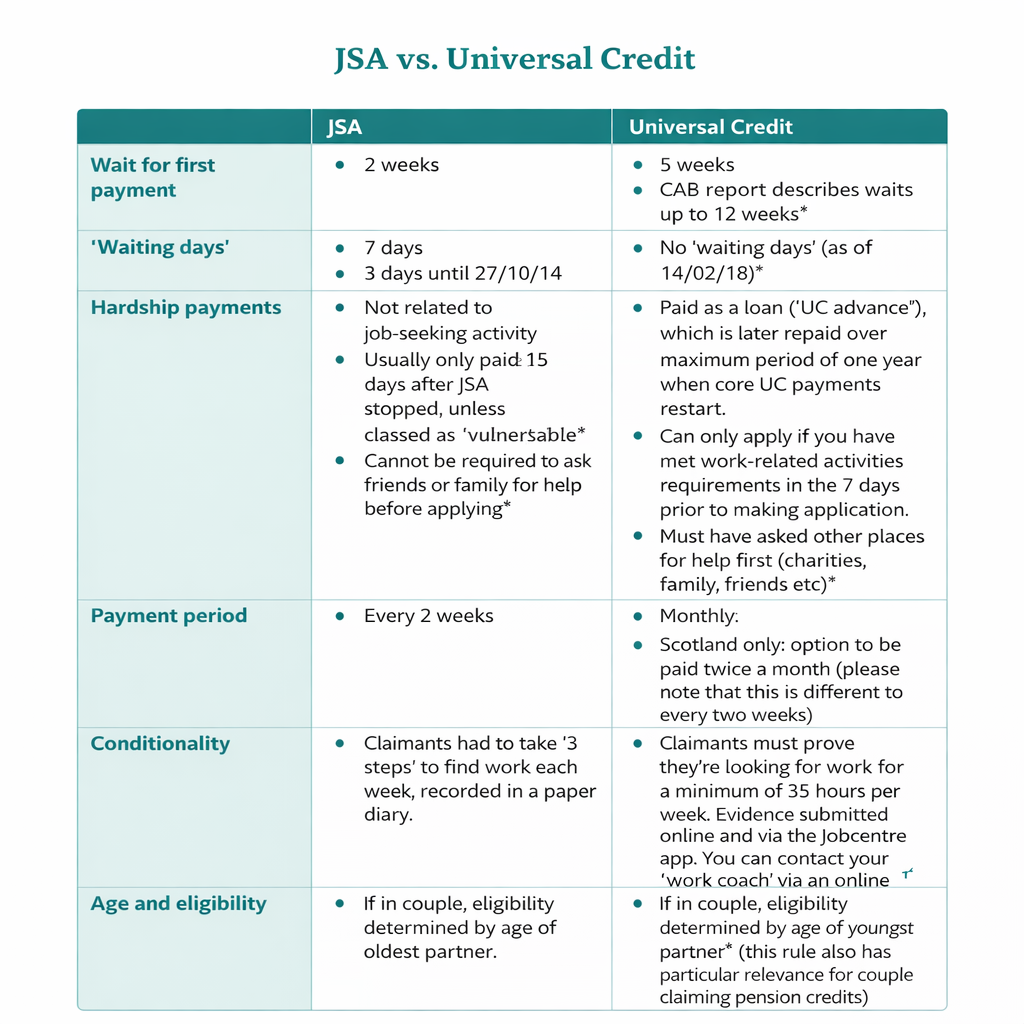
    • You may wait up to 7 days before your claim starts
    • Your first payment may take up to 2 weeks
    • After that, you will receive JSA payment every 2 weeks

    Important rules during your claim

    To continue receiving JSA, you must:

    • Actively apply for jobs
    • Attend scheduled Jobcentre meetings
    • Follow your Claimant Commitment

    If you fail to meet these conditions, your payments may be reduced or stopped.

    Care sector example

    A care assistant who recently left a role can claim job seekers allowance online, attend a Jobcentre interview, and begin receiving payments while applying for new care jobs.

    In simple terms, to claim job seekers allowance, apply online, attend your interview, and actively search for work to keep receiving payments.

    JSA Contact Number and Support

    If you need help with your claim, you can contact Jobcentre Plus, which handles all JSA enquiries.

    Job Seekers Allowance contact telephone number

    • Telephone: 0800 055 6688
    • Opening hours: Monday to Friday, usually 8am to 5pm
    • Calls are free from mobiles and landlines

    This covers common searches like:

    • job seekers allowance contact telephone number
    • jsa contact no
    • jsa enquiries number
    • jsa allowance contact number

    When should you call?

    You should contact Jobcentre Plus if:

    • You need help with your JSA application
    • You want to check your claim status
    • You need to report a change in circumstances
    • You missed an appointment or payment

    What to prepare before calling

    To avoid delays, have the following ready:

    • Your National Insurance number
    • Your personal details (name, address)
    • Details of your claim or application

    Alternative support options

    • Visit your local Jobcentre Plus office
    • Request help if English is not your first language
    • Ask for support with online applications if needed

    Care sector tip

    Care workers moving between jobs often need quick support to keep their claims active. Calling early and keeping records of conversations can help avoid payment issues during job transitions.

    If you’re unsure about your claim, using the JSA contact number is the fastest way to get direct support and resolve issues quickly.

    Job Seekers Allowance Rules You Must Follow
    Types of Employee Benefits
    Types of Employee Benefits

    To keep receiving JSA, you must follow strict job seekers allowance rules set by the Department for Work and Pensions (DWP). These rules focus on your commitment to finding work.

    Your main responsibilities

    You must:

    • Actively search for work every week
    • Be available to start work immediately
    • Attend all Jobcentre appointments
    • Follow your agreed Claimant Commitment

    Your Claimant Commitment outlines the steps you will take to find a job, such as applying for roles, attending interviews, or completing training.

    What happens if you don’t follow the rules?

    If you fail to meet these requirements:

    • Your JSA payment may be reduced or stopped
    • You may receive a sanction, which pauses your payments
    • You must provide a valid reason (for example, illness or emergencies) to avoid penalties

    Understanding the 35-hour job search rule

    Traditionally, claimants are expected to spend around 35 hours per week looking for work. However, policies can change, and there have been discussions around flexibility in job search expectations depending on individual circumstances.

    If you’ve heard that the DWP is ending the 35-hour work search rule, it’s important to check with your work coach, as requirements can vary based on your situation.

    Care sector example

    A care worker claiming JSA may agree to:

    • Apply for a set number of care jobs weekly
    • Attend interviews with care agencies
    • Complete refresher training (e.g. safeguarding)

    Failing to meet these commitments without a valid reason could result in reduced payments.

    In simple terms, JSA is not automatic income. You must actively prove that you are looking for work and ready to return to employment.

    How Care Providers Can Support Staff on JSA

    Care providers play a key role in supporting staff who are between roles or experiencing reduced hours. Understanding how JSA works allows providers to guide workers through transitions and maintain a strong workforce.

    1. Support staff during employment gaps

    When a care worker leaves or finishes a contract, providers can:

    • Inform them about how to claim Job Seekers Allowance
    • Encourage early applications to avoid payment delays
    • Direct them to Jobcentre support services

    This helps workers stay financially stable while searching for new roles.

    2. Maintain a talent pipeline

    Care providers can use JSA periods as an opportunity to:

    • Reconnect with experienced carers
    • Offer flexible or part-time roles
    • Build a pool of workers ready to return quickly

    Workers receiving JSA often remain active job seekers, making them ideal candidates for rapid recruitment.

    3. Provide guidance on compliance

    Providers can help staff understand:

    • JSA eligibility requirements
    • Job search expectations
    • How part-time work affects their JSA payment

    Clear guidance reduces confusion and helps workers avoid sanctions.

    4. Encourage training and upskilling

    During periods of unemployment, providers can:

    • Recommend short courses (e.g. care certifications)
    • Support refresher training
    • Prepare staff for higher-level roles

    This improves both worker confidence and service quality.

    5. Strengthen retention and reputation

    When providers support staff even after contracts end, they:

    • Build trust and loyalty
    • Increase the likelihood of staff returning
    • Enhance their reputation as a supportive employer

    Care sector insight

    Many care workers move between roles due to the nature of the industry. Providers who understand unemployment and benefits systems like JSA can better support staff transitions and reduce long-term workforce shortages.

    In simple terms, JSA is not just a worker benefit, it is also a tool that care providers can use to retain talent, support staff, and strengthen recruitment pipelines.

    Conclusion

    Jobseeker’s Allowance offers short-term financial support while you actively look for work. If you meet the JSA eligibility requirements, you can receive up to £72.90 or £92.05 per week, depending on your age, for up to 6 months.

    For care workers, JSA helps bridge employment gaps between roles. For care providers, it supports workforce stability by keeping skilled workers active in the job market.

    If you’re considering your options:

    • Check your eligibility early
    • Start your JSA application as soon as your work situation changes
    • Stay consistent with your job search requirements
    • Explore Universal Credit if you need longer-term support

    If you’re asking “how much is JSA”, the real value goes beyond the weekly payment. JSA gives you time, stability, and support while you secure your next role, especially in fast-moving sectors like care.

    Need Support Navigating Compliance, Staffing, or Care Business Growth?

    At Care Sync Experts, we help care providers stay compliant, strengthen their workforce, and grow with confidence.

    Whether you need support with:

    • CQC registration and inspection readiness
    • Staff compliance, onboarding, and retention strategies
    • Tender writing and securing local authority contracts
    • Policies, documentation, and operational setup

    We’ve got you covered.

    Don’t let staffing gaps, compliance issues, or missed opportunities slow your growth.

    Let our experts handle the complexity while you focus on delivering high-quality care.

    Get Started Today

    Book a consultation with Care Sync Experts and take the next step toward building a compliant, scalable, and resilient care business.

    FAQ

    What are the two types of JSA?

    There are two main types of Jobseeker’s Allowance in the UK:
    – New Style JSA – based on your National Insurance contributions and not means tested
    – Income-based JSA – an older benefit that is now being replaced by Universal Credit and is no longer available for new claims

    Most new applicants will apply for New Style JSA, sometimes alongside Universal Credit.

    Can I claim JSA if I have redundancy pay?

    Yes, you can still claim New Style JSA if you have redundancy pay.
    Redundancy payments do not usually affect your eligibility because New Style JSA is based on your National Insurance contributions, not your savings or lump-sum payments.
    However, if you apply for Universal Credit, your redundancy pay may be taken into account.

    Can I claim JSA if I resign?

    You can claim JSA if you resign, but your payments may be delayed or reduced.
    The Jobcentre will assess your reason for leaving. If they decide you left your job without a good reason, you may receive a sanction, which means your payments could be paused for a period of time.
    Valid reasons may include workplace issues, health concerns, or unsafe working conditions.

    What proof do I need for New Style JSA?

    To apply for New Style JSA, you typically need to provide:
    – Your National Insurance number
    – Proof of identity (such as passport or driving licence)
    – Details of your recent employment history
    – Your bank account details
    – Information about any income or part-time work

    The Jobcentre may also ask for additional documents during your application or interview.

  • Children’s DLA Rates: Who Qualifies, and What to Claim in 2026

    Children’s DLA Rates: Who Qualifies, and What to Claim in 2026

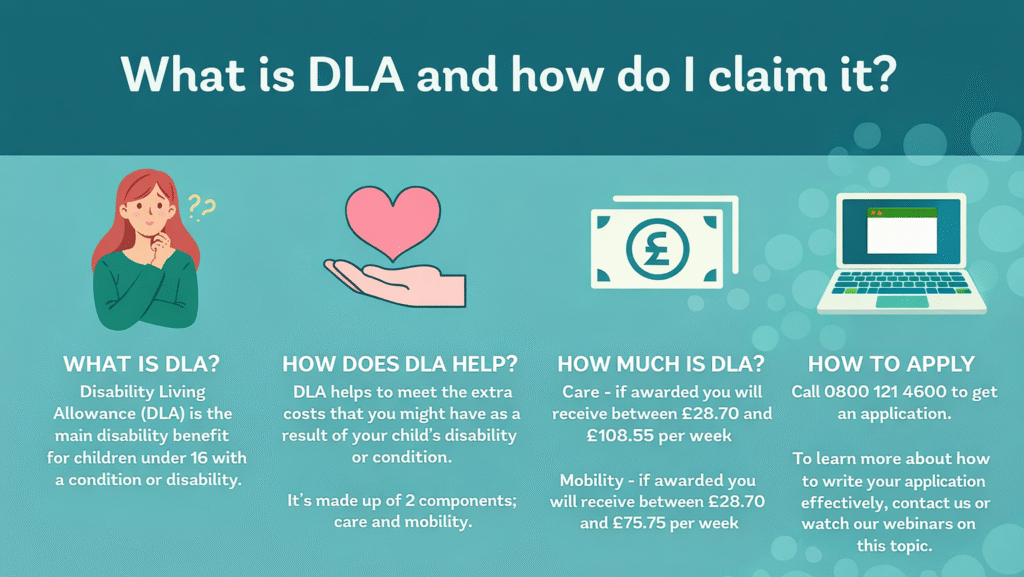
    Children’s DLA rates help cover the extra costs of caring for a child with a disability or long-term health condition. If your child is under 16 and needs significantly more care or supervision than other children their age, you may qualify for Disability Living Allowance (DLA).

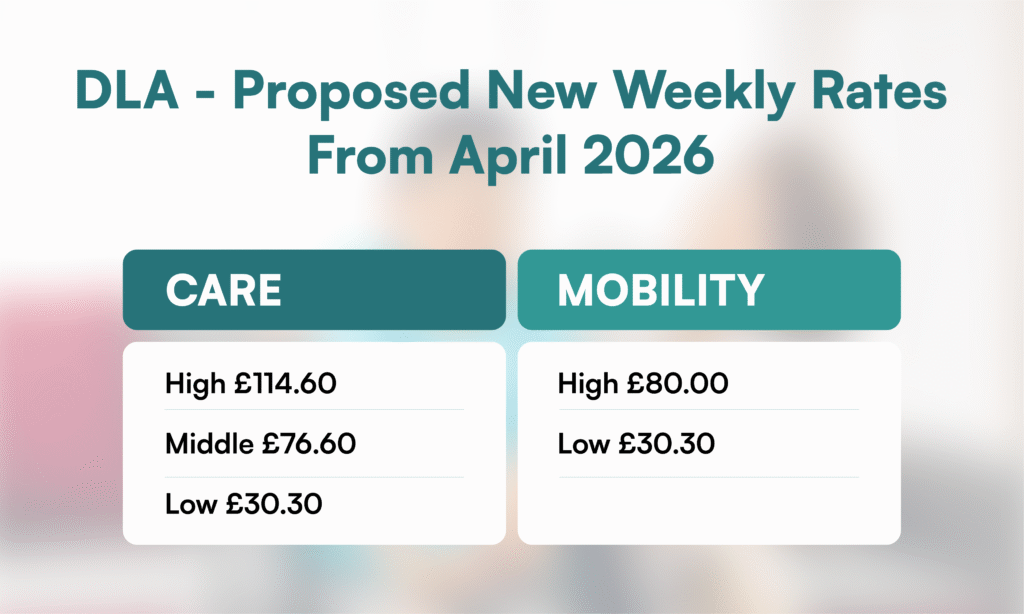
    The amount you receive depends on the level of help your child needs with daily care or mobility. Current DLA child rates range from £29.20 to £187.45 per week, based on two components: care and mobility.

    Parents and caregivers often ask questions such as “how much is high rate DLA for a child?” or “how much is middle rate DLA for a child?” The exact rate depends on how much support your child requires during the day, at night, or when moving around.

    Many families use DLA to pay for:

    • extra supervision or care needs
    • transport or mobility support
    • specialist equipment or therapy
    • additional household costs linked to a disability

    If your child receives DLA, you may also qualify for other support, including Carer’s Allowance or the carer element in Universal Credit, depending on your situation.

    Get expert support for your next tender, inspection-ready policies, or CQC registration — book a call with Care Sync Experts today and let’s get you compliant and competitive.

    How much are children’s DLA rates in 2026?

    DBS Update Service for CQC Registration: The Rule That Catches Everyone

    The children’s DLA rates depend on how much extra help your child needs with daily care or mobility. Disability Living Allowance for children has two components:

    • Care component – for children who need extra supervision, help with daily activities, or support during the night.
    • Mobility component – for children who have difficulty walking or need guidance when moving around outdoors.

    Your child may qualify for one component or both, depending on their needs.

    Care component (weekly payments)

    Level of care neededWeekly amount
    Lowest rate£29.20
    Middle rate£73.90
    Highest rate£110.40

    Parents often ask “how much is middle rate DLA for a child?” or “how much is high rate DLA for a child?”. The answer depends on how much supervision or assistance your child needs throughout the day or night.

    • Lowest rate – for children who need help during part of the day.
    • Middle rate – for children who need frequent help during the day or supervision at night.
    • Highest rate – for children who need care or supervision both day and night, or who have a serious life-limiting condition.

    Mobility component (weekly payments)

    Mobility support neededWeekly amount
    Low rate mobility DLA child£29.20
    High rate mobility DLA£77.05

    The low rate mobility DLA applies when a child can walk but still needs guidance or supervision outdoors. The high rate mobility DLA applies when a child cannot walk, can only walk short distances without severe discomfort, or has a severe visual impairment.

    In official terms, this lower tier is also called disability living allowance lower rate mobility.

    Age rules apply to the mobility component:

    • Lower rate mobility usually applies from age 5.
    • Higher rate mobility can apply from age 3.

    If your child qualifies for the highest mobility rate, they may also become eligible for the Motability Scheme, which can help families access adapted vehicles.

    RELATED: Equality Act Protected Characteristics: 2026 Importance for Care Work

    Do autism or ADHD change the DLA rate?

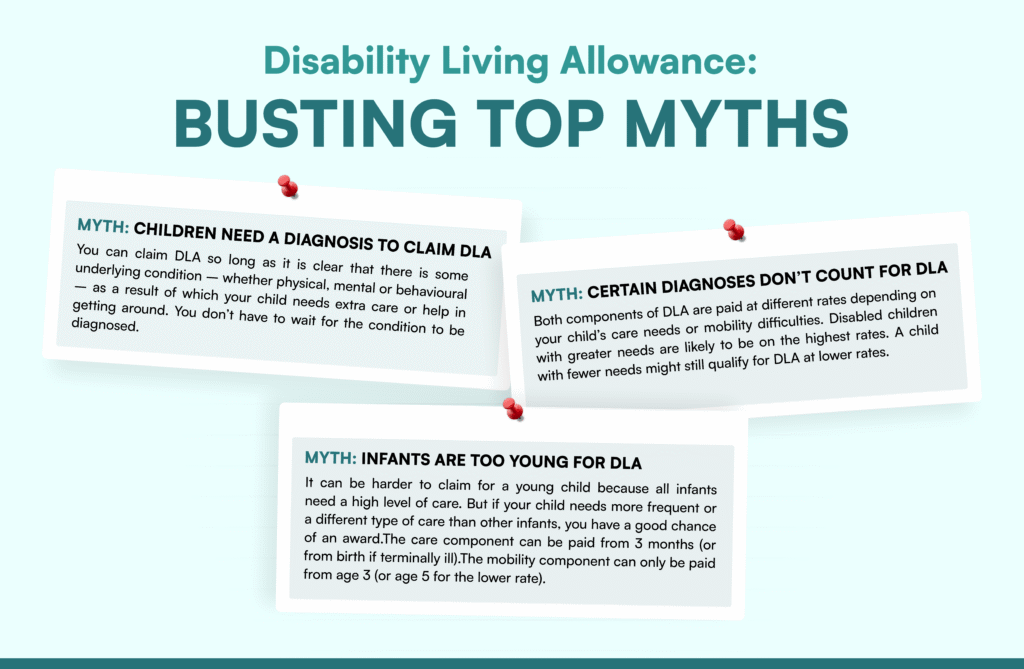
    Many parents search for DLA rates for child with autism, DLA rates for child with ADHD, or DLA rates for child with autism and ADHD. In practice, the diagnosis itself does not determine the amount of Disability Living Allowance a child receives.

    The Department for Work and Pensions looks at how much extra care, supervision, or mobility support your child needs, not the medical label attached to the condition.

    For example, two children with autism may receive different DLA child rates if their daily needs differ. One child might qualify for the middle care rate because they need frequent help during the day, while another child may qualify for the highest care rate if they require supervision both day and night.

    Decision-makers usually assess things such as:

    • how much extra supervision your child needs compared with other children the same age
    • whether your child needs help with personal care, communication, or safety
    • whether your child experiences mobility difficulties or needs guidance outdoors
    • whether their condition affects sleep, behaviour, or risk awareness

    Children with autism, ADHD, or a combination of both often qualify for DLA when they require significantly more supervision than other children of the same age. For instance, some children may need constant supervision outside because of limited danger awareness, while others may require structured support for daily routines.

    This is why DLA focuses on practical daily needs rather than diagnosis alone. When applying, it helps to describe clearly what support your child actually needs throughout the day and night, rather than only listing their medical conditions.

    Who can claim DLA for a child?

    childrens dla rates
    childrens dla rates

    You can claim Disability Living Allowance (DLA) for a child if you look after them as a parent and they meet the eligibility rules. This includes parents, step-parents, guardians, grandparents, foster parents, or older siblings who take on the main caring role.

    To qualify, your child must usually:

    • be under 16 years old
    • need much more care, supervision, or help moving around than other children the same age
    • live in England or Wales when the claim is made
    • have had these difficulties for at least 3 months and expect them to last for at least 6 months

    You can claim DLA whether you work or not, and your household income does not affect the benefit. The assessment focuses entirely on your child’s care and mobility needs.

    Living in different parts of the UK

    Where your child lives affects which benefit you apply for:

    • England and Wales: apply for Disability Living Allowance for children
    • Scotland: DLA for children has been replaced by Child Disability Payment
    • Northern Ireland: children still claim Disability Living Allowance, but the application process runs through the Northern Ireland system

    If your child lives in Scotland, you should apply for Child Disability Payment instead of DLA. This benefit provides similar support but is managed by Social Security Scotland.

    Living abroad or moving countries

    In some situations, you may still be able to claim if your child lives outside the UK temporarily, such as when:

    • your child receives medical treatment abroad
    • a parent works in the armed forces
    • your child lives in certain European countries under specific agreements

    However, most families must show that the child normally lives in England or Wales when applying.

    Who receives the payments?

    DLA payments usually go to the parent or caregiver responsible for the child. The money helps cover the additional costs of caring for a child with a disability, such as supervision, transport, specialist equipment, or extra support services.

    READ MORE: UK Cost of Living Payment Eligibility (2026): What Caregivers and Families Need to Know

    Is there a DLA points scoring system for children?

    Many parents search for a “DLA points scoring system child”, especially if they have heard about the points-based system used for Personal Independence Payment (PIP). However, DLA for children does not use a public points system.

    Instead, decision-makers look at how your child’s condition affects their daily life compared with other children the same age. The Department for Work and Pensions reviews the information you provide in the claim form and decides whether your child qualifies for the care component, the mobility component, or both.

    What the DLA decision is based on

    When reviewing a claim, assessors usually focus on:

    • how much extra supervision your child needs during the day
    • whether your child needs help with personal care tasks, such as eating, dressing, or washing
    • whether someone must watch over them for safety, especially outdoors
    • whether your child needs help moving around or guidance when walking
    • whether their condition affects sleep or night-time care

    The key question is whether your child needs significantly more support than another child of the same age.

    Evidence that can strengthen a claim

    You do not need to prove your child’s condition using points. Instead, it helps to explain clearly how their needs affect everyday life. Useful evidence can include:

    • reports from doctors, therapists, or specialists
    • letters from schools or support workers
    • care plans or therapy plans
    • examples of supervision or support your child needs during the day and night

    Parents often improve their chances by focusing on real daily challenges, rather than just listing the child’s diagnosis.

    SEE ALSO: PIP Contact Number: Number for PIP Payment and Enquiries (2026)

    My child gets DLA: what else am I entitled to?

    DLA – Proposed New Rates (April 2026)

    Many parents ask “my child gets DLA, what else am I entitled to?” because Disability Living Allowance can unlock other types of support for families caring for a disabled child.

    If your child receives middle or highest rate care, you may qualify for additional financial help and support services.

    Carer’s Allowance

    You may be able to claim Carer’s Allowance if:

    • you care for your child for at least 35 hours per week
    • your child receives middle or highest rate care component
    • you meet the income and eligibility rules

    Some families receiving Universal Credit may instead qualify for the carer element, which increases their monthly payment if they provide regular care.

    Motability Scheme

    If your child receives the high rate mobility DLA, you may be able to access the Motability Scheme. This allows families to lease a vehicle, scooter, or powered wheelchair using the mobility component of the benefit.

    Many caregivers use this option to make transport easier for school, medical appointments, or daily activities.

    Other support your family may qualify for

    Depending on your situation, DLA may also help you access:

    • extra Universal Credit support for disabled children
    • free school meals or additional school support
    • council tax reductions
    • grants from charities supporting disabled children

    Because every family’s situation differs, it is worth checking which additional support you can claim once your child’s DLA child rates are approved.

    Child Disability Payment in Scotland and DLA in Northern Ireland

    The benefit you apply for depends on where your child lives in the UK. While Disability Living Allowance (DLA) still applies to children in England, Wales, and Northern Ireland, Scotland now uses a different system.

    Scotland: Child Disability Payment

    If your child lives in Scotland, you cannot apply for DLA. Instead, you must apply for Child Disability Payment, which replaced disability living allowance Scotland (DLA Scotland) for children.

    Child Disability Payment works in a similar way to DLA and also includes:

    • a care component
    • a mobility component

    The amount your child receives still depends on how much help they need with daily care or mobility, rather than the specific diagnosis.

    Northern Ireland: DLA for children

    Children living in Northern Ireland can still claim Disability Living Allowance for children through the Northern Ireland system.

    The eligibility rules and DLA child rates are broadly similar to those used in England and Wales, but the claim process and support services operate through Northern Ireland departments.

    Families in Northern Ireland can contact the Disability and Carers Service for help with claims. Many parents search for the DLA Northern Ireland telephone number when starting an application or asking about their claim.

    Because the application routes differ slightly across the UK, it’s important to make sure you apply through the correct system for your child’s location.

    MORE: Labour Home Support Plan Pensioner Devices: 2026 Update

    DLA contact information and helpline numbers

    What Is DLA and How Do i Claim It
    What Is DLA and How Do i Claim It

    If you need help with a claim, you can contact the Disability Living Allowance helpline. Parents often search for the disability living allowance contact number, children’s DLA number, or general DLA contact information when starting an application or reporting a change.

    England and Wales

    You can request a claim form or ask questions about an existing claim by contacting the DLA helpline:

    Disability Living Allowance helpline

    Telephone: 0800 121 4600

    Textphone: 0800 121 4523

    Relay UK: dial 18001 then 0800 121 4600

    You can ask the helpline to send you a DLA claim form by post, or download and print one from the GOV.UK website.

    Northern Ireland

    Families in Northern Ireland must contact the Disability and Carers Service instead of the England and Wales helpline. Parents often search for the DLA Northern Ireland telephone number when starting a claim.

    Disability and Carers Service (Northern Ireland)

    Telephone: 0800 587 0912

    They can send you the claim pack and help answer questions about DLA child rates and eligibility.

    When to contact the DLA helpline

    You should contact the helpline if:

    • you want to request a claim form
    • you need to report a change in your child’s circumstances
    • you want to check the progress of a claim
    • you need help understanding your child’s DLA child rates or eligibility

    Keeping the DLA office updated helps ensure your payments continue correctly.

    Key takeaway…

    Children’s DLA rates depend on the level of care and mobility support your child needs, not just their diagnosis. If your child qualifies, the benefit can help cover the additional costs of care and may also unlock other support, such as Carer’s Allowance or mobility schemes.

    If you think your child may qualify, contacting the DLA helpline or requesting a claim form is often the first step toward accessing the support your family needs.

    Need Expert Support Navigating Disability Benefits and Care Funding?

    Care Sync Experts supports care providers, parents, and healthcare organisations across the UK with clear, practical guidance on disability benefits, care funding, and regulatory processes that affect children and families.

    From helping families understand children’s DLA rates and eligibility to guiding care organisations through benefit-related policies, compliance requirements, and support frameworks, our specialists translate complex government guidance into straightforward, actionable advice.

    Whether you need help understanding Disability Living Allowance for children, Child Disability Payment in Scotland, carers’ support options, or benefit-linked care funding, our team provides structured guidance aligned with current UK health and social care standards.

    Help families access the support they deserve while strengthening compliance across your organisation.

    Contact Care Sync Experts today to receive expert guidance on disability benefits, care funding, and support pathways with clarity and confidence.

    FAQ

    What conditions qualify a child for DLA?

    There is no fixed list of medical conditions that automatically qualify a child for Disability Living Allowance (DLA). Instead, the decision depends on how the child’s condition affects their daily care or mobility needs.

    A child may qualify if they need significantly more help or supervision than other children of the same age because of a long-term condition or disability.

    Examples of conditions that commonly lead families to claim DLA include:
    – autism spectrum disorder
    – ADHD
    – learning disabilities
    – physical disabilities
    – sensory impairments such as blindness or severe hearing loss
    – long-term medical conditions that require regular supervision

    The Department for Work and Pensions focuses on the level of care and support required, not just the diagnosis itself.

    What evidence do I need for child DLA?

    When you apply for Disability Living Allowance for a child, you should include evidence that explains how your child’s condition affects their daily life.

    Helpful evidence may include:
    – letters or reports from GPs, paediatricians, or specialists
    – reports from speech therapists, occupational therapists, or physiotherapists
    – information from schools or special educational needs coordinators (SENCOs)
    – care plans or support plans
    – examples of daily supervision or assistance your child needs

    Strong applications usually describe real situations from everyday life, such as help needed with dressing, supervision for safety, or support required at night.

    What happens after DLA is approved?

    After a successful claim, the Department for Work and Pensions sends you a decision letter explaining:
    – which care or mobility components your child has been awarded
    – the weekly rate your child will receive
    – how long the award will last

    Payments usually go into your bank or building society account every four weeks.
    Once your child receives DLA, you may also become eligible for other support, such as Carer’s Allowance or additional benefits depending on your circumstances.

    Can a 2 year old get DLA for autism?

    Yes, a 2-year-old child can qualify for Disability Living Allowance, including children with autism, if they need much more supervision or care than other children their age.

    However, the mobility component usually only applies at certain ages:
    – Higher mobility rate can apply from age 3
    – Lower mobility rate usually applies from age 5

    Even if a child is younger than these ages, they may still qualify for the care component if they require significant extra supervision or support due to their condition.

    Parents applying for young children should focus on explaining how much extra care their child needs compared with other children of the same age.

  • Attendance Allowance Pitfalls (2026): Best Guide to Claim AA Successfully

    Attendance Allowance Pitfalls (2026): Best Guide to Claim AA Successfully

    If you’re a daughter, son, spouse, or caregiver filling in the form, remember this: the Department for Work and Pensions (DWP) will only see what you write. They won’t see the bad mornings. They won’t see the falls you prevented. They won’t see the confusion at 2 am.

    They will decide based on your words alone.

    Many families lose claims because they unintentionally fall into common attendance allowance pitfalls. They rush the form. They describe “good days” instead of difficult ones. They forget to explain how often help is needed or why supervision keeps someone safe.

    Attendance Allowance is not awarded because someone has a diagnosis. It is awarded because that condition creates real, ongoing care or supervision needs. If you want to know how to successfully claim Attendance Allowance, you must show exactly how daily life breaks down without help.

    In this guide, we will show you:

    • The most common attendance allowance pitfalls
    • What decision-makers actually look for
    • What medical conditions qualify for Attendance Allowance (and what really matters)
    • How to structure answers so they are clear, specific, and persuasive
    • Practical examples that make your application stronger
    Get expert support for your next tender, inspection-ready policies, or CQC registration — book a call with Care Sync Experts today and let’s get you compliant and competitive.

    The Top Attendance Allowance Pitfalls That Cause Refusals

    Domiciliary Care Mistakes Destroying Your Business (And How To Fix Them)

    If you avoid these attendance allowance pitfalls, you dramatically improve your chances of approval. Most refusals happen because the form does not clearly show care needs, not because someone is “not ill enough.”

    Here are the mistakes that cost families the most:

    1. You describe the best days, not the worst ones

    Many applicants write about days when they are coping. DWP assesses what help is needed most of the time, not on rare good days.

    2. You forget to explain frequency and time

    Saying “I need help dressing” is not enough.
    How often? How long does it take? What happens if nobody helps?

    3. You ignore supervision and safety risks

    Attendance Allowance covers supervision to stay safe.
    Falls, confusion, wandering, choking, medication errors, leaving the gas on, these matter. If someone must watch over you, say so clearly.

    4. You focus on housework instead of personal care

    Cleaning, shopping, and gardening do not qualify on their own.
    DWP looks at personal care: washing, dressing, eating, toileting, taking medication, and staying safe.

    5. You give vague answers

    “I struggle.”

    “It’s difficult.”

    These phrases mean nothing to a decision-maker. Replace them with specifics: what goes wrong, how often, and what help is required.

    6. You leave sections blank or rush the form

    DWP decides based only on what appears on the attendance allowance form. If you leave out details, they cannot assume anything.

    7. You miss the 6-week return rule

    If you request the attendance allowance application form by phone, your claim can start from the call date, but only if you return it within 6 weeks. Miss that window, and you may lose backdated money.

    8. You forget supporting evidence

    Attach medication lists, hospital letters, GP summaries, care plans, or occupational therapy reports. These documents strengthen your answers.

    9. You assume you won’t qualify because of savings

    Attendance Allowance is one of the UK’s non means tested benefits. Savings and income do not affect eligibility.

    RELATED: Council Care Cost Inheritance: Who Pays for Care Home Fees 2026?

    How DWP Decides, And Why Detail Wins

    DWP does not assess your personality. They do not assess effort. They assess evidence on the attendance allowance form.

    A decision-maker reads your answers and asks one question: Does this person need help with personal care or supervision because of illness or disability?

    They will not:

    • Contact your GP unless necessary
    • Visit your home
    • Fill in gaps for you

    If you do not write it, they cannot assume it.

    That is why vague answers fail. The attendance allowance application form asks how your condition affects daily life. You must show:

    1. What happens
    2. How often it happens
    3. How long it takes
    4. What risks exist without help

    For example:

    Weak answer:“I struggle with washing.”

    Strong answer:

    “I need help getting in and out of the bath because I lose balance and have fallen twice this year. My daughter supervises me every morning. Washing takes around 30 minutes with support. Without help, I risk slipping.”

    See the difference? The second answer shows:

    • Frequency (every morning)
    • Risk (falls)
    • Time (30 minutes)
    • Supervision (daughter present)

    That is what moves a claim from uncertain to approved.

    What Medical Conditions Qualify for Attendance Allowance?

    Attendance Allowance Form
    Attendance Allowance Form

    Many families ask:

    • What medical conditions qualify for Attendance Allowance?
    • Is there a list?
    • What are the 56 conditions that qualify for attendance allowance?

    Here’s the truth: Attendance Allowance is not awarded based on diagnosis alone.

    DWP does not approve claims simply because someone has arthritis, dementia, Parkinson’s, heart failure, or another condition.

    They award Attendance Allowance because the condition creates a need for:

    • Personal care
    • Or supervision to stay safe

    That distinction matters.

    You could have a serious diagnosis and still be refused if you do not explain how it affects daily living. On the other hand, someone with a less dramatic diagnosis may qualify if they clearly show they need ongoing help.

    Common qualifying situations

    While there is no official “56-condition list,” claims often succeed where conditions cause:

    • Mobility problems that affect washing or dressing
    • Cognitive decline (e.g. dementia) requiring supervision
    • Severe arthritis affecting grip and balance
    • Stroke recovery needing assistance
    • Parkinson’s causing tremors and falls
    • Severe anxiety or depression affecting personal care
    • Sensory loss increasing safety risks

    If you are searching “what medical conditions qualify for attendance allowance,” shift the focus. Ask instead: Does this condition mean I need help with personal care or supervision most days?

    That is what DWP measures.

    READ MORE: What Is Respite Care in the UK? 2026

    The Refusal-Proof Method: What to Write (With Clear Examples)

    If you want to know how to successfully claim Attendance Allowance, this is the section that matters most.

    Do not just list tasks. Show impact, frequency, time, and risk. Use simple, direct sentences. Write in the first person, even if you are completing the form for someone else.

    Below is a practical structure you can follow for each area of daily living.

    1. Washing, Dressing and Toileting

    DWP looks for personal care needs, not inconvenience.

    Weak answer: “I struggle to get dressed.”

    Strong answer: “I need help dressing every morning because I cannot lift my arms above shoulder height due to arthritis. Buttons and zips take too long and cause pain. My daughter helps me for around 20 minutes daily. Without help, I would stay in nightwear.”

    Notice what the strong answer includes:

    • Daily frequency
    • Specific limitation
    • Time required
    • Consequence without help

    Use this structure: I need help with ___ because ___. This happens ___ times per week. It takes ___ minutes. Without help, ___ would happen.

    1. Meals and Medication (Supervision Counts)

    Many claims fail because families ignore safety risks.

    If someone:

    • Forgets to eat
    • Leaves the hob on
    • Misses medication
    • Double-doses
    • Chokes or struggles to swallow

    You must state this clearly.

    Example: “I need supervision when preparing meals because I forget pans on the stove and have caused smoke twice. My son now stays in the kitchen with me. This happens daily.”

    Supervision qualifies. Do not downplay it.

    1. Night-Time Needs

    Attendance Allowance pays at a higher rate if care is needed during the day and at night.

    Explain clearly if the person:

    • Wakes for toileting
    • Needs repositioning in bed
    • Becomes confused or distressed
    • Wanders
    • Needs reassurance

    Example:

    “I wake at least twice every night to use the toilet. My wife must help me stand safely because I lose balance. Without help, I would fall.”

    State how often. State who helps. State what would happen without help.

    1. Good Days vs Bad Days

    Do not hide fluctuations.

    If some days are better, say so, but explain what happens on difficult days.

    Example: “On better days I can wash my upper body alone. On bad days (3–4 times a week), I cannot step into the bath safely and need full assistance.”

    DWP expects variation. They do not expect perfection.

    This is how you avoid attendance allowance pitfalls. You replace vague statements with measurable detail.

    Examples of Completed Attendance Allowance Forms (What “Specific” Really Looks Like)

    Attendance Allowance Pitfalls (2026)
    Attendance Allowance Pitfalls (2026)

    You do not need to write pages of medical history. You need to write clear, specific descriptions of what happens in daily life.

    Below are short examples inspired by strong examples of completed attendance allowance forms. Use them as a model for tone and structure.

    Example 1: Dressing

    Vague answer: “I have trouble getting dressed.”

    Strong answer: “I need help dressing every morning because I cannot bend to put on socks due to severe hip pain. It takes around 15 minutes with help. Without support, I would remain partially dressed.”

    Why it works:

    • States daily frequency
    • Names the physical limitation
    • Shows time required
    • Explains consequence

    Example 2: Medication

    Vague answer: “I take medication for my heart.”

    Strong answer: “I take five medications daily. I forget doses at least twice a week due to memory problems. My daughter now prepares a dosette box and reminds me every evening. Without reminders, I miss tablets.”

    Why it works:

    • Shows risk
    • Shows supervision
    • Shows frequency

    Example 3: Night Needs

    Vague answer: “I wake during the night.”

    Strong answer: “I wake two to three times each night needing help to use the toilet. I feel dizzy when standing. My husband supports me to prevent falls. This happens every night.”

    Why it works:

    • Gives numbers
    • Mentions safety risk
    • Shows consistent pattern

    If you want to know how to successfully claim Attendance Allowance, follow one rule: Replace general words with measurable detail.

    Avoid emotional language. Avoid exaggeration. Do not dramatise. Just explain clearly what happens and how often.

    SEE ALSO: CHC Funding: A Caregiver’s Step-by-Step Guide (2026)

    How to Claim Attendance Allowance (Forms, Deadlines and Key Details)

    Once you understand the attendance allowance pitfalls, you need to submit the form correctly.

    Here is how to claim Attendance Allowance without losing time or money.

    1. Getting the Form

    You cannot complete the claim fully online and submit digitally. You must send the completed form by post.

    You have two main options:

    • Download the attendance allowance form online from GOV.UK, print it and complete it.
    • Call the helpline and request a paper form.

    If you request the form by phone, your claim can start from the date of your call — but only if you return the completed form within 6 weeks. Missing that deadline can cost you backdated payments.

    This is one of the most overlooked attendance allowance pitfalls.

    1. Where to Send the Form

    Once completed, send the form to:

    Freepost DWP Attendance Allowance

    You do not need a postcode or a stamp.

    If you are searching for the attendance allowance address, use the Freepost address above unless GOV.UK states otherwise.

    1. Is There an Attendance Allowance Email Address?

    There is no general Attendance Allowance email address for submitting claims. DWP requires paper forms.

    If you need help, contact the helpline rather than searching for an email submission option.

    1. Before You Post It

    Before you send the attendance allowance application form:

    • Check that every relevant section is completed.
    • Attach supporting evidence (medication list, letters, care plans).
    • Keep a copy of the entire form.
    • Ensure the claimant signs it (or that you have legal authority if signing on their behalf).

    Do not rush this stage. DWP makes its decision based only on what you send.

    Payments, Duration, and Common Questions About Attendance Allowance

    The Refusal-Proof Method – What to Write (Attendance Allowance)

    Once you submit the claim, families usually ask practical questions about money, timing and eligibility. Here are clear answers.

    How Often Is Attendance Allowance Paid?

    DWP usually pays Attendance Allowance every 4 weeks directly into a bank account.

    If you are wondering how often is Attendance Allowance paid, the answer is not monthly, it is paid in 4-weekly cycles.

    How Much Is Attendance Allowance Per Month?

    Attendance Allowance is set as a weekly rate, but DWP pays it every 4 weeks.

    There are two rates:

    • A lower rate for help during the day or night
    • A higher rate for help during the day and night, or for terminal illness

    If you want to calculate how much is Attendance Allowance per month, multiply the weekly rate by four (since payments are made every four weeks).

    Always check the current rates on GOV.UK because they usually increase in April.

    How Long Is Attendance Allowance Awarded For?

    Many people search:

    • How long is Attendance Allowance awarded for?
    • how long is attendance allowance awarded for?

    DWP can award it for:

    • An ongoing period (no fixed end date), or
    • A fixed period if your condition may improve

    DWP can review your award if circumstances change. You must report changes in care needs.

    Is Attendance Allowance Taxable?

    No. Attendance Allowance is tax-free.

    What About Rate Increases or “Boosts”?

    Search terms like:

    • uk pensioner attendance allowance boost
    • DWP pensioner attendance allowance boost
    • pip dla attendance allowance payment increase

    usually refer to annual benefit uprating. The government typically reviews benefit rates each year, with changes often applied in April.

    Attendance Allowance is separate from PIP and DLA, but rate increases may happen across benefits at the same time.

    MORE: CQC Application 2026: Avoid Rejection From 9 February (Supporting Documents, Registered Manager Guide)

    What Other Benefits Can I Claim With Attendance Allowance?

    Attendance Allowance does more than provide direct payments. It can increase entitlement to other support.

    Many families ask:

    • What other benefits can I claim with Attendance Allowance?
    • Can you get free glasses on Attendance Allowance?
    • Does Attendance Allowance qualify for free TV licence?

    Here’s what you need to know.

    It Can Increase Means-Tested Benefits

    Attendance Allowance itself is not means-tested, but receiving it can increase entitlement to:

    • Pension Credit
    • Housing Benefit
    • Council Tax Reduction

    In some cases, it may also allow a carer to claim Carer’s Allowance if eligibility rules are met.

    This is because Attendance Allowance can trigger additional “disability premiums” within the benefits system.

    Free Glasses or Dental Treatment?

    If you are asking, can you get free glasses on Attendance Allowance? the answer is not automatically.

    Free NHS glasses or dental treatment usually depend on income-related benefits (such as Pension Credit), not Attendance Allowance alone. However, if Attendance Allowance increases your Pension Credit entitlement, that may unlock help with health costs.

    Free TV Licence?

    If you search, does Attendance Allowance qualify for free TV licence? the benefit itself does not automatically grant this.

    Free TV licences are generally limited to people over 75 who receive Pension Credit. Again, Attendance Allowance may help you qualify for Pension Credit, which could then make you eligible.

    Wales and Northern Ireland

    If you are searching for attendance allowance Wales, the rules are the same as in England because Attendance Allowance is a UK-wide DWP benefit.

    If you are searching for attendance allowance in Ireland, note that Northern Ireland follows DWP rules, but the Republic of Ireland operates a separate system under different legislation.

    Final Caregiver Checklist: Avoid Attendance Allowance Pitfalls Before You Post

    Before you seal the envelope, stop and check this list. This simple review prevents most attendance allowance pitfalls.

    • Have you described the worst days, not just the good ones?

    DWP needs to understand what happens when things are difficult.

    • Did you explain frequency and time?

    For each care need, have you stated:

    • How often it happens
    • How long it takes
    • What would happen without help
    • Did you include supervision and safety risks?

    Falls, confusion, choking, wandering, medication mistakes, these must be clear.

    • Did you focus on personal care, not housework?

    Washing, dressing, eating, toileting, medication, and staying safe matter most.

    • Did you replace vague phrases with detail?

    Remove “I struggle” and replace it with facts.

    • Did you attach supporting evidence?

    Medication lists, care plans, hospital letters, and GP summaries strengthen your claim.

    • Did you sign the attendance allowance application form?

    If someone signed on the claimant’s behalf, do they have legal authority?

    • If you requested the form by phone, are you returning it within 6 weeks?

    Missing this deadline may reduce backdated payment.

    • Did you keep a full copy of everything?

    Attendance Allowance is not awarded because someone has a condition. It is awarded because that condition creates real, ongoing care or supervision needs.

    If you show those needs clearly, specifically, and honestly, you dramatically improve your chances of success.

    If you support older people or caregivers professionally and want a second set of eyes on a form before submission, Care Sync Experts can review the Attendance Allowance form for clarity, strength, and compliance.

    We help families and care professionals present needs accurately and avoid the common attendance allowance pitfalls that lead to refusals, so small wording errors do not cost vital financial support.

    FAQ

    What stops you from getting Attendance Allowance?

    Several factors can prevent someone from receiving Attendance Allowance:
    – You are under State Pension age (you may need to claim PIP instead).
    – You have not needed care or supervision for at least 6 months (unless you are terminally ill).
    – You do not clearly show a need for personal care or supervision.
    – You live permanently in a local authority-funded care home (payments may stop after a set period).
    – You are already receiving certain overlapping benefits.

    Most refusals happen because the form does not clearly explain care needs, not because the person is “not unwell enough.”

    Does Attendance Allowance count as an income?

    Attendance Allowance itself is not taxable, and it does not count as earned income.

    However, it can be taken into account when calculating entitlement to some means-tested benefits. In many cases, it actually increases entitlement by adding a disability premium.
    It does not affect your State Pension.

    Does arthritis qualify for Attendance Allowance?

    Arthritis can qualify, but only if it causes a genuine need for help with personal care or supervision.

    DWP does not award Attendance Allowance based on diagnosis alone. If arthritis affects your ability to wash, dress, cook safely, manage medication, or move around without risk, you may qualify.

    The key question is not “Do you have arthritis?”
    The key question is “Do you need regular help because of it?”

    What happens if you are refused Attendance Allowance?

    If DWP refuses your claim, you have options.
    Request a Mandatory Reconsideration within one month of the decision letter.

    If DWP does not change the decision, you can appeal to an independent tribunal.
    Many refusals succeed at reconsideration or appeal, especially when applicants provide clearer examples and additional supporting evidence.

    If you receive a refusal, review your original answers carefully. Most successful appeals strengthen the detail around frequency, supervision, and safety risks.

  • Carers Allowance Scotland: What’s Changed in 2026?

    Carers Allowance Scotland: What’s Changed in 2026?

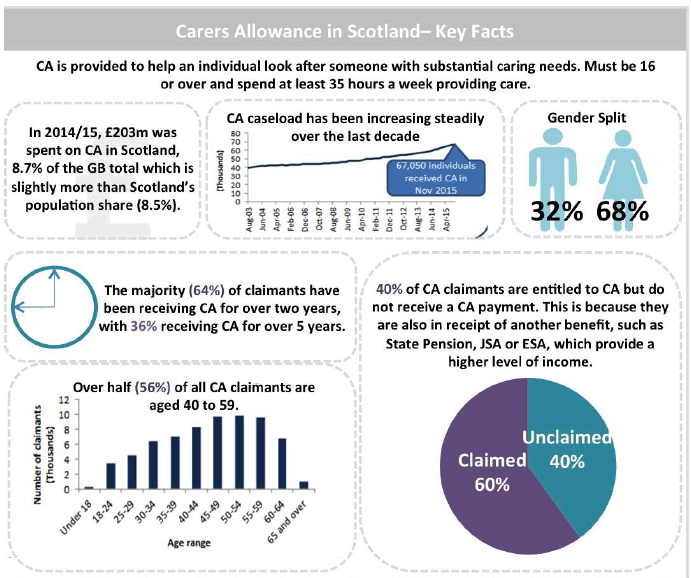
    If you live in Scotland, Carers Allowance Scotland now operates as Carer Support Payment. The Scottish Government replaced the DWP benefit with Carer Support Payment, which Social Security Scotland now manages across the country.

    If you already receive Carer’s Allowance from the DWP and live in Scotland, you usually do not need to reapply. Social Security Scotland transfers your award to Carer Support Payment automatically. You cannot receive both at the same time.

    If you live in England, Wales, or Northern Ireland, you still claim through Gov UK Carer’s Allowance instead.

    This guide explains who qualifies, how much you can get, how work affects your claim, and how to apply for Carer Support Payment in 2025/2026.

    How much is Carer’s Allowance in 2025/2026?

    If you’re asking “how much is Carer’s Allowance UK?”, the weekly rate for 2025/2026 is:

    BenefitWeekly rate
    Carer’s Allowance (England, Wales, NI)£83.30 per week
    Carer Support Payment (Scotland)£83.30 per week

    So if you live in Scotland, Carer Support Payment currently matches the standard Carer’s Allowance rate.

    Many carers search for “how much is carers allowance” or “carers allowance rate 2025”, and the answer is the same weekly amount unless the government announces an uprating.

    How you’re paid

    • In Scotland, Social Security Scotland normally pays you every 4 weeks in arrears.
    • If you transferred from DWP Carer’s Allowance, you may keep a weekly payment schedule depending on your circumstances.
    • Outside Scotland, you can usually choose weekly or 4-weekly payments under Gov UK Carer’s Allowance.

    If you receive other benefits, the payment structure can affect your overall income, especially if you also claim Universal Credit carer element, which we’ll explain shortly.

    RELATED: RQIA Registration for Domiciliary Care Agency in Northern Ireland (2026)

    Who can claim? The rules for claiming Carer’s Allowance (and Carer Support Payment)

    Domiciliary Care vs Supported Living CQC Registration: Which Route Is Easier in 2026

    Before you apply, check the core rules for claiming Carer’s Allowance or Carer Support Payment. You must meet all of the following:

    You must provide enough care

    • You care for someone at least 35 hours a week.
    • You do not need to live with them.
    • You do not need to be related to them.

    The person you care for must receive a qualifying benefit

    They must receive a disability benefit such as:

    • Personal Independence Payment (PIP) daily living component
    • Disability Living Allowance (middle or highest care rate)
    • Attendance Allowance
    • Or certain other qualifying benefits

    Only one person can usually claim for caring for the same individual.

    You must meet age and residence rules

    • You must be 16 or over.
    • You must live in the UK (with specific rules for Scotland under Carer Support Payment).

    Is Carer’s Allowance means tested?

    Many carers ask: “Is carers allowance means tested?”

    It is not means tested in the traditional way; your savings do not affect it. However, your earnings do matter, and you must stay below the weekly earnings limit after allowed deductions. We’ll break that down clearly in the next section.

    If you’re unsure whether you qualify, especially if you work part time or receive other benefits, review the work and Universal Credit sections carefully before you apply.

    Carer’s Allowance and part-time work: how the earnings limit works

    You can work and still claim, but you must stay within the weekly earnings limit.

    For 2026, you must not earn more than £196 per week after certain deductions. Many carers search for “carers allowance part time work” because this rule causes the most confusion.

    What counts as earnings?

    Your earnings include:

    Before the government applies the £196 limit, it allows certain deductions, including:

    • Income tax
    • National Insurance
    • Half of your pension contributions
    • Some work-related expenses (for example, care costs while you work)

    If your earnings go even slightly above the limit in a week, you can lose entitlement for that period. That’s why tracking your income carefully matters.

    What if your hours or pay change?

    If your earnings fluctuate:

    • Keep copies of payslips.
    • Tell the relevant authority quickly (DWP for Gov UK Carer’s Allowance, Social Security Scotland for Carer Support Payment).
    • Do not wait until the end of the year; overpayments can build up.

    Working part time does not automatically disqualify you. Many carers successfully combine part-time work with their benefit, but you must manage your weekly earnings carefully.

    READ MORE: When Does Child Benefit Stop in the UK? (2026 Guide)

    Universal Credit carer element: how it works with Carer’s Allowance

    Care Allowance in Scotland 2026
    Care Allowance in Scotland 2026

    If you claim Universal Credit, you may also qualify for the universal credit carer element. This is an extra monthly amount added to your Universal Credit award if you care for someone at least 35 hours a week.

    Many carers search for:

    • carers element universal credit
    • universal credit carers element
    • carer element
    • how to apply for carers element of universal credit

    Here’s what you need to know.

    You do not need to receive Carer’s Allowance to get the carer element

    You can qualify for the carer element even if you do not receive Carer’s Allowance, as long as:

    • You provide at least 35 hours of care per week, and
    • The person you care for receives a qualifying disability benefit.

    How it interacts with Carer’s Allowance

    If you receive both:

    • Carer’s Allowance counts as income for Universal Credit.
    • Universal Credit reduces by the same amount.
    • However, you still receive the separate carer element within Universal Credit.

    This means many carers are not “double paid,” but they still benefit from the additional element.

    How to apply for carers element of Universal Credit

    You do not submit a separate paper form. Instead:

    1. Log into your Universal Credit account.
    2. Report that you care for someone 35+ hours per week.
    3. Provide details about the person you care for and their disability benefit.
    4. Keep your journal updated if your caring hours change.

    Always report changes promptly. Delays can lead to overpayments or missed entitlements.

    Is Carer’s Allowance taxable?

    Yes, Carer’s Allowance is taxable if your total annual income goes above the Personal Allowance.

    Many carers search “is carers allowance taxable” because the payment feels like support rather than earnings. However, HMRC treats it as taxable income.

    When do you actually pay tax?

    You only pay tax if:

    • Your total income (wages, pension, benefits, etc.) exceeds the yearly Personal Allowance.
    • The combined amount pushes you into a taxable band.

    If Carer’s Allowance (or Carer Support Payment in Scotland) is your only income, you will usually not pay tax because it sits below the Personal Allowance threshold.

    If you work part time or receive a pension, your tax position can change. In those cases:

    • Check your tax code.
    • Review your total annual income.
    • Contact HMRC if something looks incorrect.

    Remember: being taxable does not automatically mean you will owe tax. It depends on your overall income for the year.

    Can I claim Carer’s Allowance for myself?

    Short answer: No.

    You cannot claim Carer’s Allowance (or Carer Support Payment in Scotland) for caring for yourself. You claim it because you care for someone else who receives a qualifying disability benefit.

    Many people search:

    • Can I claim carers allowance for myself?
    • Can I claim carers allowance for myself on PIP?

    Here’s where the confusion comes from.

    PIP is for the disabled person, not the carer

    If you receive Personal Independence Payment (PIP) yourself, that does not make you eligible to claim Carer’s Allowance for your own condition.

    However:

    • If someone else cares for you for at least 35 hours a week,
    • And you receive the daily living component of PIP (or another qualifying benefit),

    Then they may be able to claim Carer’s Allowance or Carer Support Payment for caring for you.

    You can claim even if you are disabled yourself

    If you have your own health condition but still provide 35+ hours of care to someone else, you may qualify as long as you meet the earnings and eligibility rules.

    The key rule stays the same: You must care for another person who receives a qualifying disability benefit.

    SEE ALSO: Home Reversion Plan 2026: How It Works, Costs, Risks, Examples

    Carer’s Allowance Supplement in Scotland (and what changes in 2026)

    Carers Allowance Scotland
    Carers Allowance Scotland

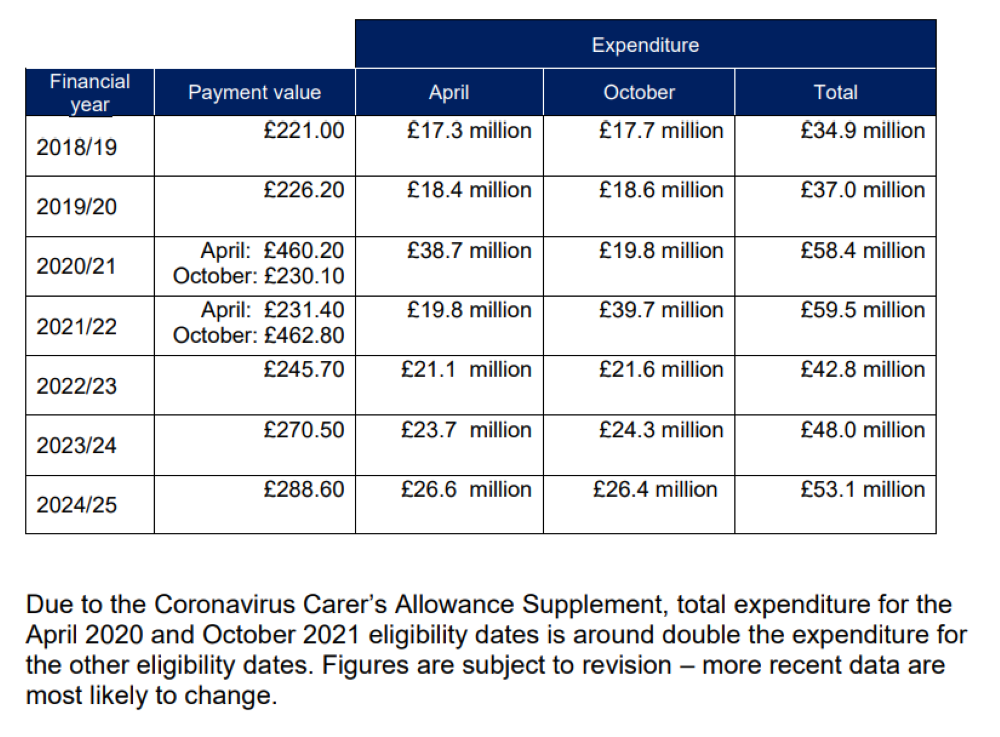
    If you live in Scotland and receive Carer Support Payment, you may also qualify for the Carer’s Allowance Supplement.

    This extra payment increases the overall value of support for carers in Scotland. The government pays it automatically; you do not need to submit a separate application.

    How it currently works

    • It is paid twice a year (traditionally in June and December).
    • You receive it automatically if you qualify on the set eligibility dates.
    • You do not need to apply separately.

    What changes from March 2026?

    From March 2026, Scotland plans to replace the twice-yearly Carer’s Allowance Supplement with a more regular payment structure (often referred to as the Scottish Carer Supplement).

    This change aims to:

    • Spread support more evenly through the year.
    • Make payments more predictable.
    • Align more closely with Scotland’s devolved social security system.

    If you already receive Carer Support Payment, the transition should happen automatically. Always check official updates from Social Security Scotland to confirm current payment arrangements.

    Apply for Carer Support Payment: step-by-step

    If you live in Scotland and do not already receive Carer’s Allowance, you need to apply for Carer Support Payment through Social Security Scotland.

    Follow these steps to apply confidently.

    1. Check your eligibility first

    Before you start your application, make sure:

    • You provide at least 35 hours of care per week.
    • The person you care for receives a qualifying disability benefit.
    • Your weekly earnings stay below the limit after deductions.

    If you are unsure, review the rules section above before submitting your claim.

    2. Gather the information you’ll need

    Have these ready:

    • Your National Insurance number
    • Bank account details
    • Details about the person you care for
    • Information about your work and earnings (if you work)

    Preparing this in advance prevents delays.

    3. Submit your application

    You can apply:

    • Online through the official Social Security Scotland website
    • By phone
    • By requesting and submitting a paper form

    Most carers choose the online route because it’s faster and easier to track.

    4. After you apply

    Social Security Scotland will:

    • Review your information
    • Contact you if they need more details
    • Confirm their decision in writing

    If they approve your claim, they will tell you:

    • Your payment amount
    • Your payment schedule
    • When your first payment will arrive

    If you previously received Gov UK Carer’s Allowance and moved to Scotland, your claim may transfer automatically. If you move into Scotland from another part of the UK, you usually need to make a new claim.

    MORE: What Are the 5 Stages of Palliative Care? 2026 Update

    Can I check my Carer’s Allowance online?

    Yes, but how you check it depends on where you live.

    Many carers search “Can I check my carers allowance online?” because they want quick updates without calling.

    If you live in Scotland

    If you receive Carer Support Payment, you manage your claim through Social Security Scotland.

    You can:

    • Check correspondence and updates online (if you applied digitally)
    • Contact Social Security Scotland directly by phone if you need clarification
    • Report changes in your circumstances (for example, changes in work or caring hours)

    Always report changes as soon as possible to avoid overpayments.

    If you live in England, Wales or Northern Ireland

    If you receive Gov UK Carer’s Allowance, you can:

    • Sign in to your government account
    • Report a change in circumstances
    • Check payment dates
    • Update personal details

    If you cannot access your online account, you can contact the Carer’s Allowance Unit by phone.

    Keeping your details up to date protects your payments and prevents unexpected repayment demands later.

    Carer’s Allowance Scotland vs the rest of the UK: what’s different?

    If you’re confused about whether to claim through Scotland or through Gov UK Carer’s Allowance, this quick breakdown will help.

    If you live in Scotland

    • You claim Carer Support Payment, not DWP Carer’s Allowance.
    • Social Security Scotland manages your claim.
    • You may receive the Carer’s Allowance Supplement (or its replacement from March 2026).
    • If you previously received DWP Carer’s Allowance while living in Scotland, your claim usually transfers automatically.

    If you live in England, Wales or Northern Ireland

    • You claim through Gov UK Carer’s Allowance.
    • The Department for Work and Pensions (DWP) manages your claim.
    • Scotland-only supplements do not apply.

    If you move between Scotland and the rest of the UK

    You must report your move immediately.

    • Moving into Scotland:

    Your DWP Carer’s Allowance will stop after a transition period. You must apply for Carer Support Payment as soon as possible to avoid gaps in payment.

    • Moving out of Scotland:

    You must report the move to Social Security Scotland and apply for Gov UK Carer’s Allowance.

    Your benefit does not automatically continue across borders without action.

    Final thoughts…

    If you live in Scotland, Carer’s Allowance Scotland now operates as Carer Support Payment. The weekly rate currently sits at £83.30; the 35-hour care rule still applies, and your earnings must stay below the weekly limit after deductions.

    If you claim Universal Credit, check whether you qualify for the universal credit carer element. If you work part time, track your weekly income carefully. If you move across UK borders, report it immediately and apply under the correct system.

    Small mistakes, missing a change in earnings, misunderstanding the transfer from Gov UK Carer’s Allowance, or assuming you can claim for yourself, can trigger overpayments or payment gaps.

    When you care for someone else, you should not have to guess your own financial position.

    Supporting UK Carers Through Benefit & Care Transitions?

    If you searched “carers allowance scotland,” “how much is carers allowance,” “apply for carer support payment,” “carers allowance part time work,” “universal credit carer element,” or “is carers allowance taxable,” you are likely managing financial pressure while providing real, hands-on care.

    Clear, accurate guidance matters. Misunderstanding earnings limits, reporting changes late, or confusing Carer Support Payment with Gov UK Carer’s Allowance can lead to overpayments, repayment demands, or avoidable stress.

    Care Sync Experts supports carers and regulated care providers across the UK with:

    • Clear interpretation of Scotland and DWP benefit rules
    • Structured compliance guidance aligned with GOV.UK and Social Security Scotland frameworks
    • Practical support on reporting obligations and documentation standards
    • Financial clarity around earnings limits and Universal Credit interaction
    • Governance advice for domiciliary and supported living providers supporting unpaid carers
    • Policy development for organisations delivering structured carer support
    • Tender-writing and compliance support for services assisting carers and families
    • Inspection-readiness frameworks for providers delivering regulated care

    Whether you are managing your own claim or leading a regulated care service supporting unpaid carers, we help you replace confusion with clarity and structured compliance.

    Get in touch with Care Sync Experts today and ensure your benefit position remains accurate, compliant, and financially secure.

    FAQ

    How long is Carer’s Allowance taking to process in 2025?

    Processing times vary depending on your circumstances and whether the authority needs additional information.

    In straightforward cases:
    Carer Support Payment (Scotland) decisions often take several weeks after you submit a complete application.
    Gov UK Carer’s Allowance claims typically take a few weeks as well, but delays can occur if eligibility checks are complex.

    Applications may take longer if:
    – The person you care for has only recently been awarded a qualifying disability benefit.
    – Your earnings require verification.
    – You recently moved between Scotland and another UK nation.
    – You can reduce delays by:
    – Providing full details about the person you care for.
    – Submitting accurate earnings information.
    – Responding quickly to follow-up requests.

    What stops you from getting Carer’s Allowance?

    Several situations can stop or prevent entitlement:
    – You earn more than the weekly earnings limit.
    – You provide fewer than 35 hours of care per week.
    – The person you care for stops receiving a qualifying disability benefit.
    – Someone else successfully claims for caring for the same person.
    – You move between Scotland and the rest of the UK and fail to apply under the correct system.
    – You enter full-time education (in most cases).
    – Reporting changes quickly protects you from overpayments and repayment demands.

    Who pays for carers in Scotland?

    If you receive financial support as a carer in Scotland:
    – Social Security Scotland pays Carer Support Payment.
    – The Scottish Government funds additional support such as the Carer’s Allowance Supplement (or its replacement structure from 2026).

    If you receive Universal Credit, the Department for Work and Pensions (DWP) pays the Universal Credit award, including any carer element.

    Separate from benefits, local authorities may fund formal care services for the person you support, but that funding does not replace Carer Support Payment.

    What benefits can I claim as a carer in Scotland?

    As a carer in Scotland, you may be eligible for:
    – Carer Support Payment
    – The Scotland-only Carer’s Allowance Supplement (or its replacement from 2026)
    – The Universal Credit carer element
    – National Insurance credits
    – Council Tax Reduction (depending on income)
    – Pension Credit (if you are over State Pension age)
    – Carer’s Credit (if you provide at least 20 hours of care but do not qualify for Carer Support Payment)

    Your eligibility depends on your income, caring hours, and household circumstances. Many carers qualify for more than one form of support.