CQC stands for the Care Quality Commission, the independent body that regulates health and adult social care services in England. If you provide regulated care without CQC registration, you break the law.
When people ask what does CQC stand for, or what is CQC in the UK, the answer needs precision. The CQC does not regulate the whole United Kingdom. It regulates England only. Scotland, Wales, and Northern Ireland each use different regulators, which we will clearly explain later in this guide.
The Care Quality Commission exists to protect people who use care services. It does this by registering providers, monitoring services, carrying out inspections, rating performance, and enforcing standards where care falls short. Every NHS service, private care provider, and voluntary organisation delivering regulated care in England must answer to the CQC.
This guide explains, in plain language, what the Care Quality Commission is, what it does, and why it matters, especially if you run, manage, or plan to start a care service in England.
What Is the Care Quality Commission?
The Care Quality Commission is the independent regulator that oversees health and adult social care services in England. It exists to make sure care providers deliver services that are safe, effective, compassionate, and well-led.
Before the CQC was created, multiple organisations regulated different parts of health and social care. This fragmented system made oversight inconsistent and harder to enforce. The government established the Commission in 2009 to create one clear authority responsible for regulating care across England under the Health and Social Care Act 2008.
Many people still confuse the name and ask whether it is the quality care commission UK or part of the NHS. The answer is simple: the CQC operates independently. It works alongside the NHS but does not run NHS services. Instead, it regulates NHS providers in the same way it regulates private and voluntary care organisations. This independence allows it to inspect services objectively and take enforcement action when standards fall below the law.
If you are asking what is CQC in the UK, the most accurate definition is this: the CQC is the body that decides who can legally provide care in England and whether that care meets national standards. Without its oversight, there would be no consistent way to protect people who rely on care services.
Understanding why the CQC exists matters because everything else, registration, inspections, ratings, enforcement, and public reports, flows directly from this purpose.
What Is the Role of the Care Quality Commission?
When people ask what is the role of the Care Quality Commission, they are really asking how the CQC controls who delivers care in England and how it protects people who rely on those services.
The Care Quality Commission does not provide care. It regulates care. Its role focuses on setting expectations, checking performance, and acting when care providers fall below the law.
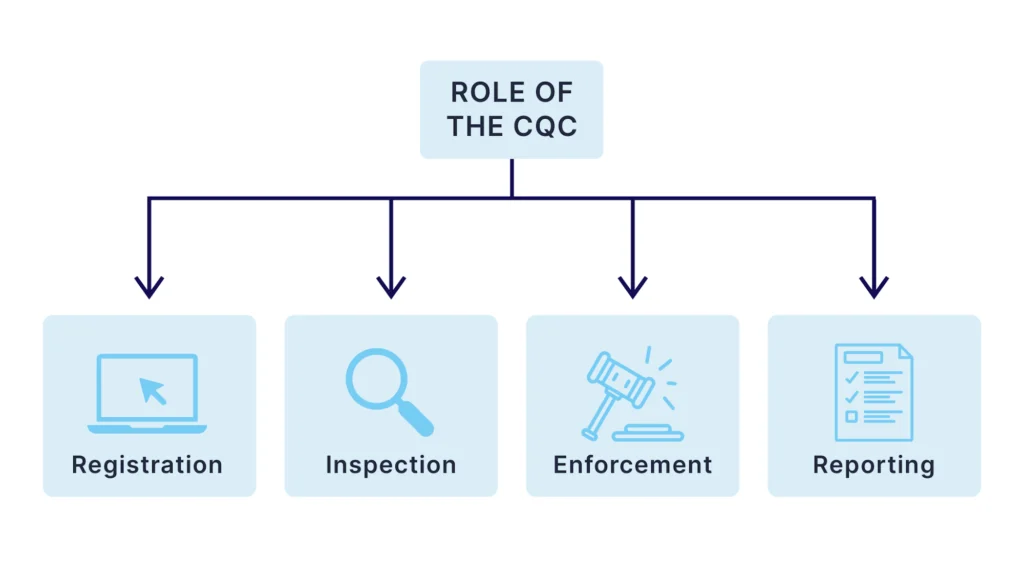
At a practical level, the CQC responsibilities fall into six core areas:
1. Registering care providers
The CQC decides who can legally deliver regulated health and adult social care services in England. Any organisation or individual that wants to provide regulated care must apply for registration and prove they can meet legal requirements before they start operating.
2. Monitoring services using data
Once a provider is registered, the CQC continuously monitors it. The Commission uses data from multiple sources, including safeguarding alerts, complaints, staffing information, and partner organisations, to identify potential risks to people using care services.
3. Inspecting care services
The CQC carries out inspections to check whether services meet required standards. Inspectors assess how services operate in practice, not just what policies say on paper. These inspections may be announced or unannounced, depending on the type of service and level of risk.
4. Rating performance
After inspections, the CQC rates services to show how well they perform. These ratings help the public, commissioners, and care professionals understand whether a service delivers safe and high-quality care.
5. Taking enforcement action
If a service fails to meet legal standards, the CQC can take enforcement action. This can include warning notices, restrictions on services, fines, or cancelling registration altogether.
6. Publishing findings for the public
Transparency sits at the centre of the CQC’s role. The Commission publishes inspection reports and ratings so people can make informed decisions about their care and so providers remain accountable for the quality of their services.
In short, the role of the Care Quality Commission is to protect people, improve care quality, and hold providers to account. Every inspection, rating, and enforcement decision serves that purpose.
What Does the CQC Regulate in England?
The Care Quality Commission regulates regulated health and adult social care services in England only. If a service delivers care that falls under the Health and Social Care Act 2008, the CQC has the legal authority to oversee it.
People often ask what are CQC or refer to CQCs as if they are multiple organisations. In reality, there is one CQC, but it regulates thousands of different care services and providers across England.
Health services regulated by the CQC
The CQC regulates healthcare services for people of all ages, including:
- NHS hospitals and NHS trusts
- Independent hospitals and clinics
- GP practices
- Dental practices
- Ambulance services
- Community health services
- Mental health services
This includes both NHS and privately operated healthcare providers.
Adult social care services regulated by the CQC
The CQC also regulates adult social care services, including:
- Residential care homes
- Nursing homes
- Domiciliary care agencies (home care)
- Supported living services
- Extra care housing
- Shared Lives schemes
Any organisation providing personal care or nursing care as a regulated activity must register with the CQC before operating.
Services covered under the Mental Health Act
The CQC has additional responsibilities for services where people’s rights are restricted under the Mental Health Act. This includes monitoring how services apply legal safeguards and protect the rights of people receiving care.
Children and young people’s services
The CQC regulates certain health and care services for children and young people, particularly where medical treatment or regulated care activities take place in registered settings.
What the CQC does not regulate
The CQC does not regulate care services outside England. Care providers in Scotland, Wales, and Northern Ireland must register with different regulators, which we will cover later in this guide.
In simple terms, if a service delivers regulated care in England, the CQC decides whether it can operate, how it performs, and whether it continues to meet the law.
What Are the 5 CQC Standards and How They Are Used
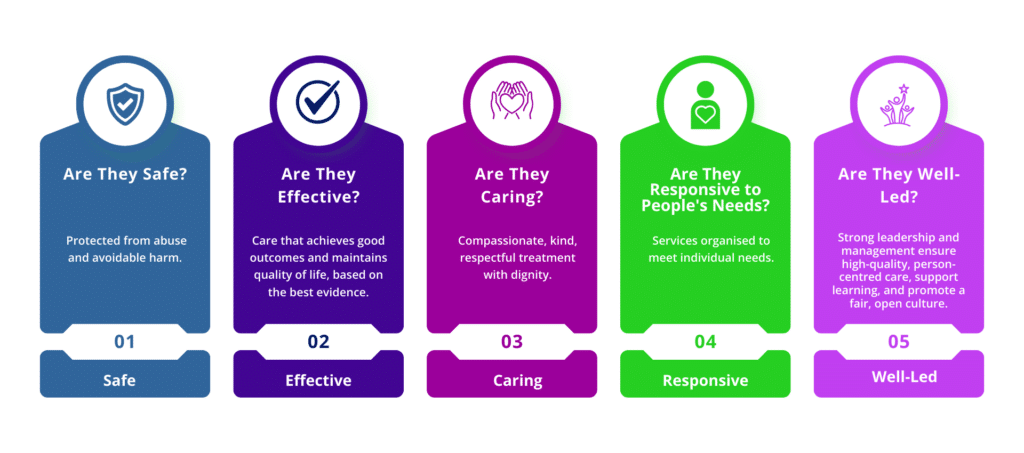
When people ask what are the 5 CQC standards, they are referring to the five key questions the CQC uses to judge whether a care service meets legal and quality expectations. These standards shape inspections, ratings, and enforcement decisions across England.
The CQC applies these standards consistently to every regulated service, from domiciliary care agencies to NHS hospitals.
1. Safe
A service must protect people from harm, abuse, and avoidable risks. This includes safe staffing levels, effective safeguarding, proper medicines management, and clear risk assessments. If a service fails on safety, the CQC treats it as a serious concern.
2. Effective
Care must achieve good outcomes and follow evidence-based practice. Services must assess needs properly, support people to maintain their health, and ensure staff have the right skills and training to deliver care effectively.
3. Caring
Staff must treat people with kindness, dignity, and respect. The CQC looks at how services involve people in decisions about their care and whether they support individual needs, preferences, and rights.
4. Responsive
Services must adapt to people’s needs rather than forcing people to fit the service. This includes timely access to care, handling complaints properly, and adjusting care plans as needs change.
5. Well-led
Strong leadership and governance underpin everything else. The CQC assesses whether leaders create a culture of openness, learning, and accountability, and whether systems exist to monitor quality and manage risk.
The CQC uses these five standards during inspections and ongoing monitoring. Inspectors gather evidence against each area and use it to decide a service’s rating. Providers that perform consistently well across all five areas receive higher ratings, while failures in one or more areas can trigger enforcement action.
Understanding these standards matters because they define what “good care” legally means in England. Every registration decision, inspection outcome, and rating links directly back to these five questions.
How CQC Inspections, Monitoring, and Ratings Work Today
The Care Quality Commission no longer relies on inspections alone to judge care quality. It now uses a continuous monitoring approach, supported by data, direct feedback, and targeted inspections. This shift allows the CQC to identify risks earlier and respond faster when care standards drop.
Ongoing monitoring and data use
The CQC collects information from multiple sources to understand how services perform between inspections. This includes:
- Safeguarding alerts
- Complaints from people using services
- Whistleblowing concerns
- Workforce data and staffing levels
- Information shared by partner organisations
This data-led approach helps the CQC decide when to inspect, what to inspect, and how urgently to act.
How inspections work
CQC inspections focus on what actually happens in practice. Inspectors observe care, speak with staff and service users, review records, and test governance systems. Depending on the service and level of risk, inspections may be announced or unannounced.
Inspectors assess services against the five CQC standards and gather evidence to support their findings. They do not rely on policies alone. They look for proof that systems work consistently and protect people every day.
How the CQC awards ratings
After an inspection, the CQC issues one of four ratings:
- Outstanding
- Good
- Requires Improvement
- Inadequate
These ratings reflect how well a service performs across safety, effectiveness, care quality, responsiveness, and leadership. The CQC publishes ratings and reports publicly so people can compare services and make informed choices.
Standards and regulations
The inspection and rating process links directly to the standards and regulations published on www.cqc.org.uk standards and regulations. These regulations define the legal expectations providers must meet and form the basis for enforcement when services fall short.
In short, the CQC combines continuous monitoring with targeted inspections to create a clearer, more accurate picture of care quality across England.
What Happens If a Care Provider Fails a CQC Inspection?
When a care provider fails a CQC inspection, the Care Quality Commission follows a formal enforcement pathway designed to protect people who use services and force rapid improvement. The process focuses on risk, not punishment, but the consequences can escalate quickly if a provider does not act.
Entering special measures
If inspectors rate a service as Inadequate, the CQC may place it into special measures. This status signals serious concerns about safety, quality, or leadership. The provider must address specific failings within a defined timeframe while the CQC increases its level of oversight.
Special measures are not optional. Providers must cooperate fully and show measurable improvement.
Improvement timelines and follow-up inspections
Once under special measures, providers usually have a limited window to improve. The CQC schedules follow-up inspections to test whether changes work in practice, not just on paper. Services rated Inadequate normally face re-inspection within 12 months, and often sooner when risks remain high.
Escalation and enforcement actions
If improvements do not happen fast enough, the CQC can escalate enforcement. This may include:
- Issuing warning notices with strict deadlines
- Placing conditions on registration
- Restricting certain services or activities
- Stopping new admissions
- Issuing fixed penalty notices
- Prosecuting serious breaches of regulations
Each action aims to reduce risk to people using the service.
Risk of registration cancellation
If a provider continues to fail and care remains unsafe or poorly led, the CQC can cancel registration. Registration cancellation legally prevents the provider from operating. This outcome represents the most serious enforcement step and typically follows repeated failures to improve.
Failing a CQC inspection does not automatically end a care service, but ignoring findings or delaying action significantly increases that risk. Providers that respond quickly, fix root causes, and demonstrate sustainable improvement give themselves the best chance to recover.
CQC Registered Providers Lists and Public Records
The Care Quality Commission maintains public records of every registered care service in England. These records help people choose care services and allow commissioners to assess provider quality and compliance.
CQC registered providers list
The CQC registered providers list shows all organisations and individuals legally allowed to deliver regulated care in England. Each entry includes:
- Provider name and locations
- Registration status
- Regulated activities
- Latest inspection ratings
- Published inspection reports
Care providers must keep their registration details accurate. Inaccurate or outdated information can raise concerns during monitoring or inspections.
CQC list of care homes
The CQC list of care homes allows the public to compare residential and nursing homes across England. Families, commissioners, and placement teams often rely on this list when making care decisions. Ratings, inspection history, and enforcement actions all appear in one place.
Why these records matter for providers
Public visibility creates accountability. Commissioners frequently check CQC records before awarding contracts or approving placements. A strong rating and a clean inspection history can improve credibility, while enforcement action or poor ratings can limit opportunities.
The CQC updates these records continuously. Providers should monitor their profiles regularly and respond promptly to inspection outcomes to ensure the information accurately reflects their service.
Who Regulates Care in Scotland, Wales, and Northern Ireland?
Care regulation in the UK is devolved, which means the Care Quality Commission does not regulate services outside England. Each nation operates its own independent regulatory bodies with similar responsibilities but different legal frameworks.
Scotland
In Scotland, the Care Inspectorate regulates most social care services. It inspects care homes, care at home services, and other social care providers. Healthcare services such as hospitals and hospices fall under a separate body, Healthcare Improvement Scotland.
Providers operating in Scotland must follow Scottish legislation and quality frameworks, which differ from CQC standards.
Wales
In Wales, regulation splits across two organisations:
- Care Inspectorate Wales (CIW) regulates social care and childcare services.
- Healthcare Inspectorate Wales (HIW) regulates NHS and independent healthcare services.
Care providers in Wales must register with CIW, not the CQC, even if they operate similar services to those in England.
Northern Ireland
In Northern Ireland, the Regulation and Quality Improvement Authority (RQIA) regulates both health and social care services. Its role closely mirrors the CQC’s responsibilities but applies only within Northern Ireland.
Why this distinction matters
Many providers operate across borders or plan to expand into other UK nations. Registration with the CQC does not transfer to Scotland, Wales, or Northern Ireland. Each regulator applies its own standards, inspection methods, and enforcement powers.
Understanding these differences helps care providers stay compliant, avoid registration delays, and plan expansion correctly.
What Does CQC Stand For in the Military? (Common Confusion Explained)
People often search what does CQC stand for military, especially when they see the term used outside health and social care. In a military context, CQC does not mean the Care Quality Commission.
In the military, CQC stands for Close Quarter Combat. The term describes tactical combat situations that take place at very short distances, such as room clearing or urban combat scenarios. It has no connection to healthcare regulation, inspections, or care services.
This confusion happens because the same acronym appears in two completely different fields. In the UK care sector, CQC always refers to the Care Quality Commission. In military or defence contexts, it refers to combat training and tactics.
If you are researching care regulation, inspections, or provider registration in England, the military meaning of CQC does not apply. Understanding this distinction helps avoid misinformation and ensures you rely on the correct guidance.
Why the CQC Matters for Care Providers, Tenders, and Contracts
For care providers in England, the Care Quality Commission does more than regulate services. CQC status directly affects whether a provider can grow, win contracts, and secure funding.
CQC compliance as a legal gateway
Before a provider can deliver regulated care, it must register with the CQC. Without registration, a service cannot legally operate. This requirement alone makes CQC compliance a non-negotiable starting point for any care business.
Impact on tenders and local authority contracts
Local authorities, NHS commissioners, and integrated care systems routinely check CQC records before awarding contracts. A provider’s rating, inspection history, and enforcement record influence procurement decisions.
In practice:
- Providers with Good or Outstanding ratings appear lower risk to commissioners.
- Providers rated Requires Improvement may face additional scrutiny.
- Providers rated Inadequate often struggle to win or retain contracts.
CQC evidence frequently appears in tender questions, including requests for inspection outcomes, quality assurance systems, and improvement plans.
Grant and funding eligibility
Many grants and improvement programmes in adult social care require providers to demonstrate regulatory compliance. Some schemes restrict funding to CQC-registered services or use inspection outcomes as part of eligibility checks. A poor compliance record can limit access to funding, even when a provider delivers essential services.
Reputation and public trust
CQC inspection reports and ratings remain publicly available. Families, placement teams, and partners use this information when choosing services. A strong CQC profile builds confidence and supports long-term sustainability, while repeated enforcement action damages trust.
Why understanding the CQC is essential
Understanding how the Care Quality Commission operates allows providers to prepare properly, respond to inspections effectively, and align governance systems with regulatory expectations. CQC compliance is not a paperwork exercise. It shapes how services operate, how they are perceived, and whether they can expand.
For care providers in England, the CQC sits at the centre of legal compliance, commercial opportunity, and public accountability.
Conclusion
Understanding what does CQC stand for goes far beyond knowing the name of a regulator. The Care Quality Commission shapes who can provide care, how care is delivered, and whether services can continue operating in England.
From registration and inspections to ratings and enforcement, the CQC influences every stage of a care provider’s journey. Its standards define what lawful, safe, and effective care looks like. Its reports shape public trust, commissioner confidence, and commercial opportunity. Its enforcement powers carry real legal and financial consequences.
For care providers, managers, and founders, treating CQC compliance as a one-off task creates risk. Providers that understand how the Care Quality Commission works, why it exists, and how it assesses services place themselves in a stronger position to:
- remain legally compliant,
- respond confidently to inspections,
- protect people who use services, and
- grow sustainably through contracts and funding opportunities.
In England’s regulated care sector, the CQC is not optional. It is the authority that defines quality, accountability, and trust. Knowing how it operates allows care providers to move from reactive compliance to informed, confident leadership.
Need clarity on CQC requirements and compliance in 2026?
Many care providers only discover compliance gaps after CQC registration delays, inspection concerns, or enforcement action has already begun. Unclear governance, incomplete evidence, or systems that look good on paper but fail in practice often lead to avoidable risk, stress, and lost opportunities.
Care Sync Experts supports care providers across England, Wales, and Northern Ireland to understand how regulators actually assess services, and how to prepare confidently for registration, inspection, tenders, and ongoing monitoring.
Support typically includes:
- Clear explanations of what the CQC and other regulators expect in practice, not just in guidance
- Practical support aligning governance, quality systems, and evidence with inspection standards
- Help preparing for registration, inspections, special measures, or enforcement reviews
- Guidance on using CQC outcomes to support tenders, contracts, and funding applications
- Independent, regulation-aligned advice grounded in current UK health and social care requirements
Book a free initial consultation
If you’re unsure whether your service would stand up to inspection today, whether your systems reflect real practice, or whether your CQC position could limit growth or funding, a short conversation now can prevent costly problems later.
This article reflects UK health and social care regulatory expectations and sector practice in 2026. Regulatory requirements may change, and outcomes depend on individual service circumstances. Providers should always refer to current guidance from the relevant regulator.
FAQ
Is CQC part of NHS England UK?
No. The Care Quality Commission is not part of NHS England.
The CQC operates as an independent regulator. It inspects and rates NHS services, but it does not manage, fund, or run them. This separation allows the CQC to assess NHS providers objectively and take enforcement action when standards fall below the law.
What is CQC registration in the UK?
CQC registration is the legal approval required to deliver regulated health or adult social care services in England.
Any organisation or individual providing regulated activities, such as personal care or nursing care, must register with the CQC before starting operations. The process checks whether the provider, managers, and systems can meet legal standards under the Health and Social Care Act 2008.
Who funds the CQC?
The CQC receives funding from two main sources:
– Fees paid by registered providers, which cover registration and ongoing regulation.
– Government funding, provided through the Department of Health and Social Care.
This mixed funding model supports the CQC’s independence while ensuring it can regulate services consistently across England.
How much does CQC cost?
CQC costs vary depending on the type, size, and risk profile of the service. Providers usually pay:
An application fee when registering
Annual fees to remain registered and regulated
Fees differ for care homes, domiciliary care agencies, GP practices, and hospitals. Larger or higher-risk services generally pay more due to increased regulatory oversight. The CQC publishes updated fee schedules annually, and providers must budget for these costs as part of operating legally.