The registered manager CQC interview questions you face will not only test what you remember from the regulations. They will test how well you can lead a care service in real life.
CQC wants to know whether you can protect people from harm, manage staff safely, handle concerns quickly, and keep the service aligned with its legal responsibilities.
For a care business, this interview matters because the registered manager sets the standard for safe care, staff accountability, record keeping, safeguarding, and continuous improvement.
Good answers should not sound rehearsed. They should show that you understand your service, your CQC Statement of Purpose, your staff team, your risks, and the people you support.
In this guide, we will cover practical registered manager interview questions and answers, including safeguarding, DBS checks, statutory notifications, the CQC Fundamental Standards, staffing, governance, and CQC interview questions for domiciliary care. You can use it to prepare stronger answers and identify gaps before the interview.

What Does the CQC Check in a Registered Manager Interview?
CQC checks whether you can manage a regulated care service safely, legally, and consistently. The interviewer wants to see that you are not just familiar with care regulations but ready to apply them every day.
From a care business standpoint, your answers must show that you can:
- Lead staff with confidence
- Protect people from abuse and avoidable harm
- Recruit safe and suitable care workers
- Keep accurate records
- Monitor care quality
- Respond to complaints and incidents
- Submit statutory notifications when required
- Keep the service within its CQC Statement of Purpose
- Improve the service when audits, feedback, or incidents reveal a weakness
The interview also checks whether you meet the “fit person” expectation. Strong CQC fit person interview questions and answers should prove that you have the character, competence, skills, and experience to manage the regulated activity.
CQC does not want vague answers like, “We follow our policy.” It wants to hear what you actually do. For example, explain how you check staff competence, how you review care plans, how you respond to safeguarding concerns, and how you make sure the CQC standards of care show up in daily practice.
RELATED: CQC Nominated Individual vs Registered Manager (2026): What You Need to Know?
Common Registered Manager CQC Interview Questions
Most registered manager CQC interview questions focus on how you lead the service, protect people, manage staff, and keep care safe.
The interviewer may ask about your experience, your legal duties, safeguarding, governance, complaints, DBS checks, training, and how your service meets the CQC Fundamental Standards.
Here are common areas to prepare for:
| Interview Topic | Example Question | What Your Answer Should Show |
| Fit person | Why are you suitable to be the registered manager? | You have the right character, skills, experience, and judgement. |
| Safeguarding | What would you do if someone reported abuse? | You act quickly, protect the person, escalate properly, and record clearly. |
| Statutory notifications | When must you notify CQC? | You understand your legal reporting duties. |
| Staffing | How do you check staff competence? | You recruit safely, use CQC DBS checks, supervise staff, and review training. |
| Governance | How do you monitor care quality? | You use audits, feedback, care reviews, and action plans. |
| Statement of Purpose | What is your service registered to provide? | You understand your regulated activities and service limits. |
| Complaints | How do you handle a family complaint? | You listen, investigate, respond, learn, and improve. |
Good CQC interview questions and answers should always include practical examples. Do not just say, “I make sure staff are trained.” Say how you check the training matrix, observe practice, review supervision notes, follow up gaps, and confirm that learning improves care.
Fit and Proper Person Questions
The CQC uses the interview to check whether you are fit to manage the regulated activity. This means you must show good character, sound judgement, relevant experience, and the ability to lead a safe care service.
Common CQC fit person interview questions and answers may cover:
- Why do you want to become the registered manager?
- What experience has prepared you for this role?
- How will you stay involved in day-to-day care quality?
- How do you handle pressure, risk, or poor performance?
- What would you do if you found that the service was not meeting regulations?
Your answer should connect your leadership style to real care outcomes. For example, you can explain how you support staff through supervision, check care records, monitor incidents, review complaints, and act when standards slip.
Avoid saying, “I am passionate about care” without proof. A stronger answer would show how your passion becomes action:
“I stay close to the service by reviewing care plans, speaking with staff and service users, checking incident trends, and following up action plans. If I find a risk, I do not wait for inspection pressure. I act, record what I have done, and check that the change has improved care.”
That kind of answer shows CQC that you do not only understand the role. You are ready to manage it.
READ MORE: Safe Medication Administration Guidelines UK: Best 2026 Guide
CQC Fundamental Standards and the 5 Key Questions
Your interview will likely test how well you understand the CQC Fundamental Standards and how you apply them in real care delivery. These are the basic standards below which care must never fall.
When preparing, do not only memorise the regulations. CQC wants to know how your service keeps people safe, treats them with dignity, gains consent, manages complaints, recruits suitable staff, and maintains strong governance.
You may hear questions such as:
- How does your service meet the fundamental standards CQC expects?
- What are the 5 CQC standards or key questions?
- How do you make sure care stays safe, effective, caring, responsive, and well-led?
- How do you evidence compliance during audits or inspections?
The CQC 5 key questions are:
- Is the service safe?
- Is the service effective?
- Is the service caring?
- Is the service responsive?
- Is the service well-led?
Some providers still refer to the CQC key lines of enquiry or Care Quality Commission key lines of enquiry, but CQC now places more focus on quality statements within its assessment framework. In your interview, show that you understand both the older language people recognise and the current direction of CQC assessment.
A strong answer might say:
“Our service meets the CQC standards of care by checking quality every week, not only before inspection. We review care plans, monitor incidents, complete audits, listen to service users, supervise staff, and update action plans when we find gaps. This helps us keep care safe, person-centred, and well-led.”
Safeguarding, Whistleblowing and Duty of Candour Questions
Safeguarding will almost always come up in registered manager CQC interview questions because CQC needs to know that you can protect people quickly when risk appears. As a registered manager, you must show that safeguarding is not just a policy in a folder. It must shape staff training, supervision, reporting, care planning, and daily decision-making.
You may hear questions such as:
- What would you do if a care worker reported abuse?
- How do you make sure staff understand safeguarding?
- How do you support whistleblowing?
- What would you do if a family member raised a serious concern?
- How do you apply duty of candour when something goes wrong?
A strong answer should follow a clear process: protect the person, listen carefully, record the facts, report to the right safeguarding authority, notify CQC where required, support the person involved, investigate properly, and take action to prevent the issue from happening again.
For whistleblowing, explain how you create a culture where staff can speak up without fear. Mention induction, CQC training, supervision, team meetings, anonymous reporting routes, and clear escalation procedures.
A good answer might sound like this:
“If a staff member reports abuse, I act immediately. I make sure the person is safe, record the concern clearly, report it through our safeguarding procedure, contact the local authority safeguarding team, and notify CQC if required. I also protect the staff member who raised the concern and make sure we investigate, learn, and improve practice.”
This shows CQC that you take safeguarding seriously and lead a service where people’s safety comes before reputation.
SEE ALSO: Setting Up Supported Living Business UK in 2026
Statutory Notifications and Serious Incidents
CQC will expect you to know when the service must submit a statutory notification. This is a legal duty, not an optional update. If a serious event affects a person using the service or the safe running of the business, the registered manager must make sure CQC receives the right information quickly.
You may hear questions such as:
- When must you notify CQC?
- What would you do after an unexpected death?
- What would you do if a service user suffered a serious injury?
- How would you respond if police attended an incident?
- How do you make sure staff report incidents to management quickly?
A strong answer should show control. Explain how you would make the person safe first, contact emergency services or safeguarding teams if needed, inform the provider, record the facts, submit the notification, investigate the cause, and update care plans or risk assessments.
For example:
“If a service user suffered a serious injury, I would make sure they received urgent medical support, secure the facts, inform the right people, and submit the required CQC notification. I would also investigate what happened, review the care plan and risk assessment, speak with staff, and take action to reduce the chance of it happening again.”
This tells CQC that you understand reporting duties, but also that you use incidents to improve care quality.
Staffing, DBS Checks and Training Questions
CQC will want to know how you recruit safe staff and keep them competent after they start work. A strong care business cannot rely on goodwill alone. It needs safe recruitment, proper induction, regular supervision, and clear action when staff performance drops.
You may hear questions such as:
- How do you check that a care worker is suitable before they start?
- How do you use CQC DBS checks during recruitment?
- How do you monitor staff competence after induction?
- What CQC training do your staff complete?
- How do you deal with poor performance?
- How do you make sure agency staff are safe to use?
A strong answer should mention identity checks, references, employment history, right-to-work checks, qualifications, DBS CQC expectations, induction, shadowing, competency checks, supervision, spot checks, appraisals, and ongoing training.
For domiciliary care, you should also explain how you check practice when staff work alone in people’s homes. This may include care note audits, medication record checks, client feedback, family feedback, spot checks, call monitoring, and direct observations.
A good answer might sound like this:
“I do not treat recruitment as a paperwork exercise. Before a care worker starts, we complete the required checks, including references, identity checks, right-to-work checks and DBS. After induction, we assess competence through shadowing, observations, supervision, spot checks and care record reviews. If we find a concern, we act quickly with extra training, closer supervision or formal performance action.”
This kind of answer shows CQC that your staff system protects people, not just your files.
MORE: What Qualifications Do You Need to Open a Care Home UK?
Statement of Purpose and Service-Specific Questions
CQC may ask about your CQC Statement of Purpose because it explains what your service is registered to do, who it supports, where it operates, and which regulated activities it provides. As a registered manager, you must know this document and make sure the business does not drift outside it.
You may hear questions such as:
- What does your Statement of Purpose say?
- Which regulated activities does your service provide?
- Who is your service designed to support?
- How do you make sure staff work within the Statement of Purpose?
- What would you do if the provider wanted to offer a new type of care?
A strong answer should connect the Statement of Purpose CQC expects with real business control. For example, if your service provides personal care in people’s homes, explain how your care planning, staff training, risk assessments, and quality checks all support that regulated activity.
A good answer might sound like this:
“Our Statement of Purpose guides what we provide, who we support, and how we run the service. I use it when reviewing referrals, assessing new care packages, planning staff training, and checking whether we have the right skills to meet people’s needs. If the provider wanted to add a new service, I would check whether it fits our registration, risks, staffing, competence, and CQC requirements before we accept that work.”
This shows CQC that you understand the business, not just the document.
CQC Interview Questions for Domiciliary Care
CQC interview questions for domiciliary care often focus on how you keep people safe when care workers support them in their own homes. Unlike a care home, you cannot watch every visit in person, so you must show CQC how you monitor quality from a distance and act quickly when something goes wrong.
You may hear questions such as:
- How do you prevent missed or late calls?
- How do you monitor care workers who work alone?
- How do you manage medication support in people’s homes?
- How do you check daily care notes and electronic records?
- How do you involve families while respecting consent and confidentiality?
- How do you manage travel time, handovers, and continuity of care?
- How do you respond when a service user’s needs change?
A strong answer should show that you use systems, not guesswork. Mention call monitoring, care plan reviews, spot checks, medication audits, staff observations, service user feedback, family communication, and clear escalation routes.
A good answer might sound like this:
“In domiciliary care, I cannot rely on trust alone. I use call monitoring, care note audits, medication checks, spot checks, supervision, and feedback from service users to monitor quality. If we identify a missed call, late visit, medication error, or change in need, we act quickly, record what happened, inform the right people, and update the care plan or risk assessment.”
This shows CQC that you understand the real risks in home care and have practical controls to manage them.
ALSO READ: Reg 44 Children’s Homes: 2026 Guide for Providers, Managers and Independent Visitors
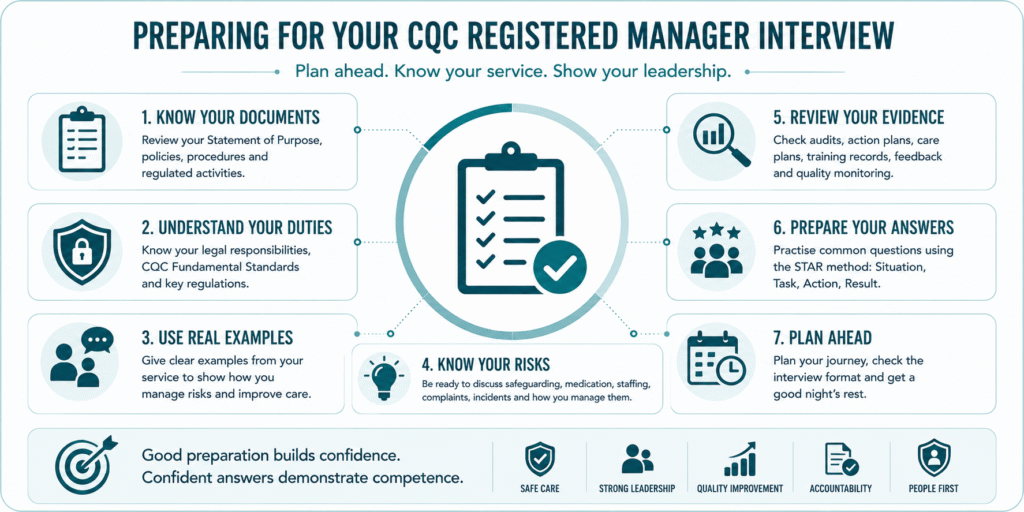
How to Prepare for Your CQC Registered Manager Interview
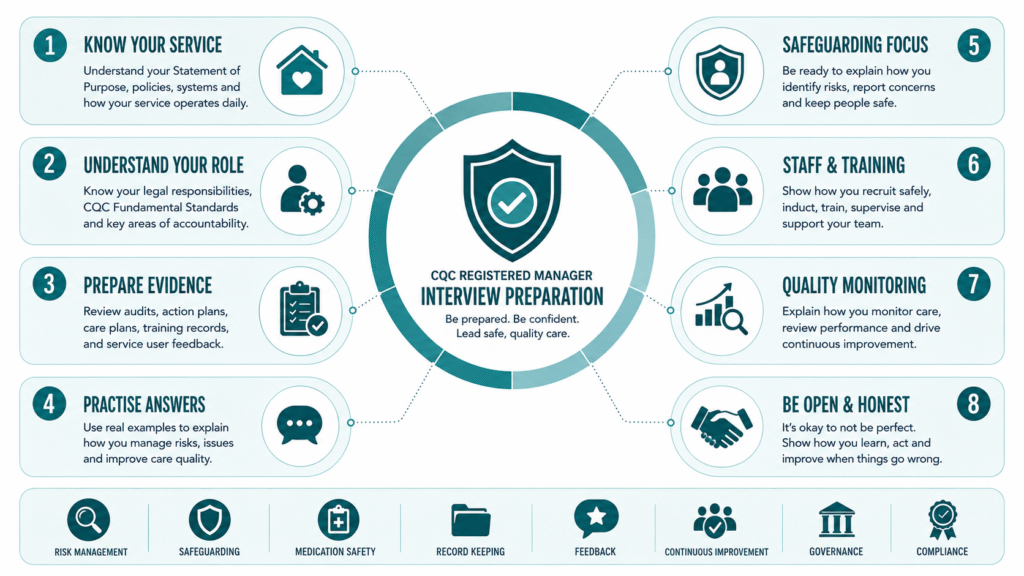
Good preparation helps you answer with evidence, not guesswork. Before the interview, review the documents and systems that show how your care business actually runs.
Use this simple CQC inspection checklist before the interview:
- Read your CQC application form again.
- Review your CQC Statement of Purpose and regulated activities.
- Check your safeguarding, complaints, whistleblowing, medication, recruitment, and incident policies.
- Review staff files, DBS CQC checks, references, induction records, and the training matrix.
- Prepare examples of how you manage poor performance, late calls, complaints, incidents, and safeguarding concerns.
- Review recent audits, action plans, care plan reviews, supervision notes, and service user feedback.
- Practise answering questions with real examples from your service.
Do not prepare by memorising perfect sentences. Prepare by understanding your systems. If CQC asks how you keep care safe, you should be able to point to your audits, training, spot checks, incident reviews, and quality improvement actions.
Some providers also use mock interviews, CQC courses, or CQC compliance consultants to identify gaps before the real interview. That support can help, but your strongest preparation will always come from knowing your service properly and being honest about how you manage risk.
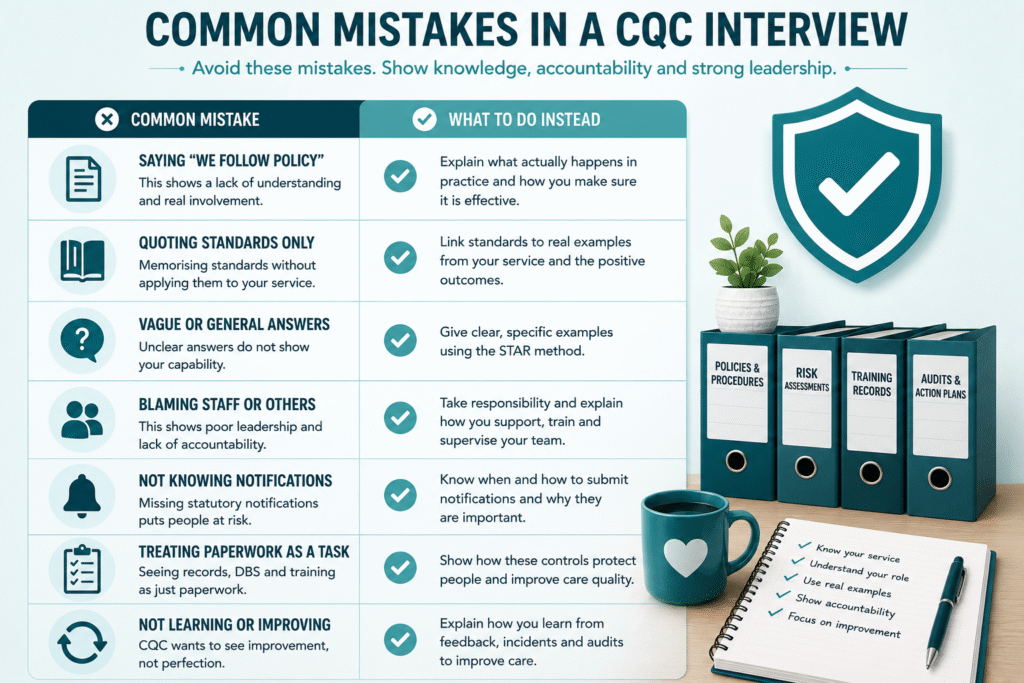
Mistakes That Make Registered Manager Answers Weak
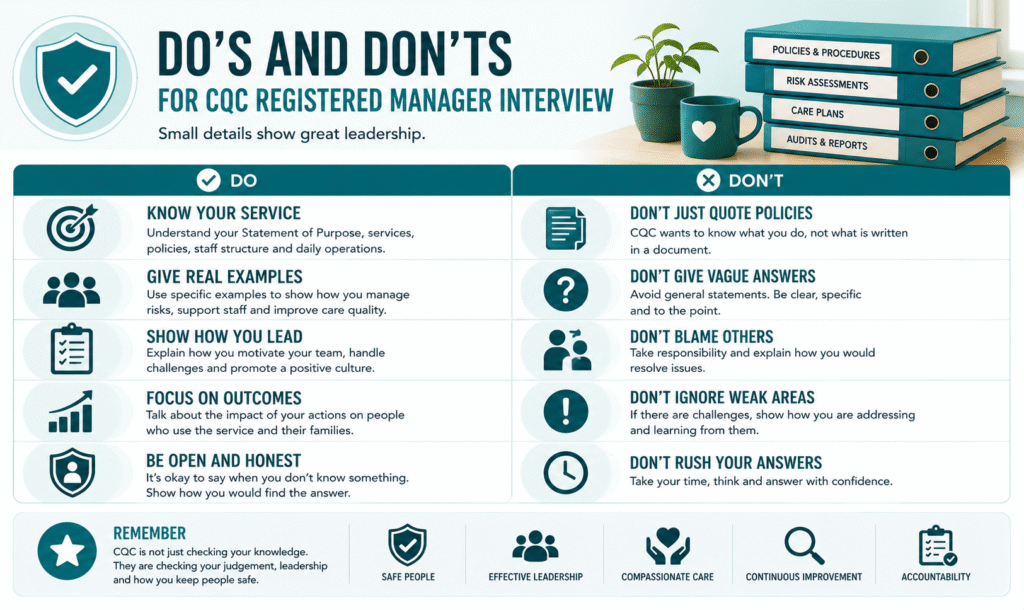
Many applicants fail to impress CQC because they answer like they are reading from a policy instead of leading a real care service. The interviewer wants clear evidence that you understand risk, people, staff, systems, and accountability.
Avoid these common mistakes:
- Saying “we follow policy” without explaining what you actually do
- Quoting the CQC Fundamental Standards without giving service examples
- Not knowing your CQC Statement of Purpose
- Giving vague safeguarding answers
- Forgetting when to submit statutory notifications
- Treating CQC DBS checks and training as paperwork instead of safety controls
- Using old CQC key lines of enquiry language without understanding the current quality statements
- Blaming staff without explaining how you supervise, train, and improve practice
- Giving answers that do not match your care business model
A stronger answer always links the rule to action. For example, do not just say, “We manage complaints properly.” Explain how you acknowledge the complaint, investigate it, speak with the person or family, record findings, share outcomes, and use lessons learned to improve care.
CQC does not expect you to pretend the service has no risks. It expects you to know the risks, manage them, and show how you improve when something goes wrong.
SEE MORE: Mock CQC Inspection: A Practical 2026 Checklist for Care Providers
When to Get Support Before the Interview
You may need extra support if the interview date is close, your evidence feels weak, or your team cannot confidently explain how the service meets CQC expectations. The earlier you identify gaps, the easier it becomes to fix them before CQC asks difficult questions.
Support can help if you need to:
- Prepare for registered manager interview questions and answers
- Practise free CQC interview questions and answers
- Review your CQC Fundamental Standards evidence
- Check your policies, audits, action plans, and training matrix
- Strengthen safeguarding, complaints, and statutory notification processes
- Prepare for CQC interview questions for domiciliary care
- Build confidence around governance, staffing, DBS checks, and quality assurance
This is where CQC compliance consultants can add value. A good consultant should not give you scripted answers to memorise. They should help you understand your service, test your evidence, identify weak areas, and practise clear answers that reflect how your care business actually operates.
If you want to prepare with more confidence, Care Sync Experts can help you review your evidence, practise interview answers, and strengthen your compliance systems before your CQC interview.
FAQ
Can you fail a CQC fit person interview?
Yes. CQC can refuse a registered manager application if the applicant does not show that they are fit to manage the regulated activity. This can happen if the applicant cannot explain their legal responsibilities, lacks the right skills or experience, gives weak safeguarding answers, or fails to show how they will keep the service safe and compliant.
If CQC has concerns, it may ask for more information, continue its assessment, or issue a notice explaining its proposed decision. The best way to prepare is to know your service, understand your evidence, and give clear examples of how you manage risk, staff, quality, and improvement.
How long does it take for CQC to respond after a registered manager application?
CQC says its registration assessment is thorough and can take a few months. After receiving your application, CQC may review the information, ask for more details, contact you to arrange an interview, and then send the decision by email. You cannot manage regulated activities as the registered manager until CQC confirms your registration.
Delays can happen if the application is incomplete, evidence is missing, DBS checks are not ready, or CQC needs more information about the provider, location, or regulated activity.
What is a red flag in a CQC registered manager interview?
A red flag is any answer that makes CQC doubt your ability to manage the service safely. Examples include not knowing your Statement of Purpose, giving vague safeguarding answers, blaming staff without explaining your management controls, ignoring statutory notifications, or saying “we follow policy” without showing how the policy works in practice.
Another red flag is pretending the service has no risks. Strong managers can identify risks, explain what they are doing about them, and show how they check whether improvements work.
What are five important things to remember during a CQC interview?
Remember these five things:
1. Answer with real examples from your service.
2. Connect every answer to safe, person-centred care.
3. Show how you monitor staff, records, risks, and quality.
4. Be honest about gaps, but explain your action plan.
5. Know your Statement of Purpose, regulated activities, safeguarding process, and statutory notification duties.
CQC does not expect a perfect speech. It expects a capable manager who understands the service and can lead safe care with confidence.