Category: Blog

Your blog category

  • Children’s DLA Rates: Who Qualifies, and What to Claim in 2026

    Children’s DLA Rates: Who Qualifies, and What to Claim in 2026

    Children’s DLA rates help cover the extra costs of caring for a child with a disability or long-term health condition. If your child is under 16 and needs significantly more care or supervision than other children their age, you may qualify for Disability Living Allowance (DLA).

    The amount you receive depends on the level of help your child needs with daily care or mobility. Current DLA child rates range from £29.20 to £187.45 per week, based on two components: care and mobility.

    Parents and caregivers often ask questions such as “how much is high rate DLA for a child?” or “how much is middle rate DLA for a child?” The exact rate depends on how much support your child requires during the day, at night, or when moving around.

    Many families use DLA to pay for:

    • extra supervision or care needs
    • transport or mobility support
    • specialist equipment or therapy
    • additional household costs linked to a disability

    If your child receives DLA, you may also qualify for other support, including Carer’s Allowance or the carer element in Universal Credit, depending on your situation.

    Get expert support for your next tender, inspection-ready policies, or CQC registration — book a call with Care Sync Experts today and let’s get you compliant and competitive.

    How much are children’s DLA rates in 2026?

    DBS Update Service for CQC Registration: The Rule That Catches Everyone

    The children’s DLA rates depend on how much extra help your child needs with daily care or mobility. Disability Living Allowance for children has two components:

    • Care component – for children who need extra supervision, help with daily activities, or support during the night.
    • Mobility component – for children who have difficulty walking or need guidance when moving around outdoors.

    Your child may qualify for one component or both, depending on their needs.

    Care component (weekly payments)

    Level of care neededWeekly amount
    Lowest rate£29.20
    Middle rate£73.90
    Highest rate£110.40

    Parents often ask “how much is middle rate DLA for a child?” or “how much is high rate DLA for a child?”. The answer depends on how much supervision or assistance your child needs throughout the day or night.

    • Lowest rate – for children who need help during part of the day.
    • Middle rate – for children who need frequent help during the day or supervision at night.
    • Highest rate – for children who need care or supervision both day and night, or who have a serious life-limiting condition.

    Mobility component (weekly payments)

    Mobility support neededWeekly amount
    Low rate mobility DLA child£29.20
    High rate mobility DLA£77.05

    The low rate mobility DLA applies when a child can walk but still needs guidance or supervision outdoors. The high rate mobility DLA applies when a child cannot walk, can only walk short distances without severe discomfort, or has a severe visual impairment.

    In official terms, this lower tier is also called disability living allowance lower rate mobility.

    Age rules apply to the mobility component:

    • Lower rate mobility usually applies from age 5.
    • Higher rate mobility can apply from age 3.

    If your child qualifies for the highest mobility rate, they may also become eligible for the Motability Scheme, which can help families access adapted vehicles.

    RELATED: Equality Act Protected Characteristics: 2026 Importance for Care Work

    Do autism or ADHD change the DLA rate?

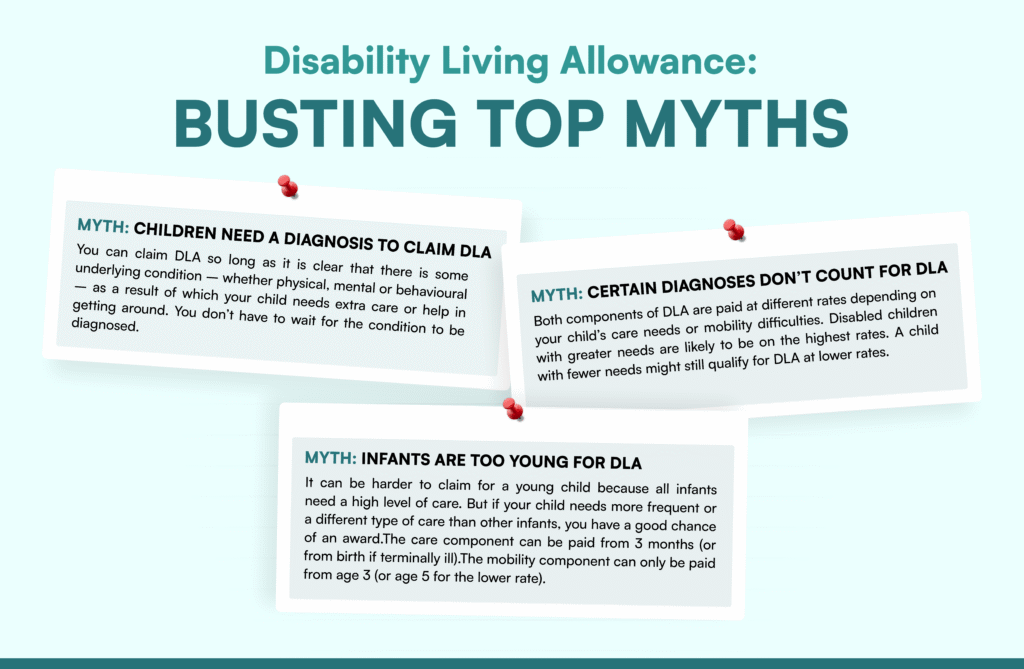
    Many parents search for DLA rates for child with autism, DLA rates for child with ADHD, or DLA rates for child with autism and ADHD. In practice, the diagnosis itself does not determine the amount of Disability Living Allowance a child receives.

    The Department for Work and Pensions looks at how much extra care, supervision, or mobility support your child needs, not the medical label attached to the condition.

    For example, two children with autism may receive different DLA child rates if their daily needs differ. One child might qualify for the middle care rate because they need frequent help during the day, while another child may qualify for the highest care rate if they require supervision both day and night.

    Decision-makers usually assess things such as:

    • how much extra supervision your child needs compared with other children the same age
    • whether your child needs help with personal care, communication, or safety
    • whether your child experiences mobility difficulties or needs guidance outdoors
    • whether their condition affects sleep, behaviour, or risk awareness

    Children with autism, ADHD, or a combination of both often qualify for DLA when they require significantly more supervision than other children of the same age. For instance, some children may need constant supervision outside because of limited danger awareness, while others may require structured support for daily routines.

    This is why DLA focuses on practical daily needs rather than diagnosis alone. When applying, it helps to describe clearly what support your child actually needs throughout the day and night, rather than only listing their medical conditions.

    Who can claim DLA for a child?
    childrens dla rates
    childrens dla rates

    You can claim Disability Living Allowance (DLA) for a child if you look after them as a parent and they meet the eligibility rules. This includes parents, step-parents, guardians, grandparents, foster parents, or older siblings who take on the main caring role.

    To qualify, your child must usually:

    • be under 16 years old
    • need much more care, supervision, or help moving around than other children the same age
    • live in England or Wales when the claim is made
    • have had these difficulties for at least 3 months and expect them to last for at least 6 months

    You can claim DLA whether you work or not, and your household income does not affect the benefit. The assessment focuses entirely on your child’s care and mobility needs.

    Living in different parts of the UK

    Where your child lives affects which benefit you apply for:

    • England and Wales: apply for Disability Living Allowance for children
    • Scotland: DLA for children has been replaced by Child Disability Payment
    • Northern Ireland: children still claim Disability Living Allowance, but the application process runs through the Northern Ireland system

    If your child lives in Scotland, you should apply for Child Disability Payment instead of DLA. This benefit provides similar support but is managed by Social Security Scotland.

    Living abroad or moving countries

    In some situations, you may still be able to claim if your child lives outside the UK temporarily, such as when:

    • your child receives medical treatment abroad
    • a parent works in the armed forces
    • your child lives in certain European countries under specific agreements

    However, most families must show that the child normally lives in England or Wales when applying.

    Who receives the payments?

    DLA payments usually go to the parent or caregiver responsible for the child. The money helps cover the additional costs of caring for a child with a disability, such as supervision, transport, specialist equipment, or extra support services.

    READ MORE: UK Cost of Living Payment Eligibility (2026): What Caregivers and Families Need to Know

    Is there a DLA points scoring system for children?

    Many parents search for a “DLA points scoring system child”, especially if they have heard about the points-based system used for Personal Independence Payment (PIP). However, DLA for children does not use a public points system.

    Instead, decision-makers look at how your child’s condition affects their daily life compared with other children the same age. The Department for Work and Pensions reviews the information you provide in the claim form and decides whether your child qualifies for the care component, the mobility component, or both.

    What the DLA decision is based on

    When reviewing a claim, assessors usually focus on:

    • how much extra supervision your child needs during the day
    • whether your child needs help with personal care tasks, such as eating, dressing, or washing
    • whether someone must watch over them for safety, especially outdoors
    • whether your child needs help moving around or guidance when walking
    • whether their condition affects sleep or night-time care

    The key question is whether your child needs significantly more support than another child of the same age.

    Evidence that can strengthen a claim

    You do not need to prove your child’s condition using points. Instead, it helps to explain clearly how their needs affect everyday life. Useful evidence can include:

    • reports from doctors, therapists, or specialists
    • letters from schools or support workers
    • care plans or therapy plans
    • examples of supervision or support your child needs during the day and night

    Parents often improve their chances by focusing on real daily challenges, rather than just listing the child’s diagnosis.

    SEE ALSO: PIP Contact Number: Number for PIP Payment and Enquiries (2026)

    My child gets DLA: what else am I entitled to?
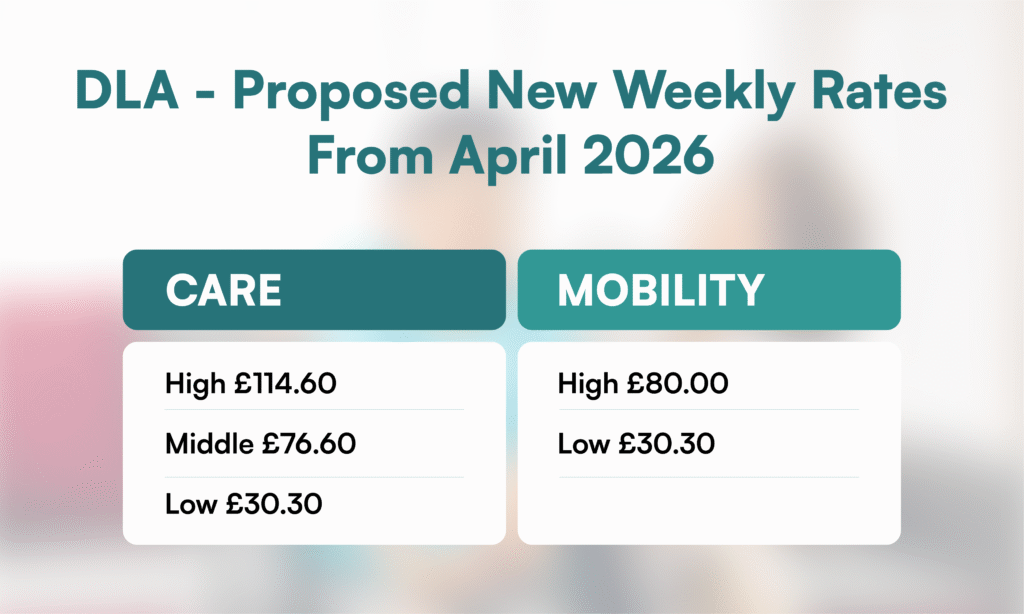
    DLA – Proposed New Rates (April 2026)

    Many parents ask “my child gets DLA, what else am I entitled to?” because Disability Living Allowance can unlock other types of support for families caring for a disabled child.

    If your child receives middle or highest rate care, you may qualify for additional financial help and support services.

    Carer’s Allowance

    You may be able to claim Carer’s Allowance if:

    • you care for your child for at least 35 hours per week
    • your child receives middle or highest rate care component
    • you meet the income and eligibility rules

    Some families receiving Universal Credit may instead qualify for the carer element, which increases their monthly payment if they provide regular care.

    Motability Scheme

    If your child receives the high rate mobility DLA, you may be able to access the Motability Scheme. This allows families to lease a vehicle, scooter, or powered wheelchair using the mobility component of the benefit.

    Many caregivers use this option to make transport easier for school, medical appointments, or daily activities.

    Other support your family may qualify for

    Depending on your situation, DLA may also help you access:

    • extra Universal Credit support for disabled children
    • free school meals or additional school support
    • council tax reductions
    • grants from charities supporting disabled children

    Because every family’s situation differs, it is worth checking which additional support you can claim once your child’s DLA child rates are approved.

    Child Disability Payment in Scotland and DLA in Northern Ireland

    The benefit you apply for depends on where your child lives in the UK. While Disability Living Allowance (DLA) still applies to children in England, Wales, and Northern Ireland, Scotland now uses a different system.

    Scotland: Child Disability Payment

    If your child lives in Scotland, you cannot apply for DLA. Instead, you must apply for Child Disability Payment, which replaced disability living allowance Scotland (DLA Scotland) for children.

    Child Disability Payment works in a similar way to DLA and also includes:

    • a care component
    • a mobility component

    The amount your child receives still depends on how much help they need with daily care or mobility, rather than the specific diagnosis.

    Northern Ireland: DLA for children

    Children living in Northern Ireland can still claim Disability Living Allowance for children through the Northern Ireland system.

    The eligibility rules and DLA child rates are broadly similar to those used in England and Wales, but the claim process and support services operate through Northern Ireland departments.

    Families in Northern Ireland can contact the Disability and Carers Service for help with claims. Many parents search for the DLA Northern Ireland telephone number when starting an application or asking about their claim.

    Because the application routes differ slightly across the UK, it’s important to make sure you apply through the correct system for your child’s location.

    MORE: Labour Home Support Plan Pensioner Devices: 2026 Update

    DLA contact information and helpline numbers
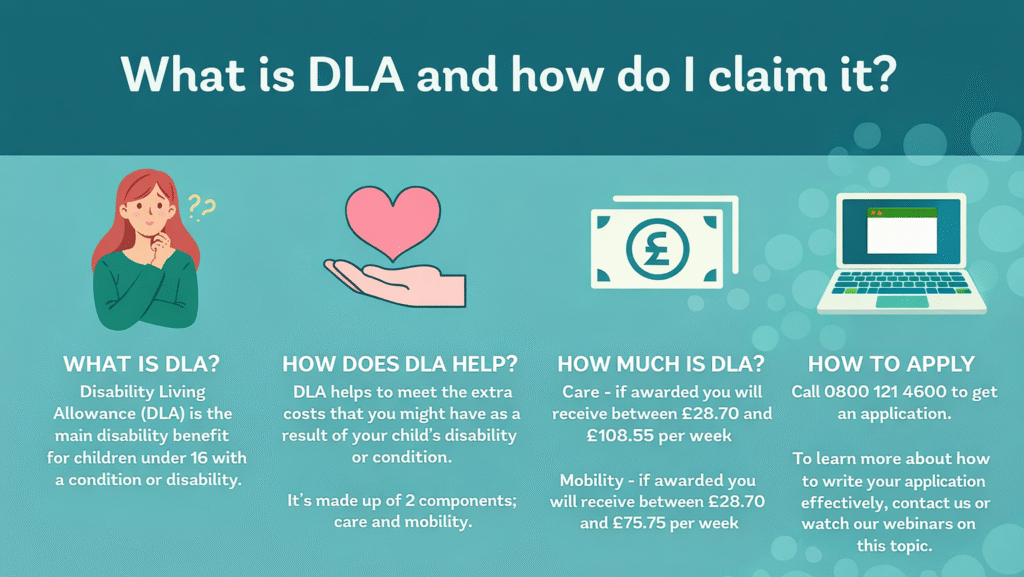
    What Is DLA and How Do i Claim It
    What Is DLA and How Do i Claim It

    If you need help with a claim, you can contact the Disability Living Allowance helpline. Parents often search for the disability living allowance contact number, children’s DLA number, or general DLA contact information when starting an application or reporting a change.

    England and Wales

    You can request a claim form or ask questions about an existing claim by contacting the DLA helpline:

    Disability Living Allowance helpline

    Telephone: 0800 121 4600

    Textphone: 0800 121 4523

    Relay UK: dial 18001 then 0800 121 4600

    You can ask the helpline to send you a DLA claim form by post, or download and print one from the GOV.UK website.

    Northern Ireland

    Families in Northern Ireland must contact the Disability and Carers Service instead of the England and Wales helpline. Parents often search for the DLA Northern Ireland telephone number when starting a claim.

    Disability and Carers Service (Northern Ireland)

    Telephone: 0800 587 0912

    They can send you the claim pack and help answer questions about DLA child rates and eligibility.

    When to contact the DLA helpline

    You should contact the helpline if:

    • you want to request a claim form
    • you need to report a change in your child’s circumstances
    • you want to check the progress of a claim
    • you need help understanding your child’s DLA child rates or eligibility

    Keeping the DLA office updated helps ensure your payments continue correctly.

    Key takeaway…

    Children’s DLA rates depend on the level of care and mobility support your child needs, not just their diagnosis. If your child qualifies, the benefit can help cover the additional costs of care and may also unlock other support, such as Carer’s Allowance or mobility schemes.

    If you think your child may qualify, contacting the DLA helpline or requesting a claim form is often the first step toward accessing the support your family needs.

    Need Expert Support Navigating Disability Benefits and Care Funding?

    Care Sync Experts supports care providers, parents, and healthcare organisations across the UK with clear, practical guidance on disability benefits, care funding, and regulatory processes that affect children and families.

    From helping families understand children’s DLA rates and eligibility to guiding care organisations through benefit-related policies, compliance requirements, and support frameworks, our specialists translate complex government guidance into straightforward, actionable advice.

    Whether you need help understanding Disability Living Allowance for children, Child Disability Payment in Scotland, carers’ support options, or benefit-linked care funding, our team provides structured guidance aligned with current UK health and social care standards.

    Help families access the support they deserve while strengthening compliance across your organisation.

    Contact Care Sync Experts today to receive expert guidance on disability benefits, care funding, and support pathways with clarity and confidence.

    FAQ

    What conditions qualify a child for DLA?

    There is no fixed list of medical conditions that automatically qualify a child for Disability Living Allowance (DLA). Instead, the decision depends on how the child’s condition affects their daily care or mobility needs.

    A child may qualify if they need significantly more help or supervision than other children of the same age because of a long-term condition or disability.

    Examples of conditions that commonly lead families to claim DLA include:
    – autism spectrum disorder
    – ADHD
    – learning disabilities
    – physical disabilities
    – sensory impairments such as blindness or severe hearing loss
    – long-term medical conditions that require regular supervision

    The Department for Work and Pensions focuses on the level of care and support required, not just the diagnosis itself.

    What evidence do I need for child DLA?

    When you apply for Disability Living Allowance for a child, you should include evidence that explains how your child’s condition affects their daily life.

    Helpful evidence may include:
    – letters or reports from GPs, paediatricians, or specialists
    – reports from speech therapists, occupational therapists, or physiotherapists
    – information from schools or special educational needs coordinators (SENCOs)
    – care plans or support plans
    – examples of daily supervision or assistance your child needs

    Strong applications usually describe real situations from everyday life, such as help needed with dressing, supervision for safety, or support required at night.

    What happens after DLA is approved?

    After a successful claim, the Department for Work and Pensions sends you a decision letter explaining:
    – which care or mobility components your child has been awarded
    – the weekly rate your child will receive
    – how long the award will last

    Payments usually go into your bank or building society account every four weeks.
    Once your child receives DLA, you may also become eligible for other support, such as Carer’s Allowance or additional benefits depending on your circumstances.

    Can a 2 year old get DLA for autism?

    Yes, a 2-year-old child can qualify for Disability Living Allowance, including children with autism, if they need much more supervision or care than other children their age.

    However, the mobility component usually only applies at certain ages:
    – Higher mobility rate can apply from age 3
    – Lower mobility rate usually applies from age 5

    Even if a child is younger than these ages, they may still qualify for the care component if they require significant extra supervision or support due to their condition.

    Parents applying for young children should focus on explaining how much extra care their child needs compared with other children of the same age.
  • Equality Act Protected Characteristics: 2026 Importance for Care Work

    Equality Act Protected Characteristics: 2026 Importance for Care Work

    The Equality Act protected characteristics refer to specific personal traits that the law protects from discrimination in the UK. The Equality Act 2010 makes it unlawful to treat someone unfairly because of these characteristics in areas such as employment, education, housing, and access to services. The law aims to promote equality, diversity, and equal opportunities by ensuring that individuals receive fair treatment regardless of who they are.

    When people ask “what are protected characteristics?”, they are referring to the legally recognised traits that the Act safeguards. These protections help prevent discrimination at work, harassment, and victimisation, particularly in workplaces where fair treatment and inclusive practices are essential.

    The Equality Act recognises nine protected characteristics in the UK. If someone treats a person less favourably because of one of these characteristics, that behaviour may count as discrimination under the law. In many workplaces, including health and social care, employers must actively ensure that policies, recruitment decisions, and daily practices respect these protections.

    Get expert support for your next tender, inspection-ready policies, or CQC registration — book a call with Care Sync Experts today and let’s get you compliant and competitive.

    What are the 9 protected characteristics of the Equality Act?

    Healthcare Tender Eligibility UK: 3 Hidden Checks Before You Bid (2026)

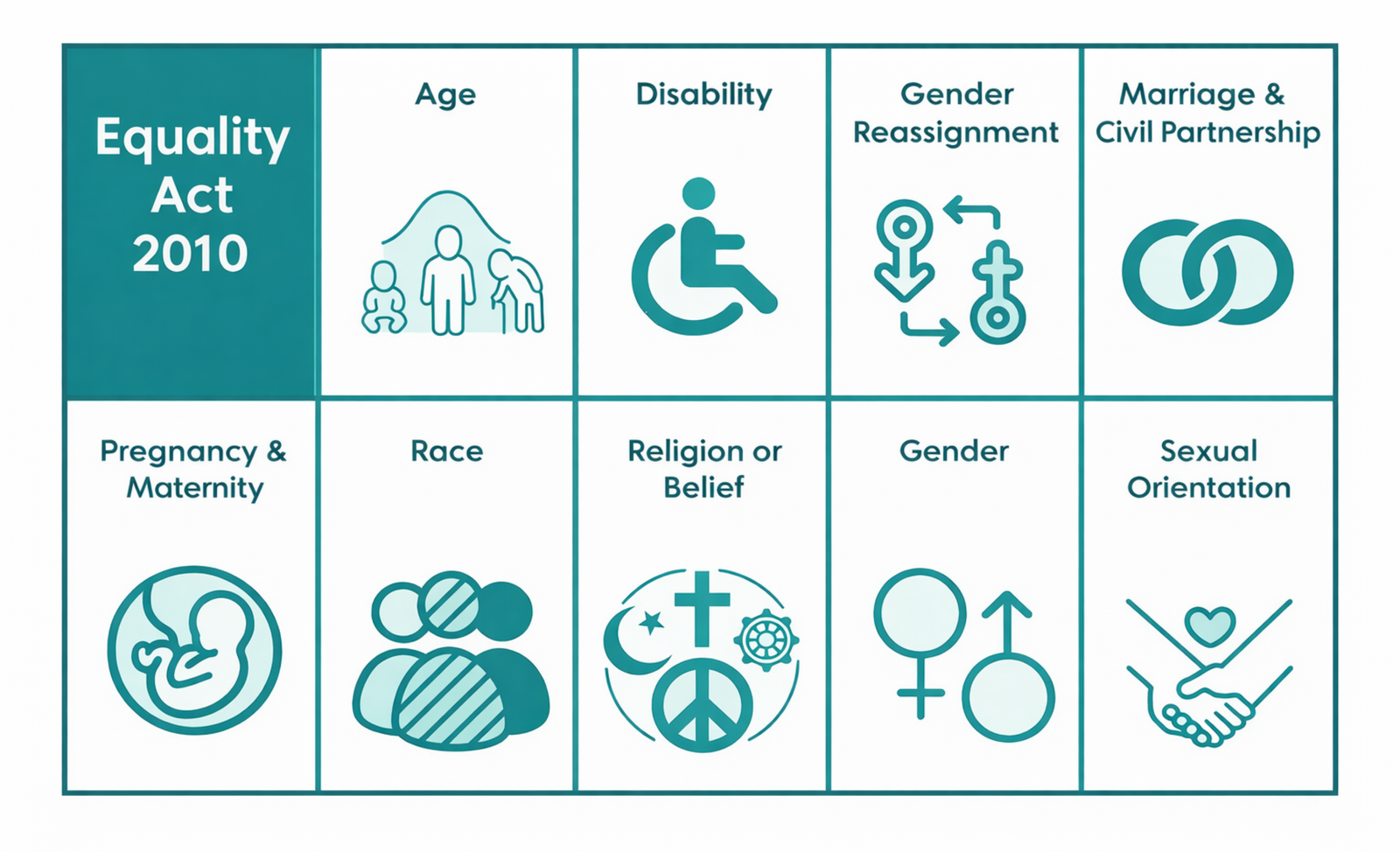
    The Equality Act protected characteristics are the nine personal traits that the law protects from discrimination in the UK. If someone treats a person unfairly because of one of these characteristics, it may count as unlawful discrimination under the Equality Act 2010.

    So, how many protected characteristics are there?

    The law recognises nine protected characteristics in the UK:

    • Age – protection from discrimination because someone belongs to a particular age group.
    • Disability – a physical or mental impairment that has a substantial, long-term effect on daily activities.
    • Gender reassignment – protection for people who are proposing to transition, are transitioning, or have transitioned.
    • Marriage and civil partnership – protection for people who are married or in a civil partnership, mainly in employment.
    • Pregnancy and maternity – protection during pregnancy, maternity leave, and the period after childbirth.
    • Race – includes colour, nationality, and ethnic or national origins.
    • Religion or belief – includes religious beliefs, philosophical beliefs, or lack of belief.
    • Sex – being a man or a woman.
    • Sexual orientation – whether someone is attracted to people of the same sex, opposite sex, or both.

    These protected characteristics UK law recognises form the foundation of equality legislation. Employers, organisations, and service providers must ensure their policies and decisions do not unfairly disadvantage people because of any of these traits.

    RELATED: UK Cost of Living Payment Eligibility (2026): What Caregivers and Families Need to Know

    Equality Act protected characteristics examples in the workplace

    Understanding equality act protected characteristics in the workplace helps employers and care providers recognise when behaviour crosses the line into unlawful discrimination. Many situations may seem small at first, but they can still lead to discrimination at work if someone treats a person unfairly because of a protected characteristic.

    Here are some Equality Act protected characteristics examples that commonly occur in workplaces:

    Age

    A manager refuses to hire a qualified applicant because they believe the person is “too old” to adapt to new systems.

    Disability

    An employer refuses to make reasonable adjustments for a worker with a long-term health condition. For example, an employee with severe arthritis may need flexible duties. If the condition has a substantial and long-term impact on daily activities, it may qualify as a disability under the law. This raises common questions such as “is arthritis a disability?” In many cases, it can be if it significantly affects normal activities.

    Pregnancy and maternity

    A supervisor removes a pregnant employee from a promotion shortlist because they expect her to go on maternity leave.

    Religion or belief

    An employer refuses to allow a worker to take a short break to observe an important religious practice when other staff receive flexible break times.

    Race

    A worker receives fewer opportunities or harsher treatment because of their nationality or ethnic background.

    These examples show how discrimination can appear in everyday workplace decisions such as recruitment, scheduling, training opportunities, or promotion. Employers must actively prevent these situations to maintain equal opportunities and promote a workplace culture built on equality and diversity.

    What is discrimination under the Equality Act?

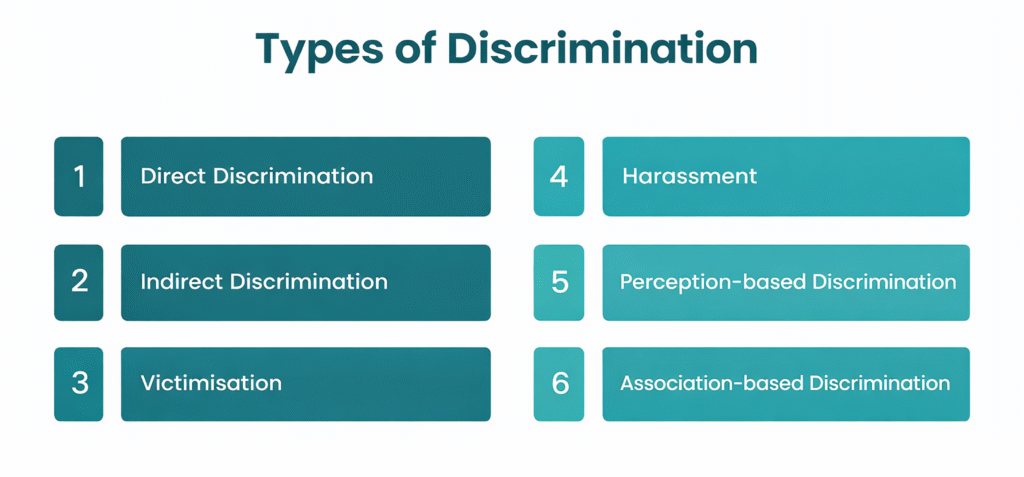
    Discrimination happens when someone treats a person unfairly because of one of the Equality Act protected characteristics. The Equality Act 2010 recognises several types of discrimination, and each can occur in workplaces, services, education, and housing.

    Understanding what discrimination is helps employers and care providers recognise unlawful behaviour and prevent discrimination at work.

    Direct discrimination

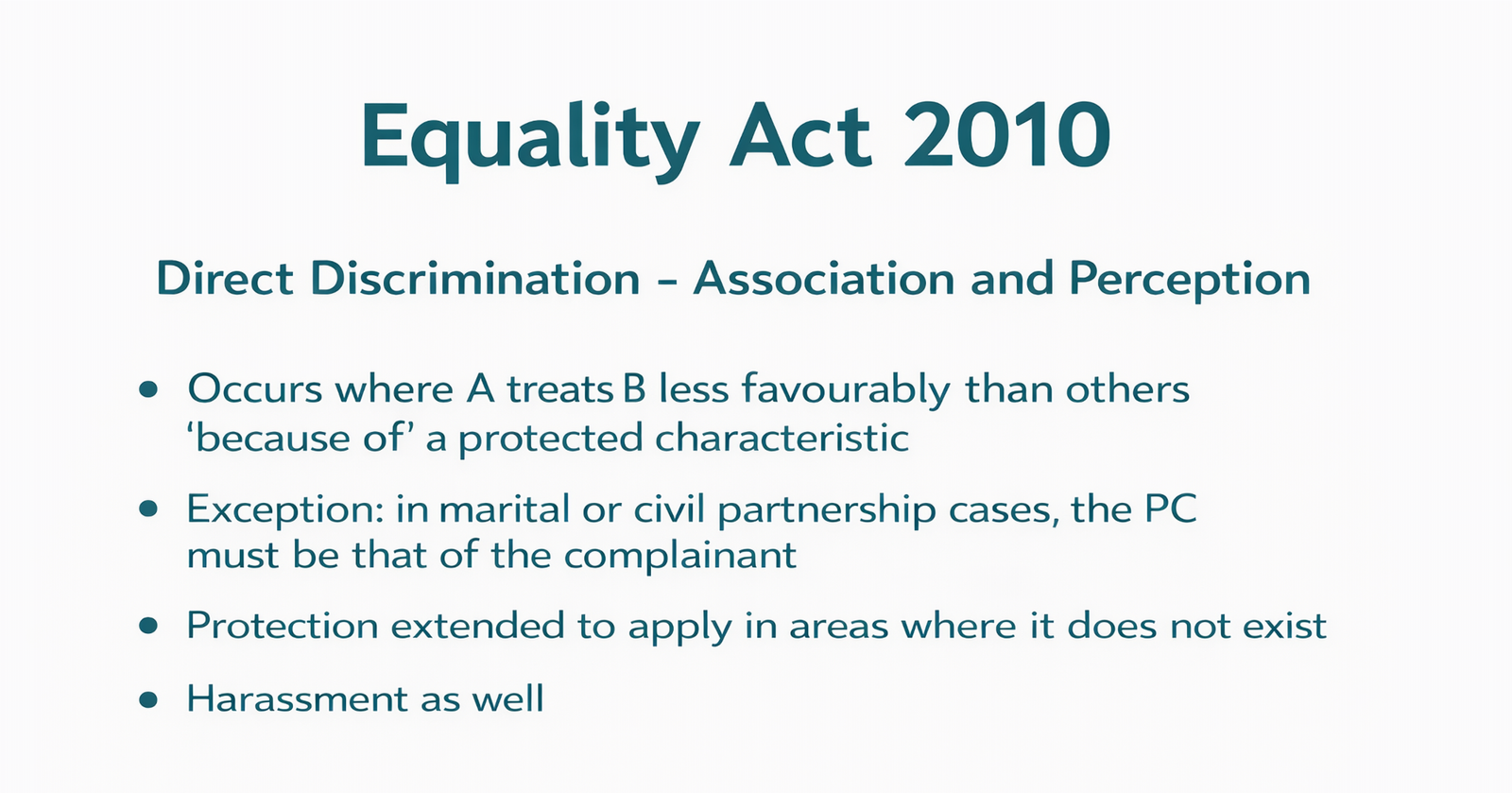
    Direct discrimination occurs when someone treats a person worse than others because of a protected characteristic.

    Example:

    A care agency rejects a qualified job applicant because of their race or religion.

    Indirect discrimination

    Indirect discrimination happens when a rule or policy applies to everyone but disadvantages people with a particular protected characteristic.

    Example:

    A workplace policy requires all staff to work late evenings. This may disadvantage employees with certain religious commitments.

    Harassment

    Harassment occurs when behaviour makes someone feel humiliated, offended, or degraded because of a protected characteristic.

    Example:

    A colleague repeatedly makes offensive jokes about a worker’s disability or sexual orientation.

    Victimisation

    Victimisation happens when someone treats a person unfairly because they made a complaint about discrimination or supported another person’s complaint.

    Example:

    An employee reports discrimination at work, and their manager then excludes them from training opportunities.

    Recognising these types of discrimination helps employers protect workers and create fair policies that support equality, diversity, and equal opportunities in the workplace.

    READ MORE: PIP Contact Number: Number for PIP Payment and Enquiries (2026)

    Discrimination by association and discrimination by perception

    What is Discrimination in the Equality Act 2010

    The Equality Act also protects people in situations where discrimination happens indirectly through assumptions or relationships. Two important legal concepts are discrimination by association and discrimination by perception.

    Discrimination by association

    Discrimination by association happens when someone treats a person unfairly because of their connection with someone who has a protected characteristic.

    The person experiencing the discrimination does not need to have the characteristic themselves.

    Example:

    A manager treats an employee unfairly because the employee’s child has a disability and sometimes requires flexible working arrangements. Even though the worker is not disabled, the treatment may still count as unlawful discrimination.

    Discrimination by perception

    Discrimination by perception occurs when someone treats a person unfairly because they believe that person has a protected characteristic, even if that assumption is incorrect.

    Example:

    An employer refuses to promote a worker because they assume the worker belongs to a particular religion or sexual orientation. Even if the assumption is wrong, the action may still be discrimination under the Equality Act.

    These protections ensure that employers and organisations cannot justify unfair treatment based on assumptions, stereotypes, or personal associations. Understanding these rules helps workplaces create fair policies that support equality, diversity, and equal opportunities.

    Why protected characteristics matter in health and social care

    Equality Act Protected Characteristics

    Understanding Equality Act protected characteristics plays a vital role in health and social care settings. Care providers work with people from many backgrounds, so employers must actively promote equality, diversity, and equal opportunities in both employment and service delivery.

    In care environments, staff support individuals who may already face vulnerability due to age, disability, or health conditions. If workers or service users experience unfair treatment because of a protected characteristic, it can undermine trust and create unsafe care environments. This is why preventing discrimination at work is essential in caregiving roles.

    Employers in health and social care must ensure that recruitment, training, and workplace policies treat everyone fairly. For example, a care organisation should not refuse to hire someone because of their age, religion, or pregnancy. Similarly, managers should provide reasonable adjustments for workers with disabilities so they can perform their roles effectively.

    Promoting fairness also improves the quality of care. When organisations respect protected characteristics UK law recognises, they build inclusive teams that better understand the needs of diverse communities. This approach supports professional standards in caregiving and strengthens public confidence in care services.

    Respecting protected characteristics helps care providers deliver compassionate, lawful, and respectful support to everyone they serve.

    SEE ALSO: Labour Home Support Plan Pensioner Devices: 2026 Update

    How many protected characteristics are there: 9, not 10 or 12

    What is Discrimination in the Equality Act 2010

    People often search questions like “how many protected characteristics are there?”, “what are the 10 protected characteristics?”, or even “what are the 12 protected characteristics?”. The Equality Act 2010 is clear on this point.

    UK law recognises nine protected characteristics.

    These are the only characteristics specifically protected under the Equality Act:

    • age
    • disability
    • gender reassignment
    • marriage and civil partnership
    • pregnancy and maternity
    • race
    • religion or belief
    • sex
    • sexual orientation

    No additional characteristics appear in the legislation. Some people confuse positive discrimination, workplace diversity initiatives, or other equality concepts with protected characteristics. However, these ideas do not add new characteristics to the law.

    Employers can take positive action to support groups that face disadvantage or under-representation, but this differs from positive discrimination, which is generally not permitted in most situations.

    Understanding how many protected characteristics exist under UK law helps organisations apply the Equality Act correctly and avoid misunderstandings when developing workplace policies or diversity programmes.

    Key takeaway

    The Equality Act protected characteristics form the foundation of UK equality law. The Act identifies nine protected characteristics that safeguard people from unfair treatment in employment, education, housing, and public services.

    For employers and care providers, understanding what protected characteristics are is essential. Fair recruitment, respectful workplace behaviour, and inclusive policies help prevent discrimination at work and promote equal opportunities for everyone.

    When organisations recognise and respect protected characteristics in the UK, they strengthen workplace culture, support equality and diversity, and ensure that staff and service users receive fair and lawful treatment.

    Need Expert Guidance on Equality and Compliance in Health and Social Care?

    Care Sync Experts supports care providers, managers, and healthcare organisations across the UK with clear, practical guidance on Equality Act compliance, workplace policies, and inclusive care practices.

    From helping organisations understand Equality Act protected characteristics and preventing discrimination at work to strengthening equality, diversity, and equal opportunities within care teams, our specialists help providers build workplaces that are both legally compliant and supportive for staff and service users.

    Whether you need support reviewing workplace policies, staff training programmes, recruitment practices, or regulatory compliance, our team provides structured, professional guidance that aligns with modern UK health and social care standards.

    Create safer, fairer, and more inclusive care environments.

    Contact Care Sync Experts today and strengthen your organisation’s equality and compliance practices with confidence.

    FAQ

    What is Section 13 of the Equality Act 2010?

    Section 13 of the Equality Act 2010 defines direct discrimination. Direct discrimination occurs when someone treats another person less favourably because of a protected characteristic, such as age, race, disability, religion, or sex.

    For example, if an employer refuses to hire a qualified candidate because of their religion or age, that decision may amount to direct discrimination. In most situations, direct discrimination is unlawful unless a specific legal exception applies.

    What is Section 4 of the Equality Act 2010?

    Section 4 of the Equality Act 2010 formally defines the protected characteristics recognised under UK law. These characteristics represent the personal traits that the law protects from discrimination, harassment, and victimisation.

    The section establishes the legal framework that ensures individuals receive fair treatment regardless of their age, disability, gender reassignment status, marital status, pregnancy, race, religion or belief, sex, or sexual orientation.

    What is Section 7 of the Equality Act 2010?

    Section 7 explains the protected characteristic of gender reassignment. It protects individuals who are proposing to transition, are undergoing a transition, or have transitioned from one gender to another.

    Importantly, the law does not require a person to undergo medical treatment or surgery to receive protection. If someone faces discrimination because they intend to transition or are perceived to be transitioning, the Equality Act may protect them.

    What is Section 20 of the Equality Act 2010?

    Section 20 introduces the duty to make reasonable adjustments for people with disabilities. Employers, service providers, and organisations must take reasonable steps to remove barriers that place disabled individuals at a disadvantage.

    Reasonable adjustments may include modifying workplace equipment, providing flexible working arrangements, or adapting physical environments. The goal is to ensure disabled individuals can access employment, services, and opportunities on equal terms with others.

  • UK Cost of Living Payment Eligibility (2026): What Caregivers and Families Need to Know

    UK Cost of Living Payment Eligibility (2026): What Caregivers and Families Need to Know

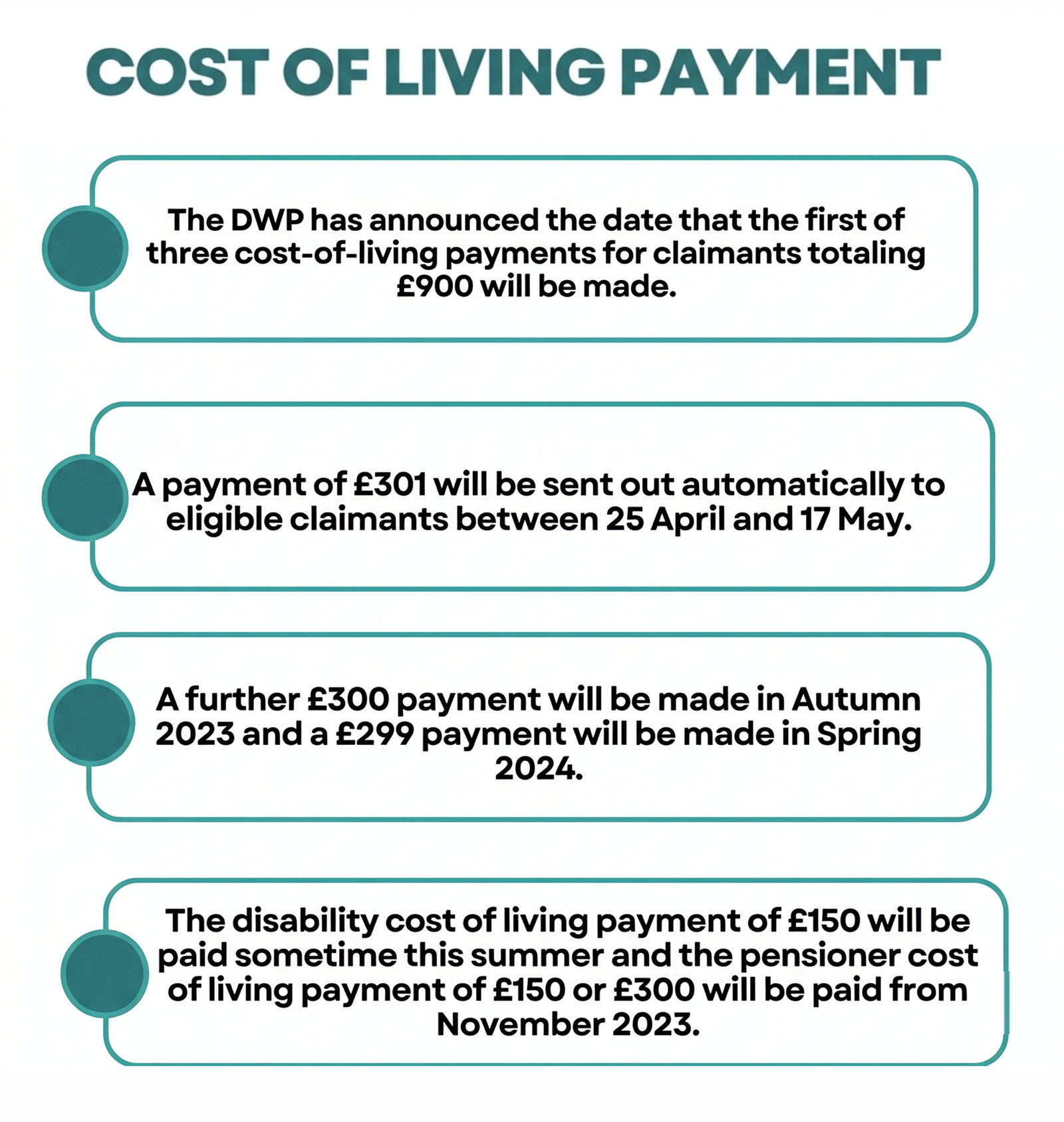
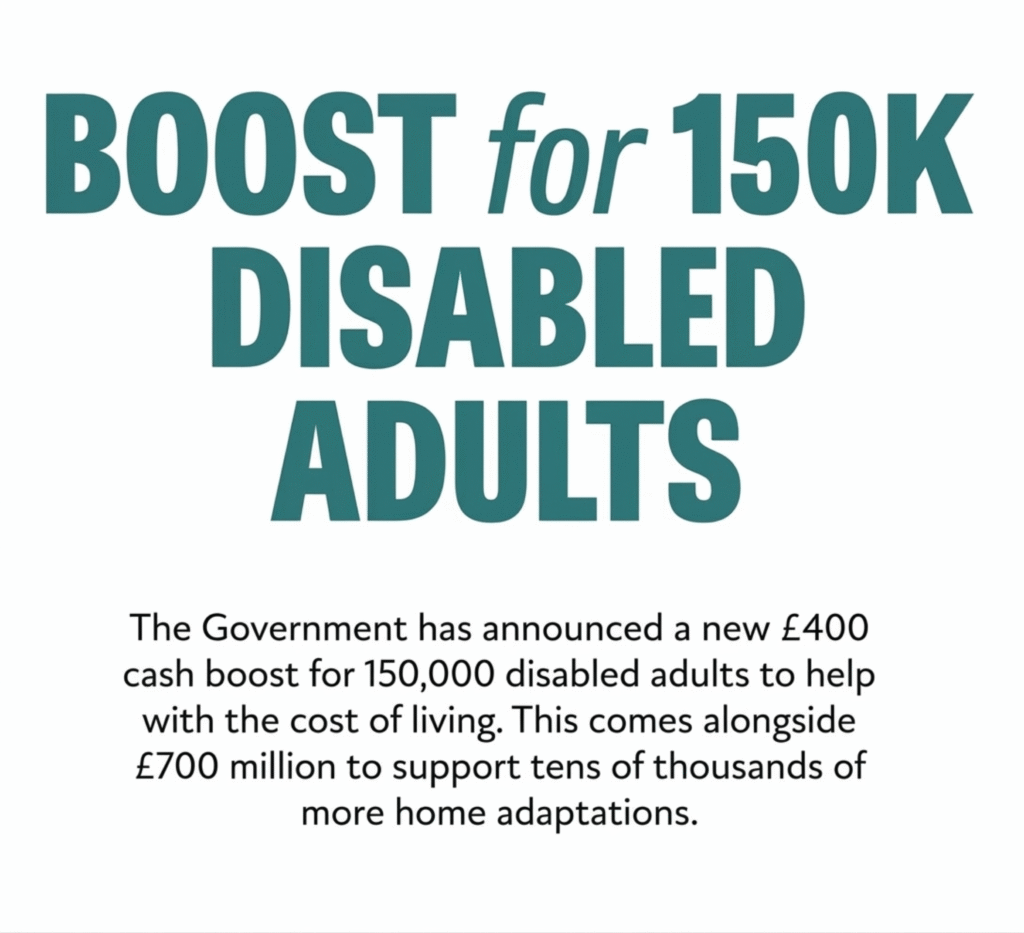
    The main UK Cost of Living Payment scheme ended in 2024, and the government has not announced a new automatic Cost of Living Payment for 2026. The Department for Work and Pensions (DWP) confirmed that the previous DWP cost of living payments were temporary support measures issued between 2022 and 2024 to help households cope with rising energy, food, and housing costs.

    During that period, people receiving certain benefits met the UK cost of living payment eligibility rules and received payments automatically. These payments went directly into the same bank account used for benefits such as Universal Credit, Pension Credit, or income-related benefits.

    In 2026, financial support has shifted away from national one-off payments. Instead, help now focuses on:

    • Income-related benefits such as Universal Credit and Pension Credit
    • Disability benefits like Personal Independence Payment (PIP)
    • Local council support, particularly through the Household Support Fund

    If you currently receive benefits or support someone who does, such as an older adult, a disabled person, or a vulnerable client, checking the latest cost of living payment update on official government guidance and local council support schemes is the best way to understand what help is still available.

    Get expert support for your next tender, inspection-ready policies, or CQC registration — book a call with Care Sync Experts today and let’s get you compliant and competitive.

    Who Qualified for the UK Cost of Living Payment

    Mastering Cost Management in Homecare: Essential Tips for Success!

    To meet UK cost of living payment eligibility during the 2022–2024 scheme, a person had to receive certain means-tested benefits or tax credits during specific assessment periods. The Department for Work and Pensions (DWP) automatically identified eligible claimants and issued the DWP cost of living payments directly into the same bank account used for their regular benefits.

    People generally qualified if they received one of the following:

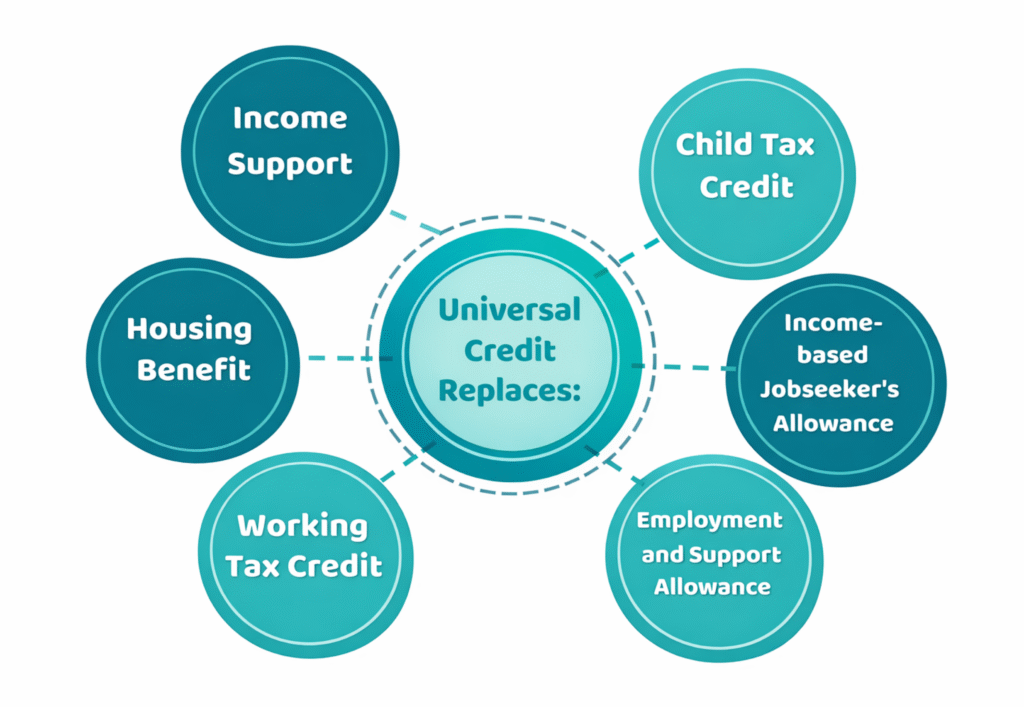
    • Universal Credit
    • Income-based Jobseeker’s Allowance (JSA)
    • Income-related Employment and Support Allowance (ESA)
    • Income Support
    • Pension Credit
    • Child Tax Credit
    • Working Tax Credit

    Eligibility depended on whether a claimant had entitlement to a payment during a defined qualifying period set by the government. Even a very small entitlement during that period could count.

    However, some people did not qualify. For example, if a benefit payment was reduced to £0 during the qualifying assessment period, often called a “nil award”, the person usually did not meet UK cost of living payment eligibility for that payment round.

    Because the process was automatic, eligible households did not need to apply. The UK cost of living payment arrived as a separate payment from the DWP or HMRC, depending on which benefit the person received.

    RELATED: Labour Home Support Plan Pensioner Devices: 2026 Update

    Universal Credit Cost of Living Payment. When Was It Paid?

    Many people still search “Universal Credit cost of living payment when will it be paid”, but those payments have already finished. The government issued the last round of DWP cost of living payments in 2024.

    For people receiving Universal Credit, the payments came in three instalments linked to specific assessment periods. If a claimant qualified during those windows, the payment arrived automatically.

    The final payment schedule looked like this:

    • £301 payment (2023): Paid between April and May 2023
    • £300 payment (2023): Paid between October and November 2023
    • £299 payment (2024): Paid between February and February 2024

    The £299 instalment, sometimes searched as the DWP 299 cost of living payment, was the last major payment issued under the scheme.

    To receive any of these payments, a person had to show entitlement to Universal Credit during a specific assessment period set by the DWP. If a claim showed a nil payment during that period, the person usually did not qualify for that round.

    Importantly, the cost of living payment never required an application. The DWP processed payments automatically using the same bank details linked to a claimant’s Universal Credit account.

    Cost of Living Payment for Disability Benefits (PIP)

    uk cost of living payment eligibility

    People receiving certain disability benefits also received additional DWP cost of living payments during the scheme. These payments aimed to support individuals who face higher daily costs because of disability or long-term health conditions.

    Eligible benefits included:

    • Personal Independence Payment (PIP)
    • Disability Living Allowance (DLA)
    • Attendance Allowance
    • Adult Disability Payment (Scotland)
    • Child Disability Payment
    • Armed Forces Independence Payment

    Claimants who met the cost of living payment (PIP) eligibility rules received two separate £150 Disability Cost of Living Payments. The government issued these payments automatically once it confirmed that a person received a qualifying disability benefit on the required eligibility dates.

    Many caregivers support individuals who rely on these benefits to cover mobility support, personal care, or specialist equipment. For those households, the additional cost of living payment provided extra financial help during periods of high inflation.

    Like the other DWP cost of living payment instalments, people did not need to apply. The payment arrived automatically in the same bank account used for their disability benefit.

    READ MORE: What Is Person Centred Care? 2026 Guide

    Cost of Living Payment for Pensioners

    Pensioners also received extra help through the UK cost of living payment scheme, mainly through Pension Credit and the Winter Fuel Payment. These payments aimed to support older households who often face higher heating and energy costs during the winter months.

    If someone met the UK cost of living payment eligibility rules and received Pension Credit, they could qualify for the same DWP cost of living payments issued to other low-income households. The payment arrived automatically in the same bank account used for their regular benefit.

    In addition, many pensioners received an extra Cost of Living Payment added to their Winter Fuel Payment during the 2022–2024 scheme. Depending on age and circumstances, this additional support ranged between £150 and £300 on top of the usual winter fuel allowance.

    For caregivers supporting older adults, checking Pension Credit eligibility remains important. Even a small Pension Credit award can unlock multiple forms of support, including heating assistance, council tax reductions, and other benefits tied to the UK cost of living payment eligibility rules that previously applied.

    Can You Apply for a Cost of Living Payment?

    uk cost of living Boost

    No. You cannot apply for a Cost of Living Payment. The government designed the scheme so the DWP cost of living payment reached eligible households automatically.

    If someone met the UK cost of living payment eligibility rules during the qualifying period, the payment arrived directly in the same bank account used for their benefits or tax credits. People did not need to fill out a form, submit documents, or contact the Department for Work and Pensions.

    Because the payment process was automatic, scammers often targeted vulnerable households. Some people still search “apply for cost of living payment” or “will I get cost of living payment tomorrow”, but legitimate payments never required applications, links, or bank detail requests.

    If someone receives a message asking them to apply or provide bank information to receive a cost of living payment, they should treat it as suspicious. The DWP and HMRC only issue these payments automatically based on benefit records.

    SEE ALSO: Do Dementia Sufferers Have to Pay Care Home Fees in the UK? (2026 Guide)

    What Support Is Available in 2025–2026 Instead?

    Although the national UK cost of living payment scheme ended in 2024, several forms of financial support remain available in 2025 and 2026. Many people still search for a cost of living payment 2025 or a DWP 2025 cost of living payment, but the government has shifted most support toward existing benefits and local assistance programs.

    One of the most important options is the Household Support Fund. The UK government provides funding to local councils, which then distribute support to residents who face financial hardship. Councils may offer help through:

    • Energy bill support
    • Food vouchers
    • Essential household items
    • Emergency cash grants

    Each council manages its own application process, so eligibility rules can vary by location.

    People receiving Universal Credit, Pension Credit, or disability benefits may also continue to receive broader financial help through benefit increases or targeted schemes. While many households still hope for a 2025 cost of living payment, the current system focuses more on local support and existing benefits rather than nationwide lump-sum payments.

    For families and caregivers supporting vulnerable people, checking local council websites regularly can help identify available Household Support Fund assistance and other regional cost-of-living support programs.

    MORE: When Does Child Benefit Stop in the UK? (2026 Guide)

    What Caregivers Should Do Next

    Difference Between Wage Rates in the UK

    Caregivers often help older adults, disabled people, or vulnerable clients manage benefits and financial support. Even though the national UK cost of living payment scheme has ended, caregivers can still take practical steps to ensure people receive the support they qualify for.

    Start by reviewing benefit eligibility. Many households miss out on support because they do not claim benefits such as Pension Credit or the correct Universal Credit components. These benefits can unlock additional help that previously linked to UK cost of living payment eligibility.

    Next, check the local council’s support programs. Many councils distribute grants and vouchers through the Household Support Fund, especially for residents struggling with heating, food, or essential household costs.

    Caregivers should also:

    • Review the person’s Universal Credit statements to confirm active entitlement
    • Check eligibility for disability benefits such as PIP if the person’s condition has changed
    • Ensure bank details are correct for benefit payments
    • Watch for scams claiming to offer a cost of living payment update

    Taking these steps helps ensure vulnerable individuals receive the financial help still available, even without new nationwide DWP cost of living payments.

    Final Thoughts…

    The UK cost of living payment scheme helped millions of households manage rising expenses between 2022 and 2024. While those one-off payments have now ended, financial support for vulnerable people has not disappeared. The government now directs most assistance through existing benefits, disability support, and local council programmes such as the Household Support Fund.

    For many households, especially older adults, people living with disabilities, and families on low incomes, understanding UK cost of living payment eligibility rules from the previous scheme still matters. Those rules often connect closely with benefits like Universal Credit, Pension Credit, and disability benefits, which continue to provide long-term support. Many people miss out on help simply because they do not realise they qualify.

    Caregivers and care professionals play an important role here. By helping clients check benefit eligibility, reviewing Universal Credit statements, and staying informed about local council assistance, they can ensure vulnerable individuals receive the financial support available in 2025 and 2026. Even small benefits or council grants can make a meaningful difference when energy bills, food prices, and daily living costs remain high.

    Understanding the latest cost of living payment update and the support that has replaced it helps families and care providers make better financial decisions, avoid scams, and access the help that still exists.

    Need Expert Guidance on Home Care and Support Services?

    Care Sync Experts supports care providers, managers, and healthcare teams across the UK with clear, practical guidance on navigating home care services, care packages, and funding pathways for older adults.

    From helping organisations understand care package assessments and continuing healthcare eligibility to strengthening care planning and preparing for regulatory expectations, our team helps providers deliver safe, effective support for people living at home.

    Whether you need assistance reviewing care documentation, improving service quality, or aligning your organisation with modern health and social care standards, we provide structured, professional guidance you can rely on.

    Support older adults to live safely and independently at home.

    Contact Care Sync Experts today and strengthen your home care services with confidence.

    FAQ

    Is £2,000 a month enough to live in the UK?

    Usually, yes, for one person outside the most expensive areas, but it depends heavily on rent. The ONS says the average UK household spent about £623.30 a week in 2023/24, which is roughly £2,701 a month across all households, while the poorest fifth spent about £1,641 a month on average.

    That means £2,000 a month can be workable for a single person with modest housing costs, but it will feel tight in places with high rent, especially London.

    Is £1,500 enough to live in the UK?

    For most people, £1,500 a month is possible but tight, and it often requires low rent, shared housing, or living in a cheaper area. Based on ONS spending data, £1,500 sits below the average spend of even the poorest fifth of households at roughly £1,641 a month, so it usually leaves very little room for unexpected costs. It may be manageable for a single person in low-cost accommodation, but it is not comfortable for most households.

    How much money will you need per month for living expenses in the UK?

    A useful benchmark is that the average household spends about £2,701 a month, but your own figure depends on rent, transport, household size, and location. The ONS data also shows a very wide spread: the poorest fifth spent about £1,641 a month, while the richest fifth spent about £4,111 a month. For a single adult, the main swing factor is usually housing, not groceries.

    What are the biggest expenses in the UK?

    According to the ONS, the largest share of weekly household spending goes to housing, fuel, and power at 18% (£113.30 a week), followed by transport at 14% (£88.20 a week). Food and drink are also major costs, with households spending £70.50 a week on average, and energy alone averaged £40.50 a week. In practice, the biggest pressure points for most people are rent or mortgage, utility bills, transport, and food.

  • PIP Contact Number: Number for PIP Payment and Enquiries (2026)

    PIP Contact Number: Number for PIP Payment and Enquiries (2026)

    If you need the number for PIP payment enquiries, you can contact the Department for Work and Pensions (DWP) using the official PIP enquiry line below. These numbers help you check an existing claim, report PIP changes, or ask about payments.

    PIP Contact Number (Existing Claims and Payments)

    • PIP contact number (existing claim): 0800 121 4433
    • Textphone / Relay UK: 0800 121 4493
    • Opening hours: Monday to Friday, 9am–5pm

    Use this pip contact number 0800 if you need to:

    • Check the status of your claim
    • Ask about PIP payments backdated
    • Report PIP changes such as a change of address or health condition
    • Ask questions about your award or assessment outcome

    Many people search for the number for personal independence payment or the dept work and pensions tel no when they need help with a claim. The number above connects you directly to the PIP enquiry line managed by the Department for Work and Pensions.

    Get expert support for your next tender, inspection-ready policies, or CQC registration — book a call with Care Sync Experts today and let’s get you compliant and competitive.

    PIP Contact Number (New Claims)

    Leicestershire Home Care Tender 2026-2034 | Complete Framework Guide

    To start a new claim, call the DWP contact number below:

    • New PIP claims: 0800 917 2222
    • Opening hours: Monday to Friday, 8am–5pm

    When you call this dept of work and pensions contact no, an advisor will ask for basic information and begin your claim for Personal Independence Payment. After the call, the DWP sends you the form called “How Your Disability Affects You.”

    Northern Ireland PIP Contact Numbers

    If you live in Northern Ireland, contact the Department for Communities instead of the DWP:

    • Existing claims / payments: 0800 587 0932
    • New claims: 0800 012 1573

    When to Use the PIP Enquiry Line

    You should call the pip enquiry line if you need help with:

    • Checking PIP payment dates
    • Reporting a change of circumstances
    • Asking about PIP extensions in the UK
    • Updating your personal details
    • Understanding a decision letter
    • Fixing payment problems

    Many caregivers contact the DWP contact number 0800 on behalf of family members who cannot manage their claim alone.

    If your question relates to a medical assessment, the DWP may ask you to contact the assessment provider directly (such as Capita, Ingeus, or Maximus).

    What Personal Independence Payment (PIP) Is and Who It Helps

    Personal Independence Payment (PIP) is a UK government benefit that helps people aged 16 to State Pension age cover the extra costs of living with a long-term health condition or disability. The Department for Work and Pensions (DWP) manages PIP in England and Wales, while different systems apply in Scotland and Northern Ireland.

    Unlike many benefits, PIP is not means-tested. Your income, savings, or employment status do not affect whether you can receive it. Many people continue working while receiving PIP because the benefit focuses on how your condition affects your daily life, not how much money you earn.

    PIP exists to support people who struggle with everyday tasks or mobility because of a physical, mental, or neurological condition. This can include people living with conditions such as arthritis, multiple sclerosis, anxiety disorders, or ADHD PIP claims, where attention and executive function difficulties affect daily activities.

    Caregivers often play a key role in the process. Many families help a relative manage their claim, contact the pip enquiry line, gather medical evidence, and communicate with the Department for Work and Pensions contact number when changes happen. Understanding how PIP works helps caregivers support someone through the application, assessment, and payment process.

    PIP contains two main components:

    Daily Living Component

    This part supports people who need help with everyday activities such as:

    • Preparing and eating food
    • Washing and bathing
    • Dressing and undressing
    • Managing medication or treatment
    • Communicating with others
    • Managing money

    Mobility Component

    This part helps people who struggle with getting around, including:

    • Planning and following a journey
    • Leaving the home safely
    • Walking or moving around

    You may receive one component or both, depending on how your condition affects your independence.

    Many families also ask what other benefits can I claim with PIP because receiving PIP can unlock additional financial support, mobility schemes, and caregiver benefits. We will explain those options later in this guide.

    Before applying, it is important to understand Personal Independence Payment eligibility, because the DWP bases every decision on how your condition affects daily living and mobility rather than the medical diagnosis itself.

    RELATED: What Is the Carers Element Universal Credit? 2026

    Personal Independence Payment Eligibility: Who Can Claim PIP?

    To qualify for Personal Independence Payment (PIP), you must meet several criteria set by the Department for Work and Pensions (DWP). These rules focus on how your health condition affects your daily life, not simply on the condition itself. Understanding Personal Independence Payment eligibility helps you decide whether it is worth starting a claim.

    Age Requirement

    You can usually claim PIP if you:

    • Are 16 years old or over
    • Have not yet reached State Pension age

    If you are already receiving PIP when you reach State Pension age, your payments normally continue as long as your circumstances remain the same.

    Health Condition or Disability

    You must have a long-term physical or mental health condition or disability that affects your ability to carry out everyday activities or move around.

    Examples include:

    • Mobility impairments
    • Chronic illnesses
    • Neurological conditions
    • Mental health conditions
    • ADHD PIP claims, where attention or executive function issues affect daily living

    The DWP does not award PIP based on the diagnosis alone. Instead, they assess how the condition affects your independence and daily functioning.

    Duration Rule

    Your condition must meet the qualifying period rule:

    • You must have experienced difficulties for at least 3 months, and
    • Those difficulties must be expected to continue for at least 9 more months

    This rule ensures PIP supports people with long-term needs rather than short-term illness or injury.

    Daily Living or Mobility Difficulties

    The DWP evaluates whether you need help with:

    Daily living activities such as:

    • Preparing food
    • Washing or bathing
    • Dressing
    • Managing medication
    • Communicating with others

    Mobility activities such as:

    • Planning and following journeys
    • Physically moving around

    During the assessment process, a health professional assigns points for different activities. Your total score determines whether you qualify for the standard or enhanced rate of PIP.

    Residency Requirements

    You must normally:

    • Live in England, Wales, or Northern Ireland
    • Have lived in the UK for a certain period before claiming

    Rules differ slightly depending on your situation.

    For example, people living in Scotland usually apply for Adult Disability Payment instead of PIP, which we will explain later in the guide.

    Supporting Evidence Matters

    Your claim becomes much stronger if you include supporting evidence, such as:

    • Letters from doctors or specialists
    • Care plans or treatment records
    • Statements from caregivers or family members
    • Prescriptions or medical reports

    This evidence helps the DWP understand how your condition affects your daily life before they schedule an assessment.

    Once you understand Personal Independence Payment eligibility, the next step is learning how to apply for Personal Independence Payment, which we will explain step by step in the next section.

    READ MORE: What Is Person Centred Care? 2026 Guide

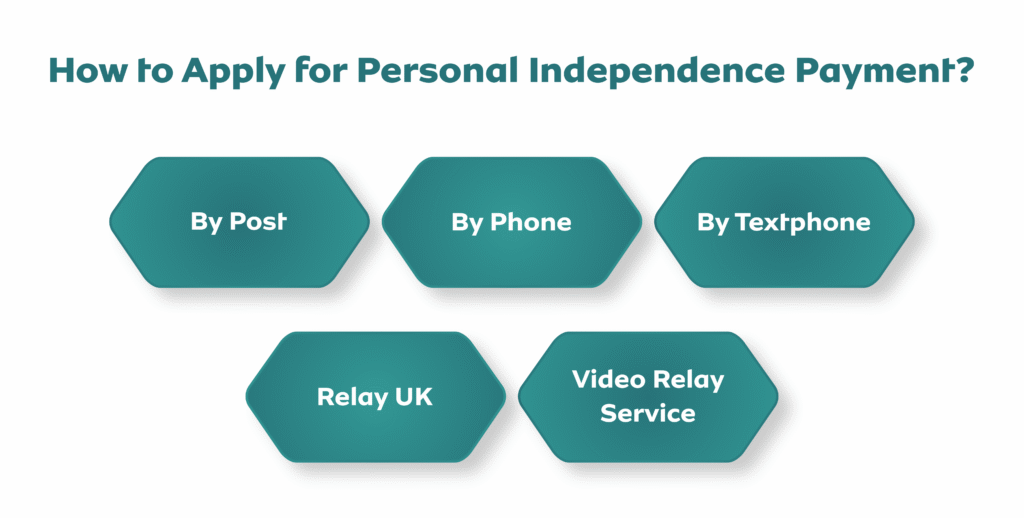
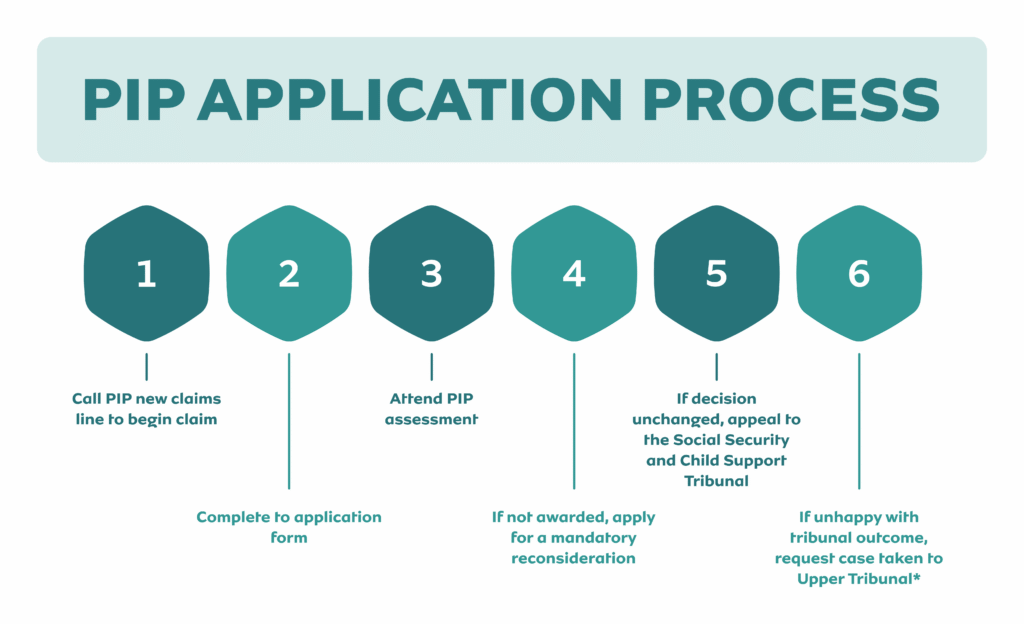
    How to Apply for Personal Independence Payment (Step-by-Step)

    How to Apply for Personal Independence Payment
    How to Apply for Personal Independence Payment

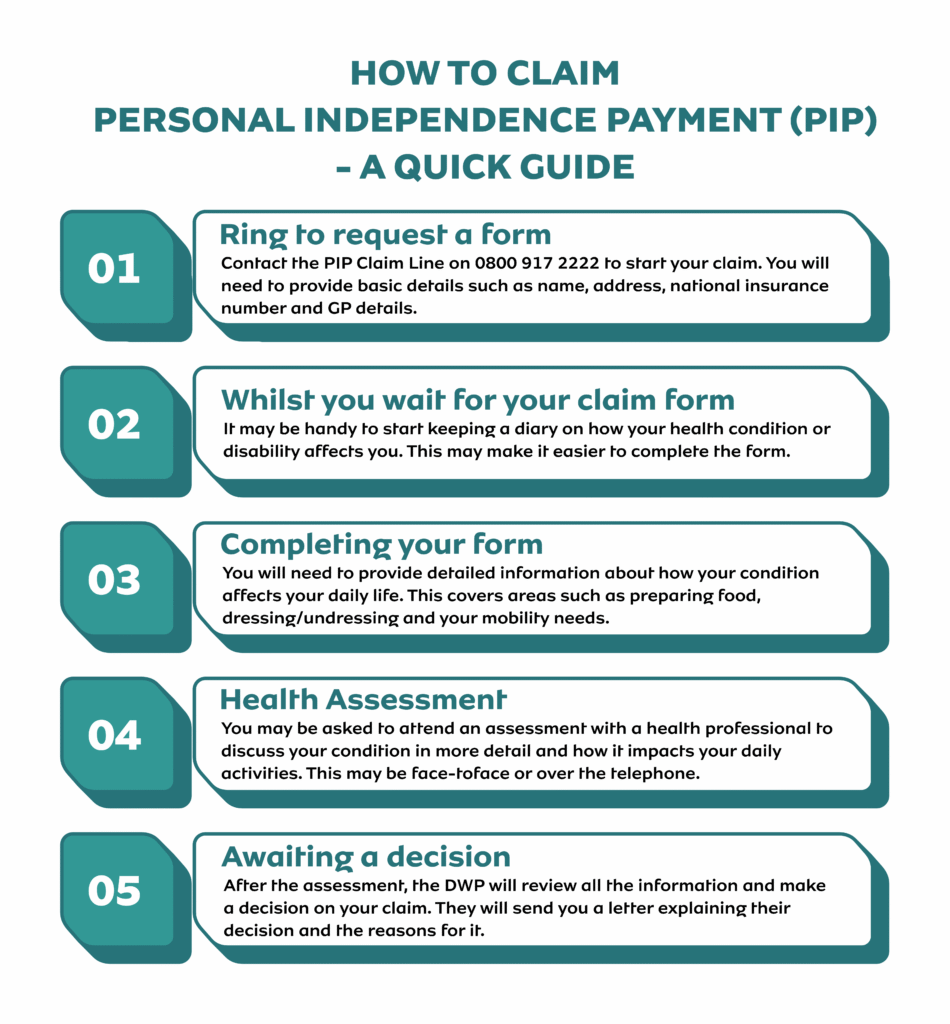
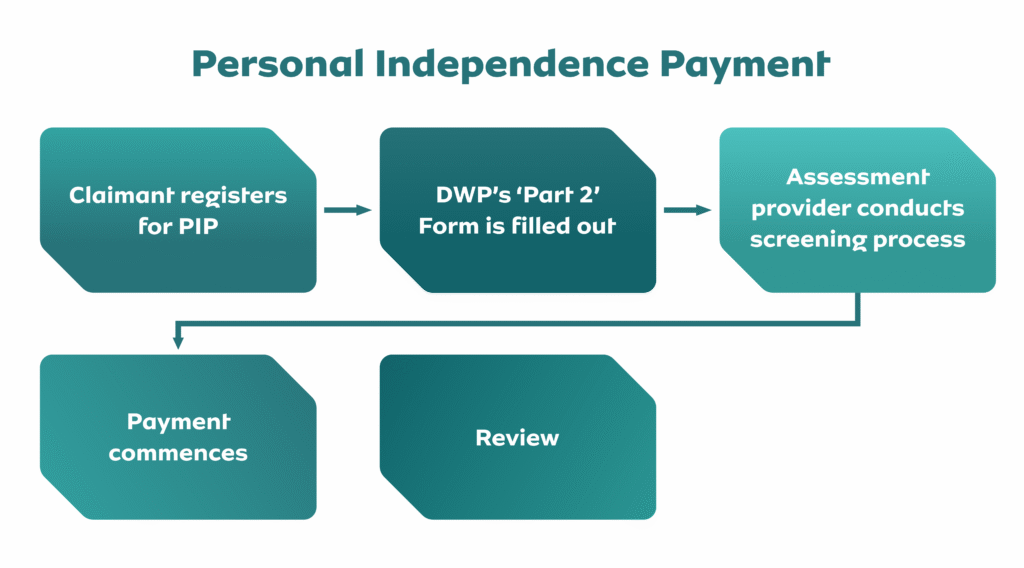
    If you meet Personal Independence Payment eligibility, the next step is to start the claim with the Department for Work and Pensions (DWP). Many caregivers help family members complete this process, especially when the person claiming struggles with paperwork or phone calls.

    The process happens in several stages.

    Step 1: Start Your Claim by Calling the DWP

    You must begin the process by calling the pip contact number for new claims:

    • New PIP claims: 0800 917 2222
    • Opening hours: Monday to Friday, 8am–5pm

    This dept work and pensions contact number allows the DWP to gather basic details before sending your application form.

    During the call, the advisor will ask for:

    • Your National Insurance number
    • Your address and contact details
    • Your bank account information
    • Your GP or healthcare professional’s details
    • Information about time spent in hospital or abroad

    Many people search online for the number for personal independence payment or how do I contact DWP by phone, but the correct starting point for a new claim is the number above.

    Once you complete the call, the DWP officially records the start date of your claim, which is important because PIP payments backdated usually begin from this date if your claim is successful.

    Step 2: Complete the PIP Application Form

    After your phone call, the DWP sends you the form called:

    “How Your Disability Affects You” (PIP2).

    Some people search for a PIP application form online, but the DWP normally sends this form by post after your initial call.

    The form asks detailed questions about how your condition affects your ability to:

    • Prepare meals
    • Manage medication
    • Wash and dress
    • Communicate with others
    • Travel and move around

    Answer honestly and provide specific examples of difficulties you face. Caregivers often help complete this form because it requires clear explanations of daily challenges.

    Step 3: Provide Supporting Evidence

    Supporting documents strengthen your claim. Examples include:

    • GP letters or specialist reports
    • Prescription lists
    • Care plans
    • Statements from caregivers or family members

    Evidence helps the DWP understand your needs before the assessment stage.

    Step 4: Attend a PIP Assessment

    Most people attend an assessment with a healthcare professional. This may happen:

    • Face-to-face
    • By telephone
    • By video call

    The assessor asks how your condition affects your everyday life. They then send a report to the DWP.

    Step 5: Receive the Decision

    After reviewing the assessment and evidence, the DWP sends a decision letter explaining:

    • Whether you qualify for PIP
    • Which component you receive
    • Whether you receive the standard or enhanced rate

    If the decision seems incorrect, you can challenge it through a process called mandatory reconsideration.

    Many caregivers stay involved throughout the claim because they help explain how the person’s condition affects daily life and assist with contacting the pip enquiry line if problems arise.

    How Much Is PIP Per Month? (2025/26 Payment Rates)

    number for pip payment
    number for pip payment

    Many people ask “How much is PIP per month?” when deciding whether to apply. Personal Independence Payment is normally paid every four weeks, but the official rates are calculated weekly.

    Your total payment depends on which components you qualify for and whether you receive the standard or enhanced rate.

    Daily Living Component

    You may receive this part if you need help with everyday activities such as preparing food, washing, dressing, managing medication, or communicating.

    Current weekly rates (2025/26):

    • Standard rate: £73.90 per week
    • Enhanced rate: £110.40 per week

    Approximate monthly payments:

    • Standard rate: about £295 per month
    • Enhanced rate: about £441 per month

    Mobility Component

    You may receive the mobility component if your condition affects how you move around or plan journeys.

    Current weekly rates (2025/26):

    • Standard rate: £29.20 per week
    • Enhanced rate: £77.05 per week

    Approximate monthly payments:

    • Standard rate: about £117 per month
    • Enhanced rate: about £308 per month

    Maximum PIP Payment Per Month

    If you qualify for the enhanced rate of both components, the maximum amount is approximately:

    • £187.45 per week
    • About £750 per month

    Actual payments arrive every four weeks, so the amount deposited in your bank account may look slightly higher than a typical monthly payment.

    Can PIP Payments Be Backdated?

    Yes. In many cases, PIP payments backdated start from the date you first contacted the Department for Work and Pensions contact number to begin your claim.

    For example, if the DWP takes several months to process your application, you may receive a lump-sum back payment covering the time between the start of your claim and the decision date.

    Special Rules for Terminal Illness

    People with a progressive illness and limited life expectancy may qualify under special rules. In these cases:

    • The process moves faster
    • The assessment may not be required
    • The claimant usually receives the enhanced daily living rate automatically

    Understanding how much PIP pays per month helps caregivers and families plan financially, especially when they rely on this support to manage the extra costs of disability or long-term illness.

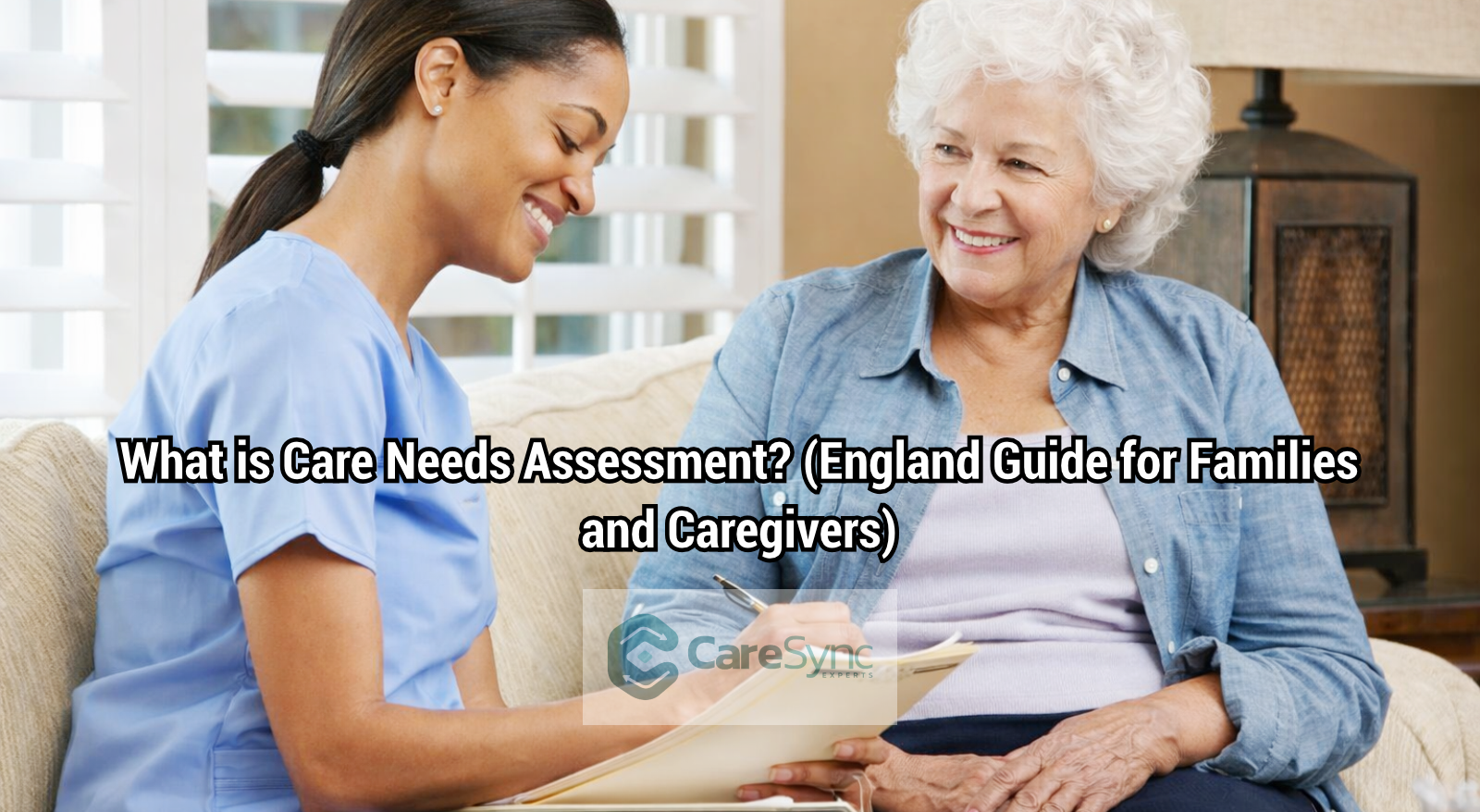
    SEE ALSO: What Is a Care Needs Assessment? (England Guide for Families and Caregivers)

    What Other Benefits Can You Claim With PIP?

    Many families ask “what other benefits can I claim with PIP?” because receiving Personal Independence Payment often unlocks additional financial support. PIP itself is not means-tested, but it can increase eligibility for other benefits and schemes that help cover daily living costs.

    Understanding these options can make a significant difference for both claimants and caregivers.

    Universal Credit

    If you receive PIP, your Universal Credit award may increase. In many cases, you may qualify for the Limited Capability for Work and Work-Related Activity (LCWRA) element, which adds extra monthly support.

    PIP can also help remove certain work requirements if your condition limits your ability to work.

    Carer’s Allowance

    If someone provides regular care for you, they may qualify for Carer’s Allowance.

    A caregiver may claim this benefit if they:

    • Provide at least 35 hours of care per week
    • Care for someone receiving the daily living component of PIP

    This support helps families who rely on caregivers to manage daily activities.

    Housing Benefit or Universal Credit Housing Support

    Receiving PIP can increase eligibility for:

    • Housing Benefit
    • Additional housing elements within Universal Credit

    Local authorities often consider disability-related benefits when assessing housing support.

    Council Tax Reduction

    Many councils offer Council Tax discounts or reductions for households where someone receives PIP.

    The exact amount depends on local council policies, but the reduction can significantly lower monthly bills.

    Motability Scheme

    If you receive the enhanced mobility component of PIP, you may qualify for the Motability Scheme.

    This program allows you to lease:

    • A car
    • A wheelchair-accessible vehicle
    • A mobility scooter

    The payment comes directly from your mobility component.

    Disabled Person’s Railcard and Travel Support

    Some people who receive PIP may qualify for:

    • Disabled Person’s Railcard
    • Discounted public transport
    • Local travel support programs

    These benefits help reduce travel costs for medical appointments, work, and daily life.

    Other Financial Support

    Depending on your circumstances, PIP may also increase eligibility for:

    • Disability-related grants
    • Energy bill support programs
    • Local authority assistance schemes

    Because PIP confirms that a person has long-term disability-related needs, many support programs use it as proof when assessing eligibility.

    Caregivers often help manage these applications and may contact the pip enquiry line or the dept work and pensions contact number if they need confirmation of an award letter.

    MORE: What Is Respite Care in the UK? 2026

    How to Contact the DWP About PIP Changes or Payment Issues

    Personal Independence Payment (PIP)

    If your situation changes or you have problems with a payment, you should contact the Department for Work and Pensions (DWP) as soon as possible. Reporting PIP changes quickly helps prevent overpayments, payment delays, or interruptions to your claim.

    The easiest way to do this is by calling the official PIP enquiry line.

    PIP Contact Number for Existing Claims

    If you already receive PIP or want to ask about your payments, use the pip contact number existing claim below:

    • PIP enquiry line: 0800 121 4433
    • Textphone / Relay UK: 0800 121 4493
    • Opening hours: Monday–Friday, 9am–5pm

    Many people search for the dwp contact number 0800, the dept work and pensions contact number, or the dept work and pensions tel no when trying to resolve issues with their claim. The number above connects you directly to the DWP team that handles Personal Independence Payment.

    Reasons to Contact the PIP Enquiry Line

    You should call the pip contact number 0800 if you need to report or discuss:

    • PIP changes to your health condition
    • A change of address or contact details
    • A hospital stay or care home admission
    • Problems with PIP payments
    • Questions about your decision letter or award review
    • Missing or delayed payments

    Caregivers often call the dept of work and pensions contact no on behalf of family members who cannot manage the claim themselves.

    What Information to Have Ready

    Before calling the PIP enquiry line, prepare the following details:

    • Your National Insurance number
    • Your date of birth
    • Your current address
    • Details about the change you need to report
    • Any letters you received from the DWP

    Having this information ready helps the advisor locate your claim quickly and resolve the issue faster.

    When the DWP May Ask You to Contact Someone Else

    Sometimes the Department for Work and Pensions contact number cannot resolve your issue directly.

    For example, if your question relates to a medical assessment appointment, the DWP may ask you to contact the company handling the assessment instead. These providers may include:

    • Capita
    • Ingeus
    • Maximus

    They manage assessment appointments and reports used to determine your PIP award.

    Scotland Update: PIP and Adult Disability Payment (ADP)

    If you live in Scotland, the system has changed. The Scottish Government has gradually replaced Personal Independence Payment (PIP) with a new benefit called Adult Disability Payment (ADP). This transition forms part of the wider Scotland PIP ADP update, which moved disability benefits from the Department for Work and Pensions to Social Security Scotland.

    What Is Adult Disability Payment (ADP)?

    Adult Disability Payment provides similar support to PIP for people with long-term disabilities or health conditions. It still includes two components:

    • Daily living support
    • Mobility support

    Like PIP, the payment helps people cover the extra costs of living with a disability or long-term health condition.

    Who Should Apply for ADP Instead of PIP?

    If you live in Scotland and need to make a new claim, you usually apply for Adult Disability Payment, not PIP.

    You may still receive PIP if:

    • You claimed PIP before ADP replaced it, or
    • Your claim is still being transferred to Social Security Scotland

    The government is gradually moving existing PIP claimants in Scotland to ADP through a managed transfer process. During this transition, most people continue receiving payments without needing to reapply.

    What Happens If You Move Between Scotland and England or Wales?

    Your benefit may change depending on where you live.

    • If you move from Scotland to England or Wales, you may need to apply for PIP again through the Department for Work and Pensions contact number.
    • If you move from England or Wales to Scotland, your PIP claim may eventually transfer to Adult Disability Payment.

    It is important to report these changes to the relevant authority so your payments continue without interruption.

    Contacting the Correct Department

    People sometimes search online for the pip contact number or the dept work and pensions contact number even though they now receive ADP.

    If you live in Scotland and receive ADP, you should normally contact Social Security Scotland instead of the DWP.

    Understanding the Scotland PIP ADP update helps avoid confusion and ensures you contact the correct department when you need help with your disability benefits.

    ALSO READ: Is MS Hereditary or Inherited? What Causes Multiple Sclerosis (2026)

    When to Contact the Assessment Provider Instead of the DWP

    PIP Application Process

    In some situations, calling the PIP enquiry line or the Department for Work and Pensions contact number will not resolve your issue. This usually happens when your question relates to the medical assessment used to decide your claim.

    The DWP reviews the final decision, but a separate organisation normally carries out the assessment itself.

    Assessment Providers Used for PIP

    Depending on where you live, the assessment may be handled by one of the following providers:

    • Capita
    • Ingeus
    • Maximus

    These organisations arrange and conduct the health assessments that help determine whether you qualify for Personal Independence Payment.

    When You Should Contact the Assessment Provider

    You may need to contact the assessment provider directly if you need to:

    • Reschedule an assessment appointment
    • Ask about the location or format of your assessment
    • Request reasonable adjustments for a disability
    • Check whether your medical evidence was received
    • Confirm details of a telephone or video assessment

    If you try to resolve these issues through the pip contact number, the DWP will usually refer you back to the assessment provider because they manage the appointment process.

    Preparing for Your Assessment

    Your assessment gives you an opportunity to explain how your condition affects your daily life. Preparing in advance can help you communicate your situation clearly.

    Consider bringing or preparing:

    • Medical reports from your GP or specialist
    • Prescription lists or treatment plans
    • A daily routine diary describing your difficulties
    • Statements from caregivers or family members

    Caregivers often attend the assessment or help explain the challenges the claimant faces each day.

    What Happens After the Assessment

    After the assessment, the healthcare professional sends a report to the Department for Work and Pensions. The DWP then reviews the report and your evidence before making the final decision on your PIP claim.

    If you disagree with the decision, you can request a mandatory reconsideration, which allows the DWP to review your case again.

    Tips for Caregivers Calling the PIP Enquiry Line

    Many people who contact the PIP enquiry line do so on behalf of a family member. Caregivers often manage the claim, report PIP changes, and resolve payment issues for someone who cannot handle the process alone.

    Calling the Department for Work and Pensions contact number can sometimes take time, so preparing in advance will make the conversation easier and faster.

    Call at the Right Time

    The pip contact number 0800 can experience long waiting times, especially during busy periods.

    To reduce delays:

    • Call early in the morning
    • Avoid Monday mornings, when call volumes are highest
    • Expect waiting times to sometimes exceed 30–60 minutes

    Planning your call can help you reach an advisor sooner.

    Have Important Information Ready

    Before calling the dept work and pensions contact number, make sure you have the key details ready. This helps the advisor locate the claim quickly.

    Prepare:

    • The claimant’s National Insurance number
    • Full name and date of birth
    • Address linked to the claim
    • Any letters received from the DWP
    • Details of the issue or change you want to report

    Caregivers should also explain that they are calling on behalf of the claimant, as the advisor may need to confirm permission before discussing the claim.

    Clearly Explain the Reason for Your Call

    When speaking to the advisor, explain the issue clearly. Common reasons for contacting the pip enquiry line include:

    • Reporting PIP changes to health conditions
    • Asking about missing or delayed payments
    • Checking the progress of a claim or review
    • Updating contact or bank details

    Providing clear information helps the advisor resolve the issue more quickly.

    Take Notes During the Call

    Write down important details during the conversation, such as:

    • The date and time of the call
    • The name of the advisor
    • Any reference numbers or instructions

    Keeping records can help if you need to follow up with the Department for Work and Pensions contact number later.

    Consider Alternative Support

    If you struggle to manage the claim process, organisations such as Citizens Advice or local disability support services can offer guidance on dealing with the DWP and managing PIP claims.

    Caregivers who understand how the pip enquiry line works often find it much easier to support a loved one through the application, review, and payment stages.

    Final Thoughts…

    Understanding Personal Independence Payment (PIP) can feel overwhelming, especially for caregivers who manage claims for a loved one. The process involves checking Personal Independence Payment eligibility, contacting the Department for Work and Pensions, completing the PIP application form, and attending an assessment before receiving a decision.

    If you need help with an existing claim, the PIP enquiry line remains the fastest way to speak directly with the DWP. The main pip contact number for existing claims is 0800 121 4433, which connects you to the Department for Work and Pensions contact number for payment questions, claim updates, or reporting PIP changes.

    For new claims, you can start the process by calling 0800 917 2222, where an advisor will guide you through the first steps of how to apply Personal Independence Payment.

    Many caregivers also want to understand how much PIP pays per month, whether PIP payments can be backdated, and what other benefits can be claimed with PIP. Knowing these details can help families plan financially and ensure the claimant receives the full support available.

    If you live in Scotland, remember that the Scotland PIP ADP update means many new claims now fall under Adult Disability Payment, which Social Security Scotland manages instead of the DWP.

    Although the process may seem complex at first, thousands of people successfully claim PIP each year with the help of caregivers, healthcare professionals, and support organisations. Preparing the right information, understanding the eligibility rules, and contacting the correct dept work and pensions contact number when needed can make the process much smoother.

    For many families, PIP provides essential financial support that helps cover the additional costs of living with a disability or long-term health condition.

    Need Help Understanding PIP or Supporting Someone With a Claim?

    If you are supporting someone with a disability and feel unsure about Personal Independence Payment eligibility, the PIP application process, or how to deal with the Department for Work and Pensions, Care Sync Experts can help.

    We support caregivers and families by explaining PIP rules in plain language, helping you understand what evidence is needed, how the assessment process works, and what steps to take if a claim becomes delayed or a decision seems incorrect.

    Our team helps you avoid common mistakes that often lead to delayed payments, failed assessments, or unnecessary stress, so you can focus on supporting the person who needs care.

    Whether you are preparing to apply for PIP, managing an existing claim, or trying to understand the support and benefits available, we are here to guide you through the process with clarity and confidence.

    FAQ

    How long does PIP last?

    Personal Independence Payment (PIP) usually lasts for a fixed award period decided by the Department for Work and Pensions (DWP). Many people receive an award that lasts between 1 and 10 years, depending on how their condition affects them and whether their situation may change over time.

    Before the award ends, the DWP normally reviews the claim. They may ask you to complete a review form or attend another assessment to confirm whether you still qualify for PIP and whether the payment rate should stay the same.

    Some people with long-term or lifelong conditions receive ongoing awards, which do not have a set end date but are still reviewed periodically.

    Can I claim PIP if I work?

    Yes, you can claim Personal Independence Payment even if you work. PIP focuses on how your health condition or disability affects your daily living and mobility, not your employment status.

    This means you may qualify for PIP if you:
    – Work full time
    – Work part time
    – Are self-employed

    The Department for Work and Pensions assesses the difficulty you have completing daily activities, rather than whether you earn a salary. Many people continue working while receiving PIP because the payment helps cover the extra costs associated with disability or long-term health conditions.

    What documents are needed to apply for PIP?

    When applying for Personal Independence Payment, you should provide supporting evidence that explains how your condition affects your daily life. Strong evidence can help the DWP understand your needs before your assessment.

    Common documents include:
    – Letters or reports from your GP or medical specialist
    – Prescription records or medication lists
    – A care plan or treatment plan
    – Statements from caregivers, family members, or support workers
    – A daily routine diary explaining your difficulties

    Providing clear evidence makes it easier for the assessor to understand how your condition affects everyday activities such as washing, dressing, cooking, or travelling.

    How is PIP back paid?

    If your claim is successful, the Department for Work and Pensions may issue backdated PIP payments. This means you receive a lump sum covering the period between the date you started your claim and the date the decision was made.

    For example, if you started your claim in January but the DWP approved it in April, you could receive several months of back payments in your first deposit.

    These payments usually arrive as a single lump sum, followed by regular PIP payments every four weeks going forward.

  • Labour Home Support Plan Pensioner Devices: 2026 Update

    Labour Home Support Plan Pensioner Devices: 2026 Update

    The labour home support plan pensioner devices initiative refers to a digital inclusion funding programme aimed at helping some older people access technology and online services. Under this approach, community organisations and local councils may distribute devices such as laptops or smartphones to pensioners who struggle with digital access.

    However, the plan does not mean every pensioner will automatically receive free devices. Instead, the funding supports targeted projects that help older adults connect to essential services, including GP appointments, benefits applications, and support for elderly living at home UK.

    For many families and caregivers, the bigger picture goes beyond devices. Pensioners may already qualify for care packages, NHS home care services, financial support for elderly living at home, and short-term help such as 6 weeks free care after hospital. Understanding how these systems work helps older people stay independent at home while receiving the support they need.

    Get expert support for your next tender, inspection-ready policies, or CQC registration — book a call with Care Sync Experts today and let’s get you compliant and competitive.

    What Labour’s Home Support Plan Means for Pensioners and Caregivers

    10 Proven Ways to Get Clients After CQC Registration in 2025

    The labour home support plan pensioner devices announcement centres on a £9.5 million Digital Inclusion Innovation Fund designed to help more people get online. Rather than sending devices directly to every pensioner, the government will distribute funding to councils, charities, and community organisations that work with digitally excluded groups. These organisations may then provide devices such as laptops, phones, or other smart tech to people who struggle to access online services.

    For many caregivers, this matters more than it first appears. Digital access now plays a major role in care UK benefits and support services. Older adults increasingly rely on online systems to book GP appointments, access NHS home care services, manage prescriptions, and apply for financial support for elderly living at home. Without a device or internet access, pensioners can struggle to connect with the very services designed to help them stay independent.

    The broader aim of the plan links technology with support for elderly living at home UK. When older people can use digital tools safely, they can communicate with health professionals, attend remote consultations, and stay connected with family members or carers who support their day-to-day wellbeing. For caregivers, this can make coordination easier and reduce isolation for the person receiving care.

    However, devices alone do not replace practical care. Most pensioners who need daily help still rely on a social services elderly care package, NHS support, or community-based care services. The next step is understanding what types of help already exist for older people living at home in the UK and how families can access them.

    RELATED: What Is the Carers Element Universal Credit? 2026

    Support for Elderly Living at Home in the UK: What Is Already Available

    Support at Home vs Home Care Packages 2026

    Many families assume they must pay privately for help when an older relative begins to struggle at home. In reality, the UK already provides several forms of support for elderly living at home UK, although access often depends on an assessment of need.

    The first place to start is the local council. Adult social services can arrange a social services elderly care package after completing a care needs assessment. This care package may include help from a paid carer with daily tasks such as washing, dressing, preparing meals, medication reminders, and sometimes overnight care if the person’s needs require it. Some councils describe this as an individual support package, meaning the support plan is tailored to the person’s health, mobility, and safety needs.

    For many older adults, councils also arrange free home help for the elderly UK when the help falls under short-term recovery or prevention support. One example is reablement services, which help people regain independence after illness, injury, or a hospital stay.

    In addition to council services, the NHS provides several forms of NHS home care services. These can include district nurses, physiotherapy, and community health support delivered directly in the person’s home. In more complex situations, the NHS may also assess someone for continuing healthcare, which can cover the full cost of care if the person’s primary need relates to health rather than social care.

    Alongside care services, many older people can access financial support for elderly living at home, including benefits such as Attendance Allowance or Personal Independence Payment. These payments help families cover additional care needs, transport, or home adjustments that support independence.

    Understanding these options helps caregivers make informed decisions. The next step is understanding exactly what a care package is in health care and how families can request one when a loved one needs extra support.

    What Is a Care Package in Health Care and Who Arranges It?

    Home Care Package Management

    A care package is a personalised plan of support designed to help someone manage daily life safely at home. In the UK, local councils usually arrange this support through adult social services after completing a care needs assessment.

    In simple terms, what is a care package in health care? It is a structured plan that identifies what help a person needs, who will provide it, and how often support should take place. Councils often describe it as an individual support package because it reflects the person’s health, mobility, and living situation.

    A typical social services elderly care package may include help with:

    • Washing, dressing, and personal hygiene
    • Preparing meals or assistance with eating
    • Medication reminders
    • Mobility support around the home
    • Light household tasks such as cleaning or laundry
    • Safety checks or welfare visits
    • In some cases, overnight care if the person cannot stay safely alone

    A social worker or care assessor usually designs the care package after visiting the person at home and discussing their needs with them and their caregiver. The assessor looks at the person’s physical health, mental well-being, mobility, and ability to carry out everyday tasks.

    If the council approves the support, the person may receive services from a home care agency, or the council may provide a personal budget so the family can arrange support themselves.

    For caregivers, requesting this assessment is often the first practical step toward getting structured help at home. However, some families do not realise that short-term support can sometimes start even earlier, especially after a hospital stay.

    This is where the 6 weeks free care after hospital service can play a crucial role in helping older adults regain independence before long-term care decisions are made.

    READ MORE: How to Choose Home Care Agencies in the UK (2026)

    6 Weeks Free Care After Hospital: What Families Should Ask For

    Many caregivers do not realise that older adults may receive 6 weeks free care after hospital through a short-term recovery service known as reablement or intermediate care. This support helps people regain independence after illness, injury, or surgery so they can return to daily life safely at home.

    When hospital staff believe someone needs help during recovery, they can arrange temporary home support before discharge. The service usually provides free home help for the elderly for up to six weeks while the person rebuilds strength and confidence.

    During this period, professionals may provide:

    • Help with washing, dressing, and using the bathroom
    • Support with mobility and preventing falls
    • Assistance with meals and medication routines
    • Visits from nurses or therapists as part of NHS and nursing recovery support
    • Short-term home visits from carers who help the person practise daily tasks safely

    Unlike long-term social care, this temporary support focuses on rehabilitation rather than ongoing assistance. The goal is to help the person become as independent as possible and reduce the likelihood of readmission to hospital.

    Families should ask about 6 weeks free care after hospital before discharge if an older relative struggles with mobility, balance, or daily tasks. The hospital discharge team, a GP, or community health professionals can usually arrange an assessment to determine whether this support is appropriate.

    If someone’s health needs remain complex even after recovery, professionals may then consider a longer-term solution such as continuing healthcare, which can fund care when medical needs become the primary concern.

    When Continuing Healthcare May Cover Care Costs at Home

    labour home support plan pensioner devices
    labour home support plan pensioner devices

    Some older adults develop health needs so complex that social care support alone no longer meets their needs. In these situations, the NHS may fund care through continuing healthcare, often called continuing health care.

    Continuing healthcare is a fully funded package of care arranged and paid for by the NHS when a person has a primary health need. This means their care requirements mainly relate to ongoing medical conditions rather than day-to-day support with tasks such as cooking or cleaning.

    If someone qualifies, the NHS can fund a wide range of services, including:

    • Regular NHS home care services delivered in the person’s home
    • Specialist nursing support from community healthcare teams
    • Personal care, such as washing, dressing, and mobility assistance
    • Medical equipment and monitoring
    • In some cases, full care support for people with complex conditions, such as advanced neurological illness or severe dementia

    For families supporting someone with dementia, it is important to understand that free care for dementia patients UK is not automatic. However, if the person’s condition creates significant medical needs, such as severe behavioural challenges, complex medication management, or high clinical supervision, they may qualify for continuing healthcare funding.

    The assessment process usually starts with a screening checklist completed by a nurse, GP, or social worker. If the person passes this stage, a multidisciplinary team will carry out a detailed assessment of their health needs.

    When approved, the NHS pays the full cost of care. This can reduce or eliminate concerns about care home fees, and it may also cover professional support delivered directly in the person’s home. For families navigating long-term illness, understanding continuing health care can make a major difference in accessing the right level of support.

    SEE ALSO: Starting a Care Home in the UK: Best 2026 Guide

    What Equipment and Home Help Might Be Available for Free?

    Many families are surprised to learn that councils and the NHS may provide certain equipment and home adaptations at little or no cost after a care needs assessment. These practical supports help older people remain safe and independent at home, especially when mobility or health conditions make everyday tasks more difficult.

    After an occupational therapist or social care assessor visits the home, they may recommend equipment designed to reduce risk and support daily living. In some cases, families can receive items such as:

    • Handrails for stairs or hallways
    • Grab rails for bathrooms
    • A free shower chair for elderly people who struggle to stand safely while bathing
    • Raised toilet seats or toilet support frames
    • Walking frames or mobility aids
    • Small ramps for wheelchair or mobility scooter access

    In some situations, families may also ask how to get a hospital bed for free UK. While hospital-style beds are not automatically provided, they may be supplied if health professionals believe the person’s medical condition requires specialist equipment at home.

    These decisions usually follow a home assessment carried out by adult social services or NHS professionals. If the assessor identifies a risk to safety or independence, the council may arrange the equipment as part of the person’s care package or wider support plan.

    For caregivers, these small adjustments can make a significant difference. Simple equipment can reduce falls, make personal care easier, and help older adults stay in their own homes longer, which is often the goal of care free or preventative support services aimed at delaying more intensive care.

    If needs increase over time, the care plan may also expand to include more structured home support or transition planning. In some cases, families may eventually need to explore options such as supported living, temporary recovery care, or understanding convalescent home costs when someone needs a short period of supervised recovery before returning home.

    MORE: Home Reversion Plan 2026: How It Works, Costs, Risks, Examples

    What Caregivers Should Do Next

    How to Access Home Care Packages in 5 Steps
    How to Access Home Care Packages in 5 Steps

    If you support an older relative at home, start by identifying what help they may already qualify for. Many families miss available support simply because they do not request an assessment early enough.

    First, contact your local council’s adult social services and request a care needs assessment. This assessment determines whether the person qualifies for a care package or social services elderly care package to support daily living at home.

    Second, if your relative recently left hospital, ask the discharge team about 6 weeks free care after hospital. This short-term support can help someone recover safely at home before deciding whether they need long-term services.

    Third, ask a GP or health professional whether the person should be assessed for continuing healthcare if their needs are primarily medical. When approved, continuing health care can cover a large portion of care costs and may reduce concerns about care home fees.

    Caregivers should also check whether the person qualifies for financial support for elderly living at home, including benefits that help cover mobility support, personal care, or additional home help.

    Finally, remember that government announcements such as the labour home support plan pensioner devices initiative may provide new ways for older adults to stay connected and access services online. However, practical support, including home care, equipment, and health services, still comes primarily through councils, the NHS, and community care providers.

    By understanding these options early, caregivers can secure the right support sooner and help older adults remain safe, independent, and comfortable in their own homes for as long as possible.

    READ: Employment Rights Bill: What UK Care Workers Must Do Before 2026–2027

    Quick Summary: Home Support Options for Pensioners in the UK

    The labour home support plan pensioner devices announcement focuses on improving digital access for older adults through a £9.5 million digital inclusion fund distributed through councils and community groups. While this may help some pensioners receive devices or smart tech, it is only one part of the wider system of support for elderly living at home UK.

    Older adults in the UK may already qualify for several forms of support, including:

    • A social services elderly care package arranged by the local council
    • Free home help for the elderly UK through short-term recovery services
    • Up to 6 weeks free care after hospital through reablement support
    • NHS home care services delivered by community nurses or therapists
    • Fully funded care through continuing healthcare when medical needs are complex
    • Equipment or adaptations that improve safety and independence at home

    For caregivers, the most important step is requesting a care assessment through the local council or NHS professionals. This process determines whether the person qualifies for a care package, financial assistance, or specialist health support at home.

    Need Expert Guidance on Home Care and Support Services?

    Care Sync Experts supports care providers, managers, and healthcare teams across the UK with clear, practical guidance on navigating home care services, care packages, and funding pathways for older adults.

    From helping organisations understand care package assessments and continuing healthcare eligibility to strengthening care planning and preparing for regulatory expectations, our team helps providers deliver safe, effective support for people living at home.

    Whether you need assistance reviewing care documentation, improving service quality, or aligning your organisation with modern health and social care standards, we provide structured, professional guidance you can rely on.

    Support older adults to live safely and independently at home.

    Contact Care Sync Experts today and strengthen your home care services with confidence.

    FAQ

    What Support Is There for Pensioners in the UK?

    Pensioners in the UK can access several forms of support depending on their health, financial situation, and care needs. This can include a social services elderly care package arranged by the local council, NHS home care services, and short-term recovery support such as 6 weeks free care after hospital through reablement services.

    Older adults may also qualify for financial support for elderly living at home, including Attendance Allowance or Pension Credit. In cases where medical needs become complex, the NHS may fund care through continuing healthcare, which can cover the full cost of care at home or in a care facility.

    What Can You Claim When You Are a Pensioner?

    Pensioners may be able to claim several benefits depending on their circumstances. Common examples include Attendance Allowance, which helps cover extra care needs, and Pension Credit, which provides additional income support for people on lower pensions.

    Some people may also qualify for help with housing costs, council tax reductions, or financial support for elderly living at home if they require regular care. If health needs become severe, the NHS may assess someone for continuing healthcare, which can fund care services directly.

    How Much Is the Full State Pension?

    The full new State Pension in the UK depends on the number of qualifying National Insurance years a person has built up during their working life. To receive the full amount, most people need around 35 qualifying years of National Insurance contributions.

    The exact weekly amount is reviewed each year under the government’s “triple lock” system, which aims to increase the pension in line with inflation, wage growth, or 2.5%, whichever is highest. Pensioners should check the latest figures through the official government pension service because payments can change each tax year.

    How Much Is the State Pension Going Up in 2026?

    State Pension increases depend on the triple lock policy, which adjusts pensions based on inflation, average wage growth, or a minimum increase of 2.5%. Each year the government announces the confirmed rise in the Autumn Budget or Spring Statement before the new tax year begins.

    Because of this system, the exact increase for 2026 can vary depending on economic conditions. Pensioners usually see any increase applied automatically to their payments from April at the start of the new financial year.

  • What Is the Carers Element Universal Credit? 2026

    What Is the Carers Element Universal Credit? 2026

    The carers element Universal Credit is an extra monthly payment added to your Universal Credit award if you spend at least 35 hours a week caring for a disabled person. For the 2025–2026 financial year, the universal credit carer element is worth £201.68 per month and is paid as part of your regular Universal Credit calculation.

    You do not need to claim Carer’s Allowance to receive the carers element, and there is no specific earnings limit attached to it. However, because it forms part of Universal Credit, the final amount you receive will still depend on your household income and other elements included in your claim.

    To qualify for the carers element Universal Credit 2026, the person you care for must receive a qualifying disability benefit, such as the daily living component of Personal Independence Payment (PIP), Disability Living Allowance care component, Attendance Allowance, or Armed Forces Independence Payment. 

    If you meet the caring requirements and report your role to the Department for Work and Pensions (DWP), the payment can be added to your Universal Credit award to provide extra financial support for your caring responsibilities.

    Get expert support for your next tender, inspection-ready policies, or CQC registration — book a call with Care Sync Experts today and let’s get you compliant and competitive.

    Carers Element Universal Credit Eligibility: Who Can Claim?

    Care Tenders UK 2026: How to Find & Win Local Authority Contracts

    You may qualify for the carers element Universal Credit if you have regular and substantial caring responsibilities for someone with a disability. The Department for Work and Pensions (DWP) adds this carers element to your Universal Credit award when you meet several key conditions.

    To meet the Carers Element Universal Credit eligibility rules, you must:

    • Be 16 years old or over
    • Provide at least 35 hours of care each week
    • Care for someone who receives a qualifying disability benefit
    • Be claiming Universal Credit
    • Not be in full-time education

    You do not need to live with the person you care for, but you must show that your caring role is genuine and consistent.

    Once you report your caring responsibilities, the DWP may also change your work requirements under Universal Credit. Many carers move into a “no work-related requirements” group, meaning the Jobcentre will not expect them to search for work while they provide significant care.

    Because the carers element Universal Credit forms part of your overall claim, your Universal Credit work allowance and household income can still affect the final amount you receive each month.

    RELATED: Attendance Allowance Pitfalls (2026): Best Guide to Claim AA Successfully

    Which Disability Benefits Qualify for the Carers Element?

    To receive the universal credit carer element, the person you care for must already receive a qualifying disability benefit. The Department for Work and Pensions uses these benefits as proof that the person needs substantial care.

    The Carers Element Universal Credit eligibility usually requires the person you support to receive one of the following:

    • Personal Independence Payment (PIP) – daily living component
    • Disability Living Allowance (DLA) – middle or highest rate care component
    • Attendance Allowance
    • Armed Forces Independence Payment

    If the person you care for receives one of these benefits, you can report your caring responsibilities in your Universal Credit account so the carers element Universal Credit can be added to your claim.

    If you care for a disabled child, your Universal Credit award may already include the child element Universal Credit or the disabled child element Universal Credit. In this situation, you may still qualify for the carers element if you personally provide at least 35 hours of care each week.

    Many families caring for disabled children receive multiple Universal Credit elements, which can significantly increase the total support available each month.

    How to Apply for Carers Element of Universal Credit

    Carers Element Universal Credit
    Carers Element Universal Credit

    You do not submit a separate application to receive the carers element Universal Credit. Instead, you must report your caring responsibilities directly in your Universal Credit account.

    To apply for carers element of Universal Credit, follow these steps:

    1. Log in to your Universal Credit online account.
    2. Open your journal and report that you provide care for someone.
    3. Provide details about the person you care for, including:
      • Their name and date of birth
      • Their National Insurance number (if known)
      • The disability benefit they receive
      • The number of hours you provide care each week

    Once you report this information, the Department for Work and Pensions (DWP) will review your circumstances. If you meet the conditions, they will add the carers element to your Universal Credit award during your next assessment period.

    It is important to report your caring role as soon as possible. The DWP does not automatically know you are a carer, even if you receive other benefits such as Carer’s Allowance, so your Universal Credit payment may stay lower until you update your claim.

    READ MORE: What Is Person Centred Care? 2026 Guide

    How Much Is the Universal Credit Carer Element in 2026?

    The carers element Universal Credit 2026 is worth £201.68 per month for the 2025–2026 financial year. The Department for Work and Pensions (DWP) adds this amount to your Universal Credit payment if you meet the caring requirements.

    This payment forms part of your maximum Universal Credit award, which includes the standard allowance and any additional elements you qualify for, such as the child element Universal Credit, housing costs element, or childcare support.

    Unlike Carer’s Allowance, the universal credit carer element does not have a strict earnings limit. However, because Universal Credit is a means-tested benefit, your total household income will still affect the final amount you receive each month.

    The carers element is designed to act as an extra DWP payment for low-income carers, helping support people who provide regular care while managing work or other responsibilities.

    Carers Element Universal Credit and Carers Allowance: What’s the Difference?

    How can Universal Credit help my business
    How can Universal Credit help my business

    Many carers confuse the carers element Universal Credit with Carer’s Allowance, but they are two different types of support.

    The carers element Universal Credit is an extra amount added to your Universal Credit payment if you provide at least 35 hours of care each week for someone receiving a qualifying disability benefit. It does not have a fixed earnings limit, although your overall Universal Credit award will still depend on your household income.

    Carer’s Allowance, on the other hand, is a separate benefit paid directly to carers. It does have an earnings limit, and the government reviews this limit each year. This often leads people to ask questions like “is Carer’s Allowance means tested?” While it is not strictly means-tested, your earnings must stay below the allowed threshold to receive it.

    You can receive both the carers element Universal Credit and Carer’s Allowance at the same time. However, if you claim Carer’s Allowance, the payment will usually count as income when the DWP calculates your Universal Credit award. In practice, this means your Universal Credit may reduce slightly, but most carers still end up better off overall.

    In Scotland, carers may also receive additional support through Carer’s Allowance Supplement, which increases the total support available for eligible carers.

    LCWRA and Carers Element: Can You Receive Both?

    You cannot receive both the carers element Universal Credit and the Limited Capability for Work and Work-Related Activity (LCWRA) element at the same time.

    The LCWRA payment supports people whose health condition or disability prevents them from working. If you qualify for LCWRA, Universal Credit will normally award this element instead of the carers element, because the system only pays one of these elements at a time.

    In most cases, the LCWRA rates are higher than the carers element. When someone qualifies for both, the Department for Work and Pensions automatically applies the higher payment to your claim.

    Recent Universal Credit LCWRA changes have not altered this rule. The system still prioritises the higher element when calculating your final Universal Credit award.

    SEE ALSO: First Person vs Third Person Care Plan: CQC and the Mental Capacity Act Expectation in 2026

    Can Couples Claim the Carer Element?

    Yes, couples can claim the Carer’s Element Universal Credit joint claim in certain situations. Universal Credit assesses couples as a single household, but both partners may still qualify for the carers element if they each care for a different disabled person.

    For example, one partner may care for a disabled parent while the other provides support for a disabled child. If both partners provide at least 35 hours of care per week, Universal Credit can include two carers elements in the same claim.

    This situation can also arise in families caring for more than one child with additional needs. If both parents provide substantial care, the claim may include both the child element Universal Credit and the carers element Universal Credit for 2 children, where the caring responsibilities apply separately.

    Because Universal Credit calculates payments at the household level, the Department for Work and Pensions will review the full claim to confirm that each partner meets the caring requirements.

    Can the Carers Element Universal Credit Be Backdated?

    In some situations, the carers element Universal Credit backdated payment may apply if you started caring earlier but did not report it straight away.

    Universal Credit usually adds the carers element from the date you report your caring responsibilities in your online journal. However, the Department for Work and Pensions may allow backdating if the person you care for only recently received their qualifying disability benefit, such as Personal Independence Payment or Attendance Allowance.

    For example, if the disabled person’s benefit award is backdated, you may also be able to request that the carers element Universal Credit applies from the same date.

    To avoid losing payments, carers should report their caring role as soon as possible in their Universal Credit account. This ensures the Department for Work and Pensions can assess the claim and include the additional support in the next assessment period.

    MORE: Do Dementia Sufferers Have to Pay Care Home Fees in the UK? (2026 Guide)

    Additional Universal Credit Payments Carers Should Know About

    What is Universal Credit

    Carers receiving the carers element Universal Credit may also qualify for other payments depending on their household circumstances. Universal Credit combines several elements to calculate the final monthly award.

    For example, families with children may receive the child element Universal Credit, while households caring for a disabled child can receive the disabled child element Universal Credit. These additional elements increase the maximum Universal Credit amount before income deductions apply.

    Carers should also watch for temporary government support such as the cost of living payment 2024/25 Universal Credit, which the government provides to many low-income households during periods of rising living costs. In previous years, the government also issued one-off payments like the Universal Credit £325 payment to support claimants.

    Your Universal Credit work allowance may also apply if you work while claiming Universal Credit. This allowance lets you earn a certain amount before your Universal Credit payment starts to reduce.

    Together, these elements and temporary payments can significantly increase the overall support available to low-income households caring for someone with a disability.

    Key Takeaways for Carers Claiming Universal Credit

    • The carers element Universal Credit provides an extra £201.68 per month for people who care for someone for at least 35 hours a week.
    • You do not need to claim Carer’s Allowance to receive the universal credit carer element.
    • The person you care for must receive a qualifying disability benefit such as PIP daily living, DLA care component, or Attendance Allowance.
    • You must report your caring responsibilities in your Universal Credit journal for the payment to be added to your claim.
    • You cannot receive both the carers element and the LCWRA element at the same time — Universal Credit will apply the higher payment.
    • In some cases, the carers element Universal Credit backdated payment may apply if the disabled person’s benefit is awarded retrospectively.
    • Couples may both receive the carer’s element Universal Credit joint claim if each partner cares for a different disabled person.

    Final Thoughts…

    Providing regular care for someone with a disability can be demanding, both emotionally and financially. The carers element Universal Credit exists to recognise that commitment and provide additional support to people who dedicate significant time to caring for others.

    However, many carers miss out on this payment simply because they do not realise they qualify or they do not report their caring responsibilities correctly in their Universal Credit claim. Understanding the rules around eligibility, backdating, and how the carers element interacts with other benefits can make a real difference to the amount of support you receive.

    If you are supporting someone with a disability and feel unsure about Universal Credit elements, caring requirements, or how to report your role correctly, Care Sync Experts can help.

    We work with carers and families to clarify benefit eligibility, explain Universal Credit rules in plain language, and help you understand the support available so you can avoid common mistakes that delay payments or reduce the financial help you may be entitled to.

    FAQ

    What can I claim if I am a carer?

    If you care for someone with a disability, you may qualify for several types of financial support depending on your circumstances. Many carers receive the carers element Universal Credit, which adds an extra monthly amount to their Universal Credit payment if they provide at least 35 hours of care per week.

    You may also qualify for Carer’s Allowance, which is a separate benefit paid to carers who meet the earnings and caring requirements. Some carers can receive both benefits at the same time, although Carer’s Allowance usually counts as income when Universal Credit is calculated.

    Other support may include the child element Universal Credit, the disabled child element Universal Credit, housing support, and occasional government payments for low-income households.

    Is carers element extra money?

    Yes. The carers element is extra money added to your Universal Credit payment if you provide substantial care for someone with a disability.
    It increases the maximum Universal Credit amount your household can receive before income deductions apply.

    The Department for Work and Pensions includes this element alongside other Universal Credit components such as the standard allowance, child element, or housing costs element.
    Because Universal Credit is means-tested, the final amount you receive will still depend on your income, savings, and household circumstances.

    How many people can claim the carers element?

    More than one person can receive the carers element Universal Credit, but each person must care for a different disabled individual.

    For example, in a couple’s Universal Credit claim, both partners may qualify for the carer’s element Universal Credit joint claim if they each provide at least 35 hours of care per week for separate people who receive qualifying disability benefits.

    However, only one person can claim caring support for the same disabled person at a time.

    Will claiming carers element affect my Universal Credit?

    Claiming the carers element Universal Credit usually increases the maximum amount you can receive each month because it adds an additional element to your claim.

    However, your total Universal Credit payment still depends on factors such as household income, savings, and other elements included in your award. If you already receive certain elements, such as LCWRA, the system may apply the higher element instead of the carers element when calculating your payment.

    In most cases, adding the carers element results in more financial support for people with significant caring responsibilities.

  • What Is Person Centred Care? 2026 Guide

    What Is Person Centred Care? 2026 Guide

    Person centred care is an approach to healthcare and social care that places the individual receiving care at the centre of all decisions about their support, treatment, and wellbeing. Instead of focusing only on a condition or illness, professionals consider the person’s preferences, values, lifestyle, and goals when delivering care.

    In simple terms, the person centred care meaning is providing care that respects the whole person and involves them as an active partner in decisions about their health.

    When people ask what is person centred care, the answer often overlaps with patient centred care and the person centred approach used across health and social care services. Caregivers, nurses, and support staff work collaboratively with individuals and their families to design care that fits their needs. This approach ensures that care remains respectful, personalised, and responsive rather than standardised or task-focused.

    In practice, person centred care in health and social care means listening carefully to the individual, adapting care plans to reflect their wishes, and supporting them to maintain independence whenever possible. Care providers move beyond simply treating symptoms and instead focus on improving the person’s overall quality of life, dignity, and wellbeing.

    Get expert support for your next tender, inspection-ready policies, or CQC registration — book a call with Care Sync Experts today and let’s get you compliant and competitive.

    What Is Person-Centred Care in Health and Social Care?

    Healthcare Tender Eligibility UK: 3 Hidden Checks Before You Bid (2026)

    In care in health and social care, a person centred approach means caregivers design support around the individual rather than around routines, institutions, or medical conditions. Care professionals listen to the person, understand their preferences, and adapt services to support their physical, emotional, and social needs.

    For example, a domiciliary caregiver visiting someone at home does more than complete scheduled tasks. They ask about the person’s daily routine, preferred meals, cultural practices, and personal goals. The caregiver then adjusts care plans so the support reflects the individual’s lifestyle rather than forcing the person to adapt to a rigid service structure.

    In hospitals, nursing teams use person centred care by involving patients in treatment decisions and clearly explaining available options. In care homes, resident site staff encourage residents to maintain independence, make choices about their day, and participate in activities that matter to them.

    Ultimately, what is person-centred care in health and social care comes down to one principle: treating people as individuals with unique lives, experiences, and priorities. When caregivers adopt this mindset, care becomes more respectful, more effective, and far more meaningful for the person receiving support.

    RELATED: What Is a Care Needs Assessment? (England Guide for Families and Caregivers)

    What Are the 4 Principles of Person-Centred Care?

    The Eight Principles of Patient-Centered Care
    The Eight Principles of Patient-Centered Care

    To understand what are the 4 principles of person-centred care, caregivers should focus on four core ideas that guide how support is delivered in care in health and social care settings. These principles ensure that person centred care remains respectful, collaborative, and responsive to individual needs.

    1. Respect and Dignity

    Care providers must treat every individual with dignity, compassion, and respect. This means recognising personal beliefs, cultural values, and privacy needs. Caregivers should listen carefully, avoid assumptions, and ensure that each person feels valued and heard.

    2. Individualised Care

    No two people have the same needs. A person centred approach requires caregivers to tailor care plans around the individual’s health condition, daily routine, preferences, and long-term goals. Support should adapt to the person rather than forcing the person to adapt to the service.

    3. Shared Decision-Making

    Person centred care encourages individuals to take an active role in decisions about their treatment and support. Care professionals provide clear information about options and work with the person to decide what approach best suits their circumstances.

    4. Independence and Empowerment

    Care should help individuals maintain control over their lives whenever possible. Caregivers support people to build confidence, make informed choices, and manage aspects of their own health and wellbeing. Empowerment helps improve both outcomes and quality of life.

    Together, these four principles form the foundation of person centred care, guiding caregivers to deliver support that respects the whole person rather than focusing only on illness or tasks.

    Examples of Person-Centred Care in Practice

    Understanding examples of person-centred care helps caregivers translate the theory into everyday practice. A strong person centred approach focuses on the individual’s preferences, routines, and goals rather than delivering identical care to every patient or resident.

    Example 1: Dementia Care in a Care Home

    A resident living with dementia becomes anxious in the evenings. Instead of applying a generic solution, resident site staff review the individual’s history and learn that the person previously worked night shifts. Caregivers adjust the routine, provide calming evening activities, and update the resident’s care plans to reflect this preference. This personalised adjustment reduces distress and improves wellbeing.

    Example 2: Person-Centred Care in Nursing

    In hospitals, examples of person-centred care in nursing often involve shared decision-making. A nurse explains treatment options to a patient recovering from surgery and asks about their comfort level, cultural needs, and recovery goals. The nurse then works with the patient to choose the most suitable care plan rather than making the decision alone.

    Example 3: Domiciliary Care Support at Home

    A domiciliary caregiver visits a client who values independence but needs help with daily activities. Instead of completing every task for them, the caregiver encourages the person to participate in preparing meals or organising medication. This person centred care approach supports independence while still ensuring safety and proper care.

    These examples of person-centred care show how small adjustments in communication, planning, and daily support can significantly improve the quality of care in both healthcare and social care settings.

    READ MORE: Do Dementia Sufferers Have to Pay Care Home Fees in the UK? (2026 Guide)

    What Is Person-Centred Care and Why Is It Important?

    The 6 C’s

    Many caregivers ask what is person-centred care and why is it important in modern healthcare systems. The answer lies in how this approach improves both the experience and the outcomes of care. When professionals adopt a person centred approach, they move away from task-based care and focus on understanding the individual’s goals, values, and daily realities.

    In care in health and social care, this approach builds stronger relationships between caregivers and the people they support. Patients and residents feel heard and respected, which increases trust and cooperation during treatment or support. As a result, individuals often follow care recommendations more confidently and remain more engaged in their own wellbeing.

    Research also shows that patient centred care can lead to better health outcomes. When caregivers involve individuals in decisions, they often choose care options that align better with their lifestyle and needs. This improves satisfaction, reduces misunderstandings, and supports safer care delivery.

    The importance of person centred care lies in recognising that healthcare is not only about treating illness. It is about supporting people to live meaningful lives while maintaining dignity, independence, and control over their own health decisions.

    Benefits of Person-Centred Care for Patients and Caregivers

    The benefits of person-centred care extend beyond improving patient satisfaction. When caregivers adopt a person centred approach, both individuals receiving care and the professionals delivering it experience better outcomes.

    1. Improved Health Outcomes

    When individuals participate in decisions about their treatment, they often follow care recommendations more consistently. This leads to better management of long-term conditions and fewer complications.

    2. Greater Independence

    Person centred care encourages people to maintain control over their daily lives. Caregivers support individuals in completing tasks themselves where possible, helping them build confidence and maintain independence.

    3. Better Communication and Trust

    Open conversations between caregivers and individuals strengthen relationships. Patients feel more comfortable sharing concerns, which helps caregivers provide safer and more effective care.

    4. Higher Satisfaction for Patients and Staff

    When care reflects a person’s preferences and goals, individuals feel respected and valued. Caregivers also experience greater job satisfaction because they see the positive impact of their work.

    5. More Effective Care Planning

    A person centred approach ensures that care plans reflect the individual’s real needs rather than generic assumptions. This leads to more coordinated support across healthcare and social care services.

    Overall, the benefits of person-centred care include improved wellbeing, stronger relationships between caregivers and patients, and better long-term outcomes across care in health and social care settings.

    SEE ALSO: Attendance Allowance Pitfalls (2026): Best Guide to Claim AA Successfully

    What Is Person-Centred Planning?

    What Is Person-Centred Care
    What Is Person-Centred Care

    Person-centred planning is the process caregivers use to turn the principles of person centred care into practical support. Instead of professionals creating plans alone, caregivers work with the individual, their family, and other professionals to design care plans that reflect the person’s goals, preferences, and daily life.

    When people ask what is person centered planning, they usually want to understand how individuals stay involved in shaping their own care. In a person centred approach, planning begins with listening. Caregivers ask about what matters most to the person, how they want to live, and what support they need to remain safe and independent.

    For example, a care worker supporting someone with mobility challenges may ask about the person’s daily routine, hobbies, and preferred level of assistance. The caregiver then adapts the care plans to support those activities rather than replacing them with a standard schedule.

    In care in health and social care, effective person-centred planning helps coordinate services across nurses, support workers, therapists, and family members. When everyone works from the same personalised plan, care becomes more consistent, respectful, and aligned with the individual’s needs.

    Person-Centred Care in Nursing and Therapy

    Healthcare professionals apply person centred care every day in clinical settings. Nurses, therapists, and support workers use a person centred approach to understand the individual behind the condition and adapt care accordingly.

    In nursing practice, examples of person-centred care in nursing often involve communication and shared decision-making. A nurse caring for a patient recovering from surgery may ask about the person’s pain tolerance, cultural preferences, and recovery goals before adjusting medication schedules or rehabilitation plans. Instead of delivering standardised treatment, the nurse works with the patient to create a recovery plan that suits their needs.

    Mental health professionals also use person centred therapy, a psychological approach that focuses on empathy, active listening, and unconditional positive regard. Therapists encourage individuals to express their thoughts and feelings openly while guiding them to develop their own solutions to personal challenges.

    Across care in health and social care, these approaches strengthen trust between professionals and individuals receiving support. When caregivers actively listen and respond to personal needs, they build stronger relationships and deliver care that respects dignity, independence, and individual identity.

    MORE: Council Care Cost Inheritance: Who Pays for Care Home Fees 2026?

    Key Takeaways

    • Person centred care places the individual at the centre of all decisions about their health, wellbeing, and daily support. It focuses on understanding the person’s preferences, values, and goals rather than treating only a condition or illness.
    • When people ask what is person centred care, the answer involves a collaborative approach where caregivers, patients, and families work together to shape support that reflects the individual’s needs.
    • The four core principles of person centred care include respect and dignity, individualised support, shared decision-making, and empowerment to maintain independence.
    • Real examples of person-centred care appear in everyday situations across care in health and social care, from nurses involving patients in treatment decisions to domiciliary caregivers adapting care plans to suit a person’s routine.
    • The benefits of person-centred care include improved health outcomes, stronger caregiver-patient relationships, better communication, and greater independence for individuals receiving support.

    By applying a consistent person centred approach, healthcare professionals and caregivers can deliver support that respects each individual’s identity, promotes wellbeing, and improves the overall quality of care.

    Need Expert Guidance on Person-Centred Care?

    Care Sync Experts supports care providers, managers, and healthcare teams across the UK with clear, practical guidance on delivering high-quality person centred care that meets regulatory expectations. From strengthening care plans and improving service quality to preparing for CQC inspections and embedding person-centred practices in daily care delivery, our team helps organisations build safer, more responsive care services.

    Whether you need support training staff, reviewing care documentation, or aligning your service with modern health and social care standards, we provide structured, professional guidance you can trust.

    Deliver care that truly puts people first.

    Contact Care Sync Experts today and build a stronger, person-centred service with confidence.

    FAQ

    Which Best Describes Person-Centred Care?

    The best description of person-centred care is an approach where healthcare professionals design care around the individual’s needs, preferences, and goals rather than focusing only on their illness.

    Caregivers work in partnership with patients and their families to make decisions about treatment, support, and daily care. This approach ensures that care remains respectful, personalised, and responsive to each person’s unique situation.

    What Are the 7 Person-Centred Care Values?

    Many healthcare frameworks describe seven person-centred care values that guide how professionals should support individuals. These values include:
    Individuality – recognising that every person has unique needs and preferences.
    Rights – respecting each person’s legal and human rights.
    Privacy – protecting personal space and confidential information.
    Choice – allowing individuals to make decisions about their care.
    Independence – supporting people to do as much for themselves as possible.
    Dignity – treating every person with respect and compassion.
    Partnership – involving families, caregivers, and professionals in collaborative care.

    Together, these values help ensure that care remains respectful, empowering, and tailored to the individual.

    What Are the Challenges of Person-Centred Care?

    While person-centred care improves outcomes, caregivers often face challenges when applying it consistently. One common challenge is time pressure, especially in busy healthcare environments where staff must complete many tasks within limited time.

    Another challenge involves communication barriers, such as language differences or cognitive conditions that make it harder to understand a person’s preferences.

    Healthcare organisations may also struggle with resource limitations, including staffing shortages or limited training on person-centred practices. Overcoming these challenges requires strong leadership, continuous staff education, and systems that prioritise individual needs rather than rigid routines.

    How to Show Person-Centred Care?

    Caregivers demonstrate person-centred care through everyday actions that respect and involve the individual. This includes actively listening to the person, asking about their preferences, and involving them in decisions about treatment or support. Care providers should also adapt care plans to reflect the individual’s lifestyle, culture, and personal goals.

    Simple actions, such as explaining procedures clearly, offering choices, and encouraging independence, help build trust and dignity. When caregivers consistently communicate with empathy and respect, they create an environment where individuals feel valued and supported in their health and well-being.

  • Do Dementia Sufferers Have to Pay Care Home Fees in the UK? (2026 Guide)

    Do Dementia Sufferers Have to Pay Care Home Fees in the UK? (2026 Guide)

    If you’re do dementia sufferers have to pay care home fees, the answer is yes. Many dementia sufferers do have to pay care home fees in the UK, because dementia care is usually classified as social care rather than medical care. This means the cost of a dementia care home is typically assessed through a financial (means) test carried out by the local authority.

    If a person’s savings, income, or assets exceed certain thresholds, they usually have to pay for their own care home fees, either fully or partly. In England, for example, people with more than £23,250 in assets are generally expected to fund their own care.

    However, some people with dementia may receive financial support or fully funded care, depending on their circumstances.

    Get expert support for your next tender, inspection-ready policies, or CQC registration — book a call with Care Sync Experts today and let’s get you compliant and competitive.

    Key points families should know:

    • Self-funding is common. Many families pay privately for dementia care homes when savings or property exceed the means-test threshold.
    • Local authorities may contribute. If assets fall below the upper threshold, the council may help with care home fees.
    • NHS Continuing Healthcare (CHC) may cover the full cost of care if the person’s needs are primarily medical rather than social.
    • NHS-Funded Nursing Care (FNC) may pay a weekly contribution if the person lives in a nursing home and needs care from registered nurses.

    Because of these rules, dementia care home costs in the UK vary widely. Some families pay the full price of long-term care, while others receive partial or full funding depending on their financial situation and health needs.

    Understanding how the system works is the first step toward finding help with care home fees for dementia patients and planning the right level of support.

    Why dementia care home costs in the UK are often high

    Care Sync Experts Bark for Private Home Care Clients in 2026

    Many families feel shocked when they first see dementia care home costs in the UK. Unlike standard residential care, dementia care requires specialist support, higher staffing levels, and a secure environment, all of which increase the overall cost of care homes.

    People living with dementia often need help throughout the day and night. Care teams support residents with memory loss, confusion, mobility problems, and changes in behaviour. As the condition progresses, care homes may provide enhanced dementia care, which includes:

    • 24-hour supervision and support
    • Staff trained specifically in dementia care
    • Secure layouts to prevent wandering
    • Structured routines and therapeutic activities
    • Specialist nursing care for complex health needs

    These additional services make dementia care homes more resource-intensive than many other forms of residential care.

    Location also plays a major role in the cost of an old people’s home. Care homes in cities or areas with higher staffing costs often charge significantly more than homes in rural regions. Facilities that provide specialist dementia units, private rooms, or advanced medical care may also charge higher fees.

    For caregivers searching online for dementia care homes near me or a care home for dementia near me, the price can vary dramatically depending on the level of support required. Families often discover that dementia care involves not just accommodation but round-the-clock professional care, which is why the price of long-term care can feel overwhelming at first.

    Understanding these factors helps families prepare for the financial side of dementia care and explore available funding options before making long-term decisions.

    READ MORE: What Is a Care Needs Assessment? (England Guide for Families and Caregivers)

    How much are dementia care home costs in the UK?

    The cost of care homes for dementia in the UK varies widely depending on the type of care, the location, and the level of support required. However, most families can expect dementia care to cost more than standard residential care, because specialist support and supervision are often needed.

    On average, weekly dementia care home costs in the UK are approximately:

    • Residential dementia care: around £1,200 – £1,500 per week
    • Nursing dementia care: around £1,400 – £1,700 per week

    These figures represent the typical price of long-term care, but the final cost depends on several factors.

    What affects the cost of care homes?

    Several factors influence how much families pay for care home fees, including:

    • Location: Care homes in London and major cities often charge more than those in smaller towns.
    • Level of care required: Residents who need specialist nursing or behavioural support may face higher costs.
    • Facilities and services: Private rooms, specialist dementia units, and enhanced dementia care programs can increase fees.
    • Availability of care homes: In some areas, limited supply means higher prices.

    For families searching online for “dementia care homes near me”, prices can vary significantly even within the same region. Some homes focus on standard residential support, while others offer specialist dementia care homes with trained staff and secure environments designed specifically for memory conditions.

    Because of these variations, the cost of an old people’s home or dementia care home can differ greatly from one provider to another. This is why many families first research local options before deciding whether to fund care privately or apply for financial support.

    Who pays dementia care home fees in the UK?

    do dementia sufferers have to pay care home fees 2026
    do dementia sufferers have to pay care home fees 2026

    In most cases, who pays care home fees depends on a financial (means) assessment carried out by the local authority. This assessment looks at the person’s income, savings, and assets to determine whether they must pay for their care themselves or qualify for financial support.

    Many people with dementia end up paying some or all of their care home fees, particularly if they have savings or property above the government thresholds.

    The financial assessment explained

    Before funding any care placement, the local council will usually complete two assessments:

    1. Needs assessment – Determines what type of care the person requires (home care, residential care, or nursing care).
    2. Financial assessment – Calculates how much the person should contribute toward the cost of care homes.

    In England, the main capital limits currently work as follows:

    • Over £23,250 in assets: The person normally pays the full dementia care home costs UK privately (self-funding).
    • Between £14,250 and £23,250: The person contributes toward care costs, and the local authority may help pay the rest.
    • Below £14,250: The local authority usually covers most care costs, although income such as pensions may still contribute.

    Assets considered in the financial assessment can include:

    • Savings and investments
    • Property (in some cases)
    • Pensions or regular income

    However, the value of a home may not always be included in the assessment. For example, if a spouse or dependent relative still lives in the property, the council may disregard its value.

    Local authority funding for care

    If someone qualifies financially and meets eligibility criteria, the council may provide local authority funding for care in your own home or help cover the cost of a residential placement.

    Families often start researching how to get help with care home fees once they understand the outcome of the financial assessment. The council may either arrange the placement directly or provide a personal budget to support the person’s care needs.

    Understanding how the financial assessment works can help families plan ahead and explore the options available for help with care home fees for dementia patients.

    SEE ALSO: Attendance Allowance Pitfalls (2026): Best Guide to Claim AA Successfully

    Is there free care home funding for dementia patients?

    Many families ask whether there is free care home funding for dementia patients in the UK. In most situations, dementia care is not automatically free, because the system treats it primarily as social care rather than healthcare. However, some people with dementia may qualify for funding that covers part or all of their care home fees.

    Two NHS funding routes can help reduce dementia care home costs in the UK.

    NHS Continuing Healthcare (CHC)

    NHS Continuing Healthcare is a package of care fully funded by the NHS. If someone qualifies, the NHS pays the full cost of care, including accommodation and nursing support in a care home.

    Eligibility does not depend on savings or assets. Instead, assessors decide whether the person has a “primary health need.” This means their care needs mainly involve medical supervision rather than personal support.

    Some people with advanced dementia qualify for CHC when they experience complex needs such as:

    • Severe cognitive impairment
    • High levels of behavioural distress
    • Complex mobility problems
    • Significant medical supervision needs

    Although families sometimes assume dementia automatically qualifies for CHC, this is not always the case. Each person must go through a detailed assessment conducted by healthcare professionals.

    For those who meet the criteria, CHC effectively provides free care for dementia patients in the UK, because the NHS covers the full cost of care.

    NHS-Funded Nursing Care (FNC)

    If someone lives in a nursing home but does not qualify for CHC, they may still receive NHS-Funded Nursing Care.

    Under this scheme, the NHS pays a weekly contribution toward the nursing element of care. The payment goes directly to the care home and helps reduce the overall care home fees families must pay.

    FNC does not cover accommodation or personal care costs, but it can still provide meaningful financial support for people living in specialist dementia care homes that require registered nursing staff.

    Understanding these funding options helps families determine whether they can access help with care home fees for dementia patients, particularly when dementia progresses, and care needs become more complex.

    Are next of kin responsible for care home fees?

    Pay for Dementia Care-Uk Financial Assessment
    Pay for Dementia Care-Uk Financial Assessment

    Many families worry that they might personally inherit the care home fees of a loved one with dementia. In most cases, next of kin are not legally responsible for paying care home fees.

    The person receiving care usually remains responsible for their own dementia care home costs in the UK. Local authorities or the NHS may contribute depending on the outcome of the needs and financial assessments, but family members do not automatically become liable for the bill.

    However, there are a few situations where a relative may agree to pay part of the cost.

    When families may contribute to care home fees

    A family member may become financially involved if they choose to:

    • Sign a contract with the care home agreeing to pay part of the fees
    • Provide a third-party top-up payment if they select a more expensive home than the local authority normally funds
    • Manage finances on behalf of the person through Lasting Power of Attorney

    For example, if a council agrees to fund care up to a certain amount but the family prefers a more expensive care home for dementia near me, they may choose to pay the difference as a top-up.

    What families should understand

    In most cases:

    • Next of kin are not automatically responsible for care home fees.
    • The financial assessment focuses on the assets and income of the person receiving care.
    • Families should carefully review any agreements before signing documents with a care home.

    Understanding this distinction can reduce anxiety for caregivers who already face emotional and practical challenges when supporting someone living with dementia.

    MORE: Council Care Cost Inheritance: Who Pays for Care Home Fees 2026?

    What about home care instead of a care home?

    Not every person with dementia needs to move into a care home immediately. Many families first explore care at home, especially in the early or moderate stages of dementia. Understanding home care services cost can help caregivers decide whether staying at home is a practical alternative.

    How much does home care cost per hour in the UK?

    The cost of home care services depends on the level of support required and the region where you live. On average:

    • Home care services: around £20–£35 per hour
    • Live-in carer cost: roughly £900–£1,600 per week depending on care needs
    • Private nursing care: higher costs if medical support is required

    Families often search questions such as “how much does home care cost per hour UK” or “how much does a home nurse cost” when deciding whether home care might be more affordable than residential care.

    When home care may work better

    Home care can be a suitable option when a person with dementia:

    • Can still live safely in familiar surroundings
    • Needs help with daily tasks such as washing, dressing, or medication
    • Benefits from routine and familiar environments

    In some situations, the local authority may also provide local authority funding for care in your own home after completing a needs and financial assessment.

    When residential care becomes necessary

    As dementia progresses, some people eventually require 24-hour supervision or specialist dementia support. At that stage, families may start exploring dementia care homes near me or a care home for dementia near me that offers structured care and specialist staff.

    Understanding the differences between home care and residential care helps families make informed decisions about the cost of care homes, the price of long-term care, and the level of support their loved one truly needs.

    How to get help with care home fees for dementia patients

    Many families feel overwhelmed when they first learn about dementia care home costs in the UK. The good news is that several funding routes may help reduce or cover care home fees, depending on the person’s financial situation and care needs.

    If you are wondering how to get help with care home fees, the process usually begins with two important assessments arranged through your local authority.

    1. Request a care needs assessment

    Start by asking your local council for a care needs assessment. A trained professional will evaluate the person’s condition and decide what level of support they require. This assessment determines whether the person needs:

    • Home care support
    • Specialist dementia care
    • A residential or nursing care home

    The results help the council decide what type of support they can provide.

    2. Complete a financial assessment

    If the person needs residential care, the council will then carry out a financial (means) assessment to determine who pays for the care.

    The assessment considers:

    • Savings and investments
    • Income, such as pensions
    • Property ownership
    • Other financial assets

    Depending on the results, the local authority may contribute toward the cost of care homes, or the person may need to self-fund their care.

    3. Ask about NHS funding options

    Families should also ask for an assessment for NHS Continuing Healthcare (CHC) if the person has complex health needs. If approved, CHC can cover the full cost of care, including accommodation in a care home.

    If CHC is not granted but the person lives in a nursing home, they may still qualify for NHS-Funded Nursing Care, which contributes toward the nursing portion of care home fees.

    4. Check benefits and financial support

    Some people with dementia may qualify for additional financial help, including:

    • Attendance Allowance
    • Personal Independence Payment (PIP) for people under pension age
    • Pension Credit
    • Council tax reductions for severe mental impairment

    These benefits can help cover daily expenses and reduce the overall price of long-term care.

    5. Explore deferred payment schemes

    If the person owns a home but does not want to sell it immediately, the local authority may offer a deferred payment agreement. This allows care fees to be paid later, usually when the property is eventually sold.

    Understanding these steps helps families access help with care home fees for dementia patients and navigate the financial side of care with more confidence.

    LEARN MORE: How a Domiciliary Care Agency Can Prepare for 2026 and Grow Faster

    Finding dementia care homes near you

    Tips for caring parent or loved ones with dementia at home

    When dementia progresses, and care needs increase, many families begin searching online for dementia care homes near me or a care home for dementia near me. Choosing the right home can feel overwhelming, but taking a structured approach can make the process easier.

    Start with local authority directories

    Your local council usually keeps a list of approved providers and can help you identify government funded care homes near me that meet required standards. If the local authority funds part of the placement, they may suggest care homes that work within their funding arrangements.

    However, families can still explore other dementia care homes if they prefer a different location or service. In some cases, this may involve paying a top-up fee if the chosen home costs more than the council normally covers.

    Check care quality ratings

    Before choosing a care home, review the inspection ratings from the relevant regulator:

    • CQC (Care Quality Commission) in England
    • Care Inspectorate Wales (CIW) in Wales
    • RQIA in Northern Ireland
    • Care Inspectorate in Scotland

    Inspection reports can reveal important details about safety, staffing levels, and the quality of dementia care provided.

    Visit care homes in person

    Whenever possible, visit several dementia care homes near you before making a decision. Pay attention to:

    • Staff interactions with residents
    • Safety and cleanliness
    • Activities designed for people with dementia
    • Secure layouts for residents who may wander

    Many homes offer specialist enhanced dementia care, including memory-friendly environments, trained staff, and structured daily routines.

    Consider care needs and future progression

    Dementia is a progressive condition, so it is important to choose a home that can support increasing care needs over time. Some homes provide both residential and nursing care, which allows residents to remain in the same environment as their condition changes.

    Taking time to research and visit care homes for dementia near you helps families make confident decisions and ensures their loved one receives the level of care and support they truly need.

    Key facts about dementia care home fees

    If you are supporting someone with dementia, understanding how care home fees work can make the financial side of care much less confusing. The most important points families should remember include the following:

    • Many people with dementia pay for their own care. Dementia care is usually treated as social care, which means funding depends on a financial assessment rather than being automatically covered by the NHS.
    • Local authorities may help with the cost of care homes. If a person’s savings and assets fall below the capital thresholds, the council may contribute toward their care.
    • NHS funding is sometimes available. People with complex medical needs may qualify for NHS Continuing Healthcare, which can cover the full cost of care.
    • NHS-Funded Nursing Care may reduce costs. If someone lives in a nursing home but does not qualify for full NHS funding, the NHS may contribute a weekly amount toward the nursing element of care.
    • Home care can be an alternative in earlier stages. Some families explore options such as live-in carers or hourly support before moving to residential care.

    Understanding these key facts can help families plan ahead, explore help with care home fees for dementia patients, and make informed decisions about the best care options for their loved ones.

    New rules for care home payments in the UK (2026 update)

    Families often ask whether the government has introduced new rules for care home payments that could reduce the price of long-term care. The UK government has discussed several reforms to the social care system in recent years, but the way care home fees work largely remains the same for most families.

    The proposed care cost cap

    A major reform previously planned was a cap on lifetime care costs, which would have limited how much individuals pay for personal care over their lifetime. The proposed cap was set at £86,000.

    However, the government later delayed these reforms, meaning the current funding system still relies mainly on the means-tested financial assessment used by local authorities.

    What this means for families today

    For now, most people entering a care home will still follow the existing system:

    • People with assets above the upper capital limit usually self-fund their care.
    • Those with fewer assets may receive local authority support.
    • NHS funding remains available through Continuing Healthcare or NHS-Funded Nursing Care for those who qualify.

    Because policy changes can happen over time, families should always check the latest government guidance or speak with their local authority before making long-term financial decisions about care.

    Understanding these rules can help caregivers plan ahead and better prepare for the cost of care homes or specialist dementia care homes in the future.

    Conclusion

    Understanding whether dementia sufferers have to pay care home fees can feel confusing at first, especially when families face emotional and financial pressure at the same time. In the UK, dementia care is usually treated as social care, which means many people pay for some or all of their care home fees depending on their financial situation.

    The amount someone pays depends on several factors, including their savings, property, and the outcome of a local authority financial assessment. Some people qualify for support from the council, while others may receive NHS funding through Continuing Healthcare or NHS-Funded Nursing Care if their needs are primarily medical.

    Because dementia care home costs in the UK can be significant, families benefit from understanding the funding process early. Requesting a care needs assessment, exploring financial support options, and reviewing care home choices carefully can make the transition into long-term care much easier to manage.

    Planning ahead also helps caregivers make informed decisions about the cost of care homes, home care alternatives, and the best level of support for their loved one.

    If you are supporting someone with dementia and need guidance navigating care home fees, funding assessments, or NHS Continuing Healthcare applications, Care Sync Experts can help.

    We work with families and care professionals to review funding eligibility, explain the assessment process clearly, and help present care needs accurately so you can access the financial support available for dementia care and avoid the common mistakes that delay or reduce funding.

    FAQ

    Do dementia patients do better at home or in a nursing home?

    It depends on the stage of dementia and the level of support the person needs. In the early stages, many people with dementia do well at home because familiar surroundings can reduce confusion and anxiety. Family support, home care services, and structured routines often help maintain independence for longer.

    However, as dementia progresses, some individuals require 24-hour supervision, specialist dementia care, or nursing support. At this stage, a dementia care home or specialist nursing home may provide a safer environment with trained staff, structured activities, and secure facilities designed to support memory-related conditions. The best option depends on the person’s safety, medical needs, and the level of support available at home.

    How fast can dementia progress?

    Dementia progresses at different speeds depending on the type of dementia, the person’s age, and their overall health. Some people experience slow progression over many years, while others may decline more quickly.

    On average, many people live between 4 and 10 years after diagnosis, although some individuals live much longer. Certain forms of dementia, such as vascular dementia, may progress in noticeable steps, while Alzheimer’s disease typically causes a gradual decline. Regular medical reviews, supportive care, and early intervention can sometimes help slow the impact of symptoms.

    What are the signs dementia is getting worse?

    As dementia progresses, symptoms usually become more noticeable and begin to affect daily life more significantly. Families often notice changes in memory, behaviour, and independence.

    Common signs that dementia may be worsening include:
    – Increasing memory loss and confusion
    – Difficulty recognising familiar people or places
    – Problems with communication or finding words
    – Changes in behaviour or mood, such as agitation or anxiety
    – Difficulty managing everyday tasks like dressing, cooking, or taking medication
    – Greater need for supervision and personal care

    When these signs appear, families may start considering additional support such as home care services or specialist dementia care.

    What are four common behaviours that people with dementia often exhibit?

    People living with dementia often experience changes in behaviour because the condition affects memory, reasoning, and emotional regulation. While symptoms vary from person to person, several behaviours commonly occur.

    Four common behaviours seen in people with dementia include:
    Memory loss – forgetting recent events, appointments, or conversations
    Confusion or disorientation – becoming lost in familiar places or forgetting the date or time
    Mood or personality changes – increased anxiety, irritability, or withdrawal
    Repetitive actions or questions – asking the same question repeatedly or repeating activities

    These behaviours usually develop gradually as the condition progresses. Understanding them can help caregivers respond with patience and choose the right level of support for the person living with dementia.

  • What Is a Care Needs Assessment? (England Guide for Families and Caregivers)

    What Is a Care Needs Assessment? (England Guide for Families and Caregivers)

    A care needs assessment is a free evaluation carried out by your local council under the Care Act 2014 to decide whether you qualify for support from adult social care services. It looks at how your physical or mental health affects your ability to manage daily life and whether those difficulties significantly impact your wellbeing. If you meet the legal criteria, the council must arrange a care plan and consider funding support.

    In England, councils call this a Care Act assessment or social care assessment, but most people refer to it as a care needs assessment. It applies to adults aged 18 and over.

    Get expert support for your next tender, inspection-ready policies, or CQC registration — book a call with Care Sync Experts today and let’s get you compliant and competitive.

    Who Can Request a Care Needs Assessment in the UK?

    Anyone aged 18 or over who appears to need care or support can request a care needs assessment UK wide, but the legal framework described here applies specifically to England.

    You do not need:

    • A diagnosis
    • A minimum income level
    • Savings below a threshold
    • A GP referral (although a GP can support your request)

    If you or someone you care for says, “I want care”, you can contact your local council directly and make an adult social care referral. The council must assess anyone who may have care and support needs, regardless of their financial situation.

    How to get a needs assessment

    You can:

    • Contact your local council’s adult care services department
    • Complete an online referral form
    • Call social services directly
    • Ask a GP or hospital discharge team to refer you

    A family member, friend, or advocate can request the assessment on someone’s behalf if that person gives permission. If the individual lacks mental capacity, the council can still arrange the assessment in their best interests.

    What if you are a carer?

    If you support someone regularly, you can request a carers assessment (also called an assessment for carers) separately. The council must assess your needs too, especially if caring affects your health, work, or wellbeing.

    A carers assessment is not the same as a care needs assessment. The first focuses on the person providing care. The second focuses on the adult who needs support.

    In short, a care needs assessment starts when someone struggles to cope day to day and reaches out. The council then decides, under the Care Act, whether it must step in and provide a care package or other support.

    What Does a Care Act Assessment Actually Look At?

    How to Start a Domiciliary Care Business: Complete CQC Setup Guide!

    A Care Act assessment (another term for a care needs assessment) does not focus on your diagnosis alone. It focuses on how your condition affects your daily life. The council must follow a national legal framework under the Care Act 2014 when carrying out this social care assessment.

    The assessor looks at three legal tests.

    1. Do You Have a Physical or Mental Condition?

    The council first confirms whether you have a physical illness, disability, mental health condition, frailty, or cognitive impairment. This includes:

    • Dementia
    • Parkinson’s disease
    • Arthritis
    • Stroke recovery
    • Learning disabilities
    • Long-term mental health conditions

    You do not need a formal diagnosis at the time of referral, but you must show that your difficulties relate to a health condition.

    2. Are You Unable to Achieve Two or More Daily Living Outcomes?

    This is where the care needs assessment questions become practical.

    The assessor will ask whether you can safely and reliably manage key areas of daily life. These are sometimes called “outcomes” in the law.

    Common questions include:

    • Can you wash, bathe, and maintain personal hygiene safely?
    • Can you dress appropriately for the weather?
    • Can you prepare and eat food?
    • Can you manage medication?
    • Can you use the toilet independently?
    • Can you keep your home safe and habitable?
    • Can you maintain relationships or avoid isolation?
    • Can you access work, volunteering, or education?
    • Can you stay safe at home?

    The council does not simply ask whether you can sometimes do these things. They assess whether you can do them:

    • Safely
    • Consistently
    • To an acceptable standard
    • Within a reasonable time

    If you cannot achieve at least two of these outcomes, you may meet the second test.

    3. Does This Have a Significant Impact on Your Wellbeing?

    This final stage separates mild difficulty from legal eligibility.

    The council must decide whether your inability to manage daily tasks significantly affects your:

    • Personal dignity
    • Physical health
    • Mental health
    • Safety
    • Control over daily life
    • Social participation

    If all three tests apply, you have what the law calls “eligible needs.”

    At this stage, the social services elderly care assessment moves toward determining support rather than questioning eligibility.

    Important: The Assessment Is About Impact, Not Diagnosis

    Many families focus too much on the medical condition. The council focuses on functional impact.

    For example:

    • Two people may both have arthritis.
    • One manages independently.
    • The other cannot wash safely or cook without risk.

    Only the second person may qualify.

    This distinction often determines whether the council provides a care package or simply offers advice.

    What Types of Support Can a Care Needs Assessment Unlock?

    Approach to Assessment

    If you meet the legal eligibility criteria, the council must create a care plan. This plan outlines the support you need and how the council will meet those needs. Many people refer to this support as a care package.

    A care needs assessment does not automatically mean free services. The council will carry out a separate financial assessment (means test) to decide how much you must contribute. However, the assessment itself remains free.

    Examples of Support a Care Needs Assessment Can Lead To

    Depending on your situation, the council may arrange:

    • Home help for elderly adults, such as support with washing, dressing, or meal preparation
    • Medication reminders or administration
    • Equipment like grab rails, walking aids, or personal alarms
    • Adaptations to your home
    • Access to day centres
    • Respite care
    • Support workers for community access
    • Supported living or residential care

    These are common care needs examples that fall under adult care services.

    If you qualify financially, the council may fully or partly fund your care package. If you do not qualify for funding, you may still receive guidance and advice about arranging private care.

    Does This Mean Free Home Help for the Elderly?

    Not necessarily.

    A care needs assessment determines eligibility for support. Funding depends on your financial assessment. Some people receive free home help for the elderly if their income and savings fall below certain thresholds. Others must contribute or self-fund.

    The key point: The council must assess your needs regardless of your finances. Money only affects how care gets funded, not whether you receive an assessment.

    What Happens After the Assessment?

    If you qualify:

    1. The council agrees a care plan with you.
    2. You receive details of your support package.
    3. A financial assessment determines contributions.
    4. Services begin once arrangements are in place.

    If you do not qualify, the council must still provide information and advice about alternative support.

    How Long Does a Social Services Assessment Take?

    care needs assessment
    care needs assessment

    There is no fixed national deadline for how long a social care assessment should take. Each council sets its own timeframes based on demand and urgency.

    However, the law requires councils to act within a reasonable timeframe.

    What affects the timeline?

    Several factors influence how long a care needs assessment takes:

    • Whether the situation involves safeguarding risks
    • Recent hospital discharge
    • Level of urgency
    • Waiting lists within adult care services
    • Availability of assessors

    In urgent cases, councils can put interim support in place before completing the full assessment.

    Typical Time Expectations

    In practice, many councils:

    • Contact you within a few weeks of referral
    • Complete the assessment within 4–8 weeks in non-urgent cases
    • Prioritise urgent cases within days

    If you face immediate risk, for example, falls, neglect, or unsafe living conditions, the council must act quickly. They cannot delay support while paperwork continues.

    What If You Wait Too Long?

    If you believe the delay is unreasonable:

    1. Contact the council for an update.
    2. Request written confirmation of the expected timeline.
    3. Use the council’s complaints procedure if necessary.

    If the issue remains unresolved, you can escalate concerns to the Social Care Ombudsman, who reviews complaints about local authority adult social care decisions.

    Delays should not leave vulnerable adults without support.

    How to Prepare for a Care Needs Assessment (From a Caregiver’s Perspective)

    Needs Assessment Process and Tools
    Needs Assessment Process and Tools

    Many families underestimate this stage. The way you present information during a care needs assessment can influence the outcome.

    The council assesses impact, not bravery. If you describe only the good days, you risk underrepresenting the real level of need.

    1. Think in “Bad Days,” Not Good Days

    When answering care needs assessment questions, describe what happens on the most difficult days.

    Instead of saying: “Mum manages, but slowly.”

    Say: “Mum cannot shower safely without assistance and has slipped twice in the last month.”

    Be specific. Use real examples.

    2. Create Your Own Care Needs Assessment Template

    Before the assessment, write your own structured summary. You can use this as a simple care needs assessment template to guide the discussion.

    Include:

    Daily Living

    • Washing and bathing
    • Dressing
    • Toileting
    • Eating and drinking

    Mobility

    • Getting out of bed
    • Using stairs
    • Risk of falls

    Medication

    • Missed doses
    • Confusion about prescriptions

    Home Safety

    • Gas left on
    • Doors unlocked
    • Clutter hazards

    Emotional and Social Needs

    • Isolation
    • Anxiety
    • Cognitive decline

    This acts as a practical care needs assessment for the elderly template that ensures you do not forget key concerns.

    3. Bring Evidence

    If possible, take:

    • GP letters
    • Hospital discharge summaries
    • Occupational therapist reports
    • Falls records
    • Medication lists

    Concrete evidence strengthens your case.

    4. Clarify the Level of Support Needed

    Use realistic care needs examples, such as:

    • “Requires prompting for medication daily.”
    • “Needs assistance to prepare hot meals.”
    • “Cannot manage personal hygiene safely.”
    • “Requires supervision at night due to wandering.”

    Avoid vague language. Precision helps the assessor apply the Care Act criteria correctly.

    5. Remember the Carer

    If you provide regular support, request a carers assessment at the same time. The council must consider how caring affects your work, health, and wellbeing.

    An assessment for carers can lead to respite support, training, or additional services.

    Preparing properly ensures the council sees the full picture. Many refusals happen because families unintentionally minimise the situation.

    What If the Council Says You’re Not Eligible?

    Care Act 2014- the assessment and eligibility process

    If the council decides you do not meet the Care Act eligibility criteria, do not assume the decision is final or correct. Many families accept refusals without understanding their options.

    Start by asking for the decision in writing. The council must explain how it applied the three legal tests during the care assessment.

    Step 1: Ask for the Full Assessment Record

    Request:

    • The written eligibility decision
    • Notes from the social care assessment
    • Explanation of which outcomes the council believes you can achieve

    Check whether the assessor properly considered safety, consistency, and reasonable time.

    Step 2: Challenge Informally First

    Contact the adult care services team and explain why you disagree. Provide additional evidence if needed. Many issues resolve at this stage.

    Be specific. For example:

    • “The assessment states Mum can prepare meals independently, but she left the cooker on twice last week.”

    Precision matters more than emotion.

    Step 3: Use the Council’s Complaints Procedure

    If the issue remains unresolved, submit a formal complaint. Every council must publish its complaints process.

    Keep the complaint structured:

    • What the council decided
    • Why you believe it misapplied the Care Act
    • Supporting evidence

    Step 4: Escalate to the Social Care Ombudsman

    If the council does not handle your complaint fairly, you can escalate the matter to the Social Care Ombudsman. The ombudsman investigates maladministration by local authorities.

    They cannot rewrite the law, but they can require councils to correct flawed processes.

    Important: Ask About Alternative Support

    Even if you do not qualify for funded services, the council must still provide information and advice about community resources.

    This may include:

    • Voluntary sector support
    • Community groups
    • Preventative services
    • Signposting to private providers

    If you believe the refusal ignores serious medical complexity, also ask whether you should be assessed for NHS Continuing Healthcare.

    Carers Assessment vs Care Needs Assessment – What’s the Difference?

    Many families confuse a care needs assessment with a carers assessment, but the law treats them separately.

    A care needs assessment focuses on the adult who may require support.

    A carers assessment focuses on the person providing unpaid care.

    You can request both at the same time.

    What Is a Carers Assessment?

    An assessment for carers examines how caring affects your:

    • Physical health
    • Mental wellbeing
    • Employment
    • Education
    • Family life
    • Ability to maintain relationships

    If caring causes strain, exhaustion, or financial pressure, the council must consider support options.

    Support might include:

    • Respite services
    • Training
    • Equipment
    • Emotional support
    • Direct payments

    You do not need to live with the person you care for to qualify.

    Sometimes a council concludes that the adult does not meet eligibility criteria. However, the carer may still qualify for support under a carers assessment.

    For example:

    • A parent supports an adult child with autism.
    • The adult may not meet Care Act eligibility.
    • The parent may still qualify for support because caring significantly affects their wellbeing.

    Always request both assessments if you provide regular care.

    Important Clarification

    A child in need plan applies under children’s services legislation and does not fall under the Care Act framework discussed here. Once a person turns 18, adult social care rules apply.

    Care Needs Assessment at a Glance (Quick Summary)

    Here’s what you need to know about a care needs assessment in England:

    • It is a free assessment carried out by your local council under the Care Act 2014.
    • Anyone aged 18 or over who appears to need support can request one.
    • You do not need a GP referral or meet an income threshold to qualify for an assessment.
    • The council applies three legal tests:
      1. You have a physical or mental condition.
      2. You cannot achieve at least two daily living outcomes.
      3. This significantly affects your wellbeing.
    • If you meet the criteria, the council must create a care plan and consider funding through a care package.
    • A separate financial assessment determines whether you contribute to costs.
    • You can request a carers assessment if you provide unpaid care.
    • If the council refuses support, you can challenge the decision and escalate complaints to the Social Care Ombudsman.

    A care needs assessment UK families rely on often marks the first formal step toward adult social care services. Preparing properly and understanding the legal framework increases your chances of receiving appropriate support.

    Conclusion

    A care needs assessment is more than a formality. It shapes whether you receive support, what kind of help you get, and how much you may need to pay. When families approach the process unprepared, councils often underestimate the real level of need. When you understand the legal framework, present clear evidence, and describe the full impact of daily challenges, you protect your position.

    The Care Act gives you rights. The assessment process applies rules. But outcomes often depend on how clearly you present your situation.

    Do not minimise difficulties. Do not assume the council sees what you see at home. And do not accept confusion as normal.

    You deserve clarity.

    Need Expert Guidance?

    Care Sync Experts supports families and care providers across the UK with clear, practical guidance on funding pathways, regulatory standards, financial assessments, and lawful planning. Whether you need clarity on who pays for care home fees, help challenging a council decision, or support understanding your rights under the Care Act framework, our team provides structured, professional advice you can rely on.

    Make informed decisions. Protect your family with confidence. Contact Care Sync Experts today and move forward with clarity, not confusion.

    FAQ

    What Are 7 Basic Care Needs?

    When professionals assess support requirements, they often group needs into core areas that affect daily living and wellbeing. Seven common basic care needs include:

    Personal hygiene – washing, bathing, grooming, toileting
    Nutrition and hydration – preparing meals, eating safely, drinking enough fluids
    Mobility – moving safely indoors and outdoors
    Medication management – taking prescriptions correctly and on time
    Safety and supervision – preventing falls, managing risks at home
    Emotional wellbeing – reducing anxiety, depression, or isolation
    Social connection – maintaining relationships and community involvement

    A formal care needs assessment focuses on how well someone manages these areas safely, consistently, and independently.

    How to Support a Caregiver?

    Supporting a caregiver requires more than appreciation. Practical action makes the real difference.
    You can help a caregiver by:
    – Offering regular respite time
    – Helping with administrative tasks (appointments, paperwork)
    – Assisting with shopping or transport
    – Checking in consistently about stress levels
    – Encouraging them to request a carers assessment
    – Helping them access training or support groups

    Caregiving often becomes overwhelming because carers try to manage everything alone. Shared responsibility reduces burnout and improves outcomes for both the carer and the person receiving care.

    What Are Three Signs of Caregiver Stress?

    Caregiver stress often develops gradually. Watch for these early warning signs:
    Chronic exhaustion – constant fatigue even after rest
    Irritability or emotional withdrawal – increased frustration, anxiety, or detachment
    Neglecting personal health – skipping medical appointments, poor sleep, unhealthy eating

    If stress continues unchecked, it can lead to depression or physical illness. Early intervention, including an assessment for carers helps protect both mental and physical wellbeing.

    What Makes a Good Carer?

    A good carer does more than complete tasks. They balance competence with compassion.
    Key qualities include:
    Patience – allowing time without rushing
    Empathy – understanding emotional as well as physical needs
    Reliability – showing up consistently
    Attention to detail – noticing small changes in health or behaviour
    Communication skills – speaking clearly and listening actively

    Professional training matters, but attitude and emotional intelligence often determine the quality of care.

  • Attendance Allowance Pitfalls (2026): Best Guide to Claim AA Successfully

    Attendance Allowance Pitfalls (2026): Best Guide to Claim AA Successfully

    If you’re a daughter, son, spouse, or caregiver filling in the form, remember this: the Department for Work and Pensions (DWP) will only see what you write. They won’t see the bad mornings. They won’t see the falls you prevented. They won’t see the confusion at 2 am.

    They will decide based on your words alone.

    Many families lose claims because they unintentionally fall into common attendance allowance pitfalls. They rush the form. They describe “good days” instead of difficult ones. They forget to explain how often help is needed or why supervision keeps someone safe.

    Attendance Allowance is not awarded because someone has a diagnosis. It is awarded because that condition creates real, ongoing care or supervision needs. If you want to know how to successfully claim Attendance Allowance, you must show exactly how daily life breaks down without help.

    In this guide, we will show you:

    • The most common attendance allowance pitfalls
    • What decision-makers actually look for
    • What medical conditions qualify for Attendance Allowance (and what really matters)
    • How to structure answers so they are clear, specific, and persuasive
    • Practical examples that make your application stronger
    Get expert support for your next tender, inspection-ready policies, or CQC registration — book a call with Care Sync Experts today and let’s get you compliant and competitive.

    The Top Attendance Allowance Pitfalls That Cause Refusals

    Domiciliary Care Mistakes Destroying Your Business (And How To Fix Them)

    If you avoid these attendance allowance pitfalls, you dramatically improve your chances of approval. Most refusals happen because the form does not clearly show care needs, not because someone is “not ill enough.”

    Here are the mistakes that cost families the most:

    1. You describe the best days, not the worst ones

    Many applicants write about days when they are coping. DWP assesses what help is needed most of the time, not on rare good days.

    2. You forget to explain frequency and time

    Saying “I need help dressing” is not enough.
    How often? How long does it take? What happens if nobody helps?

    3. You ignore supervision and safety risks

    Attendance Allowance covers supervision to stay safe.
    Falls, confusion, wandering, choking, medication errors, leaving the gas on, these matter. If someone must watch over you, say so clearly.

    4. You focus on housework instead of personal care

    Cleaning, shopping, and gardening do not qualify on their own.
    DWP looks at personal care: washing, dressing, eating, toileting, taking medication, and staying safe.

    5. You give vague answers

    “I struggle.”

    “It’s difficult.”

    These phrases mean nothing to a decision-maker. Replace them with specifics: what goes wrong, how often, and what help is required.

    6. You leave sections blank or rush the form

    DWP decides based only on what appears on the attendance allowance form. If you leave out details, they cannot assume anything.

    7. You miss the 6-week return rule

    If you request the attendance allowance application form by phone, your claim can start from the call date, but only if you return it within 6 weeks. Miss that window, and you may lose backdated money.

    8. You forget supporting evidence

    Attach medication lists, hospital letters, GP summaries, care plans, or occupational therapy reports. These documents strengthen your answers.

    9. You assume you won’t qualify because of savings

    Attendance Allowance is one of the UK’s non means tested benefits. Savings and income do not affect eligibility.

    RELATED: Council Care Cost Inheritance: Who Pays for Care Home Fees 2026?

    How DWP Decides, And Why Detail Wins

    DWP does not assess your personality. They do not assess effort. They assess evidence on the attendance allowance form.

    A decision-maker reads your answers and asks one question: Does this person need help with personal care or supervision because of illness or disability?

    They will not:

    • Contact your GP unless necessary
    • Visit your home
    • Fill in gaps for you

    If you do not write it, they cannot assume it.

    That is why vague answers fail. The attendance allowance application form asks how your condition affects daily life. You must show:

    1. What happens
    2. How often it happens
    3. How long it takes
    4. What risks exist without help

    For example:

    Weak answer:“I struggle with washing.”

    Strong answer:

    “I need help getting in and out of the bath because I lose balance and have fallen twice this year. My daughter supervises me every morning. Washing takes around 30 minutes with support. Without help, I risk slipping.”

    See the difference? The second answer shows:

    • Frequency (every morning)
    • Risk (falls)
    • Time (30 minutes)
    • Supervision (daughter present)

    That is what moves a claim from uncertain to approved.

    What Medical Conditions Qualify for Attendance Allowance?

    Attendance Allowance Form
    Attendance Allowance Form

    Many families ask:

    • What medical conditions qualify for Attendance Allowance?
    • Is there a list?
    • What are the 56 conditions that qualify for attendance allowance?

    Here’s the truth: Attendance Allowance is not awarded based on diagnosis alone.

    DWP does not approve claims simply because someone has arthritis, dementia, Parkinson’s, heart failure, or another condition.

    They award Attendance Allowance because the condition creates a need for:

    • Personal care
    • Or supervision to stay safe

    That distinction matters.

    You could have a serious diagnosis and still be refused if you do not explain how it affects daily living. On the other hand, someone with a less dramatic diagnosis may qualify if they clearly show they need ongoing help.

    Common qualifying situations

    While there is no official “56-condition list,” claims often succeed where conditions cause:

    • Mobility problems that affect washing or dressing
    • Cognitive decline (e.g. dementia) requiring supervision
    • Severe arthritis affecting grip and balance
    • Stroke recovery needing assistance
    • Parkinson’s causing tremors and falls
    • Severe anxiety or depression affecting personal care
    • Sensory loss increasing safety risks

    If you are searching “what medical conditions qualify for attendance allowance,” shift the focus. Ask instead: Does this condition mean I need help with personal care or supervision most days?

    That is what DWP measures.

    READ MORE: What Is Respite Care in the UK? 2026

    The Refusal-Proof Method: What to Write (With Clear Examples)

    If you want to know how to successfully claim Attendance Allowance, this is the section that matters most.

    Do not just list tasks. Show impact, frequency, time, and risk. Use simple, direct sentences. Write in the first person, even if you are completing the form for someone else.

    Below is a practical structure you can follow for each area of daily living.

    1. Washing, Dressing and Toileting

    DWP looks for personal care needs, not inconvenience.

    Weak answer: “I struggle to get dressed.”

    Strong answer: “I need help dressing every morning because I cannot lift my arms above shoulder height due to arthritis. Buttons and zips take too long and cause pain. My daughter helps me for around 20 minutes daily. Without help, I would stay in nightwear.”

    Notice what the strong answer includes:

    • Daily frequency
    • Specific limitation
    • Time required
    • Consequence without help

    Use this structure: I need help with ___ because ___. This happens ___ times per week. It takes ___ minutes. Without help, ___ would happen.

    1. Meals and Medication (Supervision Counts)

    Many claims fail because families ignore safety risks.

    If someone:

    • Forgets to eat
    • Leaves the hob on
    • Misses medication
    • Double-doses
    • Chokes or struggles to swallow

    You must state this clearly.

    Example: “I need supervision when preparing meals because I forget pans on the stove and have caused smoke twice. My son now stays in the kitchen with me. This happens daily.”

    Supervision qualifies. Do not downplay it.

    1. Night-Time Needs

    Attendance Allowance pays at a higher rate if care is needed during the day and at night.

    Explain clearly if the person:

    • Wakes for toileting
    • Needs repositioning in bed
    • Becomes confused or distressed
    • Wanders
    • Needs reassurance

    Example:

    “I wake at least twice every night to use the toilet. My wife must help me stand safely because I lose balance. Without help, I would fall.”

    State how often. State who helps. State what would happen without help.

    1. Good Days vs Bad Days

    Do not hide fluctuations.

    If some days are better, say so, but explain what happens on difficult days.

    Example: “On better days I can wash my upper body alone. On bad days (3–4 times a week), I cannot step into the bath safely and need full assistance.”

    DWP expects variation. They do not expect perfection.

    This is how you avoid attendance allowance pitfalls. You replace vague statements with measurable detail.

    Examples of Completed Attendance Allowance Forms (What “Specific” Really Looks Like)

    Attendance Allowance Pitfalls (2026)
    Attendance Allowance Pitfalls (2026)

    You do not need to write pages of medical history. You need to write clear, specific descriptions of what happens in daily life.

    Below are short examples inspired by strong examples of completed attendance allowance forms. Use them as a model for tone and structure.

    Example 1: Dressing

    Vague answer: “I have trouble getting dressed.”

    Strong answer: “I need help dressing every morning because I cannot bend to put on socks due to severe hip pain. It takes around 15 minutes with help. Without support, I would remain partially dressed.”

    Why it works:

    • States daily frequency
    • Names the physical limitation
    • Shows time required
    • Explains consequence

    Example 2: Medication

    Vague answer: “I take medication for my heart.”

    Strong answer: “I take five medications daily. I forget doses at least twice a week due to memory problems. My daughter now prepares a dosette box and reminds me every evening. Without reminders, I miss tablets.”

    Why it works:

    • Shows risk
    • Shows supervision
    • Shows frequency

    Example 3: Night Needs

    Vague answer: “I wake during the night.”

    Strong answer: “I wake two to three times each night needing help to use the toilet. I feel dizzy when standing. My husband supports me to prevent falls. This happens every night.”

    Why it works:

    • Gives numbers
    • Mentions safety risk
    • Shows consistent pattern

    If you want to know how to successfully claim Attendance Allowance, follow one rule: Replace general words with measurable detail.

    Avoid emotional language. Avoid exaggeration. Do not dramatise. Just explain clearly what happens and how often.

    SEE ALSO: CHC Funding: A Caregiver’s Step-by-Step Guide (2026)

    How to Claim Attendance Allowance (Forms, Deadlines and Key Details)

    Once you understand the attendance allowance pitfalls, you need to submit the form correctly.

    Here is how to claim Attendance Allowance without losing time or money.

    1. Getting the Form

    You cannot complete the claim fully online and submit digitally. You must send the completed form by post.

    You have two main options:

    • Download the attendance allowance form online from GOV.UK, print it and complete it.
    • Call the helpline and request a paper form.

    If you request the form by phone, your claim can start from the date of your call — but only if you return the completed form within 6 weeks. Missing that deadline can cost you backdated payments.

    This is one of the most overlooked attendance allowance pitfalls.

    1. Where to Send the Form

    Once completed, send the form to:

    Freepost DWP Attendance Allowance

    You do not need a postcode or a stamp.

    If you are searching for the attendance allowance address, use the Freepost address above unless GOV.UK states otherwise.

    1. Is There an Attendance Allowance Email Address?

    There is no general Attendance Allowance email address for submitting claims. DWP requires paper forms.

    If you need help, contact the helpline rather than searching for an email submission option.

    1. Before You Post It

    Before you send the attendance allowance application form:

    • Check that every relevant section is completed.
    • Attach supporting evidence (medication list, letters, care plans).
    • Keep a copy of the entire form.
    • Ensure the claimant signs it (or that you have legal authority if signing on their behalf).

    Do not rush this stage. DWP makes its decision based only on what you send.

    Payments, Duration, and Common Questions About Attendance Allowance

    The Refusal-Proof Method – What to Write (Attendance Allowance)

    Once you submit the claim, families usually ask practical questions about money, timing and eligibility. Here are clear answers.

    How Often Is Attendance Allowance Paid?

    DWP usually pays Attendance Allowance every 4 weeks directly into a bank account.

    If you are wondering how often is Attendance Allowance paid, the answer is not monthly, it is paid in 4-weekly cycles.

    How Much Is Attendance Allowance Per Month?

    Attendance Allowance is set as a weekly rate, but DWP pays it every 4 weeks.

    There are two rates:

    • A lower rate for help during the day or night
    • A higher rate for help during the day and night, or for terminal illness

    If you want to calculate how much is Attendance Allowance per month, multiply the weekly rate by four (since payments are made every four weeks).

    Always check the current rates on GOV.UK because they usually increase in April.

    How Long Is Attendance Allowance Awarded For?

    Many people search:

    • How long is Attendance Allowance awarded for?
    • how long is attendance allowance awarded for?

    DWP can award it for:

    • An ongoing period (no fixed end date), or
    • A fixed period if your condition may improve

    DWP can review your award if circumstances change. You must report changes in care needs.

    Is Attendance Allowance Taxable?

    No. Attendance Allowance is tax-free.

    What About Rate Increases or “Boosts”?

    Search terms like:

    • uk pensioner attendance allowance boost
    • DWP pensioner attendance allowance boost
    • pip dla attendance allowance payment increase

    usually refer to annual benefit uprating. The government typically reviews benefit rates each year, with changes often applied in April.

    Attendance Allowance is separate from PIP and DLA, but rate increases may happen across benefits at the same time.

    MORE: CQC Application 2026: Avoid Rejection From 9 February (Supporting Documents, Registered Manager Guide)

    What Other Benefits Can I Claim With Attendance Allowance?

    Attendance Allowance does more than provide direct payments. It can increase entitlement to other support.

    Many families ask:

    • What other benefits can I claim with Attendance Allowance?
    • Can you get free glasses on Attendance Allowance?
    • Does Attendance Allowance qualify for free TV licence?

    Here’s what you need to know.

    It Can Increase Means-Tested Benefits

    Attendance Allowance itself is not means-tested, but receiving it can increase entitlement to:

    • Pension Credit
    • Housing Benefit
    • Council Tax Reduction

    In some cases, it may also allow a carer to claim Carer’s Allowance if eligibility rules are met.

    This is because Attendance Allowance can trigger additional “disability premiums” within the benefits system.

    Free Glasses or Dental Treatment?

    If you are asking, can you get free glasses on Attendance Allowance? the answer is not automatically.

    Free NHS glasses or dental treatment usually depend on income-related benefits (such as Pension Credit), not Attendance Allowance alone. However, if Attendance Allowance increases your Pension Credit entitlement, that may unlock help with health costs.

    Free TV Licence?

    If you search, does Attendance Allowance qualify for free TV licence? the benefit itself does not automatically grant this.

    Free TV licences are generally limited to people over 75 who receive Pension Credit. Again, Attendance Allowance may help you qualify for Pension Credit, which could then make you eligible.

    Wales and Northern Ireland

    If you are searching for attendance allowance Wales, the rules are the same as in England because Attendance Allowance is a UK-wide DWP benefit.

    If you are searching for attendance allowance in Ireland, note that Northern Ireland follows DWP rules, but the Republic of Ireland operates a separate system under different legislation.

    Final Caregiver Checklist: Avoid Attendance Allowance Pitfalls Before You Post

    Before you seal the envelope, stop and check this list. This simple review prevents most attendance allowance pitfalls.

    • Have you described the worst days, not just the good ones?

    DWP needs to understand what happens when things are difficult.

    • Did you explain frequency and time?

    For each care need, have you stated:

    • How often it happens
    • How long it takes
    • What would happen without help
    • Did you include supervision and safety risks?

    Falls, confusion, choking, wandering, medication mistakes, these must be clear.

    • Did you focus on personal care, not housework?

    Washing, dressing, eating, toileting, medication, and staying safe matter most.

    • Did you replace vague phrases with detail?

    Remove “I struggle” and replace it with facts.

    • Did you attach supporting evidence?

    Medication lists, care plans, hospital letters, and GP summaries strengthen your claim.

    • Did you sign the attendance allowance application form?

    If someone signed on the claimant’s behalf, do they have legal authority?

    • If you requested the form by phone, are you returning it within 6 weeks?

    Missing this deadline may reduce backdated payment.

    • Did you keep a full copy of everything?

    Attendance Allowance is not awarded because someone has a condition. It is awarded because that condition creates real, ongoing care or supervision needs.

    If you show those needs clearly, specifically, and honestly, you dramatically improve your chances of success.

    If you support older people or caregivers professionally and want a second set of eyes on a form before submission, Care Sync Experts can review the Attendance Allowance form for clarity, strength, and compliance.

    We help families and care professionals present needs accurately and avoid the common attendance allowance pitfalls that lead to refusals, so small wording errors do not cost vital financial support.

    FAQ

    What stops you from getting Attendance Allowance?

    Several factors can prevent someone from receiving Attendance Allowance:
    – You are under State Pension age (you may need to claim PIP instead).
    – You have not needed care or supervision for at least 6 months (unless you are terminally ill).
    – You do not clearly show a need for personal care or supervision.
    – You live permanently in a local authority-funded care home (payments may stop after a set period).
    – You are already receiving certain overlapping benefits.

    Most refusals happen because the form does not clearly explain care needs, not because the person is “not unwell enough.”

    Does Attendance Allowance count as an income?

    Attendance Allowance itself is not taxable, and it does not count as earned income.

    However, it can be taken into account when calculating entitlement to some means-tested benefits. In many cases, it actually increases entitlement by adding a disability premium.
    It does not affect your State Pension.

    Does arthritis qualify for Attendance Allowance?

    Arthritis can qualify, but only if it causes a genuine need for help with personal care or supervision.

    DWP does not award Attendance Allowance based on diagnosis alone. If arthritis affects your ability to wash, dress, cook safely, manage medication, or move around without risk, you may qualify.

    The key question is not “Do you have arthritis?”
    The key question is “Do you need regular help because of it?”

    What happens if you are refused Attendance Allowance?

    If DWP refuses your claim, you have options.
    Request a Mandatory Reconsideration within one month of the decision letter.

    If DWP does not change the decision, you can appeal to an independent tribunal.
    Many refusals succeed at reconsideration or appeal, especially when applicants provide clearer examples and additional supporting evidence.

    If you receive a refusal, review your original answers carefully. Most successful appeals strengthen the detail around frequency, supervision, and safety risks.