CQC assessment changes 2026 do not replace the regulator’s current published guidance today. Adult social care providers should continue following the current assessment approach while preparing their evidence, governance and leadership systems for the sector-specific framework that CQC is testing during 2026.
The practical message is simple. Do not redesign your entire compliance system around draft material. Instead, make your existing evidence easier to retrieve, assign clear ownership, close known gaps and map your current controls against the five key questions. That work is useful under the current approach and creates a safer foundation for whatever CQC confirms after its pilots and evaluation.
CQC’s June 2026 update says pilots will run from June to October 2026, with final evaluation planned for November. Participation is voluntary. Pilot judgements have no legal standing and do not affect a provider’s current rating or regulatory status. CQC also says the pilots will run alongside existing inspections.
Key Takeaways
- Continue following CQC’s current published guidance until the regulator confirms and implements the new approach.
- The five key questions remain, but CQC intends to use sector-specific frameworks and key lines of enquiry instead of quality statements.
- Do not treat pilot feedback as a legal rating decision. Record it separately and use it as improvement intelligence.
- Prepare by strengthening evidence ownership, governance, service-user involvement and improvement records, not by creating unnecessary documents.
- Check CQC’s official updates regularly because details may change after testing and evaluation.
On This Page
What Is Changing in the CQC Assessment Approach?
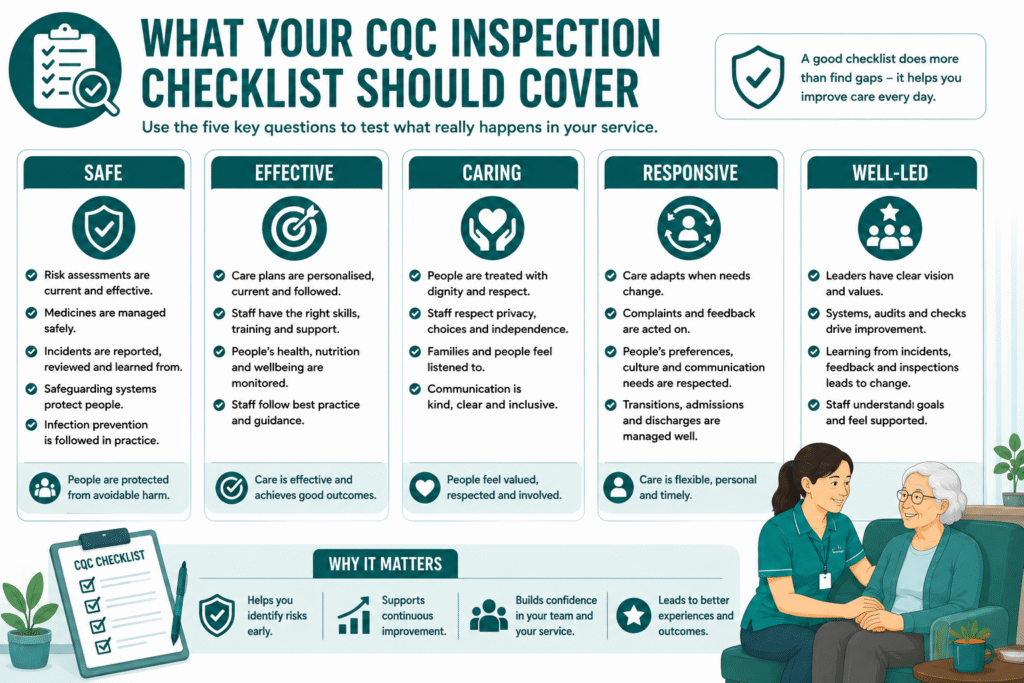
CQC is moving towards sector-specific assessment frameworks. Its March 2026 update explains that the five key questions will remain: safe, effective, caring, responsive and well-led. The regulator intends to replace quality statements with key lines of enquiry, remove scoring and introduce rating characteristics for outstanding, good, requires improvement and inadequate.
This is not simply a return to an old inspection model. CQC is testing whether its new framework and methodology make regulatory judgements clearer, more consistent and easier for providers and the public to understand. Its initial consultation response reports 1,703 responses. Around 95% agreed or strongly agreed with the proposed frameworks, and around 80% agreed or strongly agreed with the proposed methodology.
The direction is therefore clearer than the final operating detail. Providers can reasonably prepare for sector-specific expectations, key lines of enquiry and rating characteristics. They should not, however, assume that draft consultation wording is the final test that inspectors will apply.
CQC assessment changes 2026 at a glance
| Area | Current position | Direction being tested | Provider response |
|---|---|---|---|
| Five key questions | Still used | Remain central | Keep evidence organised under safe, effective, caring, responsive and well-led |
| Assessment prompts | Current published guidance applies | Sector-specific key lines of enquiry | Map existing evidence, but do not rewrite systems around draft wording |
| Scoring | Part of the current approach | CQC proposes removing scoring | Focus on the quality and impact of evidence, not a self-created numeric score |
| Ratings | Current ratings continue | Rating characteristics for four rating levels | Use characteristics as a leadership discussion tool once finalised |
| 2026 pilots | Run alongside existing inspections | Test the framework and methodology | Keep pilot feedback separate from formal regulatory outcomes |
What Stays the Same for Adult Social Care Providers Now?
CQC’s May 2026 update tells providers to continue following the current published guidance until the new approach is implemented later in 2026. The regulator’s adult social care priorities also remain relevant. These include responding to urgent and emerging risks, assessing services that have never been assessed or are considered high risk, reviewing services registered for more than a year without an assessment and addressing ratings that are more than six years old.
Your legal duties do not pause during the transition. Registration requirements, the fundamental standards, safeguarding responsibilities, notification duties, fit and proper person requirements and good governance controls still matter. Our guide to the CQC fundamental standards provides a useful companion explanation, but CQC and legislation remain the authoritative sources.
Providers should also keep using their normal channels for statutory notifications, reportable incidents and regulatory correspondence. A future methodology change does not justify delaying action on risk, unsafe care, staffing failures or poor governance.
CQC Assessment Changes 2026 Timeline
June to November 2026
- June 2026: CQC begins pilots and testing while existing inspections continue.
- June to October 2026: voluntary participants experience elements of the proposed framework and methodology.
- Throughout the pilot: CQC tests whether providers can understand how judgements and ratings were reached.
- November 2026: CQC plans its final evaluation of the testing period.
- After evaluation: providers should wait for confirmed CQC guidance, implementation dates and any final framework changes.
The timetable is a planning aid, not a promise that every detail will take effect on a particular day. Assign one senior owner to check the CQC adult social care guidance hub and regulator updates at least monthly. Record what changed, who reviewed it, whether action is needed and when staff were briefed.
Seven Essential Actions for Adult Social Care Providers
1. Keep a controlled regulatory change log
Create one short register for confirmed CQC changes. Include the official source, publication date, summary, affected services, decision, owner, target date and completion evidence. This prevents managers acting on social media commentary, outdated slides or draft consultation wording as though it were final guidance.
The register should distinguish three statuses: proposed, being tested and confirmed. Only confirmed changes should alter controlled policies or mandatory processes. Proposed and pilot information can still inform scenario planning, training discussions and evidence reviews.

2. Rebuild the evidence index, not the paperwork mountain
An inspector needs to understand how your service works and what difference your controls make. A large folder of disconnected policies does not prove safe or effective practice. Build an evidence index that links each key question to live records, accountable owners, review frequency, recent findings and improvement action.

Use evidence that shows both control and impact. For example, a medicines audit is stronger when it records the issue found, immediate safety action, root cause, learning, follow-up check and evidence that the change was sustained.
3. Test leadership explanations
Registered managers and senior staff should be able to explain the service’s main risks, recent incidents, quality priorities and improvement results without relying on rehearsed slogans. Run a monthly leadership review using a small set of questions:
- What are the three most important current risks?
- What evidence tells us those are the right risks?
- What changed after the last audit, incident, complaint or safeguarding concern?
- How do people using the service influence decisions?
- Which improvement action is overdue and why?
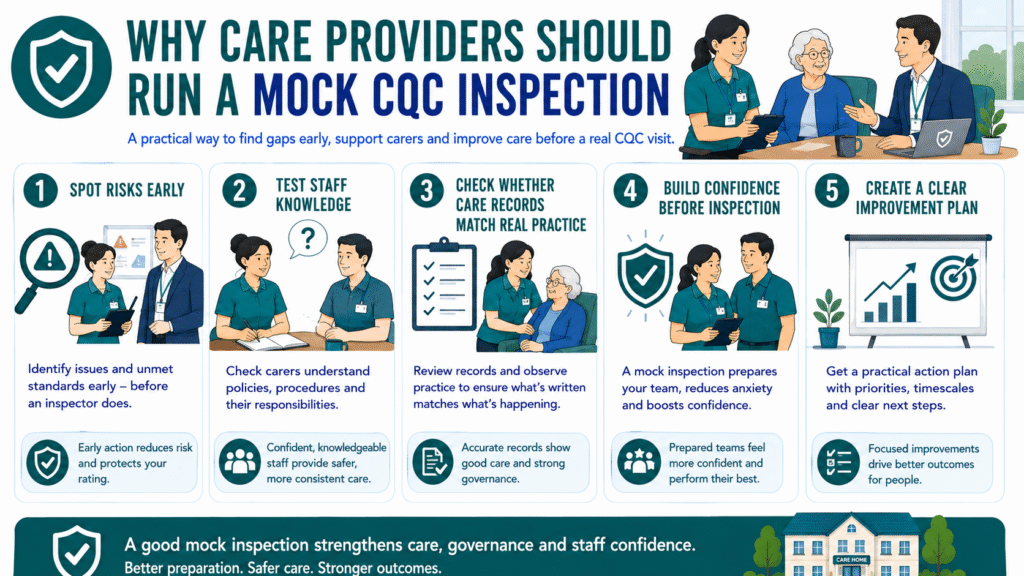
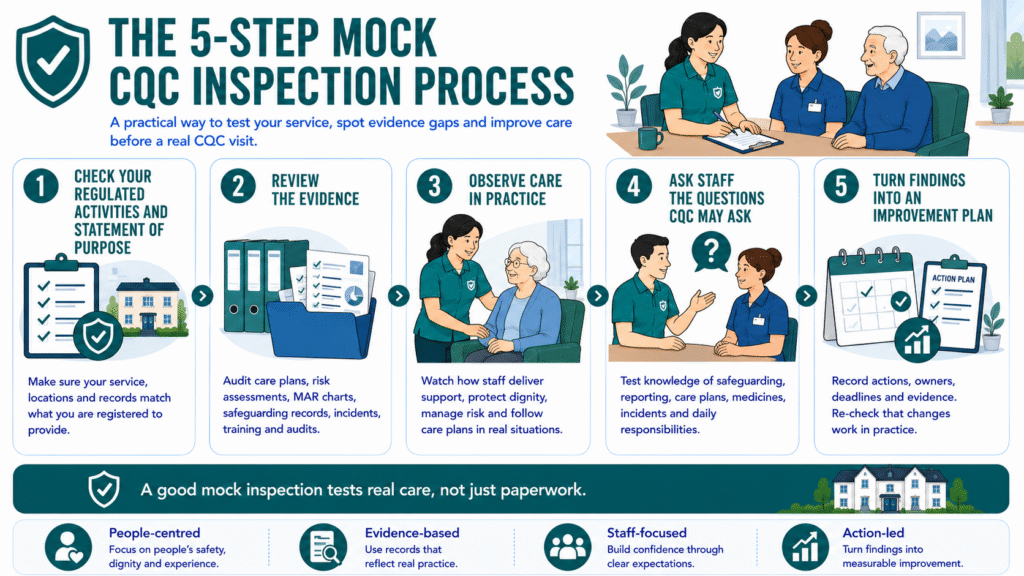
A CQC mock inspection can help test whether these explanations are consistent with frontline practice and records.
4. Map evidence across the five key questions
The five key questions remain the most stable organising structure. Avoid keeping separate copies of the same evidence in five folders. Use references to the source record and explain how one item supports different questions. A recruitment file audit may support safe staffing, effective workforce competence and well-led governance, but the explanation and impact will differ.
5. Strengthen service-user and staff evidence
Feedback should be more than an annual satisfaction percentage. Record who was asked, how communication needs were met, what people said, what changed and how you reported back. Do the same with staff learning, supervision themes and whistleblowing confidence.
Triangulate feedback with complaints, compliments, incidents, care-plan reviews and observed practice. If feedback is consistently positive but complaints and staff turnover are rising, leaders should investigate the difference rather than selecting only the favourable evidence.

6. Close known gaps before creating new templates
Transition periods can encourage organisations to buy or create new documents before fixing old problems. Start with overdue actions, repeated audit failures, incomplete training, weak risk assessments, inconsistent daily records and unresolved complaints. A completed corrective action with follow-up evidence is more valuable than a newly branded checklist that staff do not use.
7. Build a 30-day readiness cycle
Use a rolling cycle that senior leaders can repeat every month:
- Days 1 to 5: review regulatory updates, incidents, safeguarding, complaints and whistleblowing.
- Days 6 to 12: sample care records, medicines, staffing, training, supervision and recruitment controls.
- Days 13 to 18: speak with people using the service, relatives, staff and partners.
- Days 19 to 23: compare findings, identify contradictions and agree priority actions.
- Days 24 to 30: verify completed actions, update the evidence index and report to governance.
This is not a substitute for continuous oversight. It gives the provider a repeatable rhythm for bringing evidence, experience and improvement together.
How to quality-check the evidence before an assessment
Use four tests before adding an item to the evidence index. First, confirm that it is current and relates to the service being assessed. Second, check traceability: the record should show who completed it, when it was reviewed and what source information supports it. Third, test impact. A meeting minute that records a concern is incomplete unless it also shows the decision, owner, deadline and follow-up. Fourth, triangulate the finding against another reliable source, such as care records, staff competence, service-user feedback or observation.
This discipline keeps CQC assessment changes 2026 preparation focused on assurance rather than presentation. It also helps leaders identify false confidence. A policy can be current while practice is inconsistent; an audit can be complete while corrective actions remain overdue; and positive feedback can sit alongside a recurring complaint theme. The evidence index should make those tensions visible so leaders can investigate and improve.
Record exceptions, not only compliance. If a sample fails, document the immediate safety response, the wider review, the root cause and the date on which leaders will verify sustained improvement. That creates a defensible line from oversight to action and outcome.
Practical CQC Evidence Readiness Matrix
| Evidence area | What good control looks like | What to test | Owner |
|---|---|---|---|
| Risk and safeguarding | Current risks, timely escalation and learning | Do care records, incident records and staff explanations agree? | Registered manager |
| Workforce | Safe recruitment, competence, supervision and cover | Can rotas and dependency information support the staffing decision? | Service manager |
| Medicines | Safe administration, audit and action | Were repeated errors analysed and followed up? | Clinical or medicines lead |
| Person-centred care | Plans reflect current needs, choices and communication | Can the person recognise their preferences in the plan? | Key worker |
| Governance | Leaders know risks and verify improvement | Is there evidence that actions changed practice? | Nominated individual |
| Feedback | People are heard and receive a response | What changed because of feedback? | Quality lead |
Keep this matrix proportionate to your service. Add local risks, regulated activities and service-specific evidence. Remove anything that does not help leaders understand safety, quality or outcomes.
What Should You Do If CQC Invites You to a Pilot?
First, confirm the invitation through an official CQC channel. Ask which part of the proposed approach is being tested, what participation involves, how information will be used, how feedback will be provided and how the pilot sits alongside any formal inspection activity.
CQC states that participation is voluntary and that declining has no regulatory consequence. It also states that pilot judgements have no legal standing and do not affect your current status or rating. Keep the pilot record separate from your formal regulatory record, while still acting promptly on any genuine safety concern or improvement opportunity identified.
Nominate one internal pilot lead. Maintain a simple log of requests, evidence shared, staff involved, feedback received and improvement decisions. Brief staff honestly. Do not tell them the pilot is a formal rating exercise, and do not create artificial evidence solely for the visit.
Pilot decision checklist
- Has the invitation been verified with CQC?
- Do we understand the scope, dates and expected involvement?
- Can participation be managed without compromising care delivery?
- Who will co-ordinate evidence and staff communication?
- How will we record learning without confusing it with a formal rating?
- Who will decide and monitor any improvement action?
Watch: Understanding the New CQC Inspection Framework
Our Care Sync Experts video, Mastering the New CQC Inspection Framework, provides a practical explanation for care providers. Use it alongside current official CQC guidance, and recheck any time-sensitive detail before changing your service systems.
Common CQC Transition Mistakes to Avoid
- treating a proposal, consultation document or pilot as final guidance;
- stopping current compliance activity while waiting for the new approach;
- creating large volumes of evidence without checking quality or impact;
- relabeling existing folders without testing whether the evidence is current and retrievable;
- training staff on unconfirmed wording as though it were law;
- confusing pilot observations with a formal rating decision;
- ignoring contradictory evidence, such as positive surveys alongside rising complaints;
- failing to assign an owner and review date to improvement actions;
- using an outdated consultant slide deck instead of the latest official source.
The safest transition approach is controlled, evidence-led and proportionate. Keep the current system working, improve weak controls and update processes only when the authoritative requirement is clear.
How Care Sync Experts Can Help
Care Sync Experts can review your evidence system, governance controls and inspection readiness through our compliance management support. We can help you identify gaps, organise evidence, test leadership explanations and turn findings into a practical improvement plan.
For a wider review of your service’s current compliance position, see our CQC compliance guidance. If you would like to discuss your priorities, book a consultation with Care Sync Experts.
Evidence note: this article was checked against current official CQC sources on 20 July 2026. The new assessment approach is still being tested and details may change. Check the latest CQC guidance before making a regulatory or operational decision.
Frequently Asked Questions
When will the new CQC assessment framework start?
CQC says pilots are running from June to October 2026, with final evaluation planned for November. Providers should not assume a final implementation date until CQC publishes confirmed guidance. Continue following the current published approach in the meantime.
Are the five CQC key questions being removed?
No. CQC says the five key questions, safe, effective, caring, responsive and well-led, will remain. The regulator intends to support them with sector-specific key lines of enquiry and rating characteristics.
Will a CQC pilot affect our current rating?
CQC says pilot judgements have no legal standing and do not affect a provider’s current rating or regulatory status. The pilots run alongside existing inspections, so providers should keep pilot feedback and formal regulatory outcomes clearly separated.
What evidence should a care provider prepare now?
Prioritise current, retrievable evidence that shows safe practice, good outcomes, effective governance and completed improvement. Link each record to an owner and review date, and test whether staff explanations, service-user experience and written records agree.
Should we rewrite our policies for the draft CQC framework?
Not solely because draft material exists. Review policies when legislation, confirmed guidance, service risks or learning require a change. Record proposed and pilot information in a change log, but wait for authoritative final requirements before making unnecessary controlled-document changes.