Tag: Pension

  • NHS Pension Calculator: How to Estimate Retirement Income in 2026

    NHS Pension Calculator: How to Estimate Retirement Income in 2026

    The most accurate NHS pension calculator is the Total Reward Statement (TRS) or Annual Benefit Statement (ABS) available through ESR or My NHS Pension. These official tools use your actual NHS service record, pensionable pay, and scheme membership to estimate how much pension you could receive in retirement.

    For caregivers, nurses, and NHS staff, understanding your pension matters just as much as understanding your salary. Your NHS banding, years of service, and pension scheme all directly affect your retirement income.

    Get expert support for your next tender, inspection-ready policies, or CQC registration — book a call with Care Sync Experts today and let’s get you compliant and competitive.

    Key Takeaways

    • The official NHS pension calculator is available through ESR, your Total Reward Statement (TRS), or My NHS Pension.
    • Your pension estimate depends on your NHS pension scheme, pensionable pay, and total years of service.
    • Staff in higher NHS banding levels, such as Band 6 NHS pay and Band 7 NHS pay, usually build larger pension benefits over time.
    • The 1995, 2008, and 2015 NHS pension schemes all calculate benefits differently.
    • Many caregivers use both an NHS salary calculator and an NHS pension calculator to compare take-home pay with long-term retirement income.
    • The NHS Pension calculator UNISON tools and official NHS calculators can help staff model retirement scenarios and early retirement options.
    • Understanding the NHS pension scheme April 2025 changes can help caregivers plan their future contributions and retirement age more effectively.

    What Is the Most Accurate NHS Pension Calculator?

    How We Got Precious Care CQC Registered (Domiciliary Care Startup)

    The most accurate NHS pension calculator is your official Annual Benefit Statement (ABS) or Total Reward Statement (TRS), available through ESR or My NHS Pension. These tools calculate your pension using your real NHS employment history, pensionable earnings, and current scheme membership.

    Many NHS workers search for terms like:

    • Nhs pension calculator gov uk
    • NHS Pension calculator UNISON
    • Nhs pension calculator 2022

    However, official NHS records almost always provide the most reliable estimate because they include:

    • your actual years of service
    • pension contributions
    • salary progression
    • scheme transfers
    • retirement age calculations

    Where NHS Staff Can Access Their Pension Estimate

    ToolBest ForAccuracy
    ESR Total Reward Statement (TRS)Current NHS staffHighest
    My NHS PensionNon-ESR usersHigh
    UNISON NHS Pension CalculatorQuick estimatesModerate
    NHS Ready Reckoner ToolsGeneral projectionsModerate

    Why Caregivers Should Check Their Pension Regularly

    Many caregivers focus on monthly earnings and overtime but overlook long-term retirement income. Your pension can become one of your most valuable financial benefits throughout your NHS career.

    For example, a nurse on Band 6 NHS pay 2025 may contribute thousands of pounds yearly into the NHS pension scheme while also receiving significant employer contributions.

    Checking your pension regularly helps you:

    • understand your projected retirement income
    • plan early retirement options
    • track contribution growth
    • compare pension value against current take-home pay
    • prepare for future changes in the NHS pension scheme

    The NHS pension scheme remains one of the most valuable public sector pension schemes in the UK for long-term healthcare workers and caregivers.

    RELATED: PIP and ADP Insider Tips for 2026: Everything You Need to Know

    How NHS Staff and Caregivers Calculate Their Pension
    NHS pension examples for staff bands
    NHS pension examples for staff bands

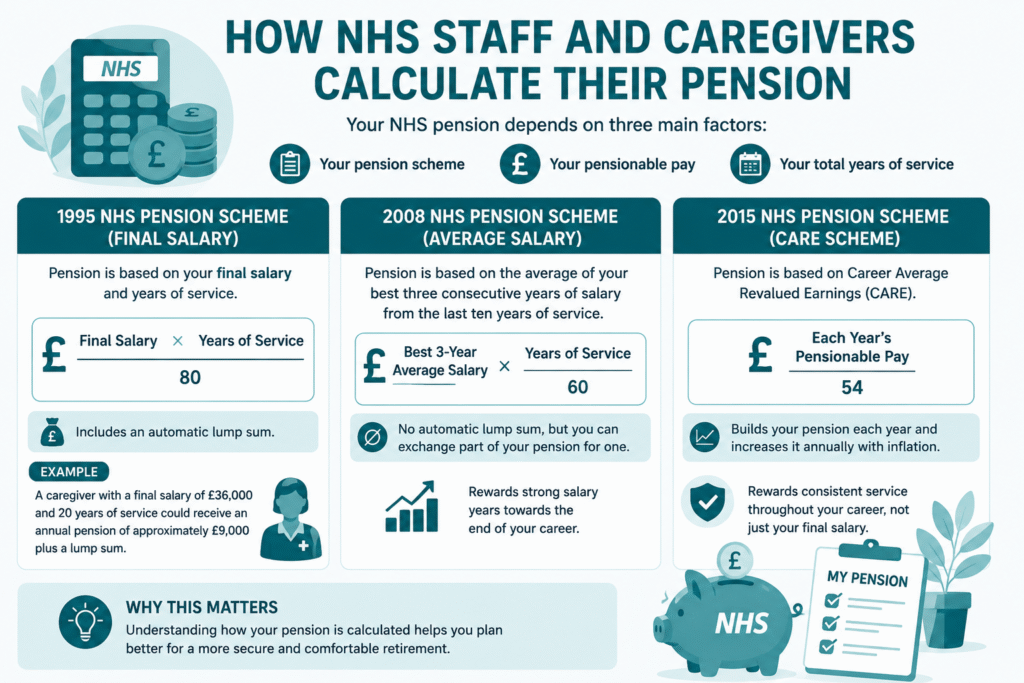
    Your NHS pension depends on three main factors:

    • your pension scheme
    • your pensionable pay
    • your total years of service

    Many caregivers ask:

    “How much NHS pension will I get after 20 years?”

    The answer varies based on whether you belong to the 1995, 2008, or 2015 NHS pension scheme.

    NHS Pension Calculator 1995 Section

    The 1995 scheme calculates pension using your final salary and years of service.

    Final Salary×Years of Service80\frac{\text{Final Salary}\times \text{Years of Service}}{80}80Final Salary×Years of Service​

    This scheme also includes an automatic lump sum.

    Example

    A caregiver with:

    • final salary of £36,000
    • 20 years of service

    could receive an annual pension of approximately £9,000 plus a lump sum.

    2008 NHS Pension Scheme

    The 2008 section uses the average of your best three consecutive years of salary from the last ten years of service.

    Best 3-Year Average Salary×Years of Service60\frac{\text{Best 3-Year Average Salary}\times \text{Years of Service}}{60}60Best 3-Year Average Salary×Years of Service​

    This scheme does not automatically include a lump sum, although members can usually exchange part of their pension for one.

    2015 NHS Pension Scheme (CARE)

    The 2015 scheme uses a Career Average Revalued Earnings (CARE) model.

    Each Year’s Pensionable Pay54\frac{\text{Each Year’s Pensionable Pay}}{54}54Each Year’s Pensionable Pay​

    Each year, the NHS adds a portion of your pensionable earnings to your pension pot and adjusts it annually for inflation.

    This structure benefits many long-term caregivers because it rewards consistent service across an entire career rather than only focusing on final salary.

    Why Your Salary Matters

    Your pension grows alongside your earnings. Staff progressing through Agenda for Change pay scales often see pension growth as they move through different NHS bands.

    For example:

    • Band 5 NHS pay builds a smaller pension than Band 6
    • Band 6 NHS pay and Band 7 NHS pay usually generate larger retirement benefits due to higher pensionable earnings

    That is why many staff use both an NHS pay calculator and an NHS pension calculator together when planning their finances.

    How NHS Banding and Salary Affect Your Pension

    Your NHS pension increases as your salary increases. Higher earnings usually lead to higher pension contributions and larger retirement benefits over time.

    Many caregivers and nurses move gradually through different levels of NHS banding during their careers. Each promotion can improve both monthly earnings and future pension income.

    How Agenda for Change Pay Scales Influence Pension Growth

    The NHS uses Agenda for Change pay scales to determine salary bands for most healthcare staff. As your salary rises, your pensionable pay also rises.

    For example:

    • a healthcare assistant on Band 4 NHS salary
    • a nurse on Band 5 NHS pay
    • a senior nurse on Band 6 NHS pay
    • or a manager on Band 7 NHS pay

    will all build different pension values based on their earnings and years of service.

    Band 6 NHS Pay and Pension Impact

    Many caregivers search for:

    • nhs band 6 salary
    • band 6 nhs pay 2025
    • nurse earnings uk

    because Band 6 often marks a major jump in both salary and pension growth.

    A higher pensionable salary means:

    • larger yearly pension accrual
    • higher employer contributions
    • stronger retirement income projections

    For many NHS workers, pension growth accelerates after progressing beyond Band 5.

    Why NHS Staff Use Salary and Pension Calculators Together

    An NHS salary calculator or NHS take home pay calculator helps staff estimate monthly pay after tax and pension deductions.

    An NHS pension calculator helps estimate long-term retirement income.

    Using both tools together gives caregivers a clearer financial picture because:

    • take-home pay affects current lifestyle
    • pension contributions affect future retirement security

    This balance matters even more as staff prepare for:

    • the NHS pay rise July 2025
    • pension contribution adjustments
    • and wider NHS pension scheme April 2025 changes.

    READ MORE: End of Life Care at Home: What to Expect in 2026, Costs, and Family Support

    NHS Pension Examples for Band 5, Band 6, and Band 7 Staff
    NHS pension scheme changes for 2025

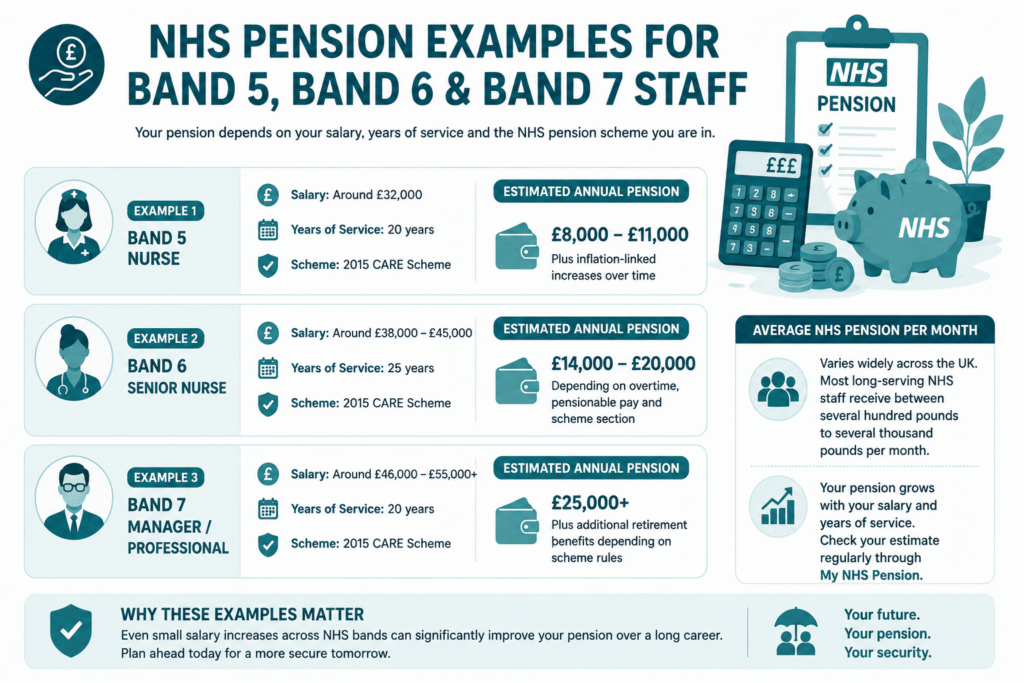
    Real-life pension examples help caregivers understand how salary and years of service affect retirement income. These estimates are not official figures, but they show how the NHS pension scheme can build long-term financial security.

    Example 1: Band 5 Nurse

    A nurse earning approximately £32,000 under Band 5 NHS pay with 20 years of NHS service could build a pension worth several thousand pounds yearly, depending on their scheme membership and retirement age.

    Under the 2015 CARE scheme, consistent yearly contributions and salary progression could produce:

    • an estimated pension of £8,000–£11,000 annually
    • plus inflation-linked increases over time

    Example 2: Band 6 NHS Salary

    A caregiver or senior nurse on Band 6 NHS pay 2025 earning around £38,000–£45,000 may build significantly higher benefits over the same career period.

    After 25 years of service, many Band 6 staff could potentially receive:

    • £14,000–£20,000 yearly pension income
    • depending on overtime, pensionable pay, and scheme section

    This is one reason many NHS workers closely monitor their pension growth through My NHS Pension and ESR statements.

    Example 3: Band 7 NHS Pay

    Staff on Band 7 NHS pay often contribute more into the scheme because of higher pensionable earnings.

    A Band 7 healthcare professional with:

    • 30 years of NHS service
    • salary progression through multiple pay points
    • stable pension contributions

    could potentially build:

    • annual pension income above £25,000
    • plus additional retirement benefits depending on scheme rules

    Average NHS Pension Per Month

    The average NHS pension per month varies widely across the UK because retirement income depends on:

    • career length
    • salary history
    • pension scheme membership
    • retirement age

    Many long-serving NHS workers and caregivers receive monthly pensions ranging from several hundred pounds to several thousand pounds after retirement.

    That is why checking your pension estimate regularly matters, especially if your salary changes or you move into higher NHS bands.

    ALSO SEE: HICBC Child Benefit Rule Change UK: What Care Workers Need to Know in 2026

    NHS Pension Scheme April 2025 Changes Caregivers Should Know
    NHS Pension Calculator 2026
    NHS Pension Calculator 2026

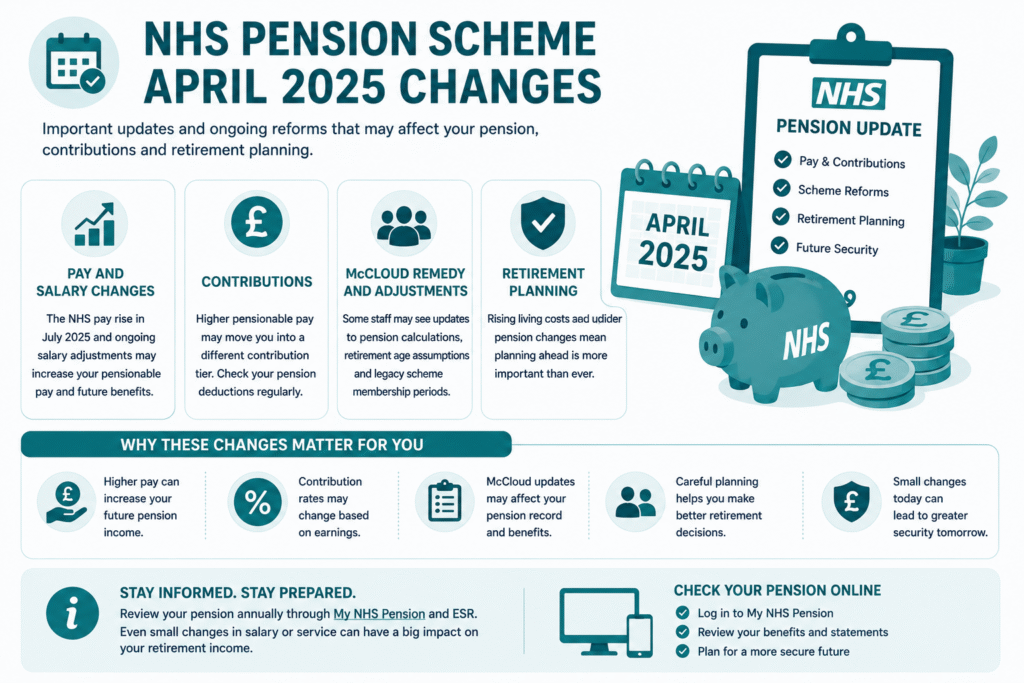
    Recent updates to the NHS pension scheme continue to affect how caregivers, nurses, and healthcare staff plan for retirement. Understanding these changes can help you make better decisions about contributions, retirement timing, and long-term financial planning.

    Pension Contribution and Pay Changes

    The NHS pay rise July 2025, and ongoing salary adjustments across NHS bands may increase pensionable pay for many staff. Higher pensionable earnings can improve future pension benefits, but they may also move some workers into higher contribution tiers.

    Caregivers should regularly review:

    • contribution rates
    • pension deductions
    • updated pay bands
    • retirement projections

    especially after promotions or salary increases.

    McCloud Remedy and Scheme Adjustments

    Many NHS workers still review how the McCloud remedy affects their pension records and retirement estimates. Some staff may see updates to:

    • pension calculations
    • retirement age assumptions
    • legacy scheme membership periods

    This especially affects workers with service spanning multiple NHS pension schemes.

    Retirement Planning Matters More Than Ever

    Rising living costs and wider retirement concerns, including discussions around UK pensioner cash withdrawal changes 2025, have encouraged many healthcare workers to pay closer attention to pension planning.

    For caregivers and NHS staff, reviewing your pension annually can help you:

    • avoid retirement surprises
    • understand projected income
    • prepare for early retirement decisions
    • maximise long-term pension value

    Even small salary increases across NHS bands can significantly affect retirement income over a long healthcare career.

    MORE: Is There a Senility Test? 2026 Guide to Dementia Screening Tools

    Should You Use an NHS Salary Calculator or Pension Calculator?

    An NHS salary calculator and an NHS pension calculator serve different purposes. Most caregivers and NHS workers benefit from using both together.

    An NHS salary tool estimates:

    • monthly take-home pay
    • tax deductions
    • National Insurance
    • pension deductions

    An NHS pension tool estimates:

    • future retirement income
    • yearly pension growth
    • projected benefits after retirement

    When to Use an NHS Salary Calculator

    An NHS pay calculator or NHS take home pay calculator helps staff understand how much money reaches their bank account each month.

    This becomes especially useful when:

    • moving between NHS bands
    • checking overtime impact
    • reviewing salary increases
    • comparing new job offers

    For example, staff moving from Band 5 NHS pay to Band 6 NHS pay often use salary calculators to estimate changes in take-home income before accepting a new role.

    When to Use an NHS Pension Calculator

    An NHS pension calculator helps caregivers plan for long-term financial security.

    You should check your pension estimate when:

    • your salary changes
    • you change NHS bands
    • you plan early retirement
    • you approach retirement age
    • pension rules change

    Official tools through ESR or My NHS Pension usually provide the most accurate estimates because they use your real employment and contribution records.

    Why Both Tools Matter

    Many NHS workers focus heavily on present income but underestimate the long-term value of the NHS pension scheme.

    Using both calculators together helps caregivers:

    • balance current income with future retirement planning
    • understand how pension contributions affect take-home pay
    • make better career and retirement decisions

    For long-serving healthcare staff, the NHS pension can become one of the most valuable financial benefits they ever receive.

    Conclusion

    The NHS pension scheme remains one of the strongest retirement benefits available to healthcare workers and caregivers in the UK. Whether you work under Band 5 NHS pay, Band 6 NHS pay, or Band 7 NHS pay, your salary, years of service, and pension scheme all directly shape your future retirement income.

    Using an official NHS pension calculator through ESR or My NHS Pension gives you the clearest picture of what you may receive in retirement. Combining this with an NHS salary calculator or NHS take home pay calculator can also help you balance present earnings with long-term financial security.

    For caregivers and NHS staff, regular pension reviews are no longer optional. Understanding your pension today can help you make smarter career, salary, and retirement decisions for the future.

    Need Help Navigating NHS Career, Compliance, or Workforce Support?

    At Care Sync Experts, we help caregivers, care providers, and healthcare organisations stay informed about the latest NHS workforce developments, compliance updates, funding opportunities, and operational best practices.

    Whether you run a care business or work within the NHS, our resources and expert guidance can help you make more confident financial and professional decisions in 2026 and beyond.

    FAQ

    Is an NHS pension a good pension?

    Many financial experts consider the NHS pension one of the strongest public sector pension schemes in the UK. The scheme includes employer contributions, inflation-linked benefits, and long-term retirement security that many private pensions do not fully match.

    For long-serving caregivers and NHS workers, the pension can become a major part of their retirement income.

    What percentage of my NHS pension do I pay?

    NHS pension contributions vary based on your pensionable salary. Lower earners pay a smaller percentage, while higher earners contribute more through tiered contribution rates.
    Contribution rates typically range from around 5% to over 12% depending on:
    – NHS banding
    – pensionable pay
    – current contribution thresholds

    Your employer also contributes a significant percentage toward your pension.

    What happens to my NHS pension if I leave the NHS?

    If you leave the NHS before retirement, your pension usually remains in the scheme as a deferred pension. It will normally continue to increase in value over time until you reach retirement age.
    Your options may include:
    – leaving the pension where it is
    – transferring it to another pension scheme
    – returning to NHS employment later and continuing contributions

    The best option depends on your career plans and length of NHS service.

    What are the disadvantages of taking your pension at 55?

    Taking your NHS pension early can reduce your yearly retirement income because the scheme expects to pay benefits for a longer period.
    Early retirement may lead to:
    – permanently reduced pension payments
    – lower lifetime pension value
    – reduced lump sum options
    – fewer contribution years

    Many caregivers choose to compare early retirement estimates carefully before making a final decision.
  • Scottish Pension Age Winter Heating Payment (PAWHP): 2026 Update

    Scottish Pension Age Winter Heating Payment (PAWHP): 2026 Update

    The Scottish pension age winter heating payment is a yearly benefit paid by Social Security Scotland to people over State Pension age to help cover winter heating costs. Most eligible pensioners receive between £101.70 and £305.10 automatically, with payments made around November to December based on eligibility during the September qualifying week.

    Unlike the previous winter fuel allowance Scotland system, this payment runs fully under Scotland’s devolved benefits system and requires no application for most pensioners, making it easier for caregivers and families to ensure older adults receive timely winter support.

    Get expert support for your next tender, inspection-ready policies, or CQC registration — book a call with Care Sync Experts today and let’s get you compliant and competitive.

    Key Takeaways

    • The Scottish pension age winter heating payment helps pensioners in Scotland cover winter heating costs.
    • Most eligible people receive £101.70 to £305.10 automatically, no application required.
    • Payments are usually made between November and December, answering the common question: winter heating payment Scotland when will it be paid?
    • Eligibility depends on State Pension age and living in Scotland during the September qualifying week.
    • Some people must apply, especially those who deferred their State Pension or have complex circumstances.
    • If a pensioner earns over £35,000 annually, HMRC may recover the payment later.
    • Caregivers should track Scottish pension age winter heating payment dates to support clients during peak winter months.

    What Is the Scottish Pension Age Winter Heating Payment?

    Care Tenders UK 2026: How to Find & Win Local Authority Contracts

    The Scottish pension age winter heating payment is a government-funded benefit that helps older adults in Scotland pay for heating during winter. Social Security Scotland introduced it to replace the previous winter fuel payment Scotland system, giving Scotland full control over how pensioner winter support works.

    For caregivers, this payment plays a direct role in client wellbeing. Many older adults reduce heating to save costs, which increases risks such as hypothermia, respiratory issues, and general discomfort.

    The winter heating payment Scotland ensures that pensioners can maintain safe indoor temperatures without financial strain.

    Care providers, whether domiciliary agencies or care homes, should treat this payment as part of a client’s financial care plan. When clients receive this support, they are more likely to:

    • Keep their homes adequately heated
    • Maintain better health during colder months
    • Reduce emergency care needs

    This benefit also falls under broader pensioner winter heating support Scotland, which aims to protect vulnerable individuals during peak winter periods. Understanding how it works allows caregivers to proactively support clients, especially those who may not fully understand their entitlement.

    In short, this is not just a payment; it is a critical winter stability tool that directly impacts the quality of care and safety outcomes for pensioners across Scotland.

    RELATED: Scotland PIP ADP Update 2026: What Care Businesses and Claimants Must Know

    Who Qualifies for Winter Heating Payment in Scotland?

    Not all pensioners automatically qualify, so caregivers need to understand the rules clearly.

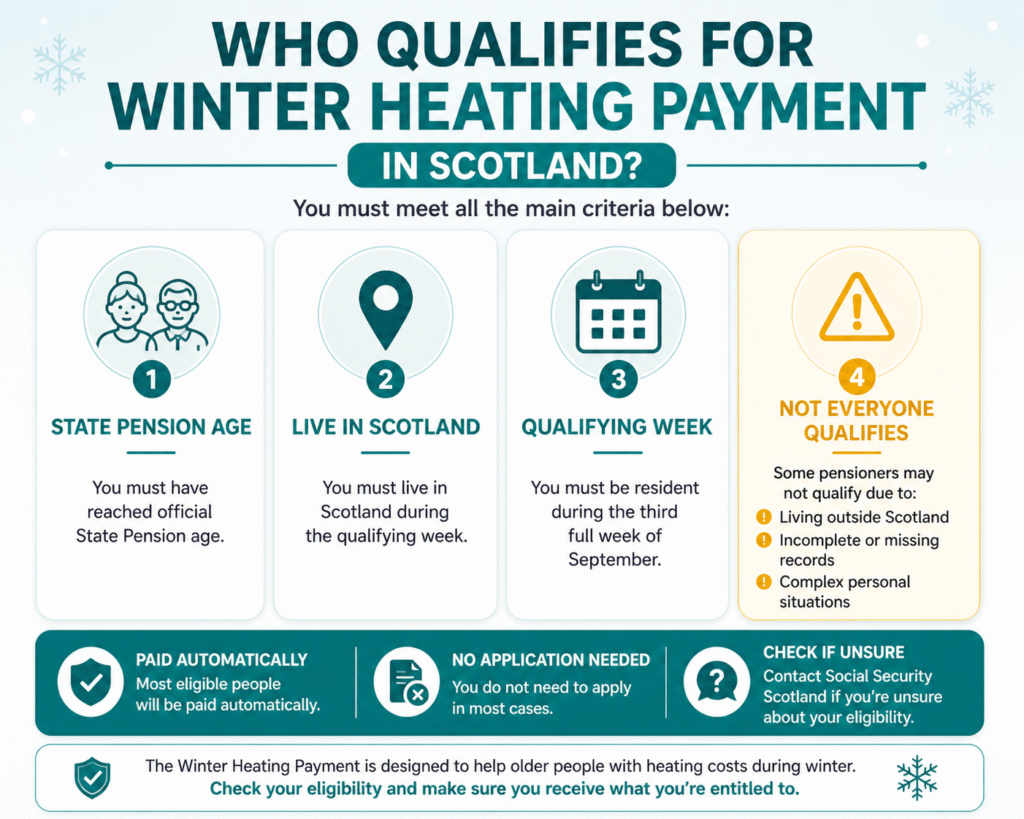
    To receive the Scottish pension age winter heating payment, a person must:

    • Be over State Pension age (this answers the common question: will I get winter fuel allowance at 66? → only if you’ve reached official State Pension age)
    • Live in Scotland during the qualifying week (usually the third full week of September)
    • Be ordinarily resident in the UK

    Do all pensioners get winter fuel allowance?

    No, this is one of the biggest misconceptions.

    While most pensioners Scotland winter fuel payment recipients qualify automatically, some people may not receive it if:

    • They live outside Scotland
    • Their circumstances fall outside eligibility rules
    • Their records are incomplete or unclear

    Caregiver Insight (Important)

    Care providers should actively check which clients qualify instead of assuming eligibility.

    You should:

    • Confirm the client’s age and residency status
    • Check if they were living in Scotland during the qualifying week
    • Identify clients who recently moved, changed benefits, or have complex living arrangements

    These edge cases often lead to missed payments, and this is where caregiver intervention adds real value.

    In practice, most eligible clients will receive the payment automatically, but the ones who don’t are usually the most vulnerable, making this step critical for care planning.

    How Much Is the Payment? (2025/26 Rates)

    Scottish winter heating payment
    Scottish winter heating payment breakdown

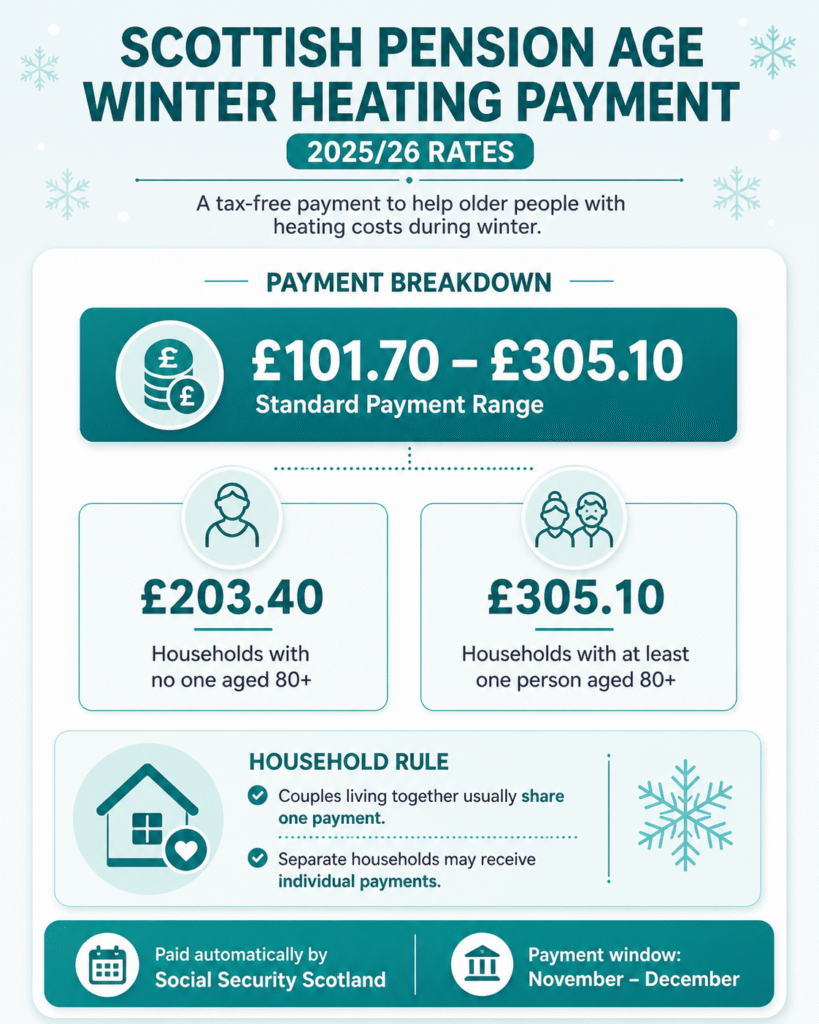
    The Scottish pension age winter heating payment varies based on age and household circumstances. For the 2025/26 winter, pensioners receive between £101.70 and £305.10.

    Payment Breakdown

    • £101.70 – £305.10: Standard payment range
    • £203.40: Households where no one is aged 80 or over
    • £305.10: Households with at least one person aged 80+

    Do husband and wife both get winter fuel allowance?

    This depends on living arrangements.

    • If a couple lives together, they typically share the payment, rather than each receiving the full amount.
    • If they live separately, they may each receive their own payment.

    This applies across winter fuel payment Scotland pensioners, and it often causes confusion among families.

    Caregiver Insight (Important)

    Care providers should not assume each individual client receives the full amount.

    Instead:

    • Check household structure (shared vs independent living)
    • Identify if clients are in care homes or supported housing, as payments may differ
    • Use the payment amount to anticipate winter affordability risks

    For example, a single pensioner aged 80+ receiving £305.10 may still struggle if heating costs rise significantly, while a shared household receiving £203.40 may need additional support planning.

    Understanding these payment tiers helps caregivers make better decisions around winter care planning, heating support, and client safety.

    READ MORE: What Is Pension Age Disability Payment (PADP)? 2026 Update

    When Will the Payment Be Made?

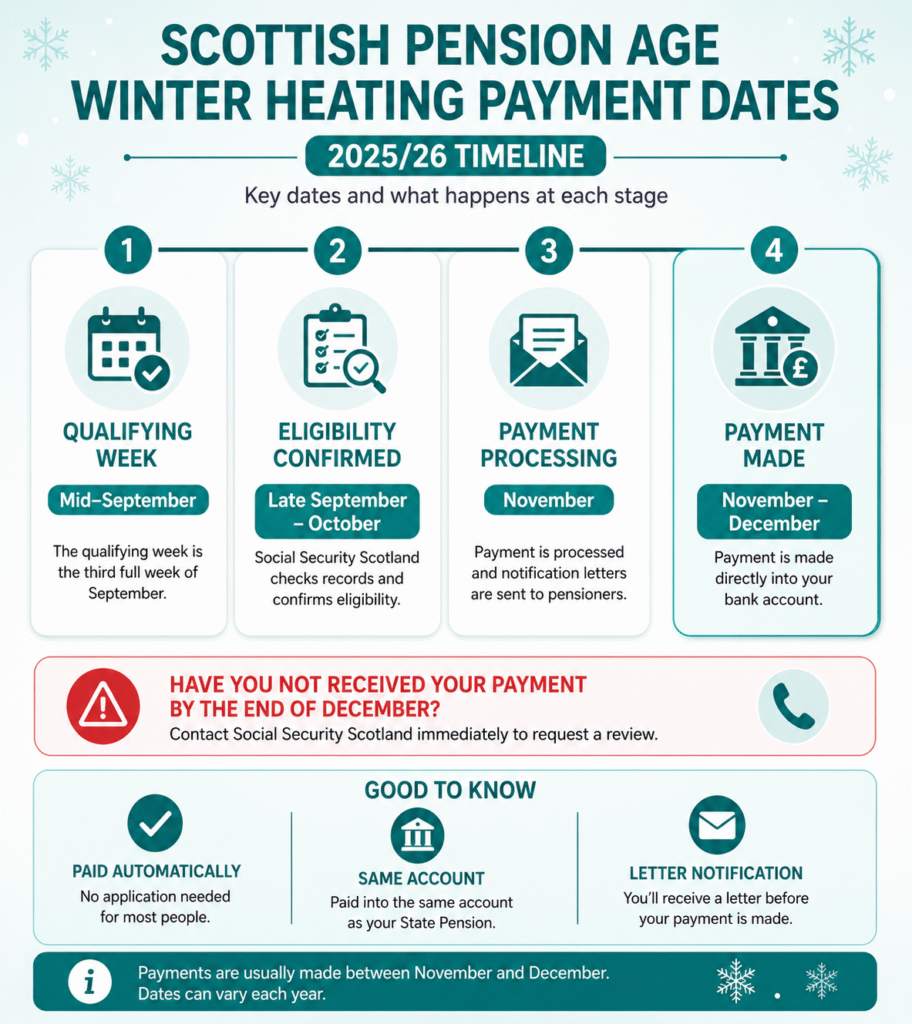
    Most people receive the Scottish pension age winter heating payment between November and December, shortly after the September qualifying week.

    Key Dates to Know

    • Qualifying week: Third full week of September
    • Payment window: November to December
    • Notification: A letter arrives before payment

    This answers the common questions:

    • What month do I get my Winter Fuel Payment? → November or December
    • Winter heating payment Scotland when will it be paid? → Late autumn to early winter

    Payments go directly into the same bank account used for the State Pension or other Social Security Scotland benefits.

    Caregiver Insight (Critical for Planning)

    Care providers should track Scottish pension age winter heating payment dates to manage client expectations and avoid unnecessary concern.

    You should:

    • Inform clients that payments do not arrive immediately after the qualifying week
    • Monitor accounts during November–December
    • Reassure clients who expect earlier payments

    This timing matters because:

    • Many pensioners increase heating usage before the payment arrives
    • Delays can lead to reduced heating and health risks
    • Clients may contact caregivers with concerns about missing payments

    Proactive communication helps prevent panic and ensures clients maintain safe heating levels during early winter.

    Do You Need to Apply?

    Most people do not need to apply for the Scottish pension age winter heating payment. Social Security Scotland pays it automatically using existing benefit and pension records.

    When You Don’t Need to Apply

    You will usually receive the payment automatically if:

    • You get the State Pension
    • Your details are up to date with Social Security Scotland
    • Your situation is straightforward (no unusual living arrangements)

    The payment goes into the same account used for your pension, and you’ll receive a confirmation letter.

    When You May Need to Apply

    A small number of people must apply, especially if they:

    • Deferred their State Pension
    • Recently moved to Scotland
    • Have complex household arrangements
    • Do not receive other qualifying benefits

    In these cases, you may need to contact the Winter Fuel Payment Centre or complete a winter fuel payment claim form online free through official channels.

    Caregiver Insight (High Impact)

    Caregivers play a key role in identifying clients who fall into the “must apply” category.

    You should:

    • Ask if the client receives their State Pension normally
    • Check if they recently moved or changed circumstances
    • Support vulnerable clients with applications if needed

    Many missed payments happen because:

    • Clients assume it’s automatic
    • They are unaware they fall into an exception group

    Early identification ensures clients don’t miss out on critical winter heating support.

    SEE ALSO: Bank Holiday Early Benefit Payments DWP: May 2026 Update

    What Happens If You Don’t Receive the Payment?

    Scottish winter heating payment timeline

    If a client does not receive the Scottish pension age winter heating payment by the end of December, do not assume they are ineligible, action is required.

    First Steps to Take

    • Check bank statements (look for payments from Social Security Scotland)
    • Confirm if a notification letter was received
    • Verify the client’s eligibility and circumstances

    If the payment is still missing, contact Social Security Scotland directly to request a review.

    Common Reasons for Missing Payments

    • Incorrect or outdated personal details
    • Recent move or change in residency
    • Deferred State Pension
    • Complex household arrangements
    • Administrative delays

    Some clients may also receive misleading alerts, such as a DWP winter fuel payment text, which can cause confusion. Caregivers should treat unexpected messages with caution and rely only on official communication.

    Social Security Scotland Winter Payments Warning

    Social Security Scotland may issue updates or warnings when:

    • Payments are delayed
    • Additional checks are required
    • Eligibility needs verification

    Staying informed helps caregivers respond quickly and avoid unnecessary stress for clients.

    Caregiver Insight (Critical)

    Care providers should not wait for clients to raise concerns.

    Instead:

    • Track expected payment timelines
    • Proactively check in with clients in December
    • Escalate missing payments early

    Many vulnerable pensioners will not follow up on missing funds themselves.

    Early intervention ensures clients receive their pensioner winter heating support Scotland without disruption, which directly impacts their comfort and safety during peak winter months.

    MORE: Is There a Senility Test? 2026 Guide to Dementia Screening Tools

    Will High-Income Pensioners Have to Repay It?

    Winter heating payment eligibility in Scotland

    Yes. While most pensioners receive the Scottish pension age winter heating payment, those with higher incomes may need to repay it later.

    Income Threshold Rule

    • If a pensioner earns over £35,000 per year, HMRC will recover the payment
    • Recovery happens through the tax system in the following year
    • This applies to individual income, not joint household income

    How Repayment Works

    • The payment is still issued in full during winter
    • HMRC then adjusts the person’s tax (usually in the next tax year)
    • No action is required upfront, the system handles recovery automatically

    This system differs slightly from older DWP Scotland pensioners winter payment structures, where eligibility rules were stricter upfront.

    Caregiver Insight (Important)

    Care providers should flag this for clients who:

    • Have private pensions or additional income
    • May not expect repayment
    • Rely on predictable finances

    You should:

    • Inform clients that the payment is not always “free money”
    • Encourage them to plan for possible recovery
    • Avoid confusion with other payments like the DWP January pensioner bonus payment, which follows different rules

    Clear communication helps prevent financial misunderstandings and ensures clients make informed decisions about their winter spending.

    Final Insight…

    The Scottish pension age winter heating payment is more than a seasonal benefit, it directly affects how well your clients cope during winter.

    For many older adults, heating is a daily financial decision. Without adequate support, clients may:

    • Reduce heating to save money
    • Experience cold-related health issues
    • Become more vulnerable to illness and hospitalisation

    This is where pensioner winter heating support Scotland becomes critical.

    How Care Providers Should Use This Information

    Care providers should treat this payment as part of winter risk planning, not just financial support.

    You should:

    • Identify which clients rely heavily on Scotland winter heating payments
    • Monitor vulnerable individuals during early winter (before payments arrive)
    • Ensure clients understand what they are entitled to
    • Step in quickly if payments are delayed or missing

    Real Impact on Care Outcomes

    When clients receive and use this support properly:

    • Homes stay consistently warm
    • Health risks decrease
    • Emergency interventions reduce
    • Overall care quality improves

    Care providers who understand how the Scottish pension age winter fuel payment works can prevent avoidable health risks and improve client wellbeing during the most critical months of the year.

    This is not just financial support, it is a key part of safe, effective winter care planning.

    Need Help Supporting Your Clients This Winter?

    At Care Sync Experts, we help care providers stay ahead of regulatory changes, funding opportunities, and critical support systems like winter heating payment Scotland.

    Whether you need help:

    • Understanding complex benefit systems
    • Supporting vulnerable clients with applications
    • Improving care planning and compliance
    • Winning contracts and scaling your care business

    We provide expert guidance tailored to the UK care sector

    Get in touch with Care Sync Experts today and ensure your clients receive the support they deserve, while you build a stronger, more resilient care service.

    FAQ

    How do I know if I am entitled to the fuel allowance?

    You are entitled to the Scottish pension age winter heating payment if you:
    – Have reached State Pension age
    – Live in Scotland during the qualifying week (September)
    – Meet residency requirements

    Most eligible people receive it automatically. If you are unsure, check your eligibility with Social Security Scotland or ask your caregiver to help verify your status.

    Who will not get winter fuel allowance?

    You may not receive the payment if you:
    – Do not meet the State Pension age requirement
    – Live outside Scotland
    – Have incomplete or conflicting records
    – Fall into certain exception cases (e.g., long-term hospital or care arrangements)

    Caregivers should pay close attention to these cases, as they often require manual follow-up or applications.

    Who is eligible for the free heating scheme in Scotland?

    The winter heating payment Scotland is available to pensioners who meet age and residency criteria. However, other heating support schemes may exist for:
    – Low-income households
    – Disabled individuals
    – People receiving certain benefits

    Care providers should assess each client individually, as eligibility varies depending on the specific scheme.

    Can I still get UK winter Fuel Allowance if I live abroad?

    In most cases, you cannot receive the Scottish winter heating payment if you live outside Scotland.
    However, under the older UK system, some pensioners living abroad in certain countries could receive payments depending on:
    – Their connection to the UK
    – The country they live in
    – Local temperature conditions

    Rules are complex, so it’s best to check directly with the Winter Fuel Payment Centre if you or your client lives outside the UK.

  • What Is Pension Age Disability Payment (PADP)? 2026 Update

    What Is Pension Age Disability Payment (PADP)? 2026 Update

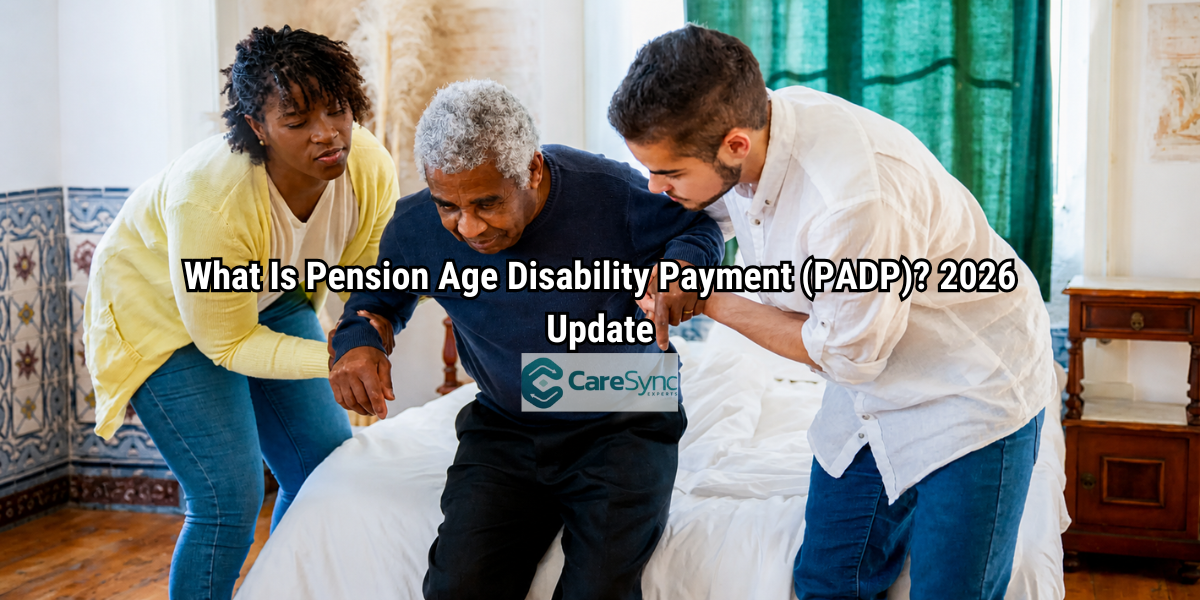
    Pension Age Disability Payment (PADP) is a non-means-tested benefit in Scotland for people who have reached pension age and need help or supervision due to a long-term health condition or disability. Social Security Scotland pays it to help cover the extra costs of care, and it is replacing Attendance Allowance in Scotland.

    For caregivers and care businesses, PADP provides essential financial support that helps clients afford care services, maintain independence, and improve quality of life.

    Get expert support for your next tender, inspection-ready policies, or CQC registration — book a call with Care Sync Experts today and let’s get you compliant and competitive.

    Key Takeaways

    • Pension Age Disability Payment (PADP) supports people at pension age in Scotland who need help with daily care or supervision
    • It replaces attendance allowance as part of ongoing attendance allowance Scotland changes
    • The benefit is not means-tested, so income and savings do not affect eligibility
    • Payments are made at two rates, depending on the level of care needed
    • You can apply for pension age disability payment online, by phone, or by paper form through Social Security Scotland
    • Caregivers and care businesses play a key role in helping clients apply successfully and access the right level of support

    What Is Pension Age Disability Payment

    Person with Dementia Refusing Care: MCA and CQC Explained (2026)

    For caregivers and care businesses, pension age disability payment Scotland is more than just a benefit, it directly affects how clients access and sustain care.

    Many older adults struggle with daily tasks like dressing, bathing, or staying safe at home. Pension Age Disability Payment provides financial support that helps cover these care needs, allowing clients to pay for home care services, assistive tools, or additional supervision.

    From a care provider’s standpoint, this benefit often determines:

    • Whether a client can afford consistent care
    • The level of support a care plan can include
    • How long a client can remain independent at home

    This makes PADP one of the most important benefits for pensioners over 65 in Scotland. When clients receive the correct rate, caregivers can deliver better, more stable care without interruptions caused by funding gaps.

    Care businesses also benefit indirectly. When clients secure PADP, they are more likely to:

    • Commit to long-term care services
    • Increase care hours when needs grow
    • Maintain continuity of care

    In short, pension age disability payment is not just a financial benefit; it is a key enabler of quality care, better outcomes, and sustainable care delivery.

    RELATED: UK State Pension Age Increase 2026: What Care Businesses Need to Know

    Who Qualifies for Pension Age Disability Payment?

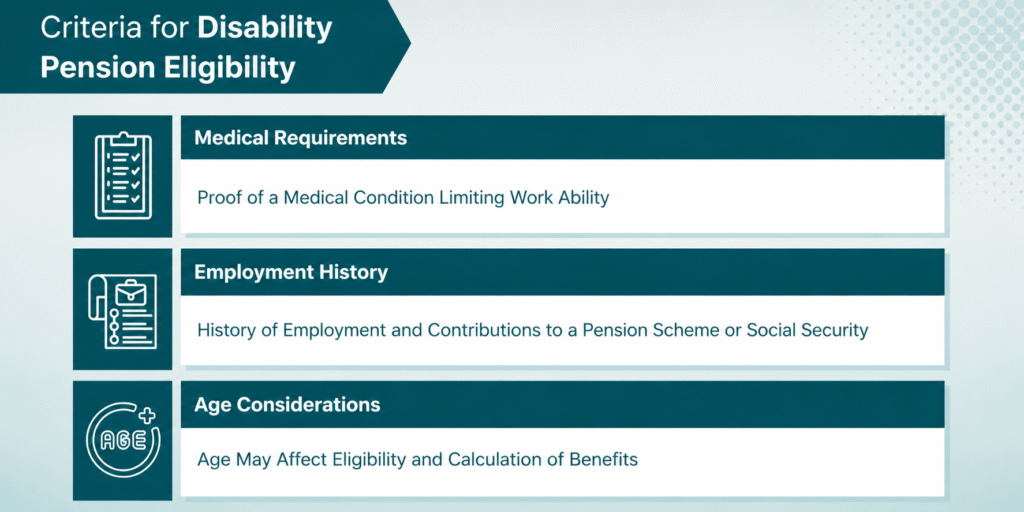
    To qualify for pension age disability payment, a person must meet both age and care-related conditions.

    Basic eligibility criteria:

    • You must have reached pension age
    • You must live in Scotland (or have a strong link to Scotland)
    • You must need help or supervision due to a long-term health condition or disability

    Care needs requirement:

    To be eligible, the person must:

    • Need help during the day, night, or both
    • Have had these needs for at least 6 months (unless terminally ill)
    • Require support with tasks like dressing, eating, mobility, or staying safe

    Pension Age Disability Payment is awarded based on care needs, not income, making it one of the most accessible sickness benefits for older adults.

    Important exceptions:

    • If the person is terminally ill, they can qualify immediately and receive the higher rate
    • A formal diagnosis is not required to apply
    • You can still apply before the 6-month period ends (payments will start once the condition meets the requirement)

    From a caregiver’s perspective, understanding eligibility is critical. Many clients who qualify for over 60 benefits like PADP never apply because they assume they need a diagnosis or full-time care—which is not true.

    How Much Is Pension Age Disability Payment?

    Attendance Allowance
    Attendance Allowance

    Pension Age Disability Payment is paid at two fixed weekly rates, depending on how much care or supervision a person needs.

    Current payment rates:

    • Lower rate: £76.70 per week
      • Paid if the person needs help either during the day or at night
    • Higher rate: £114.60 per week
      • Paid if the person needs help both during the day and at night

    The amount you receive depends on the level of care required, not your income or savings.

    What determines the rate?

    Social Security Scotland looks at:

    • The type of support needed (personal care, supervision, safety)
    • How often help is required
    • Whether support is needed during the day, night, or both

    For caregivers and care businesses, this matters a lot. The rate a client receives often determines:

    • How many care hours they can afford
    • Whether they can access additional services
    • The level of independence they can maintain

    As part of a broader pensioner benefits UK list, PADP stands out because it gives clients flexibility, they can use the money in any way that supports their care needs.

    READ MORE: Labour Home Support Plan Pensioner Devices: 2026 Update

    PADP vs Attendance Allowance: What Changed in Scotland?

    Pension Age Disability Payment (PADP) is replacing attendance allowance in Scotland as part of major attendance allowance Scotland changes.

    Key difference:

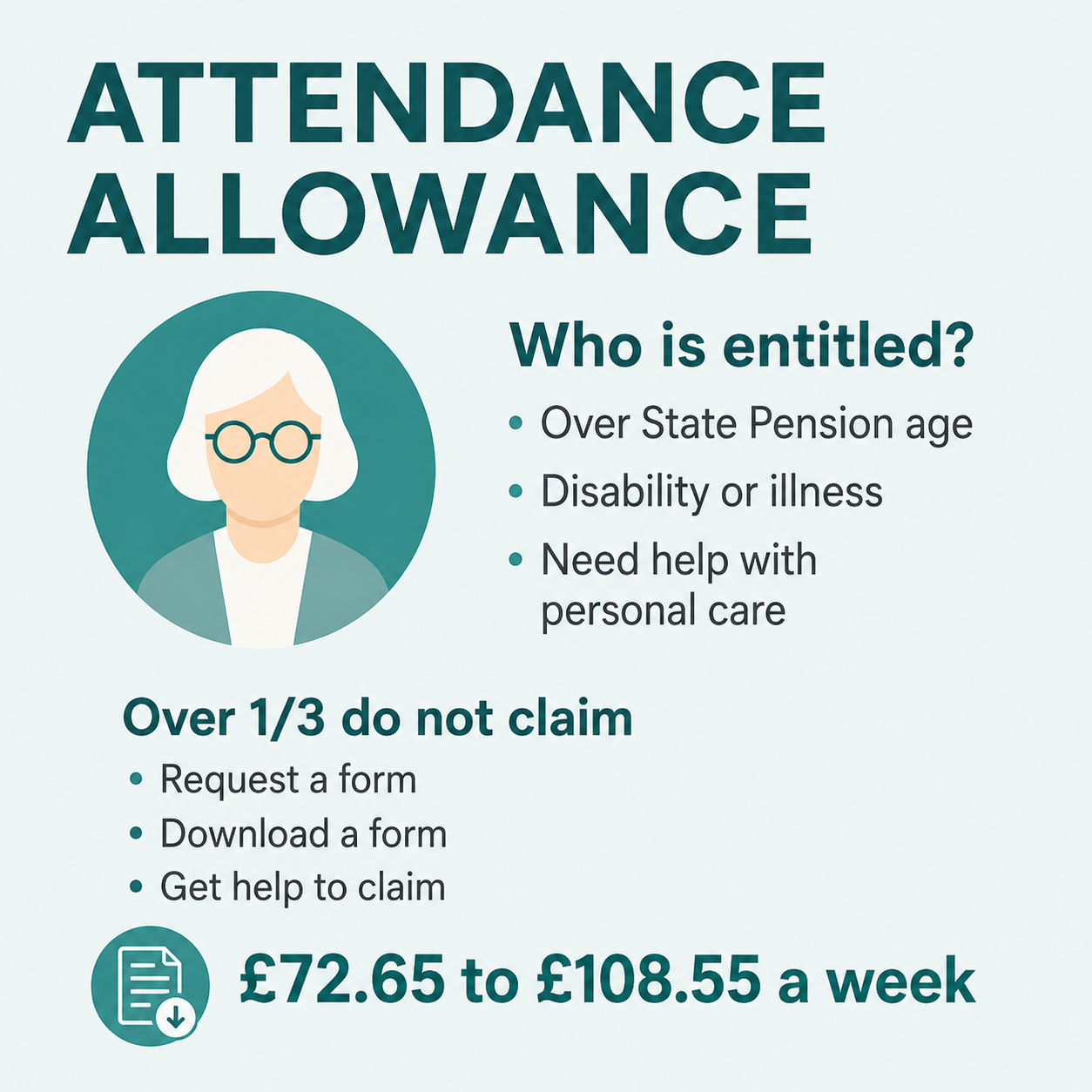
    • Attendance Allowance is paid by the DWP (UK Government)
    • PADP is paid by Social Security Scotland

    What happens if you already receive Attendance Allowance?

    • You do not need to apply again
    • Your benefit will automatically transfer to PADP
    • You will not lose your payments during the switch

    You cannot receive both attendance allowance and PADP at the same time.

    Payment comparison:

    • The structure remains similar (lower and higher rates)
    • Eligibility rules are largely aligned
    • PADP aims to provide a more person-centred application process

    How long is attendance allowance awarded for?

    Attendance Allowance (and now PADP) can be:

    • Ongoing (indefinite) if needs are unlikely to change
    • Reviewed periodically if circumstances may change

    Why this matters for caregivers:

    For care providers, these changes are important because:

    • Clients may transition automatically without disruption
    • Funding for care services continues under PADP
    • The application and review process may become more supportive and flexible

    In simple terms, attendance allowance PADP transition ensures continuitym, but with a system managed locally in Scotland, which often leads to better support for both clients and caregivers.

    How to Apply for Pension Age Disability Payment

    Criteria for Disability Pension Eligibility
    Criteria for Disability Pension Eligibility

    You can apply for pension age disability payment through Social Security Scotland using one of three methods. The process is straightforward, but caregivers often play a key role in making sure applications are completed correctly.

    Ways to apply:

    • Online: Through the official Social Security Scotland website
    • By phone: Call the adult disability payment phone number (0800 182 2222) to start your application
    • By paper form: Request a form by phone and return it by post

    Step-by-step application process:

    1. Start Part 1 (Basic Details)
      • Provide personal information
      • This date can determine when payments start
    2. Complete Part 2 (Care Needs Assessment)
      • Explain how the condition affects daily life
      • Include details about supervision, safety, and personal care
    3. Submit Supporting Information
      • Medical reports, prescriptions, or care plans
      • Statements from caregivers or family members
    4. Wait for a Decision
      • Social Security Scotland reviews the application
      • They may contact you for more details

    Tip: Always complete Part 1 as early as possible—this can affect backdated payments.

    Fast-track for terminal illness:

    • Applications are processed quickly
    • The applicant usually receives the higher rate automatically

    From a caregiver perspective:

    Caregivers and care businesses often improve success rates by:

    • Providing detailed care evidence
    • Describing real daily challenges clearly
    • Ensuring no sections are left incomplete

    A well-prepared application significantly increases the chances of receiving the correct pension age disability payment award without delays.

    SEE ALSO: Attendance Allowance Pitfalls (2026): Best Guide to Claim AA Successfully

    What Caregivers and Care Businesses Should Know

    For care providers, pension age disability payment is not just a benefit; it is a key funding source that directly affects care delivery, client retention, and service planning.

    1. PADP can determine care affordability

    When clients receive PADP, they are more likely to:

    • Increase care hours
    • Maintain consistent support
    • Avoid gaps in care due to financial pressure

    This makes PADP just as important as other support options like carers allowance or disability living allowance when planning long-term care.

    2. Your input can strengthen applications

    Caregivers often provide the most accurate picture of a client’s needs.

    You can help by:

    • Describing daily care routines clearly
    • Highlighting safety risks (falls, confusion, mobility issues)
    • Explaining supervision needs during day and night

    Strong caregiver evidence often leads to higher approval rates and correct payment levels.

    3. Many eligible clients do not apply

    A common issue in care settings:

    • Clients assume they need a diagnosis
    • Clients think they must already receive full-time care
    • Families confuse PADP with older benefits like attendance allowance

    Care businesses that educate clients about pension age disability payment Scotland can:

    • Unlock funding opportunities
    • Improve care outcomes
    • Build stronger client relationships

    4. PADP supports care business growth

    From a business standpoint, PADP helps:

    • Stabilise client income streams
    • Increase demand for domiciliary care
    • Support long-term care packages

    This is why many providers actively guide clients through the process of how to apply for pension age disability payment.

    5. It connects with other benefits

    PADP may also increase access to:

    • Carers allowance for family caregivers
    • Additional support under wider pensioner benefits UK list

    Understanding how PADP fits into the broader system allows care providers to offer more complete, informed support.

    In practice, care businesses that understand PADP do more than deliver care, they help clients secure the funding that makes quality care possible.

    MORE: Bank Holiday Early Benefit Payments DWP: May 2026 Update

    Common Mistakes to Avoid When Applying

    Pension Age Disability Payment
    Pension Age Disability Payment

    Many applications for pension age disability payment are delayed or awarded at the wrong rate because of avoidable mistakes. Caregivers and care businesses can help clients avoid these issues.

    1. Giving vague or incomplete answers

    Applicants often write short responses like “needs help sometimes.” This does not show the full level of need.

    Instead:

    • Describe specific daily challenges
    • Explain how often help is needed
    • Include day and night supervision details

    2. Not including supporting evidence

    Some people submit the form without additional information.

    Strong applications include:

    • Care plans
    • Medical letters
    • Statements from caregivers

    Missing evidence is one of the main reasons for delays.

    3. Understating care needs

    Many older adults try to appear more independent than they are.

    This can lead to:

    • Lower rate awards
    • Rejections

    Caregivers should ensure the application reflects real daily struggles, not ideal situations.

    4. Confusing PADP with other benefits

    Applicants sometimes mix up PADP with:

    • Attendance Allowance
    • Older benefits like severe disablement allowance
    • Other warnings or updates such as attendance allowance DWP warning

    This confusion can lead to:

    • Wrong applications
    • Missed eligibility

    5. Delaying the application

    Waiting too long can affect when payments start.

    Best practice:

    • Start the application early
    • Complete Part 1 as soon as possible

    6. Ignoring follow-up requests

    Social Security Scotland may ask for more information.

    Failing to respond quickly can:

    • Delay decisions
    • Reduce chances of approval

    From a caregiver’s perspective, avoiding these mistakes can make the difference between a smooth application and a stressful, delayed process. A well-prepared application ensures clients receive the correct pension age disability payment without unnecessary setbacks.

    Related Benefits You Should Know

    Pension Age Disability Payment sits within a wider system of UK support. Understanding how it connects to other benefits helps caregivers and care businesses give better advice and unlock more support for clients.

    Key related benefits:

    • Carer’s Allowance

    If someone provides regular care, they may qualify for carers allowance alongside PADP. This supports family members or unpaid caregivers.

    • Disability Living Allowance (DLA)

    Disability living allowance is mainly for children, but some older adults still receive it. It does not apply to new pension-age claims but may continue for existing cases.

    • Adult Disability Payment (ADP)

    This is the Scottish replacement for PIP for working-age adults. If someone is below pension age, they may qualify for ADP instead of PADP.

    • Attendance Allowance (outside Scotland)

    In England, Wales, and Northern Ireland, attendance allowance still applies. In Scotland, it has been replaced by PADP.

    • Other pensioner benefits

    PADP can work alongside other support in the pensioner benefits UK list, such as:

    • Pension Credit
    • Housing Benefit
    • Council Tax Reduction
    • Other sickness benefits

    PADP is part of a broader category of sickness benefits, but unlike many others, it is not based on income or employment status.

    Important note for caregivers:

    Receiving pension age disability payment can increase eligibility for other support. For example:

    • A client receiving PADP may unlock additional financial help
    • A caregiver may become eligible for carers allowance

    Understanding these connections allows care providers to support clients more effectively, not just with care delivery, but with accessing the full range of benefits available to them.

    Final Thoughts

    Pension Age Disability Payment (PADP) plays a crucial role in supporting older adults with care needs in Scotland. It is not just another benefit, it is a key funding stream that enables people at pension age to access the support they need while maintaining independence.

    For caregivers and care businesses, understanding how pension age disability payment Scotland works is essential. It allows you to:

    • Help clients secure the right level of funding
    • Deliver more consistent and higher-quality care
    • Support long-term care planning without financial disruption

    Many eligible individuals still miss out simply because they do not understand the system or delay applying. By guiding clients on how to apply for pension age disability payment, caregivers can make a real difference in both care outcomes and quality of life.

    Need Help Navigating PADP?

    At Care Sync Experts, we help care providers and caregiver businesses:

    • Improve compliance and readiness
    • Support clients with benefit applications
    • Win contracts and access funding opportunities

    If you want to strengthen your care service and ensure your clients receive the financial support they deserve, we’re here to help.

    Contact Care Sync Experts today to get expert support with care compliance, funding strategies, and application guidance.

    FAQ

    Who gets a disability pension?

    A disability pension or benefit is typically paid to people who have a long-term physical or mental condition that affects their ability to carry out daily activities or work.

    In the UK context, this includes benefits like pension age disability payment, which supports people who have reached pension age and need help with personal care or supervision due to a disability or health condition.

    How long does a disability pension take?

    Processing times vary depending on the benefit and the complexity of the application. For pension age disability payment, most decisions are made within a few months. However, if the applicant is terminally ill, the process is fast-tracked, and a decision is usually made within days.

    Can I earn money while on a disability pension?

    Yes, in many cases you can still earn money while receiving disability-related benefits. For example, pension age disability payment is not means-tested, so income or savings do not affect eligibility. This means individuals can continue to receive payments regardless of their financial situation.

    What types of disabilities qualify?

    A wide range of conditions can qualify, as long as they result in care or supervision needs. These include:
    – Physical disabilities (e.g. mobility issues)
    – Mental health conditions
    – Sensory impairments (e.g. vision or hearing loss)
    – Cognitive conditions (e.g. dementia)
    – Long-term illnesses that affect daily living

    The key factor is not the diagnosis itself, but how the condition impacts a person’s ability to manage everyday activities safely and independently.