Tag: Scotland

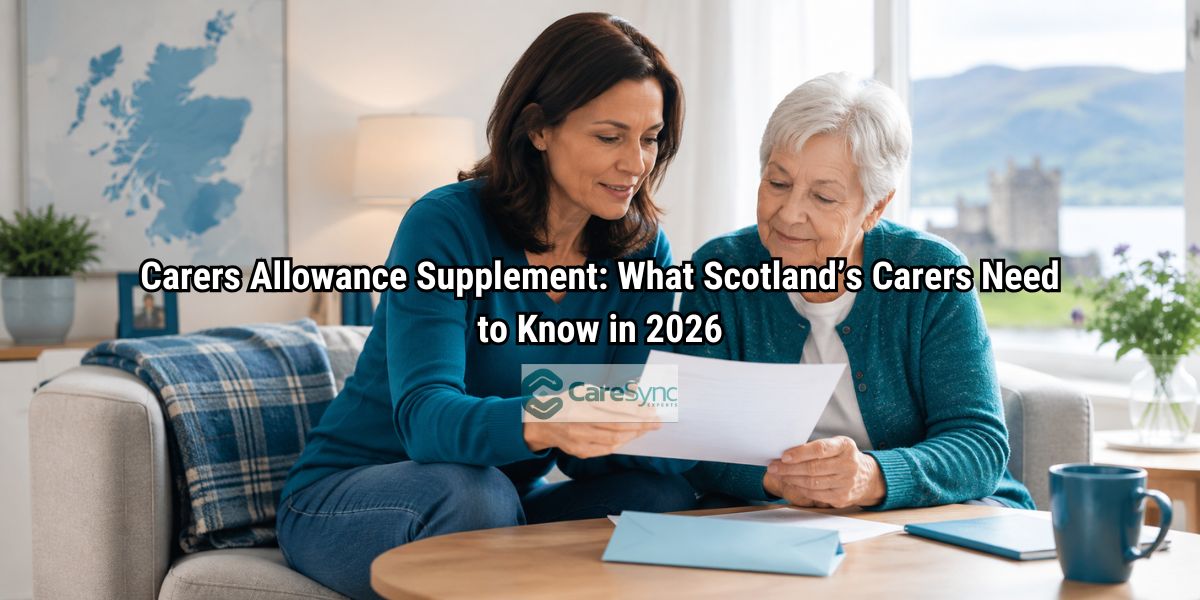
  • Carers Allowance Supplement: What Scotland’s Carers Need to Know in 2026

    Carers Allowance Supplement: What Scotland’s Carers Need to Know in 2026

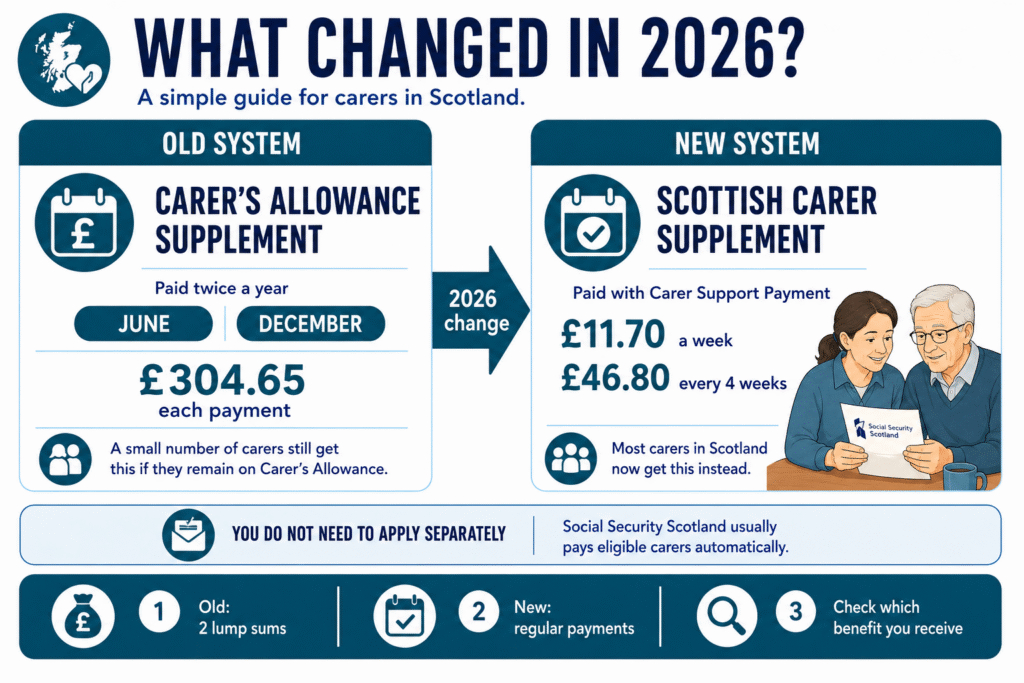
    Carers Allowance Supplement used to give eligible unpaid carers in Scotland two extra payments each year. In 2026, the system changed for most carers. Scottish Carer Supplement now replaces Carer’s Allowance Supplement for most people who receive Carer Support Payment.

    This matters because many carers still plan around the old June and December lump sums. If you now get Carer Support Payment, you will usually receive Scottish Carer Supplement alongside your regular payments instead. Official Scottish guidance lists Scottish Carer Supplement as £11.70 a week, or £46.80 every 4 weeks, paid automatically on top of Carer Support Payment.

    A small number of carers may still receive Carers Allowance Supplement 2026 as two payments if they remain on Carer’s Allowance or meet specific exception rules. The key point is simple: most eligible carers do not need to apply separately. Social Security Scotland checks eligibility and pays the supplement automatically.

    For carers and families, this extra support will not remove every pressure, but it can help with the real cost of caring: travel, food, heating, missed work, and the daily responsibility of supporting someone who depends on you.

    Get expert support for your next tender, inspection-ready policies, or CQC registration — book a call with Care Sync Experts today and let’s get you compliant and competitive.

    What Changed in 2026?

    CQC Fit Person Interview: How to Pass It First Time in 2026

    In 2026, Scotland changed how many unpaid carers receive this extra support. Scottish Carer Supplement replaced Carers Allowance Supplement for most carers who get Carer Support Payment.

    The old Carers Allowance Supplement usually came as two lump-sum payments each year. Many carers expected those payments in June and December and used them for larger household costs, travel, food, energy bills, or breaks from caring.

    The new Scottish Carer Supplement works differently. Instead of waiting for two larger payments, eligible carers receive the extra money more regularly alongside Carer Support Payment. This can make budgeting easier because the support comes throughout the year, not only twice a year.

    So, has carers allowance gone up? The support has changed more in structure than in purpose. The supplement still gives extra financial help to eligible carers in Scotland, but most carers now receive it through the newer Scottish Carer Supplement system.

    Some people may still receive Carers Allowance Supplement 2026 under the older rules, but most carers should check whether they now receive Carer Support Payment and Scottish Carer Supplement instead.

    RELATED: New Style ESA (Employment and Support Allowance) 2026

    Who Still Gets Carers Allowance Supplement?

    Most carers in Scotland who receive Carer Support Payment now get Scottish Carer Supplement instead of the old Carers Allowance Supplement.

    A small number of people may still receive Carers Allowance Supplement if they continue to get Carer’s Allowance rather than Carer Support Payment, or if they fall under special exception rules. This is why some carers still see information about June and December payments, while others now receive the supplement more regularly with their Carer Support Payment.

    The important rule is this: the carer element of Universal Credit does not qualify you for Carers Allowance Supplement on its own. To receive the supplement, you must usually receive the qualifying carer benefit, such as Carer Support Payment or Carer’s Allowance.

    From a caregiver’s point of view, this difference matters. Many unpaid carers provide daily support but do not always claim the right benefit. If you care for someone for many hours each week, check which carer benefit you receive, not just whether Universal Credit includes a carer element. That one detail can affect which payment route applies to you.

    What Date Does Carer’s Allowance Supplement Get Paid?
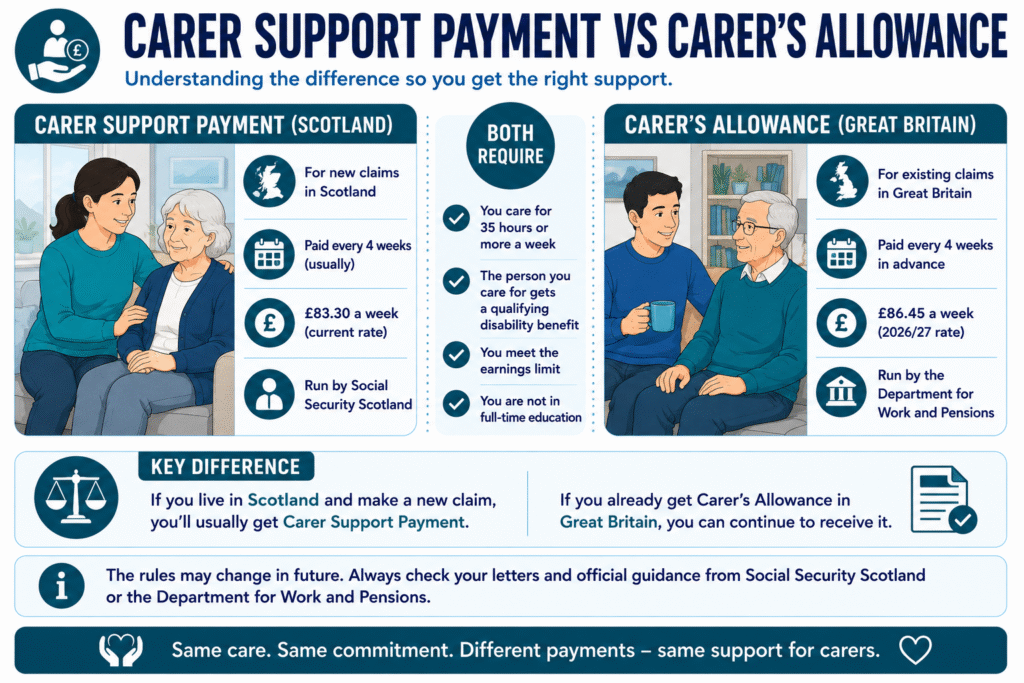
    Carer support payment vs allowance breakdown
    Carer support payment vs allowance breakdown

    Many carers still ask, what date does Carer’s Allowance Supplement get paid? Under the older system, eligible carers usually received two payments each year: one in June and one in December.

    For Carers Allowance Supplement Scotland payment date June 2026, the payment applies only to people who still qualify under the older Carer’s Allowance Supplement rules. Scotland’s newer system now pays most eligible carers through Scottish Carer Supplement, which comes with Carer Support Payment instead of two lump sums.

    Here is the simple difference:

    Payment typeHow carers receive it
    Scottish Carer SupplementPaid regularly with Carer Support Payment
    Carer’s Allowance SupplementPaid twice yearly, usually June and December

    If you searched when is Carer’s Supplement paid 2025 or Carer’s Allowance Supplement 2025, remember that the payment system changed in 2026 for most carers in Scotland. Check your latest Social Security Scotland letter to confirm which supplement you receive, the payment date, and the amount.

    READ MORE: Support Hose Compression: Benefits, Side Effects, and Safe Use

    Do You Need to Apply for Carers Allowance Supplement?

    Most eligible carers do not need to apply for Carers Allowance Supplement separately. Social Security Scotland usually checks who qualifies and sends the payment automatically.

    This also applies to the newer Scottish Carer Supplement. If you receive Carer Support Payment and meet the rules, the supplement should be added to your regular payments without a separate claim.

    So, how to apply for Carers Allowance Supplement? In most cases, you do not apply for the supplement itself. You apply for the main carer benefit, such as Carer Support Payment in Scotland or Carer’s Allowance if that still applies to your situation.

    Some people search for Carers Allowance Supplement form ADP online, but there is usually no separate form for the supplement. ADP often refers to Adult Disability Payment, which may be the disability benefit received by the person you care for. It does not mean you need a special supplement form.

    If you have recently applied for a carer benefit, you may also wonder how long does Carers Allowance take. Processing times can vary, so keep your application reference, check your letters, and contact the relevant benefit office if you have waited longer than expected.

    Does Carers Allowance Supplement Affect Universal Credit or Other Benefits?

    Carers Allowance Supplement and Scottish Carer Supplement do not reduce Universal Credit, Housing Benefit, Income Support, Council Tax Reduction, or the benefits of the person you care for. Social Security Scotland confirms that Scottish Carer Supplement and Carer Additional Person Payment do not affect other benefits.

    However, the main carer benefit can affect other benefits. Carer Support Payment may affect your income-related benefits, your partner’s benefits, or the benefits of the person you care for. 

    So, does care allowance affect Universal Credit? The supplement itself should not, but Carer Support Payment or Carer’s Allowance can be counted when Universal Credit works out your award. If you care for someone and claim Universal Credit, you should report your caring role and ask about the carer element.

    For 2026/27, the Universal Credit carer amount is listed as £209.34 per month. If you need to know how to apply for carers element of Universal Credit, update your Universal Credit journal and report that you provide care for someone who gets a qualifying disability benefit.

    SEE MORE: The 5 Principles of Mental Capacity Act: A Practical Guide for 2026

    Is Carers Allowance Taxable or Means Tested?
    Carers Allowance Supplement 2026
    Carers Allowance Supplement 2026

    Many carers ask two important questions: is Carers Allowance taxable and is Carers Allowance means tested?

    Carer’s Allowance and Carer Support Payment count as taxable income. This does not mean every carer will pay tax. It means the payment forms part of your taxable income, and you may pay tax if your total income goes above the personal tax allowance. Scottish guidance also says Carer Support Payment will usually only be taxed where the person’s taxable income is above the personal allowance.

    Carer’s Allowance is not means tested in the same way as Universal Credit. However, it does have an earnings limit. For 2026/27, GOV.UK lists the Carer’s Allowance earnings limit as £204 per week. Social Security Scotland also says Carer Support Payment has a take-home pay limit of £204 a week after tax, National Insurance, and allowed expenses. 

    So, is Carer’s Allowance means tested? Not in the usual benefit-assessment sense, but your earnings can still stop you from qualifying. That is why carers who work part-time, run a small business, or have changing hours should track earnings carefully before assuming they qualify.

    Can You Get Carers Allowance and PIP?

    Yes, you can get Carers Allowance and PIP in some situations, but the rules depend on who receives each benefit.

    If you receive PIP for your own health condition or disability, you may still claim Carer’s Allowance or Carer Support Payment for caring for someone else, as long as you meet the caring rules. You usually need to provide care for 35 hours or more a week, and the person you care for must receive a qualifying disability benefit.

    However, you do not usually claim Carer’s Allowance for caring for yourself. The carer benefit supports someone who provides care to another person.

    Families also ask, can you claim Carers Allowance for 2 people? You cannot get two full Carer’s Allowance payments for caring for two different people. In Scotland, if you receive Carer Support Payment and care for more than one person, you may qualify for Carer Additional Person Payment, currently £41.60 every 4 weeks for each additional person you care for.

    So, can I claim Carers Allowance and PIP? Possibly, yes, but only when you care for someone else and meet the eligibility rules. Check the qualifying benefit, your caring hours, your earnings, and whether anyone else already claims as the main carer for the same person.

    MORE: Universal Credit Compensation DWP: Can You Claim Money Back in 2026?

    What About Carers Allowance Supplement in England?
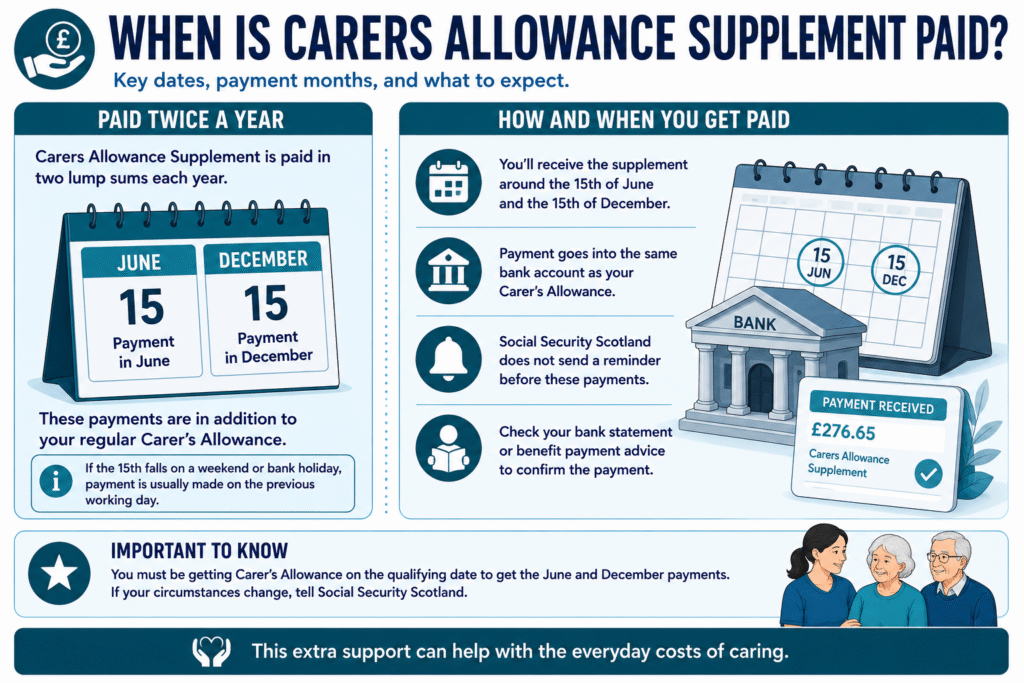
    Carers allowance supplement payment details

    Carers Allowance Supplement is a Scottish payment. Carers in England do not receive Scottish Carer Supplement or Carer’s Allowance Supplement.

    If you live in England, you may still be able to claim Carer’s Allowance if you care for someone for at least 35 hours a week and they receive a qualifying disability benefit. GOV.UK lists Carer’s Allowance as £86.45 a week for 2026/27.

    If you claim Universal Credit, you may also qualify for the carer element. GOV.UK explains that Universal Credit can include an extra amount for caring, but you need to report your caring role through your Universal Credit account.

    So, if someone searches Carers Allowance Supplement England, the answer is simple: England does not have this Scottish supplement. English carers should check Carer’s Allowance, Universal Credit carer element, local council carer’s assessments, and any local support available through their council or carer support service.

    Final Thoughts…

    Caring affects more than your diary. It can affect your income, energy, health, work, family life, and peace of mind. That is why carers should not ignore extra support like Carers Allowance Supplement, Scottish Carer Supplement, Carer Support Payment, or the Universal Credit carer element.

    If you care for someone in Scotland, check which benefit you currently receive. If you now receive Carer Support Payment, you will usually get Scottish Carer Supplement instead of the old twice-yearly Carers Allowance Supplement. If you still receive Carer’s Allowance, check your letters from Social Security Scotland so you know whether you still qualify for the June and December payments.

    Keep every payment letter, check your bank statements, and ask for advice if something does not look right. A missed payment, wrong benefit route, or unreported caring role can place extra pressure on a carer who already gives so much.

    The right support will not remove every challenge, but it can help carers plan better, protect their wellbeing, and continue caring with more confidence.

    Need Help Understanding Carer Support?

    Caring for someone can affect your time, income, health, and peace of mind. Knowing which payments apply, when support is paid, and what you may be entitled to can make planning much easier.

    At Care Sync Experts, we help carers, families, and care providers understand care-related support with confidence.

    Explore our practical care guides to make safer, clearer, and better-informed care decisions every day.

    FAQ

    Who cannot claim Carers Allowance?

    You usually cannot claim Carer’s Allowance if you do not care for someone for at least 35 hours a week, if the person you care for does not receive a qualifying disability benefit, if you earn over the earnings limit, or if you are in full-time education. In Scotland, new claims usually go through Carer Support Payment instead of Carer’s Allowance.

    How do I claim Carer’s Allowance?

    You can claim Carer’s Allowance online through GOV.UK or by post using the DS700 claim form. If you live in Scotland, you should apply for Carer Support Payment instead of Carer’s Allowance.

    How much is Carer Support Payment?

    Carer Support Payment is currently £83.30 a week if you are eligible. Social Security Scotland usually pays it every 4 weeks, although some people can receive weekly payments in special circumstances, such as terminal illness rules. 

    Do carers still get $600?

    The $600 Carer Supplement is an Australian payment, not a UK or Scottish payment. Services Australia says eligible carers can receive an annual $600 supplement for each qualifying payment, and they do not need to apply separately.

  • Scotland PIP ADP Update 2026: What Care Businesses and Claimants Must Know

    Scotland PIP ADP Update 2026: What Care Businesses and Claimants Must Know

    The Scotland PIP ADP update confirms that Social Security Scotland has completed the transfer of existing Personal Independence Payment (PIP) cases to Adult Disability Payment (ADP) by late 2025.

    If you live in Scotland and still receive PIP, you should have already received a transfer letter. If not, you must contact Social Security Scotland immediately.

    From November 2025, new applicants can no longer apply for PIP in Scotland. All new claims must go through Adult Disability Payment Scotland, which now fully replaces PIP for working-age adults. You cannot receive both benefits at the same time.

    This Adult Disability Payment update also maintains the same eligibility criteria and payment rates as PIP, ensuring continuity for claimants during the transition. However, the system now follows a more person-centred approach, with fewer face-to-face assessments and simplified reporting requirements.

    For care providers, this pip adp 2025/2026 transition means one thing: every eligible client in Scotland should now be on ADP or in the process of applying for it.

    Get expert support for your next tender, inspection-ready policies, or CQC registration — book a call with Care Sync Experts today and let’s get you compliant and competitive.

    Key Updates Care Providers Should Know

    • Social Security Scotland has completed all transfers from PIP to Adult Disability Payment Scotland, so most clients should now be on ADP.
    • New applicants must apply directly for ADP through mygov scotland. PIP is no longer available for new claims in Scotland.
    • ADP rates remain aligned with PIP, so clients receive the same level of financial support after transfer.
    • ADP uses a more person-centred system, reducing the need for face-to-face assessments and making the process less stressful for vulnerable individuals.
    • Care providers must actively support clients with ADP change of circumstances, ensuring updates are reported correctly when required.
    • Clients cannot receive both PIP and ADP at the same time, so any overlap or confusion must be resolved quickly.

    For care teams, these updates are not just administrative; they directly affect how you support clients, manage care plans, and ensure individuals continue receiving the correct Scottish disability payment without disruption.

    What This Means for Care Providers and Support Workers

    Somerset Homecare DPS 2026: £450m Contract 13 Zones Explained

    The Scotland PIP ADP update places care providers at the centre of the transition. You are no longer just delivering care; you are helping clients navigate the Scottish disability payment system correctly.

    Care providers must now:

    • Identify clients still on PIP in Scotland and guide them to contact Social Security Scotland if they missed the transfer
    • Support new clients applying for Adult Disability Payment Scotland instead of PIP
    • Help clients gather supporting evidence for applications (care plans, observations, reports)
    • Monitor and assist with ADP change of circumstances to prevent payment disruptions

    This shift also changes how you approach care planning. ADP focuses more on how a condition affects daily living rather than rigid assessments. That means your documentation, daily notes, incident reports, and care observations now plays a bigger role in supporting claims.

    For example, if a client struggles with mobility or daily tasks, your recorded observations can directly support their eligibility during an ADP review. This makes accurate, consistent documentation essential.

    Care providers who understand this transition gain a clear advantage. You reduce delays, prevent benefit interruptions, and build stronger trust with clients and families. In today’s system, strong care delivery and benefit support now go hand in hand.

    RELATED: UK Pensioners PIP Backdated Payments 2025: What You Need to Know in 2026

    Who Needs to Act After the PIP to ADP Transfer?

    Not every client needs to take action, but care providers must quickly identify those who do. The Scotland PIP ADP update affects different groups in different ways.

    1. Clients Still Receiving PIP in Scotland

    If a client still receives pip scotland payments and has not received a transfer letter, they must act immediately. They should contact Social Security Scotland to confirm their status and avoid any disruption in payments.

    Care provider role:

    • Flag these clients during reviews
    • Help them contact the social security scotland number
    • Document any delays or risks

    2. New Applicants

    Anyone making a new claim must apply for Adult Disability Payment Scotland—not PIP.

    This includes:

    • Adults with long-term physical or mental conditions
    • Individuals previously asking “who qualifies for PIP in Scotland”—the same criteria now applies to ADP
    • Young people moving from child disability payment scotland to adult support

    Care provider role:

    • Guide clients through the correct application route
    • Ensure they use mygov scotland or approved channels
    • Help prepare supporting evidence early

    3. Existing ADP Claimants

    Clients already on ADP do not need to reapply, but they must stay compliant.

    They must:

    • Report relevant updates using ADP change of circumstances
    • Respond to reviews or requests for information

    Care provider role:

    • Monitor client conditions
    • Assist with Adult Disability Payment change of circumstances online submissions
    • Prevent underpayments or overpayments

    4. Clients Transitioning Between Benefits

    Some clients may still be confused about overlapping benefits like:

    • disability living allowance scotland
    • Child Disability Payment
    • ADP

    Important: Clients cannot receive multiple overlapping disability benefits at the same time.

    Every client falls into one of these categories. Your job is to:

    • Identify their status
    • Take the correct action early
    • Prevent delays, errors, or missed payments

    This is where care providers move from support roles to essential system navigators.

    How to Apply for Adult Disability Payment in Scotland

    scotland pip adp update
    Scotland PIP ADP Update

    Care providers should guide clients through a simple but structured application process. Since the Scotland PIP ADP update, all new claims must go through Adult Disability Payment Scotland.

    Apply Online (Fastest Method)

    Clients can apply through mygov scotland, which provides the official application portal.

    Steps:

    1. Create an account via Adult Disability Payment Scotland login
    2. Complete Part 1 (basic details)
    3. Complete Part 2 (how the condition affects daily life)
    4. Upload supporting evidence

    This method allows clients to save progress and return later.

    Apply by Phone or Request a Paper Form

    Some clients may struggle with digital access. In these cases, they can apply by phone.

    Contact:

    • Adult Disability Payment phone number: 0800 182 2222
    • This is also the social security scotland number for general enquiries

    They can request:

    • A paper application form
    • Face-to-face support through local delivery services

    What Care Providers Must Do During Application

    Care providers play a critical role in strengthening applications.

    You should:

    • Help clients describe how their condition affects daily living and mobility
    • Provide supporting evidence (care notes, reports, risk assessments)
    • Ensure consistency between care records and application responses

    Supporting Information (Where Most Claims Succeed or Fail)

    Strong applications rely on evidence.

    Useful documents include:

    • Care plans and daily logs
    • Medical reports or prescriptions
    • Statements from caregivers or family

    If clients lack documentation, encourage them to submit the form anyway. Social Security Scotland can help gather evidence.

    Key Tip for Care Providers

    Do not treat this as a one-time task.

    Applications often require:

    • Follow-ups
    • Clarifications
    • Additional evidence

    Care providers who stay involved throughout the process significantly improve approval outcomes for clients applying for Adult Disability Payment Scotland.

    READ MORE: What is the Work Capability Assessment? 2026 Update for Care Businesses

    How Much is Adult Disability Payment in 2026?

    Understanding payment amounts helps care providers set clear expectations and support financial planning. The Adult Disability Payment Scotland system keeps the same structure and rates as PIP, even after the Scotland PIP ADP update.

    Weekly ADP Rates (2026)

    Daily Living Component

    • Standard rate: £76.70
    • Enhanced rate: £114.60

    Mobility Component

    • Standard rate: £30.30
    • Enhanced rate: £80.00

    A client may receive:

    • One component only, or
    • Both components, depending on their needs

    These ADP rates reflect the latest pip adp dla payment scotland increase aligned with the dwp benefit payment increase april adjustments.

    How Payments Work

    • Payments are made every 4 weeks (in arrears)
    • The benefit is not means-tested
    • Income, savings, or employment do not affect eligibility

    What Determines How Much a Client Gets?

    Social Security Scotland uses a points-based system to assess:

    • Daily living needs (e.g. washing, eating, communication)
    • Mobility needs (e.g. moving around, planning journeys)

    Tools like the ADP Scotland points calculator can help estimate eligibility, but care providers should rely on real-life observations and documented support needs.

    Care Provider Insight

    Payment levels depend heavily on how well a client’s needs are described and evidenced.

    Strong documentation can:

    • Increase the likelihood of enhanced rates
    • Prevent under-assessment
    • Support successful reviews

    If a client asks “how much is adult disability payment?”, the answer depends on how their condition affects daily life, not their income.

    Care providers who understand this system can help clients receive the correct Scottish disability payment without delays or disputes.

    Key Differences Between PIP and Adult Disability Payment Scotland

    PIP Payment Dates 2026
    PIP Payment Dates 2026

    The Scotland PIP ADP update did not change payment amounts, but it changed how the system works. Care providers must understand these differences to support clients effectively.

    1. Fewer Face-to-Face Assessments

    ADP does not rely heavily on in-person assessments.

    Social Security Scotland makes most decisions using existing information and supporting evidence.

    Impact:

    • Less stress for clients
    • Greater reliance on care records and written evidence

    2. More Person-Centred Approach

    ADP focuses on how a condition affects daily life, not just strict assessment criteria.

    Unlike some dwp pip payments reforms, ADP:

    • prioritises individual circumstances
    • reduces rigid evaluation processes

    3. Reduced Reporting Requirements

    Clients do not need to report every minor change.

    For example:

    • Short hospital stays may not require reporting
    • Some lifestyle changes do not affect payments

    This differs from PIP, where reporting requirements are stricter.

    4. Same Rates, Different Delivery

    ADP keeps the same payment structure as PIP.

    There is no freeze pip disability benefits difference in Scotland:

    • Daily living and mobility rates remain aligned
    • The change is administrative, not financial

    5. Managed by Scotland, Not DWP

    ADP is delivered by Social Security Scotland, not the DWP.

    This means:

    • Different communication channels
    • Different support systems
    • Localised decision-making

    What This Means for Care Providers

    These changes shift responsibility toward evidence and documentation.

    You must:

    • Record client needs clearly
    • Provide consistent care notes
    • Support applications with real-life examples

    ADP simplifies the process for clients, but increases the importance of accurate care documentation.

    Care providers who understand these differences can help clients transition smoothly from pip scotland to Adult Disability Payment Scotland without unnecessary delays or reassessments.

    SEE ALSO: What is a Discretionary Housing Payment? 2026 Update for Care Business

    ADP Change of Circumstances: What You Must Report

    The Scotland PIP ADP update introduced a more flexible reporting system, but clients still need to report important changes. Care providers must guide clients to avoid overpayments, underpayments, or penalties.

    What Clients Must Report

    Clients should report changes that affect how their condition impacts daily life or mobility.

    Key examples:

    • Their condition gets worse or improves
    • The level of care or support they need changes
    • They move out of Scotland
    • They enter long-term hospital or residential care

    These updates can be submitted through Adult Disability Payment change of circumstances online via mygov scotland or by contacting Social Security Scotland.

    What Clients Do NOT Always Need to Report

    ADP reduces unnecessary reporting compared to PIP.

    In many cases, clients do not need to report:

    • Starting or leaving a job
    • Changes in income or savings
    • Minor short-term changes in routine

    This reflects the more supportive approach of Adult Disability Payment Scotland.

    How to Report Changes

    Clients can update their details using:

    • Online services through Adult Disability Payment Scotland login
    • Phone via the social security scotland number
    • Paper forms if needed

    Care providers should encourage clients to report changes early to avoid complications.

    Role of Care Providers

    Care providers act as the first line of support.

    You should:

    • Monitor changes in client condition or care needs
    • Help complete ADP change of circumstances submissions
    • Ensure care records match reported information

    Accurate documentation is critical. If care notes show increased support needs but the benefit remains unchanged, clients may miss out on higher adp rates.

    Common Mistake to Avoid

    Many clients delay reporting because they are unsure.

    This can lead to:

    • Incorrect payments
    • Backdated adjustments
    • Stress during reviews

    ADP simplifies reporting, but it does not remove responsibility.

    Care providers who actively manage Adult Disability Payment change of circumstances online processes protect clients from errors and ensure they continue receiving the correct Scottish disability payment.

    MORE: Earned Income Disallowance: Benefits & Allowances (2026 Guide)

    Tools and Support Available for ADP Applications

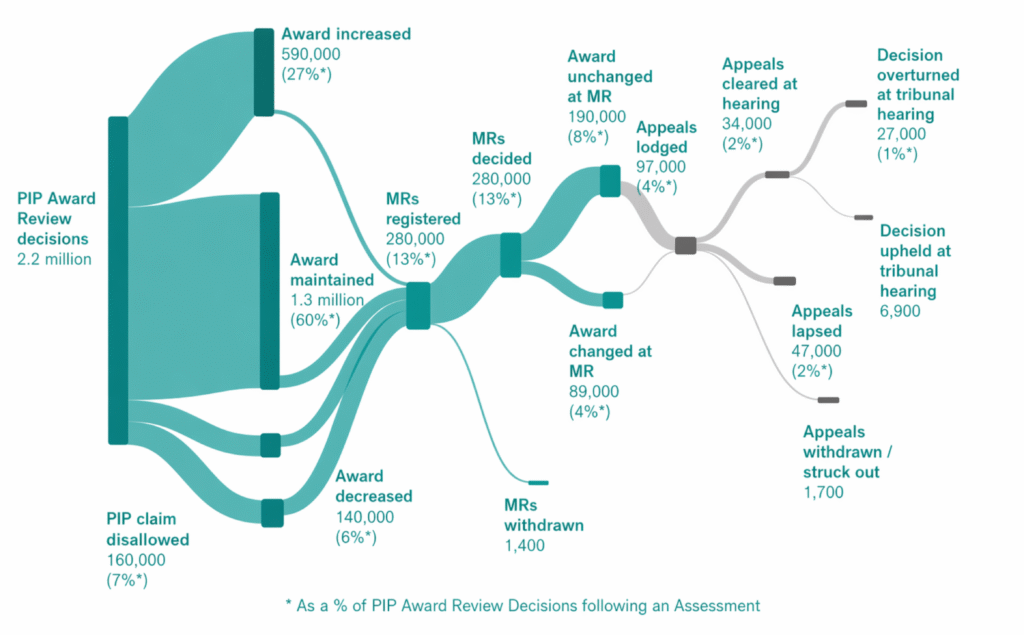
    Personal Independent Payment (PIP) Statistics

    Care providers do not need to navigate the Adult Disability Payment Scotland system alone. Several tools and support services can improve application success and reduce errors.

    ADP Scotland Points Calculator

    The ADP Scotland points calculator helps estimate whether a client may qualify and at what rate.

    It assesses:

    • Daily living needs
    • Mobility limitations

    While helpful, do not rely on it alone. Real-life care evidence and documentation carry more weight during decision-making.

    Online Services and Login Access

    Clients can manage their applications through:

    • Adult Disability Payment Scotland login on mygov scotland
    • Online forms for applications and updates
    • Adult Disability Payment change of circumstances online submissions

    Care providers should guide clients through these systems, especially those with limited digital skills.

    Phone and Direct Support

    For clients who need assistance, phone support remains essential.

    Key contacts:

    • Adult disability payment phone number: 0800 182 2222
    • This is also the social security scotland number

    Clients can:

    • Request paper forms
    • Ask for updates
    • Get help completing applications

    Additional Support Services

    Clients may also access:

    • Local delivery teams from Social Security Scotland
    • Advocacy services (for vulnerable individuals)
    • Advice organisations for complex cases

    Support for Related Benefits

    Some clients may also receive or transition from:

    • child disability payment or child disability payment scotland
    • disability living allowance scotland

    Care providers must understand how these benefits connect to ADP to avoid overlap issues.

    Care Provider Advantage

    Using the right tools improves outcomes.

    You can:

    • Identify eligibility early
    • Strengthen applications with evidence
    • Reduce delays and rejections

    Tools and support systems make the ADP process easier, but only when used correctly.

    Care providers who actively use platforms like mygov scotland and guide clients through available support services will achieve faster approvals and more accurate Scottish disability payment outcomes.

    READ: NVQ Level 3 Health and Social Care: Requirements, Jobs, Salary, How to Get It in 2026

    Should Care Providers Help Clients Switch to ADP?

    Yes—care providers should actively support clients through the transition and ongoing management of Adult Disability Payment Scotland. The Scotland PIP ADP update has removed much of the complexity for claimants, but it has increased the importance of accurate guidance and documentation.

    When Care Providers Should Step In

    Care providers should take a proactive role when:

    • A client still receives pip scotland and has not completed the transfer
    • A client struggles to understand the application process
    • A client has complex care needs that require detailed evidence
    • A review or ADP change of circumstances is required

    Why Your Support Matters

    Most clients do not fully understand:

    • How eligibility works
    • What evidence is required
    • When to report changes

    Without support, this can lead to:

    • Underpayments
    • Delays in approval
    • Rejected claims

    Care providers bridge this gap by translating care needs into clear, evidence-based information.

    The Business Advantage for Care Providers

    Supporting clients with ADP is not just helpful; it strengthens your service offering.

    Benefits include:

    • Improved client outcomes
    • Stronger trust with families
    • Better care documentation standards
    • Reduced complaints related to financial support

    When Professional Help May Be Needed

    In complex cases, consider involving:

    • Advocacy services
    • Benefit advisors
    • Specialist consultants

    This is especially useful when:

    • A claim has been denied
    • Evidence is insufficient
    • The client’s situation is unclear

    Care providers who ignore the ADP process risk leaving clients unsupported.

    Care providers who engage with it become essential partners in ensuring clients receive the correct Scottish disability payment, on time and without complications.

    Need Help Navigating ADP Changes?

    The Scotland PIP ADP update has simplified the system, but many clients still struggle to understand what to do next. This is where care providers can make a real difference.

    Care Sync Experts supports care providers with:

    • Guidance on Adult Disability Payment Scotland processes
    • Compliance-ready documentation aligned with ADP requirements
    • Support for applications and ADP change of circumstances
    • Best practices to improve approval rates and reduce delays

    If your team wants to:

    • Reduce application errors
    • Improve client outcomes
    • Stay compliant with evolving Scottish disability payment systems

    Then it’s time to treat benefits support as part of your core care delivery, not an afterthought.

    Final Takeaway

    The move from PIP to ADP is complete. The responsibility now shifts to care providers to ensure every client:

    • Applies correctly
    • Reports changes accurately
    • Receives the correct adp rates without interruption

    Care providers who master this process will not only support clients better but also position themselves as trusted, forward-thinking service providers in Scotland’s evolving care system.

    Care Sync Experts helps care providers handle Adult Disability Payment Scotland applications, evidence, and change updates, so your clients get the right support without delays.

    Strengthen your care delivery and support clients with confidence.

    Get Started Today

    FAQ

    How long for an ADP decision in Scotland?

    Social Security Scotland usually makes a decision on Adult Disability Payment (ADP) within 4 months.

    In more complex cases, it can take up to 6 months. If the applicant is terminally ill, decisions are fast-tracked and typically made within a few working days.

    What changes are coming to PIP in 2026?

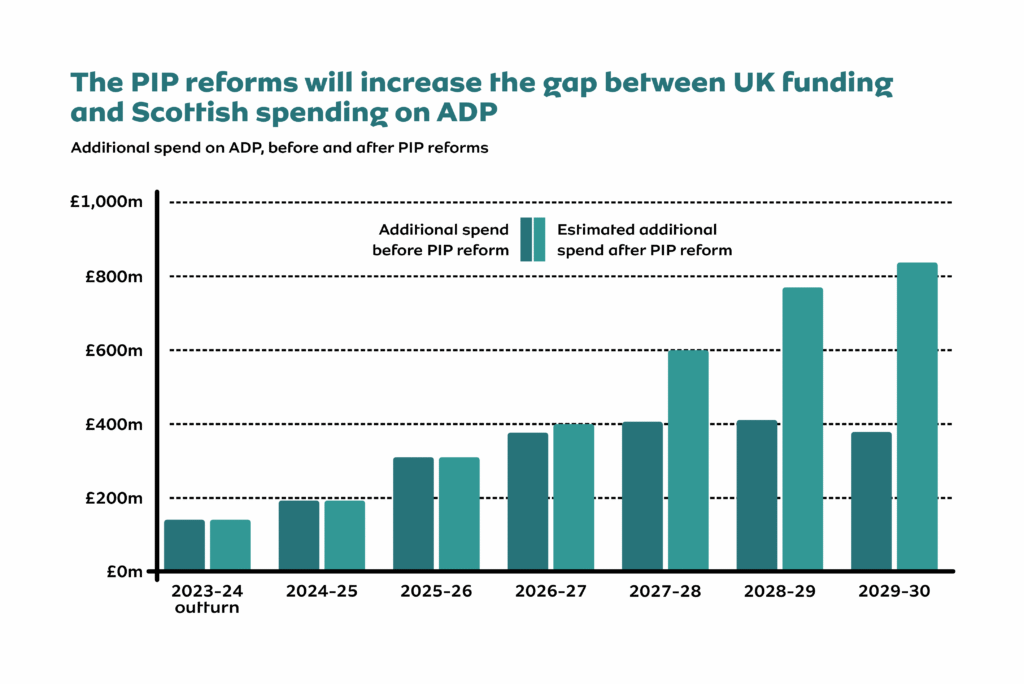
    In 2026, discussions around DWP PIP payment reforms focus on tightening assessments and increasing face-to-face evaluations in some cases.

    However, these changes mainly affect England and Wales. In Scotland, PIP has already been replaced by ADP, which follows a more supportive and person-centred approach.

    Will everyone on PIP be reassessed?

    Not everyone will be reassessed immediately.
    In Scotland, most people have already moved from PIP to ADP without needing a full reassessment. Social Security Scotland typically reviews claims only when:
    – A scheduled review is due
    – A change of circumstances is reported

    Will PIP know if I go abroad?

    Yes. The DWP can check travel records, and going abroad can affect PIP payments.
    Key rule:
    – You must report if you plan to leave the UK for more than 4 weeks
    – Payments may stop depending on the length and reason for travel

    For ADP in Scotland, short temporary absences are allowed, but longer stays must still be reported to avoid payment issues.

  • Carers Allowance Scotland: What’s Changed in 2026?

    Carers Allowance Scotland: What’s Changed in 2026?

    If you live in Scotland, Carers Allowance Scotland now operates as Carer Support Payment. The Scottish Government replaced the DWP benefit with Carer Support Payment, which Social Security Scotland now manages across the country.

    If you already receive Carer’s Allowance from the DWP and live in Scotland, you usually do not need to reapply. Social Security Scotland transfers your award to Carer Support Payment automatically. You cannot receive both at the same time.

    If you live in England, Wales, or Northern Ireland, you still claim through Gov UK Carer’s Allowance instead.

    This guide explains who qualifies, how much you can get, how work affects your claim, and how to apply for Carer Support Payment in 2025/2026.

    How much is Carer’s Allowance in 2025/2026?

    If you’re asking “how much is Carer’s Allowance UK?”, the weekly rate for 2025/2026 is:

    BenefitWeekly rate
    Carer’s Allowance (England, Wales, NI)£83.30 per week
    Carer Support Payment (Scotland)£83.30 per week

    So if you live in Scotland, Carer Support Payment currently matches the standard Carer’s Allowance rate.

    Many carers search for “how much is carers allowance” or “carers allowance rate 2025”, and the answer is the same weekly amount unless the government announces an uprating.

    How you’re paid

    • In Scotland, Social Security Scotland normally pays you every 4 weeks in arrears.
    • If you transferred from DWP Carer’s Allowance, you may keep a weekly payment schedule depending on your circumstances.
    • Outside Scotland, you can usually choose weekly or 4-weekly payments under Gov UK Carer’s Allowance.

    If you receive other benefits, the payment structure can affect your overall income, especially if you also claim Universal Credit carer element, which we’ll explain shortly.

    RELATED: RQIA Registration for Domiciliary Care Agency in Northern Ireland (2026)

    Who can claim? The rules for claiming Carer’s Allowance (and Carer Support Payment)

    Domiciliary Care vs Supported Living CQC Registration: Which Route Is Easier in 2026

    Before you apply, check the core rules for claiming Carer’s Allowance or Carer Support Payment. You must meet all of the following:

    You must provide enough care

    • You care for someone at least 35 hours a week.
    • You do not need to live with them.
    • You do not need to be related to them.

    The person you care for must receive a qualifying benefit

    They must receive a disability benefit such as:

    • Personal Independence Payment (PIP) daily living component
    • Disability Living Allowance (middle or highest care rate)
    • Attendance Allowance
    • Or certain other qualifying benefits

    Only one person can usually claim for caring for the same individual.

    You must meet age and residence rules

    • You must be 16 or over.
    • You must live in the UK (with specific rules for Scotland under Carer Support Payment).

    Is Carer’s Allowance means tested?

    Many carers ask: “Is carers allowance means tested?”

    It is not means tested in the traditional way; your savings do not affect it. However, your earnings do matter, and you must stay below the weekly earnings limit after allowed deductions. We’ll break that down clearly in the next section.

    If you’re unsure whether you qualify, especially if you work part time or receive other benefits, review the work and Universal Credit sections carefully before you apply.

    Carer’s Allowance and part-time work: how the earnings limit works

    You can work and still claim, but you must stay within the weekly earnings limit.

    For 2026, you must not earn more than £196 per week after certain deductions. Many carers search for “carers allowance part time work” because this rule causes the most confusion.

    What counts as earnings?

    Your earnings include:

    Before the government applies the £196 limit, it allows certain deductions, including:

    • Income tax
    • National Insurance
    • Half of your pension contributions
    • Some work-related expenses (for example, care costs while you work)

    If your earnings go even slightly above the limit in a week, you can lose entitlement for that period. That’s why tracking your income carefully matters.

    What if your hours or pay change?

    If your earnings fluctuate:

    • Keep copies of payslips.
    • Tell the relevant authority quickly (DWP for Gov UK Carer’s Allowance, Social Security Scotland for Carer Support Payment).
    • Do not wait until the end of the year; overpayments can build up.

    Working part time does not automatically disqualify you. Many carers successfully combine part-time work with their benefit, but you must manage your weekly earnings carefully.

    READ MORE: When Does Child Benefit Stop in the UK? (2026 Guide)

    Universal Credit carer element: how it works with Carer’s Allowance

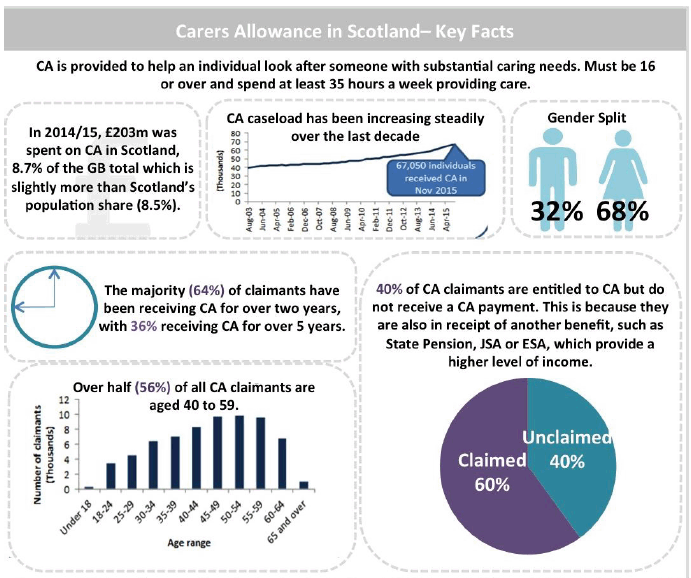
    Care Allowance in Scotland 2026
    Care Allowance in Scotland 2026

    If you claim Universal Credit, you may also qualify for the universal credit carer element. This is an extra monthly amount added to your Universal Credit award if you care for someone at least 35 hours a week.

    Many carers search for:

    • carers element universal credit
    • universal credit carers element
    • carer element
    • how to apply for carers element of universal credit

    Here’s what you need to know.

    You do not need to receive Carer’s Allowance to get the carer element

    You can qualify for the carer element even if you do not receive Carer’s Allowance, as long as:

    • You provide at least 35 hours of care per week, and
    • The person you care for receives a qualifying disability benefit.

    How it interacts with Carer’s Allowance

    If you receive both:

    • Carer’s Allowance counts as income for Universal Credit.
    • Universal Credit reduces by the same amount.
    • However, you still receive the separate carer element within Universal Credit.

    This means many carers are not “double paid,” but they still benefit from the additional element.

    How to apply for carers element of Universal Credit

    You do not submit a separate paper form. Instead:

    1. Log into your Universal Credit account.
    2. Report that you care for someone 35+ hours per week.
    3. Provide details about the person you care for and their disability benefit.
    4. Keep your journal updated if your caring hours change.

    Always report changes promptly. Delays can lead to overpayments or missed entitlements.

    Is Carer’s Allowance taxable?

    Yes, Carer’s Allowance is taxable if your total annual income goes above the Personal Allowance.

    Many carers search “is carers allowance taxable” because the payment feels like support rather than earnings. However, HMRC treats it as taxable income.

    When do you actually pay tax?

    You only pay tax if:

    • Your total income (wages, pension, benefits, etc.) exceeds the yearly Personal Allowance.
    • The combined amount pushes you into a taxable band.

    If Carer’s Allowance (or Carer Support Payment in Scotland) is your only income, you will usually not pay tax because it sits below the Personal Allowance threshold.

    If you work part time or receive a pension, your tax position can change. In those cases:

    • Check your tax code.
    • Review your total annual income.
    • Contact HMRC if something looks incorrect.

    Remember: being taxable does not automatically mean you will owe tax. It depends on your overall income for the year.

    Can I claim Carer’s Allowance for myself?

    Short answer: No.

    You cannot claim Carer’s Allowance (or Carer Support Payment in Scotland) for caring for yourself. You claim it because you care for someone else who receives a qualifying disability benefit.

    Many people search:

    • Can I claim carers allowance for myself?
    • Can I claim carers allowance for myself on PIP?

    Here’s where the confusion comes from.

    PIP is for the disabled person, not the carer

    If you receive Personal Independence Payment (PIP) yourself, that does not make you eligible to claim Carer’s Allowance for your own condition.

    However:

    • If someone else cares for you for at least 35 hours a week,
    • And you receive the daily living component of PIP (or another qualifying benefit),

    Then they may be able to claim Carer’s Allowance or Carer Support Payment for caring for you.

    You can claim even if you are disabled yourself

    If you have your own health condition but still provide 35+ hours of care to someone else, you may qualify as long as you meet the earnings and eligibility rules.

    The key rule stays the same: You must care for another person who receives a qualifying disability benefit.

    SEE ALSO: Home Reversion Plan 2026: How It Works, Costs, Risks, Examples

    Carer’s Allowance Supplement in Scotland (and what changes in 2026)

    Carers Allowance Scotland
    Carers Allowance Scotland

    If you live in Scotland and receive Carer Support Payment, you may also qualify for the Carer’s Allowance Supplement.

    This extra payment increases the overall value of support for carers in Scotland. The government pays it automatically; you do not need to submit a separate application.

    How it currently works

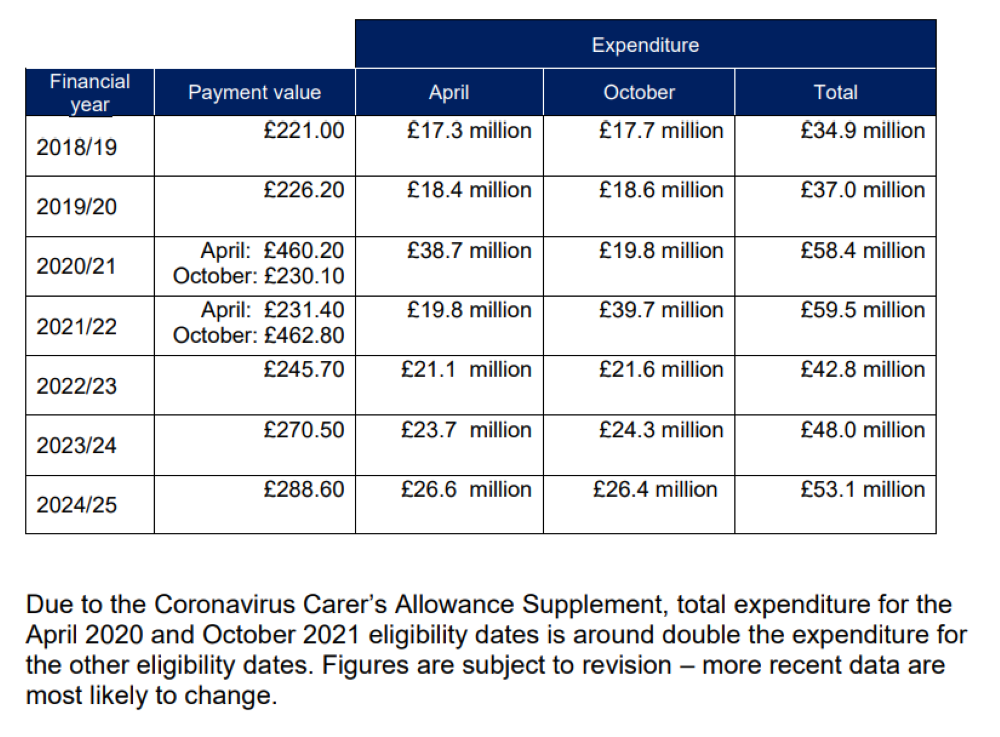
    • It is paid twice a year (traditionally in June and December).
    • You receive it automatically if you qualify on the set eligibility dates.
    • You do not need to apply separately.
    What changes from March 2026?

    From March 2026, Scotland plans to replace the twice-yearly Carer’s Allowance Supplement with a more regular payment structure (often referred to as the Scottish Carer Supplement).

    This change aims to:

    • Spread support more evenly through the year.
    • Make payments more predictable.
    • Align more closely with Scotland’s devolved social security system.

    If you already receive Carer Support Payment, the transition should happen automatically. Always check official updates from Social Security Scotland to confirm current payment arrangements.

    Apply for Carer Support Payment: step-by-step

    If you live in Scotland and do not already receive Carer’s Allowance, you need to apply for Carer Support Payment through Social Security Scotland.

    Follow these steps to apply confidently.

    1. Check your eligibility first

    Before you start your application, make sure:

    • You provide at least 35 hours of care per week.
    • The person you care for receives a qualifying disability benefit.
    • Your weekly earnings stay below the limit after deductions.

    If you are unsure, review the rules section above before submitting your claim.

    2. Gather the information you’ll need

    Have these ready:

    • Your National Insurance number
    • Bank account details
    • Details about the person you care for
    • Information about your work and earnings (if you work)

    Preparing this in advance prevents delays.

    3. Submit your application

    You can apply:

    • Online through the official Social Security Scotland website
    • By phone
    • By requesting and submitting a paper form

    Most carers choose the online route because it’s faster and easier to track.

    4. After you apply

    Social Security Scotland will:

    • Review your information
    • Contact you if they need more details
    • Confirm their decision in writing

    If they approve your claim, they will tell you:

    • Your payment amount
    • Your payment schedule
    • When your first payment will arrive

    If you previously received Gov UK Carer’s Allowance and moved to Scotland, your claim may transfer automatically. If you move into Scotland from another part of the UK, you usually need to make a new claim.

    MORE: What Are the 5 Stages of Palliative Care? 2026 Update

    Can I check my Carer’s Allowance online?

    Yes, but how you check it depends on where you live.

    Many carers search “Can I check my carers allowance online?” because they want quick updates without calling.

    If you live in Scotland

    If you receive Carer Support Payment, you manage your claim through Social Security Scotland.

    You can:

    • Check correspondence and updates online (if you applied digitally)
    • Contact Social Security Scotland directly by phone if you need clarification
    • Report changes in your circumstances (for example, changes in work or caring hours)

    Always report changes as soon as possible to avoid overpayments.

    If you live in England, Wales or Northern Ireland

    If you receive Gov UK Carer’s Allowance, you can:

    • Sign in to your government account
    • Report a change in circumstances
    • Check payment dates
    • Update personal details

    If you cannot access your online account, you can contact the Carer’s Allowance Unit by phone.

    Keeping your details up to date protects your payments and prevents unexpected repayment demands later.

    Carer’s Allowance Scotland vs the rest of the UK: what’s different?

    If you’re confused about whether to claim through Scotland or through Gov UK Carer’s Allowance, this quick breakdown will help.

    If you live in Scotland

    • You claim Carer Support Payment, not DWP Carer’s Allowance.
    • Social Security Scotland manages your claim.
    • You may receive the Carer’s Allowance Supplement (or its replacement from March 2026).
    • If you previously received DWP Carer’s Allowance while living in Scotland, your claim usually transfers automatically.

    If you live in England, Wales or Northern Ireland

    • You claim through Gov UK Carer’s Allowance.
    • The Department for Work and Pensions (DWP) manages your claim.
    • Scotland-only supplements do not apply.

    If you move between Scotland and the rest of the UK

    You must report your move immediately.

    • Moving into Scotland:

    Your DWP Carer’s Allowance will stop after a transition period. You must apply for Carer Support Payment as soon as possible to avoid gaps in payment.

    • Moving out of Scotland:

    You must report the move to Social Security Scotland and apply for Gov UK Carer’s Allowance.

    Your benefit does not automatically continue across borders without action.

    Final thoughts…

    If you live in Scotland, Carer’s Allowance Scotland now operates as Carer Support Payment. The weekly rate currently sits at £83.30; the 35-hour care rule still applies, and your earnings must stay below the weekly limit after deductions.

    If you claim Universal Credit, check whether you qualify for the universal credit carer element. If you work part time, track your weekly income carefully. If you move across UK borders, report it immediately and apply under the correct system.

    Small mistakes, missing a change in earnings, misunderstanding the transfer from Gov UK Carer’s Allowance, or assuming you can claim for yourself, can trigger overpayments or payment gaps.

    When you care for someone else, you should not have to guess your own financial position.

    Supporting UK Carers Through Benefit & Care Transitions?

    If you searched “carers allowance scotland,” “how much is carers allowance,” “apply for carer support payment,” “carers allowance part time work,” “universal credit carer element,” or “is carers allowance taxable,” you are likely managing financial pressure while providing real, hands-on care.

    Clear, accurate guidance matters. Misunderstanding earnings limits, reporting changes late, or confusing Carer Support Payment with Gov UK Carer’s Allowance can lead to overpayments, repayment demands, or avoidable stress.

    Care Sync Experts supports carers and regulated care providers across the UK with:

    • Clear interpretation of Scotland and DWP benefit rules
    • Structured compliance guidance aligned with GOV.UK and Social Security Scotland frameworks
    • Practical support on reporting obligations and documentation standards
    • Financial clarity around earnings limits and Universal Credit interaction
    • Governance advice for domiciliary and supported living providers supporting unpaid carers
    • Policy development for organisations delivering structured carer support
    • Tender-writing and compliance support for services assisting carers and families
    • Inspection-readiness frameworks for providers delivering regulated care

    Whether you are managing your own claim or leading a regulated care service supporting unpaid carers, we help you replace confusion with clarity and structured compliance.

    Get in touch with Care Sync Experts today and ensure your benefit position remains accurate, compliant, and financially secure.

    FAQ

    How long is Carer’s Allowance taking to process in 2025?

    Processing times vary depending on your circumstances and whether the authority needs additional information.

    In straightforward cases:
    Carer Support Payment (Scotland) decisions often take several weeks after you submit a complete application.
    Gov UK Carer’s Allowance claims typically take a few weeks as well, but delays can occur if eligibility checks are complex.

    Applications may take longer if:
    – The person you care for has only recently been awarded a qualifying disability benefit.
    – Your earnings require verification.
    – You recently moved between Scotland and another UK nation.
    – You can reduce delays by:
    – Providing full details about the person you care for.
    – Submitting accurate earnings information.
    – Responding quickly to follow-up requests.

    What stops you from getting Carer’s Allowance?

    Several situations can stop or prevent entitlement:
    – You earn more than the weekly earnings limit.
    – You provide fewer than 35 hours of care per week.
    – The person you care for stops receiving a qualifying disability benefit.
    – Someone else successfully claims for caring for the same person.
    – You move between Scotland and the rest of the UK and fail to apply under the correct system.
    – You enter full-time education (in most cases).
    – Reporting changes quickly protects you from overpayments and repayment demands.

    Who pays for carers in Scotland?

    If you receive financial support as a carer in Scotland:
    – Social Security Scotland pays Carer Support Payment.
    – The Scottish Government funds additional support such as the Carer’s Allowance Supplement (or its replacement structure from 2026).

    If you receive Universal Credit, the Department for Work and Pensions (DWP) pays the Universal Credit award, including any carer element.

    Separate from benefits, local authorities may fund formal care services for the person you support, but that funding does not replace Carer Support Payment.

    What benefits can I claim as a carer in Scotland?

    As a carer in Scotland, you may be eligible for:
    – Carer Support Payment
    – The Scotland-only Carer’s Allowance Supplement (or its replacement from 2026)
    – The Universal Credit carer element
    – National Insurance credits
    – Council Tax Reduction (depending on income)
    – Pension Credit (if you are over State Pension age)
    – Carer’s Credit (if you provide at least 20 hours of care but do not qualify for Carer Support Payment)

    Your eligibility depends on your income, caring hours, and household circumstances. Many carers qualify for more than one form of support.