An unregulated care provider is a person or business that offers practical support without operating as a CQC-registered care service.
In England, people often use this term for companions, home-help workers, sitting services, and support workers who help with everyday life.
However, the label alone does not decide whether a service needs regulation. The key question is what care the provider delivers, who manages it, and whether a legal exemption applies.
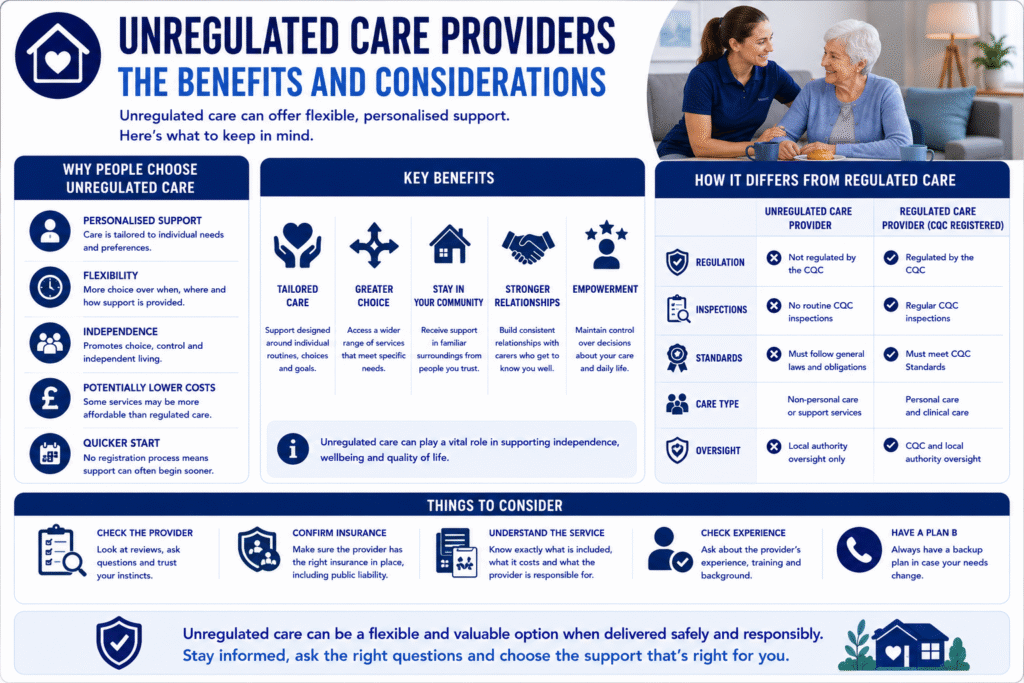
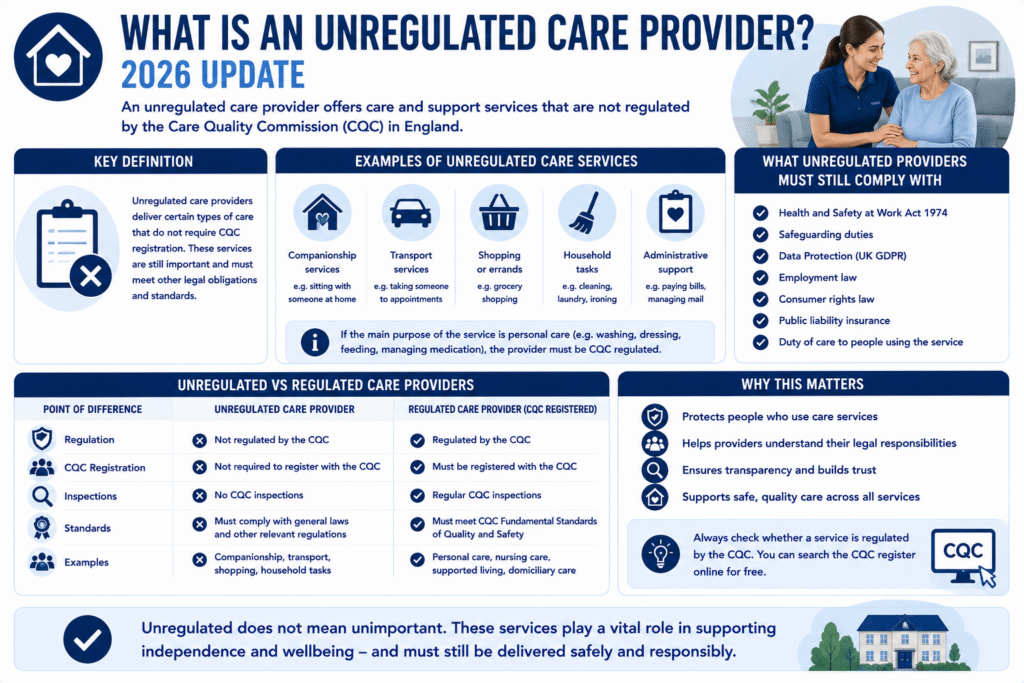
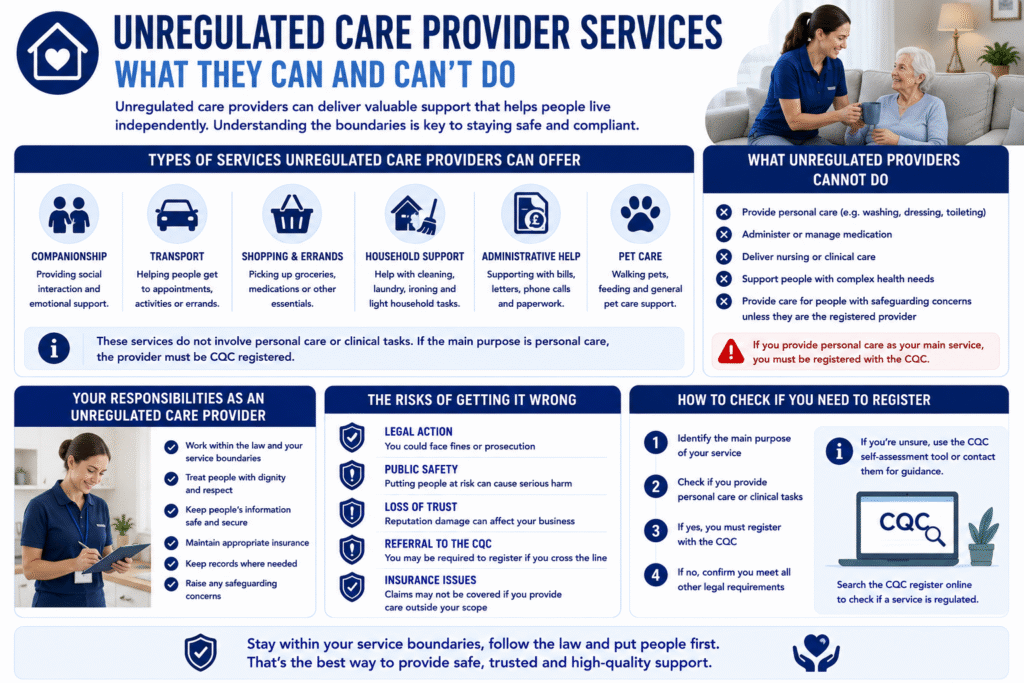
For example, companionship, shopping, light cleaning, meal preparation, and help attending appointments may sit outside CQC regulation. But personal care can raise different rules.
In England, personal care for someone who cannot manage it because of old age, illness, or disability is generally a CQC-regulated activity. This can include help with washing, dressing, toileting, bathing, or cleaning themselves.
From a caregiver business perspective, clarity matters. A trustworthy provider explains exactly what its team can do, what it cannot do, how it manages risks, and when a family may need a CQC-registered home care service instead.

Unregulated Care Provider Examples
An unregulated care provider may offer practical help that makes daily life easier without presenting itself as a regulated personal care service. Families often use this type of support when someone feels lonely, struggles with household tasks, or needs help staying active in the community.
Common unregulated care provider examples include:
- Companionship visits and social support
- Shopping, errands, and collecting prescriptions
- Light cleaning, laundry, and household organisation
- Meal preparation and help with eating routines
- Transport or escorting support for appointments
- Sitting services while a family carer takes a break
- Help attending social activities or community groups
- Reminders about appointments, meals, or daily routines
These services can offer real value, especially for people who want help without needing regular hands-on care.
However, providers need to stay clear about their scope. A companion can remind someone to take medication, for example, but medication administration may require additional training, policies, risk checks, and sometimes a regulated care arrangement. The same applies to personal care tasks such as washing, dressing, continence support, or bathing.
From a caregiver business perspective, clear boundaries protect everyone. Families know what to expect, workers understand their role, and the provider can refer the person to a CQC-registered service when their needs become more complex.
Regulated vs Unregulated Care: What Is the Difference?
The biggest difference between regulated and unregulated care is accountability.
A regulated care provider must register with the Care Quality Commission, CQC, when it carries on a regulated activity. The provider must meet legal standards, follow safeguarding procedures, manage complaints, train staff properly, and remain open to CQC inspection.
An unregulated care provider does not operate as a CQC-registered service. It may still offer useful support, but families need to check its training, insurance, DBS checks, supervision, and care boundaries themselves.
| Regulated care service | Unregulated support service |
| May need CQC registration | Not registered with CQC |
| Can provide regulated personal care where registered | Usually provides companionship and practical support |
| Must meet CQC requirements | Still follows general employment, safeguarding, and consumer law |
| Can be inspected by CQC | Is not inspected by CQC as a regulated provider |
| Usually has formal policies for incidents, medication, and complaints | May have its own policies, but standards vary |
Personal care often creates the dividing line. Help with washing, dressing, toileting, bathing, continence, or similar intimate support may fall within CQC-regulated personal care when the person cannot manage those tasks because of age, illness, or disability. Families should always ask the provider to explain its registration status and the exact support it can legally deliver.
RELATED: CQC Registration for Domiciliary Care Providers: Complete 2026 Guide
Can an Unregulated Care Provider Give Medication?
Medication support needs clear boundaries. An unregulated care provider may remind someone to take their medicine, but families should not assume that every caregiver can safely administer it.
The CQC makes an important distinction: supporting, prompting, or supervising medicines on its own does not automatically mean a provider must register for personal care. But medication support can still create real risks, especially when someone has complex prescriptions, controlled drugs, swallowing difficulties, poor memory, or reduced capacity.
For any unregulated care provider medication administration arrangement, the provider should have:
- A clear medication policy
- Training and competency checks
- Written consent and care-plan instructions
- Accurate medication records
- A process for missed doses, errors, refusals, or concerns
- Clear limits on what the worker can and cannot do
Care workers should only provide medicine support that has been agreed and recorded in the person’s care plan.
From a caregiver business perspective, honesty matters. If a person needs injections, complex medication, controlled drugs, or clinical monitoring, the provider should assess the risk properly and involve a regulated service, pharmacist, nurse, or other appropriate professional where needed.
Is a PSW an Unregulated Care Provider?
A PSW, or Personal Support Worker, is a job title used mainly in Canada. In many Canadian provinces, PSWs support people with personal care, mobility, meals, companionship, and daily living, but they do not belong to a regulated nursing college in the same way as registered nurses.
So, is a PSW an unregulated care provider? In many Canadian settings, yes. PSWs often form part of the unregulated care workforce, although employers may still require recognised training, background checks, supervision, and workplace policies.
This creates confusion for UK readers. In the UK, employers rarely use the term PSW. You are more likely to see titles such as:
- Care worker
- Care assistant
- Support worker
- Home care worker
- Domiciliary care worker
- Personal assistant
The phrase unregulated care provider vs PSW is therefore not a direct UK comparison. A PSW describes a Canadian support-worker role, while “unregulated care provider” describes whether a person or service sits outside a formal regulatory system. In England, the important question remains what care the worker provides and whether that activity requires CQC registration.
READ MORE: Ofsted Regulations for Children’s Homes: What Providers Need to Know
Do You Need an Unregulated Care Provider Certificate?
There is no single UK qualification called an unregulated care provider certificate. However, responsible care businesses should still make sure workers have the right training for the support they provide.
For companionship or home-help roles, this may include safeguarding, first aid, food hygiene, dementia awareness, lone-working safety, and basic record keeping. For roles involving personal care, moving and handling, medication support, or dementia care, workers need more detailed training and competency checks.
Many employers also use the Care Certificate to give new care workers a recognised foundation in areas such as dignity, privacy, communication, safeguarding, infection control, and duty of care.
Families should also ask whether the worker has:
- A DBS check
- References
- Right-to-work checks
- Public liability insurance
- Relevant training records
- Ongoing supervision
Training does not replace CQC registration where registration is legally required. It simply helps show that the caregiver has the skills, awareness, and support needed to work safely within their role.
Unregulated Care Provider Job and Salary in the UK
“Unregulated care provider job” is not a common UK job title. Employers usually advertise similar roles as a care worker, care assistant, support worker, companion, home help, or domiciliary care worker.
These roles may involve companionship, meal preparation, shopping, daily routines, escorting people to appointments, and practical support at home. The exact duties matter more than the title, especially where personal care or medication support is involved.
An unregulated care provider salary can vary by location, shift pattern, experience, employer, and level of responsibility. The National Careers Service lists care worker pay at around £20,000 for starters to £25,000 for experienced workers. Senior care workers typically earn around £24,000 to £29,000 a year.
Evening, weekend, waking-night, live-in, and specialist support roles may pay differently. Care businesses should also be transparent about travel time, mileage, training pay, and whether workers receive guaranteed hours or zero-hours contracts.
SEE ALSO: Care Home Risk Assessment: 2026 Practical Guide to Safer, Person-Centred Care
What Is the Unregulated Care Provider NOC Code?
The unregulated care provider NOC code applies to Canada, not the UK. NOC means National Occupational Classification, which Canada uses to group jobs for immigration, labour-market data, and employment services.
Care-related roles such as home support workers, caregivers, and personal support workers are commonly linked to NOC 44101: Home support workers, caregivers and related occupations in Canada. The code can help Canadian employers and workers understand job duties, immigration pathways, and occupational requirements.
In the UK, there is no equivalent “unregulated care provider NOC code.” Employers normally use job titles such as care worker, care assistant, support worker, home help, or domiciliary care worker. When recruiting, UK care businesses should focus on the actual duties, training needs, DBS checks, and whether the role involves regulated personal care.
What Families Should Check Before Hiring
Before hiring an unregulated care provider, families should ask clear questions about the support they need and the provider’s limits.
Check:
- What exact tasks will the caregiver provide?
- Will they offer companionship, home help, or personal care?
- Is the provider registered with the CQC where required?
- What training has the worker completed?
- Do they hold a DBS check, references, and public liability insurance?
- Can they support medication, and what is their medication policy?
- Who supervises the worker or responds if something goes wrong?
- How do they record visits, risks, concerns, or incidents?
- What happens if the person’s needs increase?
- Who can the family contact to raise a complaint or safeguarding concern?
A reliable provider does not make vague promises. It explains its role, its boundaries, and how it keeps people safe.
From a caregiver business perspective, this honesty builds trust. Some people only need companionship or practical help at first. Others need a CQC-registered home care provider because they require personal care, medication support, dementia care, or more complex daily assistance. The right choice depends on the person’s needs, not the label used by the provider.
Need Clarity on Safe, Compliant Care Support?
Choosing between regulated and unregulated care can feel confusing, especially when a loved one’s needs start to change. The right support depends on the tasks involved, the person’s risks, and whether they need companionship, practical help, personal care, medication support, or more complex care.
Care Sync Experts helps care providers, families, and support teams understand care responsibilities, strengthen safe working practices, and build clearer systems around safeguarding, training, policies, and person-centred support.
Do not wait until unclear roles or missed care needs create avoidable risks. Get the right guidance early and make sure every person receives safe, appropriate support.
FAQ
What does “unregulated” mean in care?
In care, unregulated means the worker is not licensed by a professional regulatory college in the way a registered nurse or registered practical nurse is.
In Ontario, unregulated care providers do not have a legally defined scope of practice, so employers and supervising professionals must set clear duties, training requirements, and safety processes.
What are the 4 types of caregivers?
Four common caregiver types are:
Family caregivers — relatives or friends who provide unpaid support
Professional caregivers — paid care workers, support workers, or home-care staff
Personal support workers — workers who help with daily living and personal support
Specialist caregivers — staff trained for needs such as dementia, disability, palliative, or complex care
A person may receive support from more than one type at the same time.
Can a UCP administer insulin?
In Ontario, a UCP may administer insulin only in specific circumstances. The College of Nurses of Ontario says an insulin injection may require delegation when it does not count as a routine activity of living. A nurse who delegates must follow the relevant delegation requirements and make sure the UCP has appropriate training and support.
For families and care providers, this means a UCP should never administer insulin simply because they have been asked to. The arrangement needs clear authority, competency checks, care-plan instructions, and clinical oversight.
How much do unregulated care providers make in Ontario?
Pay varies by employer, city, setting, qualifications, and shift pattern. Canada’s Job Bank lists Ontario home-support PSW wages at roughly CAD $17.60 to $28.00 per hour. Current UCP job listings commonly show rates around CAD $20 to $22 per hour, although some roles pay more.
Leave a Reply