Author: caresyncexperts

  • What Is a Tender in Health and Social Care? 2026 Update

    What Is a Tender in Health and Social Care? 2026 Update

    If you run a domiciliary care agency, supported living service, or care home, understanding what a tender is could be the difference between relying on private clients and securing long-term contracts worth thousands, or even millions, of pounds.

    So, what is a tender?

    A tender is a formal invitation from a buyer, such as a local authority, NHS organisation, housing association, or Integrated Care Board (ICB), asking providers to submit proposals to deliver specific services. The buyer then evaluates all submissions and awards the contract to the provider that offers the best combination of quality, compliance, experience, and value for money.

    In simple terms, what is tendering? Tendering is the competitive process providers follow to win those contracts.

    Within health and social care, commissioners use tenders to procure services such as:

    • Domiciliary care
    • Supported living
    • Residential care
    • Reablement services
    • Respite care
    • Learning disability support
    • Children’s services
    • Community-based care programmes

    Many providers searching online for what does tender mean, what is a tender process, or what is a tender in business often assume tendering is only relevant to construction or large corporations. In reality, care providers of all sizes compete for public sector contracts every year through formal procurement exercises.

    A tender is a formal request for organisations to submit proposals to deliver services under agreed terms, pricing, and performance standards. In health and social care, councils, NHS bodies, and other commissioners use tenders to identify the most suitable provider for a care contract.

    Get expert support for your next tender, inspection-ready policies, or CQC registration — book a call with Care Sync Experts today and let’s get you compliant and competitive.

    What Is a Tender in Business?

    How New Care Providers Can Win NHS And Council Care Tenders With No References UK

    A business tender is simply a competitive proposal submitted by an organisation in response to a buyer’s requirements. For care providers, that proposal typically includes evidence of CQC compliance, staffing structures, safeguarding arrangements, service delivery plans, pricing schedules, and examples of previous work.

    The strongest tender submissions do more than promise excellent care. They prove that the provider can deliver safe, effective, person-centred services while meeting contractual and regulatory requirements.

    Understanding what a tender is forms the foundation of every successful care business growth strategy. Before you can win contracts, you must understand how commissioners buy services, and why they choose one provider over another.

    RELATED: Bid Writing Service: Top 5 Mistakes Care Providers Make in 2026

    Why Care Tenders Matter for Care Providers

    Care tenders matter because they can move your business from unpredictable enquiries to structured, long-term contract income. Instead of waiting for private referrals, you can win commissioned work from local authorities, NHS bodies, housing associations, and other public sector buyers.

    For a care provider, a tender is not just paperwork. It is a growth route.

    A successful tender can help your organisation:

    • Secure multi-year care contracts
    • Build a stable income pipeline
    • Expand into new local authority areas
    • Recruit staff with more confidence
    • Strengthen your reputation with commissioners
    • Serve more people who need regulated care and support

    This is especially important for domiciliary care, supported living, reablement, respite care, and specialist adult social care services. These services often depend on public sector commissioning, which means providers need to understand what is tendering and how to compete properly.

    However, winning care tenders takes more than being passionate about care. Buyers want proof. They want to see your CQC registration, safeguarding systems, staffing model, training records, quality assurance process, financial stability, and ability to deliver the service safely from day one.

    That is why the best care providers treat tendering as part of their business strategy, not as a last-minute admin task. When you understand what a tender means in business, you start preparing before the opportunity appears.

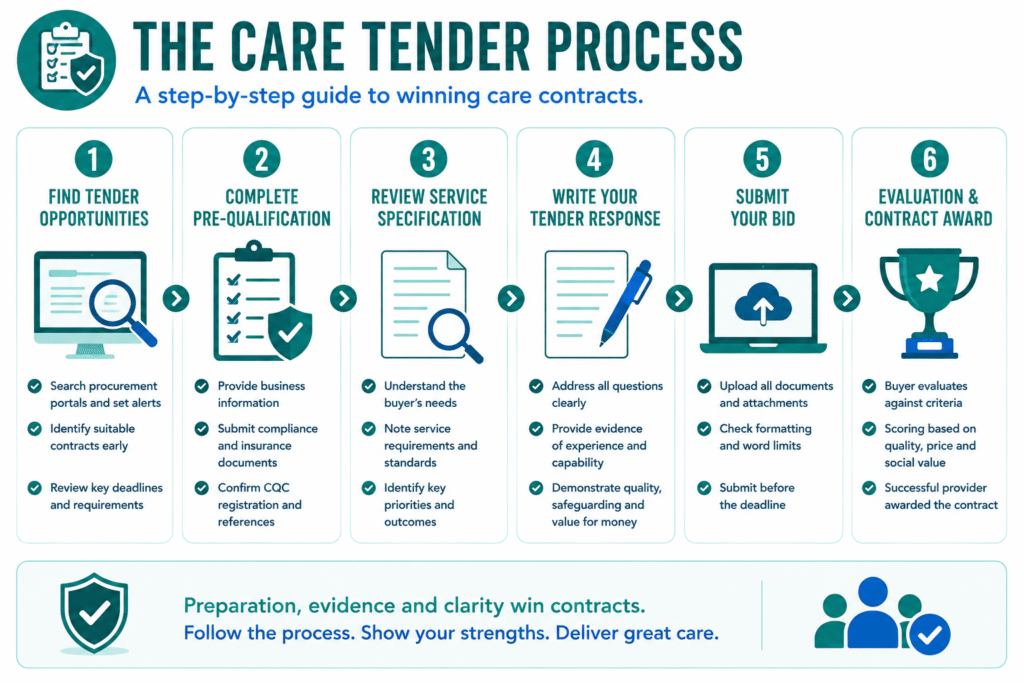
    Understanding the Care Tender Process Step by Step
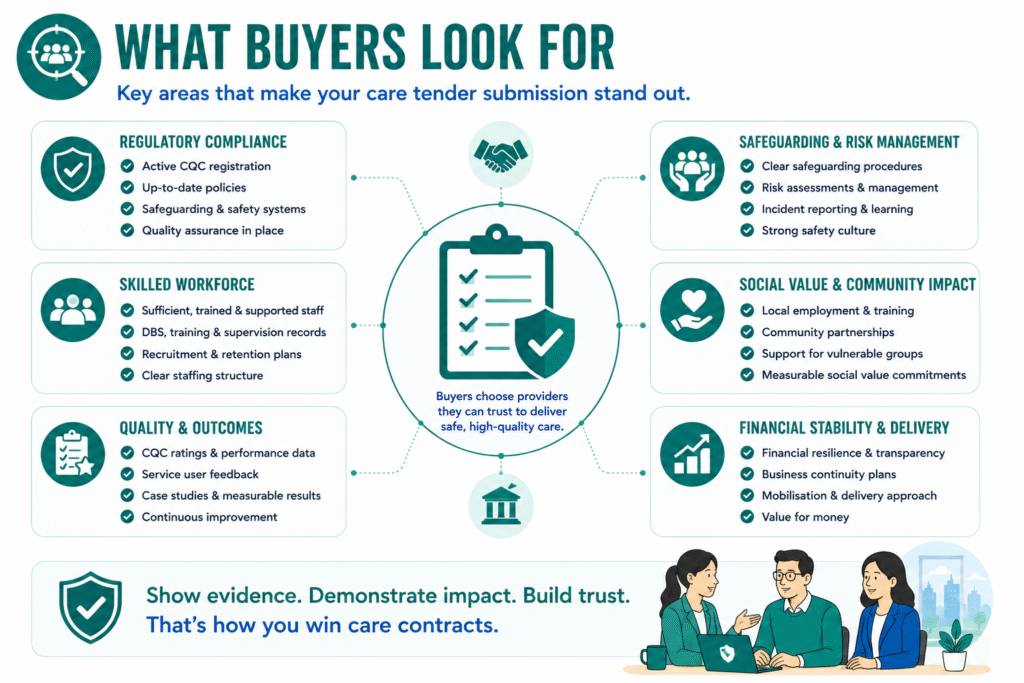
    Buyer priorities for care submissions

    Many providers understand what a tender is, but far fewer understand how the tender process actually works. Knowing the stages helps you prepare the right documents, avoid costly mistakes, and improve your chances of winning contracts.

    Step 1: Find Tender Opportunities

    Most care contracts are advertised through procurement portals such as Find a Tender, Contracts Finder, NHS Atamis, and local authority procurement systems. Successful providers set up alerts so they can identify opportunities early rather than rushing a submission close to the deadline.

    Step 2: Complete Pre-Qualification Requirements

    Before a buyer considers your proposal, they need evidence that your organisation can legally and safely deliver the service.

    This stage often includes:

    • Company information
    • Financial checks
    • Insurance documents
    • CQC registration details
    • Safeguarding policies
    • References from existing or previous clients

    If your documentation is incomplete or out of date, you may fail before the evaluation even begins.

    Step 3: Review the Service Specification

    The specification explains exactly what the buyer wants.

    It may include:

    • Service hours
    • Staffing requirements
    • Quality standards
    • Reporting expectations
    • Performance targets
    • Contract length

    Strong providers read the specification carefully and align every part of their response to the buyer’s requirements.

    Step 4: Write Your Tender Response

    This is where you explain how you will deliver the service.

    Your response should clearly demonstrate:

    • Relevant experience
    • Staffing capacity
    • Quality assurance systems
    • Safeguarding procedures
    • Service delivery approach
    • Social value commitments

    Many providers searching for how to write a tender proposal or how to write a tender bid struggle at this stage because they focus on what they do rather than how they will solve the buyer’s challenges.

    Step 5: Submit Your Bid

    Most tenders require submission through an online procurement portal.

    Always submit early. Technical issues, missing attachments, or portal errors can prevent a last-minute submission and automatically disqualify an otherwise strong bid.

    Step 6: Evaluation and Contract Award

    Once the deadline passes, evaluators score each submission against predetermined criteria.

    Typical scoring areas include:

    • Quality
    • Service delivery
    • Safeguarding
    • Workforce capability
    • Social value
    • Price

    The highest-scoring provider does not always offer the cheapest price. Buyers often prioritise quality, compliance, and evidence of successful service delivery when awarding care contracts.

    READ MORE: CQC Registered Manager: Requirements, Interview Tips for 2026

    How to Write a Tender Proposal That Scores Well

    Understanding how to write a tender proposal is often the difference between winning a contract and receiving a rejection email.

    Many care providers lose tenders because they write generic responses. Evaluators do not award marks for good intentions. They award marks for evidence, relevance, and clear answers that address the question directly.

    Understand the Scoring Criteria First

    Before writing a single sentence, review the evaluation criteria.

    Ask yourself:

    • What is the buyer actually asking?
    • How many marks is this question worth?
    • What evidence can we provide?

    A question worth 20% of the total score deserves far more attention than one worth 5%.

    Answer the Question Directly

    One of the biggest mistakes providers make when learning how to write a tender bid is writing around the question instead of answering it.

    For example, if the buyer asks how you will manage safeguarding concerns, do not spend half the response talking about your company history. Focus on your safeguarding process, escalation pathways, staff training, reporting procedures, and quality monitoring.

    Use Real Evidence

    Commissioners want proof.

    Instead of writing:

    “We provide high-quality care.”

    Write:

    “Our service achieved a Good CQC rating, maintained a 98% visit completion rate, and delivered mandatory safeguarding training to 100% of care staff during the previous 12 months.”

    Specific evidence builds trust and earns marks.

    Demonstrate Compliance

    Strong tender responses reference:

    • CQC regulations
    • Safeguarding responsibilities
    • Quality assurance systems
    • Risk management processes
    • Staff training requirements

    Buyers need confidence that your organisation can meet both contractual and regulatory obligations.

    Show Outcomes, Not Activities

    Many providers describe what they do but fail to explain the results.

    Rather than saying:

    “We conduct regular staff supervision.”

    Explain the outcome:

    “Regular supervision helps us identify training needs early, improve staff retention, and maintain consistent standards of care for service users.”

    Tailor Every Submission

    Even if you have written similar bids before, avoid copying and pasting entire sections.

    The strongest tender responses reflect:

    • The buyer’s priorities
    • Local population needs
    • Service requirements
    • Contract objectives

    Providers who tailor their submissions consistently outperform those who rely on generic templates.

    Learning how to write a tender is not about producing the longest response. It is about giving evaluators clear, evidence-based answers that show why your organisation is the best choice to deliver the service.

    SEE ALSO: How to Start a Healthcare Recruitment Agency Uk in 2026

    Common Reasons Care Providers Lose Tenders
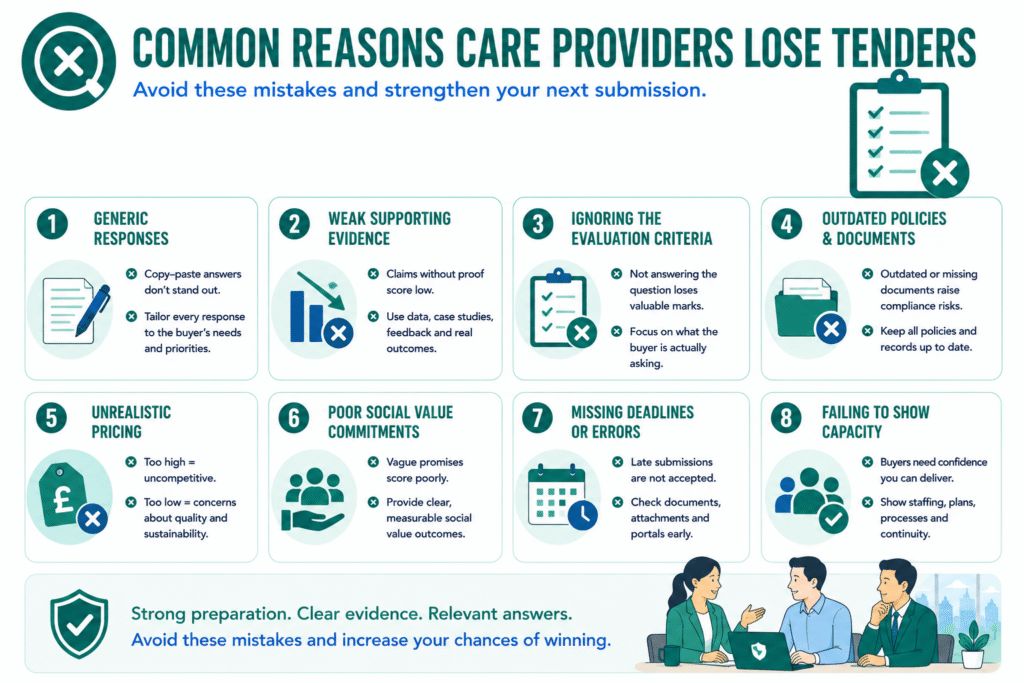
    Common mistakes in tender submissions
    Common mistakes in tender submissions

    Many care providers assume they lost a tender because another organisation offered a lower price. In reality, most bids fail long before pricing becomes the deciding factor.

    Commissioners often reject submissions because they lack evidence, miss key requirements, or fail to answer the questions properly.

    Here are the most common reasons care providers lose tenders.

    Generic Responses

    Buyers can spot a copied response immediately.

    If your answer could apply to any care provider in the UK, it will not stand out. Strong bids reference the specific service, location, challenges, and outcomes the commissioner wants to achieve.

    Weak Supporting Evidence

    Claims without evidence rarely score well.

    Statements such as “we provide excellent care” carry little weight unless you support them with measurable results, inspection outcomes, service-user feedback, or performance data.

    Ignoring the Evaluation Criteria

    Every tender contains scoring criteria.

    Some providers spend pages describing their business history while barely addressing the actual question. The highest-scoring responses mirror the evaluation criteria and provide evidence against each requirement.

    Outdated Policies and Documents

    Commissioners expect current documentation.

    Expired policies, missing training records, outdated insurance certificates, or old safeguarding procedures can raise concerns about compliance and governance.

    Unrealistic Pricing

    Pricing too high can make your bid uncompetitive.

    Pricing too low can create concerns about sustainability and service quality.

    Buyers want confidence that you can deliver the contract safely, legally, and consistently throughout its duration.

    Poor Social Value Commitments

    Many providers treat social value as an afterthought.

    Successful bidders demonstrate how they will create local employment opportunities, support communities, improve wellbeing, reduce inequalities, or contribute to wider social outcomes.

    Missing Deadlines or Submission Errors

    A strong bid submitted late is still a failed bid.

    Procurement portals close automatically once the deadline passes. Missing attachments, uploading incorrect documents, or waiting until the final hour can eliminate your chances before evaluation begins.

    Failing to Demonstrate Capacity

    Buyers need reassurance that you can deliver the contract from day one.

    If your submission does not explain staffing levels, mobilisation plans, management oversight, or service continuity arrangements, evaluators may question whether your organisation can handle the contract successfully.

    The most successful providers do not simply learn what a tender process is. They learn why bids fail and build systems that prevent those mistakes from happening in the first place.

    What Buyers Look for in Winning Care Tender Submissions
    What Is a Tender in Health and Social Care
    What Is a Tender in Health and Social Care

    Every commissioner wants reassurance that the provider they appoint can deliver safe, effective, and person-centred care from the first day of the contract.

    While evaluation criteria vary between organisations, most buyers look for the same core qualities when scoring care tender submissions.

    Strong Regulatory Compliance

    Buyers expect providers to demonstrate a clear understanding of CQC requirements and wider regulatory obligations.

    This includes:

    • CQC registration details
    • Safeguarding arrangements
    • Quality assurance systems
    • Policies and procedures
    • Governance structures

    A provider that can clearly evidence compliance often starts with a significant advantage.

    A Skilled and Stable Workforce

    Care services depend on people.

    Commissioners want confidence that you can recruit, train, retain, and support the workforce required to deliver the contract.

    Strong bids explain:

    • Recruitment processes
    • Induction programmes
    • Mandatory training
    • Supervision arrangements
    • Workforce retention strategies

    Evidence of Quality Care

    Buyers look beyond promises.

    They want evidence that demonstrates your ability to achieve positive outcomes for the people you support.

    Useful evidence may include:

    • CQC inspection outcomes
    • Service-user feedback
    • Family testimonials
    • Performance reports
    • Case studies
    • Quality audits

    Effective Safeguarding and Risk Management

    Safeguarding remains one of the highest-priority areas in most care tenders.

    Commissioners want to understand:

    • How concerns are identified
    • How incidents are reported
    • How risks are managed
    • How lessons learned improve services

    Clear processes and real examples strengthen your response considerably.

    Social Value and Community Impact

    Many public sector tenders allocate a percentage of the total score to social value.

    Buyers increasingly favour providers that create wider benefits beyond direct care delivery.

    Examples include:

    • Local employment opportunities
    • Apprenticeship programmes
    • Community partnerships
    • Volunteering initiatives
    • Support for disadvantaged groups

    The strongest submissions provide measurable commitments rather than vague promises.

    Financial Stability and Service Continuity

    Commissioners need assurance that your organisation can remain operational throughout the contract period.

    They often assess:

    • Financial standing
    • Business continuity plans
    • Contingency arrangements
    • Leadership structure
    • Operational resilience

    A provider that demonstrates stability reduces risk for the buyer.

    Ultimately, winning care tenders comes down to trust. Buyers want evidence that your organisation can deliver high-quality care, manage risks effectively, meet regulatory standards, and provide value for money over the life of the contract.

    MORE: Inheritance Tax Threshold UK: 2026 Update

    Care Tender Checklist Before You Submit

    Even the strongest tender response can fail if key documents are missing or important requirements are overlooked. Before you submit any bid, run through this checklist to make sure your organisation is genuinely tender-ready.

    Business and Compliance

    ✓ CQC registration is active and up to date

    ✓ Companies House details match your tender submission

    ✓ Insurance certificates are current

    ✓ Policies and procedures have been reviewed within the last 12 months

    ✓ Safeguarding policies align with current legislation and best practice

    Workforce Readiness

    ✓ Staff training records are complete and accessible

    ✓ DBS checks are current

    ✓ Supervision and appraisal records are available

    ✓ Recruitment and retention plans are documented

    ✓ Registered Manager details are included where required

    Quality and Performance Evidence

    ✓ Recent case studies demonstrate similar service delivery

    ✓ Service-user feedback and testimonials are available

    ✓ Quality assurance reports support your claims

    ✓ CQC inspection outcomes are referenced where relevant

    ✓ Performance data supports key statements within the bid

    Financial and Operational Information

    ✓ Financial accounts meet the buyer’s requirements

    ✓ Pricing schedules have been checked for accuracy

    ✓ Business continuity plans are current

    ✓ Mobilisation plans are realistic and achievable

    ✓ Key personnel and escalation contacts are identified

    Tender Submission Checks

    ✓ Every question has been answered fully

    ✓ Responses stay within the word count

    ✓ Supporting documents are attached

    ✓ Social value commitments are specific and measurable

    ✓ Another team member has completed a final review

    ✓ Submission deadline has been scheduled well in advance

    The most successful providers treat tender preparation as an ongoing process rather than a last-minute task. Keeping your evidence, policies, training records, and case studies updated throughout the year makes it much easier to respond quickly when the right opportunity appears.

    How Care Sync Experts Helps Providers Win More Tenders

    Care tendering rewards preparation. The providers that win consistently do not wait until a deadline appears before organising their policies, evidence, pricing, and compliance documents.

    Care Sync Experts helps care providers build that readiness before they bid.

    Our support covers the key areas commissioners expect to see in a strong tender submission, including CQC registration evidence, policies and procedures, safeguarding documentation, staff training records, quality assurance systems, service delivery models, and social value planning.

    We also support providers with care tender writing, bid reviews, tender readiness assessments, and document preparation. This helps you submit stronger responses that answer the buyer’s questions clearly and evidence your ability to deliver safe, compliant, high-quality care.

    If you are new to tendering, we can help you understand what a tender is, how the tender process works, and what buyers expect from a credible care provider. If you already bid for contracts, we can help you strengthen your method statements, improve your evidence, and reduce the common mistakes that lead to lost marks.

    The goal is simple: help your care business become tender-ready, commissioner-ready, and contract-ready.

    FAQ

    Why do they call it a tender?

    They call it a tender because a supplier “tenders” or formally offers to provide goods or services for a stated price and standard. In care procurement, this means a provider submits a structured offer to deliver services such as domiciliary care, supported living, respite care, or community support.

    What are the three types of tendering?

    The three common types of tendering are open tendering, restricted tendering, and negotiated tendering. Open tendering allows any qualified provider to apply. Restricted tendering invites only shortlisted providers. Negotiated tendering involves direct discussion with selected suppliers, often for specialist or urgent services.

    What are the 5 pillars of procurement?

    The five pillars of procurement are value for money, transparency, fairness, competition, and accountability. In care tenders, these principles help commissioners choose providers who can deliver safe, compliant, high-quality services at a sustainable cost.

    What are the 5 C’s of caring?

    The 5 C’s of caring are compassion, competence, confidence, conscience, and commitment. Care providers can strengthen tender responses by showing how these values shape staff training, safeguarding, quality assurance, and everyday service delivery.
  • CQC Registered Manager: Requirements, Interview Tips for 2026

    CQC Registered Manager: Requirements, Interview Tips for 2026

    A CQC Registered Manager is the person responsible for the day-to-day leadership, safety, quality, and compliance of a regulated health or social care service in England.

    Whether you operate a domiciliary care agency, supported living service, residential care home, or specialist care provision, the Care Quality Commission (CQC) expects a registered manager to oversee how the service runs and how people receive care.

    Many people assume the role focuses mainly on paperwork and inspections. In reality, a successful CQC Manager shapes the culture of the entire service. They recruit and develop staff, manage risks, respond to safeguarding concerns, monitor care quality, and ensure every person receives safe and compassionate support.

    From a business perspective, the CQC Registered Manager often determines whether a service achieves a Good or Outstanding rating. Strong leadership influences staff retention, client satisfaction, compliance outcomes, and long-term growth. Poor leadership can lead to complaints, enforcement action, safeguarding failures, and reputational damage.

    Get expert support for your next tender, inspection-ready policies, or CQC registration — book a call with Care Sync Experts today and let’s get you compliant and competitive.

    Quick Answer: What Is a CQC Registered Manager?

    A CQC Registered Manager is the legally accountable individual who manages the daily operation of a regulated care service and works with the provider to ensure compliance with CQC regulations and quality standards.

    Unlike care coordinators or team leaders, a registered manager shares legal responsibility for meeting regulatory requirements. They act as the main point of contact for inspectors and must demonstrate that the service delivers care that is safe, effective, caring, responsive, and well-led.

    For anyone planning to start or grow a care business, appointing the right registered manager is one of the most important decisions you will make. The role goes far beyond administration. It directly affects the quality of care people receive every day.

    What Do CQC Do and Why Does the Role Matter?

    CQC Registered Manager Training Evidence: What You Need (2026)

    Before applying to become a CQC Registered Manager, it helps to understand what the regulator actually does and why the role carries so much responsibility.

    What Are CQC?

    The Care Quality Commission (CQC) is the independent regulator of health and social care services in England. Its job is to monitor, inspect, and regulate care providers to ensure people receive safe, effective, and high-quality care.

    If you have ever searched “what are CQC” or “what is the Quality Care Commission”, the answer is simple: CQC exists to protect people who use health and social care services by holding providers accountable to national standards.

    What Do CQC Do?

    CQC regulates thousands of services across England, including:

    • Domiciliary care agencies
    • Residential care homes
    • Nursing homes
    • Supported living services
    • Hospices
    • GP practices
    • Hospitals

    Inspectors assess whether providers meet legal requirements and take action when services fall below acceptable standards. Depending on their findings, they can issue warnings, impose conditions, suspend services, or even cancel registrations.

    This is why every CQC Registered Manager plays such a critical role. CQC does not just inspect buildings and paperwork. Inspectors assess leadership, culture, governance, staff competence, and the quality of care people receive.

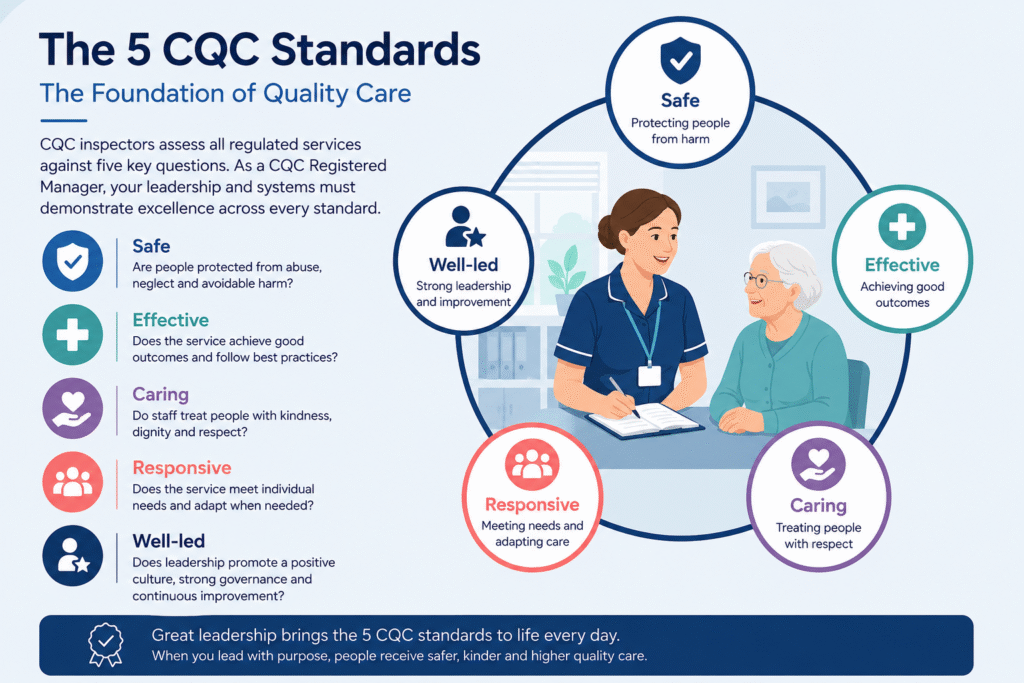
    What Are the 5 CQC Standards?

    When inspectors visit a service, they assess it against five key questions:

    StandardWhat CQC Looks For
    SafeAre people protected from abuse, neglect, and avoidable harm?
    EffectiveDoes the service achieve positive outcomes and follow best practices?
    CaringDo staff treat people with dignity, kindness, and respect?
    ResponsiveDoes the service meet individual needs and adapt when circumstances change?
    Well-ledDoes leadership create a positive culture, strong governance, and continuous improvement?

    Many people search “what are the 5 CQC standards” before a registration interview because these five areas underpin almost every question an inspector asks.

    Why the Registered Manager Matters

    A care business can invest in policies, systems, and technology, but strong leadership ultimately determines whether those systems work in practice.

    A successful CQC Manager creates a culture where staff feel supported, safeguarding concerns are reported quickly, care plans remain person-centred, and quality improvements happen continuously rather than only before inspections.

    In simple terms, when a service performs well during a CQC inspection, inspectors often see evidence of effective leadership behind the scenes. That leadership usually starts with the CQC Registered Manager.

    RELATED: Bid Writing Service: Top 5 Mistakes Care Providers Make in 2026

    What Do CQC Do and Why Does the Role Matter?

    CQC Registered Manager 2026

    Before applying to become a CQC Registered Manager, it helps to understand what the regulator actually does and why the role carries so much responsibility.

    What Are CQC?

    The Care Quality Commission (CQC) is the independent regulator of health and social care services in England. Its job is to monitor, inspect, and regulate care providers to ensure people receive safe, effective, and high-quality care.

    If you have ever searched “what are CQC” or “what is the Quality Care Commission”, the answer is simple: CQC exists to protect people who use health and social care services by holding providers accountable to national standards.

    What Do CQC Do?

    CQC regulates thousands of services across England, including:

    • Domiciliary care agencies
    • Residential care homes
    • Nursing homes
    • Supported living services
    • Hospices
    • GP practices
    • Hospitals

    Inspectors assess whether providers meet legal requirements and take action when services fall below acceptable standards. Depending on their findings, they can issue warnings, impose conditions, suspend services, or even cancel registrations.

    This is why every CQC Registered Manager plays such a critical role. CQC does not just inspect buildings and paperwork. Inspectors assess leadership, culture, governance, staff competence, and the quality of care people receive.

    What Are the 5 CQC Standards?

    When inspectors visit a service, they assess it against five key questions:

    StandardWhat CQC Looks For
    SafeAre people protected from abuse, neglect, and avoidable harm?
    EffectiveDoes the service achieve positive outcomes and follow best practices?
    CaringDo staff treat people with dignity, kindness, and respect?
    ResponsiveDoes the service meet individual needs and adapt when circumstances change?
    Well-ledDoes leadership create a positive culture, strong governance, and continuous improvement?

    Many people search “what are the 5 CQC standards” before a registration interview because these five areas underpin almost every question an inspector asks.

    Why the Registered Manager Matters

    A care business can invest in policies, systems, and technology, but strong leadership ultimately determines whether those systems work in practice.

    A successful CQC Manager creates a culture where staff feel supported, safeguarding concerns are reported quickly, care plans remain person-centred, and quality improvements happen continuously rather than only before inspections.

    In simple terms, when a service performs well during a CQC inspection, inspectors often see evidence of effective leadership behind the scenes. That leadership usually starts with the CQC Registered Manager.

    READ MORE: How to Start a Healthcare Recruitment Agency Uk in 2026

    CQC Registered Manager Requirements

    The CQC does not approve applications simply because someone has worked in care for several years. To become a CQC Registered Manager, you must demonstrate that you have the qualifications, experience, knowledge, and character needed to lead a regulated service safely and effectively.

    During the CQC Registration process, inspectors assess whether you can manage the specific needs of your service users, understand your legal responsibilities, and maintain compliance long after registration is granted.

    Qualifications

    While the CQC does not prescribe a single qualification for every service type, most successful applicants hold a Level 5 Diploma in Leadership and Management for Adult Care or an equivalent qualification.

    Depending on the service you manage, the CQC may also accept:

    • Registered Nurse qualifications
    • Social Work qualifications
    • Health and social care management degrees
    • Equivalent leadership qualifications supported by relevant experience

    Holding a Level 5 qualification strengthens your application, but qualifications alone will not secure approval. Inspectors want evidence that you can apply your knowledge in real-world care settings.

    Management Experience

    Experience remains one of the most important factors in any application.

    The CQC expects applicants to demonstrate:

    • Leadership experience within health or social care
    • Experience supervising and developing staff
    • Knowledge of safeguarding and risk management
    • Understanding of person-centred care
    • Familiarity with regulated services and compliance requirements

    If you plan to manage a domiciliary care agency, for example, experience within home care will significantly strengthen your application.

    Character and Fitness Requirements

    Every CQC Registered Manager must prove they are a fit and proper person to hold the role.

    This includes:

    • A current Enhanced DBS check
    • Suitable employment references
    • A complete employment history
    • Evidence of honesty, integrity, and professionalism
    • Physical and mental fitness to perform the role

    The CQC carefully reviews gaps in employment, disciplinary issues, criminal records, and inconsistencies within applications. Providing inaccurate or misleading information can lead to refusal and may affect future applications.

    Understanding Care Regulations

    Strong applicants understand far more than daily care delivery. They also understand the legal framework that governs care services.

    Inspectors expect you to demonstrate knowledge of:

    • The Health and Social Care Act 2008
    • Fundamental Standards
    • Safeguarding responsibilities
    • Mental Capacity Act principles
    • Duty of Candour
    • Notification requirements
    • Governance and quality assurance systems

    Many applicants focus heavily on qualifications and underestimate the importance of regulatory knowledge. In reality, a large proportion of the CQC Registered Manager interview focuses on how you would apply these regulations in practical situations.

    For this reason, preparing for registration should involve more than collecting certificates. You must be ready to show that you can lead a service, protect vulnerable people, and maintain compliance from day one.

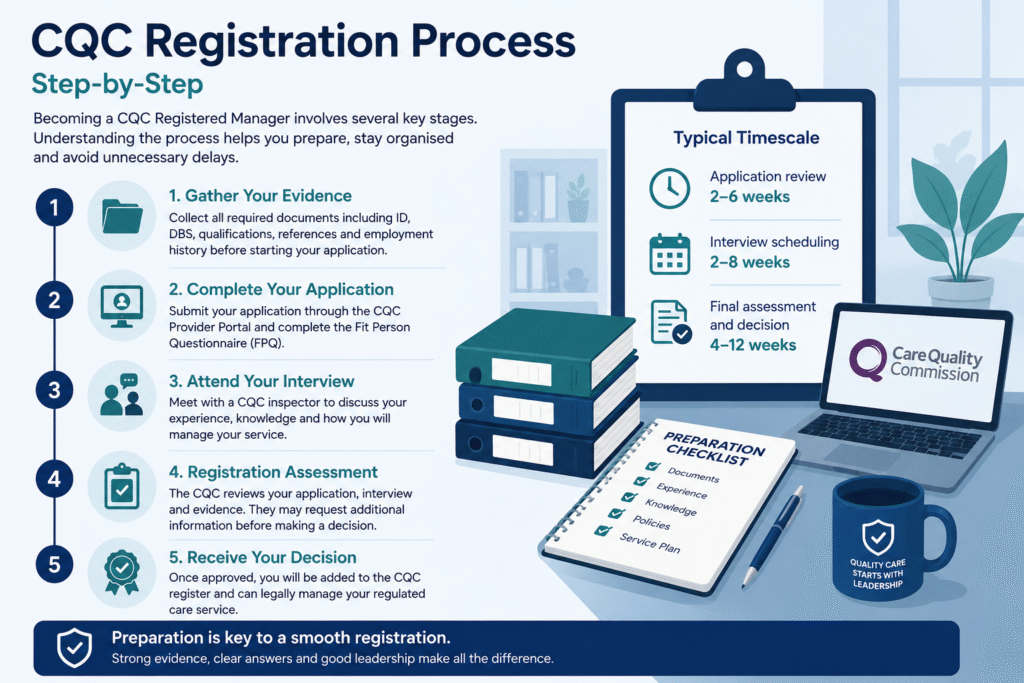
    CQC Registration Process: Step-by-Step

    CQC Registered Manager salary breakdown
    CQC Registered Manager salary breakdown

    Understanding the CQC Registration process can save you months of delays and significantly improve your chances of approval. Many applications fail not because applicants lack experience, but because they submit incomplete information, provide weak evidence, or perform poorly during the interview stage.

    If you are wondering what is CQC registration, it is the formal process of obtaining approval from the Care Quality Commission to manage or provide regulated health and social care services in England.

    Step 1: Gather Your Evidence

    Before starting your application, collect all supporting documents and information, including:

    • Enhanced DBS certificate
    • Employment history
    • Professional references
    • Qualifications and training records
    • Proof of identity
    • Details of previous management experience

    The CQC will compare this information against your application, interview responses, and references, so accuracy matters.

    Step 2: Complete Your Application

    Most applicants submit their registration through the official CQC Provider Portal.

    During this stage, you will complete several sections covering:

    • Personal details
    • Employment history
    • Qualifications
    • Regulated activities
    • Management experience
    • Service user groups
    • Fitness and suitability declarations

    You will also complete a Fit Person Questionnaire (FPQ), which helps the CQC assess your competence, character, and understanding of the role.

    Step 3: Prepare for the CQC Registered Manager Interview

    The CQC Registered Manager interview is often the most important stage of the process.

    Inspectors use the interview to assess whether you can safely lead a regulated service and apply care regulations in real-world situations.

    Expect questions about:

    • Safeguarding
    • Mental Capacity Act
    • Complaints handling
    • Staffing challenges
    • Governance systems
    • Risk management
    • The five CQC standards

    This stage is where many applicants succeed or fail.

    Step 4: Registration Assessment

    After reviewing your application and interview, the CQC may:

    • Approve your registration
    • Request additional information
    • Arrange follow-up discussions
    • Issue a Notice of Proposal if concerns exist

    The inspector’s recommendation forms only part of the decision. A Registration Manager reviews the entire application before approval is granted.

    How Long Does CQC Registration Take?

    One of the most common questions applicants ask is “how long does CQC registration take?”

    The answer depends on the complexity of the application, the quality of the evidence submitted, and how quickly you respond to requests for information.

    In most cases:

    StageTypical Timescale
    Application review2–6 weeks
    Interview scheduling2–8 weeks
    Final assessment and decision4–12 weeks

    Many applicants experience a total registration period of between 8 and 16 weeks, although more complex applications can take longer.

    Common Reasons for Delays

    The most frequent causes of delays include:

    • Missing documentation
    • Incomplete employment history
    • Weak references
    • Poorly prepared interview responses
    • Unclear business structures
    • Delayed responses to CQC requests

    The strongest applications present a clear picture of who you are, how your service will operate, and why you are capable of leading safe, high-quality care from day one.

    SEE ALSO: Inheritance Tax Threshold UK: 2026 Update

    CQC Registered Manager Interview: How to Pass First Time

    For many applicants, the interview is the most challenging part of becoming a CQC Registered Manager. While your qualifications and experience matter, the CQC ultimately wants to know whether you can lead a service safely, make sound decisions under pressure, and protect the people who depend on your care.

    If you are searching for CQC Registered Manager how to pass the interview, the answer is simple: focus less on memorising regulations and more on demonstrating how you would apply them in practice.

    What CQC Really Wants to Hear

    Inspectors are not looking for perfect textbook answers. They want evidence that you can think like a leader.

    Throughout the interview, you should show that you:

    • Put people before profits
    • Understand safeguarding responsibilities
    • Can manage risk effectively
    • Learn from mistakes and complaints
    • Promote person-centred care
    • Lead and support staff confidently
    • Understand the five CQC standards

    Strong candidates consistently connect their answers back to the people they support rather than simply quoting policies.

    Common Mistakes That Cause Applications to Fail

    Many applicants underestimate how much the interview influences the final decision.

    Some of the most common mistakes include:

    • Giving vague safeguarding answers
    • Blaming staff or previous employers for problems
    • Failing to understand their own business plan
    • Showing weak knowledge of the Mental Capacity Act
    • Prioritising operational convenience over safety
    • Being unable to explain regulated activities or notification requirements

    Inspectors want reassurance that you will take ownership of problems and act decisively when people are at risk.

    Questions You Should Expect

    Although every interview differs, most CQC Registered Manager interviews include questions around:

    Safeguarding

    • How would you handle an allegation of abuse?
    • What steps would you take to protect a vulnerable adult?

    Leadership

    • Tell us about a difficult management situation.
    • How do you support staff performance?

    Complaints

    • How would you respond to a family complaint?
    • How do you use complaints to improve services?

    Mental Capacity Act

    • What are the five principles of the Mental Capacity Act?
    • How would you make a best interests decision?

    Governance

    • How do you monitor quality?
    • What would you do if audits identified repeated issues?

    Use Real Examples Wherever Possible

    One of the most effective interview techniques is using examples from your own career.

    When answering scenario-based questions, explain:

    • The situation you faced
    • The action you took
    • The outcome you achieved
    • What you learned

    This approach helps inspectors see evidence of real leadership rather than theoretical knowledge.

    Final Interview Tip

    Many applicants spend weeks revising regulations but forget to review their own application.

    Before your interview, make sure you know:

    • Your Statement of Purpose
    • Your service user groups
    • Your staffing structure
    • Your policies
    • Your business plan
    • Your regulated activities

    Inspectors frequently ask questions based on information you have already submitted. When your answers align with your application and demonstrate confident leadership, you give the CQC strong evidence that you are ready to become a successful CQC Registered Manager.

    MORE: Universal Credit Permanent Boost 2026

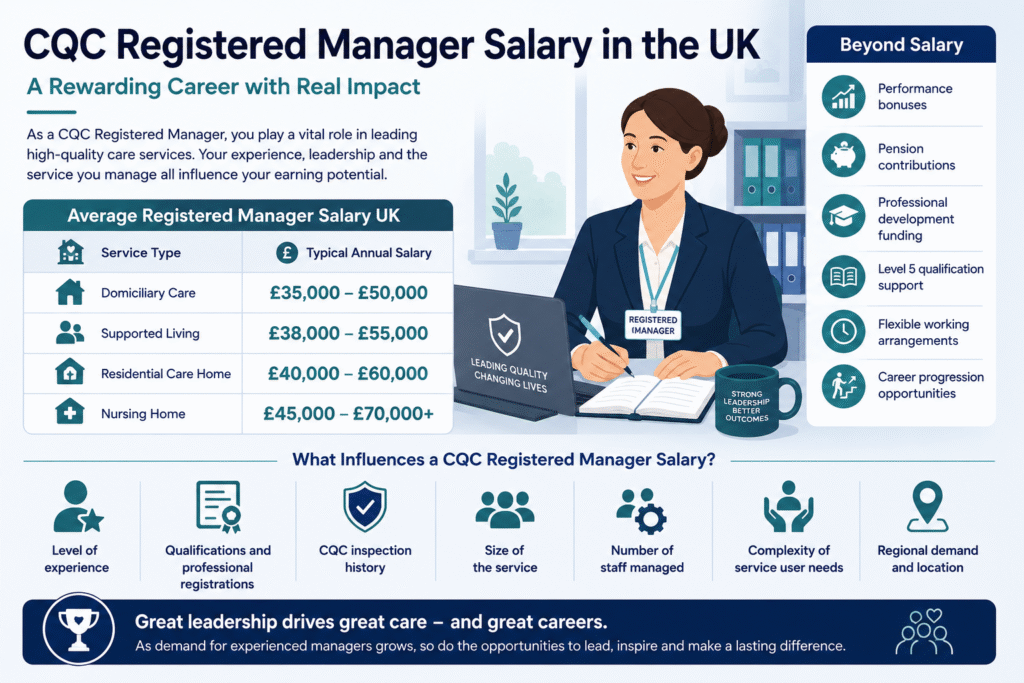
    CQC Registered Manager Salary in the UK

    CQC registration process
    CQC registration process

    While many professionals pursue the role because they want to lead high-quality care services, salary remains an important consideration when planning your career progression.

    The Registered Manager salary UK varies depending on the service type, location, size of the organisation, and level of responsibility.

    For example, a manager overseeing a small domiciliary care agency will typically earn less than someone leading a large residential care home with multiple regulated activities and a large workforce.

    Average Registered Care Manager Salary UK

    Although salaries fluctuate across the country, many employers offer:

    Service TypeTypical Annual Salary
    Domiciliary Care£35,000 – £50,000
    Supported Living£38,000 – £55,000
    Residential Care Home£40,000 – £60,000
    Nursing Home£45,000 – £70,000+

    In areas facing significant recruitment challenges, experienced managers can command even higher salaries.

    What Influences a CQC Registered Manager Salary?

    Several factors affect a CQC Registered Manager salary, including:

    • Level of management experience
    • Qualifications and professional registrations
    • CQC inspection history
    • Size of the service
    • Number of staff managed
    • Complexity of service user needs
    • Regional demand for experienced managers

    Providers often place a premium on managers who have successfully achieved or maintained Good and Outstanding ratings because strong leadership directly impacts business performance.

    Beyond Salary

    When evaluating opportunities, it is important to look beyond basic pay.

    Many employers also offer:

    • Performance bonuses
    • Pension contributions
    • Professional development funding
    • Level 5 qualification support
    • Flexible working arrangements
    • Career progression into regional or operational management roles

    For ambitious professionals, becoming a CQC Registered Manager often opens the door to senior leadership positions within larger healthcare organisations.

    Is Becoming a Registered Manager Worth It?

    The role carries significant responsibility, but it also offers the opportunity to shape care quality, support vulnerable people, and influence the success of an entire service.

    For many leaders, the greatest reward comes from building a positive culture where staff thrive, people receive outstanding care, and the service consistently meets the standards expected by the CQC.

    As demand for experienced managers continues to grow across England, the career prospects for skilled registered managers remain strong.

    SEE MORE: Early Sign of MND in 2026: What Care Businesses Should Notice First

    How Often Do CQC Inspections Take Place?

    One of the most common questions providers ask after completing CQC Registration is: how often do CQC inspections take place?

    The answer depends on several factors, including your service type, previous inspection ratings, risk profile, complaints received, safeguarding concerns, and information shared with the regulator.

    How Often Do CQC Inspections Happen?

    There is no fixed inspection timetable that applies to every service.

    Instead, the CQC uses a risk-based approach. This means inspectors may visit sooner if concerns arise or wait longer if a service consistently demonstrates high standards.

    In general:

    • Newly registered services often receive an inspection within their first year of operation.
    • Services rated Requires Improvement or Inadequate usually receive more frequent monitoring.
    • Services rated Good or Outstanding may experience longer periods between full inspections.

    Because the CQC continuously monitors services using data, notifications, complaints, safeguarding reports, and feedback, providers should always remain inspection-ready.

    What Are the 3 Types of CQC Inspections?

    Although inspection activity has evolved over time, providers commonly encounter three forms of regulatory assessment:

    1. Comprehensive Inspections

    These inspections review the entire service against the five key questions:

    • Safe
    • Effective
    • Caring
    • Responsive
    • Well-led

    Inspectors assess leadership, care quality, staffing, governance, and outcomes for people using the service.

    2. Focused Inspections

    Focused inspections examine specific concerns or areas of risk.

    For example, inspectors may investigate:

    • Medication management
    • Safeguarding concerns
    • Staffing levels
    • Infection prevention and control
    • Governance failures

    3. Follow-Up or Monitoring Inspections

    These inspections usually occur after a service receives a lower rating or enforcement action.

    The inspector’s goal is to assess whether the provider has addressed previously identified concerns and implemented sustainable improvements.

    Why Inspection Readiness Matters

    Many providers make the mistake of preparing only when they expect an inspection.

    Strong CQC Registered Managers take a different approach.

    They build systems that continuously monitor quality, support staff development, track incidents, analyse complaints, and identify risks before they become regulatory issues.

    This proactive approach not only improves inspection outcomes but also creates safer and more effective services for the people receiving care.

    The best preparation for a CQC inspection is not a last-minute audit. It is consistent leadership, strong governance, and a culture that prioritises quality every day.

    Final Thoughts…

    Becoming a CQC Registered Manager requires more than qualifications and paperwork. The role demands leadership, accountability, regulatory knowledge, and a genuine commitment to improving people’s lives.

    From understanding the five CQC standards and completing the CQC Registration process to preparing for the CQC Registered Manager interview, every stage demonstrates your ability to lead a safe, effective, caring, responsive, and well-led service.

    The strongest applicants do not focus solely on passing registration. They focus on building a culture where people receive outstanding care, staff feel supported, and continuous improvement becomes part of everyday practice.

    If you are preparing for registration, need support with your application, or want expert guidance before your interview, Care Sync Experts can help you navigate the process with confidence and avoid the common mistakes that delay or derail applications.

    FAQ

    How Many CQC Regulations Are There?

    The Health and Social Care Act 2008 (Regulated Activities) Regulations contain multiple regulations covering areas such as person-centred care, safeguarding, staffing, governance, fit and proper persons, complaints, and duty of candour.

    For a CQC Registered Manager, the most important requirement is understanding how these regulations apply in practice rather than memorising regulation numbers.

    How Do I Become a CQC Inspector?

    Many experienced health and social care professionals move into regulatory roles after working as managers, nurses, social workers, or senior leaders.

    To become a CQC inspector, you typically need:
    – Significant experience in health or social care
    – Strong knowledge of care regulations
    – Leadership and quality assurance experience
    – Excellent communication and assessment skills

    The CQC advertises inspector vacancies through its careers portal when positions become available.

    How to Become a Care Quality Commission Inspector

    If your long-term career goal involves regulation rather than service management, building experience as a CQC Registered Manager can provide a strong foundation.

    Inspectors need practical knowledge of safeguarding, governance, quality improvement, and service delivery. Many successful inspectors have previously managed regulated services themselves.

    What Does Quality Control Mean in Social Care?

    In social care, quality control refers to the systems and processes used to ensure people consistently receive safe, effective, and high-quality care.

    Examples include:
    – Care plan audits
    – Medication audits
    – Staff supervision
    – Spot checks
    – Incident reviews
    – Service user feedback
    – Complaints analysis

    Effective quality control helps providers identify problems early and continuously improve service delivery.

  • Bid Writing Service: Top 5 Mistakes Care Providers Make in 2026

    Bid Writing Service: Top 5 Mistakes Care Providers Make in 2026

    Many care providers assume that winning a tender comes down to delivering a good service. In reality, buyers can only score what they see in your submission. A well-run domiciliary care agency, supported living provider, or complex care service can still lose a contract if it fails to present its strengths clearly and compliantly.

    This is where a specialist bid writing service becomes valuable.

    Before looking at the mistakes that cost care providers contracts, it helps to understand what is bid writing and why it differs from general business writing.

    Bid writing is the process of preparing structured responses to tender questions, demonstrating how your organisation will meet the buyer’s requirements, manage risks, deliver outcomes, and provide value for money. Every answer must align with the specification, evaluation criteria, and scoring methodology.

    Many providers also ask, what is a bid writer? A bid writer is a specialist who turns operational knowledge into high-scoring tender responses.

    They gather evidence, analyse buyer requirements, structure answers, and ensure every claim is supported by proof. When care providers ask what does a bid writer do, the simplest answer is this: they help buyers understand why your service deserves the contract.

    In health and social care procurement, generic bid support often falls short because care contracts require sector-specific knowledge. Evaluators expect detailed responses on safeguarding, medication management, workforce development, continuity of care, quality assurance, CQC compliance, social value, and service-user outcomes.

    A writer who understands construction, technology, or facilities management may not understand the evidence that local authorities, NHS commissioners, and Integrated Care Boards want to see.

    A specialist bid writing service understands the realities of delivering care services. They know how to present inspection outcomes, workforce metrics, service-user feedback, mobilisation plans, and governance arrangements in a way that earns marks. More importantly, they understand the common mistakes that cause otherwise capable providers to lose contracts.

    The five mistakes below appear repeatedly across domiciliary care, supported living, home care, and healthcare tenders throughout the UK. Fixing them can improve the quality of your submissions and significantly increase your chances of winning future contracts.

    Get expert support for your next tender, inspection-ready policies, or CQC registration — book a call with Care Sync Experts today and let’s get you compliant and competitive.

    Mistake 1: Treating the Tender Like a Form Instead of a Scored Competition

    Leicestershire Home Care Tender 2026-2034 | Complete Framework Guide for Care Providers

    This is one of the most expensive mistakes care providers make.

    Many providers open a tender, read the question, and immediately start writing. They focus on completing the form rather than understanding how evaluators will score the answer. As a result, they submit responses that describe their service but fail to demonstrate why they should win the contract.

    Understanding how to write a tender starts with recognising that every question exists for a reason. Buyers are not looking for generic statements about compassionate care or experienced staff. They want evidence that proves you can deliver the specific outcomes outlined in the specification.

    For example, a question about continuity of care is not really asking whether you provide continuity of care. Every bidder will say they do. The evaluator wants to know:

    • How you maintain continuity during staff sickness.
    • What percentage of visits are delivered by regular carers.
    • How you monitor missed calls.
    • What systems you use to ensure consistency.
    • What results you have achieved previously.

    Care providers often lose marks because they answer the question they wish had been asked rather than the one in front of them.

    Another common issue appears when providers research how to write a tender bid and follow generic online advice. Most of that advice is designed for broad commercial sectors and fails to reflect how health and social care contracts are evaluated.

    Local authorities and NHS commissioners typically score responses against quality outcomes, safeguarding arrangements, workforce capability, governance, mobilisation plans, and measurable evidence.

    A strong response follows a simple principle:

    Requirement → Evidence → Outcome

    Instead of saying:

    “We provide excellent care and have highly trained staff.”

    Say:

    “During the last 12 months, 98% of care visits were delivered by regular care workers. We maintain this consistency through workforce planning software, monthly rota audits, and a dedicated contingency team, helping service users build trusted relationships while reducing missed visits.”

    The difference is significant. The first statement makes a claim. The second statement provides evidence and demonstrates an outcome.

    How to Fix This Mistake

    Before drafting a single answer:

    1. Read the full specification from start to finish.
    2. Review the scoring criteria for every question.
    3. Build a compliance matrix mapping each requirement to evidence.
    4. Identify what proof supports every claim.
    5. Structure responses around outcomes the buyer wants to achieve.

    Many providers engage a specialist bid writing service at this stage because an external reviewer can quickly identify gaps between the buyer’s requirements and the proposed response. Fixing those gaps early often has a greater impact on scores than rewriting the answer later.

    The providers that consistently win care contracts do not treat tenders as paperwork exercises. They treat them as competitive scoring events and write every response with the evaluator’s score sheet in mind.

    RELATED: CQC Registration for Domiciliary Care Providers: Complete 2026 Guide

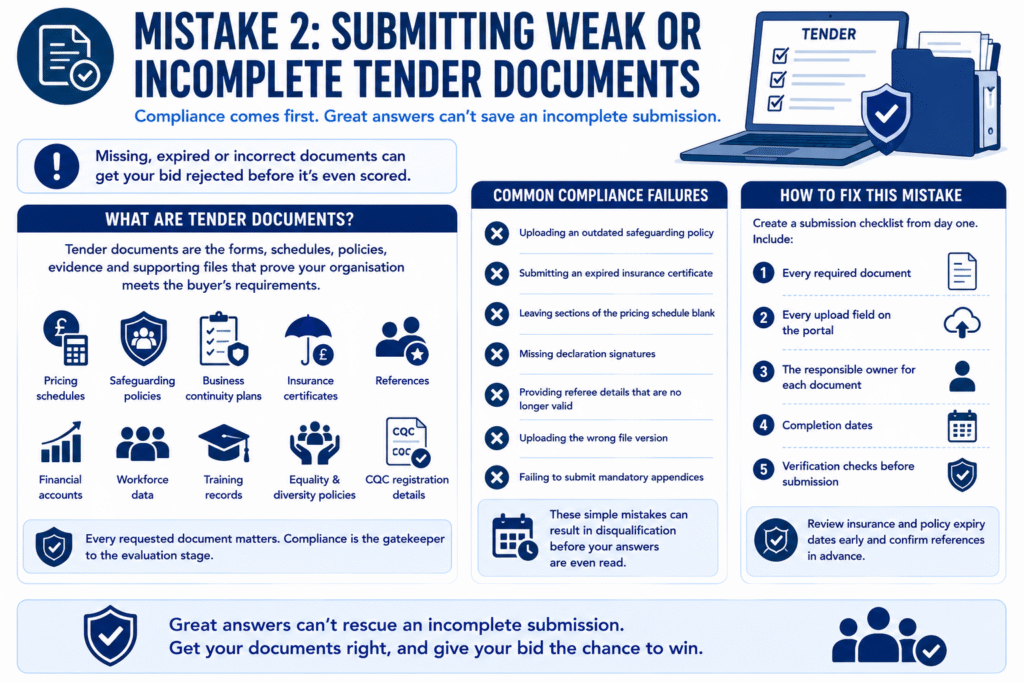
    Mistake 2: Submitting Weak or Incomplete Tender Documents

    Some care providers lose a tender before the evaluator even reads their method statements.

    Why? Because the submission fails the compliance check.

    Every tender contains a collection of mandatory documents that prove your organisation meets the buyer’s requirements. If one document is missing, expired, incomplete, or uploaded incorrectly, the buyer may reject the submission before scoring begins.

    This is why understanding what are tender documents is so important. Tender documents are the forms, schedules, declarations, policies, evidence files, and supporting information that accompany your bid response. Together, they demonstrate that your organisation has the legal, financial, operational, and regulatory capability to deliver the contract.

    Many providers ask what is a tender document when preparing their first council or NHS submission. In reality, there is rarely just one document. Most health and social care tenders require a complete pack that may include:

    • Pricing schedules.
    • Safeguarding policies.
    • Business continuity plans.
    • Insurance certificates.
    • References.
    • Financial accounts.
    • Workforce data.
    • Training records.
    • Equality and diversity policies.
    • CQC registration details.
    • Quality assurance evidence.

    When providers ask what are the tender documents required for a care contract, the answer usually depends on the buyer, but the principle remains the same: every requested document matters.

    Common compliance failures include:

    • Uploading an outdated safeguarding policy.
    • Submitting an expired insurance certificate.
    • Leaving sections of the pricing schedule blank.
    • Missing declaration signatures.
    • Providing referee details that are no longer valid.
    • Uploading the wrong file version.
    • Failing to submit mandatory appendices.

    These mistakes often happen because providers focus heavily on writing quality answers and leave compliance until the final few hours before submission.

    Unfortunately, buyers do not award contracts for effort. They award contracts for compliant submissions.

    How to Fix This Mistake

    Create a submission checklist on the first day of the tender.

    Your checklist should include:

    1. Every required document.
    2. Every upload field on the portal.
    3. The responsible owner for each document.
    4. Completion dates.
    5. Verification checks before submission.

    It is also good practice to review insurance renewal dates, update policies before the tender starts, and confirm references in advance rather than scrambling to gather evidence at the last minute.

    A specialist bid writing service often acts as an additional compliance safeguard by checking every document against the buyer’s requirements before submission. This extra review can prevent simple administrative errors from destroying weeks of bid preparation.

    Winning care providers understand a simple truth: great answers cannot rescue an incomplete submission. Compliance comes first. Scoring comes second.

    READ MORE: How to Start a Healthcare Recruitment Agency Uk in 2026

    Mistake 2: Submitting Weak or Incomplete Tender Documents

    Compliant tender submissions checklist

    Some care providers lose a tender before the evaluator even reads their method statements.

    Why? Because the submission fails the compliance check.

    Every tender contains a collection of mandatory documents that prove your organisation meets the buyer’s requirements. If one document is missing, expired, incomplete, or uploaded incorrectly, the buyer may reject the submission before scoring begins.

    This is why understanding what are tender documents is so important. Tender documents are the forms, schedules, declarations, policies, evidence files, and supporting information that accompany your bid response. Together, they demonstrate that your organisation has the legal, financial, operational, and regulatory capability to deliver the contract.

    Many providers ask what is a tender document when preparing their first council or NHS submission. In reality, there is rarely just one document. Most health and social care tenders require a complete pack that may include:

    • Pricing schedules.
    • Safeguarding policies.
    • Business continuity plans.
    • Insurance certificates.
    • References.
    • Financial accounts.
    • Workforce data.
    • Training records.
    • Equality and diversity policies.
    • CQC registration details.
    • Quality assurance evidence.

    When providers ask what are the tender documents required for a care contract, the answer usually depends on the buyer, but the principle remains the same: every requested document matters.

    Common compliance failures include:

    • Uploading an outdated safeguarding policy.
    • Submitting an expired insurance certificate.
    • Leaving sections of the pricing schedule blank.
    • Missing declaration signatures.
    • Providing referee details that are no longer valid.
    • Uploading the wrong file version.
    • Failing to submit mandatory appendices.

    These mistakes often happen because providers focus heavily on writing quality answers and leave compliance until the final few hours before submission.

    Unfortunately, buyers do not award contracts for effort. They award contracts for compliant submissions.

    How to Fix This Mistake

    Create a submission checklist on the first day of the tender.

    Your checklist should include:

    1. Every required document.
    2. Every upload field on the portal.
    3. The responsible owner for each document.
    4. Completion dates.
    5. Verification checks before submission.

    It is also good practice to review insurance renewal dates, update policies before the tender starts, and confirm references in advance rather than scrambling to gather evidence at the last minute.

    A specialist bid writing service often acts as an additional compliance safeguard by checking every document against the buyer’s requirements before submission. This extra review can prevent simple administrative errors from destroying weeks of bid preparation.

    Winning care providers understand a simple truth: great answers cannot rescue an incomplete submission. Compliance comes first. Scoring comes second.

    SEE ALSO: Inheritance Tax Threshold UK: 2026 Update

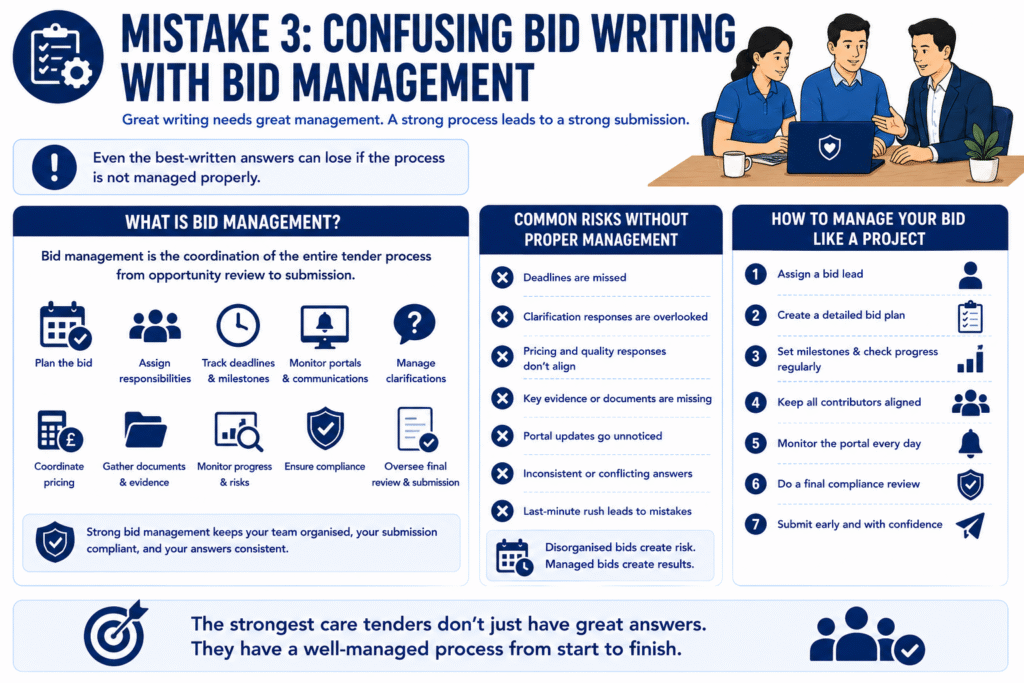
    Mistake 3: Confusing Bid Writing With Bid Management

    Confusing bid writing and management
    Confusing bid writing and management

    Many care providers believe that writing strong answers is enough to win contracts.

    It is not.

    Some of the best-written submissions still lose because nobody managed the process properly. Deadlines slip, clarification responses go unnoticed, pricing schedules remain incomplete, and key evidence never makes it into the final submission.

    This is where many providers misunderstand what is bid management.

    Bid writing focuses on creating persuasive, evidence-based responses. Bid management focuses on coordinating the entire tender process from opportunity review through to submission. Both are essential if you want to compete consistently for NHS, local authority, supported living, and domiciliary care contracts.

    Providers often ask what is a bid manager and whether they need one. A bid manager oversees the tender from start to finish. They coordinate contributors, manage deadlines, track compliance requirements, gather evidence, monitor buyer communications, and ensure the final submission aligns with the evaluation criteria.

    So, what does a bid manager do on a typical care tender?

    They:

    • Build the bid plan.
    • Assign responsibilities.
    • Monitor tender portals.
    • Track clarification deadlines.
    • Coordinate pricing inputs.
    • Manage document collection.
    • Review progress against milestones.
    • Ensure the final submission remains compliant.

    Without this oversight, even experienced care businesses can find themselves rushing during the final days before submission.

    A common example occurs when the Registered Manager writes method statements while the finance team prepares pricing. Neither team realises that their assumptions conflict. The quality response promises enhanced staffing levels, while the pricing schedule reflects standard staffing ratios. Evaluators quickly spot the inconsistency and question the credibility of the submission.

    Another frequent problem involves portal management. Many care providers assign portal notifications to one person’s inbox. When that person is on annual leave, clarification responses, addendums, and deadline updates go unnoticed. By the time the team discovers the changes, it is often too late.

    How to Fix This Mistake

    Treat every tender as a project.

    Assign clear ownership for:

    1. Bid leadership.
    2. Quality responses.
    3. Pricing.
    4. Compliance documents.
    5. Portal monitoring.
    6. Final review.

    Schedule weekly progress reviews from the moment the tender is released. For shorter tenders, hold reviews every two or three days.

    Most importantly, separate writing from management. The person writing the answers should not carry sole responsibility for tracking deadlines, gathering evidence, managing contributors, and handling uploads.

    Many care providers use a specialist bid writing service because it combines writing expertise with structured bid management. This reduces risk, improves coordination, and allows operational leaders to focus on running the service while the tender process remains under control.

    The strongest care tenders do not succeed because they have the best writer. They succeed because they have the best-managed process.

    MORE: Universal Credit Permanent Boost 2026

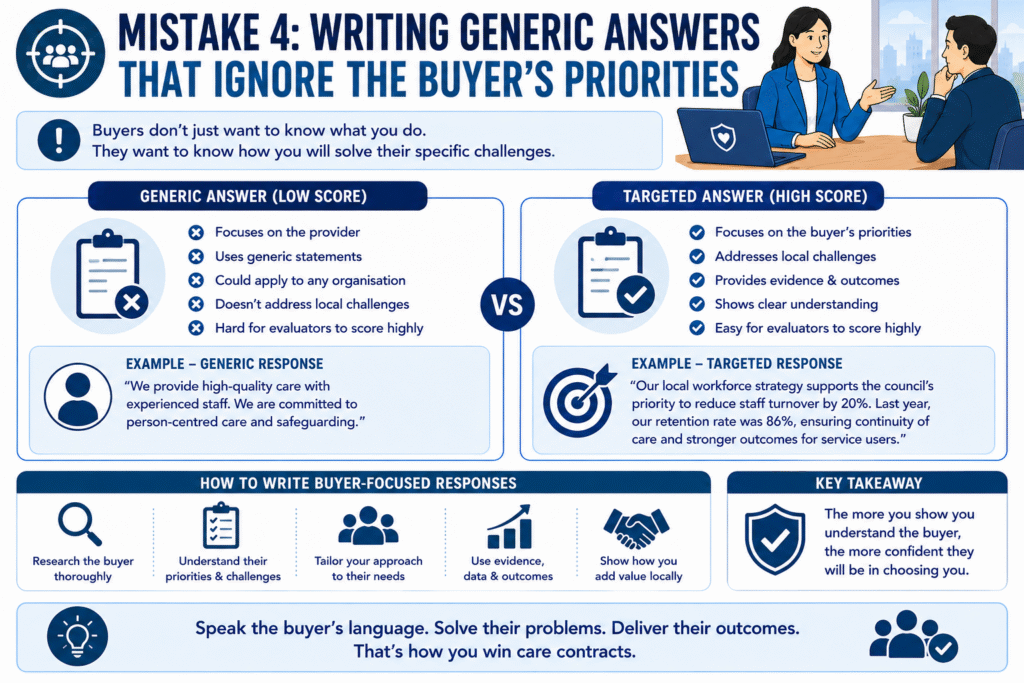
    Mistake 4: Writing Generic Answers That Ignore the Buyer’s Priorities

    Bid Writing Service 2026
    Bid Writing Service 2026

    Many care providers spend hours writing detailed responses only to receive average scores.

    The problem is not always the quality of the writing. The problem is relevance.

    Buyers do not award contracts simply because you provide good care. They award contracts to providers who demonstrate that they understand the buyer’s specific challenges, priorities, and outcomes.

    This is where many providers struggle with how to write a tender proposal that stands out.

    A generic response focuses on the provider:

    • Our staff are highly trained.
    • We provide person-centred care.
    • We have strong safeguarding processes.
    • We deliver high-quality services.

    Every bidder says the same thing.

    A high-scoring response focuses on the buyer:

    • How your service supports the council’s adult social care strategy.
    • How your staffing model addresses local workforce shortages.
    • How your approach reduces delayed discharges.
    • How your service improves outcomes for people with complex needs.
    • How your social value commitments benefit the local community.

    Evaluators want evidence that you understand their environment, not just your own business.

    For example, a local authority may identify hospital discharge delays as a major challenge. Another authority may prioritise workforce retention. An Integrated Care Board may focus on reducing emergency admissions. If your answers fail to address those priorities directly, evaluators often view your submission as generic.

    This mistake becomes even more damaging when providers copy and paste content from previous bids. While reusing evidence can save time, reusing strategy rarely works. Every buyer has different priorities, different service pressures, and different success measures.

    A response that scored highly in one borough may score poorly in another.

    How to Fix This Mistake

    Before writing any method statement, research the buyer thoroughly.

    Review:

    • Adult Social Care Strategies.
    • Integrated Care Board plans.
    • Joint Strategic Needs Assessments (JSNAs).
    • Market Position Statements.
    • Social Value Frameworks.
    • Recent contract award notices.
    • CQC local authority assessment findings where relevant.

    Create a simple one-page buyer profile that highlights:

    1. Their strategic priorities.
    2. Their biggest service challenges.
    3. Their workforce pressures.
    4. Their social value objectives.
    5. Their expected outcomes.

    Then build your responses around those priorities.

    For example, instead of saying:

    “We recruit skilled care workers.”

    You could say:

    “Our recruitment strategy directly supports the authority’s workforce sustainability objectives by maintaining a local talent pipeline, reducing vacancy rates, and improving continuity of care for service users.”

    The second response speaks the buyer’s language.

    A specialist bid writing service will usually spend significant time researching the commissioning landscape before drafting begins. This research often makes the difference between an average submission and a winning one.

    The most successful care providers do not write about themselves. They write about the buyer’s challenges and show exactly how their service solves them.

    READ: Is Carers Allowance Taxable in 2026?

    Mistake 4: Writing Generic Answers That Ignore the Buyer’s Priorities

    Many care providers spend hours writing detailed responses only to receive average scores.

    The problem is not always the quality of the writing. The problem is relevance.

    Buyers do not award contracts simply because you provide good care. They award contracts to providers who demonstrate that they understand the buyer’s specific challenges, priorities, and outcomes.

    This is where many providers struggle with how to write a tender proposal that stands out.

    A generic response focuses on the provider:

    • Our staff are highly trained.
    • We provide person-centred care.
    • We have strong safeguarding processes.
    • We deliver high-quality services.

    Every bidder says the same thing.

    A high-scoring response focuses on the buyer:

    • How your service supports the council’s adult social care strategy.
    • How your staffing model addresses local workforce shortages.
    • How your approach reduces delayed discharges.
    • How your service improves outcomes for people with complex needs.
    • How your social value commitments benefit the local community.

    Evaluators want evidence that you understand their environment, not just your own business.

    For example, a local authority may identify hospital discharge delays as a major challenge. Another authority may prioritise workforce retention. An Integrated Care Board may focus on reducing emergency admissions. If your answers fail to address those priorities directly, evaluators often view your submission as generic.

    This mistake becomes even more damaging when providers copy and paste content from previous bids. While reusing evidence can save time, reusing strategy rarely works. Every buyer has different priorities, different service pressures, and different success measures.

    A response that scored highly in one borough may score poorly in another.

    How to Fix This Mistake

    Before writing any method statement, research the buyer thoroughly.

    Review:

    • Adult Social Care Strategies.
    • Integrated Care Board plans.
    • Joint Strategic Needs Assessments (JSNAs).
    • Market Position Statements.
    • Social Value Frameworks.
    • Recent contract award notices.
    • CQC local authority assessment findings where relevant.

    Create a simple one-page buyer profile that highlights:

    1. Their strategic priorities.
    2. Their biggest service challenges.
    3. Their workforce pressures.
    4. Their social value objectives.
    5. Their expected outcomes.

    Then build your responses around those priorities.

    For example, instead of saying:

    “We recruit skilled care workers.”

    You could say:

    “Our recruitment strategy directly supports the authority’s workforce sustainability objectives by maintaining a local talent pipeline, reducing vacancy rates, and improving continuity of care for service users.”

    The second response speaks the buyer’s language.

    A specialist bid writing service will usually spend significant time researching the commissioning landscape before drafting begins. This research often makes the difference between an average submission and a winning one.

    The most successful care providers do not write about themselves. They write about the buyer’s challenges and show exactly how their service solves them.

    ALSO SEE: CQC Supported Living Registration in 2026: The Complete Guide

    Mistake 5: Ignoring the Tendering Process, Portal Updates, and ITT Rules

    You can write excellent answers, submit strong evidence, and offer competitive pricing, yet still lose the contract because you ignored the process.

    This happens more often than most care providers realise.

    To avoid it, you need to understand what is tendering process in practical terms. The tendering process is the structured journey buyers use to evaluate suppliers fairly and consistently. It covers everything from publishing the opportunity and issuing clarification responses to evaluating submissions and awarding the contract.

    Every stage matters.

    Many care providers focus entirely on writing and forget that buyers also assess compliance with the Instructions to Tenderers (ITT), submission requirements, portal communications, and document formats.

    Common examples include:

    • Missing a clarification update that changes the scope of the contract.
    • Exceeding the word count on a scored question.
    • Uploading the wrong version of a pricing schedule.
    • Submitting a PDF when the buyer requested an editable spreadsheet.
    • Missing a mandatory declaration.
    • Using appendices where the ITT explicitly prohibits them.
    • Uploading documents after the deadline closes.

    Under the Procurement Act 2023, buyers are placing even greater emphasis on transparency, consistency, and compliance. Small procedural mistakes can now eliminate an otherwise strong submission before evaluators consider its quality.

    One of the most overlooked risks involves buyer portals. Platforms such as Atamis, Jaggaer, In-tend, ProContract, and Find a Tender regularly publish clarification responses and document updates during live procurements.

    A single clarification response can completely change how you answer a question.

    Yet many providers only log into the portal when they first download the documents and again on submission day.

    By then, they may have missed crucial information.

    How to Fix This Mistake

    Build a process that protects your submission from avoidable compliance failures.

    Best practice includes:

    1. Check the buyer portal every working day.
    2. Enable portal notifications for multiple team members.
    3. Submit clarification questions early rather than waiting until the final week.
    4. Capture every ITT rule inside your compliance matrix.
    5. Monitor word counts throughout drafting.
    6. Schedule submission at least 24–48 hours before the deadline.
    7. Complete a final compliance review before uploading any documents.

    The strongest care providers also run an independent review of the entire submission before it goes live. This review focuses on compliance rather than content and often catches issues the drafting team no longer notices.

    A professional bid writing service usually incorporates this review stage as part of the process. Experienced reviewers check every response against the specification, the scoring criteria, the ITT, and the submission requirements before the bid reaches the buyer.

    Care providers often lose contracts because they focus on writing and neglect the rules surrounding the submission.

    The reality is simple: buyers can only score a bid that reaches evaluation. Following the tendering process correctly ensures your hard work actually gets the chance to compete.

    SEE MORE: How a Domiciliary Care Agency Can Prepare for 2026 and Grow Faster

    What a Good Bid Writing Service Should Do for a Care Provider

    Not all bid support delivers the same results.

    Some providers hire a generalist writer to help complete a tender. Others invest in a specialist bid writing service that understands care regulations, commissioning priorities, safeguarding requirements, workforce challenges, and the realities of delivering care services.

    The difference often shows in the final score.

    A high-quality bid writing service does far more than write answers. It helps care providers build a stronger submission from the moment the tender arrives.

    A specialist service should:

    • Review the specification and identify risks early.
    • Advise whether the opportunity is worth pursuing.
    • Build a compliance matrix against the evaluation criteria.
    • Gather evidence that supports every claim.
    • Draft method statements that align with buyer priorities.
    • Monitor clarification responses and procurement portals.
    • Check all tender documents before submission.
    • Run an independent red team review.
    • Ensure the final bid complies with every ITT requirement.

    This support becomes especially valuable for domiciliary care agencies, supported living providers, and healthcare organisations that already have demanding operational responsibilities.

    Most Registered Managers do not have spare hours to monitor procurement portals, gather evidence, manage contributors, review pricing assumptions, and draft multiple quality responses at the same time.

    A specialist bid writing service fills that gap.

    The strongest providers also understand that winning a contract rarely starts when the tender is released. It starts months earlier through strong governance, updated policies, robust safeguarding systems, positive inspection outcomes, workforce development, and measurable service performance.

    These are the same areas buyers assess during evaluation.

    That is why the most successful care providers treat bid writing as part of a wider growth strategy rather than a last-minute administrative task.

    Whether you are bidding for a local authority framework, an NHS Continuing Healthcare contract, a supported living opportunity, or a home care service agreement, the goal remains the same: demonstrate compliance, prove capability, and provide evidence that gives evaluators confidence in your delivery.

    A specialist bid writing service helps you do exactly that.

    The best submissions do not simply answer questions. They show buyers why your organisation is the safest, most capable, and most reliable choice for the people who depend on their services.

    Final Thoughts…

    The most common tender losses in 2026 do not happen because care providers lack experience, skilled staff, or high-quality services. They happen because avoidable mistakes weaken the submission before evaluators can see the true value of the organisation.

    The five biggest mistakes remain remarkably consistent:

    • Treating the tender like a form instead of a scored competition.
    • Submitting incomplete tender documents.
    • Confusing bid writing with bid management.
    • Writing generic responses that ignore buyer priorities.
    • Ignoring the tendering process and ITT requirements.

    The providers that win consistently approach tenders differently. They build systems, gather evidence early, understand the buyer’s objectives, and treat every submission as a strategic opportunity rather than an administrative exercise.

    If your organisation wants to improve its success rate, a specialist bid writing service can provide the structure, sector expertise, and quality assurance needed to compete more effectively for NHS, local authority, supported living, domiciliary care, and healthcare contracts.

    At Care Sync Experts, we help care providers strengthen every stage of the tender process, from specification review and compliance checks to bid management, tender writing, and final submission support, so that the next opportunity has the best possible chance of becoming your next contract.

    FAQ

    What Is a Bid Writer?

    A bid writer is a specialist who prepares tender responses on behalf of a business. Their role is to analyse the specification, understand the evaluation criteria, gather evidence, and produce answers that demonstrate how the organisation will deliver the contract.

    In health and social care, a bid writer must understand safeguarding, workforce management, quality assurance, CQC compliance, and service-user outcomes.

    What Does a Bid Writer Do?

    A bid writer transforms operational knowledge into high-scoring tender responses. They review tender documents, interview subject matter experts, gather supporting evidence, write method statements, and ensure every answer aligns with the buyer’s scoring criteria.

    A specialist bid writing service also helps identify weaknesses before submission and improves the overall quality of the bid.

    What Is Bid Management?

    Bid management is the process of coordinating an entire tender submission from start to finish. While bid writing focuses on producing answers, bid management covers planning, timelines, document collection, compliance checks, pricing coordination, clarification responses, and final submission.

    Successful care providers often combine strong writing with strong bid management to improve win rates.

    How Do You Write a Tender Bid for a Care Contract?

    To write a strong care tender bid:
    Read the full specification and evaluation criteria.
    Build a compliance matrix.
    Gather evidence before drafting begins.
    Research the buyer’s priorities and local challenges.
    Write responses that focus on outcomes, not promises.
    Support every claim with evidence.
    Review against the scoring criteria.
    Complete a final compliance check before submission.
    Care providers that follow this process typically produce stronger and more competitive bids.