Learning how to start a healthcare recruitment agency UK is not the same as starting a general recruitment business. In healthcare, every placement can affect someone’s safety, care, dignity, and daily support. That means you need more than a company name and a list of candidates.
To start well, you need to register your business, choose a clear care staffing niche, understand whether CQC registration applies to your model, set up safe candidate vetting, arrange the right insurance, plan your payroll cash flow, and build trust with care providers before you place workers.
A healthcare staffing agency may supply healthcare assistants, support workers, nurses, live-in carers, or care home staff. But from a caregiver business standpoint, your real job is not just to fill shifts. Your job is to help care providers find reliable, trained, and properly checked workers who can support vulnerable people safely.
The agencies that last do not rush into placements. They build compliance first, protect clients from staffing risks, and treat every worker they send out as a reflection of their brand.

What Is a Healthcare Recruitment Agency?
A healthcare recruitment agency helps care providers find suitable workers for temporary, permanent, contract, or shift-based roles. These workers may include healthcare assistants, support workers, nurses, care home staff, live-in carers, domiciliary care workers, or specialist care professionals.
So, what is a recruitment agency in this setting? It is a business that connects employers with suitable candidates. But in healthcare, the responsibility goes further. A good agency does not simply send “available staff.” It checks whether each worker has the right experience, training, documents, attitude, and reliability for the care setting.
A healthcare staffing agency may support care homes, home care providers, supported living services, clinics, private hospitals, or NHS suppliers. Some agencies focus on permanent recruitment. Others provide temporary staff to cover sickness, annual leave, urgent shifts, or long-term shortages.
In simple terms, a recruitment firm finds people for jobs. A strong healthcare recruitment firm protects care quality by placing the right person in the right care environment.
RELATED: What is 24 Hour Live In Care? 2026 Update for Care Businesses
Choose Your Care Staffing Niche First
Do not start by trying to recruit every healthcare role. A new agency grows faster when it chooses a clear niche, understands that market deeply, and builds a reliable pool of workers for that specific need.
You may focus on healthcare assistants, support workers, care home staff, domiciliary care workers, nurses, live-in carers, mental health support workers, or temporary shift cover. Each niche affects your compliance process, insurance, payroll pressure, client type, and pricing model.
For example, supplying care home staff for urgent shifts requires speed, strong availability tracking, and a ready pool of vetted workers. Permanent nursing recruitment needs a different approach, with deeper candidate screening, registration checks, and client relationship management.
This is where many people asking how do I start a staffing agency make a mistake. They start too broad, then struggle to prove trust. A focused niche helps you speak directly to care providers, build better candidate pipelines, and become known for solving one clear staffing problem well.
Do You Need CQC Registration?
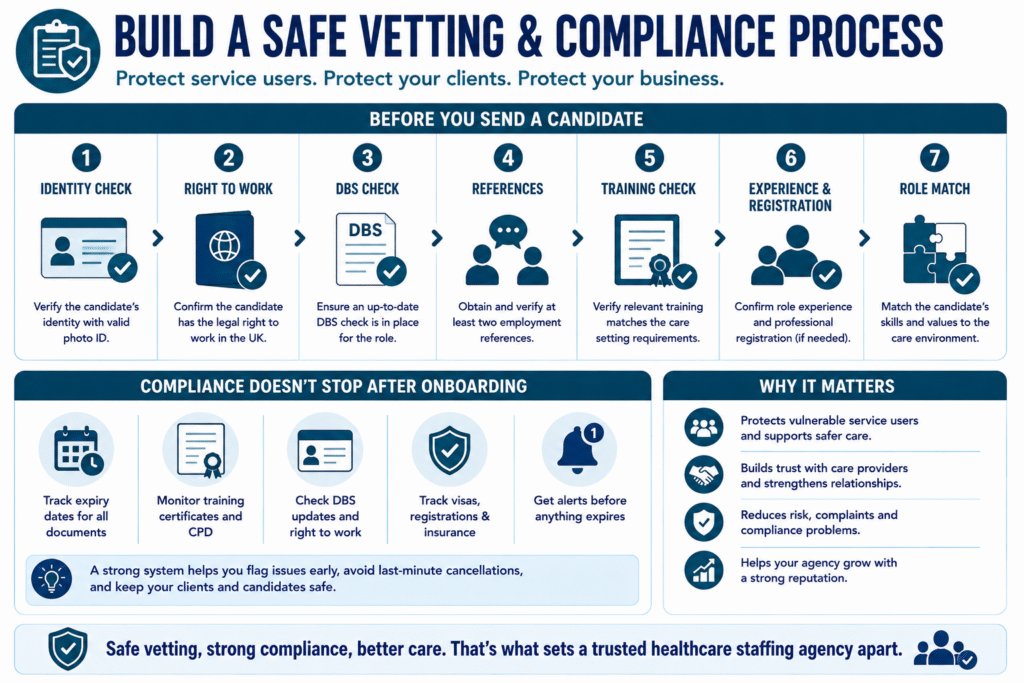
This is the question you must answer before you place your first care worker.
You may not need CQC registration if your agency only introduces or supplies workers to a care provider, and that provider manages the care, supervises the worker, and remains responsible for the regulated activity.
You may need CQC registration if your agency directly provides, manages, or controls regulated care activities, such as personal care. CQC says any person, partnership, or organisation that provides a regulated activity in England must register, otherwise they commit an offence.
This distinction matters. If you only run a healthcare staffing agency, you may operate as an employment business or recruitment agency. But if you decide how care workers support people with washing, dressing, toileting, medication support, or daily personal care, you may move into regulated care provision. CQC guidance explains that personal care covers support for people who cannot provide it for themselves because of old age, illness, or disability.
So before asking how to start a healthcare recruitment agency UK, ask a sharper question: “Will we only supply staff, or will we control the care being delivered?”
That answer shapes your registration, policies, insurance, staffing model, and legal risk.
READ MORE: Inheritance Tax Threshold UK: 2026 Update
Register the Business and Set Up the Legal Basics
Once you know your niche and CQC position, register the business properly. Most founders choose a limited company because it gives the agency a professional structure when dealing with care homes, healthcare providers, insurers, and finance partners.
You should register the company with Companies House, choose a suitable business name, and select the right SIC code. For recruitment businesses, Companies House lists 78109 for other employment placement agency activities and 78200 for temporary employment agency activities.
You also need to prepare the legal documents that protect your agency, clients, and candidates. These may include terms of business, candidate agreements, privacy notices, data protection policies, payroll processes, and client service agreements.
If you employ or pay temporary workers, you may also need to register as an employer with HMRC and run PAYE correctly. Recruitment agencies and employment businesses must also understand the Conduct Regulations, which guide how agencies deal with work-seekers and hirers.
This is where people researching how to set up a recruitment agency, how to establish a recruitment agency, or how to open a recruitment agency need to slow down. In care recruitment, paperwork is not just admin. It proves that your agency can operate professionally before any client trusts you with staffing cover.
What Qualifications Do I Need to Start a Care Agency?
You do not always need a clinical qualification to start a healthcare recruitment agency, but you do need the right knowledge, systems, and people around you. Care providers will not trust your agency because you registered a company. They will trust you because you understand safe staffing, safeguarding, compliance, and care quality.
If you only run a recruitment business, your strongest qualification is practical experience in healthcare recruitment, care operations, HR, compliance, or workforce management. You need to know how to check candidates properly, match workers to the right care setting, and respond quickly when a shift problem happens.
If your business provides regulated care directly, the expectations become higher. You may need a competent registered manager, suitable policies, staff training systems, quality assurance processes, and evidence that the service can deliver safe care.
So, what qualifications do I need to start a care agency? The honest answer depends on your model. A recruitment-only agency needs recruitment and compliance competence. A regulated care agency needs care leadership, governance, and CQC-ready systems.
If you want to know how to start a recruiting business in healthcare, start with this rule: never place a worker you would not trust around someone vulnerable.
SEE ALSO: Universal Credit Permanent Boost 2026
Build a Safe Vetting and Compliance Process
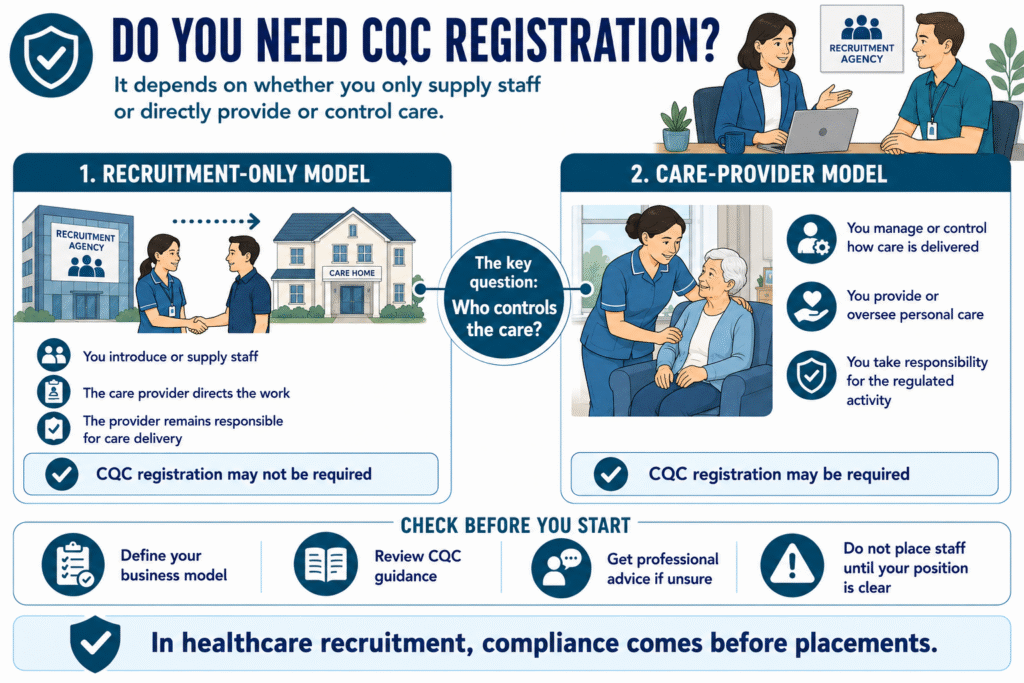
A healthcare recruitment agency only becomes valuable when clients can trust the workers it supplies. In care, one poor placement can put a vulnerable person at risk and damage your agency’s reputation quickly.
Before you send any candidate to a client, check their identity, right to work, DBS status, references, training records, role experience, and professional registration where relevant. You should also confirm that their training matches the setting. A care home may need staff with moving and handling, safeguarding, infection control, basic life support, dementia awareness, and medication training, depending on the role.
Good compliance does not stop after onboarding. Track expiry dates for documents, training certificates, DBS updates, visas, insurance requirements, and professional registrations. If something expires, your system should flag it before the worker accepts another shift.
This is where many people asking how to start a staffing agency underestimate the work. Healthcare staffing is not just candidate matching. It is risk management.
A strong vetting process protects service users, care providers, candidates, and your business. It also gives you a stronger sales message because clients want fast cover, but they trust agencies that can prove safe cover.
How Much Does It Cost to Start a Care Agency UK?
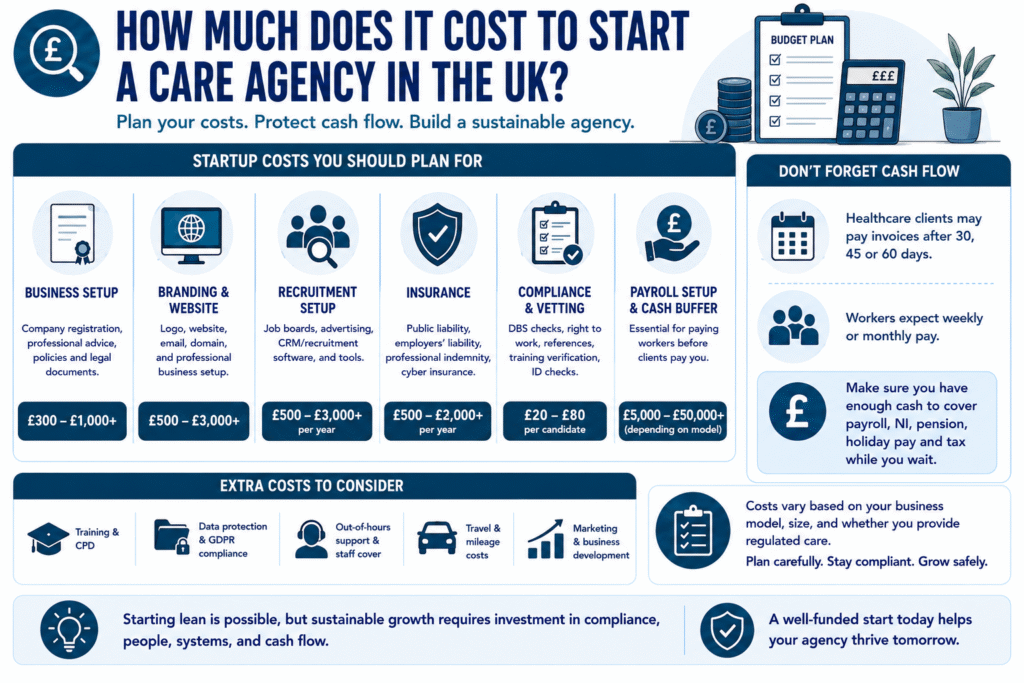
The cost depends on your business model. A recruitment-only agency can start lean, but a care agency that provides regulated care or pays temporary workers every week needs a bigger budget and stronger cash flow.
If you ask, how much does it cost to start a care agency UK, think beyond company registration. You may need money for branding, a website, job adverts, recruitment software, contracts, insurance, DBS checks, training verification, compliance systems, payroll setup, and legal advice.
You also need a payroll buffer. Many healthcare workers expect weekly pay, but care homes, clinics, or healthcare providers may pay your invoices after 30, 45, or 60 days. If you cannot cover wages while waiting for client payments, the business can run into trouble even when it has clients.
CQC costs may also apply if your model involves regulated care. CQC says provider fees depend on the type and size of service, and providers may pay more than one fee if they register for more than one regulated activity.
So, when planning how to start a recruitment agency, do not only ask, “How much does setup cost?” Ask, “Can I fund compliance, payroll, and safe growth before clients start paying on time?”
MORE: Is Carers Allowance Taxable in 2026?
How Do Recruitment Agencies Make Money?
Recruitment agencies usually make money through temporary staffing margins, permanent placement fees, contract recruitment fees, or managed staffing agreements.
With temporary healthcare staffing, your agency charges the client an hourly rate and pays the worker their agreed hourly pay. The difference must cover payroll costs, holiday pay, pension duties, insurance, compliance admin, recruitment software, marketing, and profit.
With permanent recruitment, the client usually pays a placement fee when they hire your candidate. This fee often works as a percentage of the candidate’s annual salary, although the exact structure depends on your agreement.
In healthcare, margins must cover more than business profit. They must support safe vetting, fast replacement cover, worker communication, out-of-hours support, and compliance checks. A care home does not only pay for a person to arrive on shift. It pays for confidence that the worker has the right checks, training, and attitude for vulnerable people.
So, how do recruitment agencies make money? They earn by solving staffing problems quickly and safely. The stronger your compliance, reliability, and candidate quality, the easier it becomes to justify your fees.
How to Get Private Care Clients in the UK
Getting clients starts with trust. Care homes, domiciliary care providers, supported living services, private clinics, and nursing homes will not hand staffing gaps to an agency they barely know. They need to see that you can supply reliable workers, respond quickly, and protect their service users from risk.
Start by building a simple compliance pack. Include your business details, insurance, vetting process, DBS policy, right-to-work process, training checks, reference checks, and replacement cover procedure. This gives care providers confidence before they sign your terms.
Then focus your outreach. Contact care home managers, registered managers, HR leads, and operations managers. Use LinkedIn, email, phone calls, local networking, and direct visits where appropriate. Do not open the conversation by saying, “We have staff.” Say, “We help care providers cover shifts safely with vetted healthcare workers.”
If you want to know how to get private care clients UK, remember this: care providers buy reliability. They want fewer missed shifts, fewer compliance worries, and workers who understand the care environment.
A strong healthcare staffing agency grows when clients trust its judgement, not just its candidate list.
Final Startup Checklist
Before placing your first worker, make sure your agency can prove it is safe, organised, and ready to support care providers properly.
Use this checklist:
- Choose your healthcare staffing niche
- Confirm whether you need CQC registration
- Register your business with Companies House
- Set up PAYE if you will employ or pay workers
- Prepare client terms, candidate agreements, and privacy documents
- Arrange suitable insurance
- Build a DBS, right-to-work, reference, and training-check process
- Create a system for tracking document expiry dates
- Plan your payroll buffer before taking temporary staffing contracts
- Build a client compliance pack
- Start outreach to care homes, home care providers, clinics, and supported living services
The best answer to how to start a healthcare recruitment agency UK is not “register a company and find clients.” The better answer is: build a recruitment company that care providers can trust with vulnerable people.
A successful agency grows when it combines fast staffing support with strong compliance, honest communication, and reliable workers. In healthcare recruitment, trust is the real product.
Ready to Start a Healthcare Recruitment Agency the Right Way?
Healthcare recruitment is more than filling shifts. It requires compliance, safe vetting, strong cash flow, and trust from care providers.
At Care Sync Experts, we explain healthcare business and care-sector topics in plain English, helping founders, caregivers, and providers make clearer decisions before costly mistakes happen.
Build safely. Stay compliant. Earn trust.
FAQ
Do recruitment agencies need a licence in the UK?
Most UK recruitment agencies do not need a general licence to operate, but they must follow recruitment law, including rules for employment agencies and employment businesses. Some sectors have extra licensing rules.
GOV.UK says agencies need a licence if they supply workers in areas such as agriculture, horticulture, shellfish gathering, and food processing or packaging. Healthcare agencies may also need CQC registration if they directly provide or control regulated care activities.
Can I run a recruitment agency from home?
Yes, you can run a recruitment agency from home if you can operate professionally, protect candidate and client data, handle calls and interviews properly, and meet your legal duties. You still need to register the business, prepare contracts and terms, follow data protection rules, and comply with recruitment regulations.
Working from home may reduce startup costs, but it does not reduce your compliance responsibilities. GOV.UK explains that recruitment agencies and employment businesses must follow rules on worker treatment, terms, pay, job adverts, and protection for work-seekers and hirers.
How much do recruitment agencies charge per hour in the UK?
For temporary staffing, UK recruitment agencies usually charge the client an hourly bill rate that includes the worker’s pay plus agency margin, employment costs, holiday pay, pension duties, insurance, compliance admin, and profit.
A common margin can sit around 15% to 25% above the worker’s pay rate, although healthcare, urgent shifts, specialist roles, and out-of-hours cover can cost more.
The exact rate depends on the role, location, risk level, shift pattern, and whether the agency employs the worker or supplies them through another arrangement.
What are red flags for recruiters?
Red flags include unclear fees, weak vetting, poor communication, missing contracts, pressure tactics, fake job adverts, poor candidate checks, and no clear process for complaints or replacement cover.
In healthcare recruitment, bigger warning signs include placing workers without DBS checks, right-to-work checks, references, training verification, or professional registration checks where required. GOV.UK says employment agencies and businesses must follow rules that protect work-seekers and hirers, including written terms and fair treatment.
Leave a Reply