From 9 February 2026, the CQC Application process changes in one critical way: CQC will immediately return any incomplete or inaccurate application at the point of receipt. You will not get the chance to send missing documents later. If your application lacks even one required document, CQC will reject it and require you to cancel and resubmit from scratch.
These stricter rules apply to new provider registrations in England, including care homes, supported living services, and home care agencies providing specialist services for autistic people and people with a learning disability.
CQC introduced these changes to reduce backlogs and speed up decisions for providers who submit complete, compliant applications first time.
Who the 9 February Rules Affect (Care Homes, Supported Living, Home Care)
The new reject-on-receipt rule applies to all new provider registrations in England, but CQC has tightened document requirements for specific service types.
Care homes and nursing homes must now submit additional documents upfront with their CQC application. Previously, CQC often requested these during assessment. From 9 February 2026, you must include them at submission.
Supported living services face similar changes. CQC now expects key operational and governance documents at the start, plus an additional service-specific form.
Home care agencies applying to deliver specialist services for autistic people or people with a learning disability must include new policies that demonstrate compliance with CQC’s Right Support, Right Care, Right Culture guidance.
If you are preparing a CQC application for domiciliary care, review the updated CQC supporting documents guidance carefully. CQC will not process incomplete submissions under the new rules.
READ MORE: First Person vs Third Person Care Plan: CQC & the Mental Capacity Act Expection in 2026
What Makes CQC Return Your Application Immediately
From 9 February 2026, CQC checks your documents before it moves your CQC Application into formal assessment. If your submission fails this first check, CQC will return it without progressing it any further.
CQC will reject your application immediately if:
- You fail to include all required CQC supporting documents
- You submit outdated templates or the wrong version of a required form
- Your documents contradict each other (for example, staffing numbers that differ across your business plan and financial forecast)
- Your policies use generic language that does not reflect your service type
- Your evidence of legal occupancy does not match your premises details
- You apply before your premises, staffing, or governance structure are ready
CQC assessors now review applications for completeness and accuracy at receipt. They expect a coherent, consistent pack. If anything looks incomplete or inconsistent, they will return the entire application.
Before you submit, use current CQC resources and complete a full internal cross-check. One missing document can delay your registration by months.
CQC Supporting Documents Every Provider Must Prepare
Every CQC Application must include a complete set of supporting documents. From 9 February 2026, CQC will not request missing items later. You must submit a full, accurate pack from day one.
Below are the core CQC supporting documents that apply to most new provider applications:
Governance and Operational Documents
- Business continuity plan
- Governance and quality assurance policies
- Complaints policy
- Consent policy and procedures
- Safeguarding policy and procedures
These documents must show how you will lead, monitor, and improve your service. CQC expects clear lines of accountability and safe decision-making from the start.
Financial and Business Documents
- Business plan for CQC registration
- Financial forecast
- Financial viability statement (using CQC’s current template)
Your business plan must align with your staffing model, service user numbers, and regulated activities. CQC will compare these documents closely.
Premises and Safety Evidence
- Evidence of legal occupancy
- Floor plan of premises
- Fire risk assessment
- Gas and electrical safety certificates
- Legionella risk assessment
- Environment risk assessment
If your premises are not inspection-ready, your application is premature.
Clinical and Care Policies
- Infection prevention and control policy
- Medicines management and prescribing policy
- Equality, diversity, and human rights policy
CQC expects policies that reflect how your specific service will operate, not generic templates. If your documents do not match your service type, CQC will return your application before you receive your CQC certificate of registration.
Prepare each document carefully. Check consistency across all files. A complete and coherent document pack gives your application the best chance of progressing to assessment.
SEE ALSO: CQC Registered Manager: Dismissal & How to Pass the Interview (2026)
Care Homes: Extra Documents You Must Send From 9 February 2026
If you are opening a care home or nursing home, you must now submit additional documents at the point of application. CQC previously requested some of these during assessment. From 9 February 2026, you must include them in your initial CQC Application.
Care homes must now provide:
- A detailed business plan
- A two-year financial forecast
- Evidence of legal occupancy (including landlord or mortgage consent where relevant)
- A service user guide
- A structured staff training plan
Your business plan for CQC registration must go beyond ambition. It must explain how you will operate the home, recruit and retain staff, meet residents’ needs, and maintain financial stability. CQC will cross-check this plan against your financial viability statement, staffing model, and statement of purpose.
Your service user guide must clearly explain what residents can expect, how they can raise concerns, and how you will promote dignity and safety. Your staff training plan must show how you will prepare your team to deliver person-centred care from day one.
If you plan to support autistic people or people with a learning disability, you must also demonstrate alignment with Right Support, Right Care, Right Culture guidance. CQC expects evidence that you understand specialist service delivery before it grants registration.
Submit these documents only when they are complete, consistent, and tailored to your service. Any gaps will trigger an immediate return.
Supported Living: Extra Documents & the Additional Form
Supported living providers must also front-load key documents in their CQC Application from 9 February 2026. CQC will no longer wait until assessment to request operational and governance evidence.
If you are registering a supported living service, you must submit:
- A detailed business plan and financial forecast
- Evidence of legal occupancy for the office or operational base
- A clear service user guide
- A structured staff training plan
- An additional supported living information form required by CQC
This additional form gives CQC deeper insight into your governance structure, directors, nominated individual, and proposed registered manager. CQC wants to understand how you will lead and monitor the service before it commits resources to a full assessment.
Remember, CQC regulates the personal care element of supported living, not the housing component. Your documents must clearly separate regulated activities from tenancy or housing support. If you blur these lines, CQC may question the scope of your registration.
Review the latest CQC supporting documents guidance before submitting. Ensure your statement of purpose, staffing model, and training plan align precisely. Any inconsistencies will trigger an immediate return under the new rules.
MORE: RQIA Registration for Domiciliary Care Agency in Northern Ireland (2026)
Home Care for LD and Autism: New Policies You Must Include
If you are submitting a CQC application for domiciliary care and you intend to support autistic people or people with a learning disability, you must now include two additional policies from 9 February 2026:
- A Positive Behaviour Support (PBS) policy
- A Restraint (restrictive interventions) policy
CQC introduced this requirement to ensure providers entering the specialist LD and autism market understand safe, person-centred practice from the outset.
Your Positive Behaviour Support policy must explain how you will:
- Assess behaviour proactively
- Train staff in PBS principles
- Reduce triggers and prevent escalation
- Minimise restrictive practices
Your restraint policy must clearly state:
- When restrictive intervention may be used
- How staff will record and review incidents
- How you will ensure restraint remains proportionate and a last resort
- How you comply with the Mental Capacity Act 2005
CQC will not accept generic templates. Your policies must reflect how your service will actually operate in the community. If they do not demonstrate a clear understanding of specialist care delivery, CQC will return your application.
Before you submit, review current CQC supporting documents guidance and cross-check your specialist policies against your training plan and governance framework. Consistency matters under the new reject-on-receipt process.
Registered Manager CQC: Requirements, Form, Interview and Salary (2026)
Every CQC Application must name a suitable registered manager. CQC will not process your provider registration without a compliant manager application submitted at the same time.
CQC Registered Manager Requirements and Qualifications
A registered manager CQC applicant must demonstrate competence, integrity, and the ability to lead safe and effective care. CQC expects clear evidence that the manager understands governance, safeguarding, quality assurance, incident reporting, and regulatory compliance.
There is no single mandatory “CQC qualification.” However, CQC registered manager requirements typically include:
- Relevant health or social care experience
- Management or supervisory experience
- A Level 5 Diploma in Leadership for Health and Social Care (or working towards it)
- Strong knowledge of safeguarding, MCA 2005, and regulatory standards
If you are asking, “What qualifications do I need to be a Care Manager?”, focus on leadership competence and regulatory knowledge, not just certificates. CQC registered manager qualifications must reflect your service type.
CQC Registered Manager Application Form
You must complete the CQC registered manager application form accurately and submit it alongside your provider application. Many providers fail because of inconsistencies between:
- The provider’s statement of purpose
- The staffing structure
- The manager’s declared responsibilities
Treat the CQC application form for registered manager as a regulatory document, not an HR form. Any inaccuracies can delay your registration.
CQC Registered Manager Interview Questions
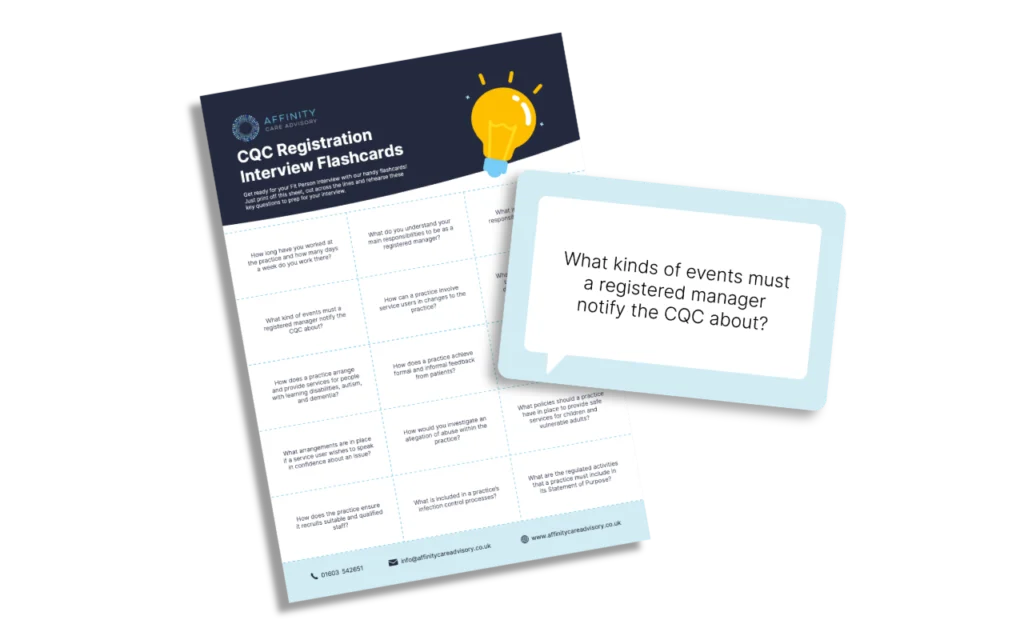
CQC often interviews proposed managers as part of assessment. Expect detailed CQC registered manager interview questions covering:
- Safeguarding procedures
- Governance and quality monitoring
- Incident reporting
- Medicines management
- Staffing oversight
- Mental Capacity Act application
Prepare for structured, scenario-based questions. If you search for registered manager CQC interview questions, you will see patterns. CQC wants evidence that you can lead safely from day one.
Registered Manager Salary UK (2026 Context)
Search interest around Registered Manager salary UK, Registered Care Manager salary UK, and CQC manager salary in UK continues to rise. Salaries vary by region, service type, and complexity. Providers typically pay more for specialist LD/autism services or large multi-site operations.
Salary alone does not secure approval. CQC evaluates competence, experience, and governance understanding above pay scale.
Appoint your registered manager carefully. A weak application at manager level can stall your entire CQC Application.
LEARN MORE: CQC Registration for Domiciliary Care Providers: Complete 2026 Guide
How Long CQC Registration Takes in 2026 (And What Slows It Down)
CQC registration does not move faster just because you submit early. It moves faster when you submit a complete, accurate CQC Application.
In 2026, most provider registrations take 10 to 16 weeks from submission to decision. However, your total timeline usually stretches longer because preparation takes time.
Your process typically includes:
- Preparing your CQC supporting documents
- Completing DBS checks for directors and the registered manager
- Submitting your provider and registered manager applications
- CQC’s initial completeness review
- Full assessment (document review, interviews, and possibly a site visit)
Under the new reject-on-receipt rule, a single missing document resets your timeline. If CQC returns your application, you must cancel and resubmit. You go back to the start of the queue.
Several factors commonly delay registration:
- Inconsistent financial forecasts
- Premises not ready for inspection
- Weak answers in the registered manager interview
- Incorrectly selected regulated activities
If you want your CQC certificate of registration without avoidable delays, submit only when your documents, premises, and leadership structure are fully ready. Preparation now protects your opening date later.
Common CQC Application Mistakes That Trigger Rejection
CQC does not reject applications at random. It rejects them because providers submit incomplete, inconsistent, or poorly prepared documents. Under the 9 February 2026 rules, these mistakes now result in immediate return.
Here are the most common CQC Application errors:
- Submitting generic template policies
CQC assessors recognise copied templates quickly. If your safeguarding policy does not reflect your service type, location, and staffing model, CQC will return your application.
- Contradictions across documents
Your business plan states 20 service users. Your financial forecast assumes 30. Your staffing plan supports 12. CQC cross-checks everything.
- Incorrect regulated activities
Many providers misunderstand the scope of registration. If you apply for the wrong regulated activity, your entire submission may fail.
- Weak financial viability statement
You must use CQC’s current template. An unsigned or outdated version can stop your application immediately.
- Incomplete registered manager information
Missing DBS checks, inconsistent responsibilities, or unclear governance roles often delay assessment.
- Premises not ready
If your premises do not match your floor plans or lack required safety documentation, CQC may question your readiness.
Before you submit, treat your application like an audit. Review every document. Check alignment across files. Compare your submission against current CQC supporting documents guidance. One small error can cost you months.
ALSO: Latest CQC Reports, Regulated Activities (2026)
CQC Application Checklist (Submit Once, Get Assessed)
If you want your CQC Application to move forward instead of coming straight back, complete this checklist before you press submit.
1. Download the latest guidance
Use only current CQC resources. Requirements changed in 2026. Old guides will mislead you.
2. Build a full document inventory
List every required CQC supporting document for your service type. Tick each one off only when final, signed, and internally reviewed.
3. Cross-check for consistency
Match your business plan, financial forecast, staffing structure, and statement of purpose. Remove contradictions before CQC finds them.
4. Finalise your registered manager submission
Complete the manager application form accurately. Ensure DBS checks are complete. Prepare for interview questions.
5. Confirm premises readiness
Secure legal occupancy evidence, safety certificates, and floor plans. Do not apply before your site is inspection-ready.
6. Run a pre-submission audit
Review your entire pack as if you were CQC. Ask: does this prove we can deliver safe, compliant care from day one?
Submit once. Submit complete. That is how you reach assessment and secure your registration without avoidable delay.
Conclusion
The 9 February 2026 changes leave no room for partial submissions. CQC now checks your documents at receipt. If your CQC Application contains gaps, inconsistencies, or generic templates, CQC will return it. You will cancel, resubmit, and lose your place in the queue.
Care homes must front-load additional documents. Supported living providers must complete extra forms. Home care agencies entering the LD and autism market must submit specialist policies. Every provider must align governance, finance, staffing, and premises evidence from day one.
The rule is simple: prepare thoroughly or prepare twice.
If you want your CQC certificate of registration without unnecessary delay, build your document pack carefully, align your registered manager submission, and audit everything before you apply.
Ready to Make Your CQC Application Rejection-Proof?
A strong CQC Application does more than tick document boxes. It proves leadership competence, financial viability, governance structure, and operational readiness from day one. Under the new reject-on-receipt rules, precision matters.
Care Sync Experts supports providers across England with:
- Complete CQC supporting documents preparation and cross-checking
- Business plan and financial forecast alignment
- Registered manager CQC application and interview preparation
- Specialist LD and autism policy development
- Pre-submission audit against 2026 CQC requirements
- Governance and compliance framework structuring
Whether you are launching a new service, expanding a location, or strengthening an existing submission, we help you build an application that stands up to scrutiny and moves forward without delay.
Get in touch with Care Sync Experts today to submit with clarity, confidence, and compliance.
FAQ
What Does CQC Stand For?
CQC stands for the Care Quality Commission. It is the independent regulator of health and adult social care services in England. CQC registers providers, monitors compliance, carries out inspections, publishes ratings, and takes enforcement action where services fail to meet legal standards.
CQC does not regulate services in Wales, Scotland, or Northern Ireland. Those jurisdictions have separate regulators.
What 5 Questions Does CQC Ask?
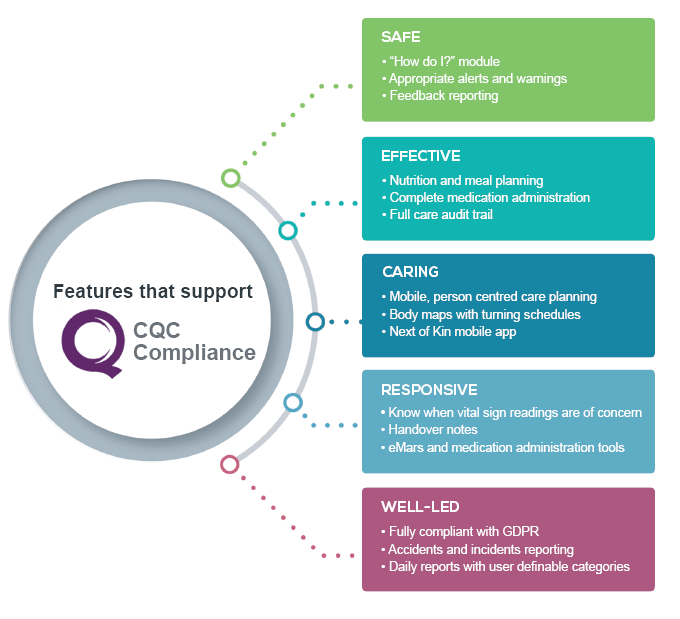
CQC bases inspections and assessments around five key questions. Inspectors ask whether a service is:
Safe – Do people receive care free from abuse and avoidable harm?
Effective – Does care achieve good outcomes and follow best practice?
Caring – Do staff treat people with dignity, compassion, and respect?
Responsive – Does the service meet people’s individual needs?
Well-led – Does leadership promote quality, safety, and accountability?
These five questions shape both registration assessments and ongoing inspections. Providers should structure governance systems around them.
What Happens If You Fail CQC?
If CQC finds that a service does not meet fundamental standards, it can:
– Issue requirement notices
– Issue warning notices
– Impose conditions on registration
– Restrict regulated activities
– Suspend registration
– Cancel registration in serious cases
CQC may also prosecute where it identifies serious breaches of legal requirements. Services rated “Inadequate” face increased monitoring and enforcement. Leadership and governance weaknesses often drive enforcement action.
What Must Be Reported to CQC?
Registered providers must notify CQC of specific events and incidents. These include:
– Serious injuries
– Deaths of people using the service
– Allegations of abuse
– Incidents reported to the police
– Events that stop the service from operating safely
– Changes to registered managers or nominated individuals
Providers must submit notifications within required timeframes using CQC’s notification system. Failure to report notifiable incidents can lead to enforcement action.
Leave a Reply