Tag: benefit

  • How to Report Benefit Fraud in the UK (2026)

    How to Report Benefit Fraud in the UK (2026)

    To report benefit fraud in England and Wales, use the official GOV.UK Report Benefit Fraud service or call the National Benefit Fraud Hotline on 0800 854 440, Monday to Friday, 8am to 6pm. You can make a report anonymously, and you do not need to give your name or contact details.

    When you report benefit fraud, give as much useful information as you can. This may include the person’s name, address, the type of benefit involved, and what makes you think they may be claiming wrongly.

    For example, your concern may involve Universal Credit, hidden income, a change of address, a partner living at the property, or false information about health or care needs.

    From a caregiver’s perspective, the goal is not to accuse someone carelessly. The goal is to protect vulnerable people, public funds, and the integrity of the support system. If you have a genuine concern, use the proper reporting route.

    Do not confront the person, investigate them yourself, or tell others you plan to make a report. GOV.UK also advises people to report someone only once and not to try to find out more for their own safety.

    Get expert support for your next tender, inspection-ready policies, or CQC registration — book a call with Care Sync Experts today and let’s get you compliant and competitive.

    What Is Benefit Fraud?

    CQC Interview Questions 2026: 5 Technology Answers That Get You Approved

    Benefit fraud happens when someone deliberately claims benefits they are not entitled to, or fails to report a change that affects their claim. It is not the same as making a mistake on a form. Fraud involves dishonesty, hidden information, or false details used to get money or support unfairly.

    Common types of benefit frauds can include claiming Universal Credit while hiding earnings, saying you live alone when a partner lives with you, using a false address, failing to report savings, or giving incorrect information about a health condition, disability, or care needs.

    For caregivers and families, this subject needs care and fairness. Sometimes a situation may look suspicious from the outside, but the person may have already reported their change in circumstances, or the change may not affect their benefit. That is why you should not accuse, confront, or investigate someone yourself.

    If you ask, “How do I know if it is benefit fraud?” the honest answer is: you may not know for certain. You only need to report a genuine concern through the proper route. The DWP decides whether the information needs investigation.

    RELATED: UK Two-Child Limit Abolition: What the 2026 Changes Mean

    When Should a Caregiver or Family Member Report a Concern?

    A caregiver or family member should report a concern when they genuinely believe someone may be claiming benefits dishonestly or exploiting a vulnerable person’s benefits. This can happen when someone hides income, gives false information, claims support using another person’s details, or controls a vulnerable person’s money unfairly.

    In care settings, you may notice signs that raise concern. For example, someone may say they live alone while a partner clearly lives with them, claim disability support using false information, or receive money meant for a vulnerable person but fail to use it for their care.

    Still, suspicion does not prove fraud. You should not search private documents, follow someone, take photos, confront them, or spread the concern to others. If you work in care, follow your safeguarding policy and speak to the right person in your organisation.

    If you want to know how to report someone for benefit fraud, use the official reporting route and give the facts you already know. Let DWP decide whether the concern needs investigation.

    How to Report Benefit Fraud Anonymously Online
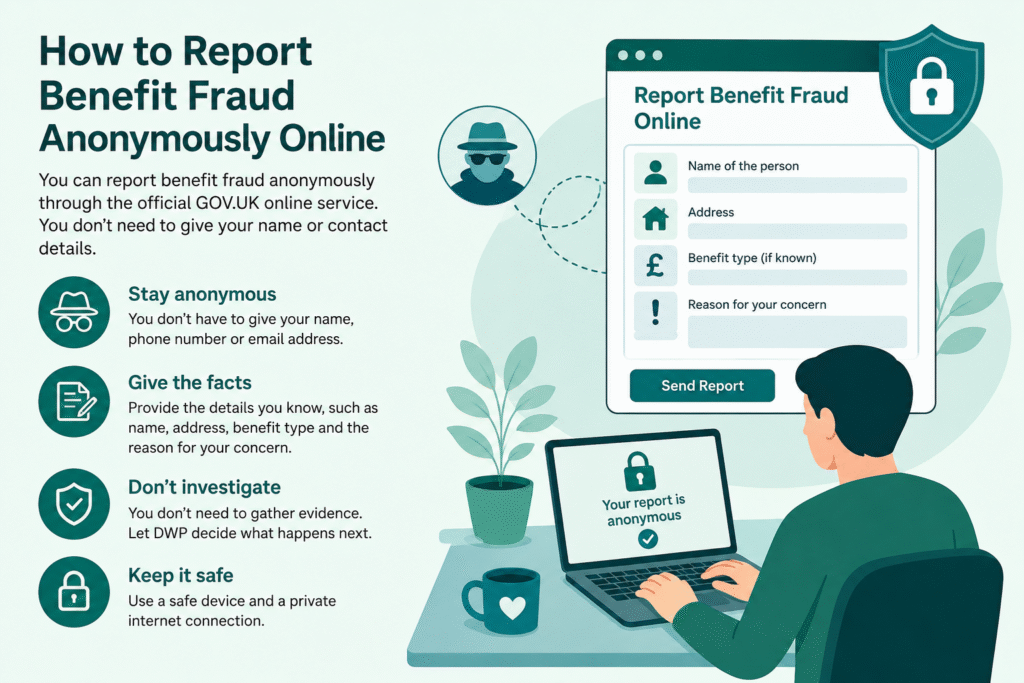
    How to Report Benefit Fraud
    How to Report Benefit Fraud

    You can report benefit fraud anonymously through the official GOV.UK Report Benefit Fraud service. You do not need to give your name, phone number, email address, or contact details. The report should focus on the facts you already know, not guesses or rumours.

    When using the online form, include helpful details such as the person’s name, address, the benefit involved if you know it, and the reason you believe they may be claiming wrongly. For example, the concern may involve hidden earnings, a partner living at the address, false information about care needs, or undeclared work while claiming Universal Credit.

    If you prefer to report by phone in England and Wales, you can call the National Benefit Fraud Hotline on 0800 854 440. GOV.UK says reports are anonymous and advises people not to investigate the person themselves or let anyone know they are making a report. (gov.uk)

    So, if you are wondering how to report a benefit cheat anonymously online, the safest route is simple: use the official GOV.UK service, share only what you genuinely know, and allow DWP to decide what happens next.

    READ MORE: Individual Support Package: What It Means for Care at Home

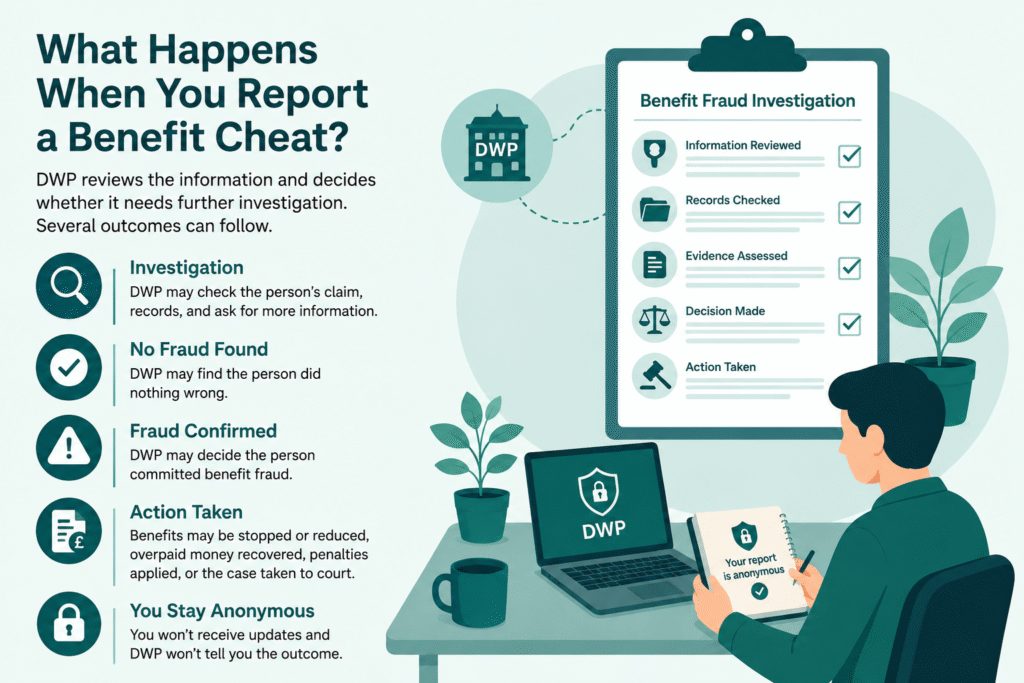
    What Happens When You Report a Benefit Cheat?

    When you report a benefit cheat, the Department for Work and Pensions reviews the information you provide and decides whether it needs further investigation. You will not receive updates, and DWP will not tell you the outcome of the case.

    If the report raises a genuine concern, investigators may check the person’s claim, compare records, request more information, or contact the person directly. This process can take time, especially if the case involves Universal Credit, disability benefits, hidden income, or several changes in circumstances.

    Several outcomes can follow. DWP may find that the person has done nothing wrong. They may discover that the person already reported the change, or that the issue does not affect their benefit. If DWP finds fraud, they may stop or reduce benefits, recover overpaid money, issue a penalty, or take the case to court.

    So, what happens when you report a benefit cheat? You pass your concern to the right authority, and they decide the next step. Your role ends with giving honest information, not proving the case yourself.

    How Are Benefit Frauds Caught?
    Report benefit fraud and issues efficiently
    Report benefit fraud and issues efficiently

    Benefit fraud investigations usually start when DWP receives information that does not match someone’s benefit claim. This can come from public reports, official records, employer information, financial checks, or changes linked to benefits such as Universal Credit.

    Investigators do not act on suspicion alone. They look for evidence. For example, they may check whether someone has undeclared earnings, a partner living with them, savings they did not report, a false address, or incorrect information about disability, health, or care needs.

    So, how are benefit frauds caught? They are usually identified through a mix of reports, data checks, claim reviews, and investigation work. The DWP then decides whether the person made a mistake, failed to update their claim, or deliberately committed fraud.

    For caregivers and families, this matters because you do not need to prove fraud yourself. You only need to share honest, relevant information through the proper reporting route. The investigation belongs to the authorities, not to you.

    SEE ALSO: HICBC Child Benefit Rule Change UK: What Care Workers Need to Know in 2026

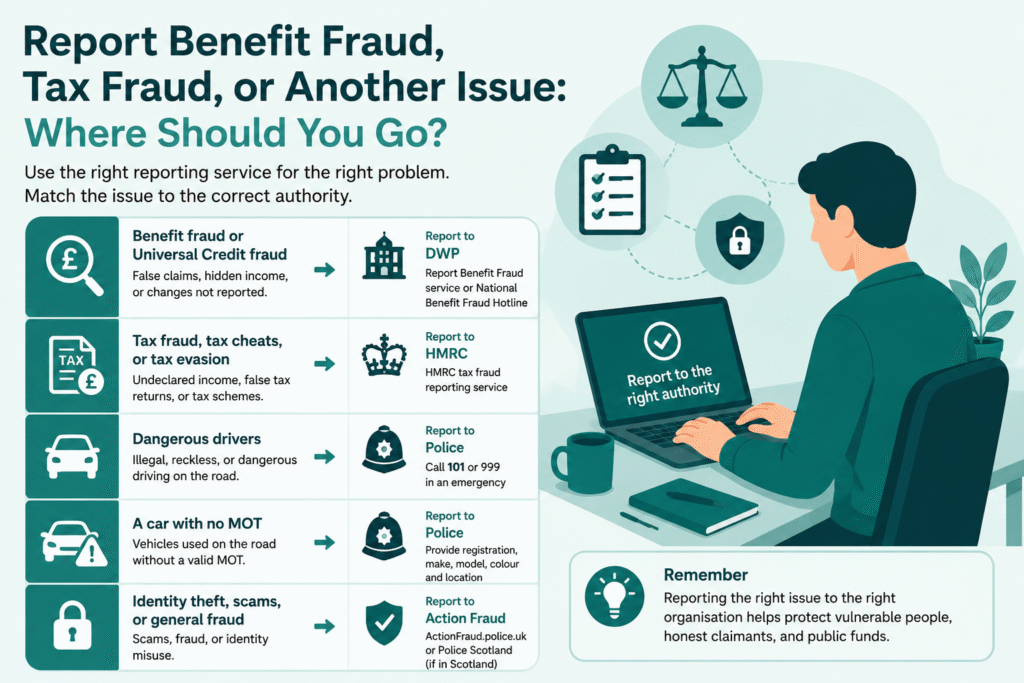
    Report Benefit Fraud, Tax Fraud, or Another Issue: Where Should You Go?

    Not every concern belongs to the same reporting service. If you want to report benefit fraud, use the official DWP route through GOV.UK. If the concern involves tax, driving, vehicle safety, or another crime, use the correct authority instead.

    ConcernWhere to report it
    Benefit fraud or Universal Credit fraudGOV.UK Report Benefit Fraud service or National Benefit Fraud Hotline
    Tax fraud, tax cheats, or tax evasionHMRC tax fraud reporting service
    Dangerous driversPolice, using 101 or 999 in an emergency
    A car with no MOTLocal police, if the vehicle is being used on a road
    Identity theft, scams, or general fraudReport Fraud / Action Fraud, or Police Scotland if you live in Scotland

    If you ask, “how can I report tax fraud?”, “how to report tax cheats?”, or “how to report tax evasion?”, that usually sits with HMRC, not DWP. HMRC says you can use its online form and you do not have to give your personal details, although sharing contact details can help them ask follow-up questions.

    If you ask “how to report a car with no MOT”, GOV.UK says you should contact the police, but only if the vehicle is being used on a road. You need details such as the number plate, make, model, colour, and location.

    The safest rule is simple: match the report to the problem. Report benefit fraud to DWP, tax fraud to HMRC, road danger to the police, and wider scams or identity fraud to the UK’s fraud reporting service.

    MORE: Can Vitamin B12 Deficiency Be a Sign of Cancer? 2026 Update

    How to Make a Private or Anonymous Report Safely
    What happens when you report fraud

    If you worry about privacy, use the online reporting form or call from a safe place where no one can overhear you. You do not have to give your name when you report benefit fraud, and you should only share details you genuinely know.

    Some people ask, “how can I make private call?” The better question is: how can I report safely? Use your own phone if possible, avoid making the call around the person involved, and do not use someone else’s device without permission. If online reporting feels safer, use the official form instead.

    Do not put yourself at risk to gather more information. Do not check private letters, bank records, phones, medication notes, or care files unless your role already gives you lawful access for safeguarding or care reasons.

    If you work in care and your concern involves a vulnerable person’s money, benefits, or possible exploitation, follow your organisation’s safeguarding process as well as the official fraud reporting route. Keep the concern factual, confidential, and professional.

    Final Advice for Caregivers and Families

    If you need to report benefit fraud, keep your action calm, factual, and safe. You do not need to prove the case yourself. You only need to share genuine concerns through the correct official route and let the authorities decide what happens next.

    For caregivers, this matters even more. You may support people who feel vulnerable, confused, controlled, or financially pressured. If you suspect someone is misusing a person’s benefits or making a false claim linked to their care needs, treat it as a serious concern.

    Do not use fraud reporting as revenge, gossip, or family conflict. Do not confront the person or investigate alone. If the concern involves financial abuse, coercion, neglect, or exploitation, follow safeguarding procedures as well as the official route to report benefit fraud.

    The right approach protects everyone: the vulnerable person, honest claimants, public funds, and the care professionals trying to do the right thing.

    Worried About Benefit Fraud or Financial Abuse in a Care Setting?

    Benefit fraud concerns can feel uncomfortable, especially when they involve a vulnerable adult, older person, family member, or someone receiving care. The right response should protect the person, follow the proper reporting route, and avoid unnecessary conflict.

    At Care Sync Experts, we help caregivers, families, and care providers understand sensitive care-related issues with clarity and confidence.

    If you suspect benefit fraud, financial exploitation, or misuse of someone’s support, do not ignore the concern or investigate alone. Keep the facts clear, follow safeguarding procedures where needed, and use the correct official reporting channel.

    Care Sync Experts provides practical, care-focused guidance to help you make safer, fairer, and more informed care decisions every day.

    FAQ

    Can I find out who reported me to DWP?

    Usually, no. GOV.UK says benefit fraud reports are anonymous and the person reporting does not have to give their name or contact details. DWP also says it will not tell the reporter the outcome of an investigation, which keeps the process confidential on both sides.

    What evidence is required to prove fraud?

    To prove fraud, investigators need evidence that the person acted dishonestly, not just that they made a mistake. Under the Fraud Act 2006, fraud can involve false representation, failing to disclose information, or abuse of position.

    In benefit cases, that may include evidence of undeclared work, hidden income, false address details, undisclosed partner circumstances, or knowingly incorrect information about health or care needs.

    How long does a benefit fraud investigation take?

    There is no fixed public timescale. A benefit fraud investigation may take weeks or months depending on the complexity of the case, the evidence needed, the benefits involved, and whether DWP needs information from other sources.

    GOV.UK says DWP will look at the information provided, but the investigation “might take some time,” and they will not share the outcome with the person who made the report.

    How far back can DWP investigate?

    There is no simple “one-size-fits-all” period that applies to every case. DWP can investigate past claims where it believes benefit rules may have been broken, and overpayment recovery depends on the benefit, the facts, and the legal route used.

    DWP’s overpayment recovery guide explains the recovery policy for overpaid social security benefits, but it is not a substitute for legal advice in a specific case.
  • Bank Holiday Early Benefit Payments DWP: May 2026 Update

    Bank Holiday Early Benefit Payments DWP: May 2026 Update

    Bank holiday early benefit payments DWP in May 2026 mean that payments due on Monday, May 4 and Monday, May 25 will arrive earlier, on Friday, May 1 and Friday, May 22.

    The Department for Work and Pensions (DWP) moves payments forward because banks and government offices close on public holidays, so processing cannot happen on the usual dates.

    This change applies across standard DWP bank holiday payment dates 2026, including Universal Credit, State Pension, and other benefits. If your payment falls on a bank holiday, you will receive it on the last working day before.

    In short:

    • Monday, May 4 → Paid Friday, May 1
    • Monday, May 25 → Paid Friday, May 22

    These DWP bank holiday payments 2026 do not increase your benefit amount, they only shift the payment date forward.

    Get expert support for your next tender, inspection-ready policies, or CQC registration — book a call with Care Sync Experts today and let’s get you compliant and competitive.

    Key Takeaways: May 2026 DWP Bank Holiday Payment Dates

    • Payments come early in May 2026:

    Monday, May 4 → Friday, May 1
    Monday, May 25 → Friday, May 22

    • Applies to major benefits:

    Universal Credit, State Pension, Child Benefit, ESA, JSA, and Carer’s Allowance follow the same DWP bank holiday payment dates.

    • Universal Credit payment dates will shift:

    If your Universal Credit payment date falls on a bank holiday, you will receive it earlier, not later.

    • Early payment does NOT mean extra money:

    The DWP only moves the date forward. You must budget carefully because the next payment will take longer to arrive.

    • Payments usually arrive early morning:

    Most banks process funds by around 6:00 AM, though this can vary slightly.

    • This follows standard DWP rules:

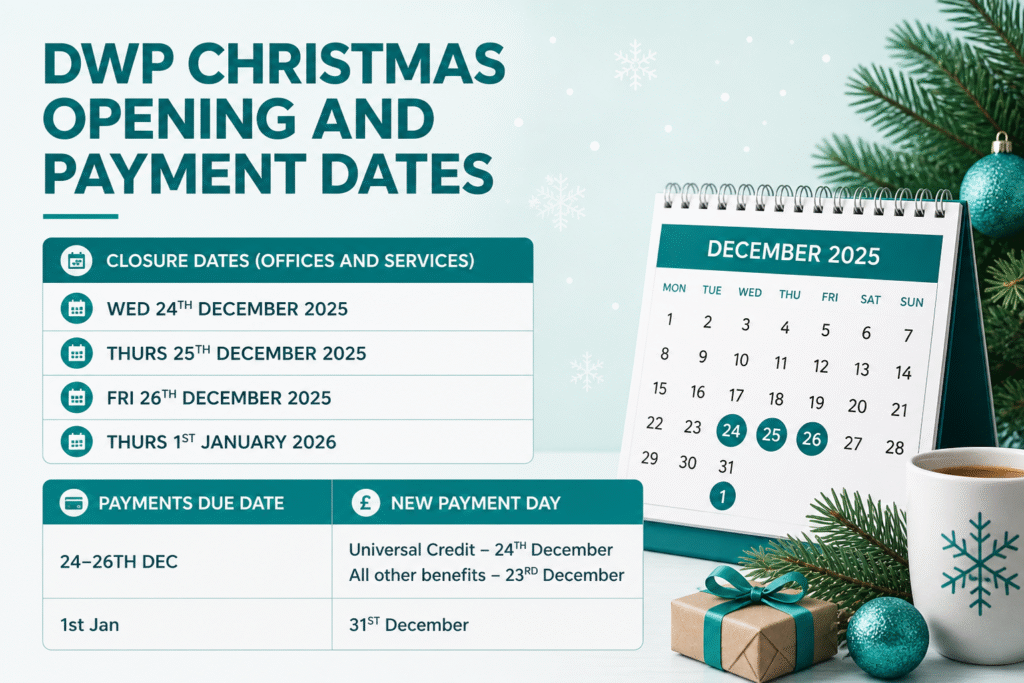
    Similar DWP payment date changes happen every bank holiday and also during Christmas periods.

    For caregivers and support workers, these Universal Credit early payments can affect how clients manage money across a longer gap between payments.

    Why Early DWP Payments Matter for Caregivers

    Applying Creams in Domiciliary Care: The CQC Rules Nobody Explains

    Early bank holiday early benefit payments DWP shifts do more than change dates, they directly affect how caregivers support clients day to day.

    Care providers rely on predictable income cycles. When the DWP moves payments forward, it creates a longer gap before the next payment, which can put vulnerable individuals at risk if no plan exists.

    1. Income Gaps Can Disrupt Care

    Clients may receive money earlier but spend it at the usual pace. This often leads to:

    • Running out of funds before the next payment
    • Difficulty covering essentials like food, medication, or transport
    • Missed care-related expenses

    These DWP payment date changes can quietly create financial pressure if caregivers do not intervene early.

    2. Care Agencies Must Manage Expectations

    Caregiver businesses and support workers must clearly explain:

    • The payment is early, not extra
    • The next payment will take longer to arrive
    • Spending habits must adjust immediately

    Clear communication prevents confusion and reduces emergency support needs later.

    3. Frontline Carers Play a Critical Role

    Support workers often notice financial stress before anyone else. They should:

    • Remind clients about the adjusted dates
    • Help plan weekly spending
    • Flag risks early to care coordinators

    A simple reminder can prevent a crisis.

    4. Higher Risk for Vulnerable Groups

    Early payments affect:

    • Elderly clients on State Pension
    • Individuals on Universal Credit
    • People with limited financial management skills

    For these groups, even small timing changes can create serious challenges.

    Key Insight for Caregiver Businesses

    Care providers who actively plan around DWP benefit payment date changes deliver more stable and reliable care.

    The goal is simple: Turn early payments into controlled spending, not financial stress.

    RELATED: DWP Benefit Scrapping 2026: Latest Update

    Full May 2026 DWP Bank Holiday Payment Dates

    The DWP bank holiday payment dates 2026 follow a simple rule: If your payment falls on a bank holiday, the DWP pays you on the last working day before.

    For May 2026, two bank holidays affect payments across the UK, including Scotland, so the same adjusted dates apply for DWP bank holiday payment dates Scotland and other regions.

    Adjusted Payment Schedule

    Expected Payment DateAdjusted Payment Date
    Monday, May 4, 2026Friday, May 1, 2026
    Monday, May 25, 2026Friday, May 22, 2026

    What This Means in Practice

    • Payments due on bank holidays will never be delayed, they move earlier
    • This applies to all bank holiday payments Scotland and across the UK
    • The rule also applies to Universal Credit payment dates on weekend or public holidays

    Example:

    If your Universal Credit payment date falls on Monday, May 25, you will receive it on Friday, May 22 instead.

    Important Note

    These bank holiday payment dates 2026 only affect timing, not the amount you receive.

    Caregivers and support workers should treat these adjusted dates as part of normal DWP payment date changes and plan accordingly to avoid financial gaps for clients.

    Which Benefits Will Be Paid Early?

    Bank Holiday Early Benefit Payments DWP
    Bank Holiday Early Benefit Payments DWP

    The May 2026 changes apply to all major DWP bank holiday payments 2026, not just one benefit. If your payment date falls on a bank holiday, the DWP will pay it early.

    Affected Benefits

    • Universal Credit

    Universal Credit is a monthly payment that supports people with living costs. If your Universal Credit payment date falls on a bank holiday, you will receive it earlier than scheduled.

    • State Pension

    The State Pension provides regular income to people over State Pension age. The DWP confirms benefits and state pension payments will arrive early under bank holiday rules.

    • Child Benefit

    Child Benefit supports families with the cost of raising children.

    The same adjustment applies to child benefit 2026 dates when they fall on a bank holiday.

    • Employment and Support Allowance (ESA)

    ESA supports people who cannot work due to illness or disability. ESA follows standard DWP bank holiday payment dates.

    • Jobseeker’s Allowance (JSA)

    JSA supports individuals actively looking for work. Payments shift earlier if they fall on a holiday.

    • Carer’s Allowance

    Carer’s Allowance supports people caring for someone with significant needs. This benefit also follows DWP benefit payments will arrive early due to bank holidays rules.

    Important Clarification

    These early payments:

    • Do not increase your benefit amount
    • Do not count as a bonus or extra payment
    • Only reflect DWP benefit payment date changes

    For caregivers, this means clients receive the same money, but must stretch it across a longer period.

    READ MORE: Is There a Senility Test? 2026 Guide to Dementia Screening Tools

    Will Early Payments Affect Your Next Payment?

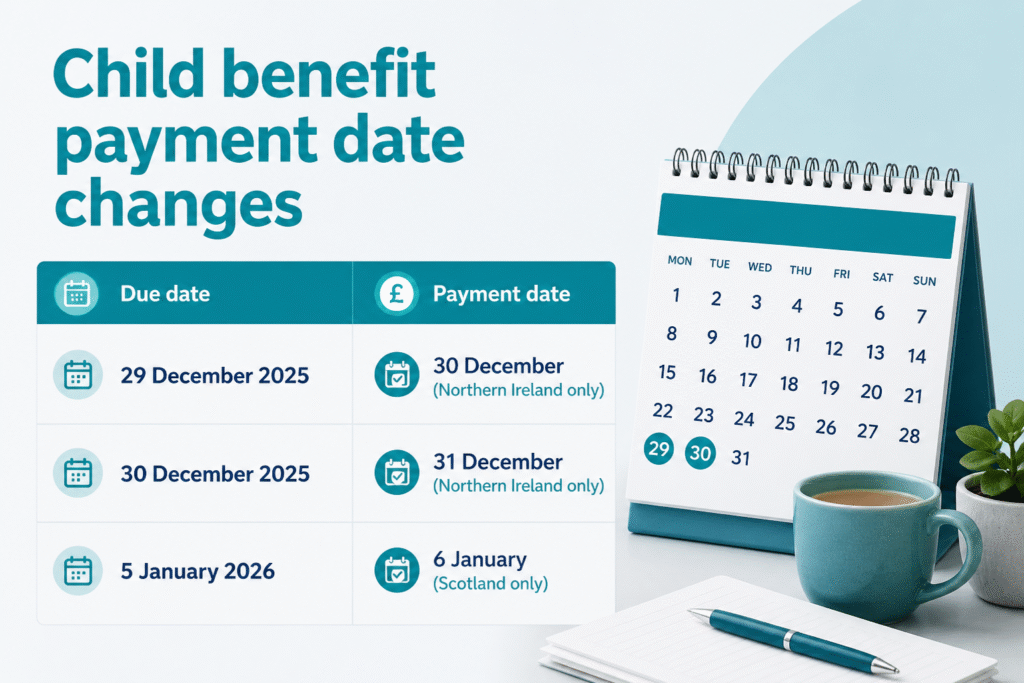
    Child Benefit Payment Date Changes

    Yes, early DWP payments will affect your payment cycle, but not your total benefit.

    When the DWP issues bank holiday early benefit payments, it simply moves your money forward. Your next payment still follows your original schedule, which creates a longer gap between payments.

    What Actually Changes?

    • You receive your payment earlier than usual
    • Your next payment date does not move forward
    • The time between payments becomes longer than normal

    Example:

    If your Universal Credit payment date shifts from Monday, May 25 to Friday, May 22, your next payment will still follow your usual monthly cycle. That means you must stretch that payment over more days.

    Key Rule to Remember

    Universal Credit early payments do not mean extra money; they only change timing.

    This rule applies to all DWP payment early bank holiday weekend adjustments.

    What About Weekend Payments?

    If your payment falls on a weekend or holiday:

    • The DWP will pay you on the working day before
    • This includes Universal Credit payment dates on weekend

    Many people assume early payments mean:

    • A bonus
    • Extra support
    • Faster payment cycles

    This is incorrect.

    Early payments can actually create financial pressure if spending habits stay the same.

    Simple Way to Think About It

    You are not getting paid more,
    You are getting paid sooner and waiting longer after

    For caregivers and support workers, this is one of the most important parts of DWP benefit payment date changes to explain clearly to clients.

    SEE ALSO: New Style ESA (Employment and Support Allowance) 2026

    How Caregivers Should Help Clients Plan for Early Payments

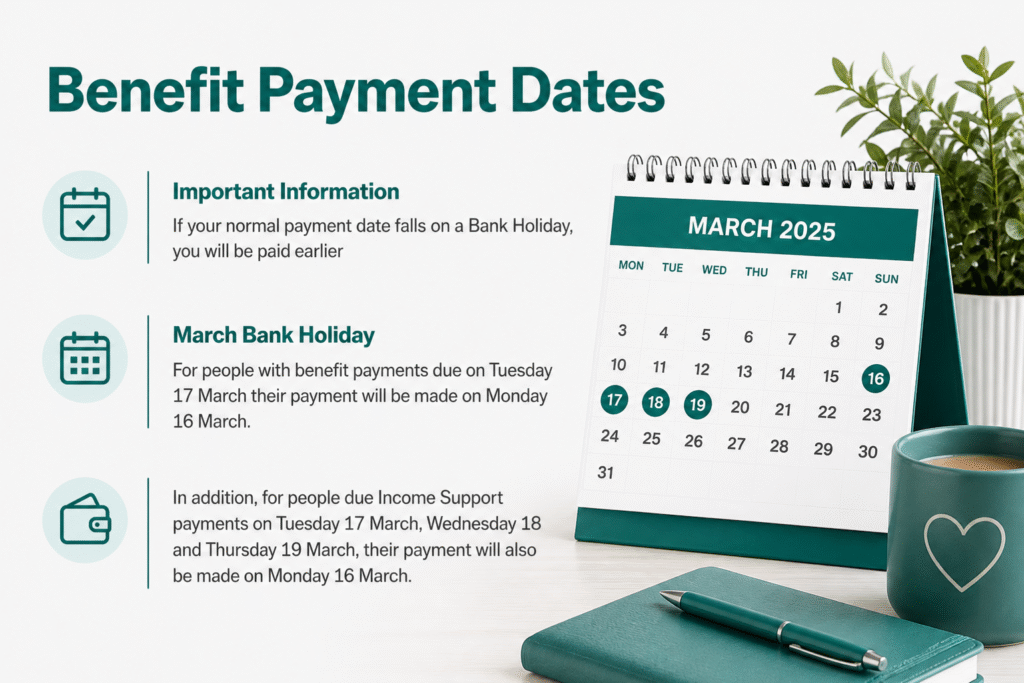
    Benefit Payment date
    Benefit Payment date

    Caregiver businesses must treat bank holiday early benefit payments DWP as a planning issue, not just a date change. Early payments can create financial gaps if no one steps in to guide clients.

    1. Explain the Change Immediately

    Support workers should clearly tell clients:

    • The payment is early, not extra
    • The next payment will take longer to arrive
    • Spending must adjust from day one

    Clear communication reduces confusion around DWP payment early bank holiday weekend changes.

    2. Break Payments Into Weekly Budgets

    Encourage clients to divide their payment into weekly amounts.

    Example:

    • Total payment → split into 4–5 weeks
    • Set daily or weekly spending limits

    This simple method helps manage Universal Credit early payments without running out of money.

    3. Identify High-Risk Clients Early

    Care providers should prioritise support for:

    • Elderly clients on State Pension
    • Individuals with limited financial management skills
    • Clients who rely fully on benefits

    These groups feel the impact of DWP benefit payment date changes the most.

    4. Prevent Common Mistakes

    Watch for these patterns:

    • Spending early due to “extra money” perception
    • Ignoring the longer gap before the next payment
    • Missing essential payments (rent, food, medication)

    Early intervention prevents emergencies.

    5. Build Payment Awareness Into Care Plans

    Care agencies should:

    • Include payment schedules in care planning
    • Train staff on DWP bank holiday payment dates
    • Use reminders for clients before and after payment dates

    This turns reactive care into proactive support.

    Caregiver Insight

    Care providers who actively manage DWP payment date changes reduce financial stress, improve care outcomes, and build stronger trust with clients.

    The goal is simple:
    Help clients stay stable between payments, not just when money arrives.

    MORE: Blue Badge PIP Welfare Reform: What Care Businesses Need to Know in 2026

    Final Thoughts…

    Bank holiday early benefit payments DWP changes may seem minor—but for caregivers, they can shape how well clients manage their daily lives.

    Early payments create one key challenge: More days to cover with the same money

    Care providers who ignore this risk:

    • Financial stress among clients
    • Missed essentials like food or medication
    • Increased emergency support needs

    But caregiver businesses that act early can turn this into an advantage.

    What Smart Care Providers Do Differently

    • They track DWP bank holiday payment dates 2026 in advance
    • They prepare clients before money arrives
    • They support budgeting immediately after payment
    • They train staff to recognise early warning signs

    This is how you stay ahead of DWP benefit payment date changes and deliver consistent, high-quality care.

    Need Help Managing Payment Changes in Your Care Business?

    At Care Sync Experts, we help caregiver businesses:

    • Stay compliant with evolving regulations
    • Build stronger financial support systems for clients
    • Train teams to handle real-world challenges like DWP payment date changes
    • Improve care delivery while reducing operational risk

    Whether you run a domiciliary care agency or support vulnerable clients, we give you the systems and expertise to stay ahead.

    Work with Care Sync Experts

    Take control of care operations, improve client outcomes, and handle complex changes, like DWP bank holiday payments 2026, with confidence.

    Contact Care Sync Experts today and build a smarter, more resilient care business.

    FAQ

    What time does DWP put money in the bank?

    The DWP usually processes payments so they arrive by around 6:00 AM on the payment day. However, the exact time can vary depending on your bank. Some accounts may show funds earlier or slightly later in the morning.

    Which banks pay a day before?

    Some banks release funds earlier than others, especially with faster payments. Digital banks like Monzo, Starling, and Revolut sometimes show incoming payments late at night the day before, but this is not guaranteed. Most traditional banks release funds on the official payment date.

    Can money go in your bank on a Saturday?

    In most cases, DWP payments do not arrive on Saturdays. If your payment date falls on a weekend, the DWP will move it to the previous working day (usually Friday).

    Some private transactions may process on Saturdays, but benefit payments follow strict weekday schedules.

    Do all UK countries have the same bank holidays?

    No, England, Scotland, Wales, and Northern Ireland do not share identical bank holidays. While many holidays overlap (like Christmas and New Year), some dates differ, especially in Scotland.

    However, DWP bank holiday payment dates generally follow UK-wide processing rules, so payments still move to the previous working day regardless of location.