Running a children’s home means more than finding a suitable property and recruiting a caring team. You must register with Ofsted and show that your service can protect children, meet their individual needs, and improve their lives every day.
The Ofsted regulations for children’s homes sit mainly within the Children’s Homes (England) Regulations 2015. These regulations set the rules for how you lead the home, recruit staff, plan care, safeguard children, maintain the premises, and review the quality of care you provide.
From a provider’s perspective, compliance should guide how you build the business from day one. Strong systems protect children, help staff work with confidence, and give local authorities greater trust in your service. Weak systems can delay registration, create safeguarding risks, and lead to serious Ofsted concerns.
This guide gives a practical Children’s Homes Regulations 2015 summary for providers who want to open, run or strengthen a children’s home in England. It covers the Nine Quality Standards, registration expectations, staffing, premises, monitoring, and inspection readiness.
Anyone who carries on or manages a children’s home that provides care and accommodation must register with Ofsted; operating without registration is an offence.

The Children’s Homes Regulations 2015 Summary: What They Mean for Your Business
The Children’s Homes (England) Regulations 2015 set the baseline for how providers run safe, stable, and child-centred homes. They do not only apply when Ofsted visits. They should shape everyday decisions, from accepting a placement and recruiting staff to responding to incidents and reviewing care.
For a care business, the regulations require you to show that your home can deliver the service promised in its Statement of Purpose. You must keep children safe, support their progress and give them a real voice in the care they receive.
A practical list of children’s homes regulations includes requirements around:
- The home’s purpose, location, and suitability
- Safeguarding, behaviour support, and missing-from-care procedures
- Individual care planning and placement matching
- Staffing, supervision, training, and qualifications
- Children’s education, health, and relationships
- Premises safety, maintenance, and records
- Notifications, complaints, and independent oversight
- Leadership, quality assurance, and continuous improvement
The Nine Quality Standards sit at the centre of the regulations. They set the outcomes each home should help children achieve, rather than simply asking providers to complete paperwork. A provider may have detailed policies, but Ofsted will still expect staff to show how those policies improve children’s daily lives.
This matters commercially as well as operationally. A home with clear systems, stable leadership and consistent care can build trust with placing authorities. A home that treats compliance as a last-minute inspection task can expose children to risk and create avoidable pressure for staff and managers.
The regulations require providers to meet the Quality Standards and run the home in a way that safeguards and promotes children’s welfare.
RELATED: New Rules for Care Home Payments in 2026
What Are the 9 Quality Standards for Children’s Homes?
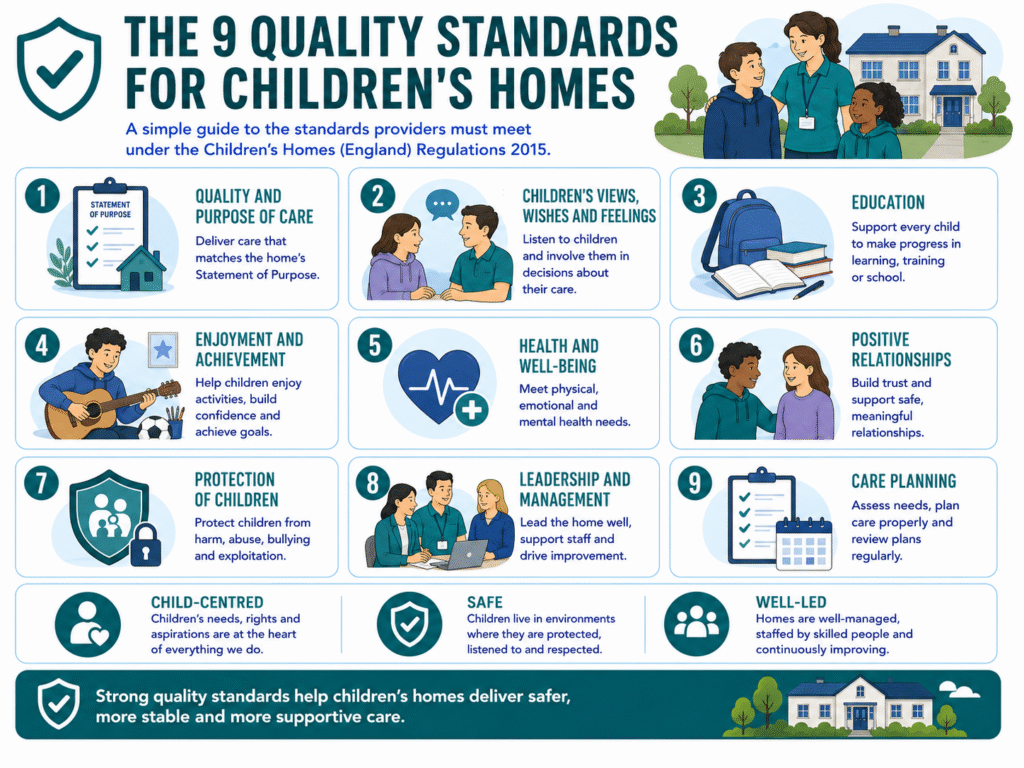
The 9 Quality Standards for children’s homes give providers a clear test: does daily care help each child feel safe, heard, supported and able to progress?
You should build each standard into staff practice, care records, supervision, and quality assurance, not treat them as a poster on the office wall.
- The Quality and Purpose of Care Standard
Your home must deliver the service described in its Statement of Purpose and meet children’s needs in a safe, nurturing environment. - The Children’s Views, Wishes and Feelings Standard
Staff must listen to children, involve them in decisions, and show how their views influence care. - The Education Standard
The home must actively support school attendance, learning, training, and educational progress. - The Enjoyment and Achievement Standard
Children should have opportunities to enjoy hobbies, build confidence, develop skills, and take part in ordinary positive experiences. - The Health and Well-Being Standard
Providers must support physical health, emotional well-being, mental health, and access to appropriate services. - The Positive Relationships Standard
Staff should build trusting relationships and help children maintain safe, meaningful links with family, friends, and professionals. - The Protection of Children Standard
The home must protect children from harm, abuse, exploitation, bullying, and unsafe behaviour. - The Leadership and Management Standard
Leaders must run the home effectively, support staff properly, and drive improvements when standards fall short. - The Care Planning Standard
Every child needs an individual care plan that reflects their placement plan, risks, needs, goals, and changing circumstances.
For providers, the key question is simple: can you show how each standard improves the child’s everyday experience? Ofsted will look for evidence in care plans, staff records, children’s feedback, incident responses, and the way the home operates day to day.
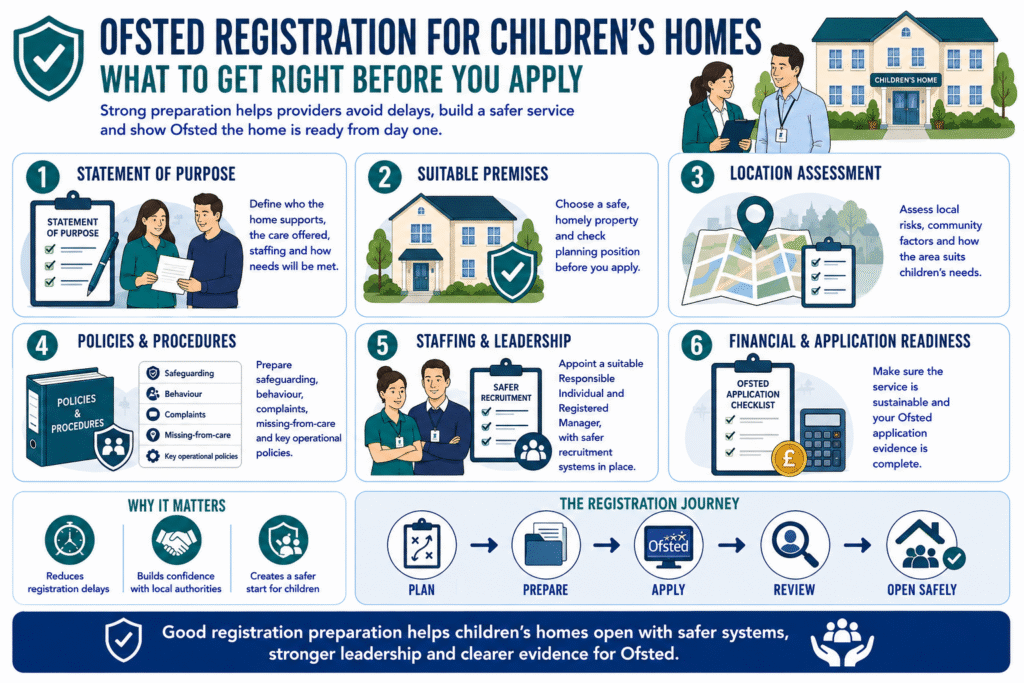
Ofsted Registration: What to Get Right Before You Apply
Ofsted registration starts long before you submit an application. As a provider, you need to show that your home can deliver safe, stable and child-centred care from the day the first child moves in.
Start with a clear Statement of Purpose. It should explain who your home supports, the type of care you provide, your staffing approach, the environment you offer and how you will meet children’s needs. Ofsted expects a separate, tailored Statement of Purpose for each home, and it considers its quality when deciding whether you are fit to operate.
You should also prepare:
- A suitable property with the right planning position
- A location assessment that considers local risks and opportunities
- A children’s guide written in language young people can understand
- Safeguarding, behaviour support, complaints and missing-from-care procedures
- Safer recruitment systems, DBS checks and staff-training plans
- A suitable Responsible Individual and Registered Manager
- Clear financial plans that show the home can operate safely and sustainably
Do not assume you can deal with planning permission later. Ofsted will not make a registration decision until you have the planning permission you need, or written evidence from the local planning authority that your proposed use is lawful.
For a caregiver business, this preparation protects more than your registration timeline. It helps you avoid opening with the wrong property, unclear staffing arrangements or policies that staff cannot follow in real life.
Ofsted currently warns that new children’s-home applications may take several months to process, so providers should plan carefully and avoid setting unrealistic opening dates.
READ MORE: Domiciliary Care Business Plan: How to Start a CQC-Ready Agency in 2026
Staffing, Leadership and Safer Recruitment Requirements
A children’s home needs more than enough people on the rota. It needs leaders who set clear expectations and staff who can build safe, consistent relationships with children.
Your Registered Manager leads the home day to day. They must show that they have the skills, knowledge and experience to manage the service effectively. Regulation 28 requires the manager to obtain a Level 5 Diploma in Leadership and Management for Residential Care, or an equivalent qualification, within three years of starting to manage the home.
Providers also need to recruit safely. Under Regulation 32, you must use recruitment procedures designed to protect children. This means checking identity, employment history, references, qualifications and enhanced DBS information before staff begin work.
For your business, the strongest approach is to keep a live workforce-compliance tracker. It should show:
- DBS and reference status
- Role-specific induction progress
- Level 3 and Level 5 qualification deadlines
- Mandatory and specialist training
- Supervision and appraisal dates
- Agency-worker checks
- Any gaps, actions and review dates
Do not treat qualifications as a box-ticking exercise. Managers need to use supervision, team meetings and spot checks to make sure staff understand safeguarding, behaviour support, missing-from-care procedures and each child’s care plan.
Stable, well-supported staff give children consistency. They also give your home stronger evidence of effective leadership when Ofsted inspects.
Premises, Fire Safety and Building Compliance
Your property must feel like a home, but it must also protect children, staff and visitors every day. Providers should check safety before opening, not after an incident exposes a gap.
Under the Children’s Homes (England) Regulations 2015, you must take adequate fire precautions, provide suitable fire equipment and make sure people can leave the home safely in an emergency. You must also keep records of fire drills, alarm tests and any faults found.
Your safety arrangements should include:
- A current fire risk assessment
- Clear evacuation procedures that staff can explain
- Regular fire drills and alarm tests
- Safe escape routes that remain clear
- Maintained fire doors, alarms, extinguishers and emergency lighting
- Records of repairs, servicing and follow-up actions
- Individual evacuation planning where a child may need extra support
The Regulatory Reform (Fire Safety) Order 2005 places duties on the responsible person to assess fire risks and put suitable precautions in place. It also requires staff to receive adequate fire-safety training.
You may also need to consider Building Regulations Part B when you alter a property, change its use or complete major building work. Part B covers fire safety requirements such as warning systems, escape routes and fire spread. Do not assume a building regulations compliance certificate alone proves the home is ready for Ofsted; you still need to show that the property works safely for the children you plan to support.
For a caregiver business, the strongest approach is practical: walk through the home as if you were a child, a new staff member or an inspector. Check whether bedrooms feel safe, exits are clear, risks are controlled and staff know exactly what to do when something goes wrong.
SEE ALSO: How Long Does CQC Registration Take? 2026 Update
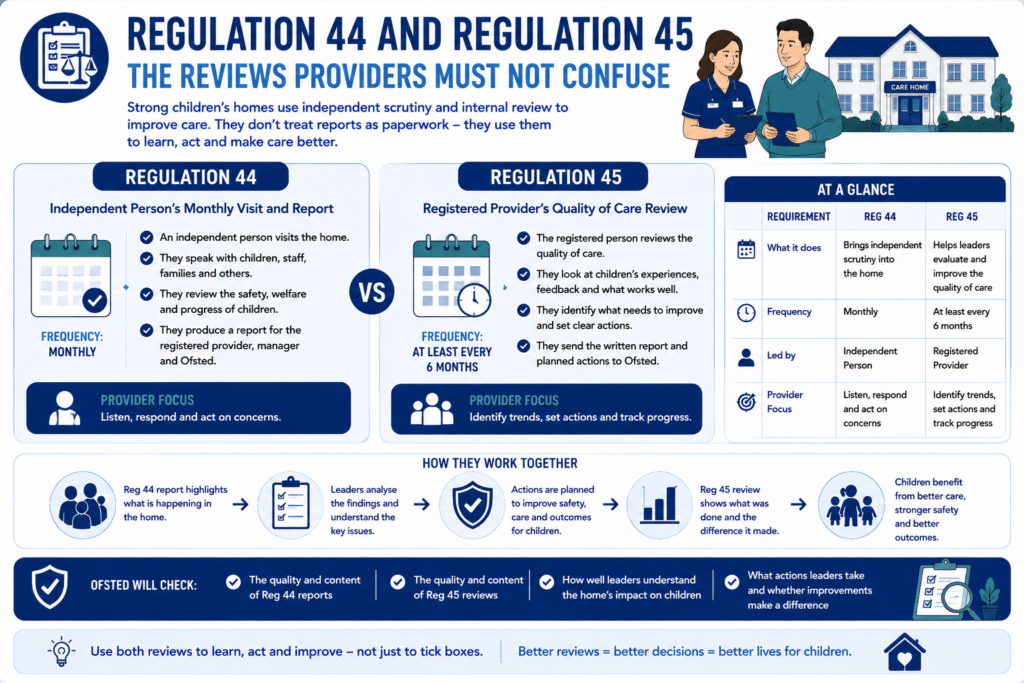
Regulation 44 and Regulation 45: The Reviews Providers Must Not Confuse
Strong children’s homes use independent scrutiny and internal review to improve care. They do not treat reports as paperwork to submit after the event.
Regulation 44 requires an independent person to visit the home every month. They review the safety, welfare and progress of children, speak with people connected to the home and produce a report for the registered provider, manager and Ofsted. The visit gives providers an outside view of how the home operates.
Regulation 45 requires the registered person to review the quality of care at least every six months. The review should examine children’s experiences, their feedback, what works well and what needs to improve. Providers then send the resulting written report to Ofsted, including actions they plan to take.
| Requirement | What it does | Frequency | Provider focus |
| Regulation 44 | Brings independent scrutiny into the home | Monthly | Listen, respond and act on concerns |
| Regulation 45 | Helps leaders evaluate and improve the quality of care | At least every 6 months | Identify trends, set actions and track progress |
For example, a Regulation 44 report may identify repeated missing-from-care incidents or inconsistent staff practice. Your Regulation 45 review should then show what leaders did next: reviewed risk assessments, strengthened staff guidance, involved children, and checked whether the changes reduced risk.
Ofsted inspectors review the quality and content of Regulation 44 and Regulation 45 reports. They use them to assess how well leaders understand the home’s impact on children and whether they learn from incidents.
Preparing for Ofsted Inspections Under the Current Framework
Do not prepare for inspection only when Ofsted gives notice. Build inspection readiness into everyday practice.
Under the current Social Care Common Inspection Framework, Ofsted focuses on the difference your home makes to children’s lives.
Inspectors spend less time reading policies and more time looking at whether children feel safe, make progress, build stable relationships and receive care that meets their individual needs.
Your team should be ready to show evidence of:
- Children’s individual progress in health, education, relationships and independence
- Safe responses to safeguarding concerns, missing-from-care incidents and complaints
- Care plans, risk assessments and placement decisions that reflect each child’s needs
- Children’s views, wishes and feedback, plus what staff did in response
- Staff supervision, training, handovers and management oversight
- Stable routines, positive relationships and meaningful activities
- Regulation 44 reports, Regulation 45 reviews and completed improvement actions
Ofsted normally judges homes across three main areas:
- The overall experiences and progress of children
- How well children are helped and protected
- The effectiveness of leaders and managers
The judgement on how well children are helped and protected carries particular weight. If Ofsted finds this area inadequate, the home’s overall judgement will also be inadequate.
For a caregiver business, the strongest approach is simple: make sure your records match real practice. Staff should understand each child’s needs, managers should know where risks sit, and children should see that adults listen and act.
MORE: CQC Mandatory Training for Care Workers: 2026 Update
Common Compliance Mistakes Children’s Home Providers Should Avoid
Most compliance issues start when providers treat regulations as paperwork instead of daily care practice. Small gaps can quickly affect children’s safety, staff confidence and Ofsted outcomes.
Common mistakes include:
- Opening with unstable staffing. Frequent agency use, weak induction or high turnover can disrupt relationships and make it harder for children to feel secure.
- Using generic care plans. Every child needs plans that reflect their history, risks, routines, communication style and goals.
- Failing to update risk assessments. Review them after incidents, missing episodes, safeguarding concerns, changes in health or changes in behaviour.
- Ignoring children’s views. Staff should record what children say and show what action they took in response.
- Treating Regulation 44 reports as a formality. Leaders should respond to findings, set actions and check whether improvements work.
- Keeping policies that staff do not understand. A safeguarding or missing-from-care policy only helps when staff can explain how to follow it.
- Missing notification deadlines. Providers must notify Ofsted and relevant agencies about significant events when required under Regulation 40.
- Handling complaints defensively. Good homes treat complaints as feedback, investigate them fairly and use lessons learned to improve.
A strong provider culture asks, “What does this mean for the child?” before asking, “Do we have a policy for this?” That mindset helps managers spot weaknesses early and build a safer, more reliable service.
Final Checklist: How to Run a Safe, Compliant Children’s Home
Strong compliance comes from consistent leadership and daily practice. Use this checklist to keep your home ready for Ofsted while focusing on better outcomes for children.
- Register the home correctly and keep your Statement of Purpose accurate.
- Meet the 9 Quality Standards for children’s homes in everyday care, not only in policies.
- Recruit safely, maintain DBS and reference checks, and track staff training and qualifications.
- Keep care plans, risk assessments and placement decisions individual to each child.
- Review risks after incidents, changes in need, missing episodes or safeguarding concerns.
- Maintain a safe, welcoming property with current fire-safety checks and clear emergency procedures.
- Complete monthly Regulation 44 visits and use findings to improve practice.
- Complete Regulation 45 quality-of-care reviews at least every six months.
- Record children’s views and show how staff responded.
- Keep clear evidence of supervision, training, safeguarding action and management oversight.
- Treat complaints, incidents and inspection findings as opportunities to improve.
The Ofsted regulations for children’s homes should help you build a safer, more stable service, not create paperwork for its own sake. When leaders use the regulations to guide decisions, staff can work with more confidence and children receive more consistent, person-centred care.
Care Sync Experts supports providers with Ofsted registration, policies, quality assurance, compliance systems, and inspection preparation for children’s homes.
Get Support With Children’s Home Compliance
Opening or running a children’s home requires more than meeting minimum rules. You need systems that help staff deliver safe, consistent care and show Ofsted how your service improves children’s lives.
Care Sync Experts can support your team with Ofsted registration preparation, policies and procedures, Regulation 44 and 45 quality assurance, staffing compliance, and inspection readiness.
Speak to our team to strengthen your children’s home compliance systems before small gaps become bigger problems.
FAQ
What is Regulation 26 of the Children’s Homes (England) Regulations 2015?
Regulation 26 sets the fitness requirements for people who want to carry on a children’s home. An individual provider must show they are fit to operate the home, while an organisation must appoint a suitable Responsible Individual to oversee the service.
Ofsted considers factors such as integrity, good character, relevant experience, financial position, and whether the person can meet their responsibilities. This helps ensure that unsuitable people cannot own or lead a children’s home.
What is Regulation 43 of the Children’s Homes (England) Regulations 2015?
Regulation 43 requires the registered provider to appoint an independent person to visit the home and report on it. This person must have the right skills and experience, and they must be independent from the home’s day-to-day management.
Their role supports Regulation 44 monitoring. They should provide an objective view of children’s welfare, safety, and the way the home operates.
Does Ofsted regulate child care in England?
Yes. Ofsted regulates and inspects several types of childcare and children’s social care services in England, including children’s homes, nurseries, childminders, adoption agencies, and fostering agencies.
For children’s homes specifically, anyone carrying on or managing a home that provides care and accommodation must register with Ofsted. Operating without registration is an offence.
Who owns children’s homes in the UK?
Children’s homes can be owned by private companies, local authorities, charities, voluntary organisations, partnerships, or individual providers. In England, private providers operate the majority of children’s homes.
As at 31 March 2025, England had 4,009 children’s homes, and most were privately operated. Large providers are also mainly private-sector organisations, although local authorities and voluntary organisations continue to run important parts of the sector.