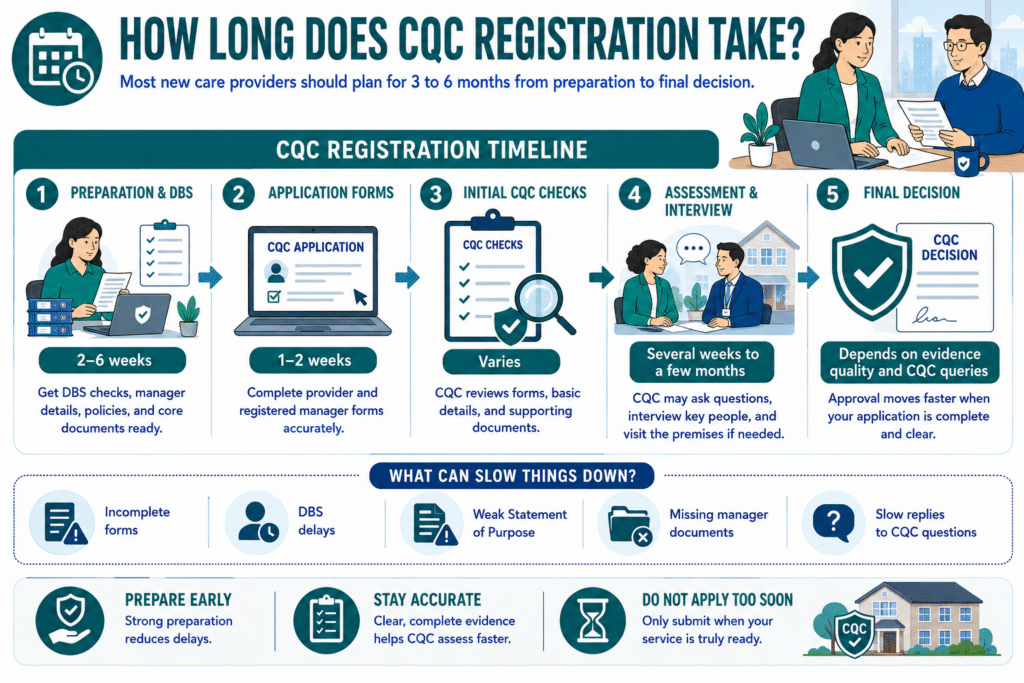
CQC registration can take a few months, but most new care providers should plan for 3 to 6 months from preparation to final decision.
The exact timeline depends on how ready your service is before you apply, how complete your documents are, whether your DBS checks come back quickly, and how well your proposed registered manager can evidence their competence.
Many new providers focus only on the application date, but the real process starts much earlier. You need your regulated activity, Statement of Purpose, policies, staffing plan, registered manager details, DBS checks, premises or office setup, and supporting evidence in place before you submit.
CQC does not treat registration as a simple form-filling exercise. It checks whether your service can provide safe, effective, caring, responsive, and well-led care from day one.
So, how long does CQC registration take? A well-prepared provider may move faster, but a rushed or incomplete application can easily stretch beyond 6 months. The safest approach is simple: prepare properly before you apply, then respond quickly when CQC asks for more information.

CQC Registration Timeline: What Usually Happens
The CQC registration timeline starts before you submit the form. If you prepare properly, you reduce questions, delays, and the risk of rejection.
Here is a realistic timeline for most new care providers:
| Stage | Typical timeframe |
| Preparation, DBS and manager readiness | 2–6 weeks |
| Application forms and documents | 1–2 weeks |
| Initial CQC checks | Varies |
| Assessment, interview and possible site visit | Several weeks to a few months |
| Final decision | Depends on evidence quality and CQC queries |
The fastest providers do not rush the application. They prepare the evidence first. They check their regulated activity, complete the right forms, organise their policies, prepare the registered manager, and make sure the service can operate safely from day one.
The slowest providers usually submit too early. They miss documents, choose the wrong regulated activity, give weak answers, or fail to show how the service will meet CQC registration requirements.
A strong application tells CQC one clear thing: this provider understands care, risk, leadership, staffing, safeguarding, and compliance before the first person receives support.
RELATED: How Much Does CQC Registration Cost in 2026?
What CQC Checks Before It Registers a Care Provider
CQC checks whether your care business can deliver safe, effective, caring, responsive, and well-led services from day one. These are often called the 5 CQC standards, and they shape how CQC looks at your application, your evidence, and your leadership.
Your application must show that you understand the regulated activity you want to provide. For example, a domiciliary care agency that provides personal care must show how it will protect people in their own homes, manage risks, train staff, handle complaints, and monitor care quality.
CQC will usually look at your:
- Statement of Purpose
- Registered manager arrangements
- Safeguarding systems
- Recruitment and staff training plans
- Policies and procedures
- Medication and risk management processes
- Complaints procedure
- Governance and quality monitoring
- Financial viability
- Office or premises setup, where relevant
This is where CQC compliance begins. You do not wait until after registration to think about quality and safety. You build the systems first, then use your application to prove that your service can run properly.
Documents Required for CQC Registration
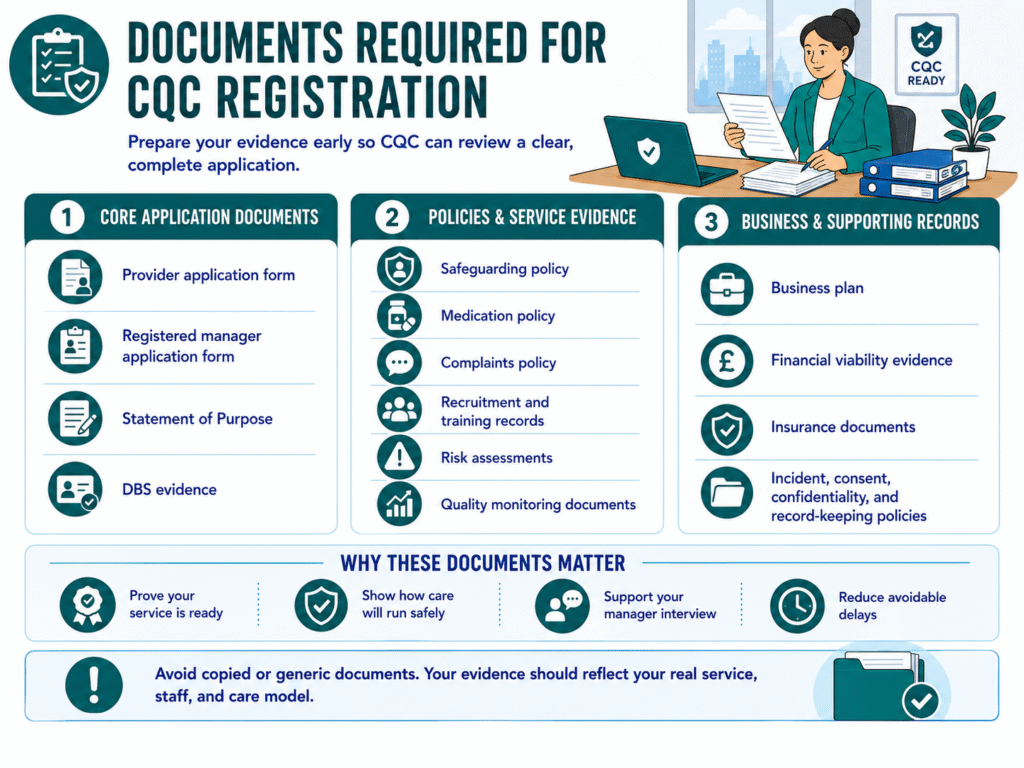
CQC will not move a weak or incomplete application forward, so you need to prepare your evidence before you apply. The exact documents required for CQC registration depend on your service type, regulated activity, business structure, and locations, but most new care providers should prepare the core documents early.
You may need:
- Provider application form
- CQC application form for registered manager, if required
- Statement of Purpose
- DBS evidence
- Safeguarding policy
- Medication policy
- Complaints policy
- Recruitment and staff training records
- Business plan
- Financial viability evidence
- Insurance documents
- Risk assessment and quality monitoring documents
- Policies for incidents, consent, mental capacity, confidentiality, and record keeping
Do not treat these documents as paperwork for CQC only. They should explain how your care business will actually operate. Your policies should match your service, your staff, your clients, and the type of care you plan to provide.
Copied or generic documents can create problems. CQC wants to see that you understand your own service and can manage real risks from day one.
READ MORE: CQC Mandatory Training for Care Workers: 2026 Update
How to Apply for CQC Registration Without Delays
If you want to know how to apply for CQC registration, start by checking whether your service needs to register and which regulated activity applies. A homecare agency that provides personal care, for example, must register for the correct activity before it starts delivering regulated care.
Follow these steps before you submit:
- Confirm that your service needs CQC registration.
- Choose the correct regulated activity.
- Prepare your Statement of Purpose.
- Complete the provider application form.
- Submit the registered manager application form, if required.
- Organise your policies, DBS evidence, staffing plans, and governance documents.
- Prepare for your interview and possible site visit.
- Respond quickly if CQC asks for more information.
Do not apply just because you want the process to start. Apply when your service can prove it is ready.
If you need to contact CQC during the process, use the official website for the latest CQC registration contact number or enquiry route. Avoid relying on old numbers from third-party websites because contact details can change.
What Qualifications Do I Need to Be a CQC Registered Manager?
Many new providers ask, what qualifications do I need to be a CQC registered manager? The answer is not just about certificates. CQC wants to see that the proposed manager has the right experience, skills, knowledge, and character to run the regulated activity safely.
A strong registered manager should understand safeguarding, risk management, recruitment, staff supervision, medication procedures, complaints, care planning, audits, and person-centred care. They must also show leadership. CQC needs confidence that the manager can make safe decisions, challenge poor practice, and keep the service compliant after registration.
Relevant care qualifications can help, especially management qualifications in health and social care, but experience matters just as much. A manager who understands the service, the people receiving care, and the regulations will usually perform better than someone who only prepares answers for the interview.
Your CQC application form for registered manager should therefore do more than list job titles. It should show how the manager will lead the service, manage quality, support staff, protect people, and respond when something goes wrong.
SEE ALSO: SME Spend Targets: How to Win More Public Contracts in 2026
How Much Does CQC Registration Cost?
Many new providers ask, how much does CQC registration cost before they apply. The answer depends on your service type, size, and registration details. CQC charges registered providers annual fees, and those fees cover registration, changes to registration, monitoring, inspection, and rating work.
For adult social care, the fee is not the same for every provider. A care home fee usually depends on the number of people the service can accommodate, while community social care fees are calculated using the number of people supported with regulated activities. CQC sends an invoice with the exact fee before payment becomes due.
So, how much is CQC registration for a new care business? Do not guess from another provider’s invoice. A small domiciliary care agency, large care home, supported living provider, and nurse agency may all pay different fees.
When you prepare your budget, include CQC fees alongside DBS checks, insurance, policies, recruitment, training, office setup, systems, and professional support. Registration costs money, but poor preparation usually costs more because it delays approval and pushes back the date you can legally start delivering regulated care.
What Causes CQC Registration Delays?
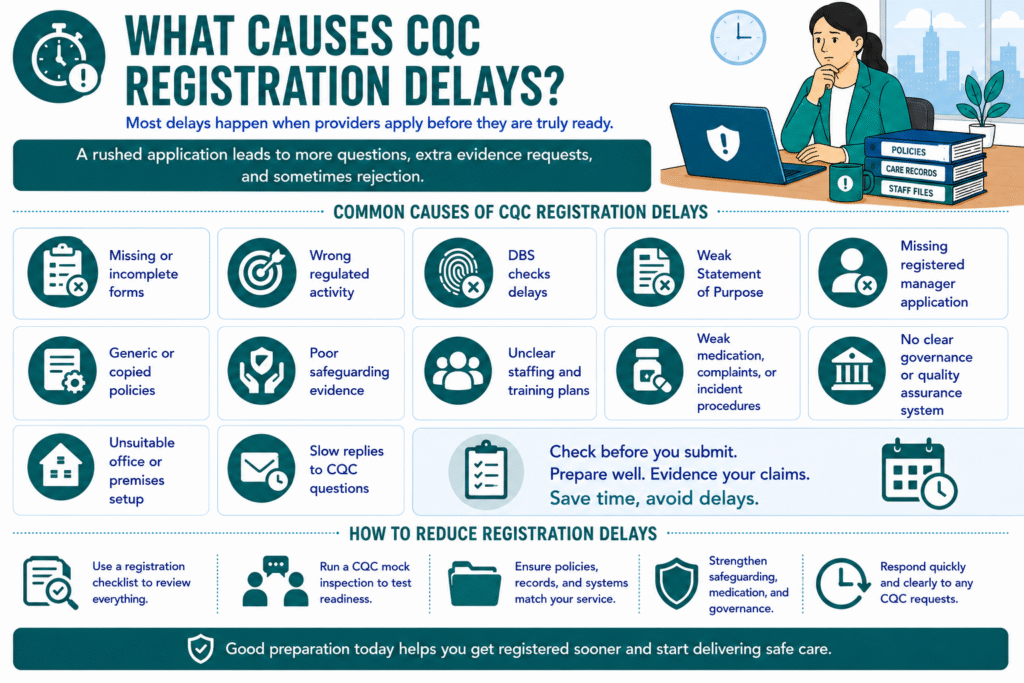
Most CQC registration delays happen when providers apply before they are truly ready. A rushed application can create extra questions, evidence requests, and sometimes rejection.
Common delays include:
- Missing or incomplete forms
- Wrong regulated activity
- DBS delays
- Weak Statement of Purpose
- Missing registered manager application
- Generic or copied policies
- Poor safeguarding evidence
- Unclear staffing and training plans
- Weak medication, complaints, or incident procedures
- No clear governance or quality assurance system
- Unsuitable office or premises setup
- Slow replies to CQC questions
A CQC registration check before submission can help you spot these issues early. Many providers also use a CQC mock inspection to test whether their documents, staff knowledge, care records, policies, and governance systems match what they promised in the application.
A mock inspection does not guarantee approval, but it can show where your service looks weak before CQC asks the same questions.
MORE: What Is a Tender in Health and Social Care? 2026 Update
How Often Does CQC Inspect After Registration?
New providers often ask, how often does CQC inspect once registration comes through. CQC no longer works only around a fixed inspection timetable. It uses a more flexible assessment approach, and the timing depends on the information it receives, the evidence it collects, and whether any concerns arise. CQC says assessments may be planned or responsive.
For newly registered services, CQC will usually assess all quality statements within 12 months before it publishes a rating.
This means registration does not mark the end of compliance. It marks the start. A new care provider should keep policies, audits, staff training, care records, complaints, incidents, risk assessments, and quality checks ready from day one.
So, how often are CQC inspections? The answer depends on risk, evidence, performance, and the type of service. The safest mindset is to run your service as if CQC could ask for evidence at any time.
Final Thought…
Do not treat CQC registration as a form-filling task. Treat it as your first serious test of whether your care business can operate safely, legally, and consistently.
If you want to reduce delays, prepare before you apply. Check your regulated activity, organise your documents, train your proposed registered manager, review your policies, and make sure your evidence matches the service you plan to run.
The question is not only how long does CQC registration take. The better question is: how ready are you to prove that your service can deliver safe, effective, caring, responsive, and well-led care?
A strong application gives CQC confidence. A weak one creates doubt. If you prepare properly, answer clearly, and build compliance into the business from day one, you give your care service the best chance of moving through registration without unnecessary setbacks.
Give me a better cta than the following for this article. Nothing longer: Preparing for CQC registration? Care Sync Experts can help you strengthen your application, prepare for your interview, and avoid the costly mistakes that delay approval.
Preparing for CQC registration? Care Sync Experts helps new care providers build stronger applications, prepare confidently for interviews, and avoid the common mistakes that slow down approval.
FAQ
What questions does CQC ask?
CQC questions usually test whether your service can prove safe, effective, caring, responsive and well-led care. Inspectors may ask how you assess risks, safeguard people from abuse, manage medicines, make sure staff have the right skills, respect dignity, and learn from incidents.
For adult social care, CQC’s own monitoring questions include examples such as how risks are assessed, how staff report concerns, how medicines are managed safely, and how people receive timely care that respects their dignity.
What are the 34 quality statements in CQC?
The 34 CQC quality statements sit under the 5 key questions: safe, effective, caring, responsive and well-led. They describe the commitments providers should meet to deliver high-quality, person-centred care.
Examples include learning culture, safeguarding, safe systems, involving people to manage risks, and safe environments under the “safe” key question.
How long does Social Work England registration take?
For UK-qualified applicants, Social Work England says you must receive your registration number before you start work as a social worker in England.
The application can take longer if you do not provide the required documents, such as ID, qualification evidence, English language evidence where needed, employment details, and declarations about health or convictions. Social Work England warns that missing documents at the online application stage will delay assessment.
How much does it cost to register with Social Work England?
For initial registration in the 2026 to 2027 registration year, Social Work England lists fees by application date: £122 from 1 December 2026 to 28 February 2027, £91.50 from 1 March to 31 May 2027, £61 from 1 June to 31 August 2027, and £30.50 from 1 September to 30 November 2027. The annual renewal fee for 2026 to 2027 is £122.
Leave a Reply