CQC registration does not have one simple total cost. The amount you need depends on your service type, your regulated activities, your business size, and how prepared you are before you apply.
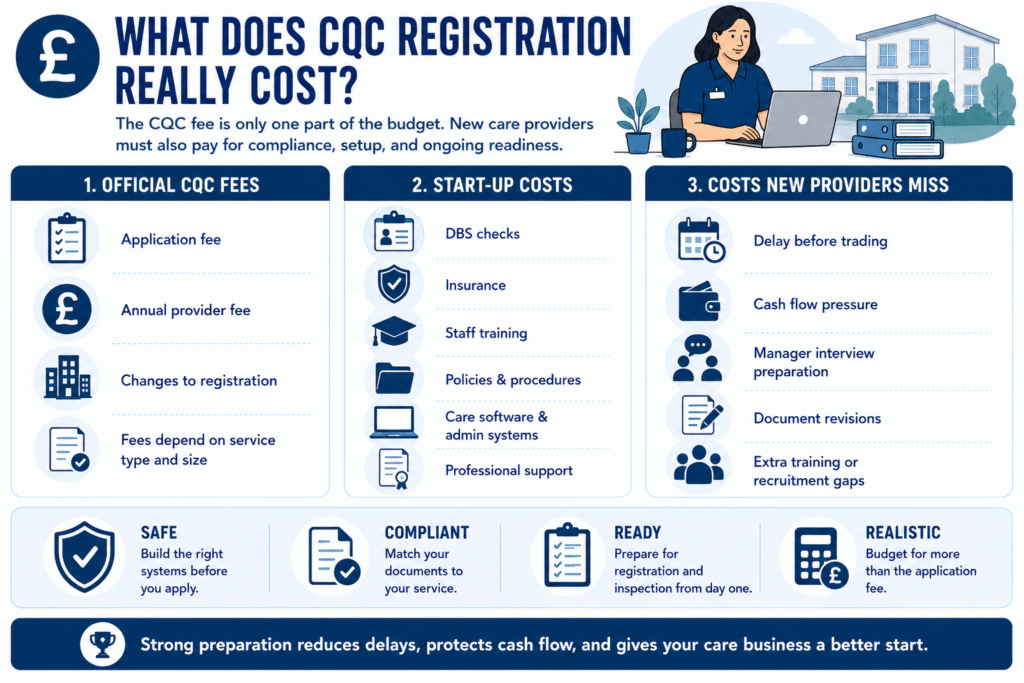
So, how much does CQC registration cost? New providers must budget for more than the official CQC fee. You also need to plan for DBS checks, insurance, staff training, policies and procedures, business systems, registered manager preparation, and possible professional support.
For a new care provider, especially a domiciliary care startup, the real question is not only “how much is CQC registration?” The better question is: “How much do I need to become safe, compliant, and ready to trade?”
A care business cannot rely on registration alone. CQC wants to see that you can run a safe, well-led service from day one. That means your documents, staff checks, training plans, safeguarding systems, complaints process, medicines policy, and quality monitoring must all make sense before you submit your CQC registration application.

What Is CQC Registration?
CQC registration gives a health or social care provider legal permission to carry out regulated activities in England. CQC stands for Care Quality Commission, not “Quality Care Commission.” It regulates services to make sure people receive safe, effective, compassionate, and well-led care.
For a new care business, registration proves that you have the right systems, people, documents, and leadership in place before you start delivering regulated care. It shows that you understand your responsibilities and can protect the people who will use your service.
In simple terms, what is CQC registration? It is the approval process that checks whether your service can legally provide regulated care.
Many new providers ask, what are CQC? The CQC is the independent regulator for health and adult social care services in England. If you plan to deliver personal care, nursing care, or certain health-related treatments, you must check whether your service needs registration before you take on clients.
For a caregiver business, this step matters because trust starts before the first care visit. Your policies, recruitment process, safeguarding approach, training plan, and quality checks all show whether your service can operate safely from day one.
RELATED: Latest CQC Reports, Regulated Activities (2026)
Do I Need to Register with CQC?
You need to register with CQC if your business will provide a regulated activity in England. For care providers, this often includes personal care, such as helping people with washing, dressing, toileting, eating, drinking, or managing daily personal routines.
For example, if you plan to start a home care agency and your carers will support people with personal care in their own homes, you will usually need CQC domiciliary care registration before you can legally provide that service.
Many new providers ask, do I need to register with CQC if I only offer companionship, cleaning, shopping, or meal preparation. These services may not always require registration on their own, but the moment your service crosses into regulated personal care, you must take CQC requirements seriously.
The same applies to CQC registration for aesthetics. Some beauty or aesthetics services may not need registration, but treatments that involve regulated healthcare activities, surgical procedures, or certain clinical treatments may fall under CQC regulation.
Before you trade, confirm exactly what services you will provide. It is much safer to check early than to build a business model that later turns out to need registration.
CQC Registration Fees vs Real Start-Up Costs
The official CQC fee forms only one part of your start-up budget. CQC fees cover registration, changes to registration, and CQC’s work around monitoring, inspection, and rating. Your annual fee depends on the type of service you provide and the scale of that service. (Care Quality Commission)
That means a new care provider should separate CQC registration fees from the wider cost of becoming ready to operate.
| Cost area | What it usually covers |
| CQC fees | Registration, annual provider fees, changes to registration, monitoring, inspection, and rating |
| DBS checks | Checks for directors, registered manager, and relevant care staff |
| Insurance | Public liability, employers’ liability, professional indemnity, and care-specific cover |
| Staff training | Safeguarding, medication, moving and handling, infection control, first aid, and care standards |
| Policies and procedures | Safeguarding, complaints, medicines, recruitment, governance, risk, and quality assurance |
| Business systems | Care planning software, secure records, phone line, email, HR files, and data protection |
| Professional support | Application review, mock interview, compliance preparation, and business setup guidance |
For CQC domiciliary care registration, the biggest mistake is budgeting only for the fee and ignoring the systems behind safe care. CQC will look at whether you understand how to recruit safely, train staff, manage risks, handle complaints, protect people from abuse, and monitor care quality.
Some providers search for a CQC registration fees calculator, but you should treat any estimate as a guide only. CQC says it uses the service types you select to calculate your annual fee, and registered providers receive an invoice showing the exact amount before it is due.
READ MORE: SME Spend Targets: How to Win More Public Contracts in 2026
Typical Budget for a New Domiciliary Care Provider
A new domiciliary care provider should budget for the full cost of becoming registration-ready, not just the CQC fee. Your application needs to show that you can run a safe, organised, and compliant service before you support your first client.
A realistic start-up budget may include:
| Cost area | What to budget for |
| CQC-related fees | Application and annual provider fees based on your service type and scale |
| DBS checks | Directors, nominated individual, registered manager, and care staff |
| Insurance | Employers’ liability, public liability, professional indemnity, and care-specific cover |
| Staff training | Safeguarding, moving and handling, medication, infection control, first aid, and care induction |
| Policies and procedures | Safeguarding, recruitment, complaints, medicines, governance, risk, and quality assurance |
| Office and admin setup | Phone, email, care software, secure records, payroll, HR files, and data protection systems |
| Professional support | CQC application review, interview preparation, compliance advice, and mock assessment |
| Contingency | Extra budget for delays, document changes, recruitment gaps, or additional training |
For a CQC domiciliary care registration, your biggest cost may not be the fee itself. It may be the time, evidence, and preparation needed to prove that your care business can protect people safely.
A strong provider prepares policies, trains staff, checks suitability, sets up care planning systems, and builds quality monitoring before submitting the application. That preparation gives CQC more confidence in your service and helps you avoid expensive delays.
Documents Required for CQC Registration
The documents required for CQC registration help prove that your care business can operate safely, legally, and consistently. CQC does not only want to know what service you plan to offer. It wants to see how you will protect people, manage risks, recruit staff, handle complaints, and monitor care quality.
For a care startup, your preparation should usually include:
| Document or evidence | Why it matters |
| Statement of purpose | Explains your service, regulated activities, aims, locations, and who you support |
| Safeguarding policy | Shows how you will protect people from abuse, neglect, and avoidable harm |
| Recruitment policy | Explains how you will check staff suitability, references, right to work, and DBS status |
| Medication policy | Shows how staff will support medicines safely, if this applies to your service |
| Complaints policy | Explains how people, families, and staff can raise concerns |
| Risk assessment process | Shows how you will identify and manage care-related risks |
| Training plan | Proves that staff will receive the right training before delivering care |
| Quality assurance process | Shows how you will monitor, audit, and improve the service |
| Insurance documents | Confirms that the business has suitable cover |
| Registered manager details | Shows who will lead the regulated activity day to day |
Your CQC registration application should match your documents. If your statement of purpose says you provide dementia care, your policies, staff training, risk assessments, and care planning process should support that claim.
This is where many new providers lose time. They gather documents, but the documents do not connect to the actual service model. A strong application tells one clear story: what care you provide, who you support, how you manage risk, and how you keep people safe.
SEE ALSO: What Is a Tender in Health and Social Care? 2026 Update
What Is the Process of CQC Registration?
The process of CQC registration starts before you open the application form. First, confirm whether your service needs registration and identify the regulated activities you plan to provide. For a care business, this often means checking whether you will deliver personal care, nursing care, or another regulated activity.
A simple process looks like this:
| Step | What you need to do |
| 1. Confirm registration need | Check whether your planned service falls under CQC-regulated activity |
| 2. Choose regulated activities | Decide exactly what care or treatment your business will provide |
| 3. Prepare your evidence | Gather policies, procedures, training plans, insurance, DBS details, and governance documents |
| 4. Complete the application | Fill in the CQC registration application carefully and make sure every answer matches your service model |
| 5. Submit supporting documents | Upload or provide the documents CQC requests |
| 6. Prepare for interview | Make sure the registered manager can explain safeguarding, staffing, risk, medicines, complaints, and quality assurance |
| 7. Respond to CQC queries | Reply quickly and clearly if CQC asks for more information |
| 8. Wait for the decision | Do not deliver regulated care until CQC approves your registration |
If you want to know how to apply for CQC registration, start with the service you plan to deliver. A domiciliary care provider, an aesthetics clinic, a dental service, and a care home may all face different registration requirements.
The strongest applications show a clear link between the service, the people it will support, the risks involved, and the systems in place to manage those risks.
How Long Does CQC Registration Take?
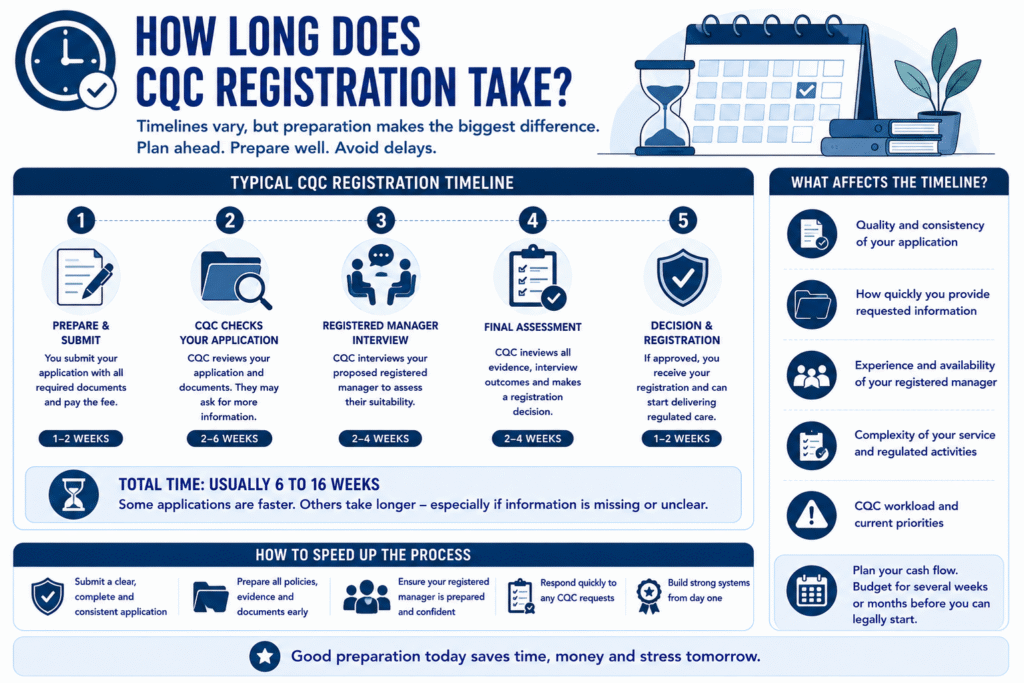
CQC registration can take several weeks or months. The timeline depends on your service type, the quality of your application, how quickly you provide evidence, and whether CQC needs more information from you.
For a new care provider, delays often happen when the application does not match the documents. For example, your statement of purpose may describe one type of service, but your policies, staffing plan, or training evidence may suggest something different. CQC may then ask more questions before making a decision.
So, how long does CQC registration take? There is no fixed answer for every provider. A well-prepared application can move faster, while missing documents, weak policies, unclear regulated activities, or poor interview preparation can slow everything down.
Care startups should plan their cash flow carefully during this period. You may still need to pay for software, insurance, training, office setup, professional support, and living costs before you can legally deliver regulated care.
The smartest approach is to prepare before you apply. Build your systems, review your evidence, train your team, and make sure your registered manager can explain how the service will keep people safe from day one.
What Happens After Registration?
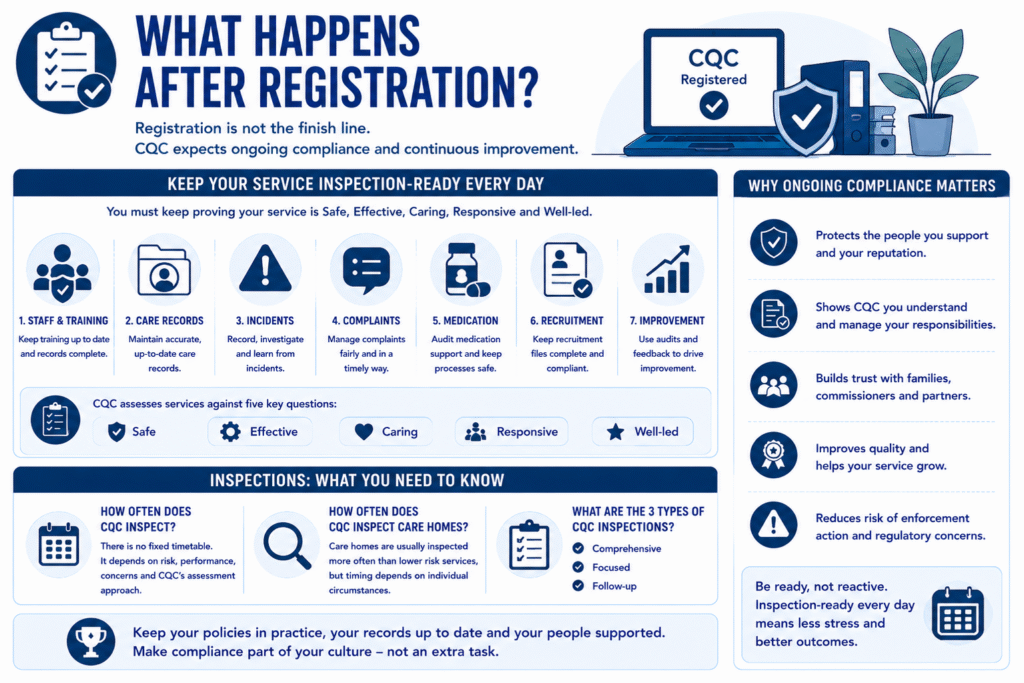
CQC registration does not end the compliance journey. Once CQC approves your application, you must keep proving that your service can deliver safe, effective, caring, responsive, and well-led care.
This is where many new providers make mistakes. They treat registration as the finish line, but CQC expects ongoing evidence. You need to keep staff training updated, review care records, monitor incidents, manage complaints properly, audit medication support, check recruitment files, and improve the service when something goes wrong.
This is the heart of CQC compliance. It means your business does not only have policies on paper. It uses those policies every day to protect people.
Providers often ask, what are the 5 CQC standards? They refer to the five key questions CQC uses to assess services: are they safe, effective, caring, responsive, and well-led?
You may also hear questions like how often does CQC inspect, how often does CQC inspect care homes, or what are the 3 types of CQC inspections. The answer depends on the service, risk level, previous performance, concerns raised, and CQC’s current assessment approach.
After registration, your job is simple but demanding: keep your service inspection-ready every day, not only when CQC contacts you.
MORE: CQC Registered Manager: Requirements, Interview Tips for 2026
When Should You Contact CQC or Get Support?
You should contact CQC when you need official guidance about registration, regulated activities, fees, forms, or your provider account. If you search for a CQC registration contact number, always use the official CQC website so you do not rely on outdated third-party details.
However, official contact and business preparation are two different things. CQC can explain its process, but it will not build your policies, prepare your registered manager, write your statement of purpose, or organise your compliance systems for you.
This is where professional support can help. A care business should get support before submitting the application, not after CQC raises concerns. The right guidance can help you check your documents, understand your regulated activities, prepare for the registered manager interview, and avoid avoidable delays.
If you feel unsure about your evidence, policies, training plan, governance documents, or registration route, pause before you apply. A rushed application can cost you time, money, and confidence. A prepared application gives your care business a stronger chance of starting safely and professionally.
Preparing for CQC registration? Care Sync Experts can help you strengthen your application, prepare for your interview, and avoid the costly mistakes that delay approval.
FAQ
What are the benefits of CQC?
CQC registration helps a care provider operate legally, build trust with families, and show that the service understands safe, effective, caring, responsive, and well-led care. It also gives commissioners, clients, and relatives a way to check inspection reports and ratings before choosing a service. CQC says it regulates health and adult social care in England to protect people and promote improvement.
What are the three types of CQC inspections?
The three commonly discussed CQC inspection types are comprehensive, focused, and follow-up inspections. A comprehensive inspection looks broadly at the service, a focused inspection looks at specific concerns or areas, and a follow-up inspection checks whether the provider has made required improvements.
CQC’s own inspection guidance for GP practices lists focused, comprehensive, and follow-up inspection types, although it also notes that some older inspection pages are under review as CQC updates its assessment approach.
How much do care agencies charge per hour in the UK?
Care agencies in the UK commonly charge around £25 to £38 per hour, depending on location, care needs, visit length, weekends, bank holidays, and whether the support involves personal care or specialist care. Age UK says homecare typically costs around £25 per hour, while Homecare.co.uk’s 2026 guide puts average UK home care between £26 and £38 per hour.
Is CQC just for England?
Yes. The Care Quality Commission regulates health and adult social care services in England. Providers in Scotland, Wales, and Northern Ireland follow different regulators and registration systems. So, if you plan to open a care business in England, you must check whether your service needs CQC registration before you start trading.
Leave a Reply