The Dementia Support Service tender seeks one provider to deliver a coordinated service across Birmingham and Solihull. NHS Birmingham and Solihull Integrated Care Board has stated an estimated value of £3,336,000 excluding VAT, with submissions due by 5pm on 29 July 2026.
This is a specialist community health service, not a routine domiciliary care contract. The successful provider will need to show how people living with dementia, their carers and families will receive timely information, practical support, effective navigation and joined-up referral pathways.
The official Dementia Support Service tender notice on Find a Tender confirms a single lot for Birmingham, an open procedure and a quality weighting of 90 per cent. The detailed conditions of participation and service requirements remain in the Atamis procurement documents, so bidders should search for project reference C387762 before making a final bid decision.
In this guide: we explain the service scope, contract structure, bidder fit, evidence priorities and practical steps required to prepare a credible response to the Dementia Support Service tender.
Key Takeaways
- The opportunity is a single-lot community health procurement covering Birmingham and Solihull.
- Technical quality carries 90 per cent of the published weighting, so pathway design and verified evidence are central to the response.
- The Dementia Support Service tender does not publicly state that CQC registration is mandatory. Bidders must confirm all conditions in Atamis.
- A credible bid needs specialist dementia capability, equitable access, local partnerships, carer support, lived experience and measurable outcomes.
On This Page
Dementia Support Service Tender at a Glance
- Buyer: NHS Birmingham and Solihull Integrated Care Board
- Procurement support: NHS Arden and Greater East Midlands Commissioning Support Unit
- Project reference: C387762
- Procurement ID: ocds-h6vhtk-060f00
- Procedure: open procedure
- Regime: Procurement Act 2023, light touch contract
- Lots: one
- Delivery area: Birmingham, with the service covering Birmingham and Solihull
- Estimated value: £3,336,000 excluding VAT
- Stated annual value: £834,000
- Initial term: 1 January 2027 to 31 December 2028
- Extension: up to two further years, to 31 December 2030
- Quality weighting: 90 per cent
- Price weighting: 10 per cent
- Submission deadline: 5pm on 29 July 2026
- Submission portal: Atamis
The public enquiry deadline was 5pm on 17 July 2026, which has passed. Bidders should still review every published clarification and document version in Atamis before submission. Review the Dementia Support Service tender record on Care Sync Experts for a convenient summary, then use the buyer’s portal as the final authority. You can also browse our wider feed of healthcare tender opportunities.
What Service Is the Buyer Commissioning?
The buyer wants a single point of access for information and advice about dementia, including support available before and after diagnosis and clear guidance on how people can access it.
The public notice describes a service that should provide or facilitate:
- signposting to relevant support services and community groups;
- practical emotional support that helps people feel safer and more resilient;
- coaching for people living with dementia and their carers, tailored to their circumstances;
- access to peer-led group support;
- person-centred support that promotes independence and wellbeing;
- better coordination across health, social care and voluntary sector partners;
- proactive intervention intended to reduce avoidable crises, hospital admissions and delayed discharges;
- meaningful involvement of lived experience in service design, delivery and evaluation;
- clear referral pathways into, through and out of the service;
- equitable access across different communities and areas of Birmingham and Solihull.
This scope aligns with the local Birmingham and Solihull Dementia Strategy 2023 to 2028, which prioritises information, timely diagnosis with support, crisis prevention and personalised care planning. A strong tender response should connect its delivery model to these local priorities without simply repeating strategy language.

Who Is This Tender Likely to Suit?
The opportunity is likely to suit established dementia charities, voluntary and community organisations, community health providers, social care organisations and partnerships that can demonstrate relevant specialist experience at scale.
The notice identifies the opportunity as particularly suitable for small and medium-sized enterprises and voluntary, community and social enterprises. That does not remove the need to prove capacity, governance, financial resilience and safe mobilisation for a contract of this size.
A domiciliary care or supported living provider may have relevant experience, but it should not assume that care delivery or CQC registration alone proves suitability. The public notice does not state that CQC registration is a condition of participation. The detailed procurement documents must be checked before making any claim about mandatory registration, accreditations, turnover thresholds or insurance levels.
Before bidding, leadership should be able to evidence:
- specialist knowledge of dementia and its impact on people, carers, families and communities;
- a credible single point of access and navigation model;
- strong local partnerships and referral arrangements across Birmingham and Solihull;
- accessible delivery for diverse communities and people affected by health inequalities;
- a competent, supervised and resilient workforce;
- safe information sharing, safeguarding and risk management;
- measurable outcomes and reliable performance reporting;
- mobilisation capacity for a 1 January 2027 start;
- financial sustainability at the proposed price.
If your team is new to public procurement, read our guide to tenders in health and social care before building the compliance matrix.
Why the 90 Per Cent Quality Weighting Matters
The published award criteria allocate 90 per cent to technical quality and 10 per cent to commercial cost. This makes the evidence, clarity and credibility of the delivery solution central to the competition.
It does not mean price can be ignored. A low quality response will struggle, but an unsustainable or poorly evidenced cost model can still damage the submission. Bid teams should align the service model, staffing assumptions, activity volumes, partnership commitments and price before final drafting.
The notice directs suppliers to the procurement documents for the detailed quality criteria. Do not invent sub-weightings or assume the final questions. Build the response plan from the latest Atamis pack, including every schedule, declaration, word limit and clarification.
Watch: Three Hidden Healthcare Tender Eligibility Checks
Our Care Sync Experts video explains three checks that can stop a healthcare bid before evaluators reach the method statements. Use it as a decision prompt for the Dementia Support Service tender, then verify every requirement against the current Atamis pack.
Eight Evidence Areas to Prepare
1. A clear person-centred pathway
Map the journey from first contact to triage, information, support planning, intervention, onward referral and exit. Explain choice, consent, accessibility, handovers and what happens when a person’s needs change.
The NICE dementia guideline places the person’s individuality, perspective, relationships and wellbeing at the centre of good practice. Use this as a clinical and practice reference, then show exactly how your operating model will deliver it.
2. Local access and health inequalities
The notice expects the service to consider geographical demand, population differences and dementia prevalence across Birmingham and Solihull. A generic city-wide claim is not enough. Show where and how people will access the service, including communities that may experience language, cultural, digital, transport or trust barriers.
3. Referral pathways and partnership governance
Identify likely referral partners, their roles, handover standards and escalation routes. Distinguish a supportive relationship from a formal commitment. Any letters of support should be current, specific and consistent with the proposed delivery model.
4. Support for carers and families
Explain how carers will receive information, practical coaching, emotional support and appropriate onward referral whilst protecting the rights and wishes of the person living with dementia. Show how the service will recognise carer strain and respond proportionately.
5. Lived experience and co-production
The notice calls for lived experience to be embedded in design, delivery and evaluation. Define who will participate, how their contribution will be supported, how feedback will influence decisions and how you will report the changes made.
6. Workforce competence and supervision
Set out roles, caseload assumptions, specialist competencies, induction, ongoing learning, supervision and cover arrangements. The workforce plan should connect directly to activity, geography, opening hours and the needs of diverse communities.
7. Outcomes, data and learning
Separate service activity from meaningful outcomes. Contact volumes and referrals are useful measures, but the buyer will also need confidence that the service improves access, wellbeing, independence, coordination and crisis prevention. Define data quality controls and how learning will change practice.
8. Mobilisation and continuity
Work backwards from 1 January 2027. Cover governance, recruitment, technology, information governance, referral testing, partner onboarding, communications, training, readiness reviews and business continuity. Give each dependency an owner and decision date.
Care Sync Experts can help turn the procurement pack into a traceable response plan through our healthcare tender writing service.
How to Turn the Dementia Support Service Tender Quality Weighting Into Scorable Evidence
The 90 per cent technical weighting makes the quality narrative central, but evaluators can only score what the response demonstrates. A strong bid should create a traceable line from each requirement to the delivery method, accountable role, evidence source and measurable outcome. The controls below help prevent specialist knowledge from becoming a set of unscored general statements.
Show the pathway, not only the service values
Values such as compassion, choice and person-centred support matter, but they need an operating method. Explain how a person or carer enters the service, receives accessible information, is triaged, agrees priorities, accesses support and moves between services. Include decision points, handovers, consent, safeguarding and exit planning. This gives evaluators a usable picture of the experience rather than asking them to infer it.
Use evidence that matches the commitment
For each important promise, identify evidence of relevant delivery. A case example may demonstrate practice, performance data may demonstrate consistency and a policy may demonstrate organisational control. None of these sources should be stretched beyond what it proves. Where direct evidence is limited, explain the gap, the transferable element and the mobilisation control. Do not present an unrelated care contract as proof of specialist dementia navigation.
Define local partnership accountability
A partnership list is not a pathway. Name the likely role of each partner, referral direction, information exchange, governance route and escalation point. Separate confirmed commitments from relationships that still need to be established. The mobilisation plan should show when agreements will be completed, how the pathway will be tested and what happens if a dependency is delayed.
Connect outcomes to service activity
Explain how contacts, referrals and group attendance contribute to outcomes that matter to people living with dementia and carers. Define the measure, data source, review frequency and person responsible for quality assurance. Include how feedback and lived experience will change the service, not simply how they will be collected. This helps demonstrate that performance management will support learning rather than becoming a reporting exercise.
Complete an independent evaluator review
A reviewer who did not draft the response should check whether every question has been answered, every claim can be verified and every commitment is reflected in staffing and price. Flag vague phrases such as seamless support or strong partnerships unless the method immediately follows. A separate compliance review should confirm declarations, attachments, word limits, filenames and the latest Atamis document versions before upload.
What the Light Touch Open Procedure Means
The notice classifies the procurement as a light touch contract under the Procurement Act 2023 and uses an open procedure. Government light touch contract guidance explains that these services are subject to a more flexible regime, whilst open procedure guidance describes a single-stage competition in which any supplier may submit a tender.
For a bidder, the practical point is simple: do not mistake procedural flexibility for relaxed evidence requirements. The buyer has published a competitive opportunity, and the response must meet the conditions, instructions and evaluation criteria in the procurement pack.
A Practical Bid Preparation Plan
- Confirm the live pack: access Atamis, search C387762 and record every document version and clarification.
- Run the bid decision: test specialist fit, local delivery capacity, partnerships, evidence, price and mobilisation risk.
- Build a compliance matrix: map every question, attachment, declaration, limit, criterion and owner.
- Lock the service model: agree the pathway, access routes, workforce, governance, partnerships, outcomes and information flows.
- Validate evidence: use current examples, data and documents that directly support each claim.
- Reconcile solution and price: check that staffing, volumes, overheads, partnership costs and performance commitments are financially consistent.
- Review independently: complete factual, compliance, evaluator, financial and presentation reviews.
- Submit early: verify every upload and retain the portal receipt before 5pm on 29 July 2026.
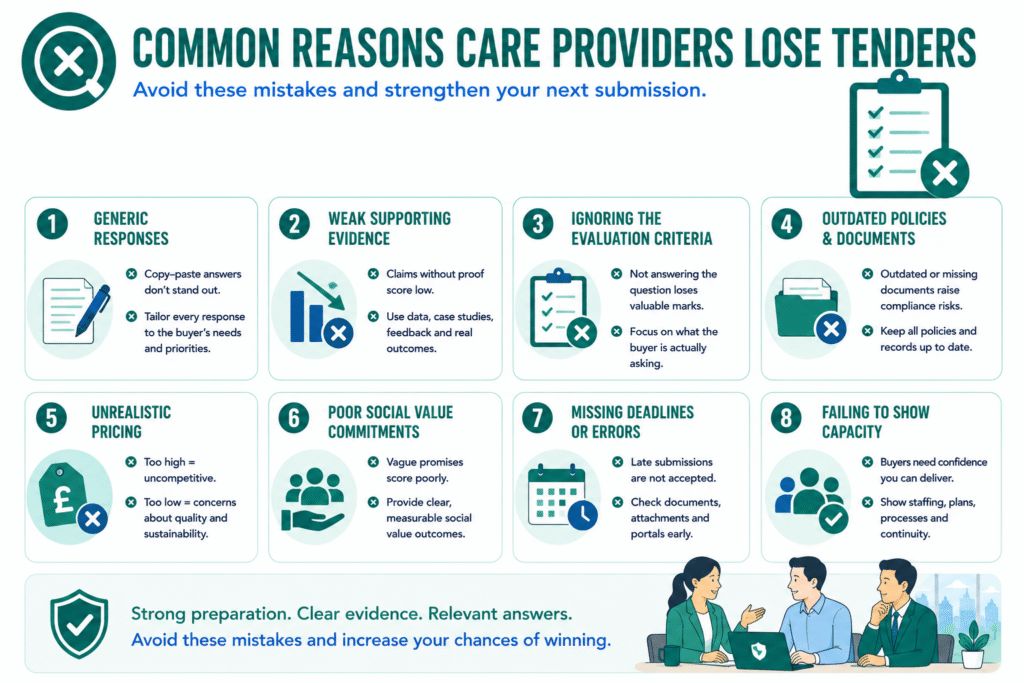
Common Reasons a Dementia Support Service Bid Could Lose Marks
- describing generic dementia awareness rather than a working service pathway;
- claiming partnerships without named roles, referral processes or accountability;
- treating lived experience as a consultation exercise with no influence on delivery;
- failing to explain equitable access across Birmingham and Solihull;
- using activity counts as substitutes for outcomes;
- presenting workforce numbers that do not match geography, demand or opening hours;
- ignoring carers, crisis prevention or coordination with other services;
- guessing requirements that are only available in the Atamis documents;
- allowing the cost model and delivery narrative to contradict each other;
- submitting against an old document version or missing a mandatory attachment.
A disciplined response makes each requirement easy to find and each material claim easy to verify. Our article on public contract readiness for smaller providers provides further context for building a stronger evidence base.
Should Your Organisation Bid?
Bid for the Dementia Support Service tender if you can demonstrate specialist dementia support capability, a realistic local delivery model, credible partnerships, a robust workforce, measurable outcomes and sustainable pricing.
Consider a no-bid decision if the organisation would need to invent local capacity, rely on unconfirmed partners, stretch unrelated care experience to fit the requirement or mobilise a service model it has not costed properly.
Before approving the bid, leadership should be able to answer:
- Why are we a strong fit for this exact service?
- What evidence proves our pathway will work across Birmingham and Solihull?
- Which gaps remain, and can they be closed before submission and mobilisation?
- Can we deliver every commitment safely and sustainably at our proposed price?
Need Support With the Dementia Support Service Tender?
Care Sync Experts can help you review the Dementia Support Service tender, build the compliance matrix, strengthen evidence and prepare a clear, evaluator-friendly tender response. We will also tell you when the available evidence supports a no-bid decision.
Book a tender consultation to discuss your current evidence and submission timetable.
This article is an independent summary based on the public notice and official guidance available on 19 July 2026. It is not the procurement pack and does not replace Atamis documents, buyer clarifications or professional legal advice.
Frequently Asked Questions
What is the deadline for the Dementia Support Service tender?
The official Dementia Support Service tender notice states that tenders must be submitted by 5pm on 29 July 2026. Bidders should confirm the live deadline and any formal amendment in Atamis.
How much is the contract worth?
The estimated value is £3,336,000 excluding VAT. The notice also states an annual value of £834,000 and provides an initial two-year term with an option to extend for up to two further years.
Is CQC registration required?
The public notice does not state that CQC registration is a condition of participation. Bidders must check the full procurement documents before deciding which registrations, accreditations and evidence are mandatory.
Can an SME or voluntary organisation bid?
Yes. The notice identifies the opportunity as particularly suitable for SMEs and voluntary, community and social enterprises. Every bidder must still meet the published conditions and demonstrate capacity to deliver the full contract.
How will the tender be evaluated?
The published criteria allocate 90 per cent to technical quality and 10 per cent to cost. The detailed questions, scoring method and sub-criteria must be taken from the current Atamis documents.