Tag: nhs

  • NHS Capacity Tracker: What Care Providers Need to Know in 2026

    NHS Capacity Tracker: What Care Providers Need to Know in 2026

    The NHS Capacity Tracker is a web-based platform that helps adult social care providers in England share up-to-date information about their service, including care capacity, workforce pressures and, where relevant, vacancies.

    Care homes, domiciliary care providers, hospices and other services use it so health and social care teams can understand available support and plan safer, faster discharges.

    For many CQC-regulated adult social care providers, completing the required NHS Capacity Tracker return is mandatory. Providers must review and submit the required information during the monthly reporting window, which normally runs from the 8th to the 14th of each month.

    Even when nothing has changed, the provider still needs to review the required fields and save the return so the system records the update.

    For a care business, Capacity Tracker should not sit at the bottom of the monthly admin list. Accurate updates help your team show genuine availability, reduce avoidable calls about vacancies, and support discharge teams when they need to find the right care option quickly.

    It also helps your business stay on top of its reporting responsibilities before a missed deadline becomes a compliance issue.

    Get expert support for your next tender, inspection-ready policies, or CQC registration — book a call with Care Sync Experts today and let’s get you compliant and competitive.

    What Is the NHS Capacity Tracker?

    NHS HWE Domiciliary Care AQP 2025 | Complete Tender Guide | Deadline 5 January 2026

    The NHS Capacity Tracker is a secure, web-based platform that gives health and social care teams a clearer picture of adult social care capacity across England.

    Care providers use it to update key information about their service, while local authorities, NHS teams and commissioners use that information to understand available support and system pressures.

    For a care provider, the platform does more than collect figures. It helps your service show its current position to the professionals who may need to place or support people quickly.

    When your team keeps information accurate, discharge teams can identify suitable care options with less reliance on repeated phone calls and outdated vacancy lists.

    The NHS England Capacity Tracker supports national and local oversight of adult social care. It brings together provider-level information so the wider system can monitor issues such as care-home capacity, workforce pressures and service demand.

    The NHS standards directory describes it as a tool that helps assess key aspects of adult social care provision at both national and local level.

    For care homes, the NHS care home capacity tracker can help make vacancy information more visible to teams arranging discharge or onward care. This is why some people also refer to it as an NHS bed capacity tracker. However, the platform covers more than beds. It also supports wider adult social care reporting and planning.

    From a business perspective, treat Capacity Tracker as part of your monthly operating routine. Your updates help the wider care system understand what your service can provide, while also helping your organisation keep its required data current.

    RELATED: What Is a Tender in Health and Social Care? 2026 Update

    Is NHS Capacity Tracker Mandatory for Care Providers?
    Capacity tracker and reporting tips
    Capacity tracker and reporting tips

    For most CQC-regulated adult social care providers in England, NHS Capacity Tracker reporting is mandatory. The legal requirement has applied since 31 July 2022 and continues unless the Department of Health and Social Care changes or withdraws the formal notice.

    This includes many care homes and home-care services, whether they support privately funded people, local-authority-funded people or NHS-funded people. Provider size does not remove the requirement. A small service still needs a reliable process for checking and submitting its monthly information.

    Your team should also avoid assuming that a quiet month means no action is needed. If your service has no current vacancies, no active service users, or little operational change, you may still need to review the required fields and submit the appropriate return. Capacity Tracker uses this information to build an accurate national and local picture of adult social care capacity.

    For a caregiver business, the simplest approach is to treat the NHS Capacity Tracker mandatory return like any other core compliance task.

    Give one named person responsibility for the update, appoint a backup user, and set an internal deadline before the final reporting date. This reduces the risk of missed submissions when managers are on leave, staff change roles, or your service faces unexpected pressures.

    When Do Providers Need to Submit Their Monthly Return?

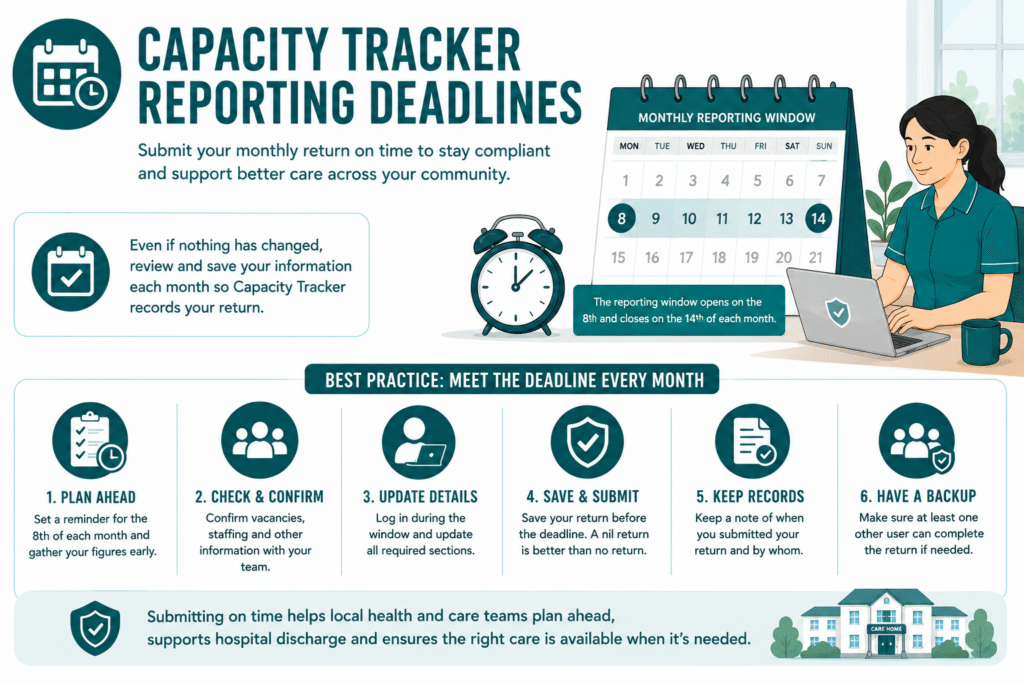
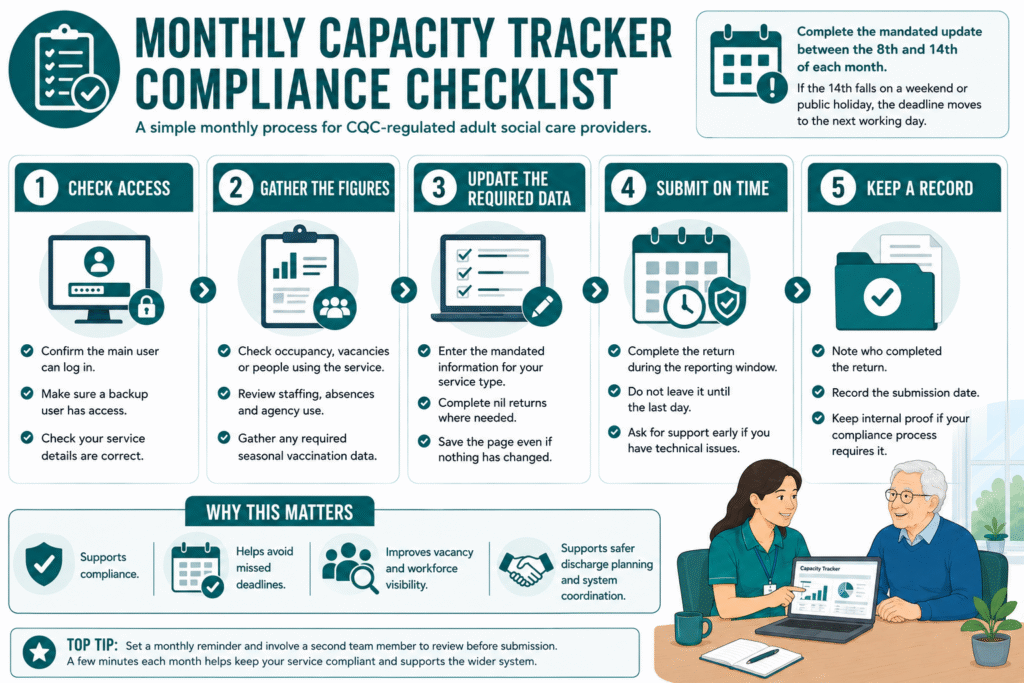
    Care providers must submit their required NHS Capacity Tracker information during a seven-day reporting window each month. The window opens on the 8th and closes at the end of the 14th. If the 14th falls on a weekend or public holiday, providers can submit by the next working day.

    Do not wait until the final day. A rushed update creates avoidable problems, especially when your manager is off duty, staffing levels change quickly, or someone cannot access the system. Set an internal deadline, such as the 10th or 11th of every month, so your team has time to check figures and resolve login issues.

    Your team should review the required fields even when nothing has changed. Capacity Tracker records the update only when you save the return during that month’s reporting window. This means a service with stable occupancy, no vacancies or no major staffing changes still needs to complete the monthly check.

    A simple routine works best:

    1. Ask the responsible manager to confirm current occupancy, vacancies, staffing and service information.
    2. Compare the figures with your latest rota, admissions, discharges and care records.
    3. Update the required fields in Capacity Tracker.
    4. Save the submission before your internal deadline.
    5. Keep a short record of who completed the return and when.

    By treating the update as a fixed monthly compliance task, your care business can avoid last-minute pressure and keep its information reliable for health and social care teams.

    READ MORE: Mock CQC Inspection: A Practical 2026 Checklist for Care Providers

    What Information Do Care Homes and Home Care Providers Need to Update?

    The information your service needs to submit depends on the type of care you provide. Capacity Tracker collects a core monthly dataset from adult social care providers, while some questions may change over time to reflect national priorities.

    For that reason, your manager should always check the live NHS Capacity Tracker guidance before completing each return.

    NHS Care Home Capacity Tracker Information

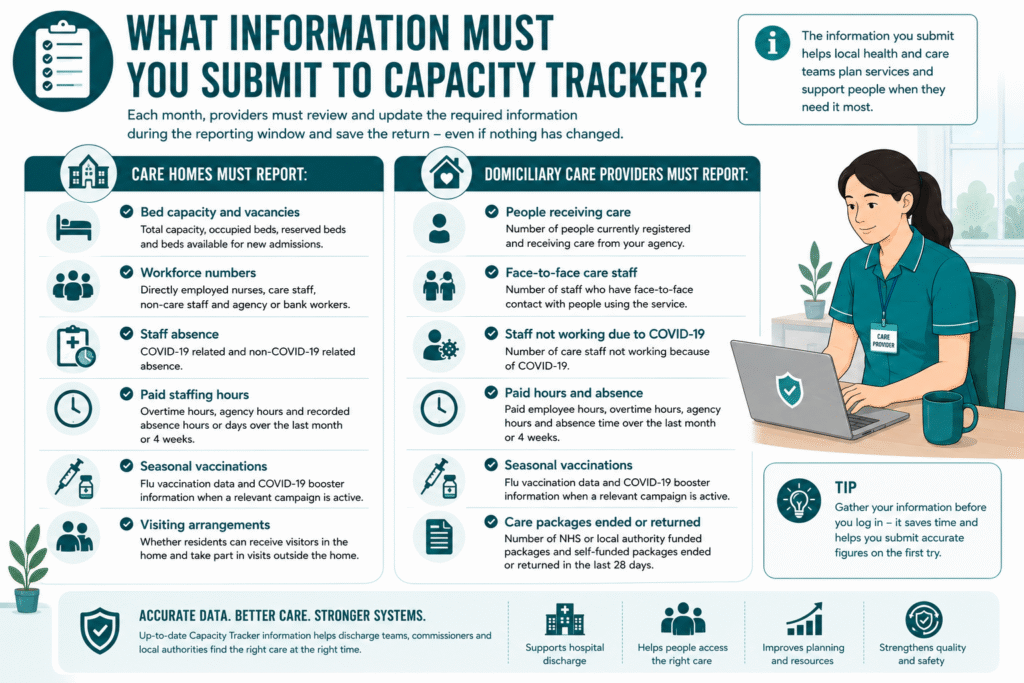
    For care homes, the monthly update can include information such as:

    • Current occupancy and the number of residents in the home
    • Available beds and whether those beds can accept admissions
    • Visiting arrangements
    • Workforce absence information
    • Seasonal vaccination information when required

    These updates help health and social care teams understand local care-home capacity. When your service records vacancies accurately, discharge teams can see whether your home may be able to support someone leaving hospital.

    Information for Home Care Providers

    Home care and domiciliary care providers report different operational information because they do not manage care-home beds. Your return may include:

    • The number of people receiving regulated domiciliary care
    • Workforce absence information
    • Seasonal vaccination information when required
    • Other service-level information included in the current monthly data set

    Your team should use the most recent rota, service-user records and operational reports when checking the figures. Do not estimate where you can confirm the information from your own records.

    The most important point is accuracy. Capacity Tracker data supports national and local planning, but it also affects how other professionals understand your service.

    A prompt, accurate update gives commissioners and discharge teams a clearer view of what your care business can offer at that time.

    Why Accurate Capacity Tracker Updates Matter to Your Care Business
    NHS Capacity Tracker 2026

    Accurate Capacity Tracker updates do more than meet a monthly requirement. They help health and social care teams understand what your service can offer right now.

    When your care home records a genuine vacancy, discharge teams can see that information while they look for suitable support for someone leaving hospital.

    When your home care service updates its capacity and staffing position, commissioners and local teams can make better decisions about available care in the community.

    This can reduce repeated calls, outdated vacancy lists and wasted time for your staff. Instead of answering the same availability questions throughout the day, your team can focus on care delivery while the wider system works from a more reliable picture.

    Accurate updates also protect your business reputation. If Capacity Tracker shows that you have space, staffing capacity or a service offer that no longer reflects reality, referral teams may contact you about placements you cannot accept. The opposite can also happen: an out-of-date return may hide genuine availability that your business could fill.

    For example, a care home with two suitable vacancies may miss potential referrals if its information still shows full occupancy. A home care provider may also receive unsuitable requests if its workforce information does not reflect current capacity.

    Your monthly return helps the wider system plan safer and more timely discharges, but it also gives your care business a chance to present an accurate picture of its service. Treat the update as part of your referral, occupancy and workforce-management routine, not just another compliance form.

    SEE ALSO: What Are the CQC Fundamental Standards? 2026 Update

    NHS Capacity Tracker Register and Login: Getting Your Team Set Up

    Your care business needs reliable access to Capacity Tracker before the monthly reporting window opens. Do not leave registration or login issues until the 8th of the month, when your team may already be managing admissions, staffing gaps and day-to-day care delivery.

    To use the platform, start with the NHS Capacity Tracker register process on the official Capacity Tracker website. The site provides registration guidance for different provider types, including care homes, hospices and other health and care services. Once your organisation is set up, authorised users can access the system through the NHS Capacity Tracker login page.

    Your business should not rely on one manager’s account. Give at least two trusted people access, such as the registered manager and a deputy, administrator or compliance lead. This protects your monthly process when someone is on annual leave, unwell or leaves the organisation.

    Keep your user details current as well. If a manager leaves, contact the NHS Capacity Tracker team promptly so they can update access and prevent avoidable delays.

    The support team can help with registration, password resets, user setup and technical questions. Current support details list telephone support on 0191 691 3729 and email support at necsu.capacitytracker@nhs.net.

    A simple rule works well: check that your login works before the reporting window opens. That small step can save your care service from a last-minute compliance problem.

    What Happens If You Miss the Capacity Tracker Deadline?

    Missing the monthly Capacity Tracker deadline does not usually lead straight to a financial penalty. The process starts with support.

    The relevant team will normally contact your service, explain what is missing and give you the chance to resolve the issue before the next reporting window.

    However, your care business should take repeated missed returns seriously. Private CQC-regulated adult social care providers can face enforcement action if they fail to provide required information without a reasonable excuse, or if they submit information that is materially false or misleading.

    The enforcement process can move through several stages:

    1. Support and contact: Your service receives guidance and help to complete the return.
    2. Further support: If the issue continues, the team may contact you again before the next deadline.
    3. Notice of intent: Persistent non-compliance can lead to a formal warning that a penalty may follow.
    4. Final decision: After considering any explanation or formal representation, the Department of Health and Social Care may issue a financial penalty.

    Your team should respond early if a technical problem, emergency or staffing crisis prevents submission. Keep records of the issue, contact the support team and explain what happened.

    A reasonable excuse may apply in some circumstances, but silence or repeated missed returns without engagement can make the situation harder to resolve.

    The best protection is a simple monthly routine: assign ownership, keep backup users, check your NHS Capacity Tracker login before the reporting window opens and submit before your internal deadline.

    MORE: What Is an Unregulated Care Provider? 2026 Update

    Monthly NHS Capacity Tracker Checklist for Care Providers
    What to submit to Capacity Tracker
    What to submit to Capacity Tracker

    A clear routine makes Capacity Tracker easier to manage. Use this checklist each month so your team can complete the return accurately and on time.

    1. Check the reporting window.
      Confirm that the monthly submission period has opened and note your internal deadline.
    2. Review current occupancy or service-user numbers.
      Care homes should check resident numbers, vacancies and beds available for admission. Home care providers should confirm the number of people receiving regulated care.
    3. Confirm workforce information.
      Check staff absences, rota changes and any other required workforce details against your latest records.
    4. Review any seasonal or additional questions.
      Some Capacity Tracker questions change during the year, so check the live guidance rather than relying on last month’s return.
    5. Update the information from reliable records.
      Use your care-management system, rota, occupancy records and staffing reports. Do not guess when your team can verify the figures.
    6. Save and submit the return.
      Make sure the system records the update before your internal deadline, even when no figures have changed.
    7. Keep a completion record.
      Note who completed the return, when they submitted it, and whether any issue needs follow-up.
    8. Resolve access problems early.
      If a user cannot log in or the data looks incorrect, contact the NHS Capacity Tracker team before the deadline rather than waiting until the last day.

    For most care businesses, assigning this task to one named owner and one backup user will keep the process simple. A five-minute check early in the reporting window can prevent a missed return, reduce unnecessary stress and keep your service information useful for referral and discharge teams.

    Make Capacity Tracker Part of Your Monthly Compliance Routine

    NHS Capacity Tracker works best when your care business treats it as part of its normal monthly routine, not as a last-minute task. The same figures that support your return can also help you manage occupancy, staffing pressure, vacancies and referral opportunities.

    Give one person clear responsibility for the update, keep a backup user in place and set an internal deadline before the 14th. This gives your team time to check the information properly, solve login issues and avoid rushed submissions.

    Accurate updates also help the wider health and care system make better decisions. When discharge teams and commissioners can see a realistic picture of your service, they can identify suitable care options more quickly and reduce unnecessary delays.

    For care providers, the goal is simple: keep your information current, submit on time and make Capacity Tracker part of the same compliance rhythm as rota checks, audits and service reviews.

    Need help keeping your care service compliant and inspection-ready?

    Care Sync Experts can help you strengthen your monthly compliance systems, identify gaps in your evidence and build a practical improvement plan that supports safer care, smoother reporting and greater confidence ahead of CQC inspection.

    FAQ

    What Does Capacity Mean in the NHS?

    In the NHS and adult social care, capacity usually means the resources available to meet people’s needs at a particular time. This can include available care-home beds, home-care hours, staff availability, specialist services, equipment and community support.

    For Capacity Tracker purposes, providers use the term mainly to describe whether their service has room and resources to accept or support more people safely. A care home may have an empty bed but still lack capacity to accept a person if it does not have the right staffing, skills or environment for their needs.

    What Is Capacity and Capability in the NHS?

    Capacity describes how much care or support a service can provide. Capability describes whether the service has the right skills, knowledge, staff mix and resources to provide that care safely.

    For example, a care home may have two vacant rooms, which gives it physical capacity. However, it may not have the capability to support someone with complex dementia, PEG feeding needs or a high level of nursing care. Safe discharge planning needs both capacity and capability.

    What Is the Difference Between the NHS and NHS England?

    The NHS is the wider publicly funded health service that provides healthcare across England, Scotland, Wales and Northern Ireland. It includes hospitals, GP practices, ambulance services, community services and many other organisations.

    NHS England is the organisation that leads and oversees the NHS in England. It works with local NHS bodies, integrated care systems and providers to plan services, set national priorities and support the delivery of care.

    Capacity Tracker supports adult social care and health-system planning in England, which is why people may refer to it as the NHS England Capacity Tracker.

    What Are the Four Criteria for Capacity?

    In adult social care, this question usually refers to mental capacity rather than care-service capacity. Under the Mental Capacity Act 2005, a person must be able to:

    – Understand the information relevant to a decision.
    – Retain that information long enough to make the decision.
    – Use or weigh that information as part of the decision-making process.
    – Communicate their decision in any way.

    These criteria relate to a person’s ability to make a specific decision at a specific time. They are different from Capacity Tracker, which records a care provider’s operational capacity and service information.
  • NHS Pension Calculator: How to Estimate Retirement Income in 2026

    NHS Pension Calculator: How to Estimate Retirement Income in 2026

    The most accurate NHS pension calculator is the Total Reward Statement (TRS) or Annual Benefit Statement (ABS) available through ESR or My NHS Pension. These official tools use your actual NHS service record, pensionable pay, and scheme membership to estimate how much pension you could receive in retirement.

    For caregivers, nurses, and NHS staff, understanding your pension matters just as much as understanding your salary. Your NHS banding, years of service, and pension scheme all directly affect your retirement income.

    Get expert support for your next tender, inspection-ready policies, or CQC registration — book a call with Care Sync Experts today and let’s get you compliant and competitive.

    Key Takeaways

    • The official NHS pension calculator is available through ESR, your Total Reward Statement (TRS), or My NHS Pension.
    • Your pension estimate depends on your NHS pension scheme, pensionable pay, and total years of service.
    • Staff in higher NHS banding levels, such as Band 6 NHS pay and Band 7 NHS pay, usually build larger pension benefits over time.
    • The 1995, 2008, and 2015 NHS pension schemes all calculate benefits differently.
    • Many caregivers use both an NHS salary calculator and an NHS pension calculator to compare take-home pay with long-term retirement income.
    • The NHS Pension calculator UNISON tools and official NHS calculators can help staff model retirement scenarios and early retirement options.
    • Understanding the NHS pension scheme April 2025 changes can help caregivers plan their future contributions and retirement age more effectively.

    What Is the Most Accurate NHS Pension Calculator?

    How We Got Precious Care CQC Registered (Domiciliary Care Startup)

    The most accurate NHS pension calculator is your official Annual Benefit Statement (ABS) or Total Reward Statement (TRS), available through ESR or My NHS Pension. These tools calculate your pension using your real NHS employment history, pensionable earnings, and current scheme membership.

    Many NHS workers search for terms like:

    • Nhs pension calculator gov uk
    • NHS Pension calculator UNISON
    • Nhs pension calculator 2022

    However, official NHS records almost always provide the most reliable estimate because they include:

    • your actual years of service
    • pension contributions
    • salary progression
    • scheme transfers
    • retirement age calculations

    Where NHS Staff Can Access Their Pension Estimate

    ToolBest ForAccuracy
    ESR Total Reward Statement (TRS)Current NHS staffHighest
    My NHS PensionNon-ESR usersHigh
    UNISON NHS Pension CalculatorQuick estimatesModerate
    NHS Ready Reckoner ToolsGeneral projectionsModerate

    Why Caregivers Should Check Their Pension Regularly

    Many caregivers focus on monthly earnings and overtime but overlook long-term retirement income. Your pension can become one of your most valuable financial benefits throughout your NHS career.

    For example, a nurse on Band 6 NHS pay 2025 may contribute thousands of pounds yearly into the NHS pension scheme while also receiving significant employer contributions.

    Checking your pension regularly helps you:

    • understand your projected retirement income
    • plan early retirement options
    • track contribution growth
    • compare pension value against current take-home pay
    • prepare for future changes in the NHS pension scheme

    The NHS pension scheme remains one of the most valuable public sector pension schemes in the UK for long-term healthcare workers and caregivers.

    RELATED: PIP and ADP Insider Tips for 2026: Everything You Need to Know

    How NHS Staff and Caregivers Calculate Their Pension

    NHS pension examples for staff bands
    NHS pension examples for staff bands

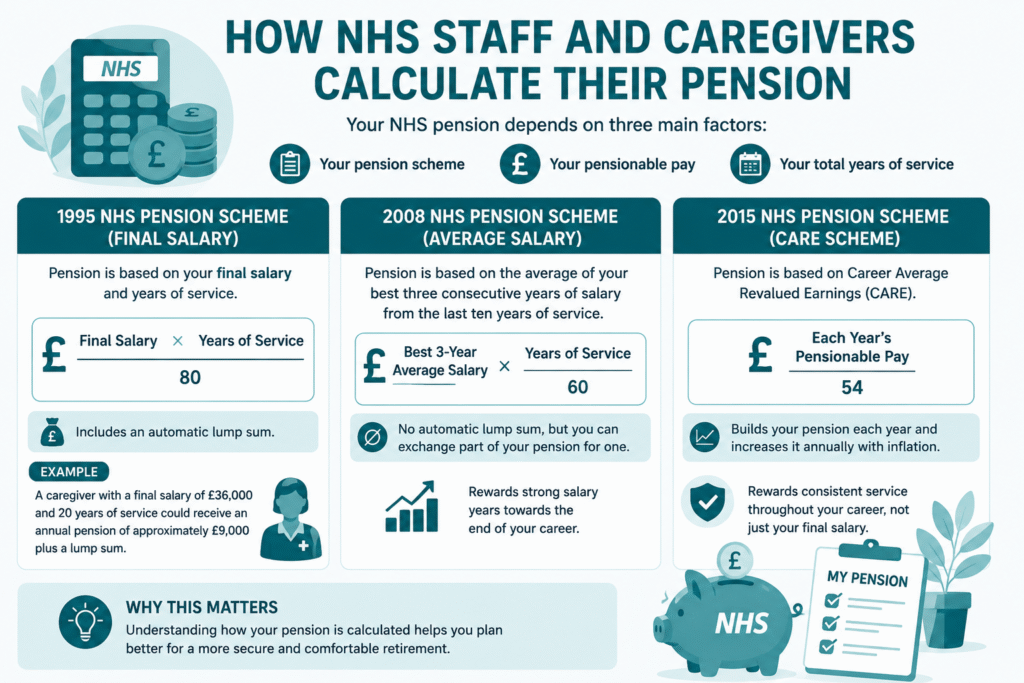
    Your NHS pension depends on three main factors:

    • your pension scheme
    • your pensionable pay
    • your total years of service

    Many caregivers ask:

    “How much NHS pension will I get after 20 years?”

    The answer varies based on whether you belong to the 1995, 2008, or 2015 NHS pension scheme.

    NHS Pension Calculator 1995 Section

    The 1995 scheme calculates pension using your final salary and years of service.

    Final Salary×Years of Service80\frac{\text{Final Salary}\times \text{Years of Service}}{80}80Final Salary×Years of Service​

    This scheme also includes an automatic lump sum.

    Example

    A caregiver with:

    • final salary of £36,000
    • 20 years of service

    could receive an annual pension of approximately £9,000 plus a lump sum.

    2008 NHS Pension Scheme

    The 2008 section uses the average of your best three consecutive years of salary from the last ten years of service.

    Best 3-Year Average Salary×Years of Service60\frac{\text{Best 3-Year Average Salary}\times \text{Years of Service}}{60}60Best 3-Year Average Salary×Years of Service​

    This scheme does not automatically include a lump sum, although members can usually exchange part of their pension for one.

    2015 NHS Pension Scheme (CARE)

    The 2015 scheme uses a Career Average Revalued Earnings (CARE) model.

    Each Year’s Pensionable Pay54\frac{\text{Each Year’s Pensionable Pay}}{54}54Each Year’s Pensionable Pay​

    Each year, the NHS adds a portion of your pensionable earnings to your pension pot and adjusts it annually for inflation.

    This structure benefits many long-term caregivers because it rewards consistent service across an entire career rather than only focusing on final salary.

    Why Your Salary Matters

    Your pension grows alongside your earnings. Staff progressing through Agenda for Change pay scales often see pension growth as they move through different NHS bands.

    For example:

    • Band 5 NHS pay builds a smaller pension than Band 6
    • Band 6 NHS pay and Band 7 NHS pay usually generate larger retirement benefits due to higher pensionable earnings

    That is why many staff use both an NHS pay calculator and an NHS pension calculator together when planning their finances.

    How NHS Banding and Salary Affect Your Pension

    Your NHS pension increases as your salary increases. Higher earnings usually lead to higher pension contributions and larger retirement benefits over time.

    Many caregivers and nurses move gradually through different levels of NHS banding during their careers. Each promotion can improve both monthly earnings and future pension income.

    How Agenda for Change Pay Scales Influence Pension Growth

    The NHS uses Agenda for Change pay scales to determine salary bands for most healthcare staff. As your salary rises, your pensionable pay also rises.

    For example:

    • a healthcare assistant on Band 4 NHS salary
    • a nurse on Band 5 NHS pay
    • a senior nurse on Band 6 NHS pay
    • or a manager on Band 7 NHS pay

    will all build different pension values based on their earnings and years of service.

    Band 6 NHS Pay and Pension Impact

    Many caregivers search for:

    • nhs band 6 salary
    • band 6 nhs pay 2025
    • nurse earnings uk

    because Band 6 often marks a major jump in both salary and pension growth.

    A higher pensionable salary means:

    • larger yearly pension accrual
    • higher employer contributions
    • stronger retirement income projections

    For many NHS workers, pension growth accelerates after progressing beyond Band 5.

    Why NHS Staff Use Salary and Pension Calculators Together

    An NHS salary calculator or NHS take home pay calculator helps staff estimate monthly pay after tax and pension deductions.

    An NHS pension calculator helps estimate long-term retirement income.

    Using both tools together gives caregivers a clearer financial picture because:

    • take-home pay affects current lifestyle
    • pension contributions affect future retirement security

    This balance matters even more as staff prepare for:

    • the NHS pay rise July 2025
    • pension contribution adjustments
    • and wider NHS pension scheme April 2025 changes.

    READ MORE: End of Life Care at Home: What to Expect in 2026, Costs, and Family Support

    NHS Pension Examples for Band 5, Band 6, and Band 7 Staff

    NHS pension scheme changes for 2025

    Real-life pension examples help caregivers understand how salary and years of service affect retirement income. These estimates are not official figures, but they show how the NHS pension scheme can build long-term financial security.

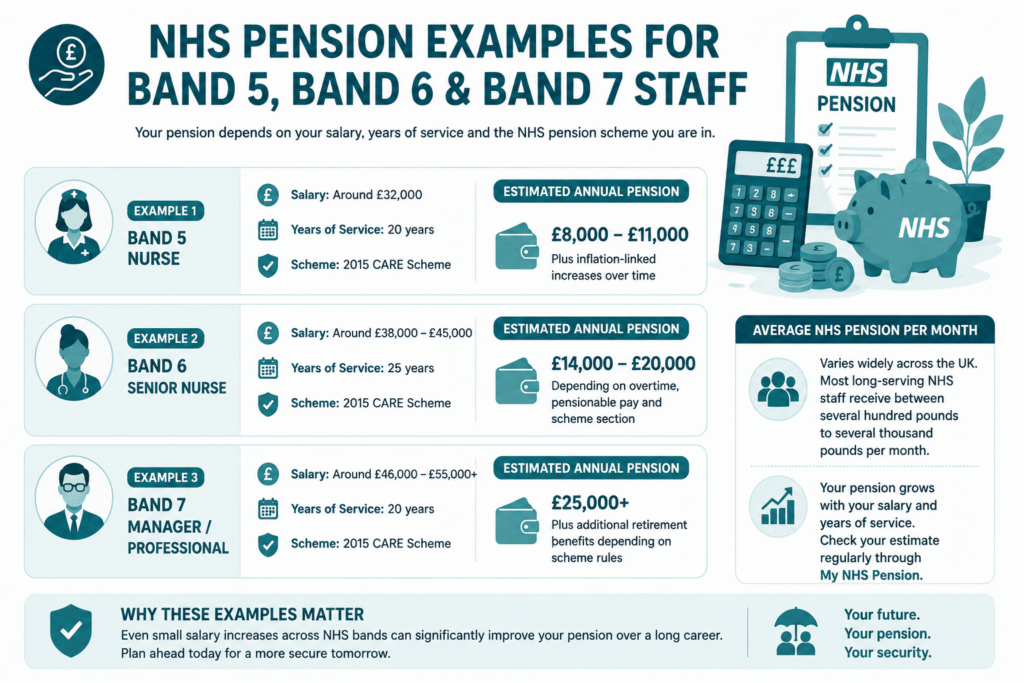
    Example 1: Band 5 Nurse

    A nurse earning approximately £32,000 under Band 5 NHS pay with 20 years of NHS service could build a pension worth several thousand pounds yearly, depending on their scheme membership and retirement age.

    Under the 2015 CARE scheme, consistent yearly contributions and salary progression could produce:

    • an estimated pension of £8,000–£11,000 annually
    • plus inflation-linked increases over time

    Example 2: Band 6 NHS Salary

    A caregiver or senior nurse on Band 6 NHS pay 2025 earning around £38,000–£45,000 may build significantly higher benefits over the same career period.

    After 25 years of service, many Band 6 staff could potentially receive:

    • £14,000–£20,000 yearly pension income
    • depending on overtime, pensionable pay, and scheme section

    This is one reason many NHS workers closely monitor their pension growth through My NHS Pension and ESR statements.

    Example 3: Band 7 NHS Pay

    Staff on Band 7 NHS pay often contribute more into the scheme because of higher pensionable earnings.

    A Band 7 healthcare professional with:

    • 30 years of NHS service
    • salary progression through multiple pay points
    • stable pension contributions

    could potentially build:

    • annual pension income above £25,000
    • plus additional retirement benefits depending on scheme rules

    Average NHS Pension Per Month

    The average NHS pension per month varies widely across the UK because retirement income depends on:

    • career length
    • salary history
    • pension scheme membership
    • retirement age

    Many long-serving NHS workers and caregivers receive monthly pensions ranging from several hundred pounds to several thousand pounds after retirement.

    That is why checking your pension estimate regularly matters, especially if your salary changes or you move into higher NHS bands.

    ALSO SEE: HICBC Child Benefit Rule Change UK: What Care Workers Need to Know in 2026

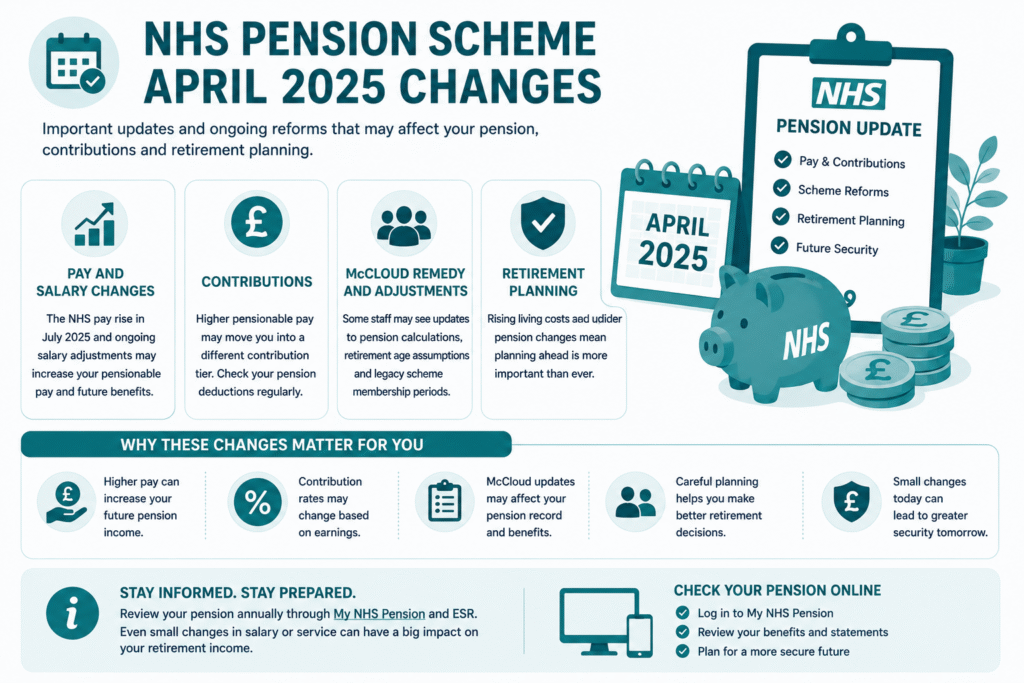
    NHS Pension Scheme April 2025 Changes Caregivers Should Know

    NHS Pension Calculator 2026
    NHS Pension Calculator 2026

    Recent updates to the NHS pension scheme continue to affect how caregivers, nurses, and healthcare staff plan for retirement. Understanding these changes can help you make better decisions about contributions, retirement timing, and long-term financial planning.

    Pension Contribution and Pay Changes

    The NHS pay rise July 2025, and ongoing salary adjustments across NHS bands may increase pensionable pay for many staff. Higher pensionable earnings can improve future pension benefits, but they may also move some workers into higher contribution tiers.

    Caregivers should regularly review:

    • contribution rates
    • pension deductions
    • updated pay bands
    • retirement projections

    especially after promotions or salary increases.

    McCloud Remedy and Scheme Adjustments

    Many NHS workers still review how the McCloud remedy affects their pension records and retirement estimates. Some staff may see updates to:

    • pension calculations
    • retirement age assumptions
    • legacy scheme membership periods

    This especially affects workers with service spanning multiple NHS pension schemes.

    Retirement Planning Matters More Than Ever

    Rising living costs and wider retirement concerns, including discussions around UK pensioner cash withdrawal changes 2025, have encouraged many healthcare workers to pay closer attention to pension planning.

    For caregivers and NHS staff, reviewing your pension annually can help you:

    • avoid retirement surprises
    • understand projected income
    • prepare for early retirement decisions
    • maximise long-term pension value

    Even small salary increases across NHS bands can significantly affect retirement income over a long healthcare career.

    MORE: Is There a Senility Test? 2026 Guide to Dementia Screening Tools

    Should You Use an NHS Salary Calculator or Pension Calculator?

    An NHS salary calculator and an NHS pension calculator serve different purposes. Most caregivers and NHS workers benefit from using both together.

    An NHS salary tool estimates:

    • monthly take-home pay
    • tax deductions
    • National Insurance
    • pension deductions

    An NHS pension tool estimates:

    • future retirement income
    • yearly pension growth
    • projected benefits after retirement

    When to Use an NHS Salary Calculator

    An NHS pay calculator or NHS take home pay calculator helps staff understand how much money reaches their bank account each month.

    This becomes especially useful when:

    • moving between NHS bands
    • checking overtime impact
    • reviewing salary increases
    • comparing new job offers

    For example, staff moving from Band 5 NHS pay to Band 6 NHS pay often use salary calculators to estimate changes in take-home income before accepting a new role.

    When to Use an NHS Pension Calculator

    An NHS pension calculator helps caregivers plan for long-term financial security.

    You should check your pension estimate when:

    • your salary changes
    • you change NHS bands
    • you plan early retirement
    • you approach retirement age
    • pension rules change

    Official tools through ESR or My NHS Pension usually provide the most accurate estimates because they use your real employment and contribution records.

    Why Both Tools Matter

    Many NHS workers focus heavily on present income but underestimate the long-term value of the NHS pension scheme.

    Using both calculators together helps caregivers:

    • balance current income with future retirement planning
    • understand how pension contributions affect take-home pay
    • make better career and retirement decisions

    For long-serving healthcare staff, the NHS pension can become one of the most valuable financial benefits they ever receive.

    Conclusion

    The NHS pension scheme remains one of the strongest retirement benefits available to healthcare workers and caregivers in the UK. Whether you work under Band 5 NHS pay, Band 6 NHS pay, or Band 7 NHS pay, your salary, years of service, and pension scheme all directly shape your future retirement income.

    Using an official NHS pension calculator through ESR or My NHS Pension gives you the clearest picture of what you may receive in retirement. Combining this with an NHS salary calculator or NHS take home pay calculator can also help you balance present earnings with long-term financial security.

    For caregivers and NHS staff, regular pension reviews are no longer optional. Understanding your pension today can help you make smarter career, salary, and retirement decisions for the future.

    Need Help Navigating NHS Career, Compliance, or Workforce Support?

    At Care Sync Experts, we help caregivers, care providers, and healthcare organisations stay informed about the latest NHS workforce developments, compliance updates, funding opportunities, and operational best practices.

    Whether you run a care business or work within the NHS, our resources and expert guidance can help you make more confident financial and professional decisions in 2026 and beyond.

    FAQ

    Is an NHS pension a good pension?

    Many financial experts consider the NHS pension one of the strongest public sector pension schemes in the UK. The scheme includes employer contributions, inflation-linked benefits, and long-term retirement security that many private pensions do not fully match.

    For long-serving caregivers and NHS workers, the pension can become a major part of their retirement income.

    What percentage of my NHS pension do I pay?

    NHS pension contributions vary based on your pensionable salary. Lower earners pay a smaller percentage, while higher earners contribute more through tiered contribution rates.
    Contribution rates typically range from around 5% to over 12% depending on:
    – NHS banding
    – pensionable pay
    – current contribution thresholds

    Your employer also contributes a significant percentage toward your pension.

    What happens to my NHS pension if I leave the NHS?

    If you leave the NHS before retirement, your pension usually remains in the scheme as a deferred pension. It will normally continue to increase in value over time until you reach retirement age.
    Your options may include:
    – leaving the pension where it is
    – transferring it to another pension scheme
    – returning to NHS employment later and continuing contributions

    The best option depends on your career plans and length of NHS service.

    What are the disadvantages of taking your pension at 55?

    Taking your NHS pension early can reduce your yearly retirement income because the scheme expects to pay benefits for a longer period.
    Early retirement may lead to:
    – permanently reduced pension payments
    – lower lifetime pension value
    – reduced lump sum options
    – fewer contribution years

    Many caregivers choose to compare early retirement estimates carefully before making a final decision.