Families and caregivers can strengthen a Personal Independence Payment (PIP) or Adult Disability Payment (ADP) claim in 2026 by focusing on how a condition affects daily living and mobility rather than the diagnosis itself.
The best PIP and ADP insider tips include keeping a detailed “bad day” diary, understanding the PIP points system, providing evidence that reflects daily struggles, and explaining risks such as pain, breathlessness, falls, or memory problems clearly during assessments.
Recent Personal Independence Payment news today also shows growing concern around new PIP rules, reviews, and the PIP payment increase expected in April 2026. For many claimants, strong preparation and consistent evidence now matter more than ever.
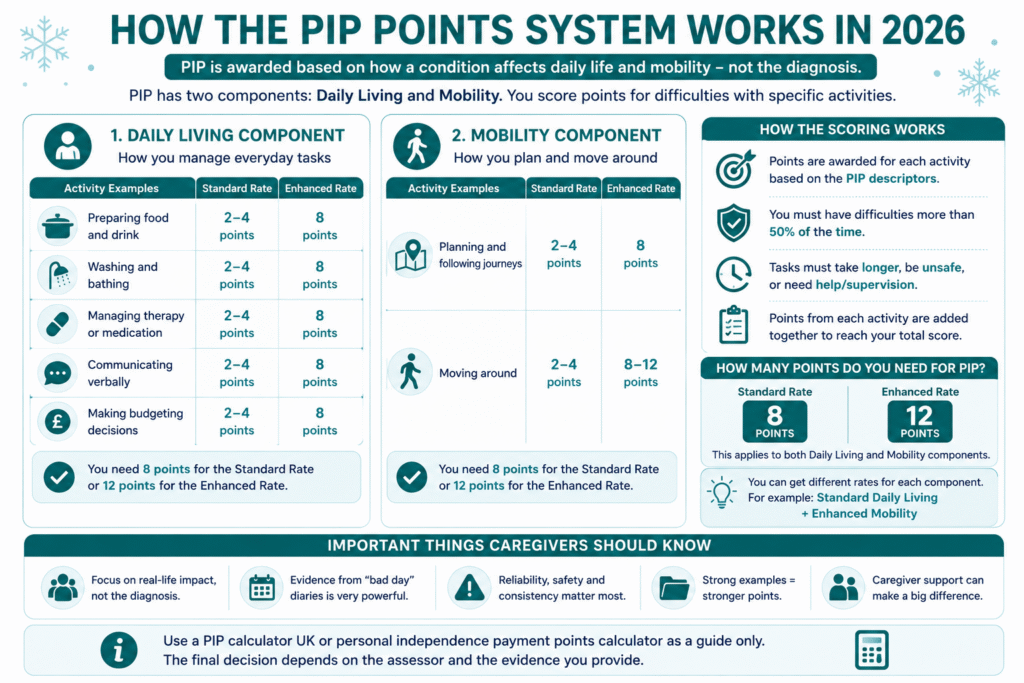
The PIP points system measures how a health condition or disability affects a person’s ability to manage everyday activities safely and consistently. Assessors do not award points based on a diagnosis alone. Instead, they use specific PIP descriptors to decide how much support someone needs with daily living and mobility tasks.
PIP divides assessments into two areas:
Daily Living
Mobility
Each section contains activities with different scoring levels. These scores are known as personal independence descriptors or PIP descriptors and points.
For example, the daily living section looks at tasks such as:
Preparing food
Washing and bathing
Managing medication
Communicating
Making budgeting decisions
The mobility section focuses on:
Planning journeys
Moving around safely
Many caregivers wrongly assume a medical diagnosis automatically qualifies someone for support. In reality, assessors look for evidence that the person cannot complete activities safely, repeatedly, to an acceptable standard, or within a reasonable time, for more than 50% of the time.
This rule becomes especially important for people with fluctuating conditions, chronic pain, mobility issues, anxiety, or personal independence payment depression claims.
How Many Points Do You Need for PIP?
Claimants usually need:
8 points for the standard rate
12 points for the enhanced rate
This applies separately to both Daily Living and Mobility components.
For example, someone may receive:
Standard Daily Living
Enhanced Mobility
depending on their total score.
Many families now use a personal independence payment points calculator or a PIP calculator UK tool to estimate potential entitlement before applying. While these tools help, they cannot replace strong written evidence and detailed examples from daily life.
Caregivers should also understand that PIP mobility points often depend on reliability and safety rather than physical distance alone. Someone may technically walk a short distance but still qualify if pain, fatigue, dizziness, or psychological distress makes the activity unsafe or inconsistent.
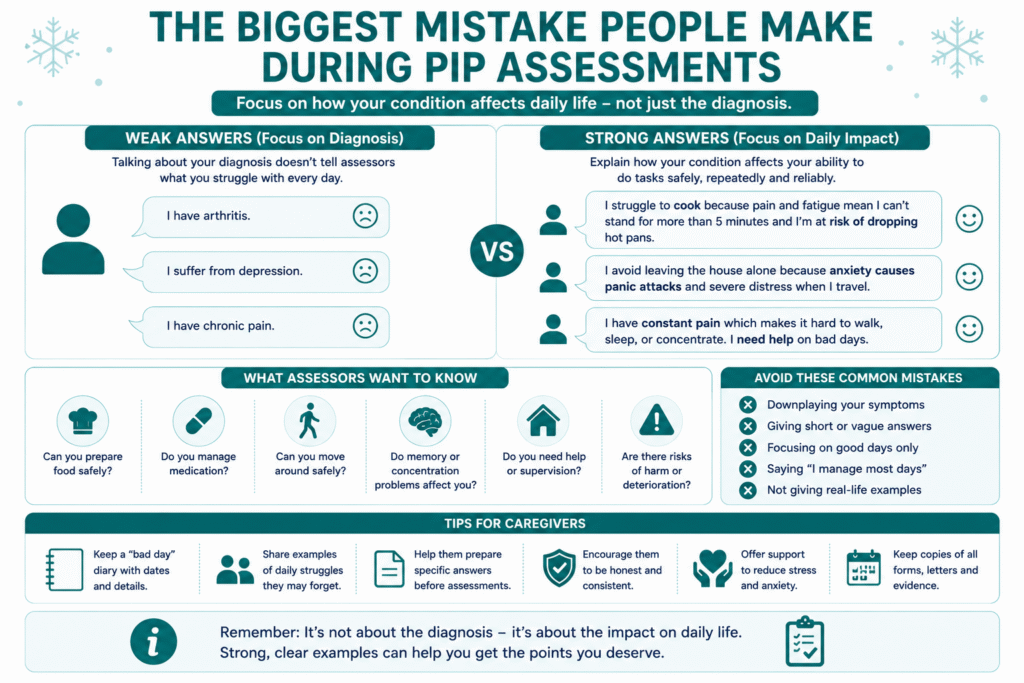
The Biggest Mistake People Make During PIP Assessments
The biggest mistake during PIP assessments
The biggest mistake claimants make during PIP assessments is talking about their diagnosis instead of explaining how their condition affects daily life.
Many people say things like:
“I have arthritis.”
“I suffer from depression.”
“I have chronic pain.”
However, PIP assessment questions focus on functional impact, not medical labels.
Assessors want to know:
What happens when you try to cook?
Do you forget medication?
Can you walk safely without stopping?
Does anxiety prevent you from travelling alone?
Do you need prompting, supervision, or physical support?
This is where many claims lose valuable points.
For example, saying, “I struggle with anxiety,” sounds far weaker than, “I avoid travelling alone because anxiety causes panic attacks, confusion, and severe distress during journeys.”
The second answer directly connects the condition to the PIP descriptors.
Caregivers often notice daily difficulties that claimants forget to mention during assessments. A family member may remember:
falls in the bathroom
missed medication
breathlessness during simple tasks
confusion with money
mobility problems after short walks
These details matter because the new PIP points system rewards evidence that clearly shows risk, supervision needs, or inability to complete tasks reliably.
Another major mistake involves downplaying symptoms. Many people try to appear positive or independent during assessments, especially older adults who feel uncomfortable discussing personal struggles. This issue affects many DWP PIP older claimants who have lived independently for years and dislike asking for help.
Unfortunately, statements like:
“I manage most days”
“I just get on with it”
“I try not to complain”
can reduce points if they contradict written evidence.
Instead, claimants should answer honestly and describe what happens on bad days, especially if those difficulties affect them more than 50% of the time.
Caregivers should also encourage claimants to give specific examples rather than short answers. Strong examples make PIP questions easier for assessors to understand and harder to misinterpret.
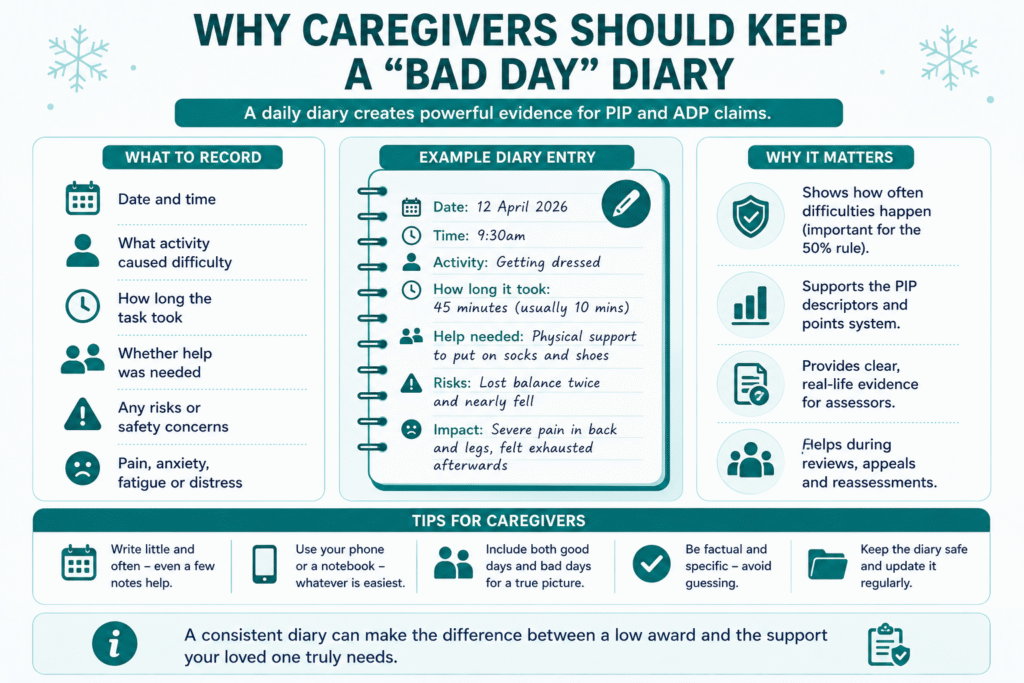
A “bad day” diary can become one of the strongest pieces of evidence in a PIP or ADP claim, especially for people with fluctuating conditions, mental health challenges, chronic pain, or fatigue-related illnesses.
Many claimants forget important details during assessments. Caregivers often remember those moments more clearly because they see the daily impact firsthand.
A diary helps create a clear timeline of:
falls or mobility struggles
panic attacks or emotional distress
missed medication
confusion or memory problems
breathlessness
pain flare-ups
unsafe situations in the kitchen or bathroom
This type of evidence supports the PIP descriptors and points system because it shows how often difficulties happen in real life.
For example, instead of writing: “My mother struggles with mobility,” a caregiver can document: “On three occasions this week, my mother stopped halfway up the stairs due to breathlessness and knee pain. She needed physical support to continue safely.”
That level of detail carries far more weight during PIP assessments.
A diary also helps caregivers answer pip assessment questions consistently during reviews or reassessments. Inconsistent answers often trigger additional scrutiny, especially when written evidence conflicts with verbal responses.
People with depression, PTSD, anxiety, fibromyalgia, arthritis, or neurological conditions may experience “good days” and “bad days.” A diary helps demonstrate that even if someone appears well occasionally, they still struggle for more than 50% of the time.
Caregivers should encourage claimants to record:
dates and times
what activity caused difficulty
how long the task took
whether help was needed
any risks or safety concerns
Even simple phone notes can help build a strong evidence trail over time.
Many families focus heavily on medical records, but assessors often place equal importance on practical daily examples. A detailed diary bridges the gap between a diagnosis and the real-life challenges behind a PIP claim.
The latest PIP News confirms that Personal Independence Payment rates increased again in April 2026 as part of the government’s annual benefits uprating process. Many families searching “How much will PIP rise in 2026” or “How much will PIP be in 2026” want to understand how these changes affect household finances and long-term care planning.
The new PIP rates for 2026/27 mean some claimants now receive up to £778.40 every four weeks, depending on their award level and eligibility.
Current PIP rates include:
Standard Daily Living: £73.90 per week
Enhanced Daily Living: £110.40 per week
Standard Mobility: £29.20 per week
Enhanced Mobility: £77.05 per week
These updated figures reflect the latest PIP payment increase introduced in April 2026.
However, caregivers should pay close attention to ongoing discussions around new PIP rules and future assessment reforms. The government continues to review eligibility criteria, assessment processes, and support for long-term conditions. These changes could affect future claims, reviews, and reassessments.
Families supporting vulnerable adults should also monitor Personal Independence Payment news today for updates involving:
reassessment rules
mental health claims
mobility scoring
support for older claimants
changes affecting ADP in Scotland
Staying informed helps caregivers prepare stronger evidence and avoid unnecessary stress during reviews or appeals.
Many caregivers struggle to find the correct PIP phone number when they need urgent help with a new claim, review, or assessment update. Keeping the right contact details nearby can reduce stress and help families respond quickly to DWP requests.
The main personal independence payment phone number for new claims and general enquiries is:
PIP New Claims: 0800 917 2222
For people managing an existing claim, review, or change in circumstances, the pip contact number existing claim is:
PIP Enquiry Line: 0800 121 4433
Claimants can use these lines to:
request forms
report health changes
ask about payments
check assessment updates
request copies of previous claim forms
Caregivers should also consider getting support from:
Citizens Advice
disability charities
welfare rights advisers
local carers’ organisations
These services often help families understand pip descriptors, gather evidence, prepare for assessments, and challenge unfair decisions.
People living in Scotland who receive Adult Disability Payment (ADP) can also contact Social Security Scotland for application support and guidance during transfers from PIP.
Before calling, caregivers should keep:
National Insurance numbers
appointment dates
medical evidence
copies of claim forms
close by to make conversations faster and easier.
Final Thoughts…
Strong PIP and ADP claims rarely succeed because of a diagnosis alone. Successful claims usually include detailed examples, consistent evidence, and clear explanations of how a condition affects daily life.
Caregivers often play a critical role in that process. They notice changes that claimants may overlook, help document difficult moments, and provide valuable support during stressful assessments or reviews.
Understanding the PIP points system, keeping a detailed “bad day” diary, and preparing carefully for pip assessment questions can significantly improve the quality of a claim. Small details matter. Explaining why a task feels unsafe, painful, exhausting, or impossible often carries more weight than medical terminology alone.
Families should also stay updated with the latest PIP News, especially as discussions around new PIP rules and future assessment changes continue throughout 2026.
Most importantly, claimants should never feel pressured to minimise their struggles. Honest, specific, and well-supported answers give assessors a clearer picture of daily challenges and help ensure people receive the support they genuinely need.
Need Support Navigating PIP or ADP?
Care Sync Experts supports caregivers, families, and vulnerable adults with practical guidance on care, compliance, and daily living support.
Whether you need help understanding PIP descriptors, preparing evidence for assessments, or staying updated with Personal Independence Payment news today, our team provides clear and compassionate resources designed for real-world caregiving challenges.
Explore more caregiver support guides and disability benefit resources with Care Sync Experts to stay informed, prepared, and confident throughout the claims process.
FAQ
Is PIP or ADP Better?
Adult Disability Payment (ADP) and Personal Independence Payment (PIP) provide similar financial support, but many claimants in Scotland consider ADP less stressful because Social Security Scotland uses a more compassionate approach during assessments and reviews.
ADP also places greater emphasis on gathering supporting information before requiring face-to-face consultations.
When Did ADP Replace PIP?
Adult Disability Payment began replacing PIP for working-age disabled adults in Scotland in 2022. Social Security Scotland gradually transferred existing PIP claimants from the DWP system to ADP, and all transfers now happen automatically without requiring a new application.
How Often Is ADP Paid?
Adult Disability Payment usually pays every four weeks directly into the claimant’s bank account. In some situations, terminally ill claimants may receive weekly payments depending on their circumstances and support arrangements.
What Are Common PIP Mistakes?
Many people lose valuable points because they: – downplay their symptoms – give vague answers during assessments – focus only on diagnosis instead of daily impact – forget to mention safety risks or supervision needs – fail to provide detailed supporting evidence
Caregivers can help avoid these mistakes by keeping records, documenting bad days, and preparing examples before the assessment.
The blue badge pip welfare reform will change how some people qualify for a Blue Badge by tightening the Personal Independence Payment (PIP) mobility assessment. The Department for Work and Pensions (DWP) plans to complete its review by Autumn 2026, with stricter eligibility rules likely to affect new applicants from late 2026.
However, the DWP confirms PIP eligibility changes won’t affect Blue Badge travel concessions for existing claimants, meaning those already receiving PIP and related benefits will keep their current support for now.
Existing claimants remain protected: The DWP confirms PIP eligibility changes won’t affect Blue Badge travel concessions for current recipients.
New applicants face stricter rules: Updated assessment criteria will apply from late 2026, affecting future Blue Badge eligibility.
8-point mobility rule under review: Automatic qualification linked to the mobility component may change.
DWP review timeline: The PIP mobility and daily living assessment review concludes in Autumn 2026, with outcomes expected before 2027.
Direct link to Blue Badge access: PIP acts as a gateway to PIP passported benefits, including the Blue Badge and other mobility support.
Wider impact on daily life: Changes may affect access to parking support, including the wheelchair parking permit system.
This PIP Blue Badge concession travel update creates uncertainty for care providers and clients, especially those planning new Blue Badge applications after 2026.
Care providers rely on stable mobility support to deliver consistent, high-quality care. The blue badge pip welfare reform directly affects how clients travel, attend appointments, and maintain independence.
A Blue Badge allows clients to park in disabled bays, reduce travel strain, and access services safely. When eligibility changes, caregivers must adjust care plans, transport arrangements, and scheduling.
How this impacts daily care delivery:
Missed or delayed appointments: Clients without a valid Blue Badge may struggle to attend medical visits or therapy sessions.
Increased travel time: Care workers may spend more time finding suitable parking, affecting visit schedules.
Reduced client independence: Losing access to a wheelchair parking permit can limit mobility and social participation.
Higher operational pressure: Care agencies may need to allocate more resources for transport and support.
The connection between Personal Independence Payment and mobility access remains critical. PIP acts as a gateway to PIP passported benefits, including Blue Badge access. When DWP PIP assessment changes tighten eligibility, fewer new applicants may qualify automatically.
Care providers should not treat this as just policy news. This is a service delivery issue. Every change in Blue Badge eligibility can directly affect how caregivers plan visits, manage risks, and support vulnerable clients.
Staying ahead of Personal Independence Payment news today helps care businesses protect continuity of care and avoid disruption for the people who depend on them most.
Current Blue Badge Eligibility and PIP Rules
Understanding current Blue Badge eligibility helps care providers prepare for upcoming changes under the blue badge pip welfare reform.
What is the current rule for automatic eligibility?
A person qualifies automatically for a Blue Badge if they score 8 points or more in the “moving around” activity of the Personal Independence Payment (PIP) mobility component.
A score of 8 or more in PIP mobility indicates significant difficulty walking and grants automatic access to a Blue Badge.
Key Blue Badge criteria (current system)
The applicant receives the higher or standard rate of the PIP mobility component
The applicant scores at least 8 points in mobility assessment
The condition affects the ability to walk or move safely
The limitation is long-term (usually 12 months or more)
Are there other ways to qualify?
Yes. Not all applicants rely on PIP for a Blue Badge application.
Local councils can approve applications based on:
Severe mobility issues (even without PIP)
Hidden disabilities (e.g. cognitive or neurological conditions)
Medical evidence supporting reduced mobility
This means:
Blue Badge eligibility does not depend solely on PIP, but PIP remains the most common route for automatic approval.
What are the new rules for a Blue Badge?
The current rules still apply today. However, the DWP PIP assessment changes under review may alter how applicants reach the 8-point threshold.
For care providers, this matters because:
Fewer new applicants may qualify automatically
More clients may need to go through manual council assessments
The blue badge criteria could become harder to meet through PIP alone
Understanding today’s system allows care providers to spot risks early and support clients through future changes in eligibility.
What Are the New Rules for a Blue Badge Under PIP Reform?
Blue Badge Application Process
The blue badge pip welfare reform focuses on tightening how the Personal Independence Payment (PIP) mobility component is assessed. The DWP has not finalized the new rules yet, but current updates point to stricter eligibility for new applicants.
What is changing under the reform?
Stricter mobility assessments: The DWP PIP assessment changes will review how walking ability and mobility limitations are scored.
Higher threshold for automatic eligibility: Some applicants may struggle to reach the current 8-point score required for automatic Blue Badge eligibility.
Greater focus on real-world mobility: Assessments may place more emphasis on how consistently a person can walk, not just whether they can walk a short distance.
Closer review of fluctuating conditions: Conditions that vary day-to-day may face stricter evaluation.
The DWP aims to ensure the Personal Independence Payment system remains “fair and fit for the future,” but this may reduce automatic qualification for some applicants.
What is NOT changing right now?
Existing claimants will not lose their Blue Badge or PIP immediately
Current eligibility rules still apply until the review concludes
No confirmed removal of the Blue Badge scheme
This Personal Independence Payment news today shows that the system is evolving—but not yet fully changed.
Why this matters for Blue Badge access
The Blue Badge depends heavily on PIP mobility scores. When the assessment becomes stricter:
Fewer people may qualify automatically
More applicants may need a manual Blue Badge application through local councils
Approval decisions may take longer
For care providers, this means:
Future clients may face delays or rejection when applying for mobility support, even if their condition remains unchanged.
Staying informed about PIP Blue Badge concession travel updates will help care businesses prepare clients for these potential changes.
Who Will Be Affected by the Blue Badge PIP Welfare Reform?
The blue badge pip welfare reform will not affect everyone in the same way. Care providers should understand exactly which groups face risk and which remain protected.
Existing Claimants (Protected for Now)
Current Personal Independence Payment recipients will keep their benefits and related support.
They will continue to receive PIP passported benefits, including Blue Badge access
They can still renew Blue Badge permits under current rules
The DWP confirms PIP eligibility changes won’t affect Blue Badge travel concessions for this group
Existing claimants will not lose their Blue Badge due to the new assessment rules.
Care providers should still monitor renewal timelines. When clients renew disabled badge permits, local councils may review eligibility, especially if circumstances change.
New Applicants (Late 2026 and Beyond)
New claimants face the biggest impact.
Stricter DWP PIP assessment changes will apply
Reaching the 8-point mobility threshold may become harder
Automatic Blue Badge eligibility may reduce
This means: More applicants may need to complete a full Blue Badge application form instead of relying on automatic qualification.
Care providers should prepare clients early, especially those planning to apply after 2026.
Borderline and Complex Cases
Some clients sit close to the eligibility threshold.
Individuals scoring near 8 points in mobility
People with fluctuating conditions
Clients with non-visible disabilities
These groups face the highest uncertainty.
They may lose automatic qualification
They may need additional medical evidence
Councils may require a manual assessment using the blue badge form
What This Means for Care Providers
Care providers must take a proactive role:
Identify clients who rely on Blue Badge access
Support early applications before stricter rules apply
Help clients gather documentation for future assessments
Changes to Blue Badge eligibility will not remove support overnight, but they will reshape how new clients access mobility assistance.
Blue Badge Application and Renewal: What Care Providers Should Do Now
Blue Badge Application
Care providers can reduce disruption by acting early. The blue badge pip welfare reform will tighten access for new applicants, so preparation matters.
Act now: support clients before stricter rules apply
Start applications early: Encourage eligible clients to submit a Blue Badge application before late 2026.
Check eligibility upfront: Use a blue badge eligibility checker to confirm current criteria.
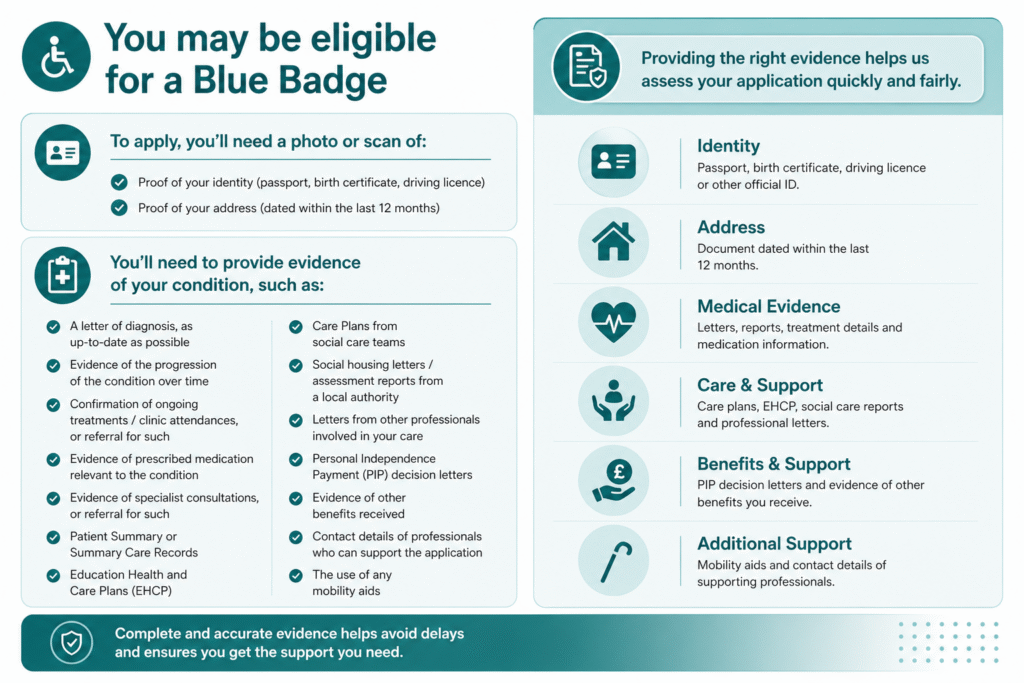
Prepare evidence: Collect medical letters, care plans, and mobility assessments in advance.
Plan renewals: Track expiry dates and help clients renew Blue Badge or renew disabled badge on time.
Early, complete applications have a higher chance of approval under current rules.
How to apply or renew a Blue Badge
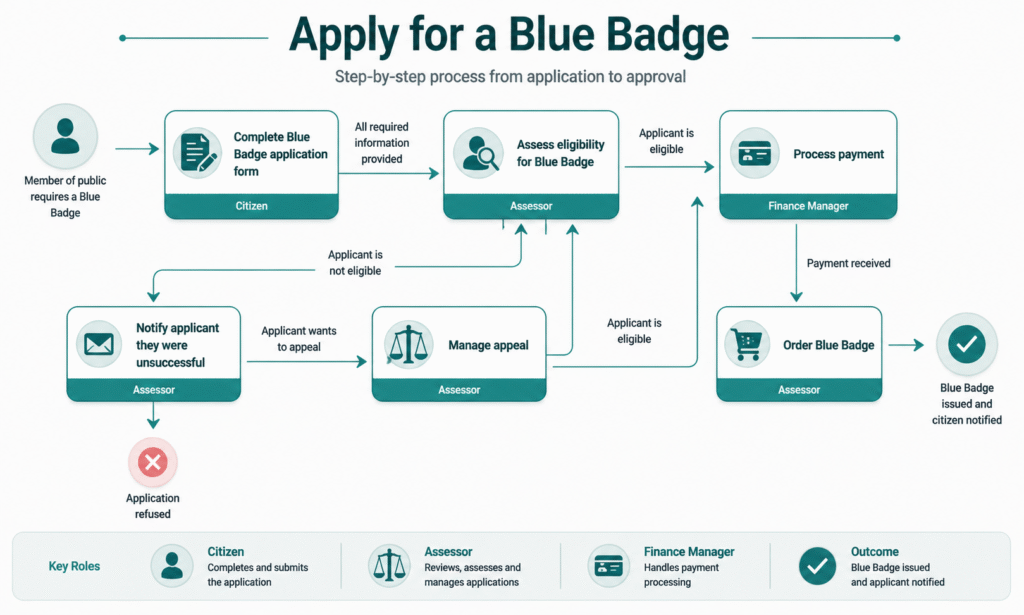
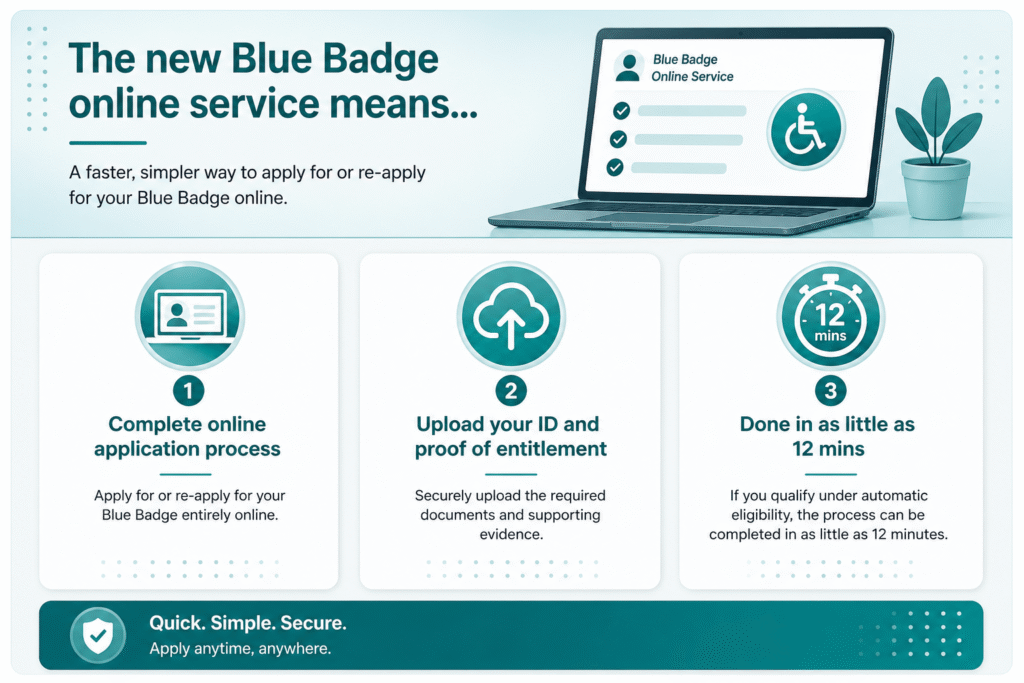
Complete the blue badge application form (or application form for blue badge) via the local council or GOV.UK
Upload supporting documents (ID, proof of address, medical evidence)
Pay any required fee
Use blue badge track application tools to monitor progress
For clients who do not qualify automatically through Personal Independence Payment, councils may request a mobility assessment before approval.
Where to get help
Contact your local council using the blue badge contact number
Use national helplines if available (blue badge phone number, disabled blue badge phone number, or disability blue badge contact number)
Refer clients to trusted advice services for form support and evidence gathering
What care providers should prioritise
Documentation readiness: Keep client records updated and accessible
Clear communication: Explain timelines and possible delays to clients and families
Contingency planning: Adjust transport and visit schedules if access to a wheelchair parking permit changes
By guiding clients through the Blue Badge application and renewal process now, care providers can protect continuity of care while the DWP PIP assessment changes evolve.
Timeline: When Will PIP and Blue Badge Changes Happen?
Blue Badge Eligibility
Care providers need a clear timeline to plan ahead. The blue badge pip welfare reform will roll out in stages, not all at once.
Key dates to watch
Now (2026): Current rules remain in place. Clients can still qualify for Blue Badge eligibility under existing Personal Independence Payment criteria.
Autumn 2026: The DWP completes its review of the PIP mobility and daily living assessment. This is when final recommendations become clear.
Late 2026 (expected): New rules begin to apply to new applicants only, based on updated DWP PIP assessment changes.
2027 onward: Full impact becomes visible as more applicants go through the revised system.
What this means in practice
Existing claimants keep their current benefits and can still renew Blue Badge permits
New applicants may face stricter assessments and delayed approvals
Councils may rely more on manual assessments instead of automatic qualification
The system will not change overnight, but eligibility for new applicants will gradually become stricter.
Action for care providers
Apply early where possible
Track Personal Independence Payment news today for confirmed updates
Prepare clients for potential delays in Blue Badge application approvals
Understanding this timeline helps care providers stay proactive instead of reactive as reforms take shape.
Should Care Providers Be Concerned About PIP Changes?
blue badge pip welfare reform
Care providers should stay alert, but they do not need to panic. The blue badge pip welfare reform introduces gradual changes, not immediate disruption.
What you should not worry about right now
Existing clients will not lose their Blue Badge or PIP overnight
Current Blue Badge eligibility rules still apply
The DWP has not finalized all PIP assessment changes
The DWP confirms PIP eligibility changes won’t affect Blue Badge travel concessions for current claimants.
Where you should focus your attention
Future clients: New applicants may struggle to qualify under stricter rules
Borderline cases: Clients near the 8-point mobility threshold face higher risk
Application delays: More manual reviews may slow down approvals
What care providers should do next
Educate clients early: Explain how Personal Independence Payment changes could affect mobility support
Encourage early applications: Help clients complete a Blue Badge application form before late 2026
Track updates: Follow reliable Personal Independence Payment news today sources
Support documentation: Ensure medical and care records clearly reflect mobility limitations
Final Thoughts…
The blue badge pip welfare reform signals a shift in how mobility support will work, but it does not remove support entirely. Care providers who act early will stay ahead of these changes.
Focus on what you can control:
Help clients understand how Personal Independence Payment affects Blue Badge eligibility
Encourage early Blue Badge application submissions before stricter rules begin
Keep documentation accurate and up to date for future assessments
Support clients when they renew Blue Badge permits or submit a blue badge form
The system is evolving, but informed care providers can still secure the support their clients need.
As DWP PIP assessment changes take shape, your role becomes even more important. You are not just delivering care, you are helping clients navigate access to essential services like parking in disabled spaces and maintaining independence.
Stay informed, stay proactive, and continue to guide your clients through every stage of the process.
Stay Ahead of PIP Reforms and Protect Your Clients
The blue badge pip welfare reform will change how clients access mobility support, and care providers who prepare early will have the advantage.
At Care Sync Experts, we help you:
Navigate DWP PIP assessment changes with confidence
Keep your service compliant and inspection-ready
Support clients through Blue Badge applications and eligibility changes
Strengthen your position to win and retain local authority contracts
Don’t wait for the changes to impact your service.
Speak to our team today and get a clear, actionable plan to protect your clients, adapt your operations, and grow your care business in 2026 and beyond.
FAQ
Do you qualify for a Blue Badge if you get PIP?
Yes, many people qualify automatically if they receive the mobility component of Personal Independence Payment (PIP) and score 8 points or more in the “moving around” activity. However, not everyone on PIP qualifies automatically, some may still need to apply through their local council and provide additional evidence.
How many years is a Blue Badge valid?
A Blue Badge is usually valid for up to 3 years. In some cases, councils may issue a shorter-term badge depending on the applicant’s condition or review requirements. Care providers should always track expiry dates to ensure clients renew Blue Badge permits on time.
What evidence is needed for a Blue Badge?
Applicants typically need to provide: – Proof of identity (passport or driving licence) – Proof of address – Recent photograph – Medical evidence (if not automatically eligible through PIP)
Councils may also request details about mobility challenges when assessing Blue Badge eligibility.
Can I use my Blue Badge abroad?
Yes, you can use a UK Blue Badge in some countries, especially within the EU, but rules vary by location. Each country sets its own parking regulations, so users should check local guidance before travelling to ensure they follow the correct rules when parking in disabled spaces.
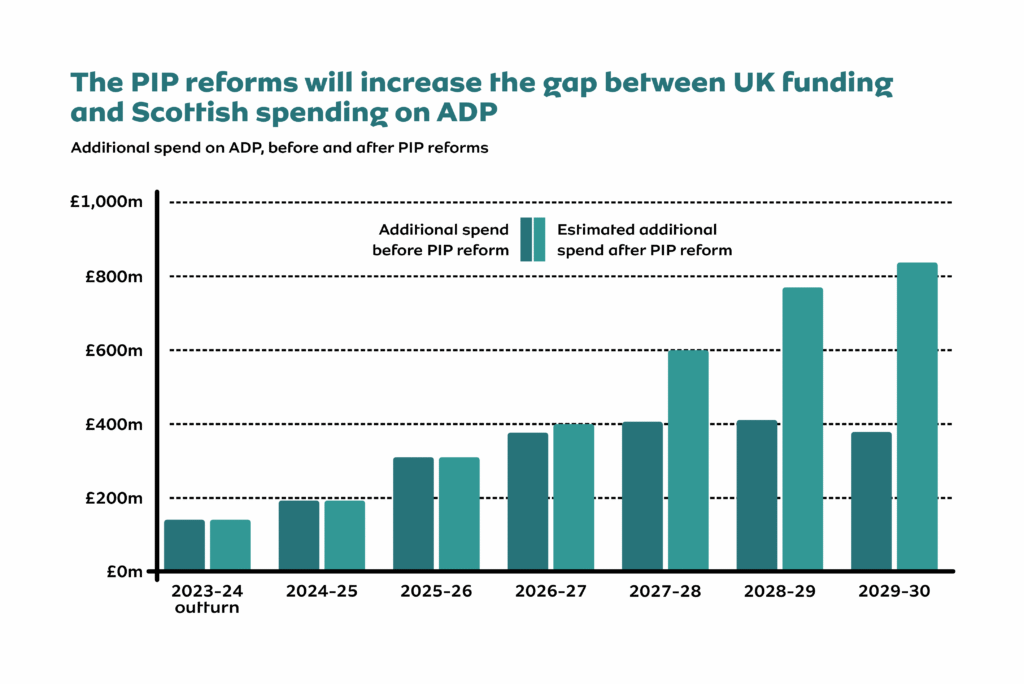
The Scotland PIP ADP update confirms that Social Security Scotland has completed the transfer of existing Personal Independence Payment (PIP) cases to Adult Disability Payment (ADP) by late 2025.
If you live in Scotland and still receive PIP, you should have already received a transfer letter. If not, you must contact Social Security Scotland immediately.
From November 2025, new applicants can no longer apply for PIP in Scotland. All new claims must go through Adult Disability Payment Scotland, which now fully replaces PIP for working-age adults. You cannot receive both benefits at the same time.
This Adult Disability Payment update also maintains the same eligibility criteria and payment rates as PIP, ensuring continuity for claimants during the transition. However, the system now follows a more person-centred approach, with fewer face-to-face assessments and simplified reporting requirements.
For care providers, this pip adp 2025/2026 transition means one thing: every eligible client in Scotland should now be on ADP or in the process of applying for it.
Social Security Scotland has completed all transfers from PIP to Adult Disability Payment Scotland, so most clients should now be on ADP.
New applicants must apply directly for ADP through mygov scotland. PIP is no longer available for new claims in Scotland.
ADP rates remain aligned with PIP, so clients receive the same level of financial support after transfer.
ADP uses a more person-centred system, reducing the need for face-to-face assessments and making the process less stressful for vulnerable individuals.
Care providers must actively support clients with ADP change of circumstances, ensuring updates are reported correctly when required.
Clients cannot receive both PIP and ADP at the same time, so any overlap or confusion must be resolved quickly.
For care teams, these updates are not just administrative; they directly affect how you support clients, manage care plans, and ensure individuals continue receiving the correct Scottish disability payment without disruption.
What This Means for Care Providers and Support Workers
The Scotland PIP ADP update places care providers at the centre of the transition. You are no longer just delivering care; you are helping clients navigate the Scottish disability payment system correctly.
Care providers must now:
Identify clients still on PIP in Scotland and guide them to contact Social Security Scotland if they missed the transfer
Support new clients applying for Adult Disability Payment Scotland instead of PIP
Help clients gather supporting evidence for applications (care plans, observations, reports)
Monitor and assist with ADP change of circumstances to prevent payment disruptions
This shift also changes how you approach care planning. ADP focuses more on how a condition affects daily living rather than rigid assessments. That means your documentation, daily notes, incident reports, and care observations now plays a bigger role in supporting claims.
For example, if a client struggles with mobility or daily tasks, your recorded observations can directly support their eligibility during an ADP review. This makes accurate, consistent documentation essential.
Care providers who understand this transition gain a clear advantage. You reduce delays, prevent benefit interruptions, and build stronger trust with clients and families. In today’s system, strong care delivery and benefit support now go hand in hand.
Not every client needs to take action, but care providers must quickly identify those who do. The Scotland PIP ADP update affects different groups in different ways.
1. Clients Still Receiving PIP in Scotland
If a client still receives pip scotland payments and has not received a transfer letter, they must act immediately. They should contact Social Security Scotland to confirm their status and avoid any disruption in payments.
Care provider role:
Flag these clients during reviews
Help them contact the social security scotland number
Document any delays or risks
2. New Applicants
Anyone making a new claim must apply for Adult Disability Payment Scotland—not PIP.
This includes:
Adults with long-term physical or mental conditions
Individuals previously asking “who qualifies for PIP in Scotland”—the same criteria now applies to ADP
Young people moving from child disability payment scotland to adult support
Care provider role:
Guide clients through the correct application route
Ensure they use mygov scotland or approved channels
Help prepare supporting evidence early
3. Existing ADP Claimants
Clients already on ADP do not need to reapply, but they must stay compliant.
They must:
Report relevant updates using ADP change of circumstances
Respond to reviews or requests for information
Care provider role:
Monitor client conditions
Assist with Adult Disability Payment change of circumstances online submissions
Prevent underpayments or overpayments
4. Clients Transitioning Between Benefits
Some clients may still be confused about overlapping benefits like:
disability living allowance scotland
Child Disability Payment
ADP
Important: Clients cannot receive multiple overlapping disability benefits at the same time.
Every client falls into one of these categories. Your job is to:
Identify their status
Take the correct action early
Prevent delays, errors, or missed payments
This is where care providers move from support roles to essential system navigators.
How to Apply for Adult Disability Payment in Scotland
Scotland PIP ADP Update
Care providers should guide clients through a simple but structured application process. Since the Scotland PIP ADP update, all new claims must go through Adult Disability Payment Scotland.
Apply Online (Fastest Method)
Clients can apply through mygov scotland, which provides the official application portal.
Steps:
Create an account via Adult Disability Payment Scotland login
Complete Part 1 (basic details)
Complete Part 2 (how the condition affects daily life)
Upload supporting evidence
This method allows clients to save progress and return later.
Apply by Phone or Request a Paper Form
Some clients may struggle with digital access. In these cases, they can apply by phone.
This is also the social security scotland number for general enquiries
They can request:
A paper application form
Face-to-face support through local delivery services
What Care Providers Must Do During Application
Care providers play a critical role in strengthening applications.
You should:
Help clients describe how their condition affects daily living and mobility
Provide supporting evidence (care notes, reports, risk assessments)
Ensure consistency between care records and application responses
Supporting Information (Where Most Claims Succeed or Fail)
Strong applications rely on evidence.
Useful documents include:
Care plans and daily logs
Medical reports or prescriptions
Statements from caregivers or family
If clients lack documentation, encourage them to submit the form anyway. Social Security Scotland can help gather evidence.
Key Tip for Care Providers
Do not treat this as a one-time task.
Applications often require:
Follow-ups
Clarifications
Additional evidence
Care providers who stay involved throughout the process significantly improve approval outcomes for clients applying for Adult Disability Payment Scotland.
Understanding payment amounts helps care providers set clear expectations and support financial planning. The Adult Disability Payment Scotland system keeps the same structure and rates as PIP, even after the Scotland PIP ADP update.
Weekly ADP Rates (2026)
Daily Living Component
Standard rate: £76.70
Enhanced rate: £114.60
Mobility Component
Standard rate: £30.30
Enhanced rate: £80.00
A client may receive:
One component only, or
Both components, depending on their needs
These ADP rates reflect the latest pip adp dla payment scotland increase aligned with the dwp benefit payment increase april adjustments.
How Payments Work
Payments are made every 4 weeks (in arrears)
The benefit is not means-tested
Income, savings, or employment do not affect eligibility
What Determines How Much a Client Gets?
Social Security Scotland uses a points-based system to assess:
Daily living needs (e.g. washing, eating, communication)
Tools like the ADP Scotland points calculator can help estimate eligibility, but care providers should rely on real-life observations and documented support needs.
Care Provider Insight
Payment levels depend heavily on how well a client’s needs are described and evidenced.
Strong documentation can:
Increase the likelihood of enhanced rates
Prevent under-assessment
Support successful reviews
If a client asks “how much is adult disability payment?”, the answer depends on how their condition affects daily life, not their income.
Care providers who understand this system can help clients receive the correct Scottish disability payment without delays or disputes.
Key Differences Between PIP and Adult Disability Payment Scotland
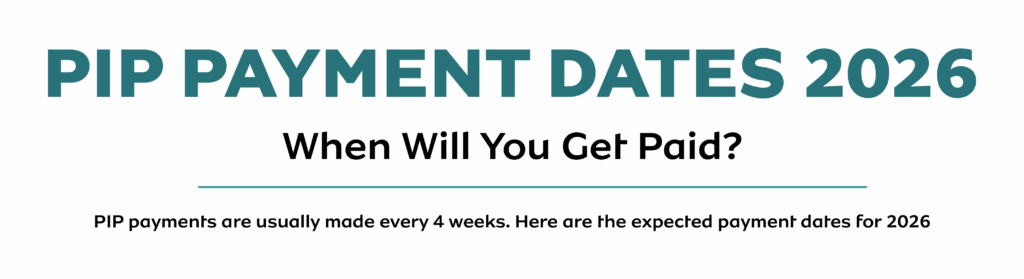
PIP Payment Dates 2026
The Scotland PIP ADP update did not change payment amounts, but it changed how the system works. Care providers must understand these differences to support clients effectively.
1. Fewer Face-to-Face Assessments
ADP does not rely heavily on in-person assessments.
Social Security Scotland makes most decisions using existing information and supporting evidence.
Impact:
Less stress for clients
Greater reliance on care records and written evidence
2. More Person-Centred Approach
ADP focuses on how a condition affects daily life, not just strict assessment criteria.
Unlike some dwp pip payments reforms, ADP:
prioritises individual circumstances
reduces rigid evaluation processes
3. Reduced Reporting Requirements
Clients do not need to report every minor change.
For example:
Short hospital stays may not require reporting
Some lifestyle changes do not affect payments
This differs from PIP, where reporting requirements are stricter.
4. Same Rates, Different Delivery
ADP keeps the same payment structure as PIP.
There is no freeze pip disability benefits difference in Scotland:
Daily living and mobility rates remain aligned
The change is administrative, not financial
5. Managed by Scotland, Not DWP
ADP is delivered by Social Security Scotland, not the DWP.
This means:
Different communication channels
Different support systems
Localised decision-making
What This Means for Care Providers
These changes shift responsibility toward evidence and documentation.
You must:
Record client needs clearly
Provide consistent care notes
Support applications with real-life examples
ADP simplifies the process for clients, but increases the importance of accurate care documentation.
Care providers who understand these differences can help clients transition smoothly from pip scotland to Adult Disability Payment Scotland without unnecessary delays or reassessments.
The Scotland PIP ADP update introduced a more flexible reporting system, but clients still need to report important changes. Care providers must guide clients to avoid overpayments, underpayments, or penalties.
What Clients Must Report
Clients should report changes that affect how their condition impacts daily life or mobility.
Key examples:
Their condition gets worse or improves
The level of care or support they need changes
They move out of Scotland
They enter long-term hospital or residential care
These updates can be submitted through Adult Disability Payment change of circumstances online via mygov scotland or by contacting Social Security Scotland.
What Clients Do NOT Always Need to Report
ADP reduces unnecessary reporting compared to PIP.
In many cases, clients do not need to report:
Starting or leaving a job
Changes in income or savings
Minor short-term changes in routine
This reflects the more supportive approach of Adult Disability Payment Scotland.
How to Report Changes
Clients can update their details using:
Online services through Adult Disability Payment Scotland login
Phone via the social security scotland number
Paper forms if needed
Care providers should encourage clients to report changes early to avoid complications.
Role of Care Providers
Care providers act as the first line of support.
You should:
Monitor changes in client condition or care needs
Help complete ADP change of circumstances submissions
Ensure care records match reported information
Accurate documentation is critical. If care notes show increased support needs but the benefit remains unchanged, clients may miss out on higher adp rates.
Common Mistake to Avoid
Many clients delay reporting because they are unsure.
This can lead to:
Incorrect payments
Backdated adjustments
Stress during reviews
ADP simplifies reporting, but it does not remove responsibility.
Care providers who actively manage Adult Disability Payment change of circumstances online processes protect clients from errors and ensure they continue receiving the correct Scottish disability payment.
Care providers do not need to navigate the Adult Disability Payment Scotland system alone. Several tools and support services can improve application success and reduce errors.
ADP Scotland Points Calculator
The ADP Scotland points calculator helps estimate whether a client may qualify and at what rate.
It assesses:
Daily living needs
Mobility limitations
While helpful, do not rely on it alone. Real-life care evidence and documentation carry more weight during decision-making.
Online Services and Login Access
Clients can manage their applications through:
Adult Disability Payment Scotland login on mygov scotland
Online forms for applications and updates
Adult Disability Payment change of circumstances online submissions
Care providers should guide clients through these systems, especially those with limited digital skills.
Phone and Direct Support
For clients who need assistance, phone support remains essential.
Local delivery teams from Social Security Scotland
Advocacy services (for vulnerable individuals)
Advice organisations for complex cases
Support for Related Benefits
Some clients may also receive or transition from:
child disability payment or child disability payment scotland
disability living allowance scotland
Care providers must understand how these benefits connect to ADP to avoid overlap issues.
Care Provider Advantage
Using the right tools improves outcomes.
You can:
Identify eligibility early
Strengthen applications with evidence
Reduce delays and rejections
Tools and support systems make the ADP process easier, but only when used correctly.
Care providers who actively use platforms like mygov scotland and guide clients through available support services will achieve faster approvals and more accurate Scottish disability payment outcomes.
Yes—care providers should actively support clients through the transition and ongoing management of Adult Disability Payment Scotland. The Scotland PIP ADP update has removed much of the complexity for claimants, but it has increased the importance of accurate guidance and documentation.
When Care Providers Should Step In
Care providers should take a proactive role when:
A client still receives pip scotland and has not completed the transfer
A client struggles to understand the application process
A client has complex care needs that require detailed evidence
A review or ADP change of circumstances is required
Why Your Support Matters
Most clients do not fully understand:
How eligibility works
What evidence is required
When to report changes
Without support, this can lead to:
Underpayments
Delays in approval
Rejected claims
Care providers bridge this gap by translating care needs into clear, evidence-based information.
The Business Advantage for Care Providers
Supporting clients with ADP is not just helpful; it strengthens your service offering.
Benefits include:
Improved client outcomes
Stronger trust with families
Better care documentation standards
Reduced complaints related to financial support
When Professional Help May Be Needed
In complex cases, consider involving:
Advocacy services
Benefit advisors
Specialist consultants
This is especially useful when:
A claim has been denied
Evidence is insufficient
The client’s situation is unclear
Care providers who ignore the ADP process risk leaving clients unsupported.
Care providers who engage with it become essential partners in ensuring clients receive the correct Scottish disability payment, on time and without complications.
Need Help Navigating ADP Changes?
The Scotland PIP ADP update has simplified the system, but many clients still struggle to understand what to do next. This is where care providers can make a real difference.
Care Sync Experts supports care providers with:
Guidance on Adult Disability Payment Scotland processes
Compliance-ready documentation aligned with ADP requirements
Support for applications and ADP change of circumstances
Best practices to improve approval rates and reduce delays
If your team wants to:
Reduce application errors
Improve client outcomes
Stay compliant with evolving Scottish disability payment systems
Then it’s time to treat benefits support as part of your core care delivery, not an afterthought.
Final Takeaway
The move from PIP to ADP is complete. The responsibility now shifts to care providers to ensure every client:
Applies correctly
Reports changes accurately
Receives the correct adp rates without interruption
Care providers who master this process will not only support clients better but also position themselves as trusted, forward-thinking service providers in Scotland’s evolving care system.
Care Sync Experts helps care providers handle Adult Disability Payment Scotland applications, evidence, and change updates, so your clients get the right support without delays.
Strengthen your care delivery and support clients with confidence.
Social Security Scotland usually makes a decision on Adult Disability Payment (ADP) within 4 months.
In more complex cases, it can take up to 6 months. If the applicant is terminally ill, decisions are fast-tracked and typically made within a few working days.
What changes are coming to PIP in 2026?
In 2026, discussions around DWP PIP payment reforms focus on tightening assessments and increasing face-to-face evaluations in some cases.
However, these changes mainly affect England and Wales. In Scotland, PIP has already been replaced by ADP, which follows a more supportive and person-centred approach.
Will everyone on PIP be reassessed?
Not everyone will be reassessed immediately. In Scotland, most people have already moved from PIP to ADP without needing a full reassessment. Social Security Scotland typically reviews claims only when: – A scheduled review is due – A change of circumstances is reported
Will PIP know if I go abroad?
Yes. The DWP can check travel records, and going abroad can affect PIP payments. Key rule: – You must report if you plan to leave the UK for more than 4 weeks – Payments may stop depending on the length and reason for travel
For ADP in Scotland, short temporary absences are allowed, but longer stays must still be reported to avoid payment issues.
UK pensioners PIP backdated payments 2025 apply when a Personal Independence Payment backdated award is approved, covering the period between the claim start date (or qualifying period) and the final decision. Most claimants receive arrears automatically, often as a lump sum that can exceed £5,000 depending on the delay and the rate awarded.
In practice, personal independence payment backdated amounts depend on eligibility, the 3-month qualifying rule, and how long the decision takes. Caregivers and families should understand that these payments are not bonuses; they are owed support for care needs that already existed before approval.
PIP payments backdated refer to money the DWP owes a claimant for the period they were already eligible but had not yet received a decision. A personal independence payment backdated award ensures individuals receive full financial support for care and mobility needs that existed before approval.
From a caregiver standpoint, this delay creates real pressure.
Care providers often step in before funding arrives, supporting clients who already need help with daily living or mobility. During this gap:
Families may cover care costs out-of-pocket
Providers may deliver limited or unpaid support
Care plans may be delayed or reduced
Backdated payments correct this gap.
When the DWP approves a claim, it calculates the total owed from:
the initial claim date, or
the point the 3-month qualifying condition is met
For caregivers, this lump sum often:
stabilizes ongoing care arrangements
clears outstanding care costs
allows upgrades in care quality (more hours, better support)
In simple terms, personal independence payment backdated amounts are not extra money; they restore missed care funding that should have been in place earlier.
To receive UK pensioners pip backdated payments 2025 England, a claimant must meet strict eligibility rules set by the DWP. The most important rule is simple: You must have been under State Pension age when you first applied for PIP.
Caregivers should pay close attention to this because it directly affects whether a client can receive pip payments backdated at all.
Key Eligibility Rules
Age requirement: New claims must start before reaching State Pension age
Existing claims: If a claimant already receives PIP, payments can continue after pension age
Care needs: The claimant must show daily living or mobility needs for at least 3 months
Ongoing condition: The condition must be expected to last at least 9 more months
What About Reviews and Ongoing Awards?
PIP does not stop automatically at pension age. The DWP assigns a pip award length 2025 based on the claimant’s condition, which can range from:
short-term awards (1–2 years)
longer-term or ongoing awards (5+ years or “light touch review”)
During reviews:
Payments may increase → leading to backdated payments after review
Payments may stay the same
In some cases, payments may stop if criteria are no longer met
Care providers should monitor review dates closely, because pip reassessment changes can affect both ongoing income and any future arrears.
Important Exception (Often Missed)
Some pensioners may still qualify for backdated payments through:
DWP administrative reviews
past decision errors
reassessment outcomes
These cases often fall under pip backdated payments after review, and they can result in significant lump sums.
Eligibility for UK pensioners pip backdated payments 2025 depends on when the claim started, not the claimant’s current age. Caregivers who understand this rule can prevent clients from missing out on thousands in owed support.
UK pensioners PIP backdated payments 2025 dates depend on when the claim started and when the claimant met the qualifying conditions.
The DWP usually backdates payments to the claim start date or the point the 3-month qualifying period is satisfied, whichever comes later.
How the Timeline Works
Caregivers should understand this sequence clearly:
Initial claim date – when the claimant first contacts the DWP
3-month qualifying period – care needs must already exist for 13 weeks
Assessment and decision phase – where delays often occur
Decision date – triggers the lump sum payment
This gap between steps 1 and 4 is what creates pip payments backdated amounts.
PIP Backdated Payments – How Long Does It Take?
PIP backdated payments how long depends on processing times.
Average wait time in 2025–2026: 12–20 weeks
Complex cases or reviews may take longer
The longer the wait, the larger the back payment
Care providers should expect delays and plan care support accordingly.
How Long to Wait for PIP Award Letter?
Many families ask:
How long to wait for PIP award letter?
Most claimants receive a decision letter within 2–4 weeks after assessment
Backdated payments usually arrive 3–14 days after the letter
In some cases, money arrives before the letter
Real-World Impact (Caregiver Insight)
From a care perspective, delays are not just administrative, they affect lives.
During the waiting period:
Care may be reduced due to lack of funds
Families carry financial stress
Providers delay full care plans
When the payment finally arrives, it often restores months of delayed care funding in one lump sum.
The longer the decision takes, the more pip payments backdated a claimant receives, but caregivers must manage the care gap until that payment arrives.
How Much Can Pensioners Receive? (Rates & Examples)
PIP backdated payments how much a claimant receives depends on the PIP rate, the award level, and how long the decision took.
The DWP calculates backdated payments by multiplying the weekly rate by the number of weeks owed.
2025/26 PIP Rates (Key Figures)
Enhanced Daily Living: £110.40 per week
Standard Daily Living: £73.90 per week
Enhanced Mobility: £77.05 per week
Standard Mobility: £29.20 per week
These figures answer the common question: how much is pip per week.
How Much Is PIP Per Month?
PIP is paid every 4 weeks.
Enhanced Daily Living ≈ £441.60 per month
Enhanced Mobility ≈ £308.20 per month
Combined awards can exceed £700+ per month, depending on eligibility.
Example: Backdated Payment Calculation
If a claimant waits 16 weeks for a decision and receives:
Enhanced Daily Living (£110.40)
Backdated amount:
£110.40 × 16 = £1,766.40
If both components are awarded:
(£110.40 + £77.05) × 16 = £2,998.40
This is why pip payments backdated can quickly reach several thousand pounds.
Using a PIP Back Pay Calculator
Caregivers and families can estimate arrears using a:
pip back pay calculator
pip back pay calculator gov UK tools
These help:
forecast expected lump sums
verify DWP calculations
identify underpayments
Caregiver Insight
From a care provider’s perspective, this lump sum often:
clears unpaid care costs
funds additional care hours
stabilizes long-term care planning
In many cases, personal independence payment backdated amounts represent months of delayed support finally being delivered at once.
PIP backdated payments how much depends on the weekly rate and delay length, but even average cases can result in £1,500–£5,000+ in owed support.
Special Cases: Reviews, Errors & Large Back Payments
PIP assessment guide
Not all pip payments backdated come from new claims. Some of the largest arrears come from reviews, reassessments, or DWP errors.
When the DWP increases or corrects an award, it often backdates the difference to the date the change should have applied.
PIP Backdated Payments After Review
PIP backdated payments after review happen when:
A claimant reports a change in condition
The DWP conducts a scheduled review
A reassessment increases the award
In these cases, the DWP pays the difference between:
the old rate
the new rate
from the effective change date, not the decision date.
PIP Reassessment Changes (What Caregivers Should Watch)
PIP reassessment changes can lead to:
Increased payments → backdated arrears
No change → no arrears
Reduced or stopped payments
Care providers should:
track reassessment timelines
document worsening conditions early
support clients in submitting strong evidence
Strong medical evidence often determines whether arrears are granted.
When PIP Payments Were Stopped (Then Reinstated)
Some claimants experience:
PIP claimants payments stopped DWP
followed by appeal or reconsideration
If the claimant wins:
payments restart
full arrears are backdated to the stop date
These cases can result in very large lump sums.
Administrative Errors & Special Reviews
In rare but important cases, the DWP reviews past decisions due to:
legal changes
policy errors
incorrect assessments
These can lead to:
backdated payments over several years
five-figure arrears in some cases
Caregiver Insight
From a caregiver perspective, these cases are critical.
Delayed or incorrect decisions can:
interrupt care delivery
reduce support levels
create financial instability
When corrected, pip payments backdated restore not just income, but missed care capacity.
The largest pip backdated payments after review often come from reassessments and errors, not new claims. Caregivers who monitor reviews closely can help clients recover significant unpaid support.
For caregivers, personal independence payment backdated amounts are not just financial, they directly affect care delivery.
Backdated payments restore funding for care that already took place but was not properly supported at the time.
The Real Impact on Care
When PIP decisions are delayed:
Families often fund care privately
Care providers reduce hours or delay services
Vulnerable clients receive less consistent support
This creates a gap between need and funding.
How Backdated Payments Change Care Outcomes
Once pip payments backdated are released, they often:
cover unpaid or reduced care services
allow immediate increase in care hours
improve access to mobility or specialist support
Care providers can then:
stabilize care plans
assign consistent staff
improve quality of care delivery
Why Caregivers Should Track Claims Closely
From a caregiver business perspective:
Delays = underfunded care
Faster approvals = better service delivery
Care teams should:
track claim timelines
help families gather medical evidence
follow up when delays exceed expected timelines
Even small delays can mean thousands in unpaid support.
Linking to Broader Financial Planning
Backdated payments also connect to:
long-term care budgeting
use of tools like a UK State Pension calculator
coordination with other benefits
This ensures care remains sustainable beyond the initial lump sum.
For caregivers, personal independence payment backdated support is not optional funding, it is essential to delivering consistent, high-quality care when it matters most.
If you believe you are missing personal independence payment backdated money, act quickly. The DWP calculates arrears automatically, but errors and omissions still happen.
You have the right to challenge incorrect backdating if the start date or amount looks wrong.
Step 1: Check Your Award Letter Carefully
Look for:
“From date” – this determines when payments start
Award level (daily living/mobility)
Total amount paid
If the date does not match your claim or qualifying period, you may be underpaid.
Step 2: Contact the DWP Immediately
Call the PIP enquiry line and ask for:
a breakdown of your calculation
clarification on your start date
This step often resolves simple errors without escalation.
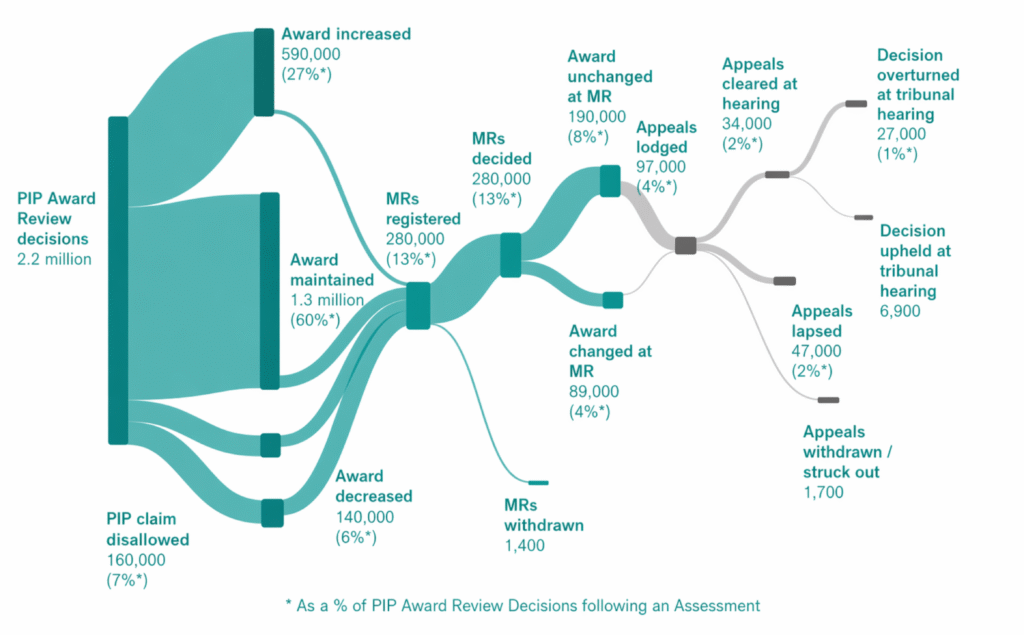
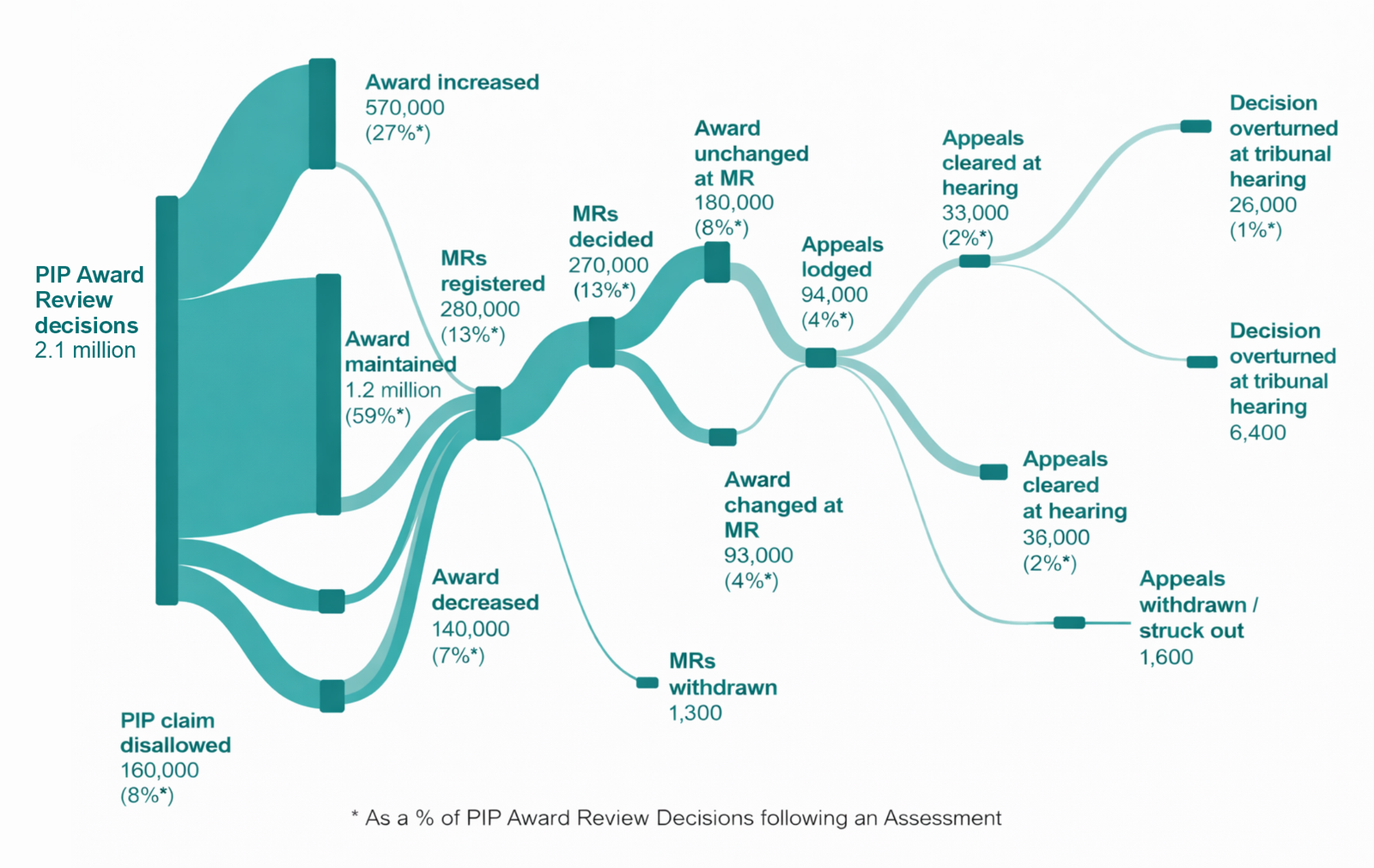
Step 3: Request Mandatory Reconsideration
If the issue remains:
request a Mandatory Reconsideration (MR)
do this within 1 month of the decision
Explain clearly:
why the backdating date is incorrect
provide supporting evidence (GP records, care notes)
Step 4: Support Your Case with Evidence
Strong evidence increases success:
medical records
care provider notes
timelines showing when needs began
This is critical for correcting pip payments backdated amounts.
Step 5: Track Related Benefits (If Applicable)
Some claimants may also need to:
notify HMRC (if receiving tax credits)
review related entitlements
In rare cases, this may connect to:
dwp universal credit compensation
overlapping benefit adjustments
Caregiver Role in This Process
Care providers play a key role by:
documenting care needs early
helping families understand timelines
supporting evidence collection
This increases the chance of recovering full personal independence payment backdated amounts.
If something looks wrong, challenge it. Many claimants recover additional thousands simply by reviewing their award and taking action within the deadline.
2026 Updates & Policy Changes (What to Expect)
Understanding PIP Applicant Experiences
Recent updates and upcoming reforms continue to shape how pip payments backdated and ongoing awards work. Caregivers and families should stay informed because small policy shifts can affect both eligibility and payment timelines.
The DWP is actively reviewing the PIP system, with changes focused on assessments, backlog reduction, and payment accuracy.
DWP PIP Reforms 2026
DWP PIP reforms 2026 aim to:
reduce assessment backlogs
improve review processes
increase digital tracking of claims
Faster decisions may reduce how much arrears build up, but improve access to support earlier.
PIP Benefit Changes 2026
PIP benefit changes 2026 may include:
updated assessment criteria
more frequent reassessments for some claimants
clearer guidance for long-term conditions
Caregivers should expect:
more structured review timelines
increased documentation requirements
Changes to Benefits Announced Today (Ongoing Trends)
Across the wider system, changes to benefits announced today often affect:
payment rates (inflation adjustments)
processing timelines
integration with other support systems
These changes influence how personal independence payment backdated amounts are calculated over time.
Other Payments & Support to Watch
Some claimants may also receive:
one off payments before new year pension (cost-of-living support)
adjustments linked to wider benefit updates
These are separate from PIP but can affect overall financial planning.
Caregiver Insight
From a care provider perspective:
Faster decisions = better care continuity
Policy changes = need for closer monitoring
Care teams should:
stay updated on DWP announcements
prepare clients for reassessments
adjust care planning based on benefit changes
Conclusion
Backdated PIP payments are more than a lump sum; they reflect missed care funding finally being delivered. For pensioners, families, and care providers, understanding how pip payments backdated work can mean the difference between delayed support and stable, consistent care.
The rules may seem complex, but one thing is clear: If the need existed, the support should follow.
Need Help Navigating PIP, Care Funding, or Compliance?
Care Sync Experts helps care providers and families across the UK understand benefits like personal independence payment backdated awards, while staying compliant and financially prepared.
From claim guidance to care planning and funding strategies, we turn complex systems into clear, actionable steps.
PIP is usually backdated to the claim start date or the point the 3-month qualifying period is met, whichever comes later. In most cases, this means a few months of arrears. However, in special situations such as DWP errors or review cases, payments can be backdated much further.
How do I know if PIP owes me money?
You can tell if you are owed money by checking your award letter. Look for the “from date” and compare it to when your care needs started or when you first applied. If the dates do not match, or if no lump sum was paid after approval, you may be owed pip payments backdated.
Does everyone get PIP backpay?
No, not everyone receives backpay. You only get pip payments backdated if: – your claim is approved, or – your award is increased after a review
If your claim is refused or remains unchanged, no arrears are paid.
Can I work and still receive PIP?
Yes, you can work and still receive PIP. The benefit is based on how your condition affects your daily living and mobility, not your employment status. Many claimants continue working while receiving PIP, as long as they meet the eligibility criteria.
If you need the number for PIP payment enquiries, you can contact the Department for Work and Pensions (DWP) using the official PIP enquiry line below. These numbers help you check an existing claim, report PIP changes, or ask about payments.
PIP Contact Number (Existing Claims and Payments)
PIP contact number (existing claim): 0800 121 4433
Textphone / Relay UK: 0800 121 4493
Opening hours: Monday to Friday, 9am–5pm
Use this pip contact number 0800 if you need to:
Check the status of your claim
Ask about PIP payments backdated
Report PIP changes such as a change of address or health condition
Ask questions about your award or assessment outcome
Many people search for the number for personal independence payment or the dept work and pensions tel no when they need help with a claim. The number above connects you directly to the PIP enquiry line managed by the Department for Work and Pensions.
To start a new claim, call the DWP contact number below:
New PIP claims: 0800 917 2222
Opening hours: Monday to Friday, 8am–5pm
When you call this dept of work and pensions contact no, an advisor will ask for basic information and begin your claim for Personal Independence Payment. After the call, the DWP sends you the form called “How Your Disability Affects You.”
Northern Ireland PIP Contact Numbers
If you live in Northern Ireland, contact the Department for Communities instead of the DWP:
Existing claims / payments: 0800 587 0932
New claims: 0800 012 1573
When to Use the PIP Enquiry Line
You should call the pip enquiry line if you need help with:
Checking PIP payment dates
Reporting a change of circumstances
Asking about PIP extensions in the UK
Updating your personal details
Understanding a decision letter
Fixing payment problems
Many caregivers contact the DWP contact number 0800 on behalf of family members who cannot manage their claim alone.
If your question relates to a medical assessment, the DWP may ask you to contact the assessment provider directly (such as Capita, Ingeus, or Maximus).
What Personal Independence Payment (PIP) Is and Who It Helps
Personal Independence Payment (PIP) is a UK government benefit that helps people aged 16 to State Pension age cover the extra costs of living with a long-term health condition or disability. The Department for Work and Pensions (DWP) manages PIP in England and Wales, while different systems apply in Scotland and Northern Ireland.
Unlike many benefits, PIP is not means-tested. Your income, savings, or employment status do not affect whether you can receive it. Many people continue working while receiving PIP because the benefit focuses on how your condition affects your daily life, not how much money you earn.
PIP exists to support people who struggle with everyday tasks or mobility because of a physical, mental, or neurological condition. This can include people living with conditions such as arthritis, multiple sclerosis, anxiety disorders, or ADHD PIP claims, where attention and executive function difficulties affect daily activities.
Caregivers often play a key role in the process. Many families help a relative manage their claim, contact the pip enquiry line, gather medical evidence, and communicate with the Department for Work and Pensions contact number when changes happen. Understanding how PIP works helps caregivers support someone through the application, assessment, and payment process.
PIP contains two main components:
Daily Living Component
This part supports people who need help with everyday activities such as:
Preparing and eating food
Washing and bathing
Dressing and undressing
Managing medication or treatment
Communicating with others
Managing money
Mobility Component
This part helps people who struggle with getting around, including:
Planning and following a journey
Leaving the home safely
Walking or moving around
You may receive one component or both, depending on how your condition affects your independence.
Many families also ask what other benefits can I claim with PIP because receiving PIP can unlock additional financial support, mobility schemes, and caregiver benefits. We will explain those options later in this guide.
Before applying, it is important to understand Personal Independence Payment eligibility, because the DWP bases every decision on how your condition affects daily living and mobility rather than the medical diagnosis itself.
Personal Independence Payment Eligibility: Who Can Claim PIP?
To qualify for Personal Independence Payment (PIP), you must meet several criteria set by the Department for Work and Pensions (DWP). These rules focus on how your health condition affects your daily life, not simply on the condition itself. Understanding Personal Independence Payment eligibility helps you decide whether it is worth starting a claim.
Age Requirement
You can usually claim PIP if you:
Are 16 years old or over
Have not yet reached State Pension age
If you are already receiving PIP when you reach State Pension age, your payments normally continue as long as your circumstances remain the same.
Health Condition or Disability
You must have a long-term physical or mental health condition or disability that affects your ability to carry out everyday activities or move around.
Examples include:
Mobility impairments
Chronic illnesses
Neurological conditions
Mental health conditions
ADHD PIP claims, where attention or executive function issues affect daily living
The DWP does not award PIP based on the diagnosis alone. Instead, they assess how the condition affects your independence and daily functioning.
Duration Rule
Your condition must meet the qualifying period rule:
You must have experienced difficulties for at least 3 months, and
Those difficulties must be expected to continue for at least 9 more months
This rule ensures PIP supports people with long-term needs rather than short-term illness or injury.
Daily Living or Mobility Difficulties
The DWP evaluates whether you need help with:
Daily living activities such as:
Preparing food
Washing or bathing
Dressing
Managing medication
Communicating with others
Mobility activities such as:
Planning and following journeys
Physically moving around
During the assessment process, a health professional assigns points for different activities. Your total score determines whether you qualify for the standard or enhanced rate of PIP.
Residency Requirements
You must normally:
Live in England, Wales, or Northern Ireland
Have lived in the UK for a certain period before claiming
Rules differ slightly depending on your situation.
For example, people living in Scotland usually apply for Adult Disability Payment instead of PIP, which we will explain later in the guide.
Supporting Evidence Matters
Your claim becomes much stronger if you include supporting evidence, such as:
Letters from doctors or specialists
Care plans or treatment records
Statements from caregivers or family members
Prescriptions or medical reports
This evidence helps the DWP understand how your condition affects your daily life before they schedule an assessment.
Once you understand Personal Independence Payment eligibility, the next step is learning how to apply for Personal Independence Payment, which we will explain step by step in the next section.
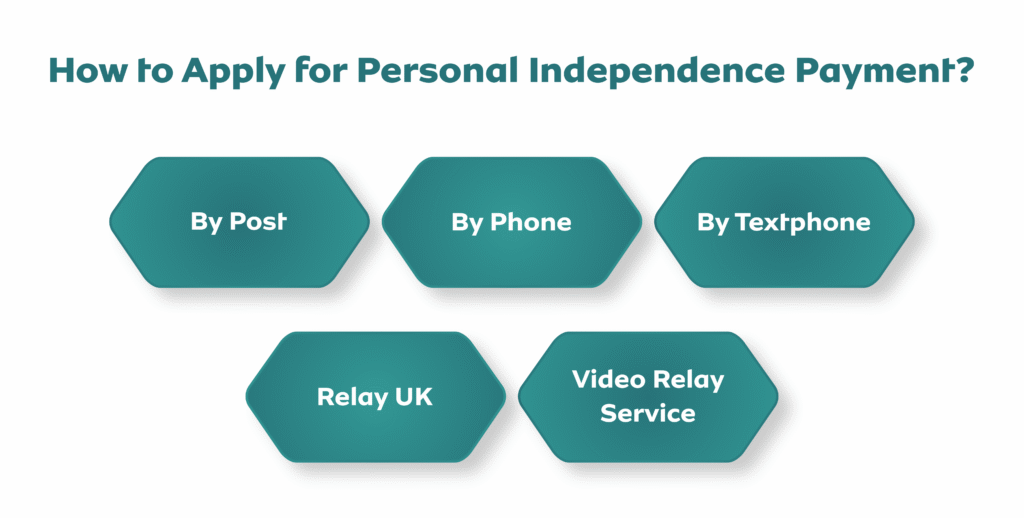
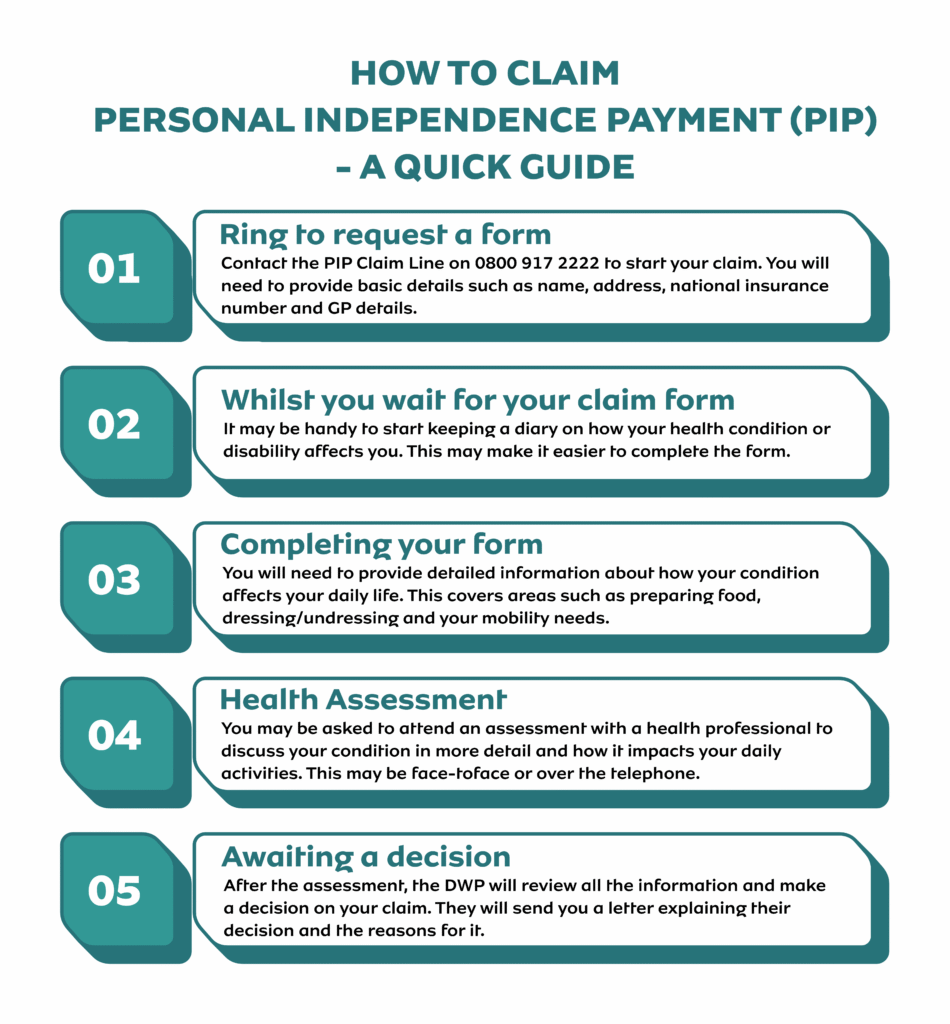
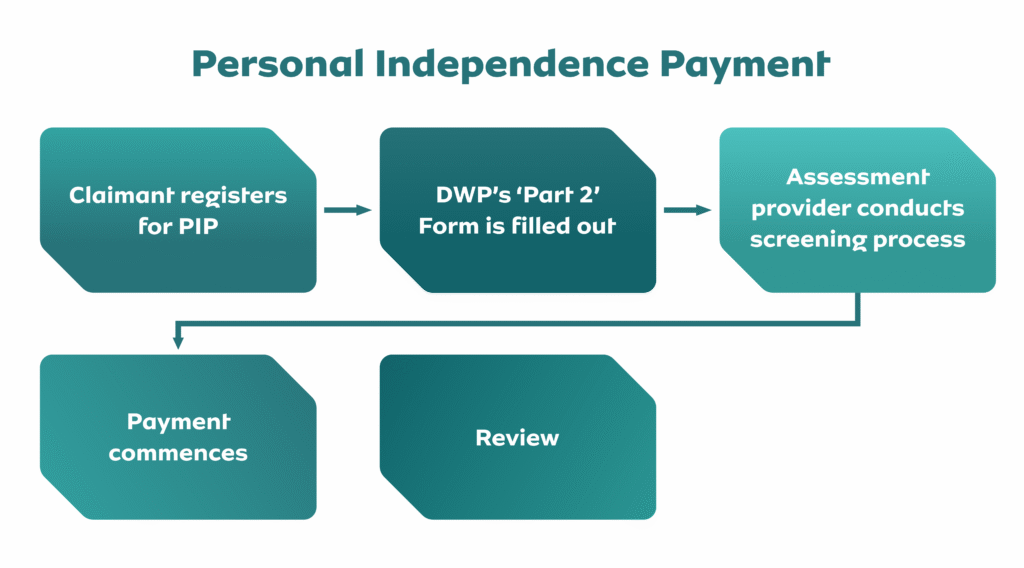
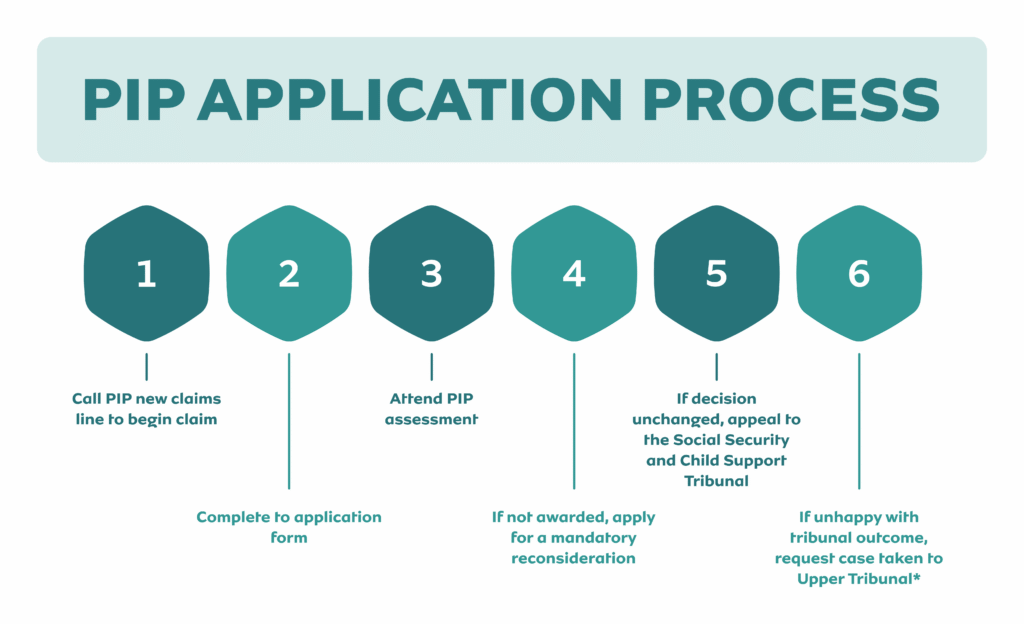
How to Apply for Personal Independence Payment (Step-by-Step)
How to Apply for Personal Independence Payment
If you meet Personal Independence Payment eligibility, the next step is to start the claim with the Department for Work and Pensions (DWP). Many caregivers help family members complete this process, especially when the person claiming struggles with paperwork or phone calls.
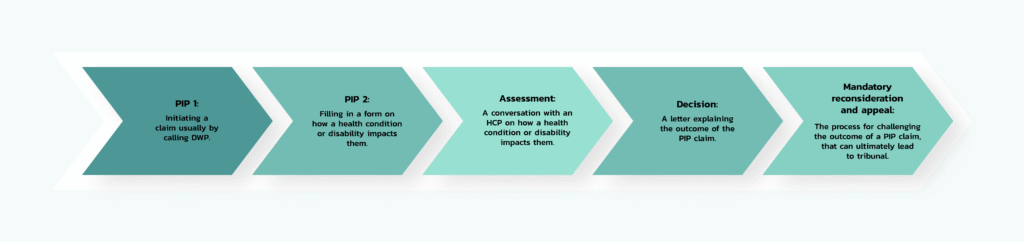
The process happens in several stages.
Step 1: Start Your Claim by Calling the DWP
You must begin the process by calling the pip contact number for new claims:
New PIP claims: 0800 917 2222
Opening hours: Monday to Friday, 8am–5pm
This dept work and pensions contact number allows the DWP to gather basic details before sending your application form.
During the call, the advisor will ask for:
Your National Insurance number
Your address and contact details
Your bank account information
Your GP or healthcare professional’s details
Information about time spent in hospital or abroad
Many people search online for the number for personal independence payment or how do I contact DWP by phone, but the correct starting point for a new claim is the number above.
Once you complete the call, the DWP officially records the start date of your claim, which is important because PIP payments backdated usually begin from this date if your claim is successful.
Step 2: Complete the PIP Application Form
After your phone call, the DWP sends you the form called:
“How Your Disability Affects You” (PIP2).
Some people search for a PIP application form online, but the DWP normally sends this form by post after your initial call.
The form asks detailed questions about how your condition affects your ability to:
Prepare meals
Manage medication
Wash and dress
Communicate with others
Travel and move around
Answer honestly and provide specific examples of difficulties you face. Caregivers often help complete this form because it requires clear explanations of daily challenges.
Step 3: Provide Supporting Evidence
Supporting documents strengthen your claim. Examples include:
GP letters or specialist reports
Prescription lists
Care plans
Statements from caregivers or family members
Evidence helps the DWP understand your needs before the assessment stage.
Step 4: Attend a PIP Assessment
Most people attend an assessment with a healthcare professional. This may happen:
Face-to-face
By telephone
By video call
The assessor asks how your condition affects your everyday life. They then send a report to the DWP.
Step 5: Receive the Decision
After reviewing the assessment and evidence, the DWP sends a decision letter explaining:
Whether you qualify for PIP
Which component you receive
Whether you receive the standard or enhanced rate
If the decision seems incorrect, you can challenge it through a process called mandatory reconsideration.
Many caregivers stay involved throughout the claim because they help explain how the person’s condition affects daily life and assist with contacting the pip enquiry line if problems arise.
How Much Is PIP Per Month? (2025/26 Payment Rates)
number for pip payment
Many people ask “How much is PIP per month?” when deciding whether to apply. Personal Independence Payment is normally paid every four weeks, but the official rates are calculated weekly.
Your total payment depends on which components you qualify for and whether you receive the standard or enhanced rate.
Daily Living Component
You may receive this part if you need help with everyday activities such as preparing food, washing, dressing, managing medication, or communicating.
Current weekly rates (2025/26):
Standard rate: £73.90 per week
Enhanced rate: £110.40 per week
Approximate monthly payments:
Standard rate: about £295 per month
Enhanced rate: about £441 per month
Mobility Component
You may receive the mobility component if your condition affects how you move around or plan journeys.
Current weekly rates (2025/26):
Standard rate: £29.20 per week
Enhanced rate: £77.05 per week
Approximate monthly payments:
Standard rate: about £117 per month
Enhanced rate: about £308 per month
Maximum PIP Payment Per Month
If you qualify for the enhanced rate of both components, the maximum amount is approximately:
£187.45 per week
About £750 per month
Actual payments arrive every four weeks, so the amount deposited in your bank account may look slightly higher than a typical monthly payment.
Can PIP Payments Be Backdated?
Yes. In many cases, PIP payments backdated start from the date you first contacted the Department for Work and Pensions contact number to begin your claim.
For example, if the DWP takes several months to process your application, you may receive a lump-sum back payment covering the time between the start of your claim and the decision date.
Special Rules for Terminal Illness
People with a progressive illness and limited life expectancy may qualify under special rules. In these cases:
The process moves faster
The assessment may not be required
The claimant usually receives the enhanced daily living rate automatically
Understanding how much PIP pays per month helps caregivers and families plan financially, especially when they rely on this support to manage the extra costs of disability or long-term illness.
Many families ask “what other benefits can I claim with PIP?” because receiving Personal Independence Payment often unlocks additional financial support. PIP itself is not means-tested, but it can increase eligibility for other benefits and schemes that help cover daily living costs.
Understanding these options can make a significant difference for both claimants and caregivers.
Universal Credit
If you receive PIP, your Universal Credit award may increase. In many cases, you may qualify for the Limited Capability for Work and Work-Related Activity (LCWRA) element, which adds extra monthly support.
PIP can also help remove certain work requirements if your condition limits your ability to work.
Carer’s Allowance
If someone provides regular care for you, they may qualify for Carer’s Allowance.
A caregiver may claim this benefit if they:
Provide at least 35 hours of care per week
Care for someone receiving the daily living component of PIP
This support helps families who rely on caregivers to manage daily activities.
Housing Benefit or Universal Credit Housing Support
Receiving PIP can increase eligibility for:
Housing Benefit
Additional housing elements within Universal Credit
Local authorities often consider disability-related benefits when assessing housing support.
Council Tax Reduction
Many councils offer Council Tax discounts or reductions for households where someone receives PIP.
The exact amount depends on local council policies, but the reduction can significantly lower monthly bills.
Motability Scheme
If you receive the enhanced mobility component of PIP, you may qualify for the Motability Scheme.
This program allows you to lease:
A car
A wheelchair-accessible vehicle
A mobility scooter
The payment comes directly from your mobility component.
Disabled Person’s Railcard and Travel Support
Some people who receive PIP may qualify for:
Disabled Person’s Railcard
Discounted public transport
Local travel support programs
These benefits help reduce travel costs for medical appointments, work, and daily life.
Other Financial Support
Depending on your circumstances, PIP may also increase eligibility for:
Disability-related grants
Energy bill support programs
Local authority assistance schemes
Because PIP confirms that a person has long-term disability-related needs, many support programs use it as proof when assessing eligibility.
Caregivers often help manage these applications and may contact the pip enquiry line or the dept work and pensions contact number if they need confirmation of an award letter.
How to Contact the DWP About PIP Changes or Payment Issues
Personal Independence Payment (PIP)
If your situation changes or you have problems with a payment, you should contact the Department for Work and Pensions (DWP) as soon as possible. Reporting PIP changes quickly helps prevent overpayments, payment delays, or interruptions to your claim.
The easiest way to do this is by calling the official PIP enquiry line.
PIP Contact Number for Existing Claims
If you already receive PIP or want to ask about your payments, use the pip contact number existing claim below:
PIP enquiry line: 0800 121 4433
Textphone / Relay UK: 0800 121 4493
Opening hours: Monday–Friday, 9am–5pm
Many people search for the dwp contact number 0800, the dept work and pensions contact number, or the dept work and pensions tel no when trying to resolve issues with their claim. The number above connects you directly to the DWP team that handles Personal Independence Payment.
Reasons to Contact the PIP Enquiry Line
You should call the pip contact number 0800 if you need to report or discuss:
PIP changes to your health condition
A change of address or contact details
A hospital stay or care home admission
Problems with PIP payments
Questions about your decision letter or award review
Missing or delayed payments
Caregivers often call the dept of work and pensions contact no on behalf of family members who cannot manage the claim themselves.
What Information to Have Ready
Before calling the PIP enquiry line, prepare the following details:
Your National Insurance number
Your date of birth
Your current address
Details about the change you need to report
Any letters you received from the DWP
Having this information ready helps the advisor locate your claim quickly and resolve the issue faster.
When the DWP May Ask You to Contact Someone Else
Sometimes the Department for Work and Pensions contact number cannot resolve your issue directly.
For example, if your question relates to a medical assessment appointment, the DWP may ask you to contact the company handling the assessment instead. These providers may include:
Capita
Ingeus
Maximus
They manage assessment appointments and reports used to determine your PIP award.
Scotland Update: PIP and Adult Disability Payment (ADP)
If you live in Scotland, the system has changed. The Scottish Government has gradually replaced Personal Independence Payment (PIP) with a new benefit called Adult Disability Payment (ADP). This transition forms part of the wider Scotland PIP ADP update, which moved disability benefits from the Department for Work and Pensions to Social Security Scotland.
What Is Adult Disability Payment (ADP)?
Adult Disability Payment provides similar support to PIP for people with long-term disabilities or health conditions. It still includes two components:
Daily living support
Mobility support
Like PIP, the payment helps people cover the extra costs of living with a disability or long-term health condition.
Who Should Apply for ADP Instead of PIP?
If you live in Scotland and need to make a new claim, you usually apply for Adult Disability Payment, not PIP.
You may still receive PIP if:
You claimed PIP before ADP replaced it, or
Your claim is still being transferred to Social Security Scotland
The government is gradually moving existing PIP claimants in Scotland to ADP through a managed transfer process. During this transition, most people continue receiving payments without needing to reapply.
What Happens If You Move Between Scotland and England or Wales?
Your benefit may change depending on where you live.
If you move from Scotland to England or Wales, you may need to apply for PIP again through the Department for Work and Pensions contact number.
If you move from England or Wales to Scotland, your PIP claim may eventually transfer to Adult Disability Payment.
It is important to report these changes to the relevant authority so your payments continue without interruption.
Contacting the Correct Department
People sometimes search online for the pip contact number or the dept work and pensions contact number even though they now receive ADP.
If you live in Scotland and receive ADP, you should normally contact Social Security Scotland instead of the DWP.
Understanding the Scotland PIP ADP update helps avoid confusion and ensures you contact the correct department when you need help with your disability benefits.
When to Contact the Assessment Provider Instead of the DWP
PIP Application Process
In some situations, calling the PIP enquiry line or the Department for Work and Pensions contact number will not resolve your issue. This usually happens when your question relates to the medical assessment used to decide your claim.
The DWP reviews the final decision, but a separate organisation normally carries out the assessment itself.
Assessment Providers Used for PIP
Depending on where you live, the assessment may be handled by one of the following providers:
Capita
Ingeus
Maximus
These organisations arrange and conduct the health assessments that help determine whether you qualify for Personal Independence Payment.
When You Should Contact the Assessment Provider
You may need to contact the assessment provider directly if you need to:
Reschedule an assessment appointment
Ask about the location or format of your assessment
Request reasonable adjustments for a disability
Check whether your medical evidence was received
Confirm details of a telephone or video assessment
If you try to resolve these issues through the pip contact number, the DWP will usually refer you back to the assessment provider because they manage the appointment process.
Preparing for Your Assessment
Your assessment gives you an opportunity to explain how your condition affects your daily life. Preparing in advance can help you communicate your situation clearly.
Consider bringing or preparing:
Medical reports from your GP or specialist
Prescription lists or treatment plans
A daily routine diary describing your difficulties
Statements from caregivers or family members
Caregivers often attend the assessment or help explain the challenges the claimant faces each day.
What Happens After the Assessment
After the assessment, the healthcare professional sends a report to the Department for Work and Pensions. The DWP then reviews the report and your evidence before making the final decision on your PIP claim.
If you disagree with the decision, you can request a mandatory reconsideration, which allows the DWP to review your case again.
Tips for Caregivers Calling the PIP Enquiry Line
Many people who contact the PIP enquiry line do so on behalf of a family member. Caregivers often manage the claim, report PIP changes, and resolve payment issues for someone who cannot handle the process alone.
Calling the Department for Work and Pensions contact number can sometimes take time, so preparing in advance will make the conversation easier and faster.
Call at the Right Time
The pip contact number 0800 can experience long waiting times, especially during busy periods.
To reduce delays:
Call early in the morning
Avoid Monday mornings, when call volumes are highest
Expect waiting times to sometimes exceed 30–60 minutes
Planning your call can help you reach an advisor sooner.
Have Important Information Ready
Before calling the dept work and pensions contact number, make sure you have the key details ready. This helps the advisor locate the claim quickly.
Prepare:
The claimant’s National Insurance number
Full name and date of birth
Address linked to the claim
Any letters received from the DWP
Details of the issue or change you want to report
Caregivers should also explain that they are calling on behalf of the claimant, as the advisor may need to confirm permission before discussing the claim.
Clearly Explain the Reason for Your Call
When speaking to the advisor, explain the issue clearly. Common reasons for contacting the pip enquiry line include:
Reporting PIP changes to health conditions
Asking about missing or delayed payments
Checking the progress of a claim or review
Updating contact or bank details
Providing clear information helps the advisor resolve the issue more quickly.
Take Notes During the Call
Write down important details during the conversation, such as:
The date and time of the call
The name of the advisor
Any reference numbers or instructions
Keeping records can help if you need to follow up with the Department for Work and Pensions contact number later.
Consider Alternative Support
If you struggle to manage the claim process, organisations such as Citizens Advice or local disability support services can offer guidance on dealing with the DWP and managing PIP claims.
Caregivers who understand how the pip enquiry line works often find it much easier to support a loved one through the application, review, and payment stages.
Final Thoughts…
Understanding Personal Independence Payment (PIP) can feel overwhelming, especially for caregivers who manage claims for a loved one. The process involves checking Personal Independence Payment eligibility, contacting the Department for Work and Pensions, completing the PIP application form, and attending an assessment before receiving a decision.
If you need help with an existing claim, the PIP enquiry line remains the fastest way to speak directly with the DWP. The main pip contact number for existing claims is 0800 121 4433, which connects you to the Department for Work and Pensions contact number for payment questions, claim updates, or reporting PIP changes.
For new claims, you can start the process by calling 0800 917 2222, where an advisor will guide you through the first steps of how to apply Personal Independence Payment.
Many caregivers also want to understand how much PIP pays per month, whether PIP payments can be backdated, and what other benefits can be claimed with PIP. Knowing these details can help families plan financially and ensure the claimant receives the full support available.
If you live in Scotland, remember that the Scotland PIP ADP update means many new claims now fall under Adult Disability Payment, which Social Security Scotland manages instead of the DWP.
Although the process may seem complex at first, thousands of people successfully claim PIP each year with the help of caregivers, healthcare professionals, and support organisations. Preparing the right information, understanding the eligibility rules, and contacting the correct dept work and pensions contact number when needed can make the process much smoother.
For many families, PIP provides essential financial support that helps cover the additional costs of living with a disability or long-term health condition.
Need Help Understanding PIP or Supporting Someone With a Claim?
If you are supporting someone with a disability and feel unsure about Personal Independence Payment eligibility, the PIP application process, or how to deal with the Department for Work and Pensions, Care Sync Experts can help.
We support caregivers and families by explaining PIP rules in plain language, helping you understand what evidence is needed, how the assessment process works, and what steps to take if a claim becomes delayed or a decision seems incorrect.
Our team helps you avoid common mistakes that often lead to delayed payments, failed assessments, or unnecessary stress, so you can focus on supporting the person who needs care.
Whether you are preparing to apply for PIP, managing an existing claim, or trying to understand the support and benefits available, we are here to guide you through the process with clarity and confidence.
FAQ
How long does PIP last?
Personal Independence Payment (PIP) usually lasts for a fixed award period decided by the Department for Work and Pensions (DWP). Many people receive an award that lasts between 1 and 10 years, depending on how their condition affects them and whether their situation may change over time.
Before the award ends, the DWP normally reviews the claim. They may ask you to complete a review form or attend another assessment to confirm whether you still qualify for PIP and whether the payment rate should stay the same.
Some people with long-term or lifelong conditions receive ongoing awards, which do not have a set end date but are still reviewed periodically.
Can I claim PIP if I work?
Yes, you can claim Personal Independence Payment even if you work. PIP focuses on how your health condition or disability affects your daily living and mobility, not your employment status.
This means you may qualify for PIP if you: – Work full time – Work part time – Are self-employed
The Department for Work and Pensions assesses the difficulty you have completing daily activities, rather than whether you earn a salary. Many people continue working while receiving PIP because the payment helps cover the extra costs associated with disability or long-term health conditions.
What documents are needed to apply for PIP?
When applying for Personal Independence Payment, you should provide supporting evidence that explains how your condition affects your daily life. Strong evidence can help the DWP understand your needs before your assessment.
Common documents include: – Letters or reports from your GP or medical specialist – Prescription records or medication lists – A care plan or treatment plan – Statements from caregivers, family members, or support workers – A daily routine diary explaining your difficulties
Providing clear evidence makes it easier for the assessor to understand how your condition affects everyday activities such as washing, dressing, cooking, or travelling.
How is PIP back paid?
If your claim is successful, the Department for Work and Pensions may issue backdated PIP payments. This means you receive a lump sum covering the period between the date you started your claim and the date the decision was made.
For example, if you started your claim in January but the DWP approved it in April, you could receive several months of back payments in your first deposit.
These payments usually arrive as a single lump sum, followed by regular PIP payments every four weeks going forward.