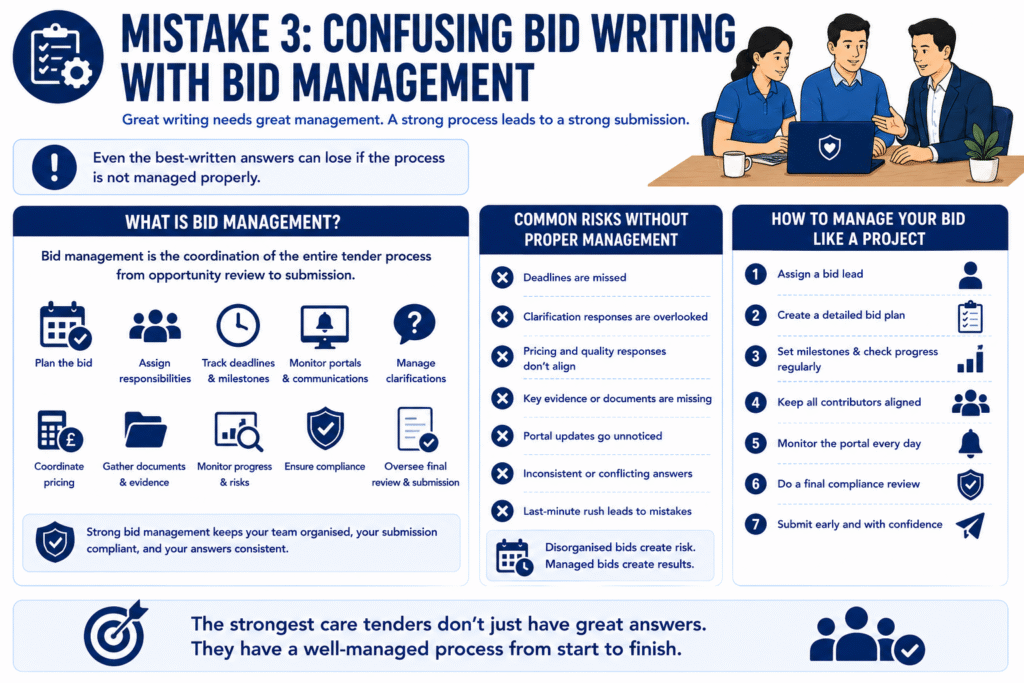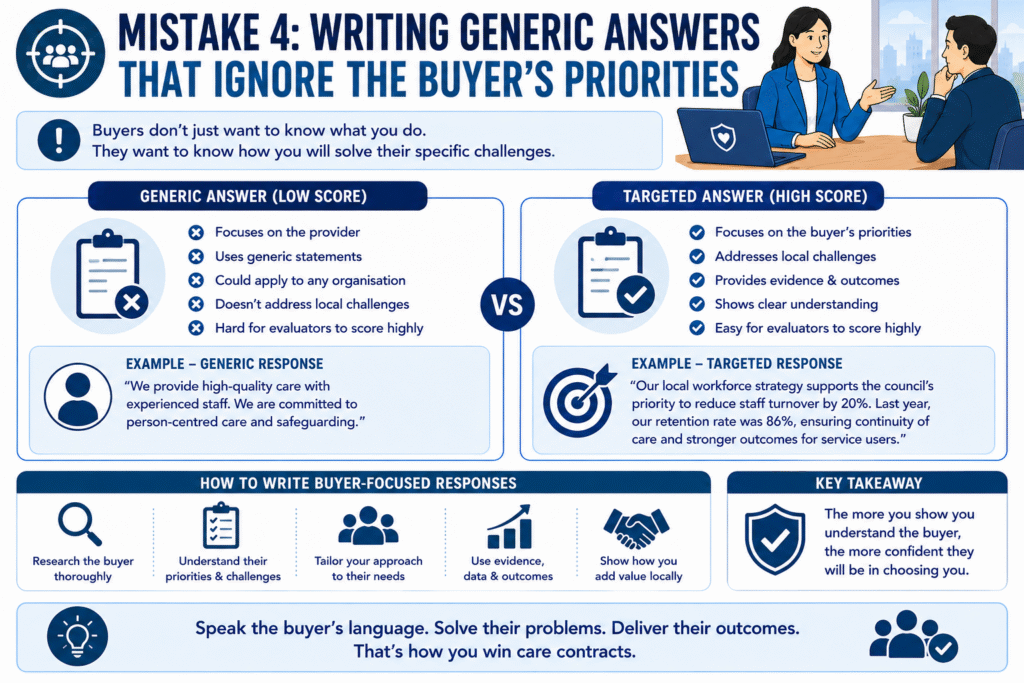
Tag: Tender Writing

  • Dementia Support Service Tender 2026: Birmingham and Solihull Bid Guide

    Dementia Support Service Tender 2026: Birmingham and Solihull Bid Guide

    The Dementia Support Service tender seeks one provider to deliver a coordinated service across Birmingham and Solihull. NHS Birmingham and Solihull Integrated Care Board has stated an estimated value of £3,336,000 excluding VAT, with submissions due by 5pm on 29 July 2026.

    This is a specialist community health service, not a routine domiciliary care contract. The successful provider will need to show how people living with dementia, their carers and families will receive timely information, practical support, effective navigation and joined-up referral pathways.

    The official Dementia Support Service tender notice on Find a Tender confirms a single lot for Birmingham, an open procedure and a quality weighting of 90 per cent. The detailed conditions of participation and service requirements remain in the Atamis procurement documents, so bidders should search for project reference C387762 before making a final bid decision.

    In this guide: we explain the service scope, contract structure, bidder fit, evidence priorities and practical steps required to prepare a credible response to the Dementia Support Service tender.

    Key Takeaways

    • The opportunity is a single-lot community health procurement covering Birmingham and Solihull.
    • Technical quality carries 90 per cent of the published weighting, so pathway design and verified evidence are central to the response.
    • The Dementia Support Service tender does not publicly state that CQC registration is mandatory. Bidders must confirm all conditions in Atamis.
    • A credible bid needs specialist dementia capability, equitable access, local partnerships, carer support, lived experience and measurable outcomes.

    Dementia Support Service Tender at a Glance

    • Buyer: NHS Birmingham and Solihull Integrated Care Board
    • Procurement support: NHS Arden and Greater East Midlands Commissioning Support Unit
    • Project reference: C387762
    • Procurement ID: ocds-h6vhtk-060f00
    • Procedure: open procedure
    • Regime: Procurement Act 2023, light touch contract
    • Lots: one
    • Delivery area: Birmingham, with the service covering Birmingham and Solihull
    • Estimated value: £3,336,000 excluding VAT
    • Stated annual value: £834,000
    • Initial term: 1 January 2027 to 31 December 2028
    • Extension: up to two further years, to 31 December 2030
    • Quality weighting: 90 per cent
    • Price weighting: 10 per cent
    • Submission deadline: 5pm on 29 July 2026
    • Submission portal: Atamis

    The public enquiry deadline was 5pm on 17 July 2026, which has passed. Bidders should still review every published clarification and document version in Atamis before submission. Review the Dementia Support Service tender record on Care Sync Experts for a convenient summary, then use the buyer’s portal as the final authority. You can also browse our wider feed of healthcare tender opportunities.

    What Service Is the Buyer Commissioning?

    The buyer wants a single point of access for information and advice about dementia, including support available before and after diagnosis and clear guidance on how people can access it.

    The public notice describes a service that should provide or facilitate:

    • signposting to relevant support services and community groups;
    • practical emotional support that helps people feel safer and more resilient;
    • coaching for people living with dementia and their carers, tailored to their circumstances;
    • access to peer-led group support;
    • person-centred support that promotes independence and wellbeing;
    • better coordination across health, social care and voluntary sector partners;
    • proactive intervention intended to reduce avoidable crises, hospital admissions and delayed discharges;
    • meaningful involvement of lived experience in service design, delivery and evaluation;
    • clear referral pathways into, through and out of the service;
    • equitable access across different communities and areas of Birmingham and Solihull.

    This scope aligns with the local Birmingham and Solihull Dementia Strategy 2023 to 2028, which prioritises information, timely diagnosis with support, crisis prevention and personalised care planning. A strong tender response should connect its delivery model to these local priorities without simply repeating strategy language.

    Dementia Support Service tender discussion with an older woman, family member and community service navigator
    The proposed service must make information, navigation and practical support easier to access for people living with dementia and those who support them.

    Who Is This Tender Likely to Suit?

    The opportunity is likely to suit established dementia charities, voluntary and community organisations, community health providers, social care organisations and partnerships that can demonstrate relevant specialist experience at scale.

    The notice identifies the opportunity as particularly suitable for small and medium-sized enterprises and voluntary, community and social enterprises. That does not remove the need to prove capacity, governance, financial resilience and safe mobilisation for a contract of this size.

    A domiciliary care or supported living provider may have relevant experience, but it should not assume that care delivery or CQC registration alone proves suitability. The public notice does not state that CQC registration is a condition of participation. The detailed procurement documents must be checked before making any claim about mandatory registration, accreditations, turnover thresholds or insurance levels.

    Before bidding, leadership should be able to evidence:

    • specialist knowledge of dementia and its impact on people, carers, families and communities;
    • a credible single point of access and navigation model;
    • strong local partnerships and referral arrangements across Birmingham and Solihull;
    • accessible delivery for diverse communities and people affected by health inequalities;
    • a competent, supervised and resilient workforce;
    • safe information sharing, safeguarding and risk management;
    • measurable outcomes and reliable performance reporting;
    • mobilisation capacity for a 1 January 2027 start;
    • financial sustainability at the proposed price.

    If your team is new to public procurement, read our guide to tenders in health and social care before building the compliance matrix.

    Why the 90 Per Cent Quality Weighting Matters

    The published award criteria allocate 90 per cent to technical quality and 10 per cent to commercial cost. This makes the evidence, clarity and credibility of the delivery solution central to the competition.

    It does not mean price can be ignored. A low quality response will struggle, but an unsustainable or poorly evidenced cost model can still damage the submission. Bid teams should align the service model, staffing assumptions, activity volumes, partnership commitments and price before final drafting.

    The notice directs suppliers to the procurement documents for the detailed quality criteria. Do not invent sub-weightings or assume the final questions. Build the response plan from the latest Atamis pack, including every schedule, declaration, word limit and clarification.

    Watch: Three Hidden Healthcare Tender Eligibility Checks

    Our Care Sync Experts video explains three checks that can stop a healthcare bid before evaluators reach the method statements. Use it as a decision prompt for the Dementia Support Service tender, then verify every requirement against the current Atamis pack.

    Watch the healthcare tender eligibility video on YouTube

    Eight Evidence Areas to Prepare

    1. A clear person-centred pathway

    Map the journey from first contact to triage, information, support planning, intervention, onward referral and exit. Explain choice, consent, accessibility, handovers and what happens when a person’s needs change.

    The NICE dementia guideline places the person’s individuality, perspective, relationships and wellbeing at the centre of good practice. Use this as a clinical and practice reference, then show exactly how your operating model will deliver it.

    2. Local access and health inequalities

    The notice expects the service to consider geographical demand, population differences and dementia prevalence across Birmingham and Solihull. A generic city-wide claim is not enough. Show where and how people will access the service, including communities that may experience language, cultural, digital, transport or trust barriers.

    3. Referral pathways and partnership governance

    Identify likely referral partners, their roles, handover standards and escalation routes. Distinguish a supportive relationship from a formal commitment. Any letters of support should be current, specific and consistent with the proposed delivery model.

    4. Support for carers and families

    Explain how carers will receive information, practical coaching, emotional support and appropriate onward referral whilst protecting the rights and wishes of the person living with dementia. Show how the service will recognise carer strain and respond proportionately.

    5. Lived experience and co-production

    The notice calls for lived experience to be embedded in design, delivery and evaluation. Define who will participate, how their contribution will be supported, how feedback will influence decisions and how you will report the changes made.

    6. Workforce competence and supervision

    Set out roles, caseload assumptions, specialist competencies, induction, ongoing learning, supervision and cover arrangements. The workforce plan should connect directly to activity, geography, opening hours and the needs of diverse communities.

    7. Outcomes, data and learning

    Separate service activity from meaningful outcomes. Contact volumes and referrals are useful measures, but the buyer will also need confidence that the service improves access, wellbeing, independence, coordination and crisis prevention. Define data quality controls and how learning will change practice.

    8. Mobilisation and continuity

    Work backwards from 1 January 2027. Cover governance, recruitment, technology, information governance, referral testing, partner onboarding, communications, training, readiness reviews and business continuity. Give each dependency an owner and decision date.

    Care Sync Experts can help turn the procurement pack into a traceable response plan through our healthcare tender writing service.

    How to Turn the Dementia Support Service Tender Quality Weighting Into Scorable Evidence

    The 90 per cent technical weighting makes the quality narrative central, but evaluators can only score what the response demonstrates. A strong bid should create a traceable line from each requirement to the delivery method, accountable role, evidence source and measurable outcome. The controls below help prevent specialist knowledge from becoming a set of unscored general statements.

    Show the pathway, not only the service values

    Values such as compassion, choice and person-centred support matter, but they need an operating method. Explain how a person or carer enters the service, receives accessible information, is triaged, agrees priorities, accesses support and moves between services. Include decision points, handovers, consent, safeguarding and exit planning. This gives evaluators a usable picture of the experience rather than asking them to infer it.

    Use evidence that matches the commitment

    For each important promise, identify evidence of relevant delivery. A case example may demonstrate practice, performance data may demonstrate consistency and a policy may demonstrate organisational control. None of these sources should be stretched beyond what it proves. Where direct evidence is limited, explain the gap, the transferable element and the mobilisation control. Do not present an unrelated care contract as proof of specialist dementia navigation.

    Define local partnership accountability

    A partnership list is not a pathway. Name the likely role of each partner, referral direction, information exchange, governance route and escalation point. Separate confirmed commitments from relationships that still need to be established. The mobilisation plan should show when agreements will be completed, how the pathway will be tested and what happens if a dependency is delayed.

    Connect outcomes to service activity

    Explain how contacts, referrals and group attendance contribute to outcomes that matter to people living with dementia and carers. Define the measure, data source, review frequency and person responsible for quality assurance. Include how feedback and lived experience will change the service, not simply how they will be collected. This helps demonstrate that performance management will support learning rather than becoming a reporting exercise.

    Complete an independent evaluator review

    A reviewer who did not draft the response should check whether every question has been answered, every claim can be verified and every commitment is reflected in staffing and price. Flag vague phrases such as seamless support or strong partnerships unless the method immediately follows. A separate compliance review should confirm declarations, attachments, word limits, filenames and the latest Atamis document versions before upload.

    What the Light Touch Open Procedure Means

    The notice classifies the procurement as a light touch contract under the Procurement Act 2023 and uses an open procedure. Government light touch contract guidance explains that these services are subject to a more flexible regime, whilst open procedure guidance describes a single-stage competition in which any supplier may submit a tender.

    For a bidder, the practical point is simple: do not mistake procedural flexibility for relaxed evidence requirements. The buyer has published a competitive opportunity, and the response must meet the conditions, instructions and evaluation criteria in the procurement pack.

    A Practical Bid Preparation Plan

    1. Confirm the live pack: access Atamis, search C387762 and record every document version and clarification.
    2. Run the bid decision: test specialist fit, local delivery capacity, partnerships, evidence, price and mobilisation risk.
    3. Build a compliance matrix: map every question, attachment, declaration, limit, criterion and owner.
    4. Lock the service model: agree the pathway, access routes, workforce, governance, partnerships, outcomes and information flows.
    5. Validate evidence: use current examples, data and documents that directly support each claim.
    6. Reconcile solution and price: check that staffing, volumes, overheads, partnership costs and performance commitments are financially consistent.
    7. Review independently: complete factual, compliance, evaluator, financial and presentation reviews.
    8. Submit early: verify every upload and retain the portal receipt before 5pm on 29 July 2026.

    Common Reasons a Dementia Support Service Bid Could Lose Marks

    • describing generic dementia awareness rather than a working service pathway;
    • claiming partnerships without named roles, referral processes or accountability;
    • treating lived experience as a consultation exercise with no influence on delivery;
    • failing to explain equitable access across Birmingham and Solihull;
    • using activity counts as substitutes for outcomes;
    • presenting workforce numbers that do not match geography, demand or opening hours;
    • ignoring carers, crisis prevention or coordination with other services;
    • guessing requirements that are only available in the Atamis documents;
    • allowing the cost model and delivery narrative to contradict each other;
    • submitting against an old document version or missing a mandatory attachment.

    A disciplined response makes each requirement easy to find and each material claim easy to verify. Our article on public contract readiness for smaller providers provides further context for building a stronger evidence base.

    Should Your Organisation Bid?

    Bid for the Dementia Support Service tender if you can demonstrate specialist dementia support capability, a realistic local delivery model, credible partnerships, a robust workforce, measurable outcomes and sustainable pricing.

    Consider a no-bid decision if the organisation would need to invent local capacity, rely on unconfirmed partners, stretch unrelated care experience to fit the requirement or mobilise a service model it has not costed properly.

    Before approving the bid, leadership should be able to answer:

    1. Why are we a strong fit for this exact service?
    2. What evidence proves our pathway will work across Birmingham and Solihull?
    3. Which gaps remain, and can they be closed before submission and mobilisation?
    4. Can we deliver every commitment safely and sustainably at our proposed price?

    Need Support With the Dementia Support Service Tender?

    Care Sync Experts can help you review the Dementia Support Service tender, build the compliance matrix, strengthen evidence and prepare a clear, evaluator-friendly tender response. We will also tell you when the available evidence supports a no-bid decision.

    Book a tender consultation to discuss your current evidence and submission timetable.

    This article is an independent summary based on the public notice and official guidance available on 19 July 2026. It is not the procurement pack and does not replace Atamis documents, buyer clarifications or professional legal advice.

    Frequently Asked Questions

    What is the deadline for the Dementia Support Service tender?

    The official Dementia Support Service tender notice states that tenders must be submitted by 5pm on 29 July 2026. Bidders should confirm the live deadline and any formal amendment in Atamis.

    How much is the contract worth?

    The estimated value is £3,336,000 excluding VAT. The notice also states an annual value of £834,000 and provides an initial two-year term with an option to extend for up to two further years.

    Is CQC registration required?

    The public notice does not state that CQC registration is a condition of participation. Bidders must check the full procurement documents before deciding which registrations, accreditations and evidence are mandatory.

    Can an SME or voluntary organisation bid?

    Yes. The notice identifies the opportunity as particularly suitable for SMEs and voluntary, community and social enterprises. Every bidder must still meet the published conditions and demonstrate capacity to deliver the full contract.

    How will the tender be evaluated?

    The published criteria allocate 90 per cent to technical quality and 10 per cent to cost. The detailed questions, scoring method and sub-criteria must be taken from the current Atamis documents.


  • Thurrock Floating Support Tender: Complete 2026 Bid Guide

    Thurrock Floating Support Tender: Complete 2026 Bid Guide

    The Thurrock floating support tender is a £1,106,241 opportunity for one provider to deliver short-term, community-based support to residents with poor mental health and/or a learning disability. Thurrock Council has set the tender submission deadline at 12 noon on 14 August 2026. The enquiry deadline is earlier, at 5pm on 5 August 2026.

    The service is designed to help people live independently, remain in their homes and reduce the risk of homelessness. Support may continue for up to two years, depending on need. This is an open procedure under the light touch regime, with one contract and a stated quality-to-price balance of 80% to 20%.

    The official Thurrock Council tender notice is the primary source for the facts in this guide. Providers must also review the complete In-tend pack, every buyer clarification and any later amendment before making a bid decision.

    In this guide: we explain the service scope, contract dates, evaluation structure, provider fit, evidence priorities and the practical steps needed to prepare a compliant response.

    Key Takeaways

    • The enquiry deadline is 5pm on 5 August 2026.
    • The tender submission deadline is 12 noon on 14 August 2026.
    • The estimated contract value is £1,106,241 excluding VAT.
    • The service is for Thurrock residents with poor mental health and/or a learning disability.
    • The contract is expected to begin on 1 January 2027 and may continue to 31 March 2033 if the optional extension is used.
    • Quality accounts for 80% of the published evaluation weighting and price accounts for 20%.

    Thurrock Floating Support Tender at a Glance

    • Buyer: Thurrock Council
    • Notice: 2026/S 000-064371
    • Procurement identifier: ocds-h6vhtk-06c6bf
    • Service: floating support for residents with poor mental health and/or a learning disability
    • Procedure: open procedure
    • Regime: light touch
    • Lots: one
    • Estimated value: £1,106,241 excluding VAT
    • Expected contract dates: 1 January 2027 to 31 March 2032
    • Possible extension: up to 31 March 2033
    • Enquiry deadline: 5pm on 5 August 2026
    • Tender deadline: 12 noon on 14 August 2026
    • Submission route: Thurrock Council In-tend portal

    Review the Thurrock floating support opportunity on Care Sync Experts for a convenient summary. The official notice and the buyer portal remain the final authority.

    Care provider leadership team planning a response to the Thurrock floating support tender
    Illustrative image: a strong response connects the operating model, workforce, outcomes, governance and price.

    What Must the Thurrock Floating Support Tender Service Achieve?

    The Thurrock floating support tender seeks a service that supports people with fluctuating needs to live as independently as possible. The official notice describes short-term support of up to two years. Delivery is community based and preventative, with a clear focus on helping people remain in their own homes and preventing homelessness wherever possible.

    That description points to a practical, outcome-led service. A credible operating model should show how the provider will move from referral and assessment to an agreed support plan, regular review, step-down and planned exit. It should also explain what happens when a person’s needs increase, risks change or urgent multi-agency action is required.

    Providers should avoid turning this into an accommodation-based or clinical service in their response unless the procurement documents specifically require those elements. Floating support usually depends on flexible, community-based work that helps people sustain tenancies, manage daily responsibilities, connect with services and build confidence. The final specification must determine the exact boundaries.

    Adult and support worker reviewing a person-centred independence plan at home
    Illustrative image: effective floating support should help each person define, review and own meaningful goals.

    Which Providers Should Consider the Thurrock Floating Support Tender?

    The Thurrock floating support tender may suit organisations with proven experience in housing-related support, community mental health support, learning disability services or comparable preventative services. The strongest fit will be a provider that can evidence safe lone working, flexible outreach, person-centred planning, multi-agency coordination and measurable progress towards independence.

    Before approving a bid, leadership should be able to demonstrate:

    • relevant delivery experience and outcomes for comparable people and services;
    • a workforce model that supports continuity, flexibility and safe community work;
    • clear safeguarding, escalation, incident and lone-working controls;
    • strengths-based assessment and support planning;
    • effective partnership working with housing, social care, health and community services;
    • a credible mobilisation plan for the expected January 2027 start;
    • performance measures that show prevention, tenancy sustainment, independence and planned exits;
    • a price that supports every staffing and delivery commitment.

    Do not assume that holding a particular registration, office location, rating or policy is enough. Test each condition of participation against the current procurement pack. If the documents require specific regulatory, financial, insurance or local-presence evidence, record the exact requirement and the evidence date before sign-off.

    How Will the Thurrock Tender Be Evaluated?

    The public notice for the Thurrock floating support tender gives a 20% price weighting and an 80% quality weighting. The quality criteria are spread across nine areas:

    Quality area Weighting
    Operating model 15%
    Outcomes 5%
    Workforce 5%
    Assessments 10%
    Performance 5%
    Outreach service 10%
    Engagement 5%
    Case study 15%
    Social value 10%

    For the Thurrock floating support tender, this weighting makes the operating model and case study especially important, but every scored area still needs a direct, evidenced response. A bidder should build one joined-up service model, then show how each answer proves a different part of that model. Repeating the same general statements across nine questions will not create nine strong answers.

    Price and quality should be developed together. Staffing ratios, caseload assumptions, management time, travel, supervision, training, data systems, absence cover and social value commitments must all be reflected in the cost model.

    Watch: Three Hidden Healthcare Tender Eligibility Checks

    Our Care Sync Experts video explains how regulator fit, local presence and quality thresholds can affect a tender decision. Use it as a prompt, then verify every requirement against the current Thurrock procurement pack.

    Watch the healthcare tender eligibility video on YouTube

    Eight Evidence Priorities for the Thurrock Floating Support Tender

    1. A clear referral-to-exit pathway

    Map how referrals are received, screened and allocated. Explain assessment, goal setting, review, risk escalation, step-down and closure. State who makes each decision, how quickly it happens and what records prove it.

    2. Strengths-based assessment

    Show how the provider identifies the person’s strengths, preferences, housing risks, support network and priorities. Connect each assessment finding to a measurable goal and a realistic support action.

    3. A responsive outreach model

    Explain where and how support is delivered, how contact frequency changes, how missed visits are managed and how the service responds to fluctuating needs. Separate planned flexibility from unsafe or unfunded availability.

    4. Workforce competence and continuity

    Connect recruitment, induction, specialist learning, supervision and competency checks to the people being supported. Explain caseloads, travel planning, lone working and cover. Distinguish existing staff from people who still need to be recruited.

    5. Safeguarding and risk escalation

    Describe the route from concern to immediate protection, reporting, management oversight, multi-agency action and learning. Include practical controls for self-neglect, exploitation, tenancy risk, deterioration and missed contact where the specification makes them relevant.

    6. Partnership working

    Define how the provider will work with council teams, housing services, health professionals, families, advocates and community organisations. Use named roles, referral routes, information-sharing controls and escalation times rather than broad partnership language.

    7. Outcomes and performance

    Identify measures that show whether people are sustaining accommodation, increasing independence, engaging with appropriate services and moving towards planned exits. Explain data ownership, quality checks, reporting and corrective action.

    8. A credible case study

    Select an example that closely matches the tender’s service model. Keep it anonymous, specific and evidence based. Show the starting position, risks, support actions, partnership work, measurable result and what the organisation learned.

    Care Sync Experts can help turn the procurement pack into a traceable response plan through our healthcare tender writing service.

    A Practical Thurrock Floating Support Tender Plan Before 14 August

    1. Confirm the live pack: register on Thurrock In-tend and record every document version and clarification.
    2. Separate the dates: submit clarification questions before 5pm on 5 August and the complete tender before 12 noon on 14 August.
    3. Run the bid decision: test eligibility, experience, workforce, systems, mobilisation and financial viability.
    4. Build a compliance matrix: map every instruction, question, attachment and declaration to an owner and due date.
    5. Lock the operating model: agree the referral pathway, staffing, caseloads, partnerships, outcomes and risks before writing separate answers.
    6. Create an evidence register: identify the document, metric or example that supports every important promise.
    7. Reconcile quality and price: make sure the commercial model funds the response.
    8. Review independently: complete compliance, factual, evaluator and financial reviews before upload.
    9. Submit early: verify every file on the portal and retain the submission receipt.

    If your team is new to public procurement, read our guide to tenders in health and social care. Our Harrow Council homecare tender guide also shows why provider fit, evidence and local delivery must be tested against each buyer’s exact requirements.

    Common Reasons a Floating Support Bid Could Lose Marks

    • describing generic values instead of a working referral-to-exit pathway;
    • treating fluctuating needs as a reason for vague or unlimited availability;
    • claiming partnership working without named roles, routes or timescales;
    • using policies as evidence without showing implementation and results;
    • presenting training lists without linking competence to the service model;
    • using an unrelated case study with no measurable outcome;
    • making social value promises that are not costed, owned or measurable;
    • failing to reconcile caseload, travel and supervision with the price;
    • confusing the enquiry deadline with the tender deadline;
    • submitting an old document version or missing a mandatory attachment.

    Should Your Organisation Bid?

    Bid for the Thurrock floating support tender if your organisation meets the current conditions, has closely relevant experience, can mobilise a safe community-based model and can evidence every major promise. Consider a no-bid decision if the response depends on unconfirmed staff, overstated partnerships, unrelated experience or a price that cannot sustain the proposed service.

    A disciplined bid decision should answer four questions:

    1. What current evidence proves we are eligible and relevant?
    2. Can our operating model deliver the required outcomes safely?
    3. Can we mobilise by the expected start date without relying on assumptions?
    4. Does the price fund every commitment in the response?

    Need Support With the Thurrock Floating Support Tender?

    Care Sync Experts can help you review the Thurrock floating support tender pack, build the compliance matrix, strengthen the evidence and prepare a clear, evaluator-friendly response. We will also tell you when the evidence supports a no-bid decision.

    Book a tender consultation to discuss your eligibility, evidence gaps and submission timetable.

    This article is an independent summary based on the public notice and official information checked on 19 July 2026. It does not replace the official procurement pack, buyer clarifications, portal instructions or professional legal advice.

    Frequently Asked Questions

    What is the deadline for the Thurrock floating support tender?

    The enquiry deadline is 5pm on 5 August 2026. The tender submission deadline is 12 noon on 14 August 2026. Providers should check Thurrock In-tend for any formal amendment.

    How much is the Thurrock floating support contract worth?

    The official notice gives an estimated value of £1,106,241 excluding VAT and £1,327,490 including VAT.

    Who will the floating support service help?

    The service is for Thurrock residents with poor mental health and/or a learning disability. It is intended to provide short-term, community-based support that promotes independence and helps prevent homelessness.

    How important is quality in the evaluation?

    The published criteria allocate 80% to quality and 20% to price. Operating model and case study each carry 15%, whilst the other quality areas cover outcomes, workforce, assessments, performance, outreach, engagement and social value.

    When is the Thurrock contract expected to start?

    The official notice gives an expected start date of 1 January 2027. The initial period may run to 31 March 2032, with an optional twelve-month extension to 31 March 2033.

  • Cumberland Care Framework: 8 Essential Agency Bid Priorities

    Cumberland Care Framework: 8 Essential Agency Bid Priorities

    The Cumberland Care Framework is a procurement opportunity for staffing organisations that can supply Support Workers, Senior Support Workers and Registered Nurses to Cumberland Council’s adult social care services. It is not simply a directory of approved local carers or a general care-planning system.

    Through the framework, Cumberland Council aims to secure reliable agency cover for residential care, domiciliary care, reablement, supported living, day services, extra care housing and Shared Lives.

    Care agencies must therefore prove that they can recruit safely, match workers to different care environments, respond to urgent shifts and maintain consistent service quality at sustainable rates.

    Key Takeaways

    • The tender deadline is 10:00am on 12 August 2026.
    • The clarification deadline is 10:00am on 5 August 2026.
    • The estimated value is £4.75 million excluding VAT.
    • The framework runs from 1 November 2026 to 30 April 2029, with no extension option.
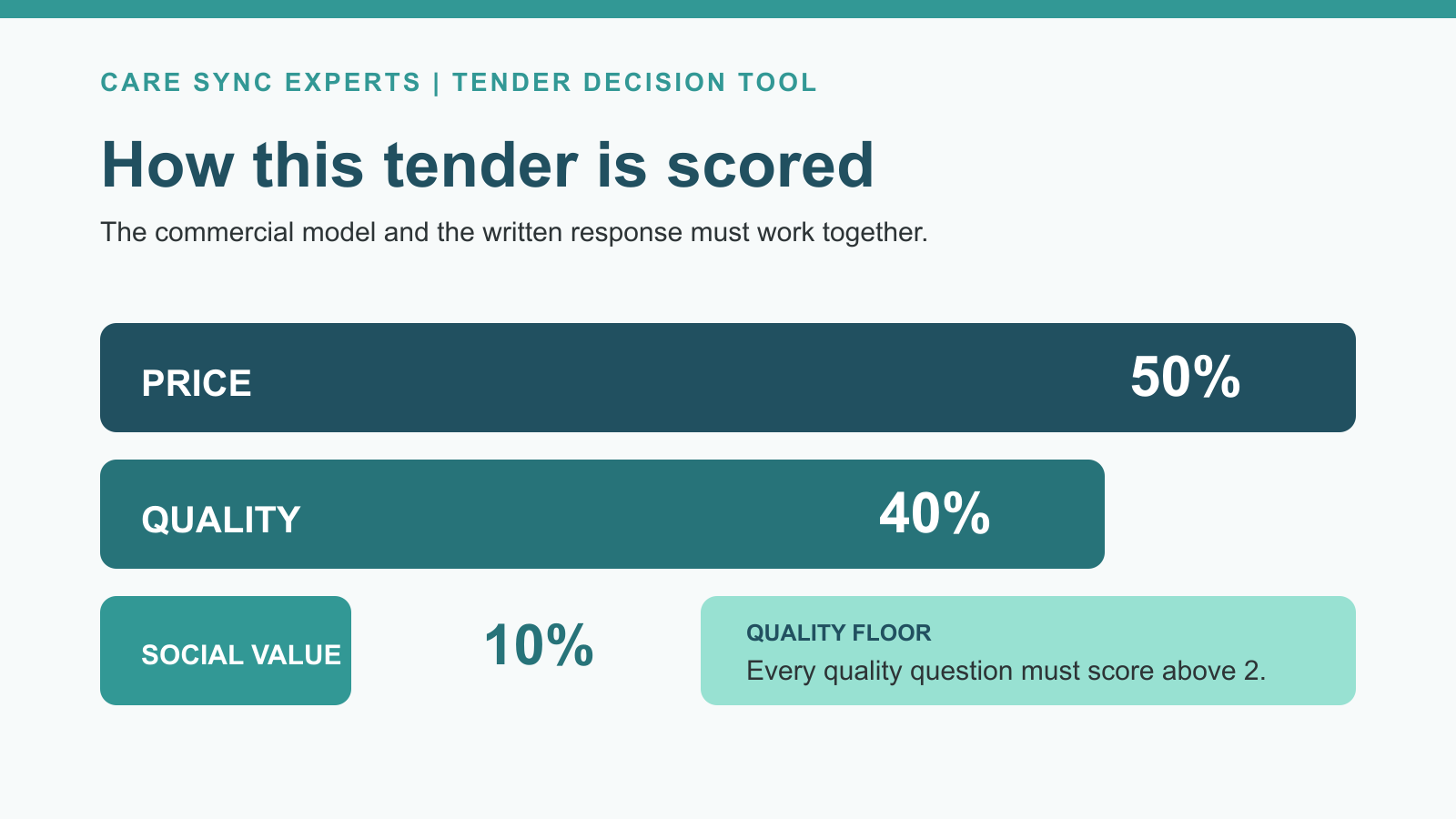
    • Evaluation is weighted 50% price, 40% quality and 10% social value.
    • Suppliers may bid for one, two or all three roles, but every required rate must be submitted for a chosen role.
    • The framework is closed, with no later admission route after award.

    Cumberland Care Framework at a Glance

    Stockport Homecare Tender: Insurance, CQC, and the May 5 Cutoff

    The Cumberland Care Framework gives care agencies one opportunity to join a closed staffing agreement worth an estimated £4.75 million excluding VAT. The framework will run from 1 November 2026 to 30 April 2029, with no extension option currently stated.

    Framework detailRequirement
    BuyerCumberland Council
    Staffing rolesSupport Workers, Senior Support Workers and Registered Nurses
    Clarification deadline10:00am on 5 August 2026
    Tender deadline10:00am on 12 August 2026
    Evaluation50% price, 40% quality and 10% social value
    Submission portalThe Chest
    Framework typeClosed framework with no later admission route

    A care agency may bid for one, two or all three staffing roles. However, it must submit every required weekday, weekend and bank holiday rate for each role it selects. Missing one required rate could remove the agency from consideration for that role.

    RELATED: Setting Up Supported Living Business UK in 2026

    What Services Will Agency Staff Support?

    The Cumberland Care framework is weighted 50 per cent price, 40 per cent quality and 10 per cent social value, with a minimum standard for every quality question.

    Agency workers appointed through the framework may support adults across several Cumberland Care settings, including residential homes, reablement and domiciliary care, supported living, day services, extra care housing and Shared Lives.

    These services support adults aged 18 and over with physical disabilities, learning disabilities, mental health needs and age-related conditions such as dementia. Each setting brings different risks, routines and levels of responsibility, so agencies cannot treat every placement in the same way.

    A worker who suits a domiciliary care shift may not automatically have the experience needed for a residential home, supported living service or nursing assignment. Care agencies must match each worker’s training, competence, experience and availability to the specific role and environment before confirming cover.

    The framework also expects agencies to provide planned and urgent staffing across different shift patterns, including weekends and bank holidays.

    Which Care Agencies Should Consider Bidding?

    The Cumberland Care Framework suits established care agencies that can demonstrate safe recruitment, dependable workforce management and the ability to supply qualified staff across the Cumberland Council area. While the opportunity is open to organisations of different sizes, every bidder must prove that it can deliver the contract requirements from day one rather than relying on future recruitment.

    Before deciding to bid, assess whether your organisation can confidently evidence:

    • Safe recruitment, including identity, right-to-work, DBS and reference checks.
    • A workforce of Support Workers, Senior Support Workers and Registered Nurses with the appropriate skills and training.
    • Sufficient staffing capacity to cover planned, urgent and out-of-hours requests.
    • Strong safeguarding, supervision and incident management procedures.
    • Reliable workforce continuity that reduces unnecessary changes of staff.
    • Accurate timesheets, invoicing and performance reporting.
    • Business continuity plans for sickness, high demand and travel disruption.
    • Financial stability to deliver the contract at the rates you submit.

    Winning a care agency tender requires more than recruiting staff. Evaluators want evidence that your systems, governance and workforce can consistently deliver safe, person-centred care across every service covered by the framework.

    Agencies that overstate their capacity or depend heavily on workers who have not completed pre-employment checks risk weakening both their quality score and overall credibility.

    READ MORE: How to Get Contracts for Domiciliary Care UK: Complete 2026 Guide

    How Cumberland Council Will Evaluate Bids

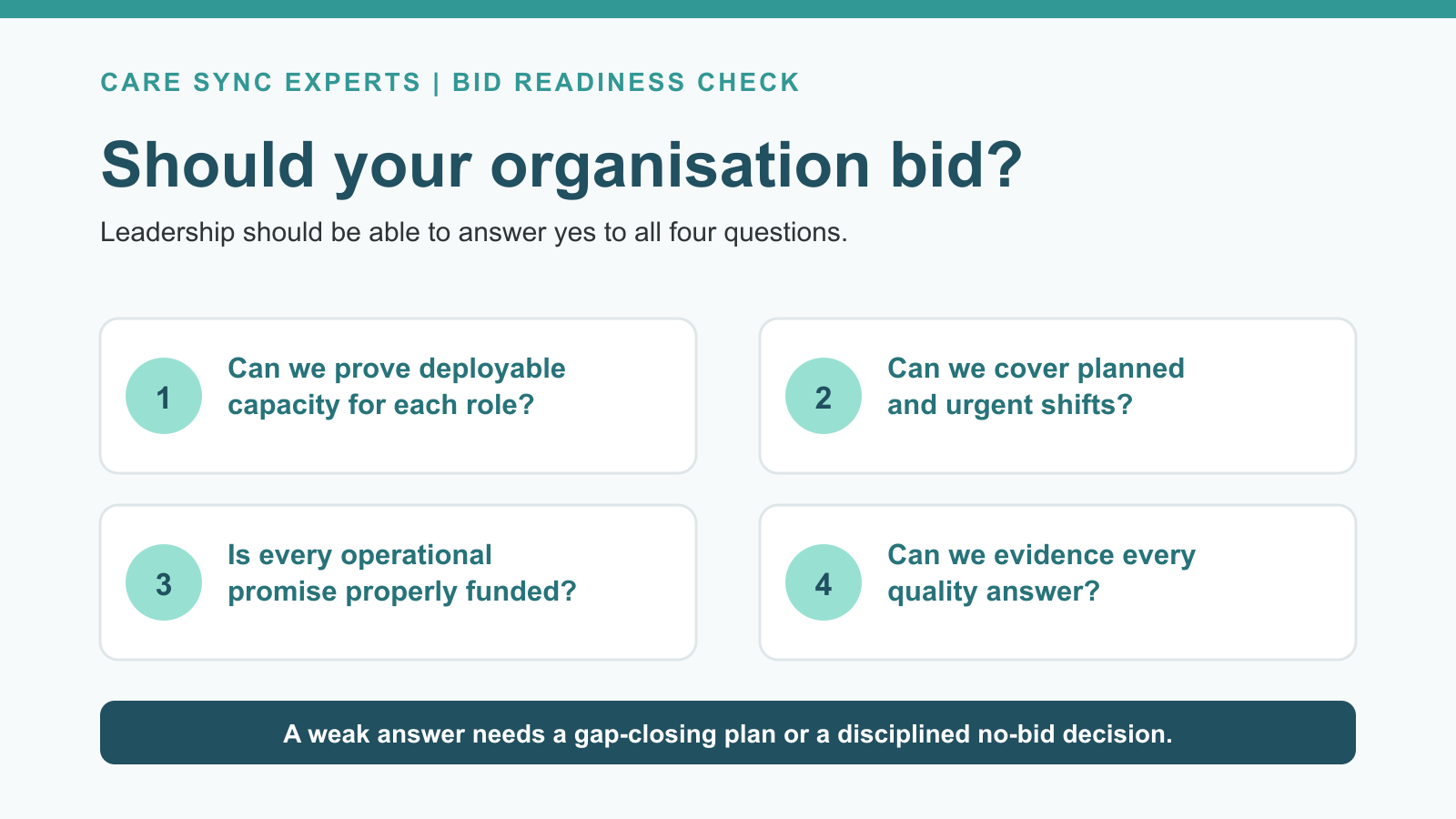
    Cumberland Care framework bid readiness check
    A provider should be able to evidence role capacity, planned and urgent shift cover, sustainable funding and every quality response before deciding to bid.

    Cumberland Council will score bids across three areas: price at 50%, quality at 40% and social value at 10%. That weighting gives price the largest share, but care agencies should not treat the exercise as a race to submit the lowest rates.

    Your pricing must cover the real cost of safe delivery, including recruitment, vetting, training, holiday pay, pension contributions, supervision, travel, sickness cover, out-of-hours coordination and agency overheads. A rate that looks competitive but cannot fund these responsibilities may weaken both delivery and evaluator confidence.

    Quality also carries a minimum standard. Each quality response must score above the stated threshold, which means one weak answer can put the whole submission at risk. Agencies should review every response separately and make sure it explains the method, accountable person, evidence, performance measure and corrective action.

    The strongest care tender evaluation strategy links the operating model and the pricing model together. Every promise in the written bid should be realistic, measurable and fully funded.

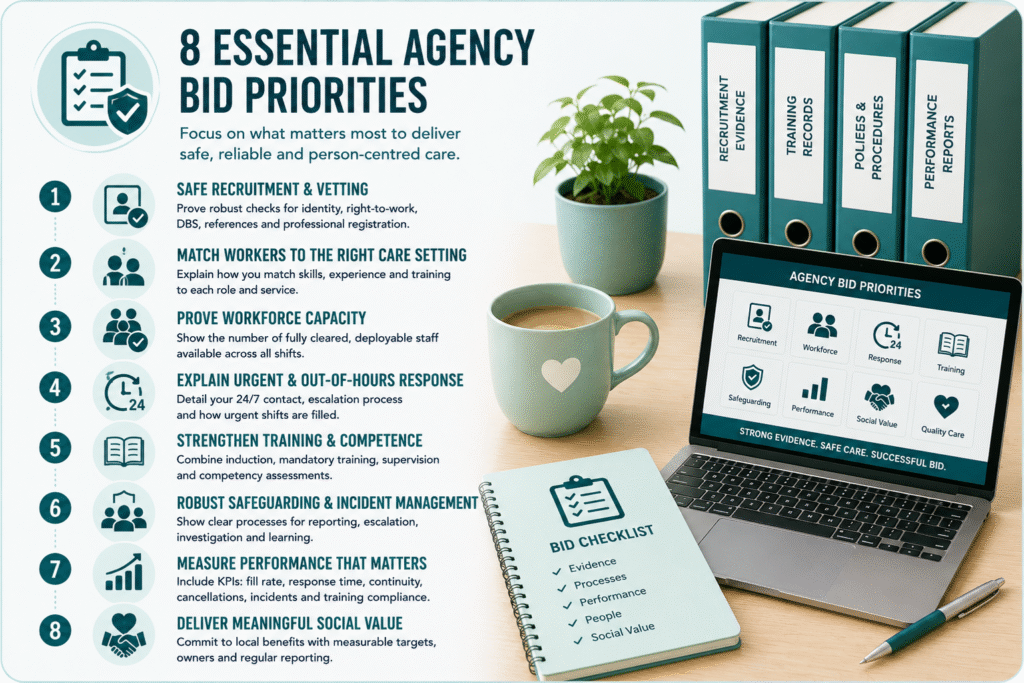
    8 Essential Agency Bid Priorities

    A successful Cumberland Care Framework bid depends on more than meeting the eligibility requirements. Evaluators want evidence that your agency can deliver safe, reliable and person-centred staffing across every service covered by the framework. Focus your response on these eight priorities.

    1. Demonstrate Safe Recruitment and Vetting

    Show how your recruitment process protects the people who receive care. Explain each stage, from identity and right-to-work checks to employment history, references, DBS clearance and professional registration where required. Make it clear who reviews the evidence, who approves deployment and how your agency manages incomplete or adverse checks.

    2. Match Workers to the Right Care Setting

    Avoid presenting your workforce as one interchangeable pool of staff. Explain how you match each worker’s experience, training and competence to the requested role and service. A Support Worker assigned to domiciliary care may not have the skills needed for supported living, while a Registered Nurse must meet additional professional and clinical requirements.

    3. Prove Workforce Capacity

    Evaluators need confidence that your agency can fill shifts without relying on future recruitment. Present realistic workforce figures and distinguish fully compliant, deployable staff from applicants who are still completing pre-employment checks. This approach demonstrates honest capacity planning and reduces concerns about mobilisation.

    4. Explain Your Urgent and Out-of-Hours Response

    The framework requires agencies to support planned and emergency staffing needs. Describe how your 24-hour contact arrangements work, how requests are logged, how staff are contacted, who manages escalations and what happens if the first available worker cannot accept the shift. Specific processes carry more weight than broad promises.

    5. Strengthen Training and Competency Assurance

    Training records alone do not prove competence. Show how your agency combines induction, mandatory training, observed practice, supervision, refresher training and competency assessments before workers support vulnerable adults. Where Registered Nurses form part of your bid, explain how you monitor professional registration and ongoing clinical competence.

    6. Show Robust Safeguarding and Incident Management

    Explain how safeguarding concerns move from identification to immediate action, reporting, investigation and organisational learning. Define responsibilities clearly and show how your agency communicates with Cumberland Council services throughout the process. A structured governance approach demonstrates accountability and protects both service users and staff.

    7. Measure Performance That Matters

    Support your quality claims with measurable performance indicators. Include metrics such as fill rates, response times, punctuality, worker continuity, cancellations, complaints, incidents and training compliance. Explain who reviews the data, how often reports are produced and what corrective action follows when performance falls below expectations.

    8. Deliver Meaningful Social Value

    Treat social value as more than a scoring exercise. Commit to activities that genuinely benefit Cumberland, such as creating local employment opportunities, investing in workforce development or supporting community initiatives. Every commitment should include a measurable target, an accountable owner and a practical method for reporting progress throughout the contract.

    SEE ALSO: Registered Manager CQC Interview Questions and Answers: 2026 Guide

    How to Make the Final Bid Decision

    Before committing resources to the Cumberland Care Framework, agency leaders should test the opportunity against current evidence rather than ambition alone.

    Ask four questions:

    • Which roles are we bidding for, and how many fully cleared workers can we supply now?
    • Can we cover planned, urgent, weekend and bank holiday shifts across Cumberland?
    • Can our proposed rates fund recruitment, training, supervision, travel and out-of-hours management?
    • Can we support every quality and social value promise with a clear process, owner and record?

    A bid may not be commercially sensible if your agency must rely on uncleared workers, unconfirmed availability or rates that fall below the true cost of safe delivery. Because this is a closed framework, missing the opportunity matters, but submitting an unsupported bid can damage credibility and consume valuable time.

    Use a formal bid or no-bid review before drafting the full response. Confirm eligibility, workforce capacity, geographic coverage, evidence quality, mobilisation requirements and financial resilience.

    Common Mistakes That Can Weaken a Care Agency Bid

    Professional agency bid checklist workspace
    Professional agency bid checklist workspace

    Even a capable agency can lose marks through avoidable errors. Before submitting, check that your team has not:

    • missed a required weekday, weekend or bank holiday rate;
    • counted applicants or uncleared workers as immediately deployable staff;
    • used generic policy language instead of explaining how processes work;
    • failed to show how the 24-hour contact route will handle urgent requests;
    • treated training attendance as proof of competence;
    • offered social value commitments without targets, owners or evidence;
    • submitted rates that cannot support safe delivery;
    • allowed one quality response to fall below the minimum threshold;
    • left portal uploads and final checks until the deadline.

    The strongest bids make every promise traceable. An evaluator should be able to see who owns each process, what evidence supports it, and what action the agency will take if delivery falls below the required standard.

    Prepare the Evidence Before You Write the Bid

    A strong Cumberland Care Framework submission starts with evidence, not persuasive wording. Confirm the latest procurement documents on The Chest, record every requirement in a compliance matrix and assign each response to a responsible owner.

    Before submission, your team should:

    • verify workforce capacity for every selected role;
    • confirm all weekday, weekend and bank holiday rates;
    • test whether pricing supports safe delivery;
    • align recruitment, training, safeguarding and escalation processes;
    • review every quality answer against the minimum score;
    • check that social value commitments are realistic and measurable;
    • complete an independent commercial and compliance review;
    • upload the final response early and retain the submission receipt.

    Care Sync Experts can support care agencies with bid planning, evidence development, quality responses, social value commitments and commercial alignment. The official notice, live procurement pack, buyer clarifications and portal instructions must always guide the final submission.

    FAQ

    What is a framework in simple terms?

    A framework is an arrangement that sets the rules, standards and commercial terms under which an organisation can buy goods or services from approved suppliers.

    In this case, the Cumberland Care Framework allows Cumberland Council to appoint eligible staffing providers that can supply care workers and nurses when its services need planned or urgent agency cover.

    What are frameworks in healthcare?

    Healthcare and social care frameworks help public bodies buy services, staffing or equipment from suppliers that have passed a formal procurement process. They usually define service standards, pricing requirements, contract terms and performance expectations.

    A place on a framework does not always guarantee work, but it allows an approved provider to receive assignments or compete for call-off opportunities under the agreed rules.

    Does an agency need CQC registration to bid for the Cumberland Care Framework?

    CQC registration will depend on the activities the agency carries out and the exact conditions stated in the procurement documents.

    A staffing agency that only supplies workers may have different registration obligations from a provider that directly manages and delivers a regulated activity.

    Bidders should check their service model, the CQC regulated-activity rules and every participation requirement in the live Cumberland procurement pack before submitting.

    What evidence should a care agency prepare before submitting a bid?

    A care agency should prepare evidence of safe recruitment, DBS and right-to-work checks, worker competence, training compliance, safeguarding procedures, urgent-cover arrangements and current workforce capacity.

    It should also gather performance data, business-continuity plans, financial assumptions, social value commitments and sample management information.

    Every important claim in the bid should connect to a named owner, a working process and an auditable record.

  • 25076 Homecare Framework: Complete Bid Guide 2026

    25076 Homecare Framework: Complete Bid Guide 2026

    The 25076 Homecare Framework is a major Cambridgeshire County Council opportunity for regulated homecare providers. The framework has an estimated value of £773.4 million excluding VAT, covers 17 lots and is expected to run from November 2027, with possible extensions to October 2037. The deadline for requests to participate is 12 noon on 19 August 2026.

    This is a two-stage competitive flexible procedure. Providers first submit a Procurement Specific Questionnaire, or PSQ. Applicants that meet the minimum criteria may then be invited to the tender stage. The enquiry deadline is 12 noon on 7 August 2026, but that is not the submission deadline.

    The official 25076 Homecare Framework notice is the primary source for the facts in this guide. Providers must also review the full Cambridgeshire In-Tend pack, all buyer clarifications and every later amendment before deciding whether to bid.

    In this guide: we explain the 17 lots, key dates, contract value, participation route, provider fit, bid restrictions, evaluation method and the evidence a serious homecare provider should prepare.

    Key Takeaways

    • The deadline for clarification questions is 12 noon on 7 August 2026.
    • The deadline for requests to participate is 12 noon on 19 August 2026.
    • The framework contains 15 geographic homecare lots, plus countywide live-in care and night-time care lots.
    • A supplier may bid for up to eight lots and may be awarded up to four lots.
    • The first stage is a PSQ shortlist. Meeting the minimum criteria does not guarantee a framework place.
    • The public notice gives an estimated value of £773.4 million excluding VAT and a potential ten-year duration.

    25076 Homecare Framework at a Glance

    • Buyer: Cambridgeshire County Council
    • Reference: 25076
    • Notice: 2026/S 000-066926
    • Procurement identifier: ocds-h6vhtk-05186c
    • Service: regulated homecare services for adults aged 18 and over
    • Procedure: two-stage competitive flexible procedure
    • Regime: light touch contract under the Procurement Act 2023
    • Framework value: £773,400,000 excluding VAT
    • Initial contract dates: 1 November 2027 to 31 October 2030
    • Possible extensions: to 31 October 2037
    • Enquiry deadline: 12 noon on 7 August 2026
    • PSQ participation deadline: 12 noon on 19 August 2026
    • Submission portal: Cambridgeshire In-Tend

    Review the 25076 Homecare Framework record on Care Sync Experts for a convenient opportunity summary. The official notice and buyer portal remain the final authority. You can also browse our wider feed of healthcare tender opportunities.

    Care provider leadership team planning a response to the 25076 Homecare Framework
    A credible bid begins with a joined-up decision on service design, workforce, local delivery, evidence and price.

    What Services Is Cambridgeshire County Council Commissioning?

    The council intends to establish a multi-provider framework through which it can commission regulated homecare packages for adults across Cambridgeshire. The public notice includes older people, people with physical disabilities, people with learning disabilities, people with mental health needs, autistic people and other eligible adults with assessed care and support needs.

    The council describes a locality-based model intended to support responsive delivery, continuity of care and coordination with health and community services. Its stated objectives include place-based services, stronger local care markets, improved consistency and quality, a sustainable provider base, preventative practice and value for money.

    The notice says the council is seeking providers that can demonstrate strong quality and safeguarding standards, flexible delivery, workforce stability, collaboration and innovation. These are broad expectations, not a substitute for the detailed conditions, questions and evidence requirements in the procurement pack.

    Providers should not infer a particular CQC rating, registered office rule, turnover threshold or insurance level from this public summary alone. Confirm every mandatory requirement in the current PSQ and tender documents. If the pack requires a local registered base or a minimum CQC rating, test the exact wording, eligible postcodes, evidence date and any exception before approving the bid.

    Homecare worker and older person reviewing a person-centred support plan at home
    The framework covers regulated homecare for adults, with a strong emphasis on personalised, locally responsive support.

    How Are the 17 Lots Structured?

    The 25076 Homecare Framework contains 15 geographic homecare zones and two countywide specialist lots.

    Cambridge and East Cambridgeshire

    • Lot 1: Cambridge East
    • Lot 2: Cambridge North
    • Lot 3: Cambridge West
    • Lot 4: East Cambridgeshire North
    • Lot 5: East Cambridgeshire South

    Fenland

    • Lot 6: West Fenland, Wisbech area
    • Lot 7: Central Fenland, March area
    • Lot 8: East Fenland, Chatteris area

    Huntingdonshire

    • Lot 9: Huntingdonshire East
    • Lot 10: Huntingdonshire North
    • Lot 11: Huntingdonshire South
    • Lot 12: Huntingdonshire West

    South Cambridgeshire and countywide services

    • Lot 13: South Cambridgeshire East
    • Lot 14: South Cambridgeshire North
    • Lot 15: South Cambridgeshire West
    • Lot 16a: countywide live-in care
    • Lot 16b: countywide night-time care, including sleeping and waking nights

    The official notice sets a maximum number of appointed providers for each of the 15 zoned lots. It also says a supplier may bid for a maximum of eight lots and may be awarded a maximum of four. This restriction should shape the bid decision. A provider needs to select the zones where it can prove workforce coverage, operational resilience, travel viability and genuine local capacity.

    The framework has additional flexibility because it is for light touch services. The authority states that it may add new providers during the framework term where demand cannot be met or provider capacity is insufficient. Any later appointment would still be subject to a procurement process.

    Who Should Consider Bidding?

    The opportunity is likely to suit established domiciliary care providers that can evidence safe regulated delivery, reliable workforce capacity and a commercially sustainable model for one or more Cambridgeshire zones. It is also relevant to providers with credible live-in care or night-time care capability.

    The notice identifies the opportunity as suitable for small and medium-sized enterprises and voluntary, community and social enterprises. Suitability does not remove the need to meet the conditions of participation or to prove that the proposed delivery model can operate at the required scale.

    Before bidding, leadership should be able to evidence:

    • current regulatory and safeguarding governance appropriate to the services offered;
    • safe recruitment, induction, supervision and competency assurance;
    • a realistic workforce plan for the selected zones or countywide lot;
    • capacity to accept, start and sustain care packages safely;
    • continuity arrangements for sickness, vacancies, travel disruption and demand peaks;
    • person-centred care planning and outcome review;
    • effective medication, incident, complaints and safeguarding controls;
    • digital systems that support scheduling, monitoring, audit and information governance;
    • credible collaboration with the council, NHS partners and community services;
    • financial resilience and pricing that supports every delivery commitment.

    If your organisation is new to public procurement, read our guide to tenders in health and social care before building the compliance matrix. Our earlier Harrow Council homecare tender guide also shows how local authority homecare opportunities can differ in lot structure, eligibility and delivery expectations.

    How Does the Two-Stage Competitive Flexible Procedure Work?

    The first stage is shortlisting. Applicants express interest and submit the completed PSQ, mandatory documents and any other material required by the buyer. The authority then assesses whether applicants meet the minimum criteria.

    Applicants that pass the first stage may be invited to the second stage, which is the Invitation to Tender. The detailed tender stage will test the provider’s solution, evidence, commercial offer and compliance with the buyer’s instructions.

    This distinction matters. The 19 August 2026 deadline is for requests to participate, not the final ITT return. A bid team should not wait for the ITT stage to resolve basic eligibility, corporate documents, insurance, financial evidence, regulatory evidence or delivery capacity.

    Meeting the minimum PSQ criteria does not guarantee a place on the framework. The notice explains that compliant bidders will be ranked and allocated to available zone places, subject to the authority’s published methodology and the maximum of four awards per bidder.

    Watch: Three Hidden Healthcare Tender Eligibility Checks

    Our Care Sync Experts video explains how regulator fit, local presence and quality thresholds can affect healthcare tender eligibility. Use it as a decision prompt for the 25076 Homecare Framework, then verify every requirement against the current Cambridgeshire PSQ and tender pack.

    Watch the healthcare tender eligibility video on YouTube

    Eight Evidence Priorities for the 25076 Homecare Framework

    1. A zone-specific operating model

    Show how the service will work in each selected lot. Map referral acceptance, assessment, care planning, rostering, visits, reviews, escalation and package closure. Explain travel assumptions, local management, on-call cover and how the provider will avoid overstretch across multiple zones.

    2. Workforce capacity and continuity

    Connect recruitment, retention, pay, travel time, contracted hours, supervision and cover arrangements to forecast demand. A strong answer distinguishes existing staff, committed recruits and future recruitment. Do not present an aspirational headcount as current capacity.

    3. Safe mobilisation

    Work backwards from the expected 1 November 2027 start. Cover governance, recruitment, TUPE where applicable, systems, care record transfer, service-user communication, workforce checks, training, rota testing and readiness assurance. Give each dependency an owner, milestone and fallback action.

    4. Person-centred outcomes

    Explain how care plans translate assessed needs, strengths, preferences and risks into deliverable outcomes. Show how people and representatives influence reviews, how changes are recorded and how staff recognise deterioration or unmet need.

    5. Safeguarding and quality governance

    Describe the operating route from concern to immediate protection, reporting, investigation, learning and oversight. Connect front-line reporting to registered manager review, senior governance, audit and improvement. Use current evidence that proves the system works, not only a policy title.

    6. Partnership and escalation

    Set out how the provider will work with social workers, commissioners, community health teams, hospitals, families and advocates. Define referral routes, information exchange, consent, handovers and escalation. Separate confirmed local relationships from arrangements that still need to be established.

    7. Data, performance and digital assurance

    Identify the measures that will show timeliness, continuity, quality, safety, outcomes and capacity. Explain data ownership, validation, reporting frequency and corrective action. Digital monitoring should support care, not replace professional judgement or human oversight.

    8. Financial sustainability

    Reconcile the price with pay, travel, training, supervision, management, technology, insurance, absence cover and overheads. Test demand variation and package complexity. Every promise in the method statements should be supported by the resource and cost model.

    Care Sync Experts can help turn the current procurement pack into a traceable response plan through our healthcare tender writing service.

    What Does Price Per Quality Point Mean for Bidders?

    The notice says the framework will use a Price Per Quality Point, or PPQP, methodology. The bidder’s price is divided by its quality score, then multiplied by 100. Compliant bidders are ranked from the lowest PPQP to the highest before zone places are allocated under the published method.

    The practical lesson is that price and quality cannot be developed separately. A lower price does not repair a weak or non-compliant quality response. A high quality score does not make an undeliverable price safe. The bid team should reconcile the service solution, staffing model, operating assumptions, evidence and commercial submission before final sign-off.

    Build a requirement-to-evidence map for every scored question. Identify the delivery method, accountable role, supporting evidence, measure and review route. Vague phrases such as robust governance, seamless partnership or person-centred care should be followed immediately by a specific method that an evaluator can assess.

    A Practical Preparation Plan

    1. Confirm the live pack: register on Cambridgeshire In-Tend, express interest and record every document version and clarification.
    2. Separate the dates: submit clarification questions before 12 noon on 7 August and the complete PSQ return before 12 noon on 19 August.
    3. Run the bid decision: test eligibility, selected lots, workforce, local capacity, evidence, mobilisation and financial viability.
    4. Build the PSQ evidence file: gather corporate, financial, insurance, regulatory, policy and technical evidence against the exact instructions.
    5. Create a lot strategy: rank the zones or countywide lots using current operational evidence, not ambition alone.
    6. Lock the delivery model: agree staffing, management, systems, partnerships, outcomes, risks and commercial assumptions.
    7. Review independently: complete factual, compliance, evaluator and financial reviews before upload.
    8. Submit early: verify every answer and attachment, then retain the portal receipt.

    Common Reasons a Homecare Framework Bid Could Lose Marks

    • confusing the enquiry deadline with the PSQ participation deadline;
    • bidding for zones without credible workforce and travel capacity;
    • assuming CQC registration alone proves full tender eligibility;
    • using policies as evidence without showing implementation and results;
    • describing person-centred values without a working care pathway;
    • making partnership claims that have no named roles or referral process;
    • failing to reconcile method statements with staffing and price;
    • overlooking the maximum of eight bids and four awards;
    • submitting an old PSQ version or missing a mandatory attachment;
    • leaving portal submission until the final hour.

    Should Your Organisation Bid?

    Bid for the 25076 Homecare Framework if your organisation meets the current PSQ conditions, has a credible service model for the selected lots, can prove safe workforce capacity and can deliver every commitment at a sustainable price.

    Consider a no-bid decision if the organisation would need to invent local capacity, rely on unconfirmed staff, stretch unrelated experience, assume eligibility or price below the true cost of safe delivery. A disciplined no-bid decision protects resources and reputation.

    Before approving the application, leadership should be able to answer:

    1. Which lots are we bidding for, and why are they our strongest fit?
    2. What current evidence proves our regulatory, operational and financial capability?
    3. Which gaps remain, and can they be closed before the relevant stage?
    4. Can we mobilise and sustain the service safely at our proposed price?

    Need Support With the 25076 Homecare Framework?

    Care Sync Experts can help you review the 25076 Homecare Framework, build the PSQ and tender compliance matrix, strengthen evidence and prepare a clear, evaluator-friendly response. We will also tell you when the evidence supports a no-bid decision.

    Book a tender consultation to discuss your lot strategy, evidence gaps and submission timetable.

    This article is an independent summary based on the public notice and official information checked on 19 July 2026. It is not the procurement pack and does not replace the official notice, Cambridgeshire In-Tend documents, buyer clarifications, portal instructions or professional legal advice.

    Frequently Asked Questions

    What is the deadline for the 25076 Homecare Framework?

    The enquiry deadline is 12 noon on 7 August 2026. The deadline for requests to participate, including the PSQ return required at stage one, is 12 noon on 19 August 2026. Providers should check Cambridgeshire In-Tend for any formal amendment.

    How much is the 25076 Homecare Framework worth?

    The official notice gives an estimated total value of £773,400,000 excluding VAT and £928,080,000 including VAT. The initial term is expected to run for three years, with optional extensions that could take the framework to 31 October 2037.

    How many lots can a provider bid for?

    A supplier may bid for a maximum of eight lots and may be awarded a maximum of four. Providers should confirm the detailed allocation method and preferences in the current tender documents.

    Is this a one-stage open tender?

    No. The notice describes a two-stage competitive flexible procedure. Stage one is the PSQ shortlist. Applicants that meet the minimum criteria may be invited to submit an Invitation to Tender response at stage two.

    Can new providers join the framework later?

    The official notice says the authority may add providers during the framework term where demand or capacity requires it. Any additional appointment would be subject to a procurement process and does not remove the need to compete for the current opportunity.

  • What Is a Tender in Health and Social Care? 2026 Update

    What Is a Tender in Health and Social Care? 2026 Update

    If you run a domiciliary care agency, supported living service, or care home, understanding what a tender is could be the difference between relying on private clients and securing long-term contracts worth thousands, or even millions, of pounds.

    So, what is a tender?

    A tender is a formal invitation from a buyer, such as a local authority, NHS organisation, housing association, or Integrated Care Board (ICB), asking providers to submit proposals to deliver specific services. The buyer then evaluates all submissions and awards the contract to the provider that offers the best combination of quality, compliance, experience, and value for money.

    In simple terms, what is tendering? Tendering is the competitive process providers follow to win those contracts.

    Within health and social care, commissioners use tenders to procure services such as:

    • Domiciliary care
    • Supported living
    • Residential care
    • Reablement services
    • Respite care
    • Learning disability support
    • Children’s services
    • Community-based care programmes

    Many providers searching online for what does tender mean, what is a tender process, or what is a tender in business often assume tendering is only relevant to construction or large corporations. In reality, care providers of all sizes compete for public sector contracts every year through formal procurement exercises.

    A tender is a formal request for organisations to submit proposals to deliver services under agreed terms, pricing, and performance standards. In health and social care, councils, NHS bodies, and other commissioners use tenders to identify the most suitable provider for a care contract.

    Get expert support for your next tender, inspection-ready policies, or CQC registration — book a call with Care Sync Experts today and let’s get you compliant and competitive.

    What Is a Tender in Business?

    How New Care Providers Can Win NHS And Council Care Tenders With No References UK

    A business tender is simply a competitive proposal submitted by an organisation in response to a buyer’s requirements. For care providers, that proposal typically includes evidence of CQC compliance, staffing structures, safeguarding arrangements, service delivery plans, pricing schedules, and examples of previous work.

    The strongest tender submissions do more than promise excellent care. They prove that the provider can deliver safe, effective, person-centred services while meeting contractual and regulatory requirements.

    Understanding what a tender is forms the foundation of every successful care business growth strategy. Before you can win contracts, you must understand how commissioners buy services, and why they choose one provider over another.

    RELATED: Bid Writing Service: Top 5 Mistakes Care Providers Make in 2026

    Why Care Tenders Matter for Care Providers

    Care tenders matter because they can move your business from unpredictable enquiries to structured, long-term contract income. Instead of waiting for private referrals, you can win commissioned work from local authorities, NHS bodies, housing associations, and other public sector buyers.

    For a care provider, a tender is not just paperwork. It is a growth route.

    A successful tender can help your organisation:

    • Secure multi-year care contracts
    • Build a stable income pipeline
    • Expand into new local authority areas
    • Recruit staff with more confidence
    • Strengthen your reputation with commissioners
    • Serve more people who need regulated care and support

    This is especially important for domiciliary care, supported living, reablement, respite care, and specialist adult social care services. These services often depend on public sector commissioning, which means providers need to understand what is tendering and how to compete properly.

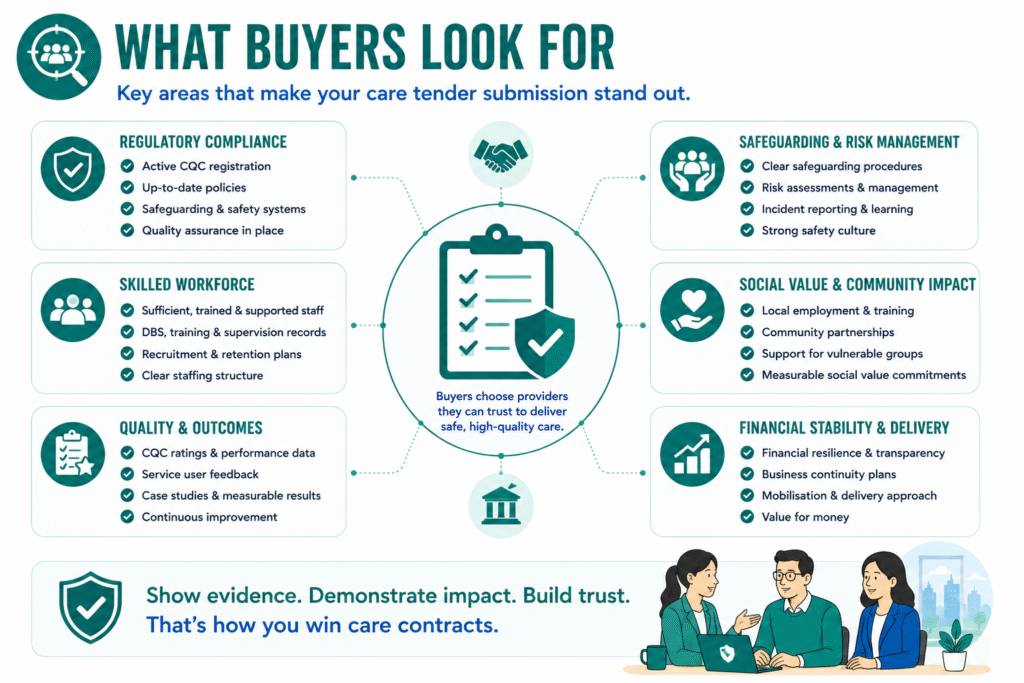
    However, winning care tenders takes more than being passionate about care. Buyers want proof. They want to see your CQC registration, safeguarding systems, staffing model, training records, quality assurance process, financial stability, and ability to deliver the service safely from day one.

    That is why the best care providers treat tendering as part of their business strategy, not as a last-minute admin task. When you understand what a tender means in business, you start preparing before the opportunity appears.

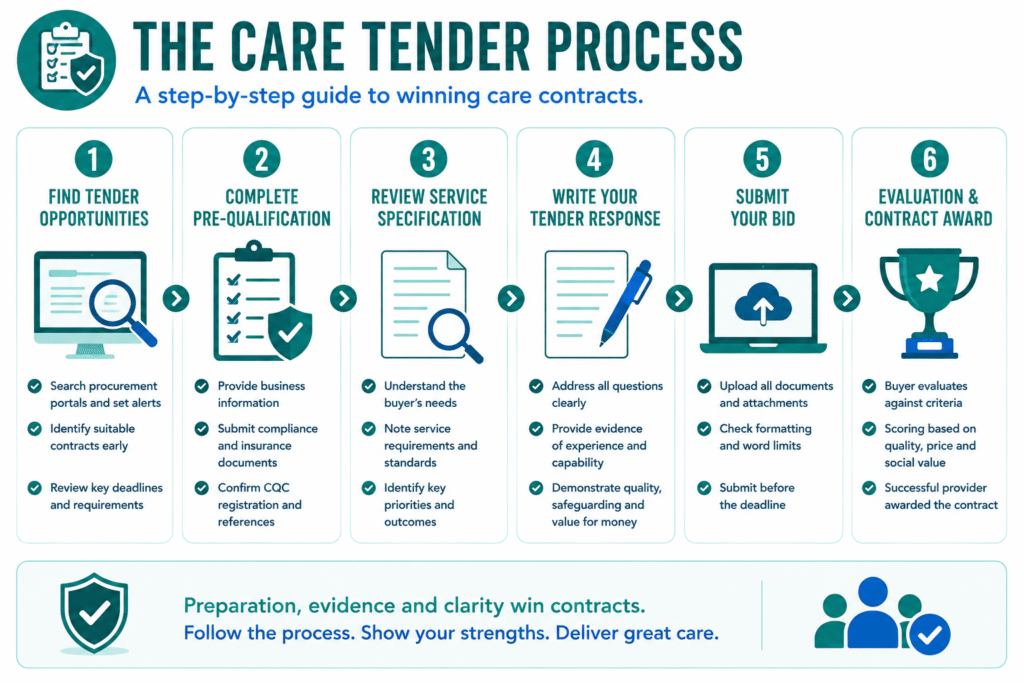
    Understanding the Care Tender Process Step by Step

    Buyer priorities for care submissions

    Many providers understand what a tender is, but far fewer understand how the tender process actually works. Knowing the stages helps you prepare the right documents, avoid costly mistakes, and improve your chances of winning contracts.

    Step 1: Find Tender Opportunities

    Most care contracts are advertised through procurement portals such as Find a Tender, Contracts Finder, NHS Atamis, and local authority procurement systems. Successful providers set up alerts so they can identify opportunities early rather than rushing a submission close to the deadline.

    Step 2: Complete Pre-Qualification Requirements

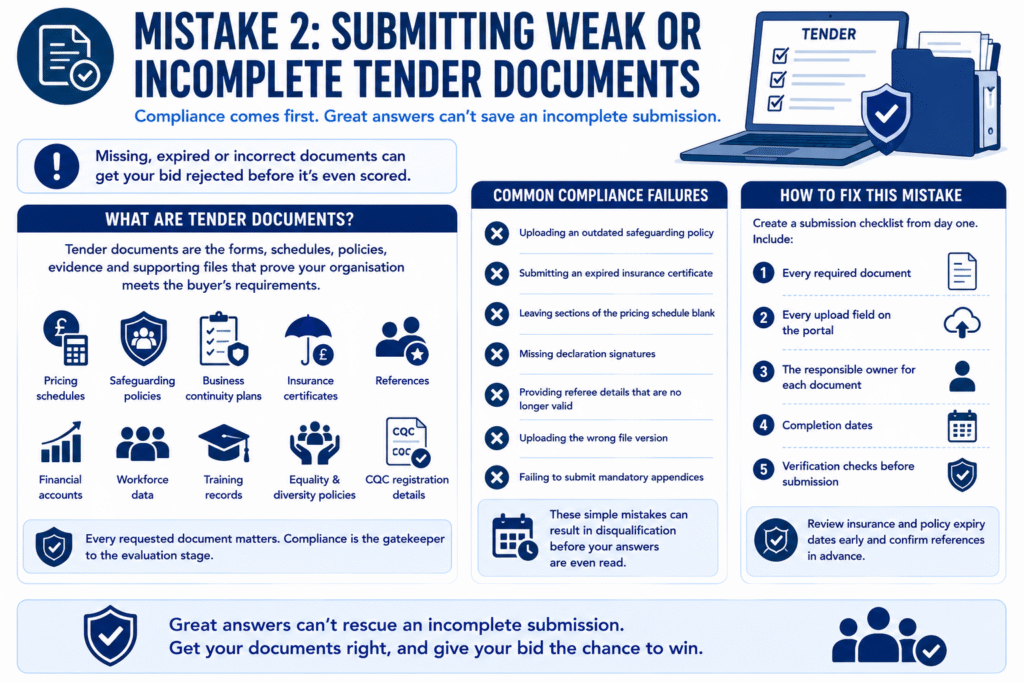
    Before a buyer considers your proposal, they need evidence that your organisation can legally and safely deliver the service.

    This stage often includes:

    • Company information
    • Financial checks
    • Insurance documents
    • CQC registration details
    • Safeguarding policies
    • References from existing or previous clients

    If your documentation is incomplete or out of date, you may fail before the evaluation even begins.

    Step 3: Review the Service Specification

    The specification explains exactly what the buyer wants.

    It may include:

    • Service hours
    • Staffing requirements
    • Quality standards
    • Reporting expectations
    • Performance targets
    • Contract length

    Strong providers read the specification carefully and align every part of their response to the buyer’s requirements.

    Step 4: Write Your Tender Response

    This is where you explain how you will deliver the service.

    Your response should clearly demonstrate:

    • Relevant experience
    • Staffing capacity
    • Quality assurance systems
    • Safeguarding procedures
    • Service delivery approach
    • Social value commitments

    Many providers searching for how to write a tender proposal or how to write a tender bid struggle at this stage because they focus on what they do rather than how they will solve the buyer’s challenges.

    Step 5: Submit Your Bid

    Most tenders require submission through an online procurement portal.

    Always submit early. Technical issues, missing attachments, or portal errors can prevent a last-minute submission and automatically disqualify an otherwise strong bid.

    Step 6: Evaluation and Contract Award

    Once the deadline passes, evaluators score each submission against predetermined criteria.

    Typical scoring areas include:

    • Quality
    • Service delivery
    • Safeguarding
    • Workforce capability
    • Social value
    • Price

    The highest-scoring provider does not always offer the cheapest price. Buyers often prioritise quality, compliance, and evidence of successful service delivery when awarding care contracts.

    READ MORE: CQC Registered Manager: Requirements, Interview Tips for 2026

    How to Write a Tender Proposal That Scores Well

    Understanding how to write a tender proposal is often the difference between winning a contract and receiving a rejection email.

    Many care providers lose tenders because they write generic responses. Evaluators do not award marks for good intentions. They award marks for evidence, relevance, and clear answers that address the question directly.

    Understand the Scoring Criteria First

    Before writing a single sentence, review the evaluation criteria.

    Ask yourself:

    • What is the buyer actually asking?
    • How many marks is this question worth?
    • What evidence can we provide?

    A question worth 20% of the total score deserves far more attention than one worth 5%.

    Answer the Question Directly

    One of the biggest mistakes providers make when learning how to write a tender bid is writing around the question instead of answering it.

    For example, if the buyer asks how you will manage safeguarding concerns, do not spend half the response talking about your company history. Focus on your safeguarding process, escalation pathways, staff training, reporting procedures, and quality monitoring.

    Use Real Evidence

    Commissioners want proof.

    Instead of writing:

    “We provide high-quality care.”

    Write:

    “Our service achieved a Good CQC rating, maintained a 98% visit completion rate, and delivered mandatory safeguarding training to 100% of care staff during the previous 12 months.”

    Specific evidence builds trust and earns marks.

    Demonstrate Compliance

    Strong tender responses reference:

    • CQC regulations
    • Safeguarding responsibilities
    • Quality assurance systems
    • Risk management processes
    • Staff training requirements

    Buyers need confidence that your organisation can meet both contractual and regulatory obligations.

    Show Outcomes, Not Activities

    Many providers describe what they do but fail to explain the results.

    Rather than saying:

    “We conduct regular staff supervision.”

    Explain the outcome:

    “Regular supervision helps us identify training needs early, improve staff retention, and maintain consistent standards of care for service users.”

    Tailor Every Submission

    Even if you have written similar bids before, avoid copying and pasting entire sections.

    The strongest tender responses reflect:

    • The buyer’s priorities
    • Local population needs
    • Service requirements
    • Contract objectives

    Providers who tailor their submissions consistently outperform those who rely on generic templates.

    Learning how to write a tender is not about producing the longest response. It is about giving evaluators clear, evidence-based answers that show why your organisation is the best choice to deliver the service.

    SEE ALSO: How to Start a Healthcare Recruitment Agency Uk in 2026

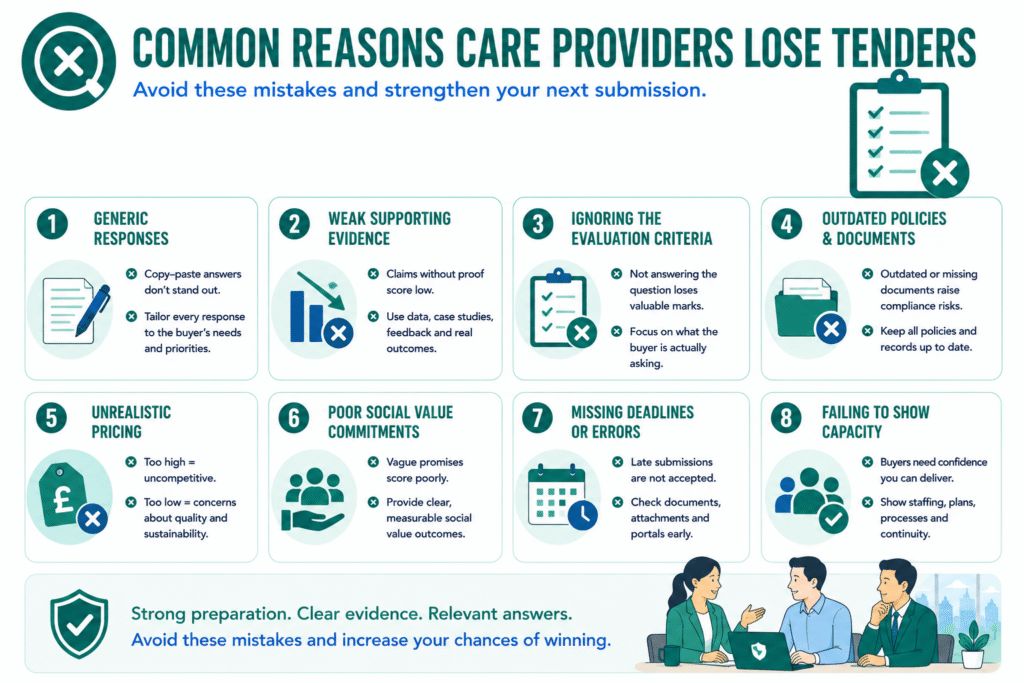
    Common Reasons Care Providers Lose Tenders

    Common mistakes in tender submissions
    Common mistakes in tender submissions

    Many care providers assume they lost a tender because another organisation offered a lower price. In reality, most bids fail long before pricing becomes the deciding factor.

    Commissioners often reject submissions because they lack evidence, miss key requirements, or fail to answer the questions properly.

    Here are the most common reasons care providers lose tenders.

    Generic Responses

    Buyers can spot a copied response immediately.

    If your answer could apply to any care provider in the UK, it will not stand out. Strong bids reference the specific service, location, challenges, and outcomes the commissioner wants to achieve.

    Weak Supporting Evidence

    Claims without evidence rarely score well.

    Statements such as “we provide excellent care” carry little weight unless you support them with measurable results, inspection outcomes, service-user feedback, or performance data.

    Ignoring the Evaluation Criteria

    Every tender contains scoring criteria.

    Some providers spend pages describing their business history while barely addressing the actual question. The highest-scoring responses mirror the evaluation criteria and provide evidence against each requirement.

    Outdated Policies and Documents

    Commissioners expect current documentation.

    Expired policies, missing training records, outdated insurance certificates, or old safeguarding procedures can raise concerns about compliance and governance.

    Unrealistic Pricing

    Pricing too high can make your bid uncompetitive.

    Pricing too low can create concerns about sustainability and service quality.

    Buyers want confidence that you can deliver the contract safely, legally, and consistently throughout its duration.

    Poor Social Value Commitments

    Many providers treat social value as an afterthought.

    Successful bidders demonstrate how they will create local employment opportunities, support communities, improve wellbeing, reduce inequalities, or contribute to wider social outcomes.

    Missing Deadlines or Submission Errors

    A strong bid submitted late is still a failed bid.

    Procurement portals close automatically once the deadline passes. Missing attachments, uploading incorrect documents, or waiting until the final hour can eliminate your chances before evaluation begins.

    Failing to Demonstrate Capacity

    Buyers need reassurance that you can deliver the contract from day one.

    If your submission does not explain staffing levels, mobilisation plans, management oversight, or service continuity arrangements, evaluators may question whether your organisation can handle the contract successfully.

    The most successful providers do not simply learn what a tender process is. They learn why bids fail and build systems that prevent those mistakes from happening in the first place.

    What Buyers Look for in Winning Care Tender Submissions

    What Is a Tender in Health and Social Care
    What Is a Tender in Health and Social Care

    Every commissioner wants reassurance that the provider they appoint can deliver safe, effective, and person-centred care from the first day of the contract.

    While evaluation criteria vary between organisations, most buyers look for the same core qualities when scoring care tender submissions.

    Strong Regulatory Compliance

    Buyers expect providers to demonstrate a clear understanding of CQC requirements and wider regulatory obligations.

    This includes:

    • CQC registration details
    • Safeguarding arrangements
    • Quality assurance systems
    • Policies and procedures
    • Governance structures

    A provider that can clearly evidence compliance often starts with a significant advantage.

    A Skilled and Stable Workforce

    Care services depend on people.

    Commissioners want confidence that you can recruit, train, retain, and support the workforce required to deliver the contract.

    Strong bids explain:

    • Recruitment processes
    • Induction programmes
    • Mandatory training
    • Supervision arrangements
    • Workforce retention strategies

    Evidence of Quality Care

    Buyers look beyond promises.

    They want evidence that demonstrates your ability to achieve positive outcomes for the people you support.

    Useful evidence may include:

    • CQC inspection outcomes
    • Service-user feedback
    • Family testimonials
    • Performance reports
    • Case studies
    • Quality audits

    Effective Safeguarding and Risk Management

    Safeguarding remains one of the highest-priority areas in most care tenders.

    Commissioners want to understand:

    • How concerns are identified
    • How incidents are reported
    • How risks are managed
    • How lessons learned improve services

    Clear processes and real examples strengthen your response considerably.

    Social Value and Community Impact

    Many public sector tenders allocate a percentage of the total score to social value.

    Buyers increasingly favour providers that create wider benefits beyond direct care delivery.

    Examples include:

    • Local employment opportunities
    • Apprenticeship programmes
    • Community partnerships
    • Volunteering initiatives
    • Support for disadvantaged groups

    The strongest submissions provide measurable commitments rather than vague promises.

    Financial Stability and Service Continuity

    Commissioners need assurance that your organisation can remain operational throughout the contract period.

    They often assess:

    • Financial standing
    • Business continuity plans
    • Contingency arrangements
    • Leadership structure
    • Operational resilience

    A provider that demonstrates stability reduces risk for the buyer.

    Ultimately, winning care tenders comes down to trust. Buyers want evidence that your organisation can deliver high-quality care, manage risks effectively, meet regulatory standards, and provide value for money over the life of the contract.

    MORE: Inheritance Tax Threshold UK: 2026 Update

    Care Tender Checklist Before You Submit

    Even the strongest tender response can fail if key documents are missing or important requirements are overlooked. Before you submit any bid, run through this checklist to make sure your organisation is genuinely tender-ready.

    Business and Compliance

    ✓ CQC registration is active and up to date

    ✓ Companies House details match your tender submission

    ✓ Insurance certificates are current

    ✓ Policies and procedures have been reviewed within the last 12 months

    ✓ Safeguarding policies align with current legislation and best practice

    Workforce Readiness

    ✓ Staff training records are complete and accessible

    ✓ DBS checks are current

    ✓ Supervision and appraisal records are available

    ✓ Recruitment and retention plans are documented

    ✓ Registered Manager details are included where required

    Quality and Performance Evidence

    ✓ Recent case studies demonstrate similar service delivery

    ✓ Service-user feedback and testimonials are available

    ✓ Quality assurance reports support your claims

    ✓ CQC inspection outcomes are referenced where relevant

    ✓ Performance data supports key statements within the bid

    Financial and Operational Information

    ✓ Financial accounts meet the buyer’s requirements

    ✓ Pricing schedules have been checked for accuracy

    ✓ Business continuity plans are current

    ✓ Mobilisation plans are realistic and achievable

    ✓ Key personnel and escalation contacts are identified

    Tender Submission Checks

    ✓ Every question has been answered fully

    ✓ Responses stay within the word count

    ✓ Supporting documents are attached

    ✓ Social value commitments are specific and measurable

    ✓ Another team member has completed a final review

    ✓ Submission deadline has been scheduled well in advance

    The most successful providers treat tender preparation as an ongoing process rather than a last-minute task. Keeping your evidence, policies, training records, and case studies updated throughout the year makes it much easier to respond quickly when the right opportunity appears.

    How Care Sync Experts Helps Providers Win More Tenders

    Care tendering rewards preparation. The providers that win consistently do not wait until a deadline appears before organising their policies, evidence, pricing, and compliance documents.

    Care Sync Experts helps care providers build that readiness before they bid.

    Our support covers the key areas commissioners expect to see in a strong tender submission, including CQC registration evidence, policies and procedures, safeguarding documentation, staff training records, quality assurance systems, service delivery models, and social value planning.

    We also support providers with care tender writing, bid reviews, tender readiness assessments, and document preparation. This helps you submit stronger responses that answer the buyer’s questions clearly and evidence your ability to deliver safe, compliant, high-quality care.

    If you are new to tendering, we can help you understand what a tender is, how the tender process works, and what buyers expect from a credible care provider. If you already bid for contracts, we can help you strengthen your method statements, improve your evidence, and reduce the common mistakes that lead to lost marks.

    The goal is simple: help your care business become tender-ready, commissioner-ready, and contract-ready.

    FAQ

    Why do they call it a tender?

    They call it a tender because a supplier “tenders” or formally offers to provide goods or services for a stated price and standard. In care procurement, this means a provider submits a structured offer to deliver services such as domiciliary care, supported living, respite care, or community support.

    What are the three types of tendering?

    The three common types of tendering are open tendering, restricted tendering, and negotiated tendering. Open tendering allows any qualified provider to apply. Restricted tendering invites only shortlisted providers. Negotiated tendering involves direct discussion with selected suppliers, often for specialist or urgent services.

    What are the 5 pillars of procurement?

    The five pillars of procurement are value for money, transparency, fairness, competition, and accountability. In care tenders, these principles help commissioners choose providers who can deliver safe, compliant, high-quality services at a sustainable cost.

    What are the 5 C’s of caring?

    The 5 C’s of caring are compassion, competence, confidence, conscience, and commitment. Care providers can strengthen tender responses by showing how these values shape staff training, safeguarding, quality assurance, and everyday service delivery.

  • Bid Writing Service: Top 5 Mistakes Care Providers Make in 2026

    Bid Writing Service: Top 5 Mistakes Care Providers Make in 2026

    Many care providers assume that winning a tender comes down to delivering a good service. In reality, buyers can only score what they see in your submission. A well-run domiciliary care agency, supported living provider, or complex care service can still lose a contract if it fails to present its strengths clearly and compliantly.

    This is where a specialist bid writing service becomes valuable.

    Before looking at the mistakes that cost care providers contracts, it helps to understand what is bid writing and why it differs from general business writing.

    Bid writing is the process of preparing structured responses to tender questions, demonstrating how your organisation will meet the buyer’s requirements, manage risks, deliver outcomes, and provide value for money. Every answer must align with the specification, evaluation criteria, and scoring methodology.

    Many providers also ask, what is a bid writer? A bid writer is a specialist who turns operational knowledge into high-scoring tender responses.

    They gather evidence, analyse buyer requirements, structure answers, and ensure every claim is supported by proof. When care providers ask what does a bid writer do, the simplest answer is this: they help buyers understand why your service deserves the contract.

    In health and social care procurement, generic bid support often falls short because care contracts require sector-specific knowledge. Evaluators expect detailed responses on safeguarding, medication management, workforce development, continuity of care, quality assurance, CQC compliance, social value, and service-user outcomes.

    A writer who understands construction, technology, or facilities management may not understand the evidence that local authorities, NHS commissioners, and Integrated Care Boards want to see.

    A specialist bid writing service understands the realities of delivering care services. They know how to present inspection outcomes, workforce metrics, service-user feedback, mobilisation plans, and governance arrangements in a way that earns marks. More importantly, they understand the common mistakes that cause otherwise capable providers to lose contracts.

    The five mistakes below appear repeatedly across domiciliary care, supported living, home care, and healthcare tenders throughout the UK. Fixing them can improve the quality of your submissions and significantly increase your chances of winning future contracts.

    Get expert support for your next tender, inspection-ready policies, or CQC registration — book a call with Care Sync Experts today and let’s get you compliant and competitive.

    Mistake 1: Treating the Tender Like a Form Instead of a Scored Competition

    Leicestershire Home Care Tender 2026-2034 | Complete Framework Guide for Care Providers

    This is one of the most expensive mistakes care providers make.

    Many providers open a tender, read the question, and immediately start writing. They focus on completing the form rather than understanding how evaluators will score the answer. As a result, they submit responses that describe their service but fail to demonstrate why they should win the contract.

    Understanding how to write a tender starts with recognising that every question exists for a reason. Buyers are not looking for generic statements about compassionate care or experienced staff. They want evidence that proves you can deliver the specific outcomes outlined in the specification.

    For example, a question about continuity of care is not really asking whether you provide continuity of care. Every bidder will say they do. The evaluator wants to know:

    • How you maintain continuity during staff sickness.
    • What percentage of visits are delivered by regular carers.
    • How you monitor missed calls.
    • What systems you use to ensure consistency.
    • What results you have achieved previously.

    Care providers often lose marks because they answer the question they wish had been asked rather than the one in front of them.

    Another common issue appears when providers research how to write a tender bid and follow generic online advice. Most of that advice is designed for broad commercial sectors and fails to reflect how health and social care contracts are evaluated.

    Local authorities and NHS commissioners typically score responses against quality outcomes, safeguarding arrangements, workforce capability, governance, mobilisation plans, and measurable evidence.

    A strong response follows a simple principle:

    Requirement → Evidence → Outcome

    Instead of saying:

    “We provide excellent care and have highly trained staff.”

    Say:

    “During the last 12 months, 98% of care visits were delivered by regular care workers. We maintain this consistency through workforce planning software, monthly rota audits, and a dedicated contingency team, helping service users build trusted relationships while reducing missed visits.”

    The difference is significant. The first statement makes a claim. The second statement provides evidence and demonstrates an outcome.

    How to Fix This Mistake

    Before drafting a single answer:

    1. Read the full specification from start to finish.
    2. Review the scoring criteria for every question.
    3. Build a compliance matrix mapping each requirement to evidence.
    4. Identify what proof supports every claim.
    5. Structure responses around outcomes the buyer wants to achieve.

    Many providers engage a specialist bid writing service at this stage because an external reviewer can quickly identify gaps between the buyer’s requirements and the proposed response. Fixing those gaps early often has a greater impact on scores than rewriting the answer later.

    The providers that consistently win care contracts do not treat tenders as paperwork exercises. They treat them as competitive scoring events and write every response with the evaluator’s score sheet in mind.

    RELATED: CQC Registration for Domiciliary Care Providers: Complete 2026 Guide

    Mistake 2: Submitting Weak or Incomplete Tender Documents

    Some care providers lose a tender before the evaluator even reads their method statements.

    Why? Because the submission fails the compliance check.

    Every tender contains a collection of mandatory documents that prove your organisation meets the buyer’s requirements. If one document is missing, expired, incomplete, or uploaded incorrectly, the buyer may reject the submission before scoring begins.

    This is why understanding what are tender documents is so important. Tender documents are the forms, schedules, declarations, policies, evidence files, and supporting information that accompany your bid response. Together, they demonstrate that your organisation has the legal, financial, operational, and regulatory capability to deliver the contract.

    Many providers ask what is a tender document when preparing their first council or NHS submission. In reality, there is rarely just one document. Most health and social care tenders require a complete pack that may include:

    • Pricing schedules.
    • Safeguarding policies.
    • Business continuity plans.
    • Insurance certificates.
    • References.
    • Financial accounts.
    • Workforce data.
    • Training records.
    • Equality and diversity policies.
    • CQC registration details.
    • Quality assurance evidence.

    When providers ask what are the tender documents required for a care contract, the answer usually depends on the buyer, but the principle remains the same: every requested document matters.

    Common compliance failures include:

    • Uploading an outdated safeguarding policy.
    • Submitting an expired insurance certificate.
    • Leaving sections of the pricing schedule blank.
    • Missing declaration signatures.
    • Providing referee details that are no longer valid.
    • Uploading the wrong file version.
    • Failing to submit mandatory appendices.

    These mistakes often happen because providers focus heavily on writing quality answers and leave compliance until the final few hours before submission.

    Unfortunately, buyers do not award contracts for effort. They award contracts for compliant submissions.

    How to Fix This Mistake

    Create a submission checklist on the first day of the tender.

    Your checklist should include:

    1. Every required document.
    2. Every upload field on the portal.
    3. The responsible owner for each document.
    4. Completion dates.
    5. Verification checks before submission.

    It is also good practice to review insurance renewal dates, update policies before the tender starts, and confirm references in advance rather than scrambling to gather evidence at the last minute.

    A specialist bid writing service often acts as an additional compliance safeguard by checking every document against the buyer’s requirements before submission. This extra review can prevent simple administrative errors from destroying weeks of bid preparation.

    Winning care providers understand a simple truth: great answers cannot rescue an incomplete submission. Compliance comes first. Scoring comes second.

    READ MORE: How to Start a Healthcare Recruitment Agency Uk in 2026

    Mistake 2: Submitting Weak or Incomplete Tender Documents

    Compliant tender submissions checklist

    Some care providers lose a tender before the evaluator even reads their method statements.

    Why? Because the submission fails the compliance check.

    Every tender contains a collection of mandatory documents that prove your organisation meets the buyer’s requirements. If one document is missing, expired, incomplete, or uploaded incorrectly, the buyer may reject the submission before scoring begins.

    This is why understanding what are tender documents is so important. Tender documents are the forms, schedules, declarations, policies, evidence files, and supporting information that accompany your bid response. Together, they demonstrate that your organisation has the legal, financial, operational, and regulatory capability to deliver the contract.

    Many providers ask what is a tender document when preparing their first council or NHS submission. In reality, there is rarely just one document. Most health and social care tenders require a complete pack that may include:

    • Pricing schedules.
    • Safeguarding policies.
    • Business continuity plans.
    • Insurance certificates.
    • References.
    • Financial accounts.
    • Workforce data.
    • Training records.
    • Equality and diversity policies.
    • CQC registration details.
    • Quality assurance evidence.

    When providers ask what are the tender documents required for a care contract, the answer usually depends on the buyer, but the principle remains the same: every requested document matters.

    Common compliance failures include:

    • Uploading an outdated safeguarding policy.
    • Submitting an expired insurance certificate.
    • Leaving sections of the pricing schedule blank.
    • Missing declaration signatures.
    • Providing referee details that are no longer valid.
    • Uploading the wrong file version.
    • Failing to submit mandatory appendices.

    These mistakes often happen because providers focus heavily on writing quality answers and leave compliance until the final few hours before submission.

    Unfortunately, buyers do not award contracts for effort. They award contracts for compliant submissions.

    How to Fix This Mistake

    Create a submission checklist on the first day of the tender.

    Your checklist should include:

    1. Every required document.
    2. Every upload field on the portal.
    3. The responsible owner for each document.
    4. Completion dates.
    5. Verification checks before submission.

    It is also good practice to review insurance renewal dates, update policies before the tender starts, and confirm references in advance rather than scrambling to gather evidence at the last minute.

    A specialist bid writing service often acts as an additional compliance safeguard by checking every document against the buyer’s requirements before submission. This extra review can prevent simple administrative errors from destroying weeks of bid preparation.

    Winning care providers understand a simple truth: great answers cannot rescue an incomplete submission. Compliance comes first. Scoring comes second.

    SEE ALSO: Inheritance Tax Threshold UK: 2026 Update

    Mistake 3: Confusing Bid Writing With Bid Management

    Confusing bid writing and management
    Confusing bid writing and management

    Many care providers believe that writing strong answers is enough to win contracts.

    It is not.

    Some of the best-written submissions still lose because nobody managed the process properly. Deadlines slip, clarification responses go unnoticed, pricing schedules remain incomplete, and key evidence never makes it into the final submission.

    This is where many providers misunderstand what is bid management.

    Bid writing focuses on creating persuasive, evidence-based responses. Bid management focuses on coordinating the entire tender process from opportunity review through to submission. Both are essential if you want to compete consistently for NHS, local authority, supported living, and domiciliary care contracts.

    Providers often ask what is a bid manager and whether they need one. A bid manager oversees the tender from start to finish. They coordinate contributors, manage deadlines, track compliance requirements, gather evidence, monitor buyer communications, and ensure the final submission aligns with the evaluation criteria.

    So, what does a bid manager do on a typical care tender?

    They:

    • Build the bid plan.
    • Assign responsibilities.
    • Monitor tender portals.
    • Track clarification deadlines.
    • Coordinate pricing inputs.
    • Manage document collection.
    • Review progress against milestones.
    • Ensure the final submission remains compliant.

    Without this oversight, even experienced care businesses can find themselves rushing during the final days before submission.

    A common example occurs when the Registered Manager writes method statements while the finance team prepares pricing. Neither team realises that their assumptions conflict. The quality response promises enhanced staffing levels, while the pricing schedule reflects standard staffing ratios. Evaluators quickly spot the inconsistency and question the credibility of the submission.

    Another frequent problem involves portal management. Many care providers assign portal notifications to one person’s inbox. When that person is on annual leave, clarification responses, addendums, and deadline updates go unnoticed. By the time the team discovers the changes, it is often too late.

    How to Fix This Mistake

    Treat every tender as a project.

    Assign clear ownership for:

    1. Bid leadership.
    2. Quality responses.
    3. Pricing.
    4. Compliance documents.
    5. Portal monitoring.
    6. Final review.

    Schedule weekly progress reviews from the moment the tender is released. For shorter tenders, hold reviews every two or three days.

    Most importantly, separate writing from management. The person writing the answers should not carry sole responsibility for tracking deadlines, gathering evidence, managing contributors, and handling uploads.

    Many care providers use a specialist bid writing service because it combines writing expertise with structured bid management. This reduces risk, improves coordination, and allows operational leaders to focus on running the service while the tender process remains under control.

    The strongest care tenders do not succeed because they have the best writer. They succeed because they have the best-managed process.

    MORE: Universal Credit Permanent Boost 2026

    Mistake 4: Writing Generic Answers That Ignore the Buyer’s Priorities

    Bid Writing Service 2026
    Bid Writing Service 2026

    Many care providers spend hours writing detailed responses only to receive average scores.

    The problem is not always the quality of the writing. The problem is relevance.

    Buyers do not award contracts simply because you provide good care. They award contracts to providers who demonstrate that they understand the buyer’s specific challenges, priorities, and outcomes.

    This is where many providers struggle with how to write a tender proposal that stands out.

    A generic response focuses on the provider:

    • Our staff are highly trained.
    • We provide person-centred care.
    • We have strong safeguarding processes.
    • We deliver high-quality services.

    Every bidder says the same thing.

    A high-scoring response focuses on the buyer:

    • How your service supports the council’s adult social care strategy.
    • How your staffing model addresses local workforce shortages.
    • How your approach reduces delayed discharges.
    • How your service improves outcomes for people with complex needs.
    • How your social value commitments benefit the local community.

    Evaluators want evidence that you understand their environment, not just your own business.

    For example, a local authority may identify hospital discharge delays as a major challenge. Another authority may prioritise workforce retention. An Integrated Care Board may focus on reducing emergency admissions. If your answers fail to address those priorities directly, evaluators often view your submission as generic.

    This mistake becomes even more damaging when providers copy and paste content from previous bids. While reusing evidence can save time, reusing strategy rarely works. Every buyer has different priorities, different service pressures, and different success measures.

    A response that scored highly in one borough may score poorly in another.

    How to Fix This Mistake

    Before writing any method statement, research the buyer thoroughly.

    Review:

    • Adult Social Care Strategies.
    • Integrated Care Board plans.
    • Joint Strategic Needs Assessments (JSNAs).
    • Market Position Statements.
    • Social Value Frameworks.
    • Recent contract award notices.
    • CQC local authority assessment findings where relevant.

    Create a simple one-page buyer profile that highlights:

    1. Their strategic priorities.
    2. Their biggest service challenges.
    3. Their workforce pressures.
    4. Their social value objectives.
    5. Their expected outcomes.

    Then build your responses around those priorities.

    For example, instead of saying:

    “We recruit skilled care workers.”

    You could say:

    “Our recruitment strategy directly supports the authority’s workforce sustainability objectives by maintaining a local talent pipeline, reducing vacancy rates, and improving continuity of care for service users.”

    The second response speaks the buyer’s language.

    A specialist bid writing service will usually spend significant time researching the commissioning landscape before drafting begins. This research often makes the difference between an average submission and a winning one.

    The most successful care providers do not write about themselves. They write about the buyer’s challenges and show exactly how their service solves them.

    READ: Is Carers Allowance Taxable in 2026?

    Mistake 4: Writing Generic Answers That Ignore the Buyer’s Priorities

    Many care providers spend hours writing detailed responses only to receive average scores.

    The problem is not always the quality of the writing. The problem is relevance.

    Buyers do not award contracts simply because you provide good care. They award contracts to providers who demonstrate that they understand the buyer’s specific challenges, priorities, and outcomes.

    This is where many providers struggle with how to write a tender proposal that stands out.

    A generic response focuses on the provider:

    • Our staff are highly trained.
    • We provide person-centred care.
    • We have strong safeguarding processes.
    • We deliver high-quality services.

    Every bidder says the same thing.

    A high-scoring response focuses on the buyer:

    • How your service supports the council’s adult social care strategy.
    • How your staffing model addresses local workforce shortages.
    • How your approach reduces delayed discharges.
    • How your service improves outcomes for people with complex needs.
    • How your social value commitments benefit the local community.

    Evaluators want evidence that you understand their environment, not just your own business.

    For example, a local authority may identify hospital discharge delays as a major challenge. Another authority may prioritise workforce retention. An Integrated Care Board may focus on reducing emergency admissions. If your answers fail to address those priorities directly, evaluators often view your submission as generic.

    This mistake becomes even more damaging when providers copy and paste content from previous bids. While reusing evidence can save time, reusing strategy rarely works. Every buyer has different priorities, different service pressures, and different success measures.

    A response that scored highly in one borough may score poorly in another.

    How to Fix This Mistake

    Before writing any method statement, research the buyer thoroughly.

    Review:

    • Adult Social Care Strategies.
    • Integrated Care Board plans.
    • Joint Strategic Needs Assessments (JSNAs).
    • Market Position Statements.
    • Social Value Frameworks.
    • Recent contract award notices.
    • CQC local authority assessment findings where relevant.

    Create a simple one-page buyer profile that highlights:

    1. Their strategic priorities.
    2. Their biggest service challenges.
    3. Their workforce pressures.
    4. Their social value objectives.
    5. Their expected outcomes.

    Then build your responses around those priorities.

    For example, instead of saying:

    “We recruit skilled care workers.”

    You could say:

    “Our recruitment strategy directly supports the authority’s workforce sustainability objectives by maintaining a local talent pipeline, reducing vacancy rates, and improving continuity of care for service users.”

    The second response speaks the buyer’s language.

    A specialist bid writing service will usually spend significant time researching the commissioning landscape before drafting begins. This research often makes the difference between an average submission and a winning one.

    The most successful care providers do not write about themselves. They write about the buyer’s challenges and show exactly how their service solves them.

    ALSO SEE: CQC Supported Living Registration in 2026: The Complete Guide

    Mistake 5: Ignoring the Tendering Process, Portal Updates, and ITT Rules

    You can write excellent answers, submit strong evidence, and offer competitive pricing, yet still lose the contract because you ignored the process.

    This happens more often than most care providers realise.

    To avoid it, you need to understand what is tendering process in practical terms. The tendering process is the structured journey buyers use to evaluate suppliers fairly and consistently. It covers everything from publishing the opportunity and issuing clarification responses to evaluating submissions and awarding the contract.

    Every stage matters.

    Many care providers focus entirely on writing and forget that buyers also assess compliance with the Instructions to Tenderers (ITT), submission requirements, portal communications, and document formats.

    Common examples include:

    • Missing a clarification update that changes the scope of the contract.
    • Exceeding the word count on a scored question.
    • Uploading the wrong version of a pricing schedule.
    • Submitting a PDF when the buyer requested an editable spreadsheet.
    • Missing a mandatory declaration.
    • Using appendices where the ITT explicitly prohibits them.
    • Uploading documents after the deadline closes.

    Under the Procurement Act 2023, buyers are placing even greater emphasis on transparency, consistency, and compliance. Small procedural mistakes can now eliminate an otherwise strong submission before evaluators consider its quality.

    One of the most overlooked risks involves buyer portals. Platforms such as Atamis, Jaggaer, In-tend, ProContract, and Find a Tender regularly publish clarification responses and document updates during live procurements.

    A single clarification response can completely change how you answer a question.

    Yet many providers only log into the portal when they first download the documents and again on submission day.

    By then, they may have missed crucial information.

    How to Fix This Mistake

    Build a process that protects your submission from avoidable compliance failures.

    Best practice includes:

    1. Check the buyer portal every working day.
    2. Enable portal notifications for multiple team members.
    3. Submit clarification questions early rather than waiting until the final week.
    4. Capture every ITT rule inside your compliance matrix.
    5. Monitor word counts throughout drafting.
    6. Schedule submission at least 24–48 hours before the deadline.
    7. Complete a final compliance review before uploading any documents.

    The strongest care providers also run an independent review of the entire submission before it goes live. This review focuses on compliance rather than content and often catches issues the drafting team no longer notices.

    A professional bid writing service usually incorporates this review stage as part of the process. Experienced reviewers check every response against the specification, the scoring criteria, the ITT, and the submission requirements before the bid reaches the buyer.

    Care providers often lose contracts because they focus on writing and neglect the rules surrounding the submission.

    The reality is simple: buyers can only score a bid that reaches evaluation. Following the tendering process correctly ensures your hard work actually gets the chance to compete.

    SEE MORE: How a Domiciliary Care Agency Can Prepare for 2026 and Grow Faster

    What a Good Bid Writing Service Should Do for a Care Provider

    Not all bid support delivers the same results.

    Some providers hire a generalist writer to help complete a tender. Others invest in a specialist bid writing service that understands care regulations, commissioning priorities, safeguarding requirements, workforce challenges, and the realities of delivering care services.

    The difference often shows in the final score.

    A high-quality bid writing service does far more than write answers. It helps care providers build a stronger submission from the moment the tender arrives.

    A specialist service should:

    • Review the specification and identify risks early.
    • Advise whether the opportunity is worth pursuing.
    • Build a compliance matrix against the evaluation criteria.
    • Gather evidence that supports every claim.
    • Draft method statements that align with buyer priorities.
    • Monitor clarification responses and procurement portals.
    • Check all tender documents before submission.
    • Run an independent red team review.
    • Ensure the final bid complies with every ITT requirement.

    This support becomes especially valuable for domiciliary care agencies, supported living providers, and healthcare organisations that already have demanding operational responsibilities.

    Most Registered Managers do not have spare hours to monitor procurement portals, gather evidence, manage contributors, review pricing assumptions, and draft multiple quality responses at the same time.

    A specialist bid writing service fills that gap.

    The strongest providers also understand that winning a contract rarely starts when the tender is released. It starts months earlier through strong governance, updated policies, robust safeguarding systems, positive inspection outcomes, workforce development, and measurable service performance.

    These are the same areas buyers assess during evaluation.

    That is why the most successful care providers treat bid writing as part of a wider growth strategy rather than a last-minute administrative task.

    Whether you are bidding for a local authority framework, an NHS Continuing Healthcare contract, a supported living opportunity, or a home care service agreement, the goal remains the same: demonstrate compliance, prove capability, and provide evidence that gives evaluators confidence in your delivery.

    A specialist bid writing service helps you do exactly that.

    The best submissions do not simply answer questions. They show buyers why your organisation is the safest, most capable, and most reliable choice for the people who depend on their services.

    Final Thoughts…

    The most common tender losses in 2026 do not happen because care providers lack experience, skilled staff, or high-quality services. They happen because avoidable mistakes weaken the submission before evaluators can see the true value of the organisation.

    The five biggest mistakes remain remarkably consistent:

    • Treating the tender like a form instead of a scored competition.
    • Submitting incomplete tender documents.
    • Confusing bid writing with bid management.
    • Writing generic responses that ignore buyer priorities.
    • Ignoring the tendering process and ITT requirements.

    The providers that win consistently approach tenders differently. They build systems, gather evidence early, understand the buyer’s objectives, and treat every submission as a strategic opportunity rather than an administrative exercise.

    If your organisation wants to improve its success rate, a specialist bid writing service can provide the structure, sector expertise, and quality assurance needed to compete more effectively for NHS, local authority, supported living, domiciliary care, and healthcare contracts.

    At Care Sync Experts, we help care providers strengthen every stage of the tender process, from specification review and compliance checks to bid management, tender writing, and final submission support, so that the next opportunity has the best possible chance of becoming your next contract.

    FAQ

    What Is a Bid Writer?

    A bid writer is a specialist who prepares tender responses on behalf of a business. Their role is to analyse the specification, understand the evaluation criteria, gather evidence, and produce answers that demonstrate how the organisation will deliver the contract.

    In health and social care, a bid writer must understand safeguarding, workforce management, quality assurance, CQC compliance, and service-user outcomes.

    What Does a Bid Writer Do?

    A bid writer transforms operational knowledge into high-scoring tender responses. They review tender documents, interview subject matter experts, gather supporting evidence, write method statements, and ensure every answer aligns with the buyer’s scoring criteria.

    A specialist bid writing service also helps identify weaknesses before submission and improves the overall quality of the bid.

    What Is Bid Management?

    Bid management is the process of coordinating an entire tender submission from start to finish. While bid writing focuses on producing answers, bid management covers planning, timelines, document collection, compliance checks, pricing coordination, clarification responses, and final submission.

    Successful care providers often combine strong writing with strong bid management to improve win rates.

    How Do You Write a Tender Bid for a Care Contract?

    To write a strong care tender bid:
    Read the full specification and evaluation criteria.
    Build a compliance matrix.
    Gather evidence before drafting begins.
    Research the buyer’s priorities and local challenges.
    Write responses that focus on outcomes, not promises.
    Support every claim with evidence.
    Review against the scoring criteria.
    Complete a final compliance check before submission.
    Care providers that follow this process typically produce stronger and more competitive bids.