Tag: Universal Credit

  • Universal Credit Permanent Boost 2026

    Universal Credit Permanent Boost 2026

    The Universal Credit permanent boost increased the basic monthly amount claimants receive through the Universal Credit standard allowance from April 2026.

    The current monthly rates are £338.58 for single claimants under 25, £424.90 for single claimants aged 25 or over, £528.34 for joint claimants both under 25, and £666.97 for joint claimants where either person is 25 or over.

    For carers and families, this rise matters because many vulnerable people already stretch their income across food, bills, transport, disability costs, appointments, and daily support. A higher standard allowance can ease some pressure, but it does not tell the full story.

    The Universal Credit boost 2026 affects the basic allowance first. A person’s final payment still depends on their rent, children, earnings, savings, deductions, health status, and caring responsibilities. So, when families ask how much is UC going up in April 2026, they should check both the new standard allowance and the full award breakdown.

    The government says the wider reform will raise the standard allowance above inflation for several years, with the increase worth an estimated £725 by 2029/30 for a single adult aged 25 or over.

    Get expert support for your next tender, inspection-ready policies, or CQC registration — book a call with Care Sync Experts today and let’s get you compliant and competitive.

    What Is the £725 Universal Credit Boost?

    Starting a Homecare Agency From Home? 5 CQC Rules You CANNOT Miss

    The £725 Universal Credit boost is not a one-off lump sum that everyone receives in their bank account. It describes the estimated yearly gain by 2029/30 for a single claimant aged 25 or over, compared with what they would have received if the standard allowance only rose with inflation.

    This means the Universal Credit boost payment works through higher monthly standard allowance rates, not through a separate “cost of living” style payment.

    For carers and families, that distinction matters. If someone you support expects one large payment, they may plan their budget wrongly. The increase comes through their normal Universal Credit award, so they should check their monthly statement to see how the new rate affects them.

    The Universal Credit Act supports this above-inflation rise over several years. In simple terms, the government wants to lift the basic Universal Credit rate while also changing parts of the wider welfare system. So the headline figure sounds simple, but each claimant’s real monthly payment still depends on their full circumstances.

    RELATED: What Is the Carers Element Universal Credit? 2026

    Why the Universal Credit Act Changed the Standard Allowance
    Universal Credit payment guide
    Universal Credit payment guide

    The Universal Credit Act changed the way the Universal Credit standard allowance rises from 2026. Instead of only increasing in line with inflation, the standard allowance will rise above inflation for several years, from 2026/27 to 2029/30. The government describes this as the first sustained above-inflation uplift to the basic UC rate.

    The aim is to raise the core monthly payment while reshaping parts of the wider welfare system. The welfare bill Universal Credit reforms also included changes to health-related UC support, including a reduced health top-up for some new claims from April 2026.

    For carers and families, the key point is simple: the Universal Credit Bill UK changes may increase the basic allowance, but they do not guarantee the same final payment for everyone. A claimant’s actual UC award still depends on rent, children, earnings, savings, deductions, disability status, health elements, and caring responsibilities.

    So families should not stop at the headline boost. They should check the full Universal Credit statement and make sure every relevant element appears correctly.

    What Carers and Families Should Check First

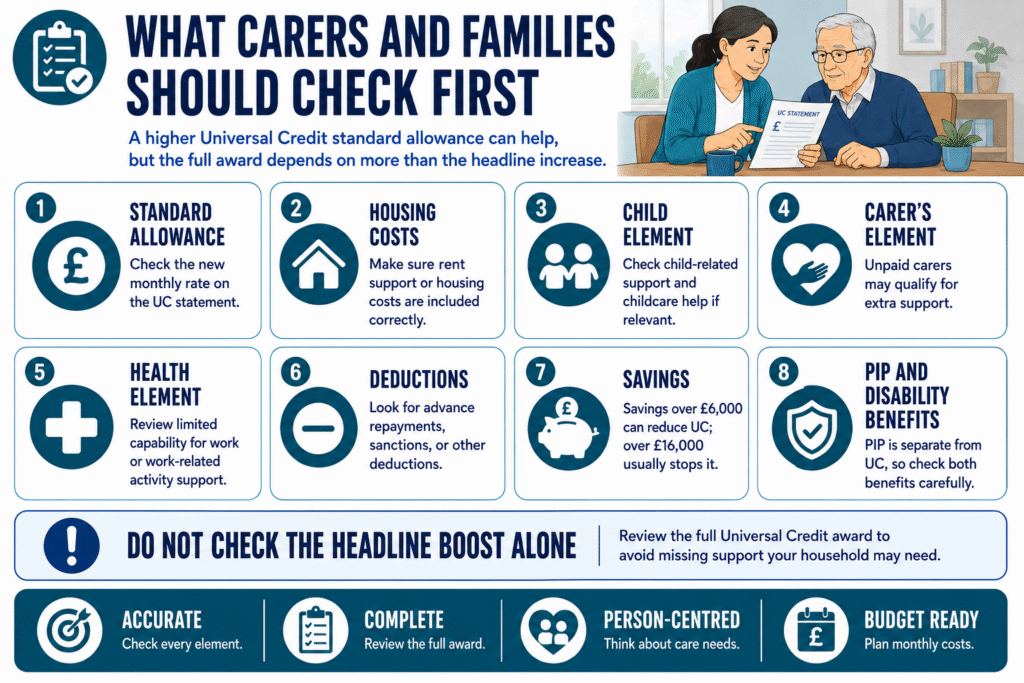
    A higher Universal Credit standard allowance can help, but carers should still check the full award. Universal Credit includes different elements, and one missing detail can reduce the money someone receives each month.

    If you support someone on UC, check these first:

    • Their new standard allowance
    • Housing costs or rent support
    • Child element and childcare support
    • Carer’s Element, if someone provides regular unpaid care
    • Limited capability for work or work-related activity
    • Advance repayments, sanctions, or deductions
    • Work income
    • Savings, investments, or other capital
    • Disability benefits, including PIP

    Families often ask, does Universal Credit affect PIP? Universal Credit and PIP serve different purposes. PIP supports people with daily living or mobility needs, while UC supports people on a low income or out of work. A person may receive both, depending on their circumstances.

    Carers should also check savings. If someone asks, can Universal Credit check my savings account or how much savings are you allowed on Universal Credit, the key rule is that savings over £6,000 can reduce UC, and savings over £16,000 usually mean the person cannot get UC. GOV.UK says UC reduces by £4.35 for every £250 between £6,000 and £16,000.

    READ MORE: Is Carers Allowance Taxable in 2026?

    Working While Claiming Universal Credit

    Universal Credit does not set one fixed number of hours everyone can work. Instead, it looks at how much someone earns, whether they qualify for a work allowance, and how the taper rate reduces their payment as earnings rise.

    So, when families ask how many hours can you work on Universal Credit, the better question is: how much will the person earn, and how will that affect their monthly award?

    Some people can work part-time and still receive Universal Credit. This often matters for carers, disabled claimants, and people trying to return to work gradually after illness. The payment may reduce as earnings increase, but work does not always mean UC stops immediately.

    If someone you support wants to increase their hours, start a new job, or try work after a health problem, check their Universal Credit journal, work allowance, childcare costs, and any health-related commitments first. A small change in earnings can affect rent support, deductions, and the final amount paid into their bank account.

    Working While Claiming Universal Credit
    Universal Credit Permanent Boost

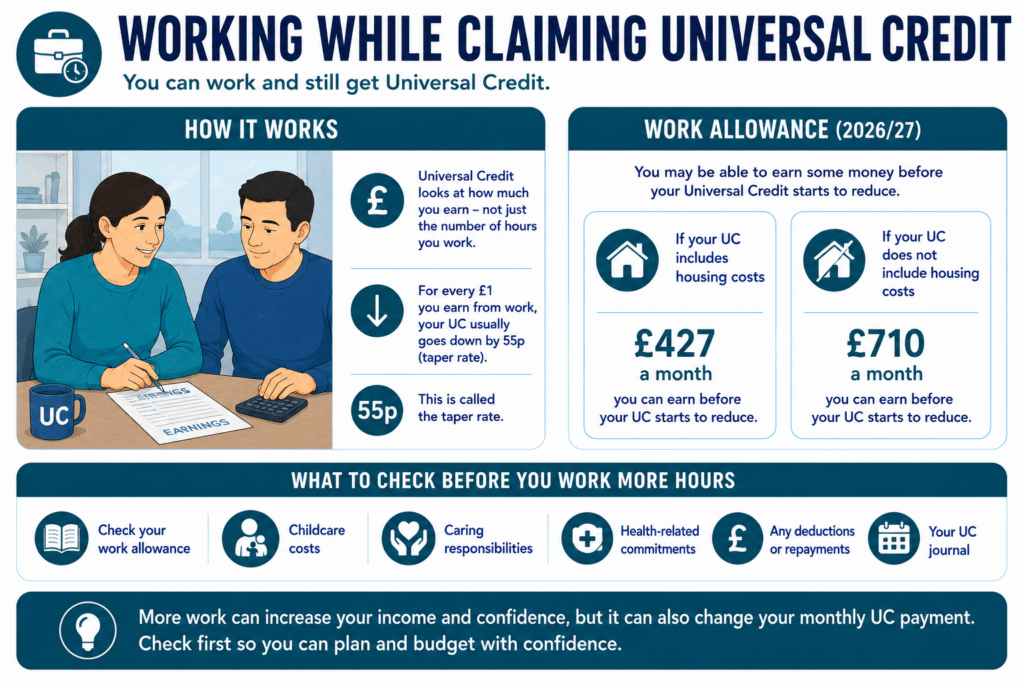
    You can work and still claim Universal Credit. There is no single answer to how many hours can you work on Universal Credit, because UC looks at how much you earn, not just how many hours you work.

    For every £1 you earn from work, your Universal Credit usually goes down by 55p. GOV.UK calls this the taper rate. If you have children or a health condition that affects your ability to work, you may also get a work allowance, which lets you earn a set amount before your UC starts to reduce. In 2026/27, that work allowance is £427 a month if UC includes housing costs, or £710 a month if it does not.

    For carers and families, this matters when someone wants to try part-time work, return after illness, or increase their hours. More work can improve confidence and income, but it can also change the monthly UC payment.

    Before changing hours, check the person’s UC journal, work allowance, childcare costs, caring responsibilities, and health-related commitments. That helps the family plan properly instead of guessing how the change will affect their budget.

    SEE ALSO: Early Sign of MND in 2026: What Care Businesses Should Notice First

    Payments, Arrears, Weekends and Backdating

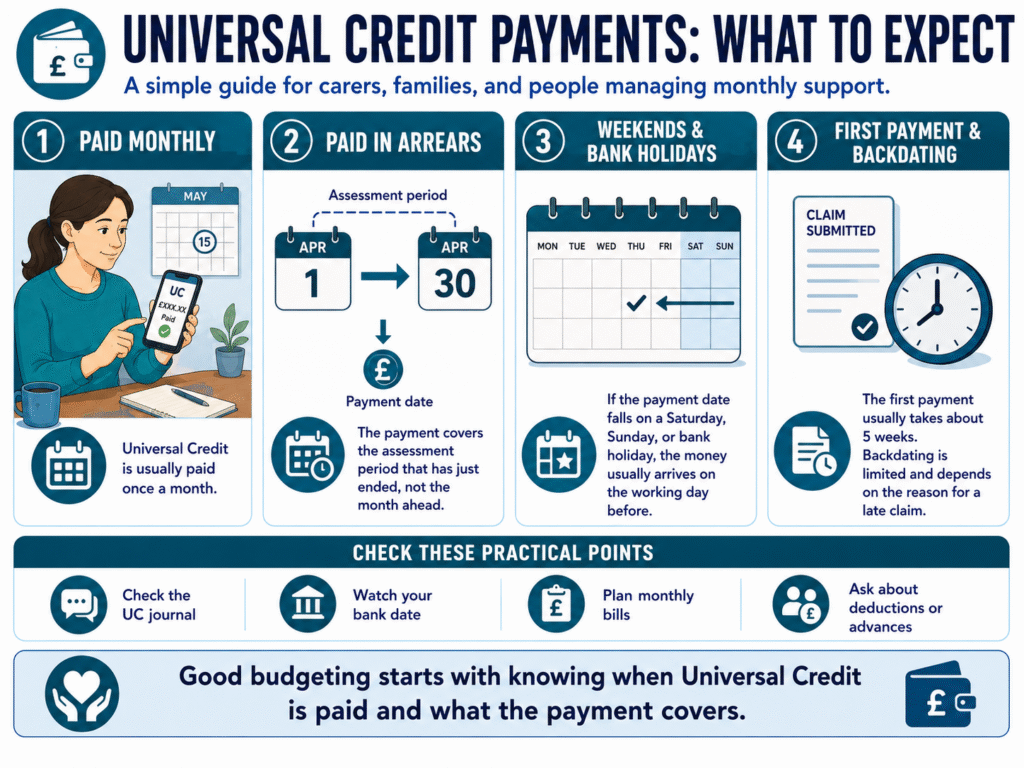
    Universal Credit is usually paid once a month, in arrears. This means the payment covers the assessment period that has just ended, not the month ahead. For carers and families, this matters because the person you support may need help budgeting between payment dates.

    GOV.UK says Universal Credit claimants usually receive their first payment around five weeks after making a claim, and later payments arrive on the same date each month. If the payment date falls on a weekend or bank holiday, the payment usually arrives on the working day before.

    So, if someone asks do Universal Credit pay on a Saturday, the answer is usually no. If the due date falls on a Saturday, Sunday, or bank holiday, the money normally comes earlier.

    Many people also ask what time does Universal Credit get paid into bank. Banks process payments at different times, so the exact time can vary. Check the UC online account first, then check the bank account later in the day if the payment has not appeared.

    Backdating works differently. If someone asks how long does it take to get backdated Universal Credit, they should know that backdating is limited and depends on why the claim started late. A carer should help the person explain the reason clearly in their UC journal and keep evidence where possible.

    Savings, Home Ownership, Travel and Stopping a Claim

    Universal Credit is means-tested, so savings and capital can change what someone receives. If the person you support has savings between £6,000 and £16,000, their UC will reduce. If they have over £16,000, they usually cannot claim Universal Credit. GOV.UK says UC reduces by £4.35 for every £250 of capital between £6,000 and £16,000.

    Families also ask, can you get Universal Credit if you own a house? Yes, owning the home you live in does not automatically stop a UC claim. However, other property, savings, or capital can affect entitlement. Homeowners may also qualify for Support for Mortgage Interest, but GOV.UK treats this as a loan that must usually be repaid with interest when the home is sold or transferred.

    If someone asks how long can you go abroad on Universal Credit, the general rule is up to one month, as long as they remain eligible and tell their work coach before going. GOV.UK says UC cannot continue if someone moves abroad permanently.

    A claimant can also ask to close their UC claim. But if someone asks, can I voluntarily stop Universal Credit, carers should help them check the impact first. Stopping a claim may affect rent support, council tax help, free prescriptions, budgeting, and future benefit access.

    MORE: What Is Safeguarding in Care? 2026 Update

    What About ESA, PIP and Disability Support?
    Working while claiming Universal Credit guide
    Working while claiming Universal Credit guide

    Universal Credit does not replace PIP. If someone asks does Universal Credit affect PIP, the answer is usually no in the direct sense: PIP supports people with daily living or mobility needs, while Universal Credit supports people on a low income or out of work. A person can receive both if they qualify.

    Carers should still look at the full picture. PIP can affect other parts of a household’s benefit situation, such as carer support, disability premiums in older benefits, or help linked to health needs. It can also strengthen the evidence that someone needs extra care, supervision, mobility support, or help with daily living.

    Many families also ask how much is PIP going up in April 2026. PIP rates usually increase each tax year, so check the latest GOV.UK rates before budgeting around disability income.

    If someone asks is ESA to Universal Credit delayed to 2028, they should check their official migration notice rather than rely on rumours. ESA and UC migration rules have changed over time, and the safest step is to read the letter, check the deadline, and get benefits advice before making a claim.

    For carers, the main point is this: do not look at the Universal Credit permanent boost alone. Check UC, PIP, ESA, Carer’s Allowance, housing support, health elements, and deductions together before making care or household budget decisions.

    Final Advice for Carers and Families

    The Universal Credit boost 2026 can give many households more breathing space, but carers should not plan around the headline rise alone. The final payment still depends on the full Universal Credit award, not just the standard allowance.

    If you support someone who depends on UC, check their monthly statement carefully. Look at their housing costs, children’s elements, Carer’s Element, health elements, work income, savings, deductions, and any advance repayments. A small change in one area can affect the money they actually receive.

    The Universal Credit permanent boost may help with food, bills, travel, appointments, and daily living costs. But vulnerable people, disabled claimants, older adults, and unpaid carers often need more than a higher basic rate. They may also need disability support, proper care planning, benefits advice, and help managing their budget.

    The safest approach is simple: check the full award, keep records, update changes quickly, and ask for advice before making big decisions about work, travel, savings, care costs, or stopping a claim.

    Need Help Understanding Universal Credit and Care Support?

    Universal Credit changes can affect household budgets, care decisions, and the support vulnerable people rely on.

    At Care Sync Experts, we explain care, benefits, and family support in plain English, helping carers and families make confident, informed decisions.

    Get practical guidance before money worries become care worries.

    FAQ

    Can Universal Credit give me extra money?

    Yes. Universal Credit may offer extra help through an advance payment, a budgeting advance, a hardship payment, or other financial support if you need help with bills or unexpected costs.

    An advance is not free money; you usually repay it through future Universal Credit payments. GOV.UK says budgeting advances are normally repaid through UC over 24 months.

    What free things can you get on Universal Credit?

    Universal Credit can help you qualify for extra support, depending on your income, household and location. This may include help with NHS prescriptions, dental care, eye tests, school meals, childcare costs, housing costs, council tax support, and local crisis support.

    GOV.UK also confirms that free school meals eligibility in England is expanding to include children from households receiving Universal Credit from the 2026/27 school year.

    Will UC get a Christmas Bonus?

    Universal Credit on its own does not qualify someone for the Christmas Bonus. The Christmas Bonus is a separate one-off £10 tax-free payment for people who receive certain qualifying benefits during the qualifying week, usually the first full week of December. If someone only gets Universal Credit, they should not assume they will get it automatically.

    Do you have to pay Universal Credit back?

    You do not usually pay back normal Universal Credit entitlement if the award is correct. But you may have to repay advance payments, budgeting advances, overpayments, or benefit debt. GOV.UK says that if you owe benefit money while getting UC, your benefit payments can reduce until you repay it.
  • Universal Credit Compensation DWP: Can You Claim Money Back in 2026?

    Universal Credit Compensation DWP: Can You Claim Money Back in 2026?

    You may be able to claim Universal Credit compensation DWP if a DWP mistake, delay, poor service, or incorrect advice caused you financial loss, serious inconvenience, distress, or hardship.

    This does not mean every reduced Universal Credit payment leads to compensation. You need to show what went wrong, when it happened, and how it affected the claimant.

    For carers and family members, this matters because vulnerable claimants may not always spot an error quickly. Someone you support may miss a journal message, misunderstand a decision letter, struggle with the Universal Credit log in, or feel too overwhelmed to challenge DWP.

    There are different routes depending on the problem. Some people may qualify for the Successful Legacy Appeals Compensation Scheme if they lost money after moving from legacy benefits to Universal Credit because of a decision that later turned out to be wrong. Others may need to use the DWP complaints process and ask for financial redress.

    The key question is simple: did DWP’s action or failure cause a real loss or unfair hardship? If yes, it may be worth checking whether a Universal Credit compensation DWP claim or complaint applies.

    Get expert support for your next tender, inspection-ready policies, or CQC registration — book a call with Care Sync Experts today and let’s get you compliant and competitive.

    When Can DWP Pay Universal Credit Compensation?

    CQC Interview Questions 2026: 10 Red Flags That Get You Rejected

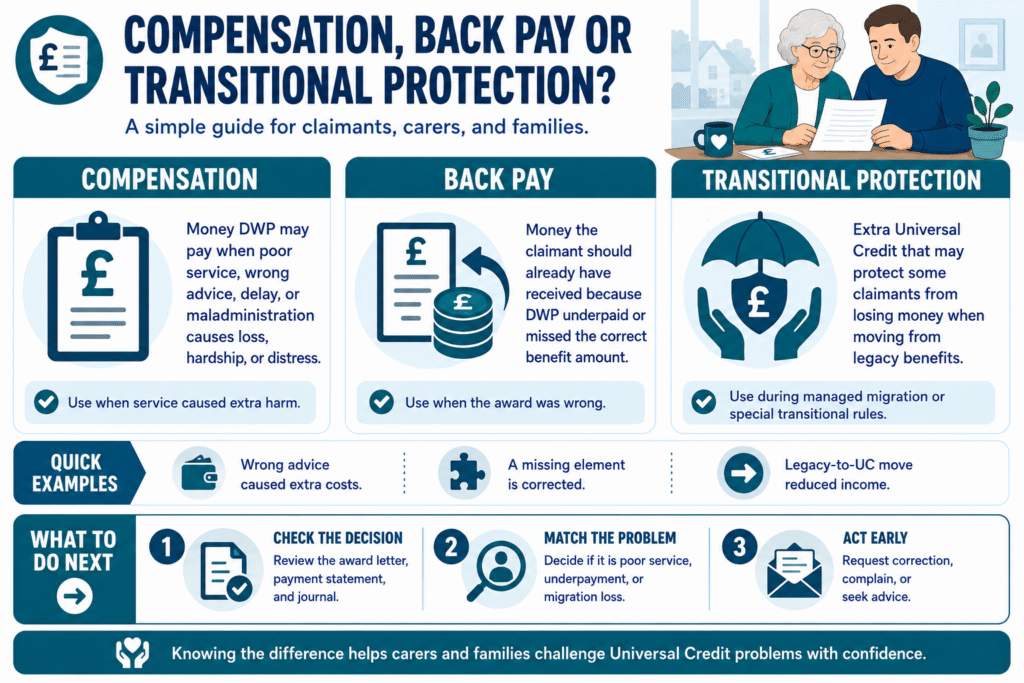
    DWP may pay compensation when its own error or poor service causes a claimant to lose money, face avoidable hardship, or suffer serious inconvenience. This can happen if DWP gives incorrect advice, delays action, misses evidence, sends confusing information, or handles a Universal Credit claim badly.

    However, compensation is different from normal Universal Credit back pay. If DWP simply underpaid someone, it should correct the award and pay the money owed. Compensation usually applies when the claimant suffered extra loss or distress because of the way DWP handled the case.

    There are three common routes:

    1. A corrected benefit decision — DWP pays arrears after fixing a wrong Universal Credit decision.
    2. Financial redress for poor service — DWP considers compensation for maladministration, delay, wrong advice, distress, or financial loss.
    3. A specific scheme — some claimants may qualify under the Successful Legacy Appeals Compensation Scheme.

    If you searched for Universal Credit compensation DWP 2025, check the latest rules before acting, because compensation schemes and benefit rates can change. For most people, the best first step is to gather evidence and make a formal complaint before considering whether to escalate further.

    RELATED: Moving From ESA Support Group to Universal Credit: What You Need to Know in 2026

    The Successful Legacy Appeals Compensation Scheme Explained

    The Successful Legacy Appeals Compensation Scheme helps a specific group of people who lost money after moving from legacy benefits to Universal Credit.

    This may apply if DWP stopped someone’s old benefit, the person claimed Universal Credit within one month, and they later won an appeal that showed the old benefit should not have ended. Because they had already moved to Universal Credit, they could not return to the legacy benefit, even though the original decision was wrong.

    To qualify, the claimant must usually show that:

    • they received a means-tested legacy benefit, such as income-related ESA, income-based JSA, Income Support, Housing Benefit, Child Tax Credit, or Working Tax Credit
    • DWP made a decision that ended that benefit
    • they claimed Universal Credit within one month of that decision
    • Universal Credit paid less than the old benefit
    • they challenged the decision and won

    This scheme does not cover every Universal Credit complaint. It focuses on people who lost money because an incorrect legacy benefit decision pushed them onto Universal Credit. For carers, the key job is to help the claimant find old letters, appeal decisions, payment statements, and dates, because those details can prove whether a Universal Credit compensation DWP claim fits this route.

    Compensation, Back Pay and Transitional Protection: What Is the Difference?

    Many people mix up compensation, back pay, and transitional protection, but they do not mean the same thing.

    TermWhat it means
    CompensationMoney DWP may pay when poor service, delay, wrong advice, or maladministration causes loss, distress, or serious inconvenience
    Back payMoney DWP already owed because the claimant should have received more Universal Credit or another benefit
    Transitional protectionExtra Universal Credit that may protect some people from losing money when they move from legacy benefits under managed migration
    Personal injury compensationLegal compensation for an injury, which may affect means-tested benefits if not handled correctly

    This matters because the next step depends on the problem. If DWP calculated the award wrongly, the claimant may need a correction or appeal. If DWP handled the case badly, they may need to complain and ask for financial redress. If the issue involves migration from legacy benefits, they may need to check transitional protection or the legacy appeals scheme.

    For carers, the safest approach is to separate the facts: what DWP should have paid, what DWP actually paid, and what extra harm the error caused. That makes any Universal Credit compensation DWP complaint clearer and harder to ignore.

    READ MORE: Band C Council Tax Per Month: What You Should Know in 2026

    What Evidence Should Carers and Families Gather?

    How to complain about Universal Credit
    How to complain about Universal Credit

    Before you complain, gather evidence. Do not rely on memory alone. DWP will look at dates, decisions, payment records, messages, and what impact the mistake had on the claimant.

    Start with the claimant’s Universal Credit log in. Check the journal, payment statements, deductions, housing costs, reported earnings, decision notices, and any messages from work coaches or case managers. Take screenshots or download records where possible.

    Carers and families should collect:

    • Universal Credit journal messages
    • decision letters
    • mandatory reconsideration notices
    • appeal decisions
    • bank statements showing missing or reduced payments
    • dates of phone calls or appointments
    • names of DWP staff, if available
    • evidence of extra costs, rent arrears, debt, hardship, or distress
    • medical or caring evidence if the claimant struggled to manage the claim

    Also keep the Universal Credit number and any reference numbers close by when contacting DWP.

    Strong evidence helps you explain what happened clearly: what DWP did, what should have happened, how much money the claimant lost, and why compensation or financial redress may be reasonable.

    How Earnings and Work Allowance Can Affect Universal Credit

    Earnings can reduce Universal Credit, so a lower payment does not always mean DWP made a mistake. If the claimant works, DWP usually looks at monthly earnings and adjusts the award for that assessment period.

    The Universal Credit work allowance is the amount some people can earn before their Universal Credit starts to reduce. A claimant may get a work allowance if they have responsibility for a child or have limited capability for work. After that allowance, Universal Credit reduces through the earnings taper.

    This is why people often ask, “how much Universal Credit will I get if I earn 1000 a month,” “how much Universal Credit will I get if I earn 1500 a month,” or “how much Universal Credit will I get if I earn 2000 a month.” The answer depends on the person’s Universal Credit standard allowance, rent, children, disability elements, caring responsibilities, deductions, savings, and work allowance.

    For carers, always check the payment statement before assuming DWP owes compensation. If the statement shows the wrong earnings, missing housing costs, incorrect deductions, or a missing element, challenge the calculation first. Compensation only becomes relevant if DWP’s error, delay, or poor service caused extra loss or hardship.

    SEE ALSO: Income Taxation UK: A Simple Guide for Care Businesses (2026)

    Savings, ISAs, Pensions and Compensation Payments

    Understanding compensation and benefits options

    Savings and lump sums can affect Universal Credit because it is a means-tested benefit. This means DWP looks at income, savings, investments, and some types of capital when working out entitlement.

    In most cases, savings over £6,000 can reduce Universal Credit, and savings over £16,000 can stop entitlement. So, if you are asking how much savings are you allowed on Universal Credit or how much saving can you have on Universal Credit, those two figures matter.

    ISAs usually count as savings, so the answer to do ISAs count as savings for Universal Credit is normally yes. DWP can also ask for bank statements or evidence of accounts, so families often ask, can Universal Credit check my savings account? DWP can request financial information when checking entitlement or investigating a claim.

    Pension income can also affect Universal Credit. If someone asks, does State Pension affect Universal Credit, the answer is yes: pension income can reduce entitlement. A pension lump sum may also affect Universal Credit if the claimant keeps it as capital, so ask for welfare advice if you are unsure how long does a pension lump sum affect Universal Credit.

    Personal injury compensation needs extra care. If someone asks does personal injury compensation affect benefits or can DWP take my compensation, get specialist advice before spending or moving the money. A properly handled compensation payment may receive different treatment, but mistakes can affect means-tested benefits.

    Does Universal Credit Affect Credit Score or Tax?

    Universal Credit does not usually appear as borrowing on a credit report, so receiving it should not directly damage a credit score. However, money problems linked to a reduced or delayed payment can still affect someone’s credit record. For example, missed rent, unpaid bills, overdrafts, loans, or debt arrangements may show on a credit file.

    So, if you ask does Universal Credit affect credit score, the benefit itself is not the main issue. The real risk comes when a claimant cannot pay essential bills because their Universal Credit stops, drops, or arrives late.

    Universal Credit is also not taxable. So, if you ask is UC taxable, the answer is no. Claimants do not pay income tax on Universal Credit.

    For carers, this matters because financial stress can build quickly. Check payment dates, deductions, rent support, and journal messages early, especially if the claimant already struggles with bills, debt, or budgeting.

    MORE: Wheelchair Parking Permit UK: Who Qualifies for a Blue Badge in 2026?

    Severe Disability Premium and Universal Credit

    Universal Credit Compensation DWP 2026?
    Universal Credit Compensation DWP 2026?

    Some claimants lost money when they moved from legacy benefits to Universal Credit, especially if their old award included a Severe Disability Premium. This issue matters because Severe Disability Premium gave extra support to some disabled people who lived alone, received a qualifying disability benefit, and did not have someone claiming Carer’s Allowance or the carer element for looking after them.

    So, who qualifies for Severe Disability Premium Universal Credit? Universal Credit does not include Severe Disability Premium in the same way legacy benefits did. Instead, some people may receive transitional protection or a transitional element if they moved across under certain rules.

    Carers should check the claimant’s old benefit letters, disability benefit awards, living situation, and Universal Credit migration history. Do not assume the award is correct just because DWP calculated it. If the claimant lost Severe Disability Premium after moving to Universal Credit, ask DWP to explain the calculation and whether any transitional protection applies.

    How to Complain About Universal Credit

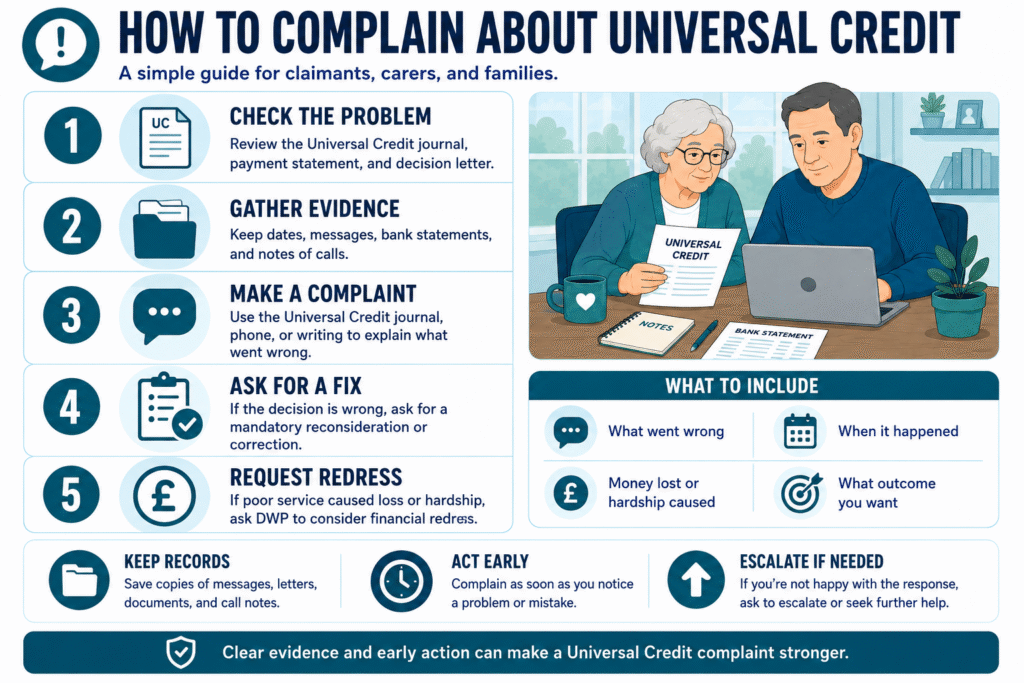
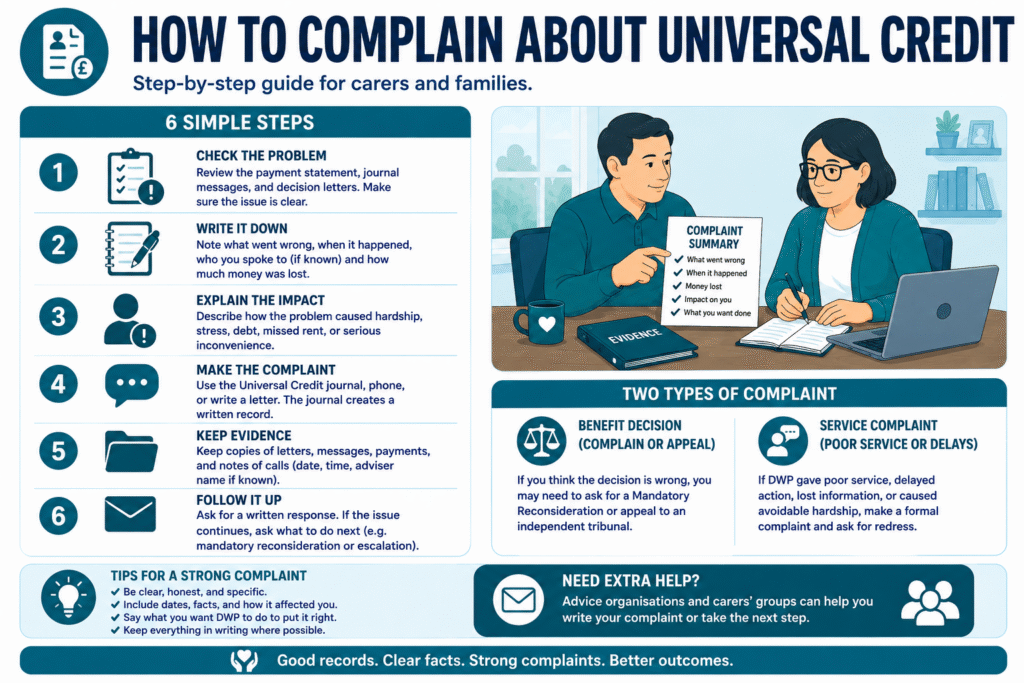
    If you believe DWP made a mistake or handled a Universal Credit claim badly, start by checking the payment statement, journal messages, and decision letters. Make sure the issue is clear before you complain.

    To complain about Universal Credit, write down:

    • what went wrong
    • when it happened
    • who you spoke to, if known
    • how much money the claimant lost
    • how the problem caused hardship, stress, debt, missed rent, or serious inconvenience
    • what you want DWP to do next

    You can complain through the Universal Credit journal, by phone, or in writing. Use the journal if the claimant can access their account, because it creates a written record. If you call, write down the date, time, and what the adviser said.

    When asking how to complain about Universal Credit, remember this difference: if DWP made a wrong benefit decision, you may need a mandatory reconsideration or appeal. If DWP gave poor service, delayed action, lost information, or caused avoidable hardship, you can make a formal complaint and ask DWP to consider financial redress.

    For a strong Universal Credit compensation DWP complaint, keep the message clear: explain the error, show the evidence, state the impact, and ask for a written response.

    Final Thoughts…

    If you support someone who struggles with forms, online accounts, phone calls, memory, disability, mental health, or complex paperwork, your help can make a real difference. Many Universal Credit problems become harder to fix when nobody checks the journal, reads decision letters, or challenges errors early.

    Start with the basics. Check the claimant’s payment statement every month, keep copies of important messages, and write down dates when payments change. If something looks wrong, ask DWP to explain it clearly.

    Do not ignore reduced payments, missing elements, unexplained deductions, or sudden changes after savings, earnings, PIP, pension payments, or compensation settlements. These issues can affect the claimant’s income quickly.

    A strong Universal Credit compensation DWP complaint needs evidence, dates, and a clear explanation of the harm caused. As a carer or family member, your role is not to fight blindly. Your role is to organise the facts, protect the claimant’s wellbeing, and help them ask the right questions before the problem becomes a crisis.

    Need Help Understanding Care and Benefit Decisions?

    Universal Credit issues, DWP errors, and care costs can quickly affect a vulnerable person’s stability at home.

    Care Sync Experts helps caregivers, families, and care providers make clearer, safer decisions around care, support, and household pressures.

    Before problems grow, check the claimant’s payments, keep evidence, and act early.

    Plan better support with practical, caregiver-focused guidance from Care Sync Experts.

    FAQ

    Will I lose benefits if I get compensation?

    Not always. It depends on the type of compensation, how much money you receive, and whether the payment counts as savings or capital for means-tested benefits like Universal Credit.

    Some compensation payments may receive special treatment if handled correctly, especially personal injury compensation placed into a trust. Always get welfare or legal advice before moving or spending a large compensation payment.

    Who is eligible for Universal Credit in the UK?

    To claim Universal Credit, a person usually needs to live in the UK, be on a low income or out of work, accept a claimant commitment, and have savings below the capital limit. Some students, carers, disabled people, self-employed workers, and people in work can also qualify depending on their circumstances.

    How much can I earn and still get Universal Credit?

    There is no single earnings limit because Universal Credit changes based on rent, children, disability elements, caring responsibilities, and the Universal Credit work allowance. Some people still receive Universal Credit while working full-time, while others may see their award reduce quickly as earnings rise.

    Will Universal Credit know if I inherit money?

    Yes, DWP expects claimants to report inheritance money because inheritance can affect means-tested benefits like Universal Credit.

    If the inheritance pushes savings above the capital limit, the claimant’s award may reduce or stop. Carers and families should report changes quickly to avoid overpayments or future disputes.

  • Moving From ESA Support Group to Universal Credit: What You Need to Know in 2026

    Moving From ESA Support Group to Universal Credit: What You Need to Know in 2026

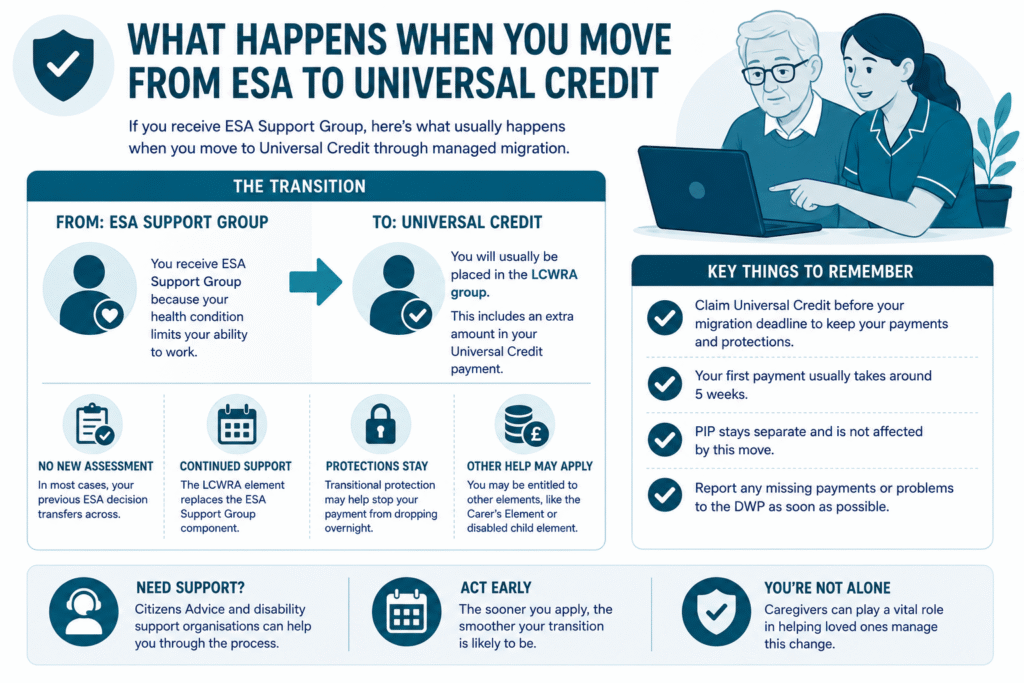
    If you are moving from ESA Support Group to Universal Credit after receiving a Migration Notice from the DWP, you usually have 3 months to make your Universal Credit claim and keep your financial support.

    Most people in the ESA Support Group move into the Limited Capability for Work and Related Activity (LCWRA) element of Universal Credit without needing a new Work Capability Assessment immediately.

    The DWP is moving benefit claimants to Universal Credit as part of the wider replacement of legacy benefits. If you claim Universal Credit before your universal credit migration deadline, you can usually receive transitional protection. Transitional protection universal credit payments help prevent a sudden drop in income when your old ESA payments stop.

    For many disabled claimants and caregivers, the biggest change involves how Universal Credit gets paid. Universal Credit normally arrives as one monthly payment and uses an online journal system. However, ESA Support Group claimants placed into LCWRA usually do not have work-search requirements.

    You should not ignore your Migration Notice letter. Moving from ESA Support Group to Universal Credit does not happen automatically, and missing the deadline can affect your payments and your access to universal credit transitional protection.

    Get expert support for your next tender, inspection-ready policies, or CQC registration — book a call with Care Sync Experts today and let’s get you compliant and competitive.

    Key Takeaways

    • Moving from ESA Support Group to Universal Credit does not happen automatically after receiving a Migration Notice.
    • Most ESA Support Group claimants move into the LCWRA element of Universal Credit without a new assessment immediately.
    • You must claim Universal Credit before your universal credit migration deadline to keep your payments and qualify for transitional protection universal credit support.
    • Universal credit transitional protection helps prevent a sudden drop in income during managed migration.
    • New Style ESA differs from income-related ESA and may continue alongside Universal Credit in some cases.
    • PIP remains separate from Universal Credit despite ongoing discussions around pip legacy benefits changes dwp updates.
    • Caregivers can reduce stress and avoid delays by helping claimants prepare documents, monitor payments, and contact the DWP early if problems appear.

    Why the DWP Is Moving Benefit Claimants to Universal Credit

    DBS Checks for Care Workers: The 3-Year Renewal Rule That Does Not Exist

    The DWP is moving benefit claimants to Universal Credit because the government wants to replace older “legacy benefits” with a single monthly payment system. This process, often called managed migration, affects people receiving income-related ESA, Housing Benefit, Tax Credits, and several other older benefits.

    Many claimants describe these changes as the DWP axing legacy benefits, but the transition will happen gradually through the universal credit migration timetable. The government originally planned to complete the move sooner, but migration has continued into later years due to concerns about vulnerable claimants and ongoing DWP Universal Credit migration struggles.

    If you receive income-related ESA, you will usually get a Migration Notice letter before your benefits stop. The letter explains your universal credit migration deadline and tells you how to apply. You must make a new Universal Credit claim because the DWP will not transfer you automatically.

    Some people still ask, “Is ESA to Universal Credit delayed to 2028?” While timelines have shifted several times, the DWP continues to move claimants across in stages. Most ESA claimants should expect migration activity to continue throughout 2026 and beyond as the government completes the transition away from legacy benefits.

    These ESA changes do not affect all benefits equally. Personal Independence Payment (PIP) remains separate from Universal Credit, although many people searching for dwp pip legacy benefits changes or pip legacy benefits migration universal credit confusion often mix the two systems together.

    RELATED: New Style ESA (Employment and Support Allowance) 2026

    What ESA Support Group Claimants Keep Under Universal Credit

    Many people worry that moving from ESA Support Group to Universal Credit means losing their health-related support, but most claimants keep important protections when they move correctly through managed migration.

    If you currently receive ESA Support Group payments, Universal Credit should place you into the Limited Capability for Work and Related Activity (LCWRA) group. This extra amount replaces the ESA Support Group component and gives continued support to people whose condition limits their ability to work.

    In most cases, the DWP will not ask you to complete a new Work Capability Assessment immediately. Your previous ESA decision usually transfers across as long as you move to Universal Credit without a break in your claim.

    Many caregivers also ask, “Is ESA means tested?” The answer depends on the type of ESA you receive. Income-related ESA forms part of the legacy benefits system and will move to Universal Credit. However, new style ESA and Universal Credit can exist together in some situations because New Style ESA depends on National Insurance contributions rather than household income.

    Some families may also qualify for extra Universal Credit support, including the disabled child element UC payment for children with qualifying disabilities or health conditions.

    Claimants who work limited hours often worry about earned income disallowance rules when moving benefits. Universal Credit handles this differently from ESA. Instead of permitted work rules, Universal Credit uses a work allowance system, which lets some LCWRA claimants earn a certain amount before deductions reduce their payment.

    Although many discussions around PIP legacy benefits DWP changes create confusion online, PIP itself does not move into Universal Credit. The DWP still pays PIP separately from UC.

    How Universal Credit Transitional Protection Works

    Moving From ESA Support Group to Universal Credit
    Moving From ESA Support Group to Universal Credit

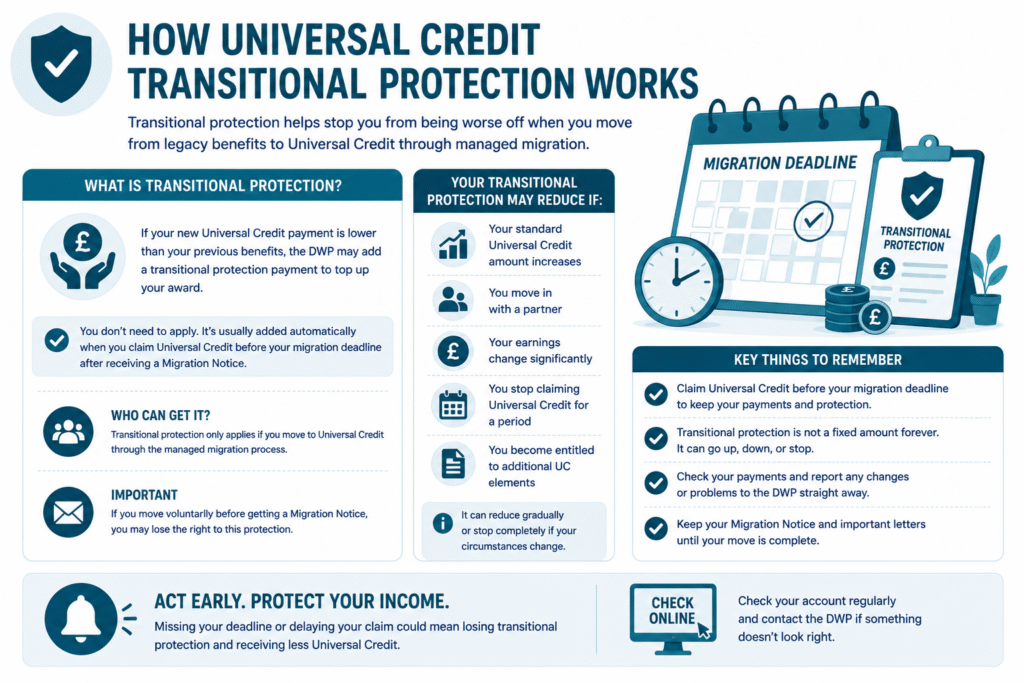
    Universal credit transitional protection helps prevent a sudden drop in income when you move from legacy benefits to Universal Credit through managed migration. If your new Universal Credit payment comes out lower than your previous benefits, the DWP may add a transitional protection universal credit payment to help bridge the gap.

    You do not need to apply separately for this support. The DWP usually adds it automatically if you claim Universal Credit before your universal credit migration deadline after receiving a Migration Notice.

    Many claimants ask, “How long does transitional protection last Universal Credit?” The answer depends on your circumstances. Transitional protection does not stay fixed forever. The amount can reduce gradually over time if your Universal Credit award increases or your situation changes.

    For example, your transitional payment may reduce if:

    • your standard Universal Credit amount increases
    • you move in with a partner
    • your earnings change significantly
    • you stop claiming Universal Credit for a period
    • you become entitled to additional UC elements

    Some people lose transitional protection completely after major claim changes or missed deadlines. That is why caregivers and claimants should act quickly after receiving a Migration Notice letter.

    Universal credit transitional protection only applies to people who move through the managed migration process. If you move voluntarily before receiving a notice, you may lose access to this financial protection.

    READ MORE: DWP Text Message Warning: How to Protect Pensioners From Winter Fuel Payment Scams

    Common Universal Credit Managed Migration Issues

    How transitional protection works in Universal Credit

    Many disabled claimants and caregivers struggle with the move from ESA to Universal Credit, especially during the first few weeks after making a claim. Although the DWP says the process should feel straightforward, many families still report universal credit managed migration issues linked to payments, deadlines, and online account problems.

    One of the biggest DWP Universal Credit migration struggles involves delayed first payments. Universal Credit usually takes around five weeks to arrive, which can place pressure on households already managing disability-related costs, rent, and caregiving responsibilities.

    Some claimants also experience problems with:

    • missing Migration Notice letters
    • incorrect LCWRA decisions after transfer
    • difficulties verifying identity online
    • confusion about housing payments
    • problems linking joint claims
    • missing journal messages or appointments

    Caregivers often need to step in and help vulnerable family members complete online forms, upload evidence, or contact the DWP when issues appear.

    If you need to report missing payment May 2025 concerns or similar Universal Credit payment issues, contact the DWP as soon as possible through your online journal or the Universal Credit helpline. Delays become harder to fix when claimants wait too long to report them.

    You should also contact the DWP immediately if:

    • your ESA payments stop unexpectedly
    • your LCWRA element does not appear
    • your transitional protection payment looks incorrect
    • your migration deadline passes before you complete your claim

    Many problems get resolved quickly once claimants provide the correct information early.

    SEE ALSO: NHS Pension Calculator: How to Estimate Retirement Income in 2026

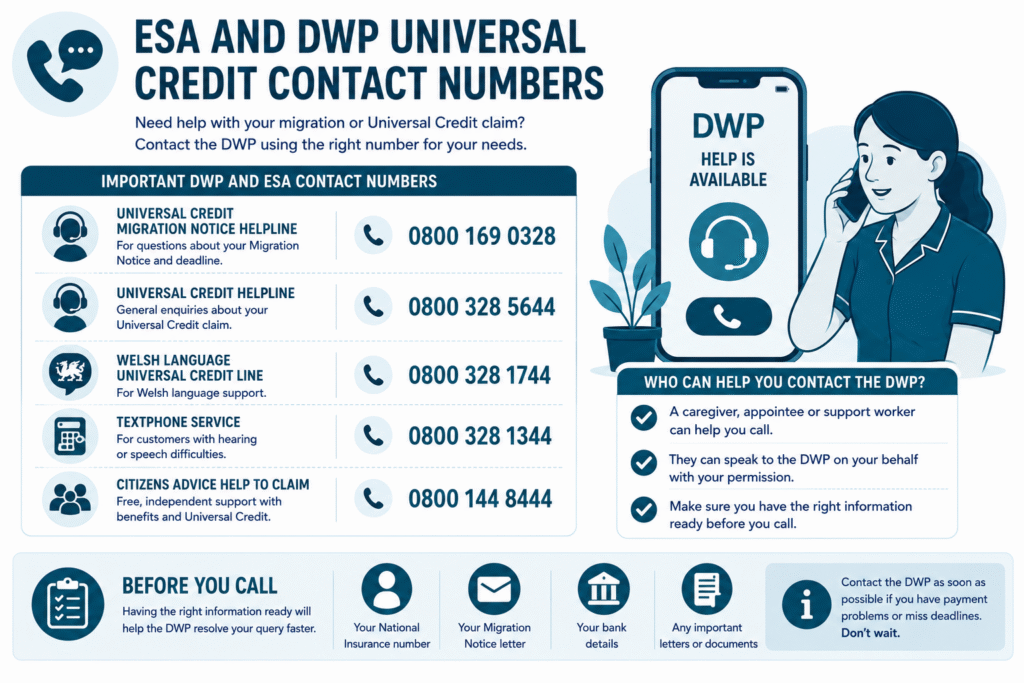
    ESA and DWP Universal Credit Contact Numbers

    If you need help during managed migration, contact the DWP as early as possible. Many ESA Support Group claimants and caregivers solve issues faster when they speak to the correct department immediately after receiving a Migration Notice.

    Important DWP and ESA Contact Numbers

    • Universal Credit Migration Notice Helpline: 0800 169 0328
    • Universal Credit Helpline: 0800 328 5644
    • Welsh Language Universal Credit Line: 0800 328 1744
    • Textphone Service: 0800 328 1344
    • Citizens Advice Help to Claim: 0800 144 8444

    Many people search online for terms like DWP 0800 contact number, ESA number 0800, or e s a contact number when payments stop, or migration letters arrive unexpectedly. Before calling, keep your National Insurance number, Migration Notice letter, and bank details nearby to speed up the process.

    If you struggle to manage phone calls yourself, a caregiver, appointee, or support worker may help you communicate with the DWP during your Universal Credit claim.

    MORE: End of Life Care at Home: What to Expect in 2026, Costs, and Family Support

    What Caregivers and Families Should Do Before the Universal Credit Migration Deadline

    DWP contact guide for Universal Credit
    DWP contact guide for Universal Credit

    Caregivers can make the move from ESA Support Group to Universal Credit much less stressful by preparing early instead of waiting until the last week before the universal credit migration deadline.

    Start by reading the entire Migration Notice letter carefully. Check the deadline date, gather important documents, and create a plan for completing the claim. Many people lose valuable transitional protection universal credit support simply because they miss deadlines or misunderstand the instructions.

    Before starting the application, caregivers should help claimants collect:

    • bank account details
    • identification documents
    • tenancy or rent information
    • recent benefit letters
    • medical or disability information if needed

    Families should also prepare for the five-week wait before the first Universal Credit payment arrives. Budgeting early can reduce pressure during the transition period, especially for households already dealing with disability-related expenses.

    If the claimant receives Housing Benefit or Council Tax support, contact the local council to check whether payments will change after migration. Many people wrongly assume Universal Credit covers everything automatically.

    Caregivers supporting people affected by DWP PIP legacy benefits changes or wider DWP PIP legacy benefits reforms should remember that PIP remains separate from Universal Credit. However, changes to income-related ESA still affect many disabled households financially and emotionally.

    You do not have to handle the process alone. Citizens Advice and disability support organisations can guide claimants through managed migration, explain complicated forms, and help resolve problems before they affect payments.

    Conclusion

    Moving from ESA Support Group to Universal Credit can feel overwhelming, especially for disabled claimants and caregivers already managing health conditions, financial pressure, and changing DWP rules. However, understanding your migration notice, acting before the deadline, and knowing what support continues under Universal Credit can make the process far more manageable.

    The most important step is to avoid delays. Claimants who respond early, prepare documents in advance, and seek support when problems appear usually experience a smoother transition and protect important payments like LCWRA and transitional protection.

    At Care Sync Experts, we help caregivers and vulnerable families understand complex care and benefits changes with clear, practical guidance.

    Whether you need support understanding ESA changes, Universal Credit migration, or wider UK care-related updates, our team continues to provide trusted information designed to help families make confident decisions during difficult transitions.

    FAQ

    What is Carer’s Element in Universal Credit?

    Carer’s Element is an extra amount added to Universal Credit for people who regularly care for someone with a disability or health condition. To qualify, you usually need to provide at least 35 hours of care each week for a person receiving a qualifying disability benefit, such as PIP daily living or Attendance Allowance.

    How Much Is the Carer’s Element of Universal Credit?

    The Carer’s Element adds extra monthly financial support to a Universal Credit claim. The amount changes slightly each year following government benefit updates. Eligible carers receive this payment in addition to the standard Universal Credit allowance, although it can affect other benefits in some situations.

    What Is the Difference Between Income-Related ESA and Contribution-Based ESA?

    Income-related ESA depends on household income, savings, and other financial circumstances. This type of ESA forms part of the legacy benefits system and is moving to Universal Credit.

    Contribution-based ESA, now called New Style ESA, depends mainly on National Insurance contributions rather than savings or household income. Many people can still receive New Style ESA alongside Universal Credit if they meet the eligibility rules.

    Is Contribution-Based ESA Changing to Universal Credit?

    Most contribution-based ESA claimants do not move fully to Universal Credit in the same way as people receiving income-related ESA. New Style ESA can continue separately because it is not part of the main legacy benefits system being replaced.

    However, some claimants receive both income-related ESA and contribution-based ESA together. In those situations, only the income-related part usually moves into Universal Credit during managed migration.