What is Regulated Activity? 2026 DBS Update, Examples
What is Regulated Activity? 2026 DBS Update, Examples
Text to speech
00:00
5sec
Duration: 00:00
Font size
Published: 2 Jul, 2026
Share this on:
If you are asking, what is regulated activity, a common example of a regulated activity is providing personal care to someone in their own home when they cannot manage it alone because of age, illness, or disability.
For a home-care business in England, this may mean the provider needs to register with the Care Quality Commission (CQC).
For example, a caregiver who helps a client wash, dress, use the toilet, eat or bathe may deliver personal care. CQC treats personal care as a regulated activity when the support meets its legal definition, and no exemption applies.
Domiciliary care agencies are therefore highly likely to need CQC registration when they provide this type of service.
Care businesses also need to understand a second meaning of regulated activity: DBS regulated activity. A care worker who provides personal care to an adult may carry out regulated work and can be eligible for an Enhanced DBS check with an Adults’ Barred List check.
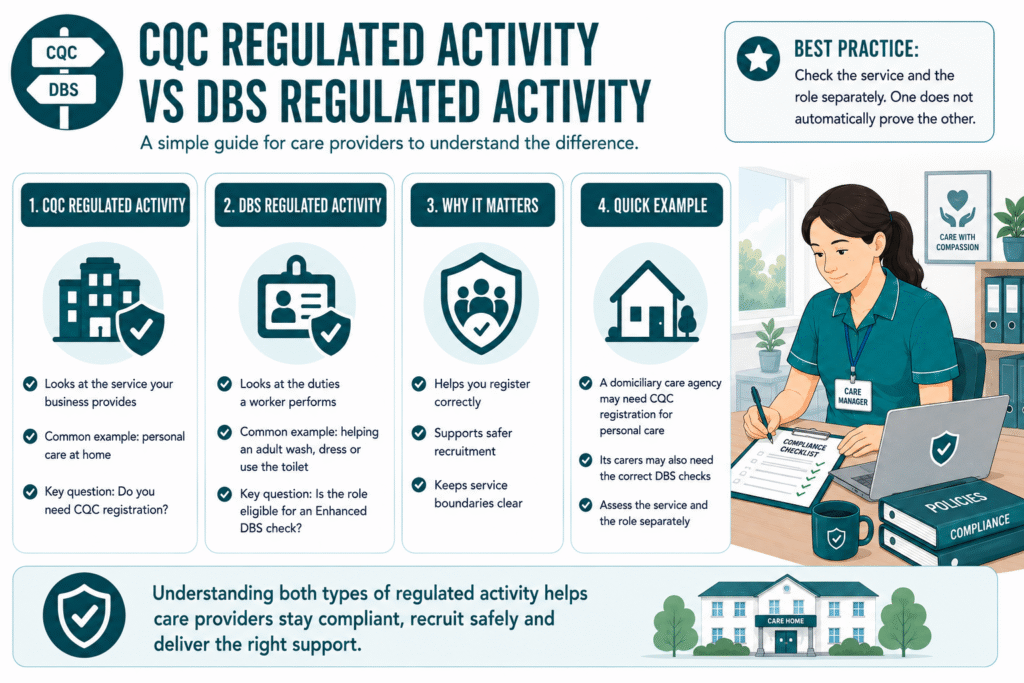
This distinction matters. CQC registration focuses on the service your business provides. DBS regulated activity focuses on the duties an individual worker performs. In many home-care businesses, both apply, but one does not automatically prove the other.
In a care business, regulated means the law sets specific requirements around a service or activity because it can affect people’s health, safety, dignity or wellbeing.
For example, a home-care agency cannot simply decide to provide personal care and begin operating. The owner must first check whether the service falls within a CQC regulated activity, whether CQC registration is required, and whether any exemptions apply.
The law defines regulated activities through the Health and Social Care Act 2008 and Schedule 1 of the Health and Social Care Act 2008 (Regulated Activities) Regulations 2014.
Put simply, rules and laws tell a care provider what it must do to operate safely and lawfully. They can cover registration, staff suitability, safeguarding, risk management, record keeping and governance. A legal rule creates an obligation: the provider must follow it, not just treat it as good practice.
For care managers, this matters because compliance starts before the first care visit. You need to understand exactly what your team will deliver, who will receive the support, and whether your service model falls within CQC regulation.
The Two Meanings of Regulated Activity: CQC Registration vs DBS Checks
Care businesses often use the phrase regulated activity as though it means one thing. In practice, it can refer to two different legal checks.
The first relates to CQC registration. This looks at the service your business provides. For example, if your agency delivers personal care in people’s homes, you may carry on a CQC regulated activity and need to register before you begin.
The second relates to DBS regulated activity. This looks at what an individual worker does. A care worker who provides personal care, healthcare or certain support to adults at risk may carry out regulated work and may be eligible for an Enhanced DBS check with barred-list information.
A barred person cannot legally carry out regulated activity with the group they are barred from working with.
Question
CQC Regulated Activity
DBS Regulated Activity
What does it assess?
The service your business provides
The duties an individual worker performs
Main purpose
To ensure care services operate safely and lawfully
To prevent barred people from working with vulnerable groups
Common care example
Providing personal care at home
Helping an adult wash, dress or use the toilet
Main action
Check whether CQC registration applies
Check the correct DBS eligibility level
A domiciliary care agency may need CQC registration because it delivers personal care, while its carers may also need Enhanced DBS checks because they carry out DBS regulated activity. However, one does not automatically confirm the other. You must assess both separately before launching or expanding your service.
What Is a Non-Regulated Activity in Home Care?
Care worker DBS regulated activity guide
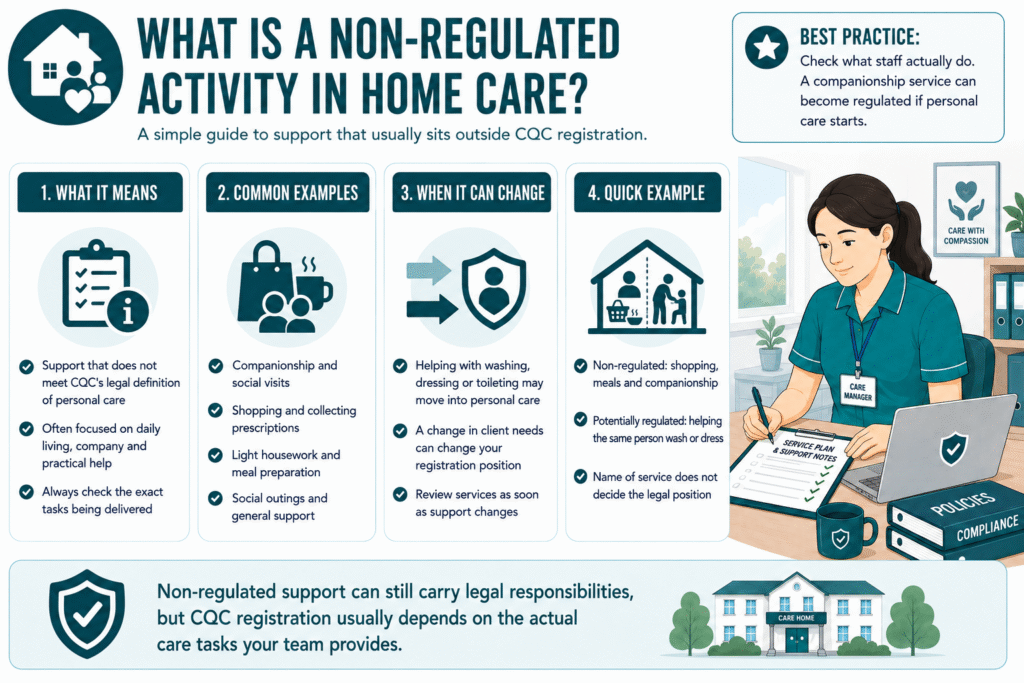
A non-regulated activity is support that does not meet CQC’s legal definition of personal care or another regulated activity. For many caregiver businesses, this can include companionship, help with shopping, light housework, meal preparation, social outings and general housing support.
For example, a caregiver may visit someone to make lunch, collect prescriptions, help with shopping and provide company. If they do not help with washing, dressing, toileting, eating, bathing or another personal-care task, the service may sit outside CQC registration.
CQC makes this distinction clear: providers do not need to register when they only provide housing or social support, such as shopping, and do not provide tasks that meet the definition of personal care. CQC also says medication prompting, supervision or administration alone does not automatically make a service personal care.
However, care businesses need to monitor the service carefully. A companionship package can become regulated when a client’s needs change and staff begin helping with personal hygiene, eating or other personal-care tasks.
For example:
Non-regulated support: A caregiver takes a client to the shops and prepares a meal.
Potentially regulated personal care: The caregiver helps the client wash, dress or use the toilet because the client cannot do this independently.
Do not rely only on what you call the service in your brochure. CQC looks at the care your staff actually provide. If your team starts delivering personal care, review your registration position before continuing or expanding that support.
When Does a Care Worker Carry Out DBS Regulated Activity?
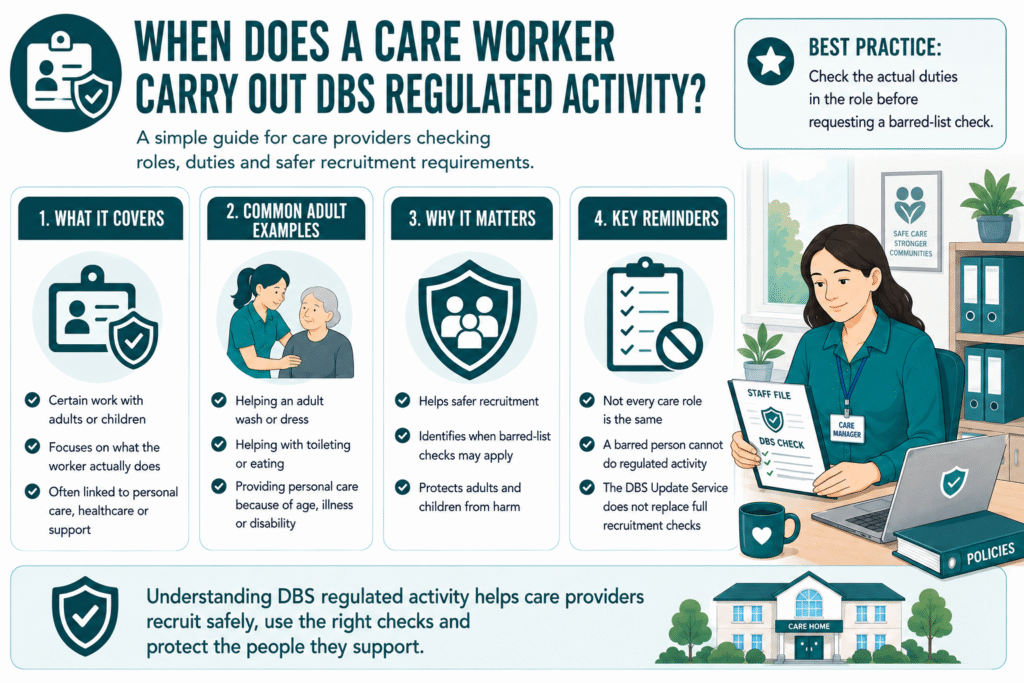
A care worker carries out DBS regulated activity when their role includes certain types of work with children or adults. In adult social care, this often includes providing personal care, healthcare, social work, help with a person’s finances or household affairs, or transport arranged for care or social-work purposes.
For example, a caregiver who helps an adult wash, dress, use the toilet, eat or manage personal care because of age, illness or disability will usually carry out regulated activity with adults. Unlike some children’s roles, adult regulated activity can apply even when the worker completes the activity only once.
A barred person is someone the DBS has legally prevented from carrying out regulated activity with children, adults, or both. Care businesses must not allow a barred person to work in the activity they are barred from. The DBS maintains the Adults’ and Children’s Barred Lists to support safer recruitment.
Before requesting a check, assess the actual duties in the role. Do not assume every care role needs the same level of DBS check.
An Enhanced DBS check with barred-list information is only available for regulated activity and a small number of other legally eligible positions.
The DBS Update Service can help an employer check whether an existing DBS certificate remains current. It does not replace proper recruitment checks, references, training, supervision or ongoing safeguarding oversight.
Common Mistakes Care Businesses Make
Understanding non-regulated home care activities
Care businesses often create compliance risks because they make assumptions instead of checking the exact service and role.
Common mistakes include:
Assuming every care worker needs the same DBS check.
Treating an Enhanced DBS certificate as proof that the business does not need CQC registration.
Advertising companionship-only support but allowing staff to deliver personal care in practice.
Failing to review care plans when a client’s mobility, health or personal-care needs change.
Using agency workers without checking their training, references, DBS status, right to work and supervision arrangements.
Ignoring health and safety responsibilities under the Management of Health and Safety at Work Regulations.
Treating disciplinaries as punishment rather than using them to address unsafe conduct, poor practice or repeated policy breaches fairly.
For example, an agency may recruit a worker for companionship visits, then ask them to help a client wash or dress because “it is only a small task.” That change can affect both the service’s CQC registration position and the worker’s DBS eligibility.
Good care businesses review what staff actually do, not just what the job description says.
A Quick Decision Check Before You Start or Expand a Care Service
What is Regulated Activity?
Before you launch a new care service or add support to an existing package, work through these questions:
What will your caregivers actually do?
List every task, including personal care, medication support, companionship, transport and household help.
Will staff provide personal care?
Help with washing, dressing, toileting, eating, bathing or other personal-care tasks can trigger CQC registration requirements.
Why does the person need the support?
CQC looks at whether the person needs help because of age, illness or disability.
Does your service include treatment, healthcare or diagnostic support?
Clinical services, treatment of disease or injury, and diagnostic and screening procedures may fall within other CQC regulated activities.
What DBS check does each role need?
Check the worker’s actual duties. A role involving DBS regulated activity may qualify for an Enhanced DBS check with barred-list information.
Do your documents match the service you deliver?
Your care plans, risk assessments, staff training, safeguarding policies and supervision arrangements should reflect real practice.
Have you checked the rules before accepting clients?
CQC registration is not optional where it applies. Providers must register before carrying on a regulated activity unless an exception or exemption applies.
A care business should never rely only on what it calls a service. The law looks at the support being delivered, the needs of the person receiving it and the responsibilities of the provider.
Final Takeaway
A regulated activity in care is not just a label. It tells you when your business may need CQC registration and when your staff may carry out DBS regulated activity.
For most home-care providers, personal care is the main area to assess. If your caregivers help people wash, dress, use the toilet, eat or manage daily care because of age, illness or disability, your service may fall within CQC regulation. Your workers may also need the correct Enhanced DBS checks.
Before you launch, expand or change a care package, check the real tasks your team will carry out, not just the service name in your brochure.
Care Sync Experts can help care providers review their service model, CQC registration position, safer recruitment process and compliance documents before they begin delivering care.
FAQ
What Is a Regulated Activity in Financial Services?
In financial services, a regulated activity is a business activity that usually requires permission from the Financial Conduct Authority (FCA), or in some cases the Prudential Regulation Authority (PRA).
Examples include accepting deposits, issuing electronic money, arranging insurance, advising on investments, dealing in investments and some consumer-credit activities. The Financial Services and Markets Act 2000 (Regulated Activities) Order 2001 sets out many of these activities.
This is different from regulated activity in care. In care, the term often relates to CQC registration or DBS safeguarding checks. In finance, it usually relates to whether a firm needs regulatory permission before providing a financial service.
What Is the Regulated Activities Order?
The Regulated Activities Order usually refers to the Financial Services and Markets Act 2000 (Regulated Activities) Order 2001. It is a UK legal instrument that lists financial activities and investments that can fall under FCA or PRA regulation.
For example, it covers activities such as accepting deposits, issuing electronic money, arranging deals in investments and advising on investments. A business that carries out a listed activity may need authorisation or another legal exemption before it can operate.
Care providers should not confuse this Order with CQC regulated activities. CQC registration for health and social care in England follows the Health and Social Care Act 2008 and the 2014 Regulated Activities Regulations instead.
What Is a Regulated Profession?
A regulated profession is a job or professional title that the law controls. Someone may need recognised qualifications, registration with a regulator, specific experience or ongoing professional standards before they can legally practise or use that title.
Examples can include doctors, nurses, social workers, solicitors, architects and some engineering roles. The exact requirements depend on the profession and the UK nation where the person works.
A regulated profession is not the same as a CQC regulated activity. For example, a nurse may work in a regulated profession, while a care provider may need CQC registration because of the service it delivers.
What Does It Mean if Something Is Not Regulated?
If something is not regulated, it usually means no specific regulator, licence or statutory permission controls that particular activity in the same way.
That does not mean a business has no legal responsibilities. A non-regulated home-care service may still need to follow employment law, health and safety requirements, data-protection rules, safeguarding responsibilities, contract law and consumer-protection law.
For example, a companionship agency may not need CQC registration if it only provides social support, shopping and light household help. However, it still needs safe recruitment, clear policies, appropriate insurance and good safeguarding practice.