Tag: Blue Badge

  • Wheelchair Parking Permit UK: Who Qualifies for a Blue Badge in 2026?

    Wheelchair Parking Permit UK: Who Qualifies for a Blue Badge in 2026?

    In the UK, a wheelchair parking permit is officially called a Blue Badge. It helps eligible disabled people park closer to where they need to go, whether they drive themselves or travel as a passenger.

    A Blue Badge can make everyday journeys safer and less stressful. It can help with hospital appointments, GP visits, shopping, pharmacy trips, social activities, and family outings. For caregivers, it can also make it easier to support someone who struggles with pain, breathlessness, fatigue, anxiety, confusion, poor mobility, or unsafe journeys.

    The badge belongs to the person, not the vehicle. This means a caregiver can use it when they drive or pick up the badge holder, but not for their own errands.

    In this Blue Badge UK guide, we explain who may qualify, what medical conditions can support an application, how to apply, how to renew, and the key Blue Badge benefits caregivers and families should understand.

    Get expert support for your next tender, inspection-ready policies, or CQC registration — book a call with Care Sync Experts today and let’s get you compliant and competitive.

    What Is a Blue Badge and Who Is It For?

    The Supported Living Property Trap UK: Why You Shouldn’t Buy Before Winning the Tender (2026)

    A Blue Badge is the UK’s disabled parking permit. It helps people with serious mobility challenges, hidden disabilities, or health conditions park closer to the places they need to reach.

    You do not always need to drive to qualify. The badge supports the disabled person, not the car. This means an older parent, disabled child, or vulnerable adult can use a Blue Badge as a passenger when a caregiver, family member, or support worker drives them.

    For caregivers, a wheelchair parking permit can turn a difficult journey into a safer one. It can reduce walking distance, lower the risk of falls, make hospital visits easier, and help someone avoid distress when busy car parks, long walks, or unfamiliar places feel overwhelming.

    A Blue Badge may help with everyday journeys such as GP appointments, shopping, pharmacy visits, day centres, family visits, and community activities. It does not remove every parking rule, but it gives important parking concessions that can protect independence and make care outside the home easier.

    What Medical Conditions Qualify for Blue Badge?
    Blue Badge parking guide

    A medical condition does not always qualify someone for a Blue Badge on its own. The council looks at how the condition affects the person’s mobility, safety, walking ability, or ability to complete journeys without serious distress or risk.

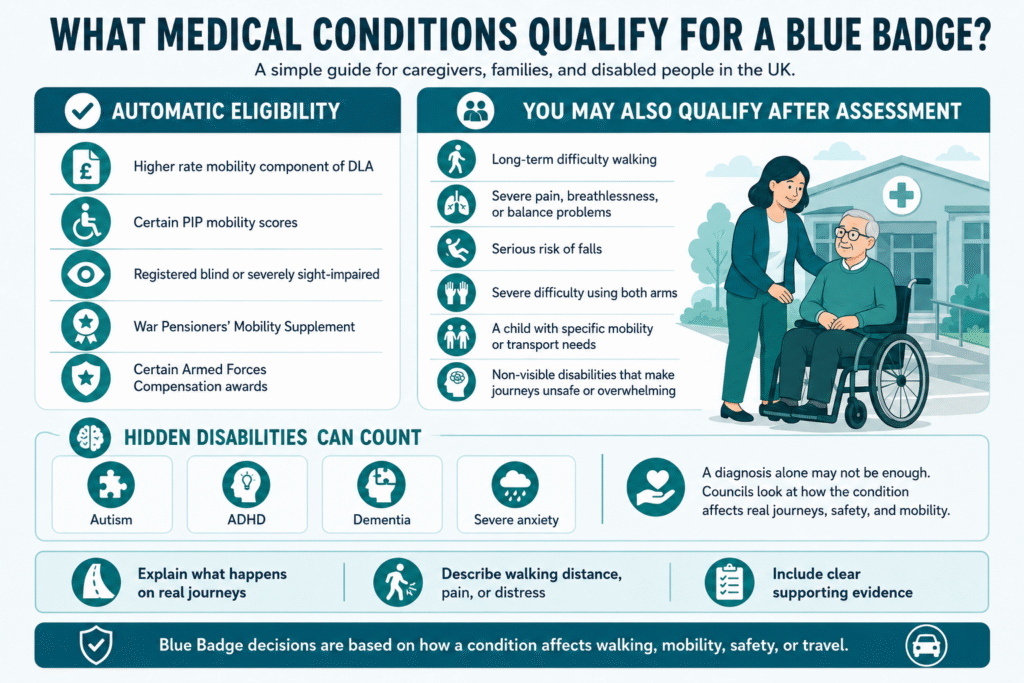
    Some people qualify automatically. This may include people who receive the higher rate mobility component of Disability Living Allowance, certain Personal Independence Payment mobility scores, War Pensioners’ Mobility Supplement, or people registered as blind or severely sight-impaired.

    Others may qualify after further assessment. This can include people with long-term difficulty walking, severe pain when walking, breathlessness, poor balance, serious risk of falls, or severe problems using both arms.

    Families often ask about the maximum walking distance for Blue Badge applications. There is no single distance that guarantees approval in every case. The council considers how far the person can walk, how safely they walk, how much pain or breathlessness they experience, and whether the difficulty happens regularly.

    You may also ask, can you get a Blue Badge for autism or can you get a Blue Badge for ADHD? The answer is: possibly. A person may qualify if autism, ADHD, anxiety, dementia, or another non-visible disability causes overwhelming distress, unsafe behaviour, or serious difficulty during journeys. The diagnosis alone may not be enough, so caregivers should explain what happens during real trips and provide clear evidence.

    RELATED: Blue Badge PIP Welfare Reform: What Care Businesses Need to Know in 2026

    What Are the New Rules for a Blue Badge?
    Wheelchair Parking Permit UK
    Wheelchair Parking Permit UK

    The most important change to the Blue Badge UK scheme is that people with non-visible disabilities can now be considered. This means a person may qualify even if they do not use a wheelchair, walking frame, or obvious mobility aid.

    So, what are the new rules for a Blue Badge? The rules allow councils to look at conditions that make journeys extremely difficult, unsafe, overwhelming, or distressing. This can include some people with autism, dementia, severe anxiety, learning disabilities, or other hidden disabilities.

    However, the rules do not give an automatic Blue Badge to everyone with a hidden disability. The person still needs to show how their condition affects real journeys. For example, a caregiver may need to explain that the person panics in busy car parks, runs into danger, becomes confused, cannot follow safe instructions, or experiences severe distress when walking from the car to a building.

    The strongest applications do not just name the condition. They explain the risk, the journey difficulty, and why closer parking would make travel safer.

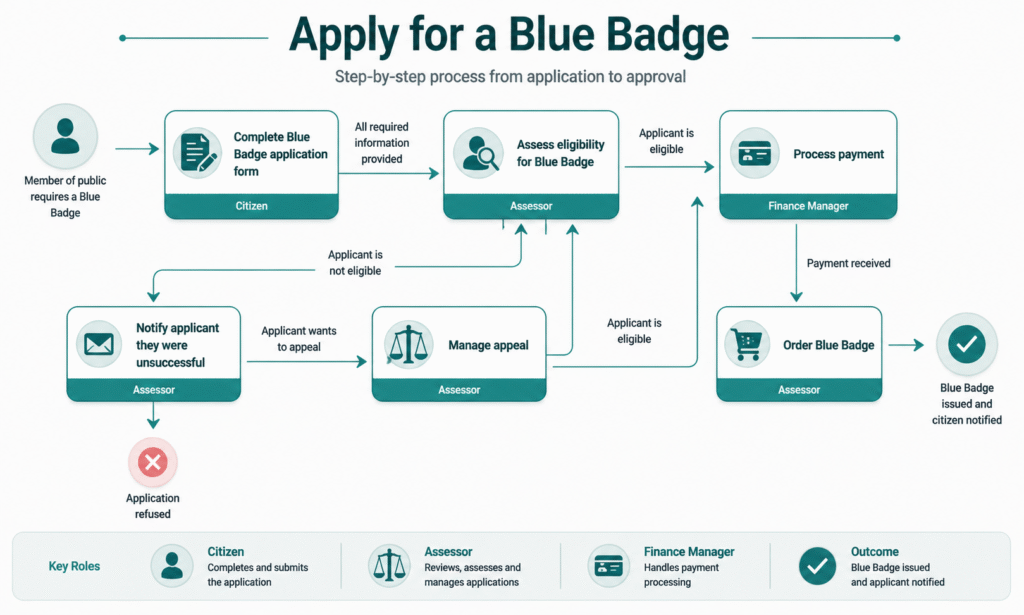
    How to Get a Blue Badge: Application Checklist

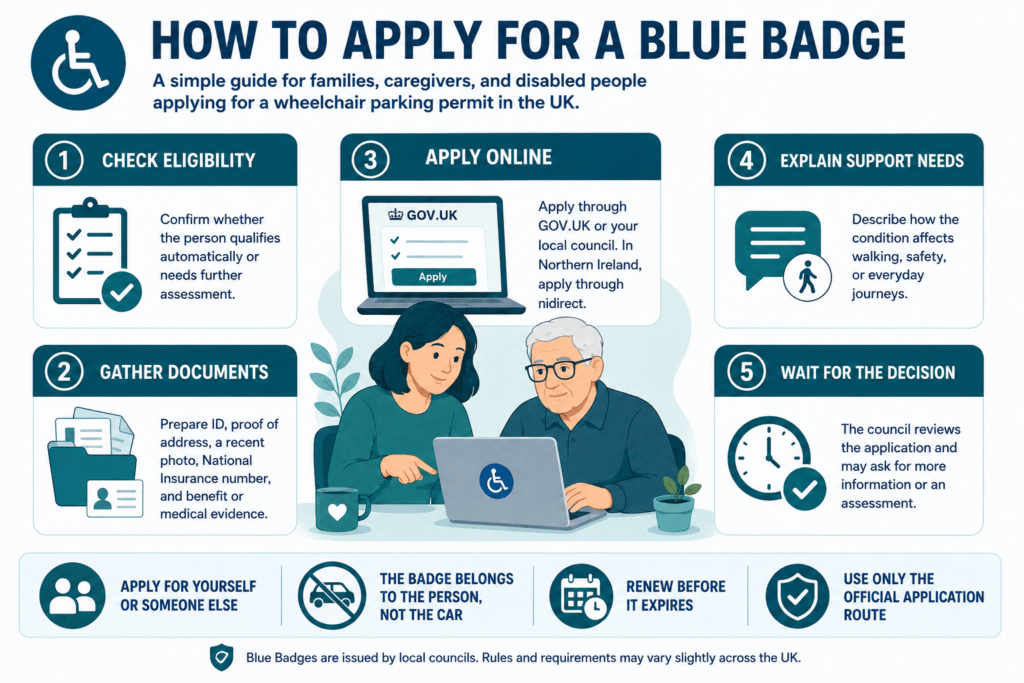
    If you want to know how to get a Blue Badge, start with the official application route. In England, Scotland, and Wales, you can apply online through GOV.UK or your local council. In Northern Ireland, you apply through nidirect.

    You can apply for yourself, for someone you care for, or for an organisation that transports disabled people. This helps caregivers who support an older parent, disabled child, vulnerable adult, or someone who cannot complete the form alone.

    Before you apply, prepare:

    • A recent digital photo of the person applying
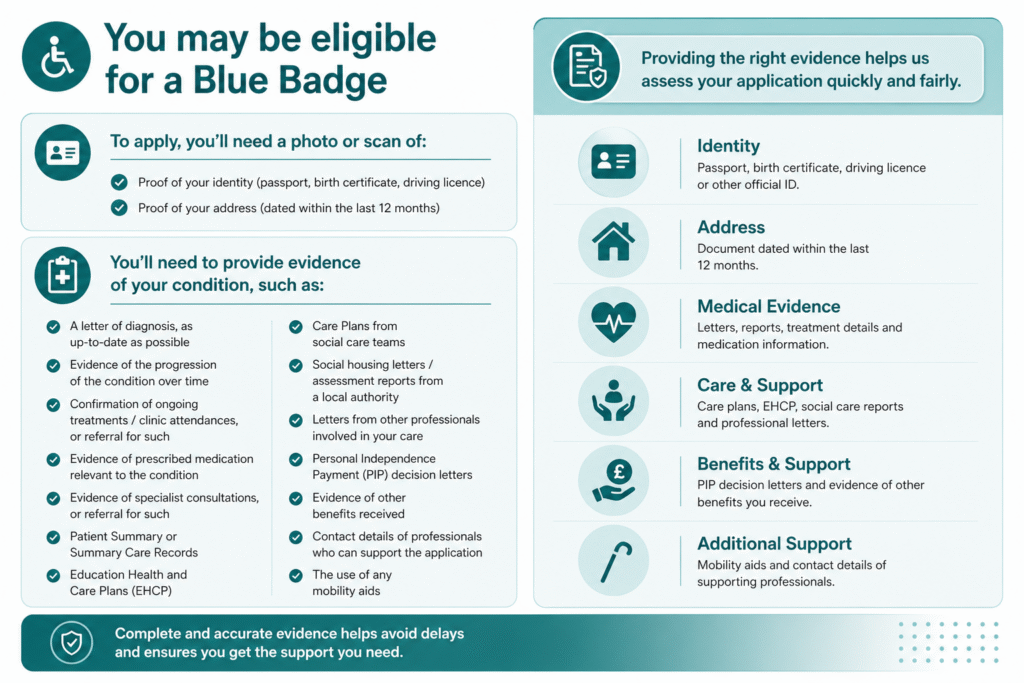
    • Proof of identity, such as a passport, birth certificate, or driving licence
    • Proof of address, such as a Council Tax bill or official letter
    • National Insurance number, if available
    • Benefit award letter, if the person qualifies through DLA, PIP, or another eligible benefit
    • Medical evidence, if the person does not qualify automatically
    • Details of the current badge, if you are renewing

    If you ask, how do I apply for a Blue Badge or how to apply for disabled badge, the answer is simple: apply through the official council or government route, give clear evidence, and explain how the person’s condition affects real journeys.

    Some people also search how to apply for a disability car, but that may refer to a different scheme, such as Motability or vehicle tax exemption. A Blue Badge only deals with disabled parking support.

    READ MORE: Working Tax Credit: What Replaced It and What You Can Claim in 2026

    How to Renew Blue Badge Before It Expires

    You need to renew your Blue Badge before it expires because you cannot use an expired badge. Most Blue Badges last up to three years, but renewal does not happen automatically.

    If you ask, how do I renew my Blue Badge, how to renew Blue Badge, how to renew disabled Blue Badge, or how do you renew a Blue Badge, the process usually means reapplying through GOV.UK, your local council, or nidirect if you live in Northern Ireland.

    Start early so you do not lose access to disabled parking support while you wait for a decision. You may need to provide a new photo, proof of identity, proof of address, benefit evidence, medical details, and your current Blue Badge number.

    Caregivers should check the expiry date for anyone they support, especially older adults, disabled children, or people who may not manage paperwork easily. If the person’s condition has changed, explain this clearly in the renewal application and include updated evidence where possible.

    Blue Badge Benefits and Parking Rules Caregivers Should Know
    Eligible for a blue badge guide
    Eligible for a blue badge guide

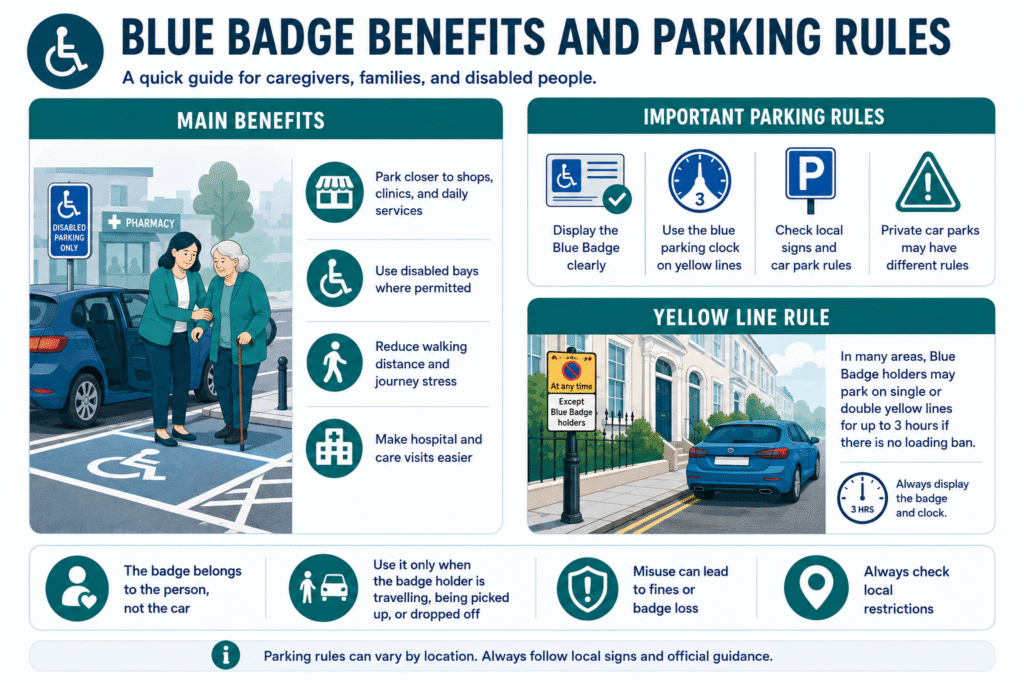
    The main Blue Badge benefits are simple: the badge helps the disabled person park closer, reduce walking distance, and make essential journeys easier. For caregivers, this can make GP appointments, hospital visits, pharmacy trips, shopping, and social outings less stressful.

    You can usually use a Blue Badge in marked disabled bays, on-street parking meters, and some pay-and-display spaces. Always check the signs because local rules can differ, especially in private car parks, hospitals, airports, town centres, and parts of London.

    Many caregivers ask, can I park on single yellow line with Blue Badge? In many areas of England, Blue Badge holders may park on single or double yellow lines for up to three hours, but not where there is a loading ban. You must display the badge and the blue parking clock showing your arrival time. 

    Remember, the badge supports the person, not the driver. You should only use it when the badge holder travels with you, or when you need to pick them up or drop them off. Misusing it can lead to fines and may put the person’s badge at risk.

    SEE ALSO: What Is the Retirement Age UK for Female Workers in 2026?

    Does a Blue Badge Entitle You to Free Road Tax?

    A Blue Badge does not automatically give someone free road tax. The badge helps with parking, but vehicle tax exemption or reduction follows separate rules.

    Some disabled people may qualify for free or reduced vehicle tax if they receive certain disability benefits, such as the higher rate mobility component of Disability Living Allowance, the enhanced mobility component of Personal Independence Payment, or other qualifying mobility support. The vehicle must usually be used for the disabled person’s needs.

    This means caregivers should not assume that a wheelchair parking permit also covers vehicle tax. Check the person’s benefit award letter, then review the vehicle tax rules separately before applying.

    So, does a Blue Badge entitle you to free road tax? No, not by itself. It may sit alongside other disability support, but it does not replace the separate application for vehicle tax exemption or reduction.

    Final Thoughts…

    A wheelchair parking permit can make a real difference when someone struggles with distance, pain, fatigue, confusion, distress, or unsafe journeys. It will not solve every care challenge, but it can make everyday travel safer and more manageable.

    If you support someone who avoids appointments, becomes distressed in car parks, cannot walk far, or needs close access to buildings, check their Blue Badge UK eligibility early. Do not wait until every journey becomes a battle.

    The strongest applications come from clear real-life evidence. Explain what happens when the person travels, how far they can walk, what risks they face, and why closer parking would help.

    For caregivers, the goal is not just easier parking. The goal is safer access, more dignity, and better independence for the person you support.

    Need Help Understanding Blue Badge Support for Someone You Care For?

    Applying for a Blue Badge can feel confusing, especially when the person you support has changing mobility needs, a hidden disability, dementia, autism, anxiety, pain, or another condition that makes journeys difficult.

    At Care Sync Experts, we help caregivers, families, and care providers understand practical support options that make everyday care safer and easier.

    If someone you care for struggles to walk far, becomes distressed during journeys, avoids appointments, or needs closer access to shops, clinics, hospitals, or community spaces, do not wait until travel becomes overwhelming. Check their eligibility, gather clear evidence, and apply through the official Blue Badge route.

    Care Sync Experts provides care-focused guidance to help you make confident care decisions, protect dignity, and support safer independence across the UK.

    FAQ

    Who can use a disabled parking permit?

    Only the disabled person named on the Blue Badge can benefit from it. They can use it as a driver or as a passenger, so a caregiver can display the badge when taking them somewhere or picking them up.

    A caregiver cannot use the badge for personal errands if the badge holder is not part of the journey. GOV.UK warns that misuse can lead to a fine of up to £1,000 and confiscation of the badge.

    Is disabled parking free in the UK?

    Not always. A Blue Badge can give parking concessions, but it does not guarantee free parking everywhere. Some council car parks, private car parks, hospitals, airports, and shopping centres set their own rules, so caregivers should always check the signs before leaving the vehicle. Northern Ireland guidance also states that a Blue Badge does not automatically entitle someone to free parking.

    Can I get a disabled parking space outside my house in the UK?

    You may be able to apply to your local council for a disabled parking bay near your home, especially if you hold a Blue Badge, have mobility difficulties, and do not have suitable off-street parking.

    However, many residential disabled bays are not reserved for one person; other Blue Badge holders may also use them unless your council offers a permit-only bay. Local rules, costs, and eligibility checks vary by council.

    Can you use someone else’s Blue Badge?

    No. You must not use someone else’s Blue Badge to park unless the badge holder travels with you or you are picking them up or dropping them off.

    The badge belongs to the person, not the car. Using it without the badge holder’s involvement counts as misuse and can lead to enforcement action, a fine of up to £1,000, and badge confiscation.
  • Blue Badge PIP Welfare Reform: What Care Businesses Need to Know in 2026

    Blue Badge PIP Welfare Reform: What Care Businesses Need to Know in 2026

    The blue badge pip welfare reform will change how some people qualify for a Blue Badge by tightening the Personal Independence Payment (PIP) mobility assessment. The Department for Work and Pensions (DWP) plans to complete its review by Autumn 2026, with stricter eligibility rules likely to affect new applicants from late 2026. 

    However, the DWP confirms PIP eligibility changes won’t affect Blue Badge travel concessions for existing claimants, meaning those already receiving PIP and related benefits will keep their current support for now.

    Get expert support for your next tender, inspection-ready policies, or CQC registration — book a call with Care Sync Experts today and let’s get you compliant and competitive.

    Key PIP and Blue Badge Changes (2026 Update)

    • Existing claimants remain protected: The DWP confirms PIP eligibility changes won’t affect Blue Badge travel concessions for current recipients.
    • New applicants face stricter rules: Updated assessment criteria will apply from late 2026, affecting future Blue Badge eligibility.
    • 8-point mobility rule under review: Automatic qualification linked to the mobility component may change.
    • DWP review timeline: The PIP mobility and daily living assessment review concludes in Autumn 2026, with outcomes expected before 2027.
    • Direct link to Blue Badge access: PIP acts as a gateway to PIP passported benefits, including the Blue Badge and other mobility support.
    • Wider impact on daily life: Changes may affect access to parking support, including the wheelchair parking permit system.

    This PIP Blue Badge concession travel update creates uncertainty for care providers and clients, especially those planning new Blue Badge applications after 2026.

    RELATED: PIP Contact Number: Number for PIP Payment and Enquiries (2026)

    Why Blue Badge and PIP Changes Matter for Care Providers

    Can One Person Be a CQC Registered Manager for Two Locations?

    Care providers rely on stable mobility support to deliver consistent, high-quality care. The blue badge pip welfare reform directly affects how clients travel, attend appointments, and maintain independence.

    A Blue Badge allows clients to park in disabled bays, reduce travel strain, and access services safely. When eligibility changes, caregivers must adjust care plans, transport arrangements, and scheduling.

    How this impacts daily care delivery:

    • Missed or delayed appointments: Clients without a valid Blue Badge may struggle to attend medical visits or therapy sessions.
    • Increased travel time: Care workers may spend more time finding suitable parking, affecting visit schedules.
    • Reduced client independence: Losing access to a wheelchair parking permit can limit mobility and social participation.
    • Higher operational pressure: Care agencies may need to allocate more resources for transport and support.

    The connection between Personal Independence Payment and mobility access remains critical. PIP acts as a gateway to PIP passported benefits, including Blue Badge access. When DWP PIP assessment changes tighten eligibility, fewer new applicants may qualify automatically.

    Care providers should not treat this as just policy news. This is a service delivery issue. Every change in Blue Badge eligibility can directly affect how caregivers plan visits, manage risks, and support vulnerable clients.

    Staying ahead of Personal Independence Payment news today helps care businesses protect continuity of care and avoid disruption for the people who depend on them most.

    Current Blue Badge Eligibility and PIP Rules

    Understanding current Blue Badge eligibility helps care providers prepare for upcoming changes under the blue badge pip welfare reform.

    What is the current rule for automatic eligibility?

    A person qualifies automatically for a Blue Badge if they score 8 points or more in the “moving around” activity of the Personal Independence Payment (PIP) mobility component.

    A score of 8 or more in PIP mobility indicates significant difficulty walking and grants automatic access to a Blue Badge.

    Key Blue Badge criteria (current system)

    • The applicant receives the higher or standard rate of the PIP mobility component
    • The applicant scores at least 8 points in mobility assessment
    • The condition affects the ability to walk or move safely
    • The limitation is long-term (usually 12 months or more)

    Are there other ways to qualify?

    Yes. Not all applicants rely on PIP for a Blue Badge application.

    Local councils can approve applications based on:

    • Severe mobility issues (even without PIP)
    • Hidden disabilities (e.g. cognitive or neurological conditions)
    • Medical evidence supporting reduced mobility

    This means:

    Blue Badge eligibility does not depend solely on PIP, but PIP remains the most common route for automatic approval.

    What are the new rules for a Blue Badge?

    The current rules still apply today. However, the DWP PIP assessment changes under review may alter how applicants reach the 8-point threshold.

    For care providers, this matters because:

    • Fewer new applicants may qualify automatically
    • More clients may need to go through manual council assessments
    • The blue badge criteria could become harder to meet through PIP alone

    Understanding today’s system allows care providers to spot risks early and support clients through future changes in eligibility.

    READ MORE: Living Wage UK 2026: What Care Providers Need to Know

    What Are the New Rules for a Blue Badge Under PIP Reform?

    Blue Badge Application Process

    The blue badge pip welfare reform focuses on tightening how the Personal Independence Payment (PIP) mobility component is assessed. The DWP has not finalized the new rules yet, but current updates point to stricter eligibility for new applicants.

    What is changing under the reform?

    • Stricter mobility assessments: The DWP PIP assessment changes will review how walking ability and mobility limitations are scored.
    • Higher threshold for automatic eligibility: Some applicants may struggle to reach the current 8-point score required for automatic Blue Badge eligibility.
    • Greater focus on real-world mobility: Assessments may place more emphasis on how consistently a person can walk, not just whether they can walk a short distance.
    • Closer review of fluctuating conditions: Conditions that vary day-to-day may face stricter evaluation.

    The DWP aims to ensure the Personal Independence Payment system remains “fair and fit for the future,” but this may reduce automatic qualification for some applicants.

    What is NOT changing right now?

    • Existing claimants will not lose their Blue Badge or PIP immediately
    • Current eligibility rules still apply until the review concludes
    • No confirmed removal of the Blue Badge scheme

    This Personal Independence Payment news today shows that the system is evolving—but not yet fully changed.

    Why this matters for Blue Badge access

    The Blue Badge depends heavily on PIP mobility scores. When the assessment becomes stricter:

    • Fewer people may qualify automatically
    • More applicants may need a manual Blue Badge application through local councils
    • Approval decisions may take longer

    For care providers, this means:

    Future clients may face delays or rejection when applying for mobility support, even if their condition remains unchanged.

    Staying informed about PIP Blue Badge concession travel updates will help care businesses prepare clients for these potential changes.

    Who Will Be Affected by the Blue Badge PIP Welfare Reform?

    The blue badge pip welfare reform will not affect everyone in the same way. Care providers should understand exactly which groups face risk and which remain protected.

    Existing Claimants (Protected for Now)

    Current Personal Independence Payment recipients will keep their benefits and related support.

    • They will continue to receive PIP passported benefits, including Blue Badge access
    • They can still renew Blue Badge permits under current rules
    • The DWP confirms PIP eligibility changes won’t affect Blue Badge travel concessions for this group

    Existing claimants will not lose their Blue Badge due to the new assessment rules.

    Care providers should still monitor renewal timelines. When clients renew disabled badge permits, local councils may review eligibility, especially if circumstances change.

    New Applicants (Late 2026 and Beyond)

    New claimants face the biggest impact.

    • Stricter DWP PIP assessment changes will apply
    • Reaching the 8-point mobility threshold may become harder
    • Automatic Blue Badge eligibility may reduce

    This means: More applicants may need to complete a full Blue Badge application form instead of relying on automatic qualification.

    Care providers should prepare clients early, especially those planning to apply after 2026.

    Borderline and Complex Cases

    Some clients sit close to the eligibility threshold.

    • Individuals scoring near 8 points in mobility
    • People with fluctuating conditions
    • Clients with non-visible disabilities

    These groups face the highest uncertainty.

    • They may lose automatic qualification
    • They may need additional medical evidence
    • Councils may require a manual assessment using the blue badge form

    What This Means for Care Providers

    Care providers must take a proactive role:

    • Identify clients who rely on Blue Badge access
    • Support early applications before stricter rules apply
    • Help clients gather documentation for future assessments

    Changes to Blue Badge eligibility will not remove support overnight, but they will reshape how new clients access mobility assistance.

    SEE MORE: What Is Tenants in Common Meaning UK: 2026 Update

    Blue Badge Application and Renewal: What Care Providers Should Do Now

    Blue Badge Application
    Blue Badge Application

    Care providers can reduce disruption by acting early. The blue badge pip welfare reform will tighten access for new applicants, so preparation matters.

    Act now: support clients before stricter rules apply

    • Start applications early: Encourage eligible clients to submit a Blue Badge application before late 2026.
    • Check eligibility upfront: Use a blue badge eligibility checker to confirm current criteria.
    • Prepare evidence: Collect medical letters, care plans, and mobility assessments in advance.
    • Plan renewals: Track expiry dates and help clients renew Blue Badge or renew disabled badge on time.

    Early, complete applications have a higher chance of approval under current rules.

    How to apply or renew a Blue Badge

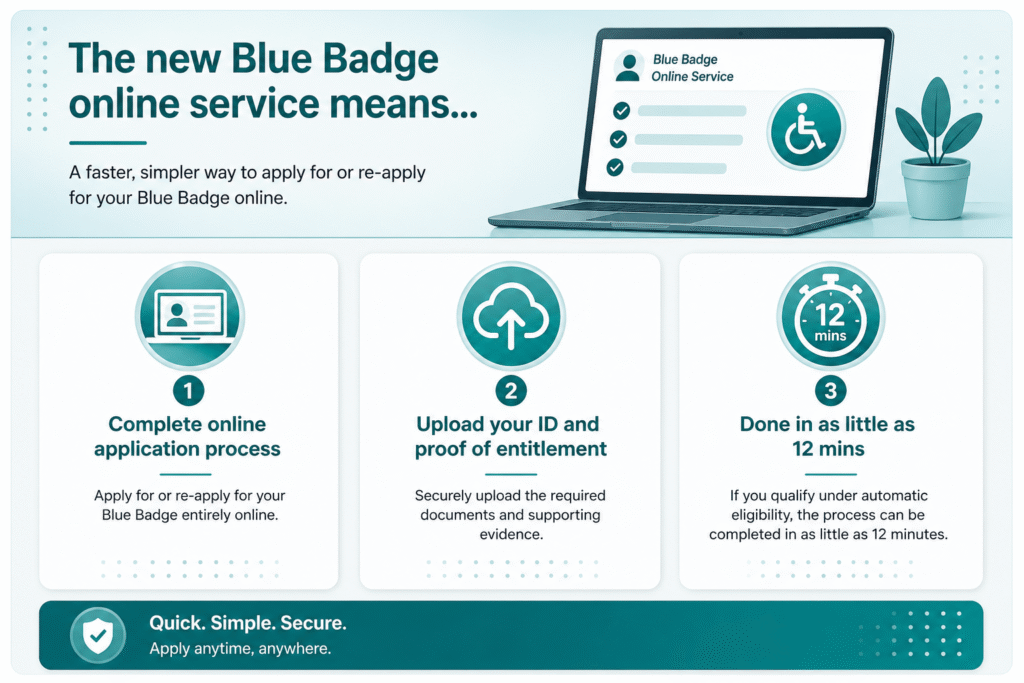
    • Complete the blue badge application form (or application form for blue badge) via the local council or GOV.UK
    • Upload supporting documents (ID, proof of address, medical evidence)
    • Pay any required fee
    • Use blue badge track application tools to monitor progress

    For clients who do not qualify automatically through Personal Independence Payment, councils may request a mobility assessment before approval.

    Where to get help

    • Contact your local council using the blue badge contact number
    • Use national helplines if available (blue badge phone number, disabled blue badge phone number, or disability blue badge contact number)
    • Refer clients to trusted advice services for form support and evidence gathering

    What care providers should prioritise

    • Documentation readiness: Keep client records updated and accessible
    • Clear communication: Explain timelines and possible delays to clients and families
    • Contingency planning: Adjust transport and visit schedules if access to a wheelchair parking permit changes

    By guiding clients through the Blue Badge application and renewal process now, care providers can protect continuity of care while the DWP PIP assessment changes evolve.

    MORE: What is the SSP rate? 2026 Update for Care Businesses

    Timeline: When Will PIP and Blue Badge Changes Happen?

    Blue Badge Eligibility
    Blue Badge Eligibility

    Care providers need a clear timeline to plan ahead. The blue badge pip welfare reform will roll out in stages, not all at once.

    Key dates to watch

    • Now (2026):
      Current rules remain in place. Clients can still qualify for Blue Badge eligibility under existing Personal Independence Payment criteria.
    • Autumn 2026:
      The DWP completes its review of the PIP mobility and daily living assessment. This is when final recommendations become clear.
    • Late 2026 (expected):
      New rules begin to apply to new applicants only, based on updated DWP PIP assessment changes.
    • 2027 onward:
      Full impact becomes visible as more applicants go through the revised system.

    What this means in practice

    • Existing claimants keep their current benefits and can still renew Blue Badge permits
    • New applicants may face stricter assessments and delayed approvals
    • Councils may rely more on manual assessments instead of automatic qualification

    The system will not change overnight, but eligibility for new applicants will gradually become stricter.

    Action for care providers

    • Apply early where possible
    • Track Personal Independence Payment news today for confirmed updates
    • Prepare clients for potential delays in Blue Badge application approvals

    Understanding this timeline helps care providers stay proactive instead of reactive as reforms take shape.

    Should Care Providers Be Concerned About PIP Changes?

    blue badge pip welfare reform
    blue badge pip welfare reform

    Care providers should stay alert, but they do not need to panic. The blue badge pip welfare reform introduces gradual changes, not immediate disruption.

    What you should not worry about right now

    • Existing clients will not lose their Blue Badge or PIP overnight
    • Current Blue Badge eligibility rules still apply
    • The DWP has not finalized all PIP assessment changes

    The DWP confirms PIP eligibility changes won’t affect Blue Badge travel concessions for current claimants.

    Where you should focus your attention

    • Future clients: New applicants may struggle to qualify under stricter rules
    • Borderline cases: Clients near the 8-point mobility threshold face higher risk
    • Application delays: More manual reviews may slow down approvals

    What care providers should do next

    • Educate clients early: Explain how Personal Independence Payment changes could affect mobility support
    • Encourage early applications: Help clients complete a Blue Badge application form before late 2026
    • Track updates: Follow reliable Personal Independence Payment news today sources
    • Support documentation: Ensure medical and care records clearly reflect mobility limitations

    Final Thoughts…

    The blue badge pip welfare reform signals a shift in how mobility support will work, but it does not remove support entirely. Care providers who act early will stay ahead of these changes.

    Focus on what you can control:

    • Help clients understand how Personal Independence Payment affects Blue Badge eligibility
    • Encourage early Blue Badge application submissions before stricter rules begin
    • Keep documentation accurate and up to date for future assessments
    • Support clients when they renew Blue Badge permits or submit a blue badge form

    The system is evolving, but informed care providers can still secure the support their clients need.

    As DWP PIP assessment changes take shape, your role becomes even more important. You are not just delivering care, you are helping clients navigate access to essential services like parking in disabled spaces and maintaining independence.

    Stay informed, stay proactive, and continue to guide your clients through every stage of the process.

    Stay Ahead of PIP Reforms and Protect Your Clients

    The blue badge pip welfare reform will change how clients access mobility support, and care providers who prepare early will have the advantage.

    At Care Sync Experts, we help you:

    • Navigate DWP PIP assessment changes with confidence
    • Keep your service compliant and inspection-ready
    • Support clients through Blue Badge applications and eligibility changes
    • Strengthen your position to win and retain local authority contracts

    Don’t wait for the changes to impact your service.

    Speak to our team today and get a clear, actionable plan to protect your clients, adapt your operations, and grow your care business in 2026 and beyond.

    FAQ

    Do you qualify for a Blue Badge if you get PIP?

    Yes, many people qualify automatically if they receive the mobility component of Personal Independence Payment (PIP) and score 8 points or more in the “moving around” activity. However, not everyone on PIP qualifies automatically, some may still need to apply through their local council and provide additional evidence.

    How many years is a Blue Badge valid?

    A Blue Badge is usually valid for up to 3 years. In some cases, councils may issue a shorter-term badge depending on the applicant’s condition or review requirements. Care providers should always track expiry dates to ensure clients renew Blue Badge permits on time.

    What evidence is needed for a Blue Badge?

    Applicants typically need to provide:
    – Proof of identity (passport or driving licence)
    – Proof of address
    – Recent photograph
    – Medical evidence (if not automatically eligible through PIP)

    Councils may also request details about mobility challenges when assessing Blue Badge eligibility.

    Can I use my Blue Badge abroad?

    Yes, you can use a UK Blue Badge in some countries, especially within the EU, but rules vary by location. Each country sets its own parking regulations, so users should check local guidance before travelling to ensure they follow the correct rules when parking in disabled spaces.