Supported Living Explained: Housing, Care and Funding
What Is Supported Living? 2026 Update for Businesses
Text to speech
00:00
5sec
Duration: 00:00
Font size
Published: 7 Jul, 2026
Share this on:
For those asking what is supported living, it is a way for adults to live in their own home while receiving personalised support to manage everyday life, build independence and stay connected to their community.
The person may rent, own or share their home, while a separate care provider delivers support around their needs, choices and goals.
Unlike a residential care home, supported living does not ask someone to fit into a fixed routine or service model. Instead, the support team works around the person’s life. One person may need help with cooking, budgeting and attending appointments, while another may need personal care, medication support or overnight assistance.
From a caregiver business perspective, good supported living care focuses on more than completing tasks. Support workers help people develop confidence, strengthen daily-living skills and make informed choices about their home, routines and relationships. The aim is to provide the right support without taking away control.
Supported living can suit adults with learning disabilities, autism, physical disabilities, mental health needs, acquired brain injuries or other support needs. However, the right arrangement depends on the person’s individual circumstances, risks, housing options and the level of care they need.
A strong supported living provider keeps housing and care arrangements clear, builds a person-centred support plan and reviews it as the person’s needs or goals change.
Supported living gives each person a home and a support plan that fits their life. The person may live in a flat, bungalow, shared house or other suitable accommodation. They may rent the property, own it or have a tenancy arranged through a housing provider.
The care provider then delivers supported living care around the person’s daily routine. This support might include a few hours each week, regular daily visits, sleep-in support or more intensive help where the person needs it.
A provider usually starts by getting to know the person properly. Staff talk with the individual, family members, social workers and other professionals to understand what matters most. They then create a support plan that covers the person’s goals, routines, communication needs, risks and preferred way of living.
For example, one person may want support to learn how to cook simple meals, manage money and travel to college independently. Another may need help with personal care, medication routines, attending health appointments and keeping their tenancy on track.
Good supported accommodation does not take control away from the person. It gives them the right level of support to make choices, stay safe and build confidence over time.
The support plan should not stay the same forever. Providers need to review it when someone’s needs change, when they reach a new goal, after an incident or when they want more independence. This keeps the support practical, person-centred and focused on real outcomes.
What Does a Support Worker Do in Supported Living?
Good supported living care explained
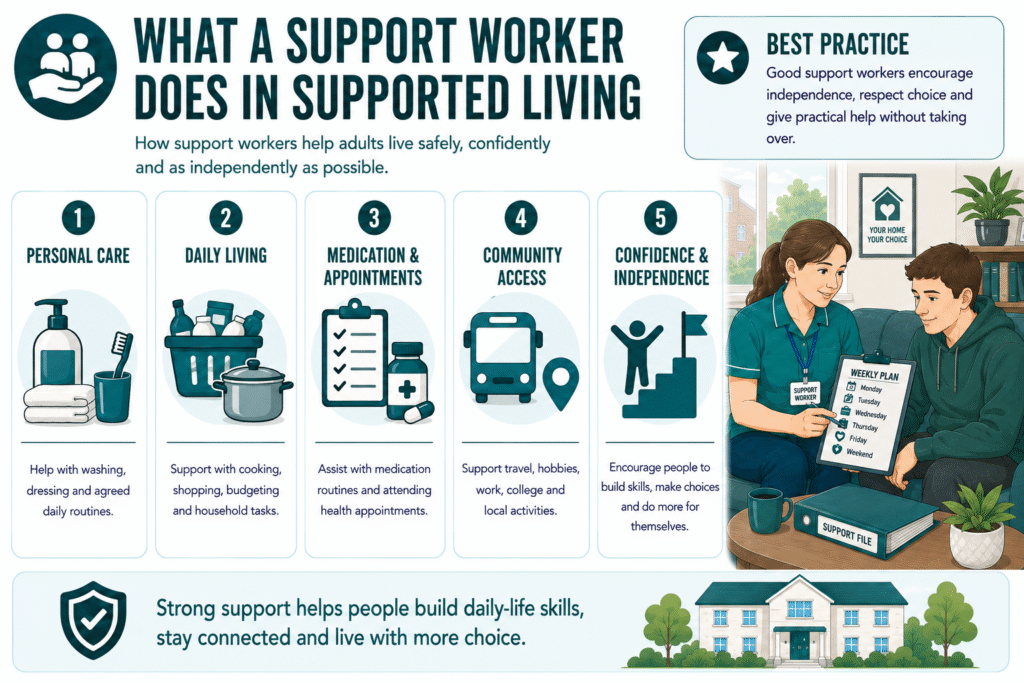
A support worker helps people live as independently as possible in their own home and community. Their role is not to take over. Instead, they encourage, guide and assist people with the parts of daily life they find difficult.
Support worker duties can vary from person to person because every supported living plan is different. One individual may need help building confidence with travel or money management, while another may need more support with personal care, medication or communication.
Common duties of a support worker include:
Helping with shopping, meal planning and cooking
Supporting personal care, where this forms part of the agreed care plan
Assisting with medication routines and health appointments
Encouraging budgeting, bill payments and tenancy responsibilities
Supporting people to use public transport, attend college or look for work
Helping people take part in hobbies, social activities and community life
Supporting communication with families, advocates and professionals
Recording progress, reporting concerns and following safeguarding procedures
The duties and responsibility of a support worker go beyond completing a checklist. Good support workers notice progress, build trust and help people practise skills until they can do more for themselves.
For example, instead of always preparing meals for someone, a support worker may help them choose ingredients, follow a simple recipe and gradually take more responsibility in the kitchen. That approach protects dignity and helps the person gain confidence.
In supported living care, the best support workers balance independence with safety. They respect the person’s choices, manage risks responsibly and step in only when support is genuinely needed.
Who Can Benefit From Supported Living?
Supported living can help adults who want more independence but still need regular support with some parts of daily life. It works best when the person wants to stay involved in choices about their home, routine and future goals.
Supported living for young adults can provide a helpful step between living with family and moving into a more independent home. Young adults may receive support with cooking, shopping, travel, budgeting, college, employment and building confidence in the community.
Supported living for young adults with disabilities can also create a more gradual move into adult life. Instead of expecting someone to manage everything alone, the provider can build support around the skills they already have and the areas where they need help.
This model can support:
Adults with learning disabilities
Autistic adults
People with physical disabilities
Adults with acquired brain injuries
People who need supported living for mental health
Young adults leaving education, family care or residential settings
Older adults who want support without moving into residential care
Supported living for mental health can help people create structure, manage appointments, maintain a tenancy, build routines and reconnect with work, education or community life. It does not replace clinical treatment, but it can give people practical day-to-day support while they work with health professionals and wider services.
A good provider does not decide that supported living suits someone based only on a diagnosis. They look at the person’s strengths, goals, risks, communication needs, housing situation and the type of support that will help them live well.
Supported Living vs Residential Care: What Is the Difference?
How to apply for supported living
Supported living and residential care both provide help with daily life, but they offer that support in very different ways.
In supported living, the person usually has their own tenancy, owns their home or shares a property with other tenants. The care provider delivers support around that person’s needs, routines and goals. The person keeps more control over when they wake up, what they eat, who they spend time with and how they use their home.
Residential care works differently. A care home provides both accommodation and care within one managed setting. Staff are available on-site, and the home runs around shared systems, routines and safety processes. This can suit people who need a more structured environment or a higher level of continuous support.
Supported living
Residential care
The person lives in their own home or tenancy
The person lives in a care home
Housing and support are usually separate
Accommodation and care come from the same provider
Support fits around the person’s routine
The service follows a shared home structure
Focuses strongly on independent living skills
Focuses on care within a managed setting
Can include shared supported accommodation
Usually involves a room within a registered care home
When people compare supported living vs residential care, the main question is not which option is “better.” The right option depends on the person’s independence, health needs, risks, communication needs, housing preferences and the level of support they require.
Supported living vs assisted living can also cause confusion. In the UK, people often use “assisted living” informally, but supported living usually refers to a model where adults receive tailored support in their own home rather than moving into a provider-run residential setting.
Supported Living for Mental Health and Complex Needs
Supported living for mental health can give people practical support while they rebuild confidence, manage daily responsibilities and stay connected to their community. It can work well for adults who want to live more independently but need help to maintain routines, manage their home or cope with periods of poor mental health.
A support worker may help someone plan meals, attend appointments, manage money, organise medication routines, keep their home safe and build structure into each day. They may also support the person to return to education, volunteering, work or social activities at a pace that feels manageable.
For people with more complex needs, the provider should create a clear plan with the individual and the wider care team. That plan may include communication needs, safety planning, crisis contacts, medication support, risk management and agreed ways to respond when the person feels overwhelmed.
Good supported living care does not replace clinical mental-health treatment. Instead, it works alongside mental-health professionals, social workers, families and advocates where appropriate. The support team focuses on everyday life, while health professionals provide specialist clinical care.
For families asking how to get supported living for mental health, the usual first step is to contact the local council and request a care and support needs assessment. The assessment helps identify what support the person needs, whether they may qualify for funding and which local services could be suitable.
The best providers avoid creating dependence. They help people build routines, practise life skills and make decisions with more confidence, while still offering reliable support when they need it most.
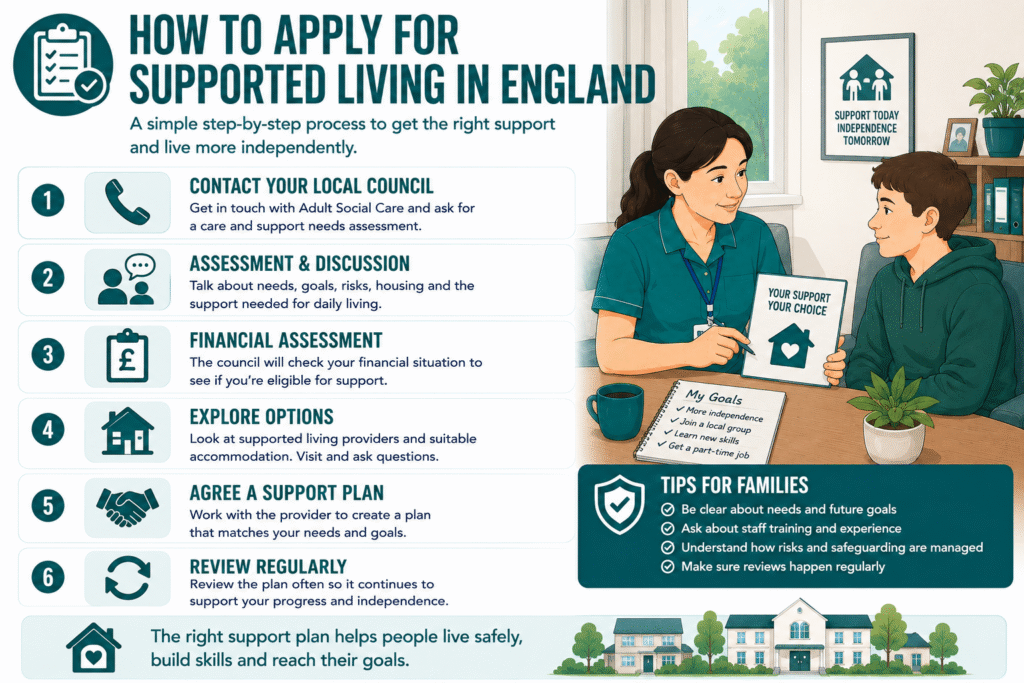
If you are wondering how to apply for supported living, start by contacting your local council’s adult social care team. Ask for a care and support needs assessment. This assessment looks at the person’s daily life, goals, housing situation, safety needs and the support they need to live as independently as possible.
During the assessment, explain clearly what support the person needs now and what they want to achieve in the future. This may include help with personal care, medication, managing money, maintaining a tenancy, accessing work or education, or building confidence in the community.
If the council agrees that the person has eligible care and support needs, it may create a care and support plan. The person may also qualify for council-funded support, a personal budget or direct payments, depending on their financial assessment and local arrangements.
A typical process looks like this:
Contact the local council and request a needs assessment.
Discuss the person’s goals, risks, housing needs and daily support needs.
Complete a financial assessment if the council asks for one.
Review local supported living providers and accommodation options.
Visit suitable services and ask how they support independence, choice and safety.
Agree a support plan before the person moves in or begins receiving support.
Review the plan regularly as needs, goals or circumstances change.
Families should also ask providers practical questions before making a decision. For example:
How do you recruit, train and supervise support workers?
How do you support medication, safeguarding and emergency situations?
How do you help people build independence instead of creating dependence?
How do you involve families while respecting the person’s privacy and choices?
How do you measure progress against the person’s goals?
For someone asking how to get supported living for mental health, the same local-council assessment route often applies. The council may work with mental-health teams, social workers and other professionals to identify the right level of housing and support.
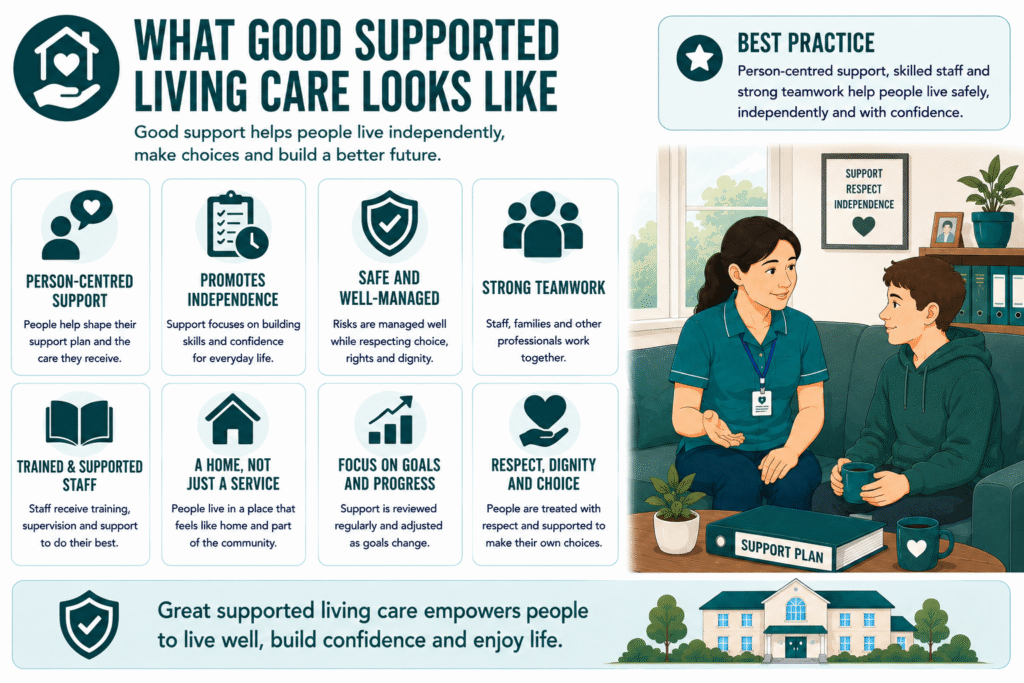
Good supported living care helps people live the life they choose, not the life a service decides for them. A strong provider listens carefully, understands the person’s goals and gives support in a way that builds confidence over time.
The best supported living services usually share the same qualities:
The person helps shape their own support plan.
Staff understand the person’s routines, communication style and preferences.
Support workers encourage people to practise skills instead of doing everything for them.
The provider manages risks without removing choice unnecessarily.
Staff respond quickly when needs, goals or circumstances change.
Families and professionals work together while respecting the person’s privacy and rights.
The service supports real community involvement, including education, work, hobbies, friendships and local activities.
Staff keep clear records and raise safeguarding concerns when needed.
A good provider also gives support workers the training, supervision and guidance they need. When staff feel confident in their role, they can provide safer and more consistent support.
The strongest supported living services do more than cover shifts. They help people build everyday skills, feel more secure at home and take greater control over their future.
Final Thoughts…
Supported living can give adults more control over where they live, how they spend their time and the support they receive. The right provider should help the person build independence while still offering reliable care when they need it.
When choosing a provider, look beyond the property and staffing levels. Ask how the service supports choice, manages risks, trains support workers and helps people reach personal goals.
A strong provider should be able to explain how they will support the person with daily living, personal care, community activities, communication, medication, safeguarding and long-term independence.
The best supported living services do not simply provide care. They create the conditions for people to live with more confidence, dignity and control in a home that feels like their own.
Care Sync Experts helps supported living providers build safe, person-centred services that promote real independence. From registration support and compliance audits to policies, staff training and operational guidance, we help your team deliver high-quality support with confidence.
FAQ
How much does supported living cost in the UK?
Supported living costs vary because housing and care support are usually charged separately. Rent, service charges and utilities depend on the property and location, while care costs depend on the number of support hours, overnight cover and personal-care needs.
A local council may contribute after a needs assessment and financial assessment; in England, councils generally consider support with care costs where savings are below £23,250.
How long can you live in supported living?
There is usually no fixed time limit. A person can remain in supported living for as long as the arrangement continues to meet their needs, they keep their tenancy or housing agreement, and the support plan remains suitable.
Providers and councils should review support when needs, risks, goals or circumstances change. Supported living aims to provide ongoing, tailored support rather than a short-term placement.
What are supported tenancies?
A supported tenancy is a tenancy where a person has legal rights to live in their home while receiving separate care, support or supervision. The tenancy may be with a housing association, local authority, private landlord or supported-housing provider. The key point is that housing should not automatically end simply because a person changes their care provider, although the exact arrangement depends on the tenancy agreement.
What is another name for supported living?
People sometimes use supported housing, supported accommodation, or housing with support to describe similar arrangements. However, they are not always identical.
Supported housing is a broader term that can include extra care housing, hostels, refuges and other housing models, while supported living usually refers to a person living in their own home and receiving tailored care or support to promote independence.