A CQC Registered Manager is the person responsible for the day-to-day leadership, safety, quality, and compliance of a regulated health or social care service in England.
Whether you operate a domiciliary care agency, supported living service, residential care home, or specialist care provision, the Care Quality Commission (CQC) expects a registered manager to oversee how the service runs and how people receive care.
Many people assume the role focuses mainly on paperwork and inspections. In reality, a successful CQC Manager shapes the culture of the entire service. They recruit and develop staff, manage risks, respond to safeguarding concerns, monitor care quality, and ensure every person receives safe and compassionate support.
From a business perspective, the CQC Registered Manager often determines whether a service achieves a Good or Outstanding rating. Strong leadership influences staff retention, client satisfaction, compliance outcomes, and long-term growth. Poor leadership can lead to complaints, enforcement action, safeguarding failures, and reputational damage.

Quick Answer: What Is a CQC Registered Manager?
A CQC Registered Manager is the legally accountable individual who manages the daily operation of a regulated care service and works with the provider to ensure compliance with CQC regulations and quality standards.
Unlike care coordinators or team leaders, a registered manager shares legal responsibility for meeting regulatory requirements. They act as the main point of contact for inspectors and must demonstrate that the service delivers care that is safe, effective, caring, responsive, and well-led.
For anyone planning to start or grow a care business, appointing the right registered manager is one of the most important decisions you will make. The role goes far beyond administration. It directly affects the quality of care people receive every day.
What Do CQC Do and Why Does the Role Matter?
Before applying to become a CQC Registered Manager, it helps to understand what the regulator actually does and why the role carries so much responsibility.
What Are CQC?
The Care Quality Commission (CQC) is the independent regulator of health and social care services in England. Its job is to monitor, inspect, and regulate care providers to ensure people receive safe, effective, and high-quality care.
If you have ever searched “what are CQC” or “what is the Quality Care Commission”, the answer is simple: CQC exists to protect people who use health and social care services by holding providers accountable to national standards.
What Do CQC Do?
CQC regulates thousands of services across England, including:
- Domiciliary care agencies
- Residential care homes
- Nursing homes
- Supported living services
- Hospices
- GP practices
- Hospitals
Inspectors assess whether providers meet legal requirements and take action when services fall below acceptable standards. Depending on their findings, they can issue warnings, impose conditions, suspend services, or even cancel registrations.
This is why every CQC Registered Manager plays such a critical role. CQC does not just inspect buildings and paperwork. Inspectors assess leadership, culture, governance, staff competence, and the quality of care people receive.
What Are the 5 CQC Standards?
When inspectors visit a service, they assess it against five key questions:
| Standard | What CQC Looks For |
| Safe | Are people protected from abuse, neglect, and avoidable harm? |
| Effective | Does the service achieve positive outcomes and follow best practices? |
| Caring | Do staff treat people with dignity, kindness, and respect? |
| Responsive | Does the service meet individual needs and adapt when circumstances change? |
| Well-led | Does leadership create a positive culture, strong governance, and continuous improvement? |
Many people search “what are the 5 CQC standards” before a registration interview because these five areas underpin almost every question an inspector asks.
Why the Registered Manager Matters
A care business can invest in policies, systems, and technology, but strong leadership ultimately determines whether those systems work in practice.
A successful CQC Manager creates a culture where staff feel supported, safeguarding concerns are reported quickly, care plans remain person-centred, and quality improvements happen continuously rather than only before inspections.
In simple terms, when a service performs well during a CQC inspection, inspectors often see evidence of effective leadership behind the scenes. That leadership usually starts with the CQC Registered Manager.
RELATED: Bid Writing Service: Top 5 Mistakes Care Providers Make in 2026
What Do CQC Do and Why Does the Role Matter?
Before applying to become a CQC Registered Manager, it helps to understand what the regulator actually does and why the role carries so much responsibility.
What Are CQC?
The Care Quality Commission (CQC) is the independent regulator of health and social care services in England. Its job is to monitor, inspect, and regulate care providers to ensure people receive safe, effective, and high-quality care.
If you have ever searched “what are CQC” or “what is the Quality Care Commission”, the answer is simple: CQC exists to protect people who use health and social care services by holding providers accountable to national standards.
What Do CQC Do?
CQC regulates thousands of services across England, including:
- Domiciliary care agencies
- Residential care homes
- Nursing homes
- Supported living services
- Hospices
- GP practices
- Hospitals
Inspectors assess whether providers meet legal requirements and take action when services fall below acceptable standards. Depending on their findings, they can issue warnings, impose conditions, suspend services, or even cancel registrations.
This is why every CQC Registered Manager plays such a critical role. CQC does not just inspect buildings and paperwork. Inspectors assess leadership, culture, governance, staff competence, and the quality of care people receive.
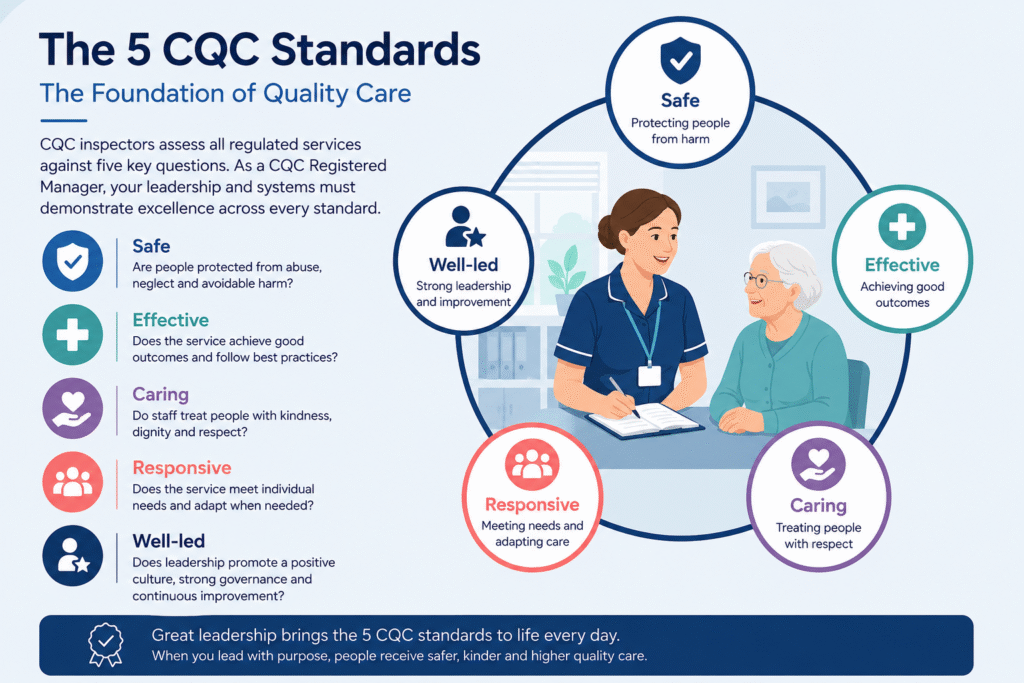
What Are the 5 CQC Standards?
When inspectors visit a service, they assess it against five key questions:
| Standard | What CQC Looks For |
| Safe | Are people protected from abuse, neglect, and avoidable harm? |
| Effective | Does the service achieve positive outcomes and follow best practices? |
| Caring | Do staff treat people with dignity, kindness, and respect? |
| Responsive | Does the service meet individual needs and adapt when circumstances change? |
| Well-led | Does leadership create a positive culture, strong governance, and continuous improvement? |
Many people search “what are the 5 CQC standards” before a registration interview because these five areas underpin almost every question an inspector asks.
Why the Registered Manager Matters
A care business can invest in policies, systems, and technology, but strong leadership ultimately determines whether those systems work in practice.
A successful CQC Manager creates a culture where staff feel supported, safeguarding concerns are reported quickly, care plans remain person-centred, and quality improvements happen continuously rather than only before inspections.
In simple terms, when a service performs well during a CQC inspection, inspectors often see evidence of effective leadership behind the scenes. That leadership usually starts with the CQC Registered Manager.
READ MORE: How to Start a Healthcare Recruitment Agency Uk in 2026
CQC Registered Manager Requirements
The CQC does not approve applications simply because someone has worked in care for several years. To become a CQC Registered Manager, you must demonstrate that you have the qualifications, experience, knowledge, and character needed to lead a regulated service safely and effectively.
During the CQC Registration process, inspectors assess whether you can manage the specific needs of your service users, understand your legal responsibilities, and maintain compliance long after registration is granted.
Qualifications
While the CQC does not prescribe a single qualification for every service type, most successful applicants hold a Level 5 Diploma in Leadership and Management for Adult Care or an equivalent qualification.
Depending on the service you manage, the CQC may also accept:
- Registered Nurse qualifications
- Social Work qualifications
- Health and social care management degrees
- Equivalent leadership qualifications supported by relevant experience
Holding a Level 5 qualification strengthens your application, but qualifications alone will not secure approval. Inspectors want evidence that you can apply your knowledge in real-world care settings.
Management Experience
Experience remains one of the most important factors in any application.
The CQC expects applicants to demonstrate:
- Leadership experience within health or social care
- Experience supervising and developing staff
- Knowledge of safeguarding and risk management
- Understanding of person-centred care
- Familiarity with regulated services and compliance requirements
If you plan to manage a domiciliary care agency, for example, experience within home care will significantly strengthen your application.
Character and Fitness Requirements
Every CQC Registered Manager must prove they are a fit and proper person to hold the role.
This includes:
- A current Enhanced DBS check
- Suitable employment references
- A complete employment history
- Evidence of honesty, integrity, and professionalism
- Physical and mental fitness to perform the role
The CQC carefully reviews gaps in employment, disciplinary issues, criminal records, and inconsistencies within applications. Providing inaccurate or misleading information can lead to refusal and may affect future applications.
Understanding Care Regulations
Strong applicants understand far more than daily care delivery. They also understand the legal framework that governs care services.
Inspectors expect you to demonstrate knowledge of:
- The Health and Social Care Act 2008
- Fundamental Standards
- Safeguarding responsibilities
- Mental Capacity Act principles
- Duty of Candour
- Notification requirements
- Governance and quality assurance systems
Many applicants focus heavily on qualifications and underestimate the importance of regulatory knowledge. In reality, a large proportion of the CQC Registered Manager interview focuses on how you would apply these regulations in practical situations.
For this reason, preparing for registration should involve more than collecting certificates. You must be ready to show that you can lead a service, protect vulnerable people, and maintain compliance from day one.
CQC Registration Process: Step-by-Step
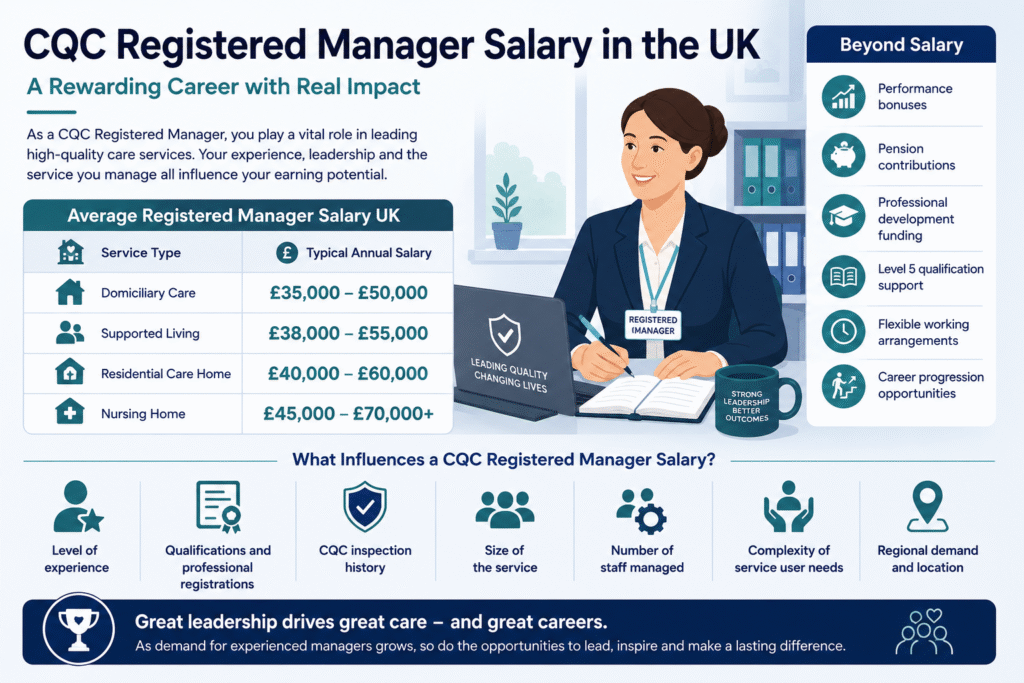
Understanding the CQC Registration process can save you months of delays and significantly improve your chances of approval. Many applications fail not because applicants lack experience, but because they submit incomplete information, provide weak evidence, or perform poorly during the interview stage.
If you are wondering what is CQC registration, it is the formal process of obtaining approval from the Care Quality Commission to manage or provide regulated health and social care services in England.
Step 1: Gather Your Evidence
Before starting your application, collect all supporting documents and information, including:
- Enhanced DBS certificate
- Employment history
- Professional references
- Qualifications and training records
- Proof of identity
- Details of previous management experience
The CQC will compare this information against your application, interview responses, and references, so accuracy matters.
Step 2: Complete Your Application
Most applicants submit their registration through the official CQC Provider Portal.
During this stage, you will complete several sections covering:
- Personal details
- Employment history
- Qualifications
- Regulated activities
- Management experience
- Service user groups
- Fitness and suitability declarations
You will also complete a Fit Person Questionnaire (FPQ), which helps the CQC assess your competence, character, and understanding of the role.
Step 3: Prepare for the CQC Registered Manager Interview
The CQC Registered Manager interview is often the most important stage of the process.
Inspectors use the interview to assess whether you can safely lead a regulated service and apply care regulations in real-world situations.
Expect questions about:
- Safeguarding
- Mental Capacity Act
- Complaints handling
- Staffing challenges
- Governance systems
- Risk management
- The five CQC standards
This stage is where many applicants succeed or fail.
Step 4: Registration Assessment
After reviewing your application and interview, the CQC may:
- Approve your registration
- Request additional information
- Arrange follow-up discussions
- Issue a Notice of Proposal if concerns exist
The inspector’s recommendation forms only part of the decision. A Registration Manager reviews the entire application before approval is granted.
How Long Does CQC Registration Take?
One of the most common questions applicants ask is “how long does CQC registration take?”
The answer depends on the complexity of the application, the quality of the evidence submitted, and how quickly you respond to requests for information.
In most cases:
| Stage | Typical Timescale |
| Application review | 2–6 weeks |
| Interview scheduling | 2–8 weeks |
| Final assessment and decision | 4–12 weeks |
Many applicants experience a total registration period of between 8 and 16 weeks, although more complex applications can take longer.
Common Reasons for Delays
The most frequent causes of delays include:
- Missing documentation
- Incomplete employment history
- Weak references
- Poorly prepared interview responses
- Unclear business structures
- Delayed responses to CQC requests
The strongest applications present a clear picture of who you are, how your service will operate, and why you are capable of leading safe, high-quality care from day one.
SEE ALSO: Inheritance Tax Threshold UK: 2026 Update
CQC Registered Manager Interview: How to Pass First Time
For many applicants, the interview is the most challenging part of becoming a CQC Registered Manager. While your qualifications and experience matter, the CQC ultimately wants to know whether you can lead a service safely, make sound decisions under pressure, and protect the people who depend on your care.
If you are searching for CQC Registered Manager how to pass the interview, the answer is simple: focus less on memorising regulations and more on demonstrating how you would apply them in practice.
What CQC Really Wants to Hear
Inspectors are not looking for perfect textbook answers. They want evidence that you can think like a leader.
Throughout the interview, you should show that you:
- Put people before profits
- Understand safeguarding responsibilities
- Can manage risk effectively
- Learn from mistakes and complaints
- Promote person-centred care
- Lead and support staff confidently
- Understand the five CQC standards
Strong candidates consistently connect their answers back to the people they support rather than simply quoting policies.
Common Mistakes That Cause Applications to Fail
Many applicants underestimate how much the interview influences the final decision.
Some of the most common mistakes include:
- Giving vague safeguarding answers
- Blaming staff or previous employers for problems
- Failing to understand their own business plan
- Showing weak knowledge of the Mental Capacity Act
- Prioritising operational convenience over safety
- Being unable to explain regulated activities or notification requirements
Inspectors want reassurance that you will take ownership of problems and act decisively when people are at risk.
Questions You Should Expect
Although every interview differs, most CQC Registered Manager interviews include questions around:
Safeguarding
- How would you handle an allegation of abuse?
- What steps would you take to protect a vulnerable adult?
Leadership
- Tell us about a difficult management situation.
- How do you support staff performance?
Complaints
- How would you respond to a family complaint?
- How do you use complaints to improve services?
Mental Capacity Act
- What are the five principles of the Mental Capacity Act?
- How would you make a best interests decision?
Governance
- How do you monitor quality?
- What would you do if audits identified repeated issues?
Use Real Examples Wherever Possible
One of the most effective interview techniques is using examples from your own career.
When answering scenario-based questions, explain:
- The situation you faced
- The action you took
- The outcome you achieved
- What you learned
This approach helps inspectors see evidence of real leadership rather than theoretical knowledge.
Final Interview Tip
Many applicants spend weeks revising regulations but forget to review their own application.
Before your interview, make sure you know:
- Your Statement of Purpose
- Your service user groups
- Your staffing structure
- Your policies
- Your business plan
- Your regulated activities
Inspectors frequently ask questions based on information you have already submitted. When your answers align with your application and demonstrate confident leadership, you give the CQC strong evidence that you are ready to become a successful CQC Registered Manager.
MORE: Universal Credit Permanent Boost 2026
CQC Registered Manager Salary in the UK
While many professionals pursue the role because they want to lead high-quality care services, salary remains an important consideration when planning your career progression.
The Registered Manager salary UK varies depending on the service type, location, size of the organisation, and level of responsibility.
For example, a manager overseeing a small domiciliary care agency will typically earn less than someone leading a large residential care home with multiple regulated activities and a large workforce.
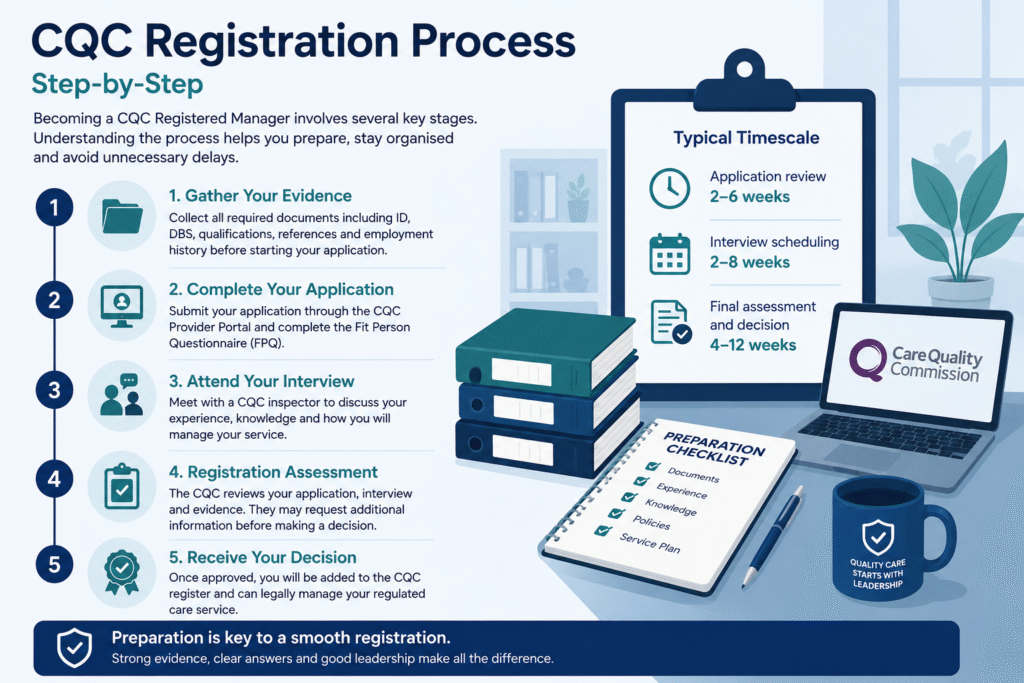
Average Registered Care Manager Salary UK
Although salaries fluctuate across the country, many employers offer:
| Service Type | Typical Annual Salary |
| Domiciliary Care | £35,000 – £50,000 |
| Supported Living | £38,000 – £55,000 |
| Residential Care Home | £40,000 – £60,000 |
| Nursing Home | £45,000 – £70,000+ |
In areas facing significant recruitment challenges, experienced managers can command even higher salaries.
What Influences a CQC Registered Manager Salary?
Several factors affect a CQC Registered Manager salary, including:
- Level of management experience
- Qualifications and professional registrations
- CQC inspection history
- Size of the service
- Number of staff managed
- Complexity of service user needs
- Regional demand for experienced managers
Providers often place a premium on managers who have successfully achieved or maintained Good and Outstanding ratings because strong leadership directly impacts business performance.
Beyond Salary
When evaluating opportunities, it is important to look beyond basic pay.
Many employers also offer:
- Performance bonuses
- Pension contributions
- Professional development funding
- Level 5 qualification support
- Flexible working arrangements
- Career progression into regional or operational management roles
For ambitious professionals, becoming a CQC Registered Manager often opens the door to senior leadership positions within larger healthcare organisations.
Is Becoming a Registered Manager Worth It?
The role carries significant responsibility, but it also offers the opportunity to shape care quality, support vulnerable people, and influence the success of an entire service.
For many leaders, the greatest reward comes from building a positive culture where staff thrive, people receive outstanding care, and the service consistently meets the standards expected by the CQC.
As demand for experienced managers continues to grow across England, the career prospects for skilled registered managers remain strong.
SEE MORE: Early Sign of MND in 2026: What Care Businesses Should Notice First
How Often Do CQC Inspections Take Place?
One of the most common questions providers ask after completing CQC Registration is: how often do CQC inspections take place?
The answer depends on several factors, including your service type, previous inspection ratings, risk profile, complaints received, safeguarding concerns, and information shared with the regulator.
How Often Do CQC Inspections Happen?
There is no fixed inspection timetable that applies to every service.
Instead, the CQC uses a risk-based approach. This means inspectors may visit sooner if concerns arise or wait longer if a service consistently demonstrates high standards.
In general:
- Newly registered services often receive an inspection within their first year of operation.
- Services rated Requires Improvement or Inadequate usually receive more frequent monitoring.
- Services rated Good or Outstanding may experience longer periods between full inspections.
Because the CQC continuously monitors services using data, notifications, complaints, safeguarding reports, and feedback, providers should always remain inspection-ready.
What Are the 3 Types of CQC Inspections?
Although inspection activity has evolved over time, providers commonly encounter three forms of regulatory assessment:
1. Comprehensive Inspections
These inspections review the entire service against the five key questions:
- Safe
- Effective
- Caring
- Responsive
- Well-led
Inspectors assess leadership, care quality, staffing, governance, and outcomes for people using the service.
2. Focused Inspections
Focused inspections examine specific concerns or areas of risk.
For example, inspectors may investigate:
- Medication management
- Safeguarding concerns
- Staffing levels
- Infection prevention and control
- Governance failures
3. Follow-Up or Monitoring Inspections
These inspections usually occur after a service receives a lower rating or enforcement action.
The inspector’s goal is to assess whether the provider has addressed previously identified concerns and implemented sustainable improvements.
Why Inspection Readiness Matters
Many providers make the mistake of preparing only when they expect an inspection.
Strong CQC Registered Managers take a different approach.
They build systems that continuously monitor quality, support staff development, track incidents, analyse complaints, and identify risks before they become regulatory issues.
This proactive approach not only improves inspection outcomes but also creates safer and more effective services for the people receiving care.
The best preparation for a CQC inspection is not a last-minute audit. It is consistent leadership, strong governance, and a culture that prioritises quality every day.
Final Thoughts…
Becoming a CQC Registered Manager requires more than qualifications and paperwork. The role demands leadership, accountability, regulatory knowledge, and a genuine commitment to improving people’s lives.
From understanding the five CQC standards and completing the CQC Registration process to preparing for the CQC Registered Manager interview, every stage demonstrates your ability to lead a safe, effective, caring, responsive, and well-led service.
The strongest applicants do not focus solely on passing registration. They focus on building a culture where people receive outstanding care, staff feel supported, and continuous improvement becomes part of everyday practice.
If you are preparing for registration, need support with your application, or want expert guidance before your interview, Care Sync Experts can help you navigate the process with confidence and avoid the common mistakes that delay or derail applications.
FAQ
How Many CQC Regulations Are There?
The Health and Social Care Act 2008 (Regulated Activities) Regulations contain multiple regulations covering areas such as person-centred care, safeguarding, staffing, governance, fit and proper persons, complaints, and duty of candour.
For a CQC Registered Manager, the most important requirement is understanding how these regulations apply in practice rather than memorising regulation numbers.
How Do I Become a CQC Inspector?
Many experienced health and social care professionals move into regulatory roles after working as managers, nurses, social workers, or senior leaders.
To become a CQC inspector, you typically need:
– Significant experience in health or social care
– Strong knowledge of care regulations
– Leadership and quality assurance experience
– Excellent communication and assessment skills
The CQC advertises inspector vacancies through its careers portal when positions become available.
How to Become a Care Quality Commission Inspector
If your long-term career goal involves regulation rather than service management, building experience as a CQC Registered Manager can provide a strong foundation.
Inspectors need practical knowledge of safeguarding, governance, quality improvement, and service delivery. Many successful inspectors have previously managed regulated services themselves.
What Does Quality Control Mean in Social Care?
In social care, quality control refers to the systems and processes used to ensure people consistently receive safe, effective, and high-quality care.
Examples include:
– Care plan audits
– Medication audits
– Staff supervision
– Spot checks
– Incident reviews
– Service user feedback
– Complaints analysis
Effective quality control helps providers identify problems early and continuously improve service delivery.
Leave a Reply