Author: Muhideen Ajibade

  • Care Home Risk Assessment: 2026 Practical Guide to Safer, Person-Centred Care

    Care Home Risk Assessment: 2026 Practical Guide to Safer, Person-Centred Care

    A care home risk assessment identifies anything that could cause harm to residents, staff, or visitors and sets out practical steps to reduce that risk.

    It should cover the whole care environment as well as each resident’s individual needs, including falls, moving and handling, medication, nutrition, dementia-related risks, infection control, fire safety, and safeguarding.

    Risk assessments matter because they help care teams prevent avoidable harm before an incident happens. They also give staff clear guidance on what to do, what equipment to use, when to ask for support, and when to review someone’s care.

    However, the purpose of a risk assessment is not to remove every risk from a resident’s life. Good care homes use risk assessments to protect people while still supporting dignity, independence, routines, and personal choice.

    For example, a resident may want to walk to the garden, make a cup of tea, or take part in an activity that carries some risk. Instead of stopping them automatically, the care team should assess the situation, put sensible controls in place, and help the person enjoy everyday life as safely as possible.

    Get expert support for your next tender, inspection-ready policies, or CQC registration — book a call with Care Sync Experts today and let’s get you compliant and competitive.

    What Is a Hazard and Risk in a Care Home?

    Starting a Homecare Agency From Home? 5 CQC Rules You CANNOT Miss

    A hazard is anything that could cause harm. A risk is the chance that harm could happen and how serious the outcome could be.

    For example, a wet bathroom floor is a hazard. The risk is that a resident could slip, fall, and suffer an injury. A hoist used without the right sling is a hazard. The risk is that the resident or carer could fall or get hurt during a transfer.

    In care homes, staff should look beyond obvious hazards such as wet floors, loose carpets, poor lighting, or trailing cables. They also need to consider less visible risks, including medication errors, dehydration, pressure damage, infection, choking, confusion, wandering, or unsafe moving and handling.

    Good risk assessment in healthcare examples always link the hazard to the person most likely to be affected. A resident with poor balance may face a higher falls risk than another resident. Someone with dementia may need extra support around exits, routines, or unfamiliar environments.

    Once staff understand the hazard and the risk, they can put the right controls in place. That may include clearer routines, equipment checks, extra supervision, staff training, or changes to the environment.

    RELATED: Council Care Cost Inheritance: Who Pays for Care Home Fees 2026?

    Types of Risk Assessment in Care Homes
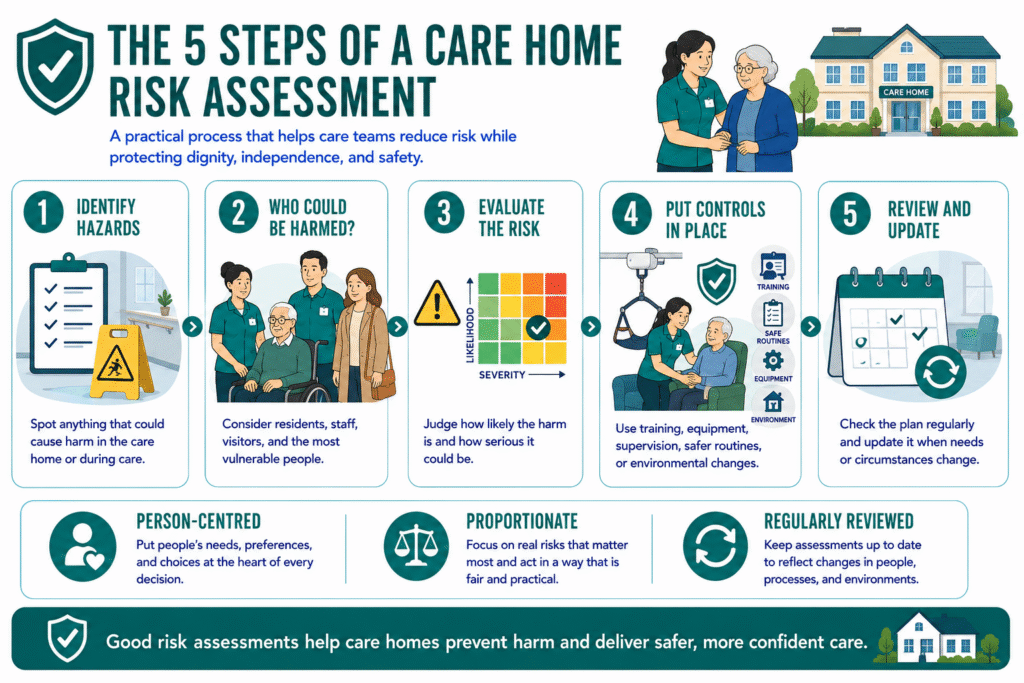
    5 steps of care home risk assessment
    5 steps of care home risk assessment

    Care homes use different types of risk assessment because residents, staff, visitors, and the building itself can face different risks. A strong care home risk assessment brings these areas together so staff can deliver safe care without losing sight of the person’s choices and routine.

    The main types of risk assessment in care include:

    • Individual resident risk assessments for falls, mobility, moving and handling, nutrition, hydration, skin integrity, medication, personal care, dementia, and behaviour that may place someone at risk.
    • Environmental risk assessments for slips, trips, poor lighting, unsafe equipment, hot water, infection risks, fire safety, and maintenance issues.
    • Staff and operational risk assessments for staffing levels, lone working, manual handling, medication procedures, training needs, and emergency response.
    • Safeguarding and security assessments for abuse, neglect, unauthorised access, missing residents, financial risks, and protecting vulnerable adults.
    • COSHH assessments for cleaning chemicals, disinfectants, laundry products, and other hazardous substances.
    • Emergency risk assessments for fire, evacuation, power failure, severe weather, outbreaks, or other incidents that could disrupt care.

    Personal care risk assessment examples may include checking whether a resident needs help with bathing, dressing, continence care, eating, or using the bathroom safely. In nursing care, staff may also assess pressure ulcer risk, swallowing difficulties, medication needs, and clinical equipment.

    The best assessments do not sit in a folder and gather dust. Care teams should use them every day, share updates clearly, and review them whenever a resident’s needs change.

    Risk Assessment in Care Homes Examples

    The clearest way to understand risk assessment is to look at everyday care situations. Good assessments do not simply identify a problem; they help carers decide what safe, practical support looks like.

    Falls risk: A resident becomes unsteady after a medication change. The team checks their footwear, mobility aid, lighting, hydration, medication timing, and level of supervision. They may add regular checks or encourage the resident to use a walking aid, while still supporting them to move around independently.

    Moving and handling: A resident needs help transferring from bed to wheelchair. The assessment should record the correct equipment, sling type, number of carers needed, transfer method, and any pain or mobility issues staff need to consider. This protects both the resident and the carers.

    Dementia-related risk: A resident enjoys walking outside but sometimes becomes confused about how to return. Rather than stopping them from going out completely, the care team can agree safer controls such as familiar routes, regular check-ins, a personal alarm, family involvement, or staff support at certain times.

    Nutrition and hydration risk: A resident loses weight or struggles to swallow safely. Staff may record food textures, drink preferences, mealtime support, allergy information, weight-monitoring plans, and when to seek clinical advice.

    These risk assessment in care homes examples show why care providers need more than generic forms. Each plan should reflect the person’s needs, choices, strengths, and daily routine.

    READ MORE: Domiciliary Care Business Plan: How to Start a CQC-Ready Agency in 2026

    How Many Steps Are There to a Risk Assessment?
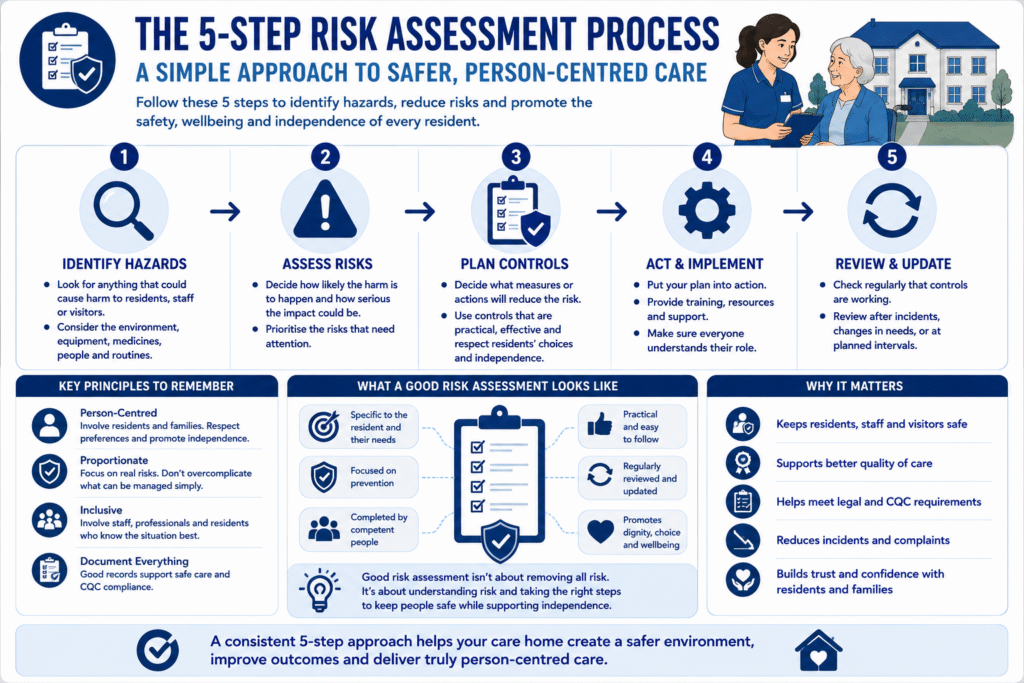
    Care Home Risk Assessment 2026

    There are five main steps in a risk assessment. Care homes can use this process to spot hazards, protect people, and make sure staff know what action to take.

    1. Identify the hazards
      Walk through the care home, observe daily routines, speak with staff and residents, and review incident records. Look for anything that could cause harm.
    2. Decide who could be harmed and how
      Consider residents, staff, visitors, contractors, and the most vulnerable people in the home. A hazard may affect each person differently.
    3. Evaluate the risk and choose controls
      Decide how likely harm is and how serious it could be. Then put sensible controls in place, such as equipment, training, supervision, safer routines, or environmental changes.
    4. Record findings and put controls into practice
      Write the assessment clearly. Staff should know what the risk is, what action they need to take, and when they must report concerns.
    5. Review and update the assessment
      Update the plan when circumstances change. A fall, hospital stay, medication change, infection outbreak, mobility decline, or new equipment may all trigger a review.

    So, who should perform a risk assessment? A competent person with the right knowledge should lead it, but good care homes involve carers, managers, residents, families, and relevant health professionals. A risk assessment only works when the people delivering care understand it and follow it consistently.

    What Is a Dynamic Risk Assessment?

    A dynamic risk assessment happens in the moment when a situation changes and a carer must make a safe decision quickly. Unlike a planned risk assessment, staff do not complete it days or weeks in advance. They use their training, the resident’s care plan, and their professional judgement at the time.

    For example, a resident may usually transfer safely from their chair to the bathroom with one carer. One morning, they appear dizzy, weak, or confused. The carer should stop, check what has changed, call for support if needed, and avoid continuing with the usual routine until it is safe.

    Dynamic risk assessments also help staff respond to changing situations such as:

    • A spill on the floor during a busy mealtime
    • A resident showing signs of distress or agitation
    • A broken mobility aid or hoist
    • A sudden deterioration in mobility
    • A visitor raising a safeguarding concern
    • A resident refusing care they would normally accept

    A good care team does not rush through these moments. Staff pause, assess what has changed, reduce immediate risks, and report the concern so the wider care plan can be reviewed if needed.

    SEE ALSO: How Long Does CQC Registration Take? 2026 Update

    Safeguarding, COSHH, and Other Risks Care Homes Must Manage

    Care homes need to manage more than falls and moving and handling. They must also protect residents from abuse, neglect, unsafe substances, medication mistakes, infection, and failures in day-to-day care.

    Safeguarding in care means protecting people from abuse, neglect, discrimination, avoidable harm, or improper treatment. In practice, this includes listening to concerns, noticing changes in behaviour, recording incidents clearly, and reporting concerns quickly through the right channels.

    So, what is safeguarding adults? It is the process of protecting adults who may have care and support needs from harm while respecting their rights, wishes, and involvement in decisions about their lives.

    Care homes also need a clear COSHH assessment. COSHH means Control of Substances Hazardous to Health. A COSHH assessment looks at cleaning chemicals, disinfectants, laundry products, and other substances that could harm staff or residents if someone stores, uses, or disposes of them incorrectly.

    Other key risks include medication management, infection prevention, fire safety, staffing levels, equipment maintenance, visitor access, and emergency planning. The Care Quality Commission, or CQC, regulates health and adult social care services in England and expects providers to manage these risks safely, consistently, and in a person-centred way.

    Why Risk Assessments Matter in Good Care

    Common care home risks
    Common care home risks

    Risk assessments protect residents, staff, and visitors, but they should never turn care into a list of restrictions. Good care teams use them to prevent avoidable harm while helping people keep their routines, choices, and independence.

    They improve care because they give staff clear guidance. Carers know what support a resident needs, what equipment to use, when to call for help, and what changes they must report. Families also gain confidence when they can see that the home understands the person’s risks and has a plan to manage them.

    Risk assessments also support better communication between carers, nurses, managers, families, and health professionals. When everyone works from the same information, the care team can respond earlier to falls, weight loss, confusion, medication changes, pressure damage, or safeguarding concerns.

    The Care Certificate also reinforces this approach by covering key areas such as safeguarding, duty of care, dignity, health and safety, fluids and nutrition, infection prevention, and dementia awareness.

    The best care home risk assessment does not ask, “How do we remove every risk?” It asks, “How do we help this person live as safely, confidently, and independently as possible?”

    Make Risk Management a Strength of Your Care Service

    Strong risk assessments protect residents, support carers, and show regulators that your service takes safe, person-centred care seriously.

    Care Sync Experts helps care providers build practical systems, strengthen compliance, and create safer services that families and staff can trust.

    FAQ

    What Are the 5 Risk Assessments?

    In a care home, the five most common risk assessment areas are usually:
    Individual resident risks — such as falls, moving and handling, nutrition, skin integrity, medication, and dementia-related risks.
    Environmental risks — such as slips, trips, lighting, hot water, fire safety, and unsafe equipment.
    Staff and operational risks — including staffing levels, lone working, training, and manual handling.
    Safeguarding and security risks — including abuse, neglect, missing residents, visitor access, and financial harm.
    Hazardous substance risks — often managed through COSHH assessments for cleaning chemicals, disinfectants, and other substances.

    The exact list may vary between homes, but these five areas help providers manage both resident safety and day-to-day care delivery.

    What Are 5 Examples of Risk?

    Five common examples of risks in a care home include:
    – A resident falling while walking to the bathroom
    – A carer injuring their back during a transfer
    – A medication dose being missed or given incorrectly
    – A resident choking during a meal
    – A cleaning chemical being stored where a resident can access it
    – A risk assessment should identify what could cause the harm, who may be affected, and what controls can reduce the chance or severity of harm.

    HSE describes risk assessment as identifying hazards, assessing the risks, controlling them, recording findings, and reviewing the controls.

    What Are the 4 Components of Risk Assessment?

    A simple risk assessment usually includes four core components:
    Hazard — what could cause harm
    Who may be harmed — residents, staff, visitors, or contractors
    Risk level — how likely the harm is and how serious it could be
    Control measures — what action will reduce the risk

    Many care homes also record who is responsible for each action and when the action must be completed.

    HSE templates commonly include existing controls, further actions needed, the responsible person, and deadlines.

    What Is a Type 2 Risk Assessment?

    “Type 2 risk assessment” is not a standard UK-wide HSE or CQC term. Different providers, local authorities, training companies, and clinical services may use it differently.

    In some settings, it can mean a more detailed or specialist assessment completed when a basic assessment identifies a higher level of risk. For example, a resident may need a more detailed moving-and-handling, falls, pressure-care, behavioural, or clinical assessment after an initial concern.

    Care homes should avoid relying on the label alone. The important question is whether the assessment clearly identifies the risk, records proportionate controls, names who will act, and sets review triggers.

  • Domiciliary Care Business Plan: How to Start a CQC-Ready Agency in 2026

    Domiciliary Care Business Plan: How to Start a CQC-Ready Agency in 2026

    A domiciliary care business plan is the practical blueprint for starting and running a safe, sustainable home care agency. It should show who you will support, the services you will provide, how you will recruit and manage carers, how you will meet CQC requirements, how you will attract clients, and how the business will remain financially stable.

    If you plan to provide personal care in England, you will usually need to register with the Care Quality Commission. Your plan must show that you can deliver safe, person-centred care with the right leadership, trained staff, clear systems, and enough financial resources to operate properly.

    A strong CQC domiciliary care business plan does not focus only on profit. It shows how you will protect clients, respond when care needs change, support your carers, and maintain reliable visits every day.

    Whether you want to know how to start a domiciliary care agency, how to start a home care business, or how to open a care agency, start with one question:

    Can this business deliver dependable care even when staffing, client needs, or daily pressures change?

    That question should shape every part of your plan.

    Get expert support for your next tender, inspection-ready policies, or CQC registration — book a call with Care Sync Experts today and let’s get you compliant and competitive.

    Why Your Domiciliary Care Business Plan Must Work in Real Life

    Your Carer Was Accused of Abuse at ANOTHER Job. What You Must Do

    A domiciliary care business plan should do more than help you apply for registration, approach lenders, or impress potential investors. It should help you run safe care every day.

    From a caregiver’s perspective, the real test starts when the rota changes at short notice, a client’s needs increase, a carer calls in sick, or traffic delays a morning visit. Your plan should already explain what your team will do, who takes responsibility, and how you will keep the client safe.

    A strong domiciliary care business plan example should answer practical questions such as:

    • Can you cover every visit safely and on time?
    • Have you allowed for travel time between clients?
    • Can your hourly rate cover wages, mileage, training, insurance, software, and management?
    • Who provides emergency cover when a carer cannot attend?
    • How will you communicate with families when support changes?
    • Can you maintain quality while your client numbers grow?

    A good CQC domiciliary care business plan turns these questions into systems. It sets out how you will plan rotas, train carers, monitor missed calls, manage risks, review care plans, and respond to incidents.

    The strongest agencies do not wait for problems before they act. They build reliable systems early, so carers can focus on what matters most: delivering safe, respectful, person-centred care.

    RELATED: How Much Does CQC Registration Cost in 2026?

    Define Your Services, Clients, and Care Promise

    When you start a domiciliary care agency, avoid saying you will provide every type of care to everyone. A clear service focus helps you recruit the right carers, set safe prices, create suitable policies, and build trust with families.

    Start by deciding what your agency can deliver well. You may offer:

    • Personal care, including washing, dressing, continence support, and grooming
    • Companionship and social support
    • Meal preparation and daily living support
    • Medication prompts or support within your governance process
    • Dementia care
    • Respite care for family carers
    • Night care or live-in care
    • Support after hospital discharge

    Choose services your team can provide safely and consistently, not services that only sound profitable. For example, complex care may bring higher fees, but it also demands stronger clinical oversight, specialist training, robust risk assessments, and dependable emergency cover.

    You also need to define who you want to support. Your target clients may include older adults, people living with dementia, adults with physical disabilities, people recovering after hospital treatment, or people who need regular support to remain independent at home.

    Your care promise should explain why families should choose you. It could focus on continuity of carers, fast response times, specialist dementia support, culturally sensitive care, flexible visit times, or stronger family communication.

    A clear care promise makes it easier to answer the question, “How do I start a care agency?” You start by knowing exactly who you will help, what support you will provide, and how you will deliver it better than local alternatives.

    Build a CQC-Ready Operating Model

    Create a domiciliary care plan
    Create a domiciliary care plan

    A strong domiciliary care agency needs more than a good idea and a list of services. It needs clear systems that help carers deliver safe, consistent care every day.

    Your operating model should show who leads the service, how carers work, how you record care, and how you respond when something goes wrong. For a CQC domiciliary care business plan, this means showing that your agency can manage people, risks, records, and quality from the first client onwards.

    Start with leadership. Decide who will act as the registered manager, who will manage rotas, who will handle safeguarding concerns, and who will support carers outside normal working hours. Families need to know that someone takes responsibility when care changes or an emergency happens.

    Then build the core care systems:

    • Safe recruitment, DBS checks, references, and right-to-work checks
    • Staff induction, training, supervision, and competency reviews
    • Care plans and risk assessments for every client
    • Safeguarding procedures and whistleblowing routes
    • Medication policies and clear recording processes
    • Incident reporting, complaints handling, and quality audits
    • Secure client records and data protection controls
    • Regular care reviews with clients and families

    Your agency should also explain how carers communicate changes. A care plan only works when carers read it, follow it, and report when a client’s needs change.

    When people ask how to start a domiciliary care agency in UK, this is where many plans become weak. They list policies but do not explain how the agency will use them in real life. A CQC-ready agency shows how those policies guide daily decisions, protect clients, and support carers to do their jobs well.

    READ MORE: How Long Does CQC Registration Take? 2026 Update

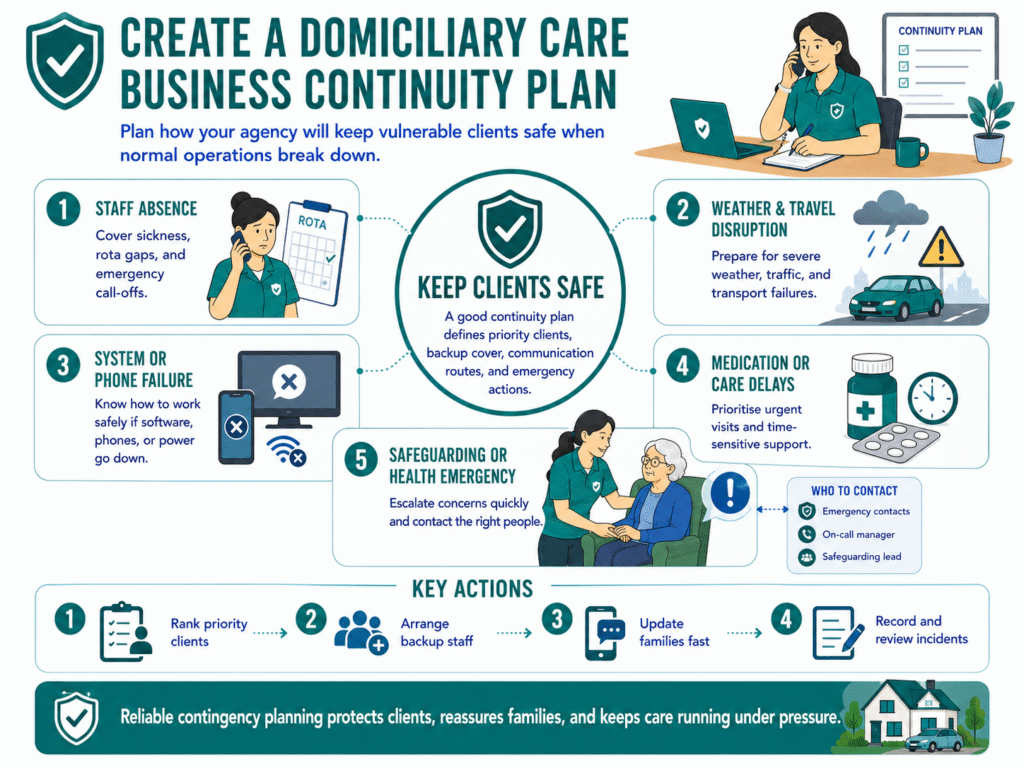
    Create a Domiciliary Care Business Continuity Plan

    Your domiciliary care business continuity plan explains how your agency will keep clients safe when normal operations break down. It is not just a document for a folder. It is the plan your team follows when a carer cannot attend, roads close, systems fail, or a client needs urgent support.

    In home care, small disruptions can quickly become serious. A missed morning visit may mean someone does not receive medication, food, mobility support, or help getting out of bed. Your plan should make it clear who notices the problem, who contacts the client, who arranges cover, and who updates the family.

    Your continuity plan should cover:

    • Carer sickness, absences, and rota gaps
    • Severe weather, traffic disruption, or transport failures
    • Power cuts, phone outages, and care-management software issues
    • Medication delays or missed deliveries
    • Safeguarding concerns and emergency escalation
    • Hospital admissions or sudden changes in care needs
    • Family communication during disruptions
    • Backup staff, on-call cover, and priority client lists

    A good domiciliary care business continuity plan also ranks clients by urgency. For example, clients who need time-sensitive medication, hoisting, insulin support, or essential personal care may need priority cover before lower-risk visits.

    The key question is simple: if the rota collapses at 6am, how will your agency make sure vulnerable clients still receive safe care?

    A strong answer protects clients, reassures families, and shows that your agency can deliver reliable care under pressure.

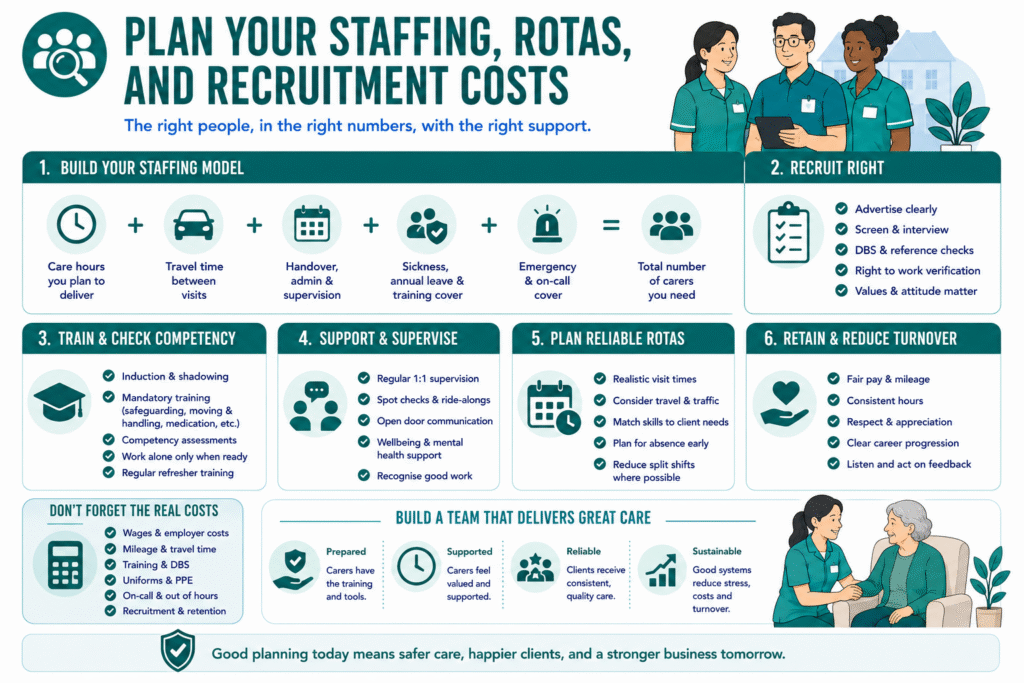
    Plan Your Staffing, Rotas, and Recruitment Costs

    Domiciliary Care Business Plan

    Your first major challenge is not designing a logo or launching a website. It is building a care team that shows up, delivers good care, and stays with your agency.

    A domiciliary care business depends on reliable people. Families notice quickly when carers arrive late, unfamiliar faces appear too often, or visits change without clear communication. Your business plan should show how you will recruit, train, support, and retain carers from day one.

    Start with your staffing model. Work out how many care hours you expect to deliver each week, how many carers you need to cover those hours, and how much time each visit requires. Include travel time, handovers, training, annual leave, sickness, supervision, and emergency cover.

    Your plan should also set out:

    • Your recruitment process, including DBS checks, references, right-to-work checks, and interviews
    • Required training, such as safeguarding, moving and handling, medication, infection prevention, and dementia awareness
    • How you will check competency before carers work alone
    • How supervisors will support carers and review performance
    • How you will manage on-call cover outside office hours
    • How you will reduce missed calls, late visits, and rushed care
    • How you will retain staff through fair pay, mileage support, recognition, and regular communication

    Do not build your rota around perfect attendance. Plan for sickness, emergencies, and turnover from the start.

    A strong agency gives carers enough time to travel, read care notes, and support clients properly. When carers feel rushed or unsupported, quality drops. When carers feel valued and prepared, clients receive more reliable, consistent care.

    SEE ALSO: CQC Mandatory Training for Care Workers: 2026 Update

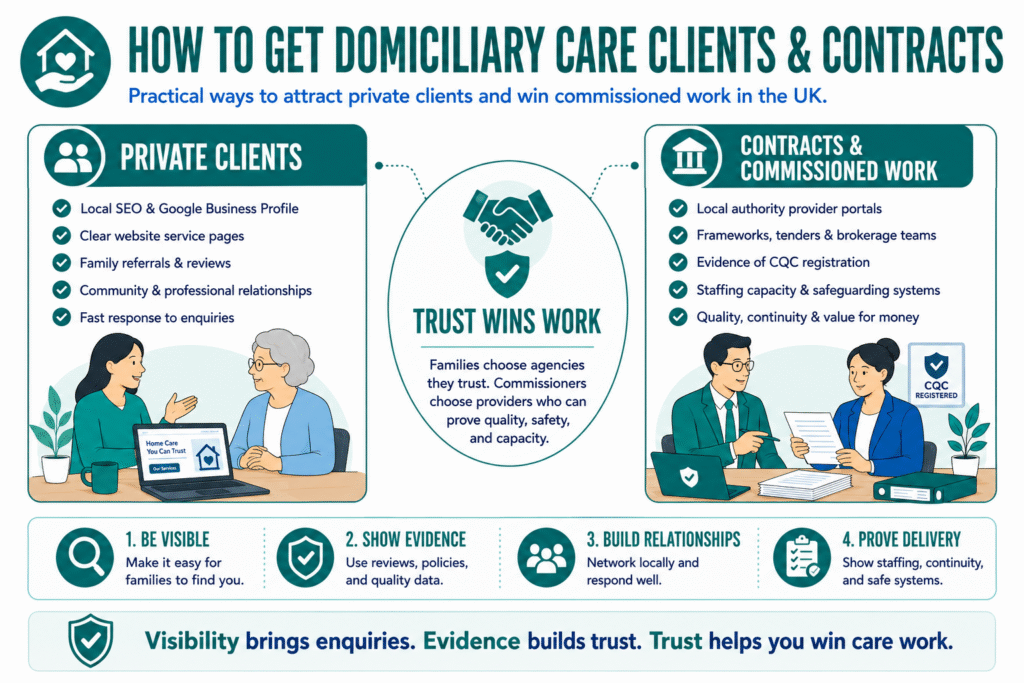
    How to Get Domiciliary Care Clients and Contracts

    A strong service needs clients, but new agencies should not rely on one source of work. Your business plan should explain how you will attract private-pay clients while also preparing for local authority, NHS, or commissioned opportunities where suitable.

    To get domiciliary care clients, start with trust. Families often search online when care becomes urgent, so your website should clearly explain your services, locations, care approach, contact process, and availability. Build local pages for the areas you serve, keep your Google Business Profile accurate, and collect genuine reviews once you begin delivering care.

    You can also build referrals through local relationships. Speak with community groups, hospitals, discharge teams, charities, pharmacies, faith groups, and professionals who support older adults and vulnerable people. Do not approach these relationships as a quick sales route. Show that your agency communicates well, responds reliably, and puts client safety first.

    For private work, focus on the question families ask: “Can I trust this agency to care for my parent properly?” Make it easy for them to find answers about your carers, care plans, continuity, pricing approach, and emergency support.

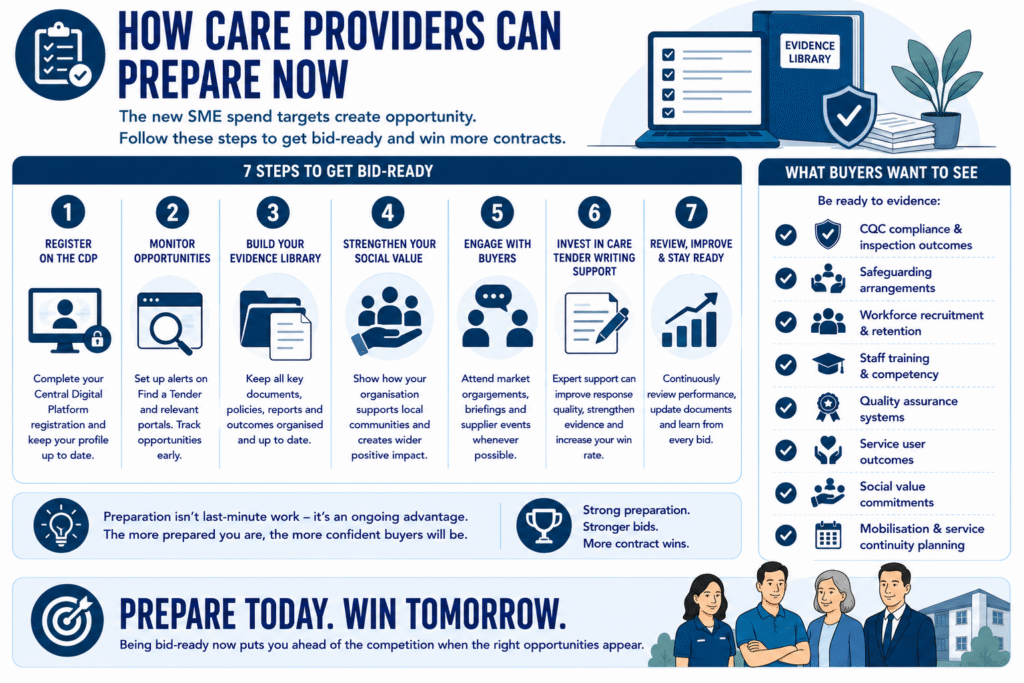
    To get contracts for domiciliary care, monitor local authority provider portals, tender opportunities, framework agreements, and brokerage routes. Commissioners often expect evidence of CQC registration, safeguarding systems, financial stability, staff capacity, quality assurance, and the ability to meet agreed care hours.

    The best answer to how to get home care clients is not simply “run adverts.” Build a visible, credible agency that families recommend and commissioners can trust.

    Build a Financial Plan Before You Launch

    Plan your staffing and recruitment strategy
    Plan your staffing and recruitment strategy

    A domiciliary care agency can look busy and still run out of cash. Your financial plan must show how the business will pay carers, cover overheads, manage delayed payments, and remain stable while client numbers grow.

    Start with your launch costs. Include CQC registration and compliance preparation, insurance, DBS checks, recruitment, training, uniforms, care management software, phones, office costs, marketing, and a payroll buffer. Do not forget mileage, unpaid travel time, employer pension contributions, holiday pay, and on-call cover.

    Then build a monthly forecast around the care hours you expect to deliver. Your plan should show:

    • Your average hourly care rate
    • Carer wages and employment costs
    • Mileage and travel time
    • Management and coordination costs
    • Training and recruitment spending
    • Software, insurance, and office costs
    • Marketing costs
    • The number of weekly care hours needed to break even

    A useful sample business plan for domiciliary care agency does not only show projected income. It shows whether the agency can keep paying staff before client payments arrive.

    For example, a new agency may win several clients quickly, but each new client can increase recruitment pressure, rota costs, management time, and travel expenses. Growth only helps when your pricing covers the real cost of delivering safe care.

    Your domiciliary care business plan example should also explain how you will fund the first few months. You may use personal savings, business loans, investors, grants, or a combination of funding sources. Whatever route you choose, keep enough working capital to protect care delivery while the business builds stable weekly hours.

    MORE: SME Spend Targets: How to Win More Public Contracts in 2026

    Domiciliary Care Agency vs Care Home or Supported Living Business

    A domiciliary care agency supports people in their own homes. Your carers travel to clients, follow individual care plans, and help people stay safe and independent in familiar surroundings.

    A care home works differently. It provides accommodation, meals, staffing, and care in one setting. If you want to know how to open a care home UK, you need to plan for a suitable property, higher staffing levels, premises safety, resident rooms, food provision, and around-the-clock care. That makes it a very different business model from domiciliary care.

    Supported living also differs from both. When people ask how to set up a supported living business UK, they usually mean a service that helps people live more independently in their own tenancy or shared accommodation. The support may include daily living skills, personal care, medication, community access, and help managing a home.

    Your business plan should stay focused on the model you actually want to run. Do not copy a care home plan into a domiciliary care agency application. The staffing, property needs, financial risks, and care delivery methods are different.

    Choose domiciliary care when you want to provide flexible support in people’s homes. Choose a care home or supported living model only when you understand the extra property, staffing, commissioning, and compliance demands that come with it.

    Final Checklist Before You Submit or Launch

    Before you submit your registration documents, approach investors, or accept your first client, check that your domiciliary care business plan answers the practical questions that matter.

    Use this final checklist:

    • Have you defined the care services you will provide?
    • Have you identified your target clients and service area?
    • Do you have a clear care promise that sets you apart?
    • Have you planned safe recruitment, DBS checks, training, supervision, and on-call cover?
    • Do you have care planning, safeguarding, medication, complaints, and incident-reporting systems?
    • Have you created a domiciliary care business continuity plan for staffing gaps and emergencies?
    • Do you know how you will get private clients, referrals, or local authority contracts?
    • Have you calculated your real staffing, travel, training, insurance, and management costs?
    • Do you have enough cash to pay carers while the business grows?
    • Can you show CQC, families, and future partners that your agency can deliver safe, reliable care?

    The strongest home care agencies do not grow by chasing every client or cutting every cost. They grow by building systems that help carers deliver dependable, respectful, person-centred care every day.

    Ready to Build a Stronger Care Business?

    Starting a domiciliary care agency takes more than a good idea. You need clear systems, confident leadership, and a plan that protects both clients and carers.

    Care Sync Experts provides practical guidance to help care providers build safer, stronger, CQC-ready services from day one.

    FAQ

    What is the description of domiciliary care?

    Domiciliary care, also called home care, provides support to people in their own homes. It can include personal care, medication support, meal preparation, companionship, mobility assistance, dementia care, respite care, and help with daily routines. The aim is to help people live safely and independently at home for as long as possible.

    How do I write a business plan sample?

    Start with a simple structure: executive summary, business description, services, target market, competitor research, marketing plan, staffing plan, operations, financial forecast, and risk management. A good sample business plan uses real numbers, clear responsibilities, and practical actions rather than vague promises.

    What are the 10 duties of a caregiver?

    A caregiver’s duties can include:
    – Supporting personal care
    – Preparing meals and encouraging hydration
    – Helping with mobility and transfers
    – Providing companionship
    – Supporting medication routines where agreed
    – Keeping the home environment safe
    – Following the person’s care plan
    – Recording changes in health or behaviour
    – Communicating with families and care managers
    – Protecting dignity, privacy, and independence

    What are the top 3 qualities of a caregiver?

    The three most important qualities are:
    Compassion: treating people with patience, kindness, and respect.
    Reliability: arriving on time, following the care plan, and doing what you say you will do.
    Communication: listening carefully, explaining support clearly, and reporting changes quickly.

  • How Long Does CQC Registration Take? 2026 Update

    How Long Does CQC Registration Take? 2026 Update

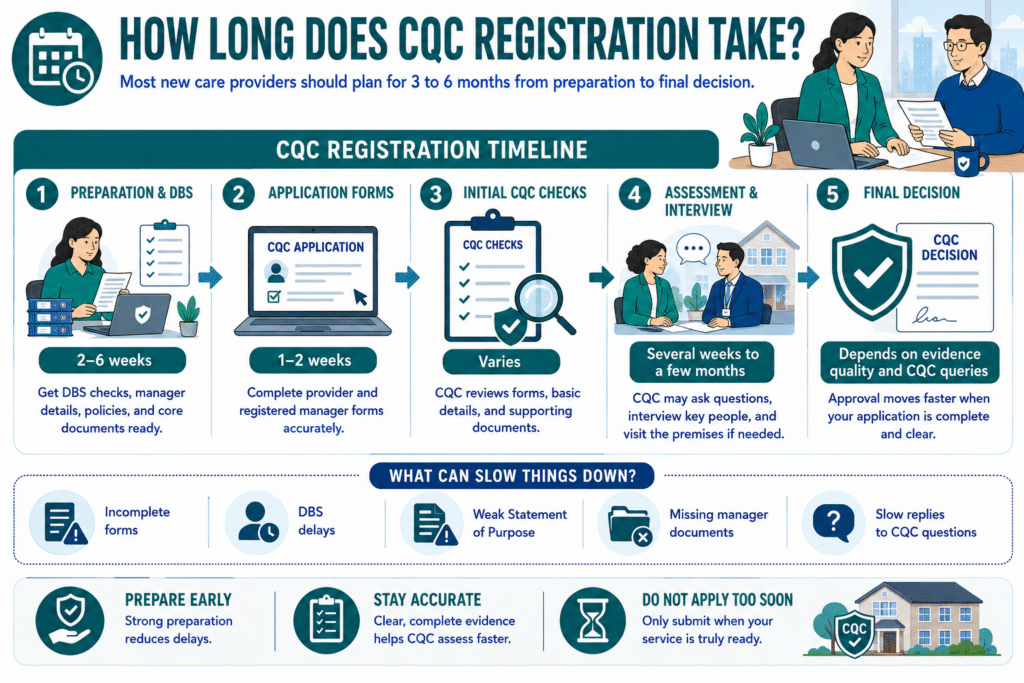
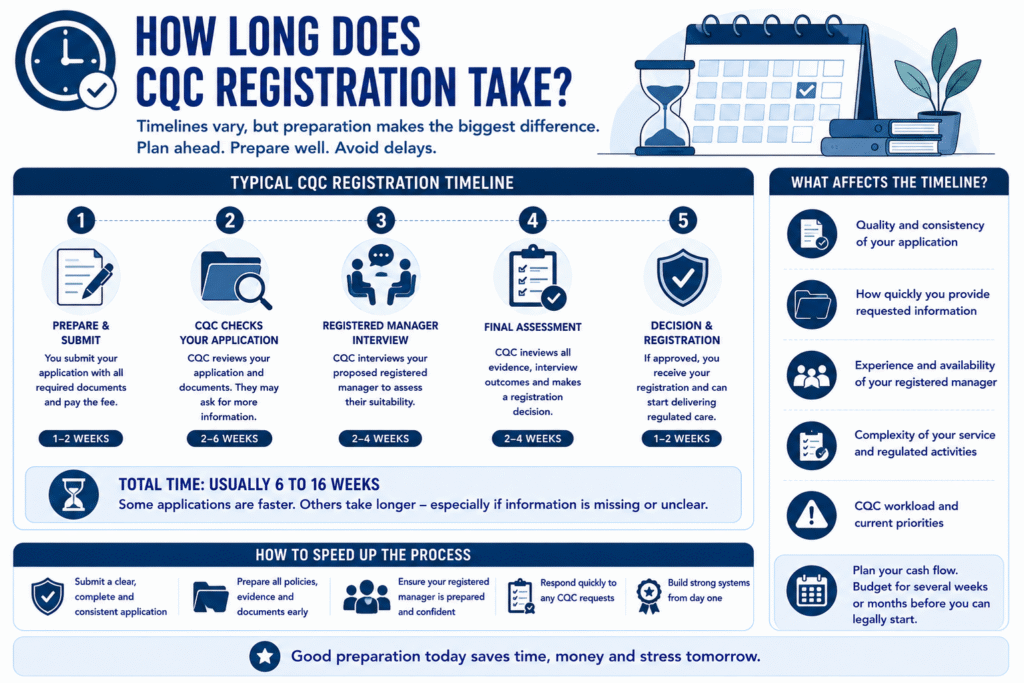
    CQC registration can take a few months, but most new care providers should plan for 3 to 6 months from preparation to final decision.

    The exact timeline depends on how ready your service is before you apply, how complete your documents are, whether your DBS checks come back quickly, and how well your proposed registered manager can evidence their competence.

    Many new providers focus only on the application date, but the real process starts much earlier. You need your regulated activity, Statement of Purpose, policies, staffing plan, registered manager details, DBS checks, premises or office setup, and supporting evidence in place before you submit.

    CQC does not treat registration as a simple form-filling exercise. It checks whether your service can provide safe, effective, caring, responsive, and well-led care from day one.

    So, how long does CQC registration take? A well-prepared provider may move faster, but a rushed or incomplete application can easily stretch beyond 6 months. The safest approach is simple: prepare properly before you apply, then respond quickly when CQC asks for more information.

    Get expert support for your next tender, inspection-ready policies, or CQC registration — book a call with Care Sync Experts today and let’s get you compliant and competitive.

    CQC Registration Timeline: What Usually Happens

    How to Register a Care Agency in Northern Ireland 2026 (Step by Step)

    The CQC registration timeline starts before you submit the form. If you prepare properly, you reduce questions, delays, and the risk of rejection.

    Here is a realistic timeline for most new care providers:

    StageTypical timeframe
    Preparation, DBS and manager readiness2–6 weeks
    Application forms and documents1–2 weeks
    Initial CQC checksVaries
    Assessment, interview and possible site visitSeveral weeks to a few months
    Final decisionDepends on evidence quality and CQC queries

    The fastest providers do not rush the application. They prepare the evidence first. They check their regulated activity, complete the right forms, organise their policies, prepare the registered manager, and make sure the service can operate safely from day one.

    The slowest providers usually submit too early. They miss documents, choose the wrong regulated activity, give weak answers, or fail to show how the service will meet CQC registration requirements.

    A strong application tells CQC one clear thing: this provider understands care, risk, leadership, staffing, safeguarding, and compliance before the first person receives support.

    RELATED: How Much Does CQC Registration Cost in 2026?

    What CQC Checks Before It Registers a Care Provider

    CQC checks whether your care business can deliver safe, effective, caring, responsive, and well-led services from day one. These are often called the 5 CQC standards, and they shape how CQC looks at your application, your evidence, and your leadership.

    Your application must show that you understand the regulated activity you want to provide. For example, a domiciliary care agency that provides personal care must show how it will protect people in their own homes, manage risks, train staff, handle complaints, and monitor care quality.

    CQC will usually look at your:

    • Statement of Purpose
    • Registered manager arrangements
    • Safeguarding systems
    • Recruitment and staff training plans
    • Policies and procedures
    • Medication and risk management processes
    • Complaints procedure
    • Governance and quality monitoring
    • Financial viability
    • Office or premises setup, where relevant

    This is where CQC compliance begins. You do not wait until after registration to think about quality and safety. You build the systems first, then use your application to prove that your service can run properly.

    Documents Required for CQC Registration

    How Long Does CQC Registration Take

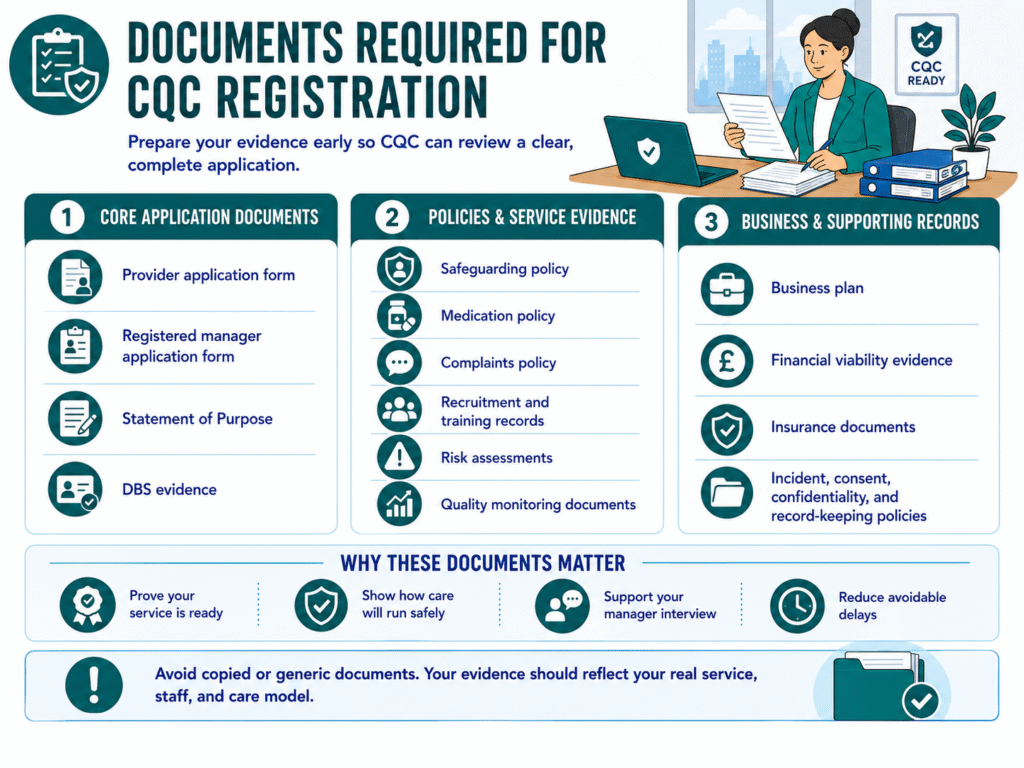
    CQC will not move a weak or incomplete application forward, so you need to prepare your evidence before you apply. The exact documents required for CQC registration depend on your service type, regulated activity, business structure, and locations, but most new care providers should prepare the core documents early.

    You may need:

    • Provider application form
    • CQC application form for registered manager, if required
    • Statement of Purpose
    • DBS evidence
    • Safeguarding policy
    • Medication policy
    • Complaints policy
    • Recruitment and staff training records
    • Business plan
    • Financial viability evidence
    • Insurance documents
    • Risk assessment and quality monitoring documents
    • Policies for incidents, consent, mental capacity, confidentiality, and record keeping

    Do not treat these documents as paperwork for CQC only. They should explain how your care business will actually operate. Your policies should match your service, your staff, your clients, and the type of care you plan to provide.

    Copied or generic documents can create problems. CQC wants to see that you understand your own service and can manage real risks from day one.

    READ MORE: CQC Mandatory Training for Care Workers: 2026 Update

    How to Apply for CQC Registration Without Delays

    If you want to know how to apply for CQC registration, start by checking whether your service needs to register and which regulated activity applies. A homecare agency that provides personal care, for example, must register for the correct activity before it starts delivering regulated care.

    Follow these steps before you submit:

    1. Confirm that your service needs CQC registration.
    2. Choose the correct regulated activity.
    3. Prepare your Statement of Purpose.
    4. Complete the provider application form.
    5. Submit the registered manager application form, if required.
    6. Organise your policies, DBS evidence, staffing plans, and governance documents.
    7. Prepare for your interview and possible site visit.
    8. Respond quickly if CQC asks for more information.

    Do not apply just because you want the process to start. Apply when your service can prove it is ready.

    If you need to contact CQC during the process, use the official website for the latest CQC registration contact number or enquiry route. Avoid relying on old numbers from third-party websites because contact details can change.

    What Qualifications Do I Need to Be a CQC Registered Manager?

    Many new providers ask, what qualifications do I need to be a CQC registered manager? The answer is not just about certificates. CQC wants to see that the proposed manager has the right experience, skills, knowledge, and character to run the regulated activity safely.

    A strong registered manager should understand safeguarding, risk management, recruitment, staff supervision, medication procedures, complaints, care planning, audits, and person-centred care. They must also show leadership. CQC needs confidence that the manager can make safe decisions, challenge poor practice, and keep the service compliant after registration.

    Relevant care qualifications can help, especially management qualifications in health and social care, but experience matters just as much. A manager who understands the service, the people receiving care, and the regulations will usually perform better than someone who only prepares answers for the interview.

    Your CQC application form for registered manager should therefore do more than list job titles. It should show how the manager will lead the service, manage quality, support staff, protect people, and respond when something goes wrong.

    SEE ALSO: SME Spend Targets: How to Win More Public Contracts in 2026

    How Much Does CQC Registration Cost?

    Documents required for CQC registration
    Documents required for CQC registration

    Many new providers ask, how much does CQC registration cost before they apply. The answer depends on your service type, size, and registration details. CQC charges registered providers annual fees, and those fees cover registration, changes to registration, monitoring, inspection, and rating work.

    For adult social care, the fee is not the same for every provider. A care home fee usually depends on the number of people the service can accommodate, while community social care fees are calculated using the number of people supported with regulated activities. CQC sends an invoice with the exact fee before payment becomes due.

    So, how much is CQC registration for a new care business? Do not guess from another provider’s invoice. A small domiciliary care agency, large care home, supported living provider, and nurse agency may all pay different fees.

    When you prepare your budget, include CQC fees alongside DBS checks, insurance, policies, recruitment, training, office setup, systems, and professional support. Registration costs money, but poor preparation usually costs more because it delays approval and pushes back the date you can legally start delivering regulated care.

    What Causes CQC Registration Delays?

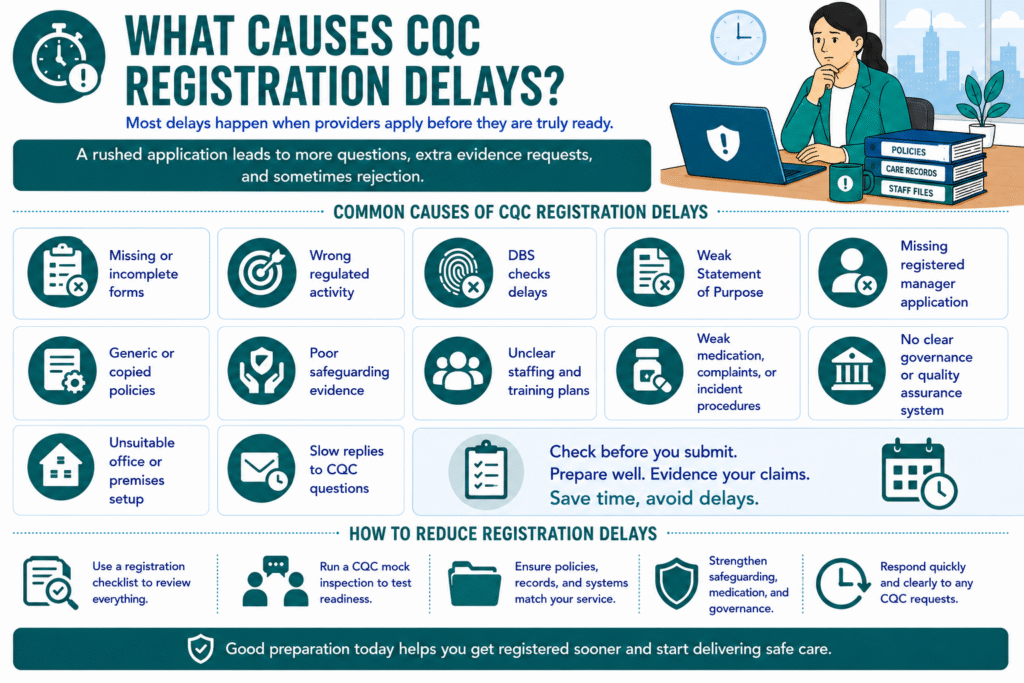
    Most CQC registration delays happen when providers apply before they are truly ready. A rushed application can create extra questions, evidence requests, and sometimes rejection.

    Common delays include:

    • Missing or incomplete forms
    • Wrong regulated activity
    • DBS delays
    • Weak Statement of Purpose
    • Missing registered manager application
    • Generic or copied policies
    • Poor safeguarding evidence
    • Unclear staffing and training plans
    • Weak medication, complaints, or incident procedures
    • No clear governance or quality assurance system
    • Unsuitable office or premises setup
    • Slow replies to CQC questions

    A CQC registration check before submission can help you spot these issues early. Many providers also use a CQC mock inspection to test whether their documents, staff knowledge, care records, policies, and governance systems match what they promised in the application.

    A mock inspection does not guarantee approval, but it can show where your service looks weak before CQC asks the same questions.

    MORE: What Is a Tender in Health and Social Care? 2026 Update

    How Often Does CQC Inspect After Registration?

    What causes CQC registration delays?
    What causes CQC registration delays?

    New providers often ask, how often does CQC inspect once registration comes through. CQC no longer works only around a fixed inspection timetable. It uses a more flexible assessment approach, and the timing depends on the information it receives, the evidence it collects, and whether any concerns arise. CQC says assessments may be planned or responsive.

    For newly registered services, CQC will usually assess all quality statements within 12 months before it publishes a rating.

    This means registration does not mark the end of compliance. It marks the start. A new care provider should keep policies, audits, staff training, care records, complaints, incidents, risk assessments, and quality checks ready from day one.

    So, how often are CQC inspections? The answer depends on risk, evidence, performance, and the type of service. The safest mindset is to run your service as if CQC could ask for evidence at any time.

    Final Thought…

    Do not treat CQC registration as a form-filling task. Treat it as your first serious test of whether your care business can operate safely, legally, and consistently.

    If you want to reduce delays, prepare before you apply. Check your regulated activity, organise your documents, train your proposed registered manager, review your policies, and make sure your evidence matches the service you plan to run.

    The question is not only how long does CQC registration take. The better question is: how ready are you to prove that your service can deliver safe, effective, caring, responsive, and well-led care?

    A strong application gives CQC confidence. A weak one creates doubt. If you prepare properly, answer clearly, and build compliance into the business from day one, you give your care service the best chance of moving through registration without unnecessary setbacks.

    Give me a better cta than the following for this article. Nothing longer: Preparing for CQC registration? Care Sync Experts can help you strengthen your application, prepare for your interview, and avoid the costly mistakes that delay approval.

    Preparing for CQC registration? Care Sync Experts helps new care providers build stronger applications, prepare confidently for interviews, and avoid the common mistakes that slow down approval.

    FAQ

    What questions does CQC ask?

    CQC questions usually test whether your service can prove safe, effective, caring, responsive and well-led care. Inspectors may ask how you assess risks, safeguard people from abuse, manage medicines, make sure staff have the right skills, respect dignity, and learn from incidents.

    For adult social care, CQC’s own monitoring questions include examples such as how risks are assessed, how staff report concerns, how medicines are managed safely, and how people receive timely care that respects their dignity.

    What are the 34 quality statements in CQC?

    The 34 CQC quality statements sit under the 5 key questions: safe, effective, caring, responsive and well-led. They describe the commitments providers should meet to deliver high-quality, person-centred care.

    Examples include learning culture, safeguarding, safe systems, involving people to manage risks, and safe environments under the “safe” key question.

    How long does Social Work England registration take?

    For UK-qualified applicants, Social Work England says you must receive your registration number before you start work as a social worker in England.

    The application can take longer if you do not provide the required documents, such as ID, qualification evidence, English language evidence where needed, employment details, and declarations about health or convictions. Social Work England warns that missing documents at the online application stage will delay assessment.

    How much does it cost to register with Social Work England?

    For initial registration in the 2026 to 2027 registration year, Social Work England lists fees by application date: £122 from 1 December 2026 to 28 February 2027, £91.50 from 1 March to 31 May 2027, £61 from 1 June to 31 August 2027, and £30.50 from 1 September to 30 November 2027. The annual renewal fee for 2026 to 2027 is £122.

  • CQC Mandatory Training for Care Workers: 2026 Update

    CQC Mandatory Training for Care Workers: 2026 Update

    CQC mandatory training for care workers is not one fixed list of courses that every provider must copy. CQC expects care providers to make sure staff have the right training, skills, competence, and experience to support people safely.

    Under Regulation 18, providers must deploy enough suitably qualified, competent, skilled, and experienced staff to meet people’s needs.

    For a care business, that means training must match the service you deliver. A domiciliary care worker who supports people at home may need safeguarding, moving and handling, infection prevention, fire safety, basic life support, medication awareness, Mental Capacity Act training, equality and diversity, and learning disability and autism training where relevant.

    But certificates alone will not protect your service during inspection. CQC wants to see that your team can apply training in real care situations. A care worker should know how to spot a safeguarding concern, move someone safely, follow a medication prompt procedure, reduce infection risks, and report changes before harm happens.

    At Care Sync Experts, we help care providers approach training as part of a wider compliance system, not a tick-box exercise. The goal is simple: train staff properly, evidence competence clearly, and build a team that delivers safe, confident, person-centred care every day.

    Get expert support for your next tender, inspection-ready policies, or CQC registration — book a call with Care Sync Experts today and let’s get you compliant and competitive.

    What Is the Care Quality Commission?

    CQC Registered Manager Training Evidence: What You Need (2026)

    The Care Quality Commission, also known as CQC, regulates health and adult social care services in England. It checks whether care providers deliver support that is safe, effective, caring, responsive, and well-led. These are often called the 5 CQC standards, although CQC describes them as five key questions used to assess quality.

    For a care business, CQC does more than inspect paperwork. It looks at how your service protects people, manages risks, trains staff, responds to concerns, and improves care. That means your training programme must connect directly to the care your workers provide every day.

    People sometimes search “what are CQC” or “what is the quality care commission,” but the correct name is Care Quality Commission. Its role is to make sure registered care services meet legal standards and give people safe, high-quality care.

    For providers, this matters because weak staff training can quickly affect safety, safeguarding, medication, infection control, moving and handling, and the overall quality of care.

    RELATED: How Much Does CQC Registration Cost in 2026?

    Does CQC Have a Fixed List of Mandatory Training for Care Workers?

    CQC Mandatory Training for Care Workers

    CQC does not give care providers one fixed list of mandatory training for care workers to copy and follow. Instead, CQC expects each provider to choose training based on the service they run, the roles staff perform, and the needs of the people they support.

    That means your CQC mandatory training requirements should reflect real care delivery. A domiciliary care agency may need strong training in safeguarding, moving and handling, medication support, infection prevention, lone working, dementia awareness, and emergency response. A supported living service, care home, or complex care provider may need additional specialist training.

    The same principle applies to the list of mandatory training for support workers. You should not train staff only because a course appears on a generic checklist. You should train them because the topic links to a real responsibility, real risk, or real person receiving care.

    This is where many providers get caught out. They collect certificates but fail to prove competence. During inspection, CQC may ask how you know a worker can apply the training safely during care visits.

    A stronger approach is to build your training around three questions:

    • What does this worker need to do?
    • What risks could they face?
    • What evidence proves they can do it safely?

    That is the difference between training that looks good on paper and training that protects your service.

    Core CQC Training Courses Most Care Providers Need

    Most care providers build their CQC training courses around the risks staff face in real care work. The exact mix depends on your service, but a strong training programme usually covers:

    • Safeguarding adults and children
    • Moving and handling
    • Infection prevention and control
    • Health and safety
    • Fire safety
    • Basic life support
    • Medication awareness or medication administration
    • Mental Capacity Act and DoLS
    • Equality, diversity, and human rights
    • Food hygiene, where staff prepare or handle meals
    • Dementia awareness, where staff support people living with dementia
    • Learning disability and autism training

    The Oliver McGowan Mandatory Training now deserves special attention. CQC explains that registered providers must make sure staff receive learning disability and autism training that matches their role, and the Oliver McGowan Code of Practice started on 6 September 2025. (Care Quality Commission)

    Some providers search for free CQC training or CQC courses online to reduce costs. Online learning can help with knowledge, but it should not replace practical checks where staff perform high-risk tasks. A care worker may complete medication training online, but the provider still needs to check whether that worker can follow the medication policy correctly during real care delivery.

    We recommend building training around your service risks, your staff roles, and the people you support. The best training plan does not simply ask, “Has this worker passed a course?” It asks, “Can this worker deliver safe, confident, person-centred care today?”

    READ MORE: SME Spend Targets: How to Win More Public Contracts in 2026

    What Is the Care Certificate?

    The Care Certificate gives new care workers a strong foundation before they support people on their own. It sets out the knowledge, skills, and behaviours that health and social care workers should show in daily practice. Skills for Care explains that the Care Certificate standards define what specific care roles need to know and do, especially during induction for people who are new to care. (Skills for Care)

    For a care business, the Care Certificate should not become a paperwork exercise. It should help new starters understand their role, duty of care, safeguarding, communication, privacy and dignity, infection prevention, mental health, dementia, learning disability, health and safety, and person-centred support.

    People often ask what is a care certificate, how to get care certificate, or how do I get a Care Certificate. In practice, the employer usually supports the worker through training, workplace assessment, observation, and sign-off. A certificate should only mean something when the worker can show the right knowledge and safe practice.

    The Care Certificate helps with induction, but it does not replace your wider CQC mandatory training for care workers. Providers still need role-specific training, refresher planning, supervision, and competency checks that match the people they support.

    CQC Training Requirements for Domiciliary Care

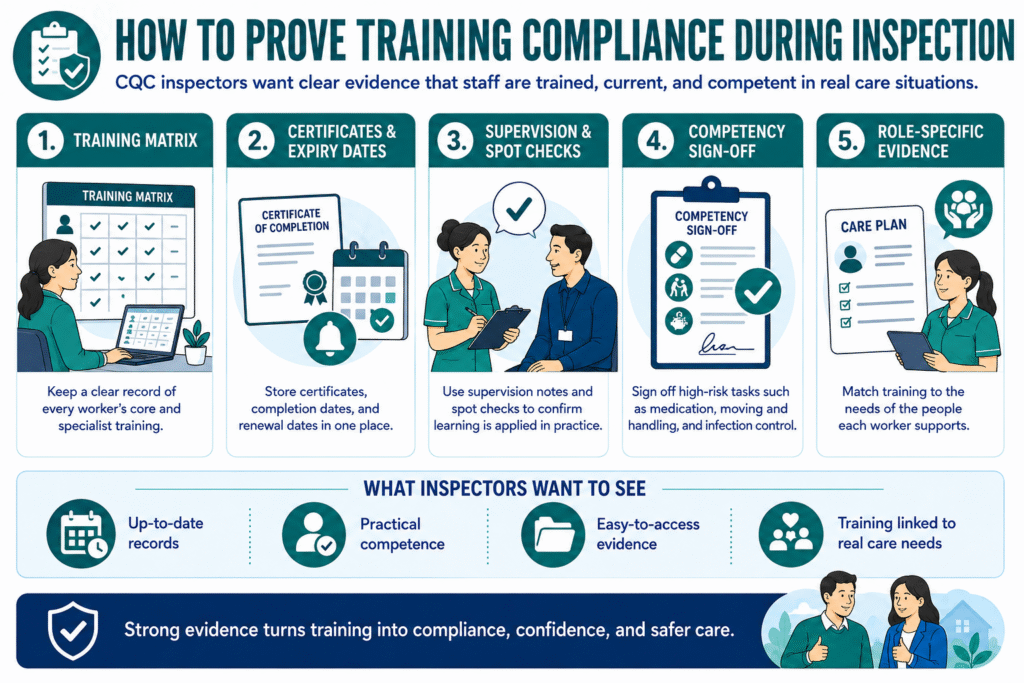
    How to prove training compliance
    How to prove training compliance

    CQC training requirements for domiciliary care must reflect the reality of working inside people’s homes. Care workers often work alone, make quick decisions, notice changes before anyone else, and support people with personal care, medication prompts, meals, mobility, dementia, safeguarding concerns, and emergency situations.

    That means a domiciliary care provider needs more than a generic training folder. Your staff should understand how to enter someone’s home respectfully, protect privacy, follow the care plan, record concerns, manage infection risks, and escalate changes quickly.

    A care worker may be the first person to notice that someone has stopped eating, fallen overnight, missed medication, become more confused, or lost confidence with personal care. Training should prepare staff to act early, not wait until a small concern becomes a serious incident.

    For Care Sync Experts, strong domiciliary care training should cover three things:

    • The worker’s role and daily responsibilities
    • The risks linked to the people they support
    • The evidence that proves they can work safely and confidently

    This is why CQC mandatory training for care workers should always connect to real care visits. A certificate shows that learning happened. Competency checks, supervision, observations, and accurate records show that the worker can apply that learning where it matters most: in the person’s home.

    SEE ALSO: What Is a Tender in Health and Social Care? 2026 Update

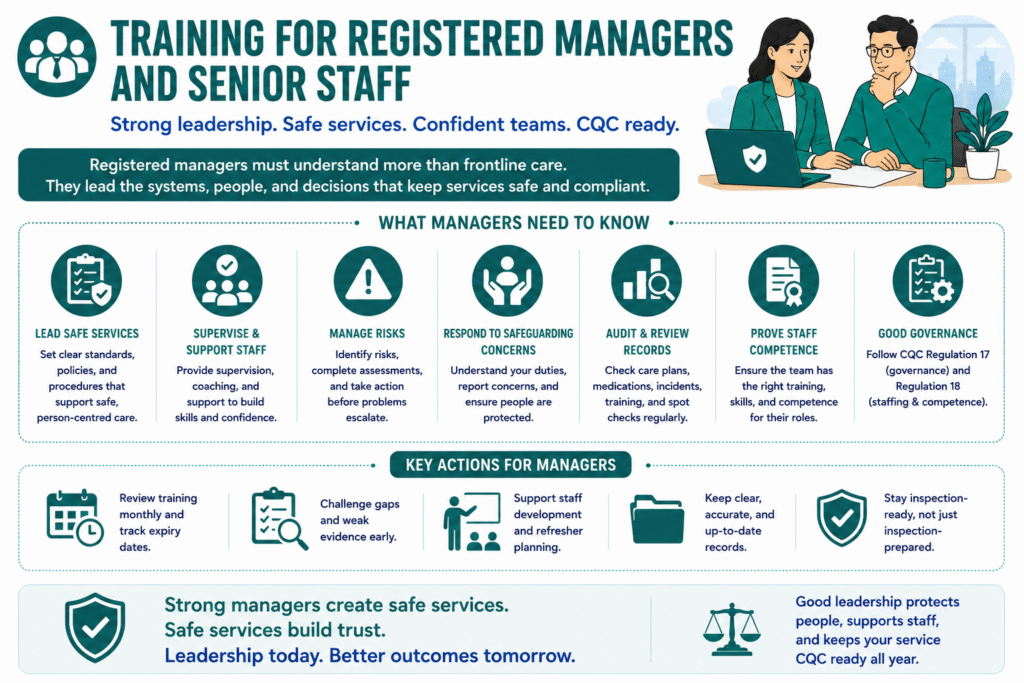
    Training for Registered Managers and Senior Staff

    CQC training for registered managers should go beyond frontline care topics. A registered manager must know how to lead safe services, supervise staff, manage risk, respond to safeguarding concerns, audit records, investigate incidents, and prove that the team has the right skills for the people they support.

    Senior staff also need strong knowledge of governance. They should understand how training links to care plans, risk assessments, complaints, medication audits, spot checks, and staff supervision. If a care worker makes a mistake, managers should be able to show what training the worker received, when they received it, how the service checked competence, and what action followed.

    Many people ask how many CQC regulations are there, but care providers should focus less on memorising numbers and more on applying the regulations that affect daily care. Regulation 18 covers staffing and staff competence, while Regulation 17 covers good governance, systems, and processes. Together, they show why training records, competency checks, and management oversight matter.

    For Care Sync Experts, strong managers do not wait for CQC to find gaps. They review training monthly, challenge weak evidence, support staff early, and keep the service inspection-ready all year.

    How to Prove Training Compliance During Inspection

    Training for managers and senior staff
    Training for managers and senior staff

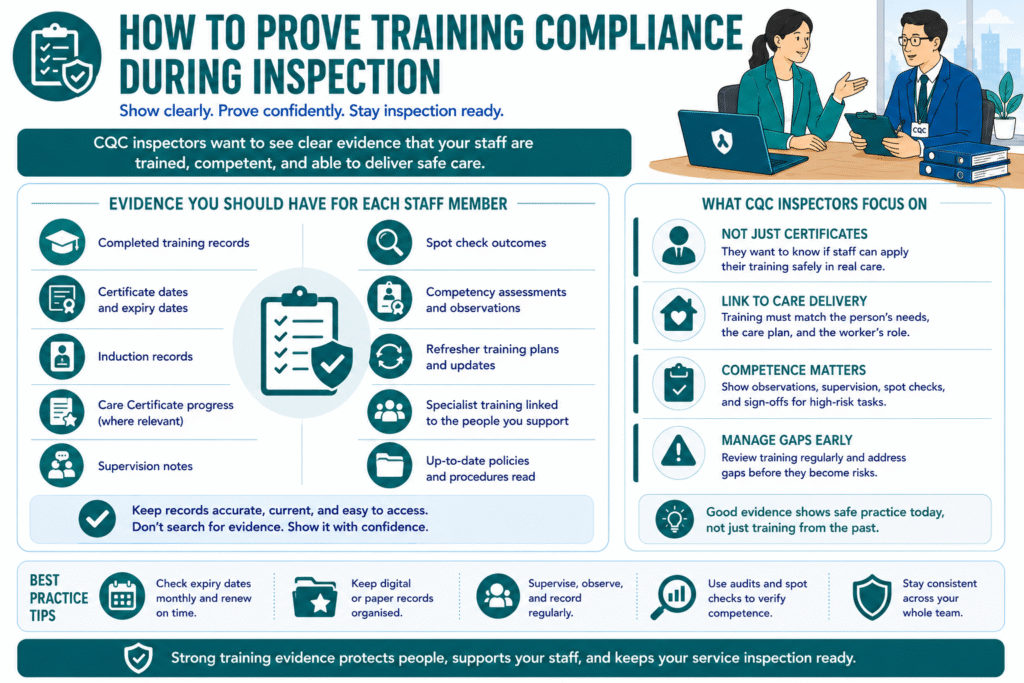
    CQC inspectors do not only want to see a folder full of certificates. They want to know whether your staff can use their training safely in real care situations.

    A strong provider should be able to show clear evidence for each worker, including:

    • Completed training records
    • Certificate dates and expiry dates
    • Induction records
    • Care Certificate progress where relevant
    • Supervision notes
    • Spot check outcomes
    • Competency assessments
    • Refresher training plans
    • Specialist training linked to the people they support

    For example, if a care worker supports medication, your records should show more than a medication course. They should also show that the worker understands your medication policy, follows the care plan, records correctly, reports errors, and has been observed as competent.

    The same applies to moving and handling, infection control, safeguarding, dementia care, catheter care, or any higher-risk task. Training should link directly to the person’s needs and the worker’s responsibilities.

    We encourage providers to treat training evidence as a live compliance system. Review gaps monthly, update records before certificates expire, and keep proof easy to access. When CQC asks for evidence, you should not need to search through old emails, loose papers, or outdated spreadsheets.

    MORE: CQC Nominated Individual vs Registered Manager (2026): What You Need to Know?

    Final Compliance Checklist for Care Providers

    Before inspection, every provider should check whether their training system can prove safe practice, not just course completion. Strong CQC-mandated training for care workers should demonstrate that staff understand their duties, manage risks effectively, and support people with confidence.

    Use this checklist:

    • Every worker has training that matches their role
    • New starters have started or completed the Care Certificate where appropriate
    • Staff refresh key training before it expires
    • Managers record supervision, spot checks, and observations
    • High-risk tasks have practical competency sign-off
    • Training links clearly to the needs of people using the service
    • Records are accurate, current, and easy to access
    • Managers review gaps regularly instead of waiting for inspection

    Care providers should also review safeguarding knowledge often. Adult safeguarding in England follows six key principles: empowerment, prevention, proportionality, protection, partnership, and accountability.

    The strongest providers do not treat training as a yearly admin task. They use it to protect people, support care workers, reduce risk, and prove that the service can deliver safe, person-centred care every day. At Care Sync Experts, that is the standard we believe every care business should aim for.

    FAQ

    What are the 4 types of caregivers?

    The four common types of caregivers are family caregivers, professional caregivers, volunteer caregivers, and informal caregivers. A family caregiver may support a parent, spouse, child, or relative without being paid. A professional caregiver, such as a care worker or support worker, provides care as part of a paid role.

    Volunteer caregivers support through charities or community groups, while informal caregivers may include friends, neighbours, or trusted people who help regularly.

    What is the difference between a carer and a care worker?

    A carer can be anyone who supports another person with daily living, health needs, emotional support, or personal care. This may include a family member or friend. A care worker usually means someone employed by a care provider to deliver professional support. Care workers often follow care plans, record visits, report concerns, and complete role-specific training as part of their job.

    What skills do I need to be a good carer?

    A good carer needs patience, kindness, communication skills, observation, reliability, respect, and confidence in following care plans. Strong carers notice small changes, protect dignity, listen carefully, and know when to report concerns.

    Practical skills also matter, especially when supporting personal care, mobility, medication prompts, dementia care, safeguarding, or end-of-life support.

    What is another word for mandatory training?

    Another word for mandatory training is compulsory training. In care, people may also call it statutory training, required training, essential training, or core training. The best term depends on the subject. For example, some training is required by law, some is required by the employer, and some is needed because the worker’s role carries specific risks.

  • How Much Does CQC Registration Cost in 2026?

    How Much Does CQC Registration Cost in 2026?

    CQC registration does not have one simple total cost. The amount you need depends on your service type, your regulated activities, your business size, and how prepared you are before you apply.

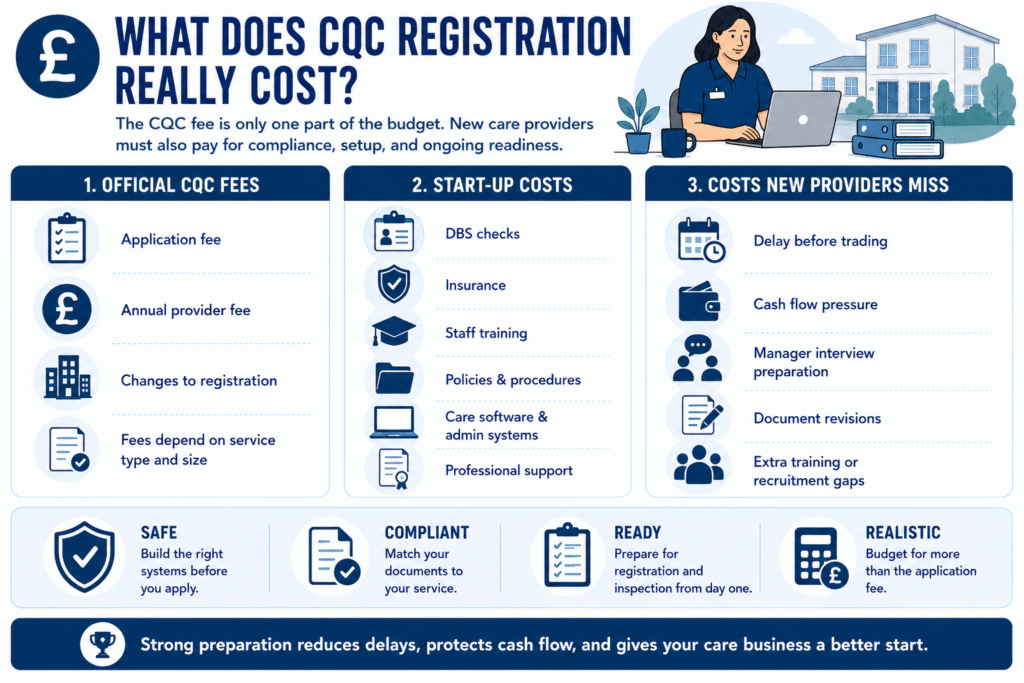
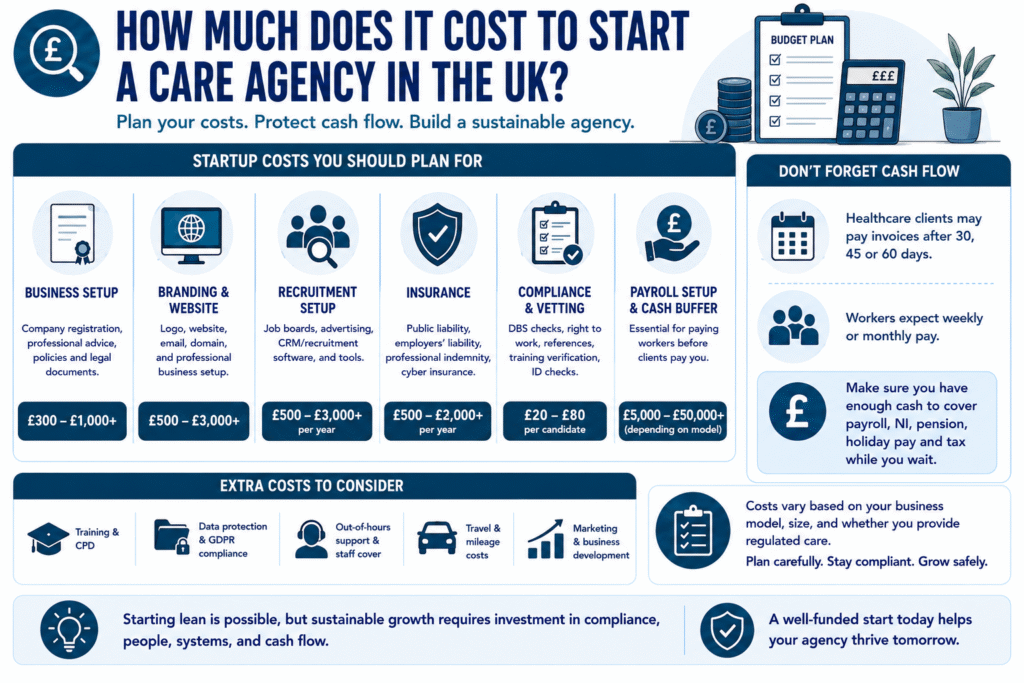
    So, how much does CQC registration cost? New providers must budget for more than the official CQC fee. You also need to plan for DBS checks, insurance, staff training, policies and procedures, business systems, registered manager preparation, and possible professional support.

    For a new care provider, especially a domiciliary care startup, the real question is not only “how much is CQC registration?” The better question is: “How much do I need to become safe, compliant, and ready to trade?”

    A care business cannot rely on registration alone. CQC wants to see that you can run a safe, well-led service from day one. That means your documents, staff checks, training plans, safeguarding systems, complaints process, medicines policy, and quality monitoring must all make sense before you submit your CQC registration application.

    Get expert support for your next tender, inspection-ready policies, or CQC registration — book a call with Care Sync Experts today and let’s get you compliant and competitive.

    What Is CQC Registration?

    CQC Interview Preparation That Actually Works | 2,300+ Questions | 98% Pass Rate

    CQC registration gives a health or social care provider legal permission to carry out regulated activities in England. CQC stands for Care Quality Commission, not “Quality Care Commission.” It regulates services to make sure people receive safe, effective, compassionate, and well-led care.

    For a new care business, registration proves that you have the right systems, people, documents, and leadership in place before you start delivering regulated care. It shows that you understand your responsibilities and can protect the people who will use your service.

    In simple terms, what is CQC registration? It is the approval process that checks whether your service can legally provide regulated care.

    Many new providers ask, what are CQC? The CQC is the independent regulator for health and adult social care services in England. If you plan to deliver personal care, nursing care, or certain health-related treatments, you must check whether your service needs registration before you take on clients.

    For a caregiver business, this step matters because trust starts before the first care visit. Your policies, recruitment process, safeguarding approach, training plan, and quality checks all show whether your service can operate safely from day one.

    RELATED: Latest CQC Reports, Regulated Activities (2026)

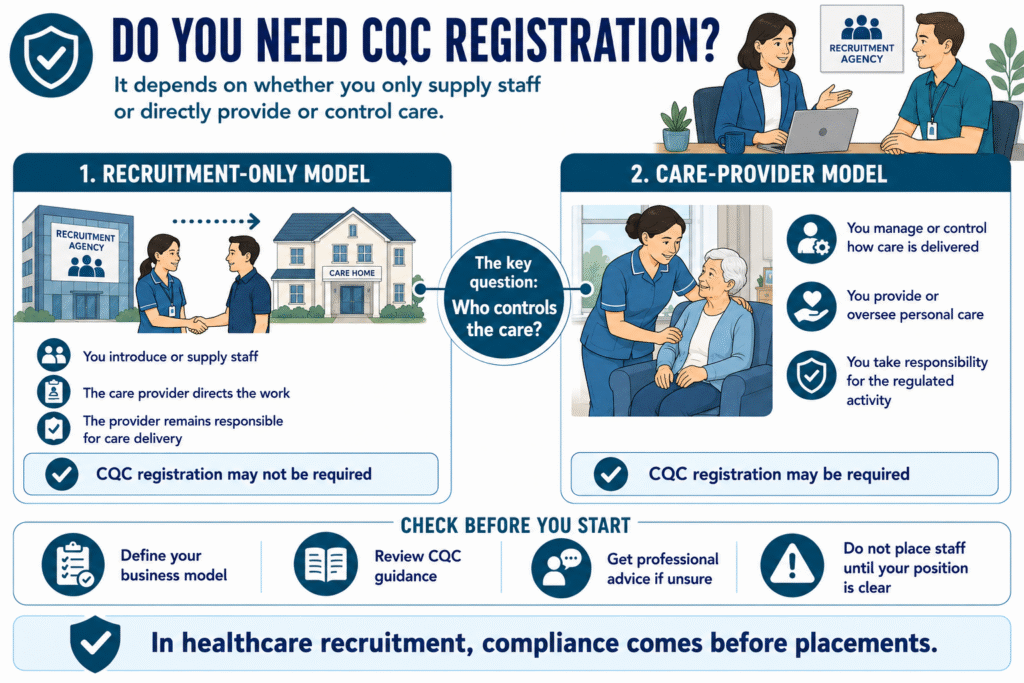
    Do I Need to Register with CQC?

    CQC registration timeline and tips
    CQC registration timeline and tips

    You need to register with CQC if your business will provide a regulated activity in England. For care providers, this often includes personal care, such as helping people with washing, dressing, toileting, eating, drinking, or managing daily personal routines.

    For example, if you plan to start a home care agency and your carers will support people with personal care in their own homes, you will usually need CQC domiciliary care registration before you can legally provide that service.

    Many new providers ask, do I need to register with CQC if I only offer companionship, cleaning, shopping, or meal preparation. These services may not always require registration on their own, but the moment your service crosses into regulated personal care, you must take CQC requirements seriously.

    The same applies to CQC registration for aesthetics. Some beauty or aesthetics services may not need registration, but treatments that involve regulated healthcare activities, surgical procedures, or certain clinical treatments may fall under CQC regulation.

    Before you trade, confirm exactly what services you will provide. It is much safer to check early than to build a business model that later turns out to need registration.

    CQC Registration Fees vs Real Start-Up Costs

    The official CQC fee forms only one part of your start-up budget. CQC fees cover registration, changes to registration, and CQC’s work around monitoring, inspection, and rating. Your annual fee depends on the type of service you provide and the scale of that service. (Care Quality Commission)

    That means a new care provider should separate CQC registration fees from the wider cost of becoming ready to operate.

    Cost areaWhat it usually covers
    CQC feesRegistration, annual provider fees, changes to registration, monitoring, inspection, and rating
    DBS checksChecks for directors, registered manager, and relevant care staff
    InsurancePublic liability, employers’ liability, professional indemnity, and care-specific cover
    Staff trainingSafeguarding, medication, moving and handling, infection control, first aid, and care standards
    Policies and proceduresSafeguarding, complaints, medicines, recruitment, governance, risk, and quality assurance
    Business systemsCare planning software, secure records, phone line, email, HR files, and data protection
    Professional supportApplication review, mock interview, compliance preparation, and business setup guidance

    For CQC domiciliary care registration, the biggest mistake is budgeting only for the fee and ignoring the systems behind safe care. CQC will look at whether you understand how to recruit safely, train staff, manage risks, handle complaints, protect people from abuse, and monitor care quality.

    Some providers search for a CQC registration fees calculator, but you should treat any estimate as a guide only. CQC says it uses the service types you select to calculate your annual fee, and registered providers receive an invoice showing the exact amount before it is due.

    READ MORE: SME Spend Targets: How to Win More Public Contracts in 2026

    Typical Budget for a New Domiciliary Care Provider

    A new domiciliary care provider should budget for the full cost of becoming registration-ready, not just the CQC fee. Your application needs to show that you can run a safe, organised, and compliant service before you support your first client.

    A realistic start-up budget may include:

    Cost areaWhat to budget for
    CQC-related feesApplication and annual provider fees based on your service type and scale
    DBS checksDirectors, nominated individual, registered manager, and care staff
    InsuranceEmployers’ liability, public liability, professional indemnity, and care-specific cover
    Staff trainingSafeguarding, moving and handling, medication, infection control, first aid, and care induction
    Policies and proceduresSafeguarding, recruitment, complaints, medicines, governance, risk, and quality assurance
    Office and admin setupPhone, email, care software, secure records, payroll, HR files, and data protection systems
    Professional supportCQC application review, interview preparation, compliance advice, and mock assessment
    ContingencyExtra budget for delays, document changes, recruitment gaps, or additional training

    For a CQC domiciliary care registration, your biggest cost may not be the fee itself. It may be the time, evidence, and preparation needed to prove that your care business can protect people safely.

    A strong provider prepares policies, trains staff, checks suitability, sets up care planning systems, and builds quality monitoring before submitting the application. That preparation gives CQC more confidence in your service and helps you avoid expensive delays.

    Documents Required for CQC Registration

    The documents required for CQC registration help prove that your care business can operate safely, legally, and consistently. CQC does not only want to know what service you plan to offer. It wants to see how you will protect people, manage risks, recruit staff, handle complaints, and monitor care quality.

    For a care startup, your preparation should usually include:

    Document or evidenceWhy it matters
    Statement of purposeExplains your service, regulated activities, aims, locations, and who you support
    Safeguarding policyShows how you will protect people from abuse, neglect, and avoidable harm
    Recruitment policyExplains how you will check staff suitability, references, right to work, and DBS status
    Medication policyShows how staff will support medicines safely, if this applies to your service
    Complaints policyExplains how people, families, and staff can raise concerns
    Risk assessment processShows how you will identify and manage care-related risks
    Training planProves that staff will receive the right training before delivering care
    Quality assurance processShows how you will monitor, audit, and improve the service
    Insurance documentsConfirms that the business has suitable cover
    Registered manager detailsShows who will lead the regulated activity day to day

    Your CQC registration application should match your documents. If your statement of purpose says you provide dementia care, your policies, staff training, risk assessments, and care planning process should support that claim.

    This is where many new providers lose time. They gather documents, but the documents do not connect to the actual service model. A strong application tells one clear story: what care you provide, who you support, how you manage risk, and how you keep people safe.

    SEE ALSO: What Is a Tender in Health and Social Care? 2026 Update

    What Is the Process of CQC Registration?

    The process of CQC registration starts before you open the application form. First, confirm whether your service needs registration and identify the regulated activities you plan to provide. For a care business, this often means checking whether you will deliver personal care, nursing care, or another regulated activity.

    A simple process looks like this:

    StepWhat you need to do
    1. Confirm registration needCheck whether your planned service falls under CQC-regulated activity
    2. Choose regulated activitiesDecide exactly what care or treatment your business will provide
    3. Prepare your evidenceGather policies, procedures, training plans, insurance, DBS details, and governance documents
    4. Complete the applicationFill in the CQC registration application carefully and make sure every answer matches your service model
    5. Submit supporting documentsUpload or provide the documents CQC requests
    6. Prepare for interviewMake sure the registered manager can explain safeguarding, staffing, risk, medicines, complaints, and quality assurance
    7. Respond to CQC queriesReply quickly and clearly if CQC asks for more information
    8. Wait for the decisionDo not deliver regulated care until CQC approves your registration

    If you want to know how to apply for CQC registration, start with the service you plan to deliver. A domiciliary care provider, an aesthetics clinic, a dental service, and a care home may all face different registration requirements.

    The strongest applications show a clear link between the service, the people it will support, the risks involved, and the systems in place to manage those risks.

    How Long Does CQC Registration Take?

    Post-registration compliance guide

    CQC registration can take several weeks or months. The timeline depends on your service type, the quality of your application, how quickly you provide evidence, and whether CQC needs more information from you.

    For a new care provider, delays often happen when the application does not match the documents. For example, your statement of purpose may describe one type of service, but your policies, staffing plan, or training evidence may suggest something different. CQC may then ask more questions before making a decision.

    So, how long does CQC registration take? There is no fixed answer for every provider. A well-prepared application can move faster, while missing documents, weak policies, unclear regulated activities, or poor interview preparation can slow everything down.

    Care startups should plan their cash flow carefully during this period. You may still need to pay for software, insurance, training, office setup, professional support, and living costs before you can legally deliver regulated care.

    The smartest approach is to prepare before you apply. Build your systems, review your evidence, train your team, and make sure your registered manager can explain how the service will keep people safe from day one.

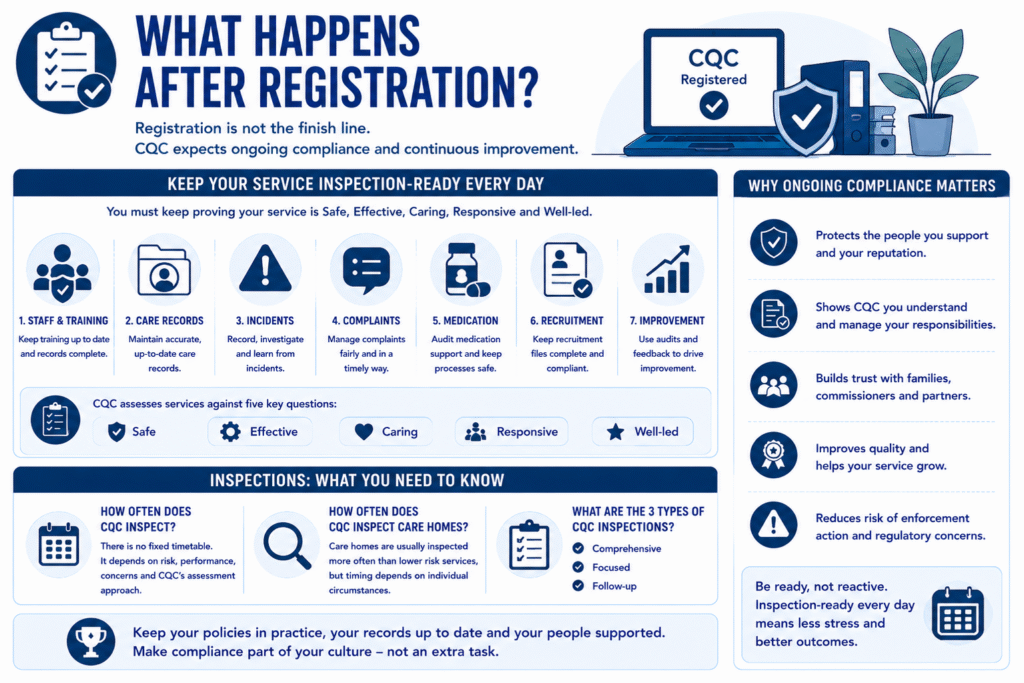
    What Happens After Registration?

    CQC registration does not end the compliance journey. Once CQC approves your application, you must keep proving that your service can deliver safe, effective, caring, responsive, and well-led care.

    This is where many new providers make mistakes. They treat registration as the finish line, but CQC expects ongoing evidence. You need to keep staff training updated, review care records, monitor incidents, manage complaints properly, audit medication support, check recruitment files, and improve the service when something goes wrong.

    This is the heart of CQC compliance. It means your business does not only have policies on paper. It uses those policies every day to protect people.

    Providers often ask, what are the 5 CQC standards? They refer to the five key questions CQC uses to assess services: are they safe, effective, caring, responsive, and well-led?

    You may also hear questions like how often does CQC inspect, how often does CQC inspect care homes, or what are the 3 types of CQC inspections. The answer depends on the service, risk level, previous performance, concerns raised, and CQC’s current assessment approach.

    After registration, your job is simple but demanding: keep your service inspection-ready every day, not only when CQC contacts you.

    MORE: CQC Registered Manager: Requirements, Interview Tips for 2026

    When Should You Contact CQC or Get Support?

    What Does CQC Registration Really Cost?
    What Does CQC Registration Really Cost?

    You should contact CQC when you need official guidance about registration, regulated activities, fees, forms, or your provider account. If you search for a CQC registration contact number, always use the official CQC website so you do not rely on outdated third-party details.

    However, official contact and business preparation are two different things. CQC can explain its process, but it will not build your policies, prepare your registered manager, write your statement of purpose, or organise your compliance systems for you.

    This is where professional support can help. A care business should get support before submitting the application, not after CQC raises concerns. The right guidance can help you check your documents, understand your regulated activities, prepare for the registered manager interview, and avoid avoidable delays.

    If you feel unsure about your evidence, policies, training plan, governance documents, or registration route, pause before you apply. A rushed application can cost you time, money, and confidence. A prepared application gives your care business a stronger chance of starting safely and professionally.

    Preparing for CQC registration? Care Sync Experts can help you strengthen your application, prepare for your interview, and avoid the costly mistakes that delay approval.

    FAQ

    What are the benefits of CQC?

    CQC registration helps a care provider operate legally, build trust with families, and show that the service understands safe, effective, caring, responsive, and well-led care. It also gives commissioners, clients, and relatives a way to check inspection reports and ratings before choosing a service. CQC says it regulates health and adult social care in England to protect people and promote improvement.

    What are the three types of CQC inspections?

    The three commonly discussed CQC inspection types are comprehensive, focused, and follow-up inspections. A comprehensive inspection looks broadly at the service, a focused inspection looks at specific concerns or areas, and a follow-up inspection checks whether the provider has made required improvements.

    CQC’s own inspection guidance for GP practices lists focused, comprehensive, and follow-up inspection types, although it also notes that some older inspection pages are under review as CQC updates its assessment approach.

    How much do care agencies charge per hour in the UK?

    Care agencies in the UK commonly charge around £25 to £38 per hour, depending on location, care needs, visit length, weekends, bank holidays, and whether the support involves personal care or specialist care. Age UK says homecare typically costs around £25 per hour, while Homecare.co.uk’s 2026 guide puts average UK home care between £26 and £38 per hour.

    Is CQC just for England?

    Yes. The Care Quality Commission regulates health and adult social care services in England. Providers in Scotland, Wales, and Northern Ireland follow different regulators and registration systems. So, if you plan to open a care business in England, you must check whether your service needs CQC registration before you start trading.

  • SME Spend Targets: How to Win More Public Contracts in 2026

    SME Spend Targets: How to Win More Public Contracts in 2026

    The new SME spend targets could create the biggest public procurement opportunity UK care providers have seen in years.

    Under the latest plans from the government of the United Kingdom, central government departments must increase the amount they spend directly with small and medium-sized enterprises (SMEs).

    The ambition is significant: government departments are expected to spend more than £7.4 billion annually with SMEs by 2027/28, creating a stronger pipeline of public sector contracts for smaller organisations.

    For many care providers, this announcement arrives at the perfect time. Rising operating costs, workforce pressures and increasing competition have left many care businesses searching for sustainable growth opportunities.

    While much of the recent news on SMEs has focused on economic challenges, these new procurement reforms offer a practical route to expansion through public sector contracts.

    The opportunity extends far beyond traditional government suppliers. Domiciliary care agencies, supported living providers, specialist care organisations and other CQC-regulated businesses could all benefit from a procurement environment that actively encourages greater SME participation.

    Most importantly, the new policy does not stand alone. The SME spend targets sit alongside the Procurement Act 2023, the Central Digital Platform and wider reforms designed to make bidding for contracts simpler and more accessible. Together, these changes create a more favourable landscape for care businesses that are ready to compete.

    The providers that act now, strengthen their bid readiness and position themselves for upcoming opportunities will place themselves in the strongest position to win the next generation of local authority care tenders, NHS care contracts and other publicly funded services.

    Get expert support for your next tender, inspection-ready policies, or CQC registration — book a call with Care Sync Experts today and let’s get you compliant and competitive.

    What Are SME Spend Targets?

    Language Barriers in Care: The Double-Up Visit Problem (2026)

    SME spend targets are government procurement goals that require public sector departments to spend a specific percentage of their budget directly with small and medium-sized enterprises (SMEs). Under the UK government’s Plan for Small Business, departments must increase direct SME spending, with annual SME procurement expected to exceed £7.4 billion by 2027/28.

    For care providers, the significance goes far beyond a headline figure. The new SME spend targets signal a clear shift in procurement policy towards creating more opportunities for smaller organisations to compete for public sector contracts.

    Historically, many care businesses struggled to access larger procurement opportunities because contracts often favoured national providers with dedicated bid teams and extensive resources. The new approach aims to level the playing field by encouraging buyers to increase direct engagement with SMEs and reduce barriers that have traditionally limited participation.

    The SME spend targets also work alongside the Procurement Act 2023, which introduces measures designed to make public procurement more transparent, accessible and competitive. These reforms encourage contracting authorities to engage more actively with SMEs and create procurement routes that support a wider range of suppliers.

    For domiciliary care agencies, supported living providers and other care businesses, this means more opportunities to compete for local authority care tenders, NHS care contracts and other publicly funded services that may previously have been difficult to access.

    In simple terms, SME spend targets for care providers create a larger pool of potential contract opportunities while making it easier for smaller care organisations to participate in the procurement process. The providers that prepare early will be best placed to benefit from these changes.

    RELATED: How to Report Benefit Fraud in the UK (2026)

    What Changed Under the Government’s SME Procurement Plan?

    Prepare now to win future bids
    Prepare now to win future bids

    The government’s new SME procurement plan goes far beyond setting spending targets. It introduces a framework designed to make public procurement more accessible, transparent and accountable for smaller businesses.

    At the centre of the reforms are department-specific SME spend targets. For the first time, individual departments must increase the percentage of their budget spent directly with SMEs rather than relying on broad government-wide ambitions.

    Some of the headline targets include:

    • Cabinet Office: 30%
    • Department for Science, Innovation and Technology: 40%
    • Department for Energy Security and Net Zero: 29%
    • Ministry of Housing, Communities and Local Government: 27.5%
    • HM Treasury: 22%
    • Department for Health and Social Care: 15%

    Collectively, these targets support the government’s ambition to exceed £7.4 billion annually in direct SME spending by 2027/28.

    The reforms also introduce greater accountability. Departments must publish annual progress reports and explain how they plan to meet their targets. Where performance falls short, departments must produce improvement plans that outline specific actions to increase SME participation.

    For care providers, this accountability matters. Procurement teams now have stronger incentives to engage with capable SMEs and demonstrate that they are creating opportunities for smaller suppliers.

    The wider reforms also support this objective.

    The Procurement Act 2023

    The Procurement Act 2023 introduces significant changes aimed at simplifying public procurement and improving access for SMEs.

    Key reforms include:

    • Greater procurement transparency.
    • Earlier supplier engagement opportunities.
    • Simpler supplier registration processes.
    • Faster payment requirements.
    • Improved visibility of future procurement opportunities.

    Together, these changes reduce many of the administrative barriers that have historically discouraged smaller care businesses from bidding.

    The Central Digital Platform and SME Hub

    Another major change is the rollout of the Central Digital Platform, which acts as the central registration system for public procurement suppliers.

    Instead of repeatedly entering the same information across multiple procurement systems, suppliers can maintain a single profile and use a share code when bidding for opportunities.

    Alongside this, the government has expanded resources through the SME Hub, helping businesses understand procurement requirements, departmental action plans and upcoming opportunities.

    For any small business UK owner considering public sector contracts, these tools significantly reduce the administrative burden associated with tendering.

    The message from the government is clear: SMEs should play a larger role in public procurement, and departments must actively support that objective. For care providers, that creates a more favourable environment for securing local authority care tenders, NHS care contracts and other publicly funded opportunities over the coming years.

    READ MORE: What Is a Tender in Health and Social Care? 2026 Update

    What This Means for Domiciliary Care and Supported Living Tenders

    The real value of the new SME spend targets lies in what happens next. Care providers do not win contracts because government departments announce new targets. They win contracts because procurement teams change how they buy services.

    That shift has already started.

    As buyers work towards their SME spend targets, many contracting authorities will need to create procurement routes that smaller providers can realistically access. This is particularly important in adult social care, where local delivery, community knowledge and workforce stability often matter more than corporate size.

    For domiciliary care providers, this could mean more opportunities to bid for local authority care tenders that previously favoured larger regional or national providers. Buyers increasingly recognise that smaller providers often deliver more responsive services and maintain stronger relationships with service users and families.

    Supported living providers may see similar opportunities emerge. Many councils and commissioners now prefer specialist providers that understand local needs, specific client groups and community integration rather than large-scale one-size-fits-all delivery models.

    The Department of Health and Social Care’s SME target may appear lower than some other departments at 15%, but its influence reaches far beyond direct departmental procurement. NHS organisations, integrated care boards and local authorities frequently align procurement practices with wider central government priorities.

    As a result, care providers should expect to see:

    • More local authority care tenders divided into smaller lots.
    • More flexible framework agreements.
    • Greater emphasis on social value.
    • Increased engagement with SME suppliers.
    • More opportunities for specialist providers.
    • Better visibility of future procurement pipelines.

    However, buyers will still expect strong evidence.

    When evaluating domiciliary care tenders, supported living tenders and NHS care contracts, procurement teams typically focus on:

    • CQC compliance and inspection outcomes.
    • Safeguarding arrangements.
    • Workforce recruitment and retention.
    • Staff training and competency.
    • Service continuity planning.
    • Quality assurance systems.
    • Complaints management.
    • Social value commitments.
    • Mobilisation capability.

    This is where many care businesses gain a competitive advantage. Unlike larger organisations, SMEs can often demonstrate direct leadership involvement, local partnerships and stronger community connections. These factors increasingly influence procurement scoring models.

    The providers most likely to benefit from the SME spend targets are not simply those that submit more bids. They are the organisations that understand what buyers want to see and can present clear evidence that they deliver safe, effective and person-centred care.

    In practical terms, the SME spend targets create opportunity. Strong preparation turns that opportunity into contract awards.

    SEE ALSO: CQC Registered Manager: Requirements, Interview Tips for 2026

    How Care Providers Can Prepare Now

    Proactive strategies for tender success
    Proactive strategies for tender success

    The SME spend targets create opportunity, but opportunity alone does not win contracts. Buyers will still expect providers to demonstrate compliance, quality and delivery capability.

    The care providers that start preparing now will have a significant advantage when new procurement opportunities reach the market.

    Register on the Central Digital Platform

    The Central Digital Platform should be one of your first priorities.

    The Procurement Act 2023 introduced the platform to simplify supplier registration and reduce repetitive administration. Instead of entering the same information for every opportunity, suppliers can maintain a central profile and use a share code when bidding.

    Complete your registration, verify your details and ensure key documents remain up to date. A fully completed supplier profile can save valuable time when responding to tenders.

    Monitor Opportunities Through Find a Tender

    Many providers only start searching when they need work. Successful bidders take the opposite approach.

    Set up alerts on Find a Tender and relevant procurement portals long before you need to submit a bid. Monitor keywords such as:

    • domiciliary care
    • supported living
    • home care
    • complex care
    • adult social care
    • care at home
    • extra care housing
    • community support

    Early visibility gives you more time to assess opportunities and prepare stronger responses.

    Build a Bid-Ready Evidence Library

    One of the biggest mistakes care businesses make is gathering evidence after a tender is published.

    Instead, create a central evidence library containing:

    • Latest CQC inspection report
    • Statement of Purpose
    • Employer liability insurance
    • Public liability insurance
    • Training matrix
    • Staff qualification records
    • Safeguarding procedures
    • Quality assurance audits
    • Complaints and compliments data
    • Service user outcomes
    • Case studies and testimonials

    A well-maintained evidence library can reduce tender preparation time dramatically.

    Strengthen Your Social Value Offer

    Social value continues to influence procurement scoring across the public sector.

    Buyers increasingly want to know how providers support local communities beyond direct service delivery.

    Strong examples include:

    • Recruiting locally
    • Supporting apprenticeships
    • Partnering with colleges
    • Working with carers’ organisations
    • Supporting disadvantaged job seekers
    • Delivering community initiatives
    • Paying the Real Living Wage

    These commitments often help SMEs compete effectively against larger providers.

    Engage With Buyers Before Tenders Go Live

    Many procurement teams now run:

    • Market engagement events
    • Supplier briefings
    • Soft market testing exercises
    • Provider forums

    Attend these sessions whenever possible.

    Early engagement helps you understand buyer priorities, identify upcoming opportunities and build credibility before formal procurement begins.

    Invest in Care Tender Writing Support

    Even excellent care providers lose contracts because they fail to communicate their strengths effectively.

    Tender responses must address scoring criteria, demonstrate compliance and present evidence clearly. Strong operational performance does not automatically translate into strong bid responses.

    Professional care tender writing support can help providers:

    • Improve response quality
    • Strengthen win themes
    • Identify evidence gaps
    • Increase compliance scores
    • Improve overall bid success rates

    As competition increases, the ability to present your service effectively becomes just as important as the service itself.

    The providers that combine strong care delivery with strong bid preparation will be best positioned to benefit from the new SME spend targets for care providers.

    MORE: Bid Writing Service: Top 5 Mistakes Care Providers Make in 2026

    The Biggest Mistake Care Businesses Should Avoid

    SME Spend Targets 2026
    SME Spend Targets 2026

    The biggest mistake care providers make is waiting for a tender to appear before they start preparing.

    By the time a local authority care tender or NHS care contract reaches the market, the strongest bidders have often been preparing for months. They already have their evidence library organised, their case studies updated and their bid processes in place.

    Many care businesses take the opposite approach.

    They discover a tender with a tight deadline, scramble to gather documents, chase references, update policies and pull together operational data at the last minute. The result is often a rushed submission that fails to showcase the quality of the service.

    This reactive approach becomes even more dangerous under the new SME spend targets.

    As more procurement opportunities become available to SMEs, competition among care providers will increase. Buyers may create more accessible routes to market, but they will still award contracts to the providers that submit the strongest responses.

    Successful care businesses treat tender readiness as an ongoing activity, not a last-minute project.

    They maintain up-to-date evidence libraries. They track procurement pipelines. They attend supplier engagement events. They regularly review their policies, workforce data and quality metrics. Most importantly, they make bid or no-bid decisions based on strategy rather than urgency.

    A provider that submits three well-prepared bids will often outperform a provider that submits ten rushed applications.

    The new SME spend targets for care providers create a valuable opening, but they do not guarantee success. Care businesses still need to demonstrate why they are the right choice for the contract.

    The providers that prepare before opportunities appear will have a clear advantage over those that start preparing after the deadline clock starts ticking.

    That is the difference between participating in the procurement market and consistently winning public sector contracts.

    How Care Sync Experts Helps Care Providers Win SME-Targeted Contracts

    The new SME spend targets create a bigger opportunity pipeline, but opportunity alone does not secure contract awards. Care providers still need a structured approach to procurement, compliance and bid quality.

    That is where Care Sync Experts helps.

    We work with domiciliary care agencies, supported living providers, complex care organisations and other regulated care businesses that want to compete more effectively for public sector contracts.

    Our support starts long before a tender reaches your inbox.

    We help providers become genuinely bid-ready by strengthening the foundations that procurement teams assess during every evaluation. This includes reviewing compliance documentation, building evidence libraries, identifying gaps in tender readiness and ensuring key organisational information remains current and accessible.

    For providers actively pursuing opportunities, we offer practical support across the entire tender lifecycle, including:

    • Care tender writing
    • Bid review and quality assurance
    • Tender compliance checks
    • Evidence library development
    • Social value response support
    • Bid or no-bid assessments
    • Red team reviews
    • Local authority care tender support
    • NHS care contract submissions
    • Supported living tender responses

    Because we specialise in health and social care, we understand the areas that matter most to evaluators. We know how to present evidence around safeguarding, workforce development, quality assurance, service user outcomes, governance and CQC compliance in a way that aligns with procurement scoring criteria.

    This sector-specific knowledge helps providers avoid generic responses and build submissions that clearly demonstrate value, quality and capability.

    As the SME spend targets continue to reshape procurement across the public sector, prepared providers will have the strongest chance of securing new opportunities. Our role is to help care businesses move from being interested in tendering to becoming confident, competitive bidders.

    Whether you are preparing for your first public sector contract or looking to improve your existing win rate, Care Sync Experts can help you position your organisation to take advantage of the growing opportunities created by the SME spend targets for care providers.

    FAQ

    Can a newly registered care provider bid for public sector contracts?

    Yes. A newly registered care provider can bid for public sector contracts if it meets the eligibility requirements set by the contracting authority.

    While some tenders require previous contract experience, many local authorities and framework providers allow newer organisations to compete by demonstrating strong governance, financial stability, workforce capability and a clear service delivery model.

    Which government departments have the highest SME spending targets?

    The Department for Science, Innovation and Technology currently has one of the highest direct SME spending targets at 40%. Other departments with significant targets include the Cabinet Office (30%), the Department for Energy Security and Net Zero (29%) and the Ministry of Housing, Communities and Local Government (27.5%). These targets are designed to increase direct procurement opportunities for SMEs across government.

    Do SME spending targets guarantee more contracts for small care providers?

    No. SME spending targets create more opportunities for smaller suppliers, but they do not guarantee contract awards. Care providers must still meet procurement requirements, demonstrate quality and compliance, and submit competitive tender responses that satisfy the evaluation criteria.

    What is the difference between direct and indirect SME spend?

    Direct SME spend occurs when a government department awards a contract directly to a small or medium-sized enterprise. Indirect SME spend occurs when a larger contractor uses SMEs within its supply chain to deliver part of a contract. The new departmental targets focus primarily on increasing direct spend with SMEs.

  • How to Start a Healthcare Recruitment Agency Uk in 2026

    How to Start a Healthcare Recruitment Agency Uk in 2026

    Learning how to start a healthcare recruitment agency UK is not the same as starting a general recruitment business. In healthcare, every placement can affect someone’s safety, care, dignity, and daily support. That means you need more than a company name and a list of candidates.

    To start well, you need to register your business, choose a clear care staffing niche, understand whether CQC registration applies to your model, set up safe candidate vetting, arrange the right insurance, plan your payroll cash flow, and build trust with care providers before you place workers.

    A healthcare staffing agency may supply healthcare assistants, support workers, nurses, live-in carers, or care home staff. But from a caregiver business standpoint, your real job is not just to fill shifts. Your job is to help care providers find reliable, trained, and properly checked workers who can support vulnerable people safely.

    The agencies that last do not rush into placements. They build compliance first, protect clients from staffing risks, and treat every worker they send out as a reflection of their brand.

    Get expert support for your next tender, inspection-ready policies, or CQC registration — book a call with Care Sync Experts today and let’s get you compliant and competitive.

    What Is a Healthcare Recruitment Agency?

    Healthcare Tender Eligibility UK: 3 Hidden Checks Before You Bid (2026)

    A healthcare recruitment agency helps care providers find suitable workers for temporary, permanent, contract, or shift-based roles. These workers may include healthcare assistants, support workers, nurses, care home staff, live-in carers, domiciliary care workers, or specialist care professionals.

    So, what is a recruitment agency in this setting? It is a business that connects employers with suitable candidates. But in healthcare, the responsibility goes further. A good agency does not simply send “available staff.” It checks whether each worker has the right experience, training, documents, attitude, and reliability for the care setting.

    A healthcare staffing agency may support care homes, home care providers, supported living services, clinics, private hospitals, or NHS suppliers. Some agencies focus on permanent recruitment. Others provide temporary staff to cover sickness, annual leave, urgent shifts, or long-term shortages.

    In simple terms, a recruitment firm finds people for jobs. A strong healthcare recruitment firm protects care quality by placing the right person in the right care environment.

    RELATED: What is 24 Hour Live In Care? 2026 Update for Care Businesses

    Choose Your Care Staffing Niche First

    Do not start by trying to recruit every healthcare role. A new agency grows faster when it chooses a clear niche, understands that market deeply, and builds a reliable pool of workers for that specific need.

    You may focus on healthcare assistants, support workers, care home staff, domiciliary care workers, nurses, live-in carers, mental health support workers, or temporary shift cover. Each niche affects your compliance process, insurance, payroll pressure, client type, and pricing model.

    For example, supplying care home staff for urgent shifts requires speed, strong availability tracking, and a ready pool of vetted workers. Permanent nursing recruitment needs a different approach, with deeper candidate screening, registration checks, and client relationship management.

    This is where many people asking how do I start a staffing agency make a mistake. They start too broad, then struggle to prove trust. A focused niche helps you speak directly to care providers, build better candidate pipelines, and become known for solving one clear staffing problem well.

    Do You Need CQC Registration?

    Building a safe vetting & Compliance process
    Building a safe vetting & Compliance process

    This is the question you must answer before you place your first care worker.

    You may not need CQC registration if your agency only introduces or supplies workers to a care provider, and that provider manages the care, supervises the worker, and remains responsible for the regulated activity.

    You may need CQC registration if your agency directly provides, manages, or controls regulated care activities, such as personal care. CQC says any person, partnership, or organisation that provides a regulated activity in England must register, otherwise they commit an offence.

    This distinction matters. If you only run a healthcare staffing agency, you may operate as an employment business or recruitment agency. But if you decide how care workers support people with washing, dressing, toileting, medication support, or daily personal care, you may move into regulated care provision. CQC guidance explains that personal care covers support for people who cannot provide it for themselves because of old age, illness, or disability. 

    So before asking how to start a healthcare recruitment agency UK, ask a sharper question: “Will we only supply staff, or will we control the care being delivered?”

    That answer shapes your registration, policies, insurance, staffing model, and legal risk.

    READ MORE: Inheritance Tax Threshold UK: 2026 Update

    Register the Business and Set Up the Legal Basics

    Once you know your niche and CQC position, register the business properly. Most founders choose a limited company because it gives the agency a professional structure when dealing with care homes, healthcare providers, insurers, and finance partners.

    You should register the company with Companies House, choose a suitable business name, and select the right SIC code. For recruitment businesses, Companies House lists 78109 for other employment placement agency activities and 78200 for temporary employment agency activities.

    You also need to prepare the legal documents that protect your agency, clients, and candidates. These may include terms of business, candidate agreements, privacy notices, data protection policies, payroll processes, and client service agreements.

    If you employ or pay temporary workers, you may also need to register as an employer with HMRC and run PAYE correctly. Recruitment agencies and employment businesses must also understand the Conduct Regulations, which guide how agencies deal with work-seekers and hirers.

    This is where people researching how to set up a recruitment agency, how to establish a recruitment agency, or how to open a recruitment agency need to slow down. In care recruitment, paperwork is not just admin. It proves that your agency can operate professionally before any client trusts you with staffing cover.

    What Qualifications Do I Need to Start a Care Agency?

    You do not always need a clinical qualification to start a healthcare recruitment agency, but you do need the right knowledge, systems, and people around you. Care providers will not trust your agency because you registered a company. They will trust you because you understand safe staffing, safeguarding, compliance, and care quality.

    If you only run a recruitment business, your strongest qualification is practical experience in healthcare recruitment, care operations, HR, compliance, or workforce management. You need to know how to check candidates properly, match workers to the right care setting, and respond quickly when a shift problem happens.

    If your business provides regulated care directly, the expectations become higher. You may need a competent registered manager, suitable policies, staff training systems, quality assurance processes, and evidence that the service can deliver safe care.

    So, what qualifications do I need to start a care agency? The honest answer depends on your model. A recruitment-only agency needs recruitment and compliance competence. A regulated care agency needs care leadership, governance, and CQC-ready systems.

    If you want to know how to start a recruiting business in healthcare, start with this rule: never place a worker you would not trust around someone vulnerable.

    SEE ALSO: Universal Credit Permanent Boost 2026

    Build a Safe Vetting and Compliance Process

    How to Start a Healthcare Recruitment Agency Uk

    A healthcare recruitment agency only becomes valuable when clients can trust the workers it supplies. In care, one poor placement can put a vulnerable person at risk and damage your agency’s reputation quickly.

    Before you send any candidate to a client, check their identity, right to work, DBS status, references, training records, role experience, and professional registration where relevant. You should also confirm that their training matches the setting. A care home may need staff with moving and handling, safeguarding, infection control, basic life support, dementia awareness, and medication training, depending on the role.

    Good compliance does not stop after onboarding. Track expiry dates for documents, training certificates, DBS updates, visas, insurance requirements, and professional registrations. If something expires, your system should flag it before the worker accepts another shift.

    This is where many people asking how to start a staffing agency underestimate the work. Healthcare staffing is not just candidate matching. It is risk management.

    A strong vetting process protects service users, care providers, candidates, and your business. It also gives you a stronger sales message because clients want fast cover, but they trust agencies that can prove safe cover.

    How Much Does It Cost to Start a Care Agency UK?

    The cost depends on your business model. A recruitment-only agency can start lean, but a care agency that provides regulated care or pays temporary workers every week needs a bigger budget and stronger cash flow.

    If you ask, how much does it cost to start a care agency UK, think beyond company registration. You may need money for branding, a website, job adverts, recruitment software, contracts, insurance, DBS checks, training verification, compliance systems, payroll setup, and legal advice.

    You also need a payroll buffer. Many healthcare workers expect weekly pay, but care homes, clinics, or healthcare providers may pay your invoices after 30, 45, or 60 days. If you cannot cover wages while waiting for client payments, the business can run into trouble even when it has clients.

    CQC costs may also apply if your model involves regulated care. CQC says provider fees depend on the type and size of service, and providers may pay more than one fee if they register for more than one regulated activity.

    So, when planning how to start a recruitment agency, do not only ask, “How much does setup cost?” Ask, “Can I fund compliance, payroll, and safe growth before clients start paying on time?”

    MORE: Is Carers Allowance Taxable in 2026?

    How Do Recruitment Agencies Make Money?

    Starting a healthcare recruitment agency in the UK
    Starting a healthcare recruitment agency in the UK

    Recruitment agencies usually make money through temporary staffing margins, permanent placement fees, contract recruitment fees, or managed staffing agreements.

    With temporary healthcare staffing, your agency charges the client an hourly rate and pays the worker their agreed hourly pay. The difference must cover payroll costs, holiday pay, pension duties, insurance, compliance admin, recruitment software, marketing, and profit.

    With permanent recruitment, the client usually pays a placement fee when they hire your candidate. This fee often works as a percentage of the candidate’s annual salary, although the exact structure depends on your agreement.

    In healthcare, margins must cover more than business profit. They must support safe vetting, fast replacement cover, worker communication, out-of-hours support, and compliance checks. A care home does not only pay for a person to arrive on shift. It pays for confidence that the worker has the right checks, training, and attitude for vulnerable people.

    So, how do recruitment agencies make money? They earn by solving staffing problems quickly and safely. The stronger your compliance, reliability, and candidate quality, the easier it becomes to justify your fees.

    How to Get Private Care Clients in the UK

    Getting clients starts with trust. Care homes, domiciliary care providers, supported living services, private clinics, and nursing homes will not hand staffing gaps to an agency they barely know. They need to see that you can supply reliable workers, respond quickly, and protect their service users from risk.

    Start by building a simple compliance pack. Include your business details, insurance, vetting process, DBS policy, right-to-work process, training checks, reference checks, and replacement cover procedure. This gives care providers confidence before they sign your terms.

    Then focus your outreach. Contact care home managers, registered managers, HR leads, and operations managers. Use LinkedIn, email, phone calls, local networking, and direct visits where appropriate. Do not open the conversation by saying, “We have staff.” Say, “We help care providers cover shifts safely with vetted healthcare workers.”
    If you want to know how to get private care clients UK, remember this: care providers buy reliability. They want fewer missed shifts, fewer compliance worries, and workers who understand the care environment.

    A strong healthcare staffing agency grows when clients trust its judgement, not just its candidate list.

    Final Startup Checklist

    Before placing your first worker, make sure your agency can prove it is safe, organised, and ready to support care providers properly.

    Use this checklist:

    • Choose your healthcare staffing niche
    • Confirm whether you need CQC registration
    • Register your business with Companies House
    • Set up PAYE if you will employ or pay workers
    • Prepare client terms, candidate agreements, and privacy documents
    • Arrange suitable insurance
    • Build a DBS, right-to-work, reference, and training-check process
    • Create a system for tracking document expiry dates
    • Plan your payroll buffer before taking temporary staffing contracts
    • Build a client compliance pack
    • Start outreach to care homes, home care providers, clinics, and supported living services

    The best answer to how to start a healthcare recruitment agency UK is not “register a company and find clients.” The better answer is: build a recruitment company that care providers can trust with vulnerable people.

    A successful agency grows when it combines fast staffing support with strong compliance, honest communication, and reliable workers. In healthcare recruitment, trust is the real product.
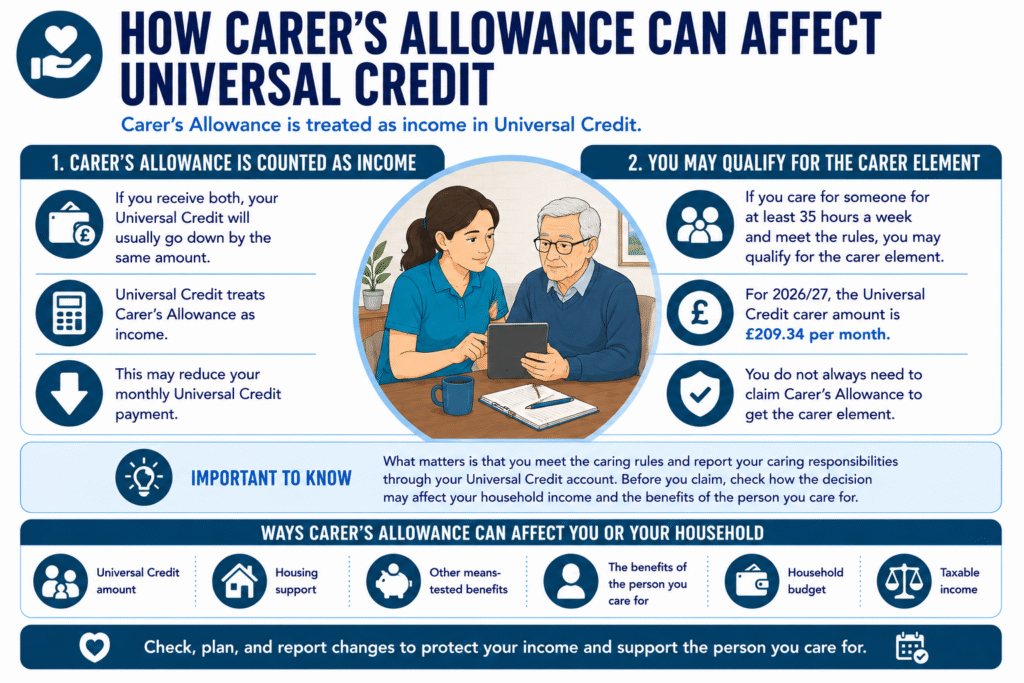
    Ready to Start a Healthcare Recruitment Agency the Right Way?

    Healthcare recruitment is more than filling shifts. It requires compliance, safe vetting, strong cash flow, and trust from care providers.

    At Care Sync Experts, we explain healthcare business and care-sector topics in plain English, helping founders, caregivers, and providers make clearer decisions before costly mistakes happen.

    Build safely. Stay compliant. Earn trust.

    FAQ

    Do recruitment agencies need a licence in the UK?

    Most UK recruitment agencies do not need a general licence to operate, but they must follow recruitment law, including rules for employment agencies and employment businesses. Some sectors have extra licensing rules.

    GOV.UK says agencies need a licence if they supply workers in areas such as agriculture, horticulture, shellfish gathering, and food processing or packaging. Healthcare agencies may also need CQC registration if they directly provide or control regulated care activities.

    Can I run a recruitment agency from home?

    Yes, you can run a recruitment agency from home if you can operate professionally, protect candidate and client data, handle calls and interviews properly, and meet your legal duties. You still need to register the business, prepare contracts and terms, follow data protection rules, and comply with recruitment regulations.

    Working from home may reduce startup costs, but it does not reduce your compliance responsibilities. GOV.UK explains that recruitment agencies and employment businesses must follow rules on worker treatment, terms, pay, job adverts, and protection for work-seekers and hirers.

    How much do recruitment agencies charge per hour in the UK?

    For temporary staffing, UK recruitment agencies usually charge the client an hourly bill rate that includes the worker’s pay plus agency margin, employment costs, holiday pay, pension duties, insurance, compliance admin, and profit.

    A common margin can sit around 15% to 25% above the worker’s pay rate, although healthcare, urgent shifts, specialist roles, and out-of-hours cover can cost more.

    The exact rate depends on the role, location, risk level, shift pattern, and whether the agency employs the worker or supplies them through another arrangement.

    What are red flags for recruiters?

    Red flags include unclear fees, weak vetting, poor communication, missing contracts, pressure tactics, fake job adverts, poor candidate checks, and no clear process for complaints or replacement cover.

    In healthcare recruitment, bigger warning signs include placing workers without DBS checks, right-to-work checks, references, training verification, or professional registration checks where required. GOV.UK says employment agencies and businesses must follow rules that protect work-seekers and hirers, including written terms and fair treatment. 

  • Inheritance Tax Threshold UK: 2026 Update

    Inheritance Tax Threshold UK: 2026 Update

    The inheritance tax threshold UK families usually start with is £325,000 per person. If an estate is worth more than the available threshold, HMRC usually charges Inheritance Tax at 40% on the amount above the threshold, not on the whole estate.

    Some families can increase the tax-free amount. If someone leaves a qualifying home to their children or grandchildren, the estate may also use the residence nil-rate band, which can add up to £175,000. This can raise one person’s tax-free allowance to as much as £500,000.

    Married couples and civil partners may also transfer unused allowances when the first partner dies. This means some couples can pass on up to £1 million tax-free, depending on their estate, property, and who inherits.

    So, is inheritance tax per person? Yes, the basic threshold applies per person, but the final allowance depends on family circumstances. Families usually need to think about Inheritance Tax when the estate includes property, savings, investments, pensions, or valuable possessions above the available threshold.

    Get expert support for your next tender, inspection-ready policies, or CQC registration — book a call with Care Sync Experts today and let’s get you compliant and competitive.

    Why Caregivers Should Understand Inheritance Tax Early

    CIW Registration in Wales: What’s Different and What Catches Providers Out

    Caregivers often deal with more than care visits, medication, meals, and appointments. Many also help an elderly parent or vulnerable relative organise paperwork, understand bills, speak with professionals, and plan what happens next.

    That is why inheritance tax planning matters. It can affect the family home, savings, pensions, gifts, and the money left to loved ones. When families delay the conversation, they often leave the hardest decisions until illness, care costs, or bereavement creates pressure.

    An inheritance tax calculator or inheritance tax UK calculator can help families get a rough idea of possible exposure. However, calculators only work with the information you enter. They do not replace proper legal, financial, or tax advice.

    Early planning gives families time to check the will, understand the estate, record wishes clearly, and avoid confusion later. Good planning does not only protect money. It protects peace of mind.

    RELATED: What Disabilities Qualify for Council Tax Reduction? 2026

    How the UK Inheritance Tax Threshold Works

    Inheritance Tax Threshold UK

    The inheritance tax threshold UK families need to understand starts with the nil-rate band. This is the amount someone can usually leave before Inheritance Tax applies. For one person, the standard nil-rate band is £325,000.

    If the estate goes above the available threshold, HMRC usually charges 40% only on the excess amount. For example, if someone has a £425,000 estate and only the £325,000 threshold applies, the taxable amount is £100,000.

    The family home can change the calculation. If someone leaves a qualifying home to direct descendants, such as children or grandchildren, the estate may claim the residence nil-rate band. This can add up to £175,000, bringing one person’s possible tax-free threshold to £500,000.

    Married couples and civil partners may transfer unused allowances. This can allow some families to pass on up to £1 million tax-free after the second death.

    So, when do you have to pay inheritance tax? Usually, when the estate is worth more than the available allowances and the excess does not pass to an exempt beneficiary, such as a spouse, civil partner, charity, or community amateur sports club.

    Inheritance Tax When the Second Parent Dies

    Inheritance tax when second parent dies often worries families because the estate may now include the family home, savings, investments, personal possessions, and anything the first parent left behind.

    When the first parent dies, they often leave everything to their spouse or civil partner. In that case, Inheritance Tax usually does not apply because transfers between spouses and civil partners are normally exempt. Their unused allowance can also pass to the surviving partner.

    The issue usually comes later. Inheritance tax when second parent dies UK families should check depends on the total value of the second parent’s estate and how much unused allowance transferred from the first parent.

    For example, if both parents were married or in a civil partnership and left the family home to their children, the estate may be able to use two nil-rate bands and two residence nil-rate bands. This can give a possible tax-free allowance of up to £1 million.

    Unmarried partners do not get the same automatic spouse or civil partner exemption, even if they lived together for many years. That is why families should review wills, property ownership, and estate plans before a crisis.

    READ MORE: Is Carers Allowance Taxable in 2026?

    What Happens to the Family Home?

    Different types of taxes
    Different types of taxes

    The family home often makes the biggest difference to Inheritance Tax. If someone leaves their home to children or grandchildren, the estate may qualify for the residence nil-rate band. This can add up to £175,000 on top of the standard £325,000 threshold.

    This is why families often ask how to avoid inheritance tax on a property. The safer way to ask is: how can we use the legal allowances properly? The answer depends on who inherits the home, the total value of the estate, whether the person had a valid will, and whether the estate falls within the residence nil-rate band rules.

    Caregivers should start this conversation early, especially when an elderly parent may need home care, live-in care, or a care home later. Property decisions can affect care planning, estate planning, and family expectations.

    Trying to give away a home at the wrong time can create tax, legal, or care funding problems. Families should get proper advice before transferring property, changing ownership, or making major gifts. Legal planning can reduce Inheritance Tax, but rushed decisions can create bigger problems later.

    Gifts, Savings, and Pensions: What Families Often Miss

    Gifts, savings, and pensions can change the Inheritance Tax picture, so families should not only focus on the house.

    Savings usually form part of the estate. So, if someone asks, do I have to pay tax on my savings UK, the answer depends on the type of tax. Savings interest may create Income Tax during life, while the savings balance may count towards Inheritance Tax after death.

    Gifts also need careful planning. Families often ask how much money can you gift tax free because they want to reduce the estate legally. Some gifts fall within annual exemptions, while larger gifts may only fall outside the estate if the person lives for seven years after giving them.

    Pensions need extra attention too. People often ask, do you pay tax on pension or how much tax will I pay on my pension. Pension income can count as taxable income during life, but pension pots also have separate death benefit rules. From April 2027, most unused pension funds and death benefits are expected to come within Inheritance Tax rules, so families should review pension planning early.

    Pension contributions may also reduce taxable income in some situations. That is why people ask, do pension contributions reduce your taxable income UK. The answer can depend on the pension type, income level, and tax position, so proper advice matters.

    SEE ALSO: Universal Credit Permanent Boost 2026

    Income Tax, Capital Gains Tax, and Inheritance Tax Are Not the Same

    Families often mix up different UK taxes when they start planning later life finances. Inheritance Tax applies to an estate after someone dies. Income Tax applies to money someone receives during life, such as wages, pension income, savings interest, rental income, or some foreign income. Capital Gains Tax may apply when someone sells or gives away an asset that has increased in value.

    So, questions like how much do you need to earn to pay tax, what is the higher tax bracket, and how much can a pensioner earn before paying tax UK relate to Income Tax, not Inheritance Tax.

    Questions like how much foreign income is tax-free in UK or how to avoid capital gains tax UK also sit outside the main Inheritance Tax rules. They may still matter when families plan property sales, overseas income, investments, or retirement income.

    The safest approach is to separate each issue clearly. Work out the estate value for Inheritance Tax, income sources for Income Tax, and asset sales for Capital Gains Tax. Then get proper advice before making major financial decisions.

    How Families Can Reduce Inheritance Tax Legally

    Understanding inheritance tax and the family home
    Understanding inheritance tax and the family home

    Families often search how to avoid inheritance tax UK, but the better goal is to reduce the bill legally and plan early. Inheritance Tax planning works best when families make clear decisions before illness, care pressure, or bereavement forces action.

    Start with a valid will. A will helps the family understand who should inherit, who should manage the estate, and how the person wants their money, property, and possessions handled. If you wonder how much does a will cost UK, the price can vary depending on whether the will is simple, complex, or written with tax and trust planning advice.

    Families can also use spouse or civil partner exemptions, review property ownership, understand gifting rules, keep records of gifts, and consider charitable giving. Some estates may qualify for a reduced Inheritance Tax rate if enough of the estate goes to charity.

    Many people search Martin Lewis inheritance tax because they want plain-English guidance. The key lesson is simple: understand your allowances early, check whether the family home qualifies for extra relief, and do not leave planning until the second parent dies.

    Legal planning can help reduce Inheritance Tax. Rushed decisions, hidden transfers, or poor records can create stress, disputes, and unexpected tax problems.

    MORE: Early Sign of MND in 2026: What Care Businesses Should Notice First

    Final Advice for Caregivers and Families

    The best time to talk about Inheritance Tax is before a crisis. Caregivers often see the warning signs first: an elderly parent forgets paperwork, care needs increase, bills pile up, or the family starts asking what should happen to the house.

    Do not wait until the second parent dies before checking the will, savings, property, pensions, and records of gifts. Start early, involve the right professionals, and keep clear notes so the family does not have to guess later.

    Good planning does more than reduce tax. It protects the person’s wishes, helps families avoid conflict, and gives everyone more confidence when difficult decisions arise.

    The inheritance tax threshold UK families can use depends on the estate, family structure, home ownership, and legal planning. When in doubt, get regulated financial or legal advice before making major decisions.

    Need Help Making Sense of Inheritance Tax and Later-Life Planning?

    Inheritance Tax, care costs, wills, pensions, and family property decisions can feel overwhelming when you are supporting an elderly parent or vulnerable loved one.

    At Care Sync Experts, we explain care and family support topics in plain English, helping caregivers make clearer, calmer decisions before a crisis begins.

    Plan early. Protect wishes. Reduce family confusion.

    FAQ

    What is a good monthly retirement income in the UK?

    A good monthly retirement income depends on lifestyle, housing costs, health needs, and whether someone lives alone or as a couple.

    As a guide, the Retirement Living Standards show that a comfortable retirement costs about £45,400 a year for one person and £62,700 for a couple, which works out at roughly £3,783 per month for one person or £5,225 per month for a couple before adjusting for personal circumstances.

    How much does a will cost in the UK?

    The cost of a will depends on how simple or complex the estate is. MoneyHelper says a straightforward solicitor-written will often costs around £180 to £420, while a more complex will may cost £420 to £900 at a high street firm, or more at larger firms.

    Families dealing with property, inheritance tax, second marriages, care planning, or trusts should consider regulated legal advice rather than relying only on a cheap template.

    What is the higher tax bracket in the UK?

    For England, Wales, and Northern Ireland, the higher Income Tax rate starts when taxable income goes above £50,270. The higher rate is 40% on taxable income from £50,271 to £125,140. Scotland uses different Income Tax bands and rates for Scottish taxpayers.

    How much foreign income is tax-free in the UK?

    For UK residents, foreign income is generally taxable in the UK, but the rules changed from 6 April 2025. GOV.UK says the remittance basis was abolished and replaced with a residence-based Foreign Income and Gains regime.

    Some qualifying new residents may claim relief and pay no UK tax on eligible foreign income and gains for up to four years, but this depends on strict conditions.

  • Universal Credit Permanent Boost 2026

    Universal Credit Permanent Boost 2026

    The Universal Credit permanent boost increased the basic monthly amount claimants receive through the Universal Credit standard allowance from April 2026.

    The current monthly rates are £338.58 for single claimants under 25, £424.90 for single claimants aged 25 or over, £528.34 for joint claimants both under 25, and £666.97 for joint claimants where either person is 25 or over.

    For carers and families, this rise matters because many vulnerable people already stretch their income across food, bills, transport, disability costs, appointments, and daily support. A higher standard allowance can ease some pressure, but it does not tell the full story.

    The Universal Credit boost 2026 affects the basic allowance first. A person’s final payment still depends on their rent, children, earnings, savings, deductions, health status, and caring responsibilities. So, when families ask how much is UC going up in April 2026, they should check both the new standard allowance and the full award breakdown.

    The government says the wider reform will raise the standard allowance above inflation for several years, with the increase worth an estimated £725 by 2029/30 for a single adult aged 25 or over.

    Get expert support for your next tender, inspection-ready policies, or CQC registration — book a call with Care Sync Experts today and let’s get you compliant and competitive.

    What Is the £725 Universal Credit Boost?

    Starting a Homecare Agency From Home? 5 CQC Rules You CANNOT Miss

    The £725 Universal Credit boost is not a one-off lump sum that everyone receives in their bank account. It describes the estimated yearly gain by 2029/30 for a single claimant aged 25 or over, compared with what they would have received if the standard allowance only rose with inflation.

    This means the Universal Credit boost payment works through higher monthly standard allowance rates, not through a separate “cost of living” style payment.

    For carers and families, that distinction matters. If someone you support expects one large payment, they may plan their budget wrongly. The increase comes through their normal Universal Credit award, so they should check their monthly statement to see how the new rate affects them.

    The Universal Credit Act supports this above-inflation rise over several years. In simple terms, the government wants to lift the basic Universal Credit rate while also changing parts of the wider welfare system. So the headline figure sounds simple, but each claimant’s real monthly payment still depends on their full circumstances.

    RELATED: What Is the Carers Element Universal Credit? 2026

    Why the Universal Credit Act Changed the Standard Allowance

    Universal Credit payment guide
    Universal Credit payment guide

    The Universal Credit Act changed the way the Universal Credit standard allowance rises from 2026. Instead of only increasing in line with inflation, the standard allowance will rise above inflation for several years, from 2026/27 to 2029/30. The government describes this as the first sustained above-inflation uplift to the basic UC rate.

    The aim is to raise the core monthly payment while reshaping parts of the wider welfare system. The welfare bill Universal Credit reforms also included changes to health-related UC support, including a reduced health top-up for some new claims from April 2026.

    For carers and families, the key point is simple: the Universal Credit Bill UK changes may increase the basic allowance, but they do not guarantee the same final payment for everyone. A claimant’s actual UC award still depends on rent, children, earnings, savings, deductions, disability status, health elements, and caring responsibilities.

    So families should not stop at the headline boost. They should check the full Universal Credit statement and make sure every relevant element appears correctly.

    What Carers and Families Should Check First

    A higher Universal Credit standard allowance can help, but carers should still check the full award. Universal Credit includes different elements, and one missing detail can reduce the money someone receives each month.

    If you support someone on UC, check these first:

    • Their new standard allowance
    • Housing costs or rent support
    • Child element and childcare support
    • Carer’s Element, if someone provides regular unpaid care
    • Limited capability for work or work-related activity
    • Advance repayments, sanctions, or deductions
    • Work income
    • Savings, investments, or other capital
    • Disability benefits, including PIP

    Families often ask, does Universal Credit affect PIP? Universal Credit and PIP serve different purposes. PIP supports people with daily living or mobility needs, while UC supports people on a low income or out of work. A person may receive both, depending on their circumstances.

    Carers should also check savings. If someone asks, can Universal Credit check my savings account or how much savings are you allowed on Universal Credit, the key rule is that savings over £6,000 can reduce UC, and savings over £16,000 usually mean the person cannot get UC. GOV.UK says UC reduces by £4.35 for every £250 between £6,000 and £16,000.

    READ MORE: Is Carers Allowance Taxable in 2026?

    Working While Claiming Universal Credit

    Universal Credit does not set one fixed number of hours everyone can work. Instead, it looks at how much someone earns, whether they qualify for a work allowance, and how the taper rate reduces their payment as earnings rise.

    So, when families ask how many hours can you work on Universal Credit, the better question is: how much will the person earn, and how will that affect their monthly award?

    Some people can work part-time and still receive Universal Credit. This often matters for carers, disabled claimants, and people trying to return to work gradually after illness. The payment may reduce as earnings increase, but work does not always mean UC stops immediately.

    If someone you support wants to increase their hours, start a new job, or try work after a health problem, check their Universal Credit journal, work allowance, childcare costs, and any health-related commitments first. A small change in earnings can affect rent support, deductions, and the final amount paid into their bank account.

    Working While Claiming Universal Credit

    Universal Credit Permanent Boost

    You can work and still claim Universal Credit. There is no single answer to how many hours can you work on Universal Credit, because UC looks at how much you earn, not just how many hours you work.

    For every £1 you earn from work, your Universal Credit usually goes down by 55p. GOV.UK calls this the taper rate. If you have children or a health condition that affects your ability to work, you may also get a work allowance, which lets you earn a set amount before your UC starts to reduce. In 2026/27, that work allowance is £427 a month if UC includes housing costs, or £710 a month if it does not.

    For carers and families, this matters when someone wants to try part-time work, return after illness, or increase their hours. More work can improve confidence and income, but it can also change the monthly UC payment.

    Before changing hours, check the person’s UC journal, work allowance, childcare costs, caring responsibilities, and health-related commitments. That helps the family plan properly instead of guessing how the change will affect their budget.

    SEE ALSO: Early Sign of MND in 2026: What Care Businesses Should Notice First

    Payments, Arrears, Weekends and Backdating

    Universal Credit is usually paid once a month, in arrears. This means the payment covers the assessment period that has just ended, not the month ahead. For carers and families, this matters because the person you support may need help budgeting between payment dates.

    GOV.UK says Universal Credit claimants usually receive their first payment around five weeks after making a claim, and later payments arrive on the same date each month. If the payment date falls on a weekend or bank holiday, the payment usually arrives on the working day before.

    So, if someone asks do Universal Credit pay on a Saturday, the answer is usually no. If the due date falls on a Saturday, Sunday, or bank holiday, the money normally comes earlier.

    Many people also ask what time does Universal Credit get paid into bank. Banks process payments at different times, so the exact time can vary. Check the UC online account first, then check the bank account later in the day if the payment has not appeared.

    Backdating works differently. If someone asks how long does it take to get backdated Universal Credit, they should know that backdating is limited and depends on why the claim started late. A carer should help the person explain the reason clearly in their UC journal and keep evidence where possible.

    Savings, Home Ownership, Travel and Stopping a Claim

    Universal Credit is means-tested, so savings and capital can change what someone receives. If the person you support has savings between £6,000 and £16,000, their UC will reduce. If they have over £16,000, they usually cannot claim Universal Credit. GOV.UK says UC reduces by £4.35 for every £250 of capital between £6,000 and £16,000.

    Families also ask, can you get Universal Credit if you own a house? Yes, owning the home you live in does not automatically stop a UC claim. However, other property, savings, or capital can affect entitlement. Homeowners may also qualify for Support for Mortgage Interest, but GOV.UK treats this as a loan that must usually be repaid with interest when the home is sold or transferred.

    If someone asks how long can you go abroad on Universal Credit, the general rule is up to one month, as long as they remain eligible and tell their work coach before going. GOV.UK says UC cannot continue if someone moves abroad permanently.

    A claimant can also ask to close their UC claim. But if someone asks, can I voluntarily stop Universal Credit, carers should help them check the impact first. Stopping a claim may affect rent support, council tax help, free prescriptions, budgeting, and future benefit access.

    MORE: What Is Safeguarding in Care? 2026 Update

    What About ESA, PIP and Disability Support?

    Working while claiming Universal Credit guide
    Working while claiming Universal Credit guide

    Universal Credit does not replace PIP. If someone asks does Universal Credit affect PIP, the answer is usually no in the direct sense: PIP supports people with daily living or mobility needs, while Universal Credit supports people on a low income or out of work. A person can receive both if they qualify.

    Carers should still look at the full picture. PIP can affect other parts of a household’s benefit situation, such as carer support, disability premiums in older benefits, or help linked to health needs. It can also strengthen the evidence that someone needs extra care, supervision, mobility support, or help with daily living.

    Many families also ask how much is PIP going up in April 2026. PIP rates usually increase each tax year, so check the latest GOV.UK rates before budgeting around disability income.

    If someone asks is ESA to Universal Credit delayed to 2028, they should check their official migration notice rather than rely on rumours. ESA and UC migration rules have changed over time, and the safest step is to read the letter, check the deadline, and get benefits advice before making a claim.

    For carers, the main point is this: do not look at the Universal Credit permanent boost alone. Check UC, PIP, ESA, Carer’s Allowance, housing support, health elements, and deductions together before making care or household budget decisions.

    Final Advice for Carers and Families

    The Universal Credit boost 2026 can give many households more breathing space, but carers should not plan around the headline rise alone. The final payment still depends on the full Universal Credit award, not just the standard allowance.

    If you support someone who depends on UC, check their monthly statement carefully. Look at their housing costs, children’s elements, Carer’s Element, health elements, work income, savings, deductions, and any advance repayments. A small change in one area can affect the money they actually receive.

    The Universal Credit permanent boost may help with food, bills, travel, appointments, and daily living costs. But vulnerable people, disabled claimants, older adults, and unpaid carers often need more than a higher basic rate. They may also need disability support, proper care planning, benefits advice, and help managing their budget.

    The safest approach is simple: check the full award, keep records, update changes quickly, and ask for advice before making big decisions about work, travel, savings, care costs, or stopping a claim.

    Need Help Understanding Universal Credit and Care Support?

    Universal Credit changes can affect household budgets, care decisions, and the support vulnerable people rely on.

    At Care Sync Experts, we explain care, benefits, and family support in plain English, helping carers and families make confident, informed decisions.

    Get practical guidance before money worries become care worries.

    FAQ

    Can Universal Credit give me extra money?

    Yes. Universal Credit may offer extra help through an advance payment, a budgeting advance, a hardship payment, or other financial support if you need help with bills or unexpected costs.

    An advance is not free money; you usually repay it through future Universal Credit payments. GOV.UK says budgeting advances are normally repaid through UC over 24 months.

    What free things can you get on Universal Credit?

    Universal Credit can help you qualify for extra support, depending on your income, household and location. This may include help with NHS prescriptions, dental care, eye tests, school meals, childcare costs, housing costs, council tax support, and local crisis support.

    GOV.UK also confirms that free school meals eligibility in England is expanding to include children from households receiving Universal Credit from the 2026/27 school year.

    Will UC get a Christmas Bonus?

    Universal Credit on its own does not qualify someone for the Christmas Bonus. The Christmas Bonus is a separate one-off £10 tax-free payment for people who receive certain qualifying benefits during the qualifying week, usually the first full week of December. If someone only gets Universal Credit, they should not assume they will get it automatically.

    Do you have to pay Universal Credit back?

    You do not usually pay back normal Universal Credit entitlement if the award is correct. But you may have to repay advance payments, budgeting advances, overpayments, or benefit debt. GOV.UK says that if you owe benefit money while getting UC, your benefit payments can reduce until you repay it.

  • Is Carers Allowance Taxable in 2026?

    Is Carers Allowance Taxable in 2026?

    Yes, Carer’s Allowance is taxable in the UK. HMRC counts it as part of your taxable income, just like wages, some pensions, and certain other state benefits. However, this does not always mean you will pay tax on it. You usually only pay Income Tax if your total taxable income goes above your Personal Allowance.

    Carer’s Allowance is currently £86.45 a week if you care for someone for at least 35 hours a week and meet the eligibility rules. GOV.UK lists Carer’s Allowance as a taxable state benefit, while benefits such as Personal Independence Payment, Universal Credit, Attendance Allowance, and Disability Living Allowance are tax-free.

    In practical terms, tax does not usually come off your Carer’s Allowance before you receive it. Instead, HMRC may collect any tax you owe through your tax code, especially if you also work, receive a pension, or have another taxable income.

    For carers, the key question is not only “is carers allowance taxable?” It is also: “What other income do I have, and does everything together take me above my tax-free allowance?”

    Get expert support for your next tender, inspection-ready policies, or CQC registration — book a call with Care Sync Experts today and let’s get you compliant and competitive.

    When Would a Carer Actually Pay Tax?

    What Records Go in a Client’s Home? CQC Rules for Domiciliary Care

    A carer pays tax only when their total taxable income goes above their tax-free Personal Allowance. For 2026/27, the standard UK Personal Allowance is £12,570, which means you can usually earn up to that amount before Income Tax starts.

    Carer’s Allowance counts towards that total. So if Carer’s Allowance is your only taxable income, you may not pay tax on it. But if you also earn wages, receive a private pension, get State Pension, or earn savings interest, HMRC adds those taxable amounts together.

    For example, a part-time worker who also claims Carer’s Allowance may cross the tax-free allowance sooner than they expect. The same can happen to an older carer who receives pension income.

    Many carers also ask, do I have to pay tax on my savings UK or do you have to pay tax on savings? Savings interest can count as taxable income too, although basic-rate taxpayers may get up to £1,000 of savings interest tax-free, while higher-rate taxpayers may get up to £500.

    So the real question is not just whether Carer’s Allowance is taxable. It is whether your combined taxable income goes above your allowance.

    RELATED: Early Sign of MND in 2026: What Care Businesses Should Notice First

    How Much Is Carer’s Allowance in 2026?

    For 2026/27, Carer’s Allowance is £86.45 per week. You may qualify if you care for someone for at least 35 hours a week and they receive a qualifying disability benefit. You do not need to live with the person or be related to them to claim.

    This answers the common question, how much is Carer’s Allowance 2026? But carers should also look beyond the weekly amount. Carer’s Allowance can affect other benefits, and it can count towards your taxable income.

    If you also work, check your earnings carefully. For 2026/27, Carers UK says the weekly earnings limit is £204 after certain deductions, such as Income Tax, National Insurance, and some pension contributions.

    From a caregiver’s perspective, this matters because many unpaid carers try to balance work, family, and care responsibilities at the same time. A small increase in hours, overtime, or irregular pay can affect eligibility, so carers should track earnings and report changes quickly.

    Is Carer’s Allowance Means-Tested?

    How Carer's Allowance Affects Universal Credit
    How Carer’s Allowance Affects Universal Credit

    No, Carer’s Allowance is not means-tested in the same way as Universal Credit, Pension Credit, or Housing Benefit. Your savings and your partner’s income do not usually decide whether you can claim it.

    However, Carer’s Allowance still has strict rules. You must care for someone for at least 35 hours a week, the person you care for must receive a qualifying disability benefit, and your own earnings must stay within the allowed weekly limit after certain deductions.

    This is where many carers get confused. The question “is Carer’s Allowance means-tested?” has a simple answer, but the earnings rule still matters. If you work and your pay goes over the limit, even by mistake, you may receive money you later have to pay back.

    Carers should also check how a claim may affect other benefits. Carer’s Allowance can count as income for some means-tested benefits, and it may affect the benefits of the person you care for. Before you claim Carer’s Allowance, check the full impact, especially if the household already receives Universal Credit, Pension Credit, Housing Benefit, or income-related ESA.

    READ MORE: What Is Safeguarding in Care? 2026 Update

    Which Benefits Are Taxable and Which Are Tax-Free?

    Not every benefit counts as taxable income. This matters because many carers support someone who receives disability benefits while also managing their own Carer’s Allowance, pension, work income, or Universal Credit.

    Here is the simple difference:

    BenefitTaxable?
    Carer’s AllowanceYes
    State PensionYes
    Contribution-based ESAYes
    PIPNo
    Universal CreditNo
    Attendance AllowanceNo
    Disability Living AllowanceNo

    So, is PIP taxable? No. Personal Independence Payment is tax-free. Is Universal Credit taxable? No. GOV.UK lists Universal Credit as a tax-free state benefit. However, is ESA taxable? It depends. Contribution-based ESA is taxable, while income-related ESA is usually tax-free.

    The State Pension works differently. Is State Pension taxable? Yes. You do not usually see tax deducted directly from the State Pension, but HMRC still counts it as taxable income. So when carers ask, “do you pay tax on State Pension?” the answer depends on whether your total taxable income goes above your Personal Allowance.

    Carer’s Allowance, Pensions, and Older Carers

    Is Carers Allowance Taxable

    Many older carers ask similar questions: is State Pension taxed, do you pay tax on pension, or is the State Pension taxable? Yes, the State Pension counts as taxable income, and private or workplace pensions usually count as taxable income too.

    This does not mean every pensioner pays tax. A pensioner usually pays Income Tax only when their total taxable income goes above the Personal Allowance. That total can include State Pension, private pension income, work income, Carer’s Allowance, and taxable savings interest.

    So, how much can a pensioner earn before paying tax UK? In most cases, the same standard Personal Allowance applies: £12,570 for the tax year, unless personal circumstances change the allowance.

    Some carers also ask, do pensioners pay Council Tax? Council Tax is separate from Income Tax. Pensioners may still pay it, but some people qualify for Council Tax Reduction, discounts, or exemptions depending on income, household circumstances, disability, or local council rules.

    One helpful point: pension contributions can reduce your taxable income in the UK, depending on the type of pension arrangement and tax relief method. If you work while caring, this can matter when checking earnings and taxable income.

    SEE ALSO: Carers Allowance Supplement: What Scotland’s Carers Need to Know in 2026

    How Carer’s Allowance Can Affect Universal Credit

    Carer’s Allowance can affect Universal Credit because Universal Credit treats it as income. If you receive both, your Universal Credit usually goes down by the same amount as your Carer’s Allowance.

    However, this does not always mean caring leaves you worse off. If you care for someone for at least 35 hours a week and meet the rules, you may qualify for the carer element of Universal Credit. For 2026/27, the Universal Credit carer amount is £209.34 per month.

    This answers the common question, how much is carers element? It is an extra amount added to your Universal Credit calculation; it is not the same thing as Carer’s Allowance.

    You do not always need to claim Carer’s Allowance to get the carer element. What matters is that you meet the caring rules and report your caring responsibilities through your Universal Credit account. Before you claim, check how the decision may affect your household income and the benefits of the person you care for.

    MORE: Support Hose Compression: Benefits, Side Effects, and Safe Use

    How to Claim Carer’s Allowance and Who to Contact

    Understanding Carer's Allowance and Universal Credit
    Understanding Carer’s Allowance and Universal Credit

    You can claim Carer’s Allowance online through GOV.UK or by post. Before you apply, check that you care for someone for at least 35 hours a week, meet the earnings rules, and understand how the claim could affect your benefits or the benefits of the person you support.

    You will usually need details such as your National Insurance number, bank details, employment information, and details of the person you care for. The person you support must also receive a qualifying disability benefit, such as PIP daily living, Attendance Allowance, or the middle or highest care rate of DLA.

    If you need help, use the official Carer’s Allowance number listed on GOV.UK or contact the Carer’s Allowance Unit. Avoid relying on old phone numbers from third-party websites, as contact details can change.

    A claim can sometimes be backdated, so apply as soon as you know you may qualify. Also, report changes quickly, especially if your earnings, caring hours, education status, or the cared-for person’s benefits change.

    Final Advice for Carers

    Carers already carry enough responsibility, so tax and benefit rules should not become another hidden pressure. If you receive Carer’s Allowance, treat it as taxable income, check your total income, and report changes before they turn into overpayments or unexpected tax bills.

    The key question is not only “is carers allowance taxable?” The better question is: “How does Carer’s Allowance affect my full financial situation?” That includes wages, pensions, savings interest, Universal Credit, Pension Credit, Housing Benefit, and the benefits of the person you care for.

    If you feel unsure, check GOV.UK, speak to HMRC, contact the Carer’s Allowance Unit, or get independent benefits advice. A few minutes of checking can protect your income, reduce stress, and help you keep supporting your loved one with more confidence.

    At Care Sync Experts, we help carers, families, and care providers understand care-related money, benefits, and support decisions in plain English, so they can make informed choices without feeling overwhelmed.

    Need Clearer Guidance on Care, Benefits, and Support?

    Carer rules can feel confusing, especially when tax, benefits, and family responsibilities overlap.

    At Care Sync Experts, we help carers, families, and care providers understand care-related decisions in plain English, so they can act with clarity, confidence, and less stress.

    Get practical guidance that helps carers make informed decisions.

    FAQ

    Who cannot claim Carer’s Allowance?

    You usually cannot claim Carer’s Allowance if you study for 21 hours a week or more, earn more than £204 a week after tax, National Insurance, and allowable expenses, or do not meet the basic caring rule of at least 35 hours a week.

    You also cannot usually get the full amount of Carer’s Allowance and State Pension at the same time; if your State Pension is £86.45 a week or more, you will not receive a Carer’s Allowance payment.

    Does Carer’s Allowance affect anything?

    Yes. Carer’s Allowance can affect the benefits you receive and the benefits of the person you care for. GOV.UK also says carers may have to pay tax on it if their income goes above the Personal Allowance.

    It can still help because each week you receive Carer’s Allowance, you automatically get National Insurance credits, which can protect your State Pension record.

    How do I report Carer’s Allowance changes?

    You can report Carer’s Allowance changes online through the Carer’s Allowance service or contact the Carer’s Allowance Unit by phone or post.

    Report changes such as starting or leaving a job, earning more than £204 a week, changing address, stopping care, providing less than 35 hours of care, taking a holiday, going into hospital, or the person you care for going into hospital or a care home.

    What’s the difference between a Carer Payment and a Carer Allowance?

    In Australia, Carer Payment is income support for someone who provides constant care to a person who needs care for at least six months or is at the end of life. Carer Allowance is a separate set-rate payment; Services Australia says it is $162.60 each fortnight and is not part of taxable income. Depending on your circumstances, you may be able to get both.